
iGCSE Physics (0625) 3.2.3 Thin lens-Exam Style Questions Paper 1 - New Syllabus
Question
The diagram shows how a converging lens forms an image of an object.
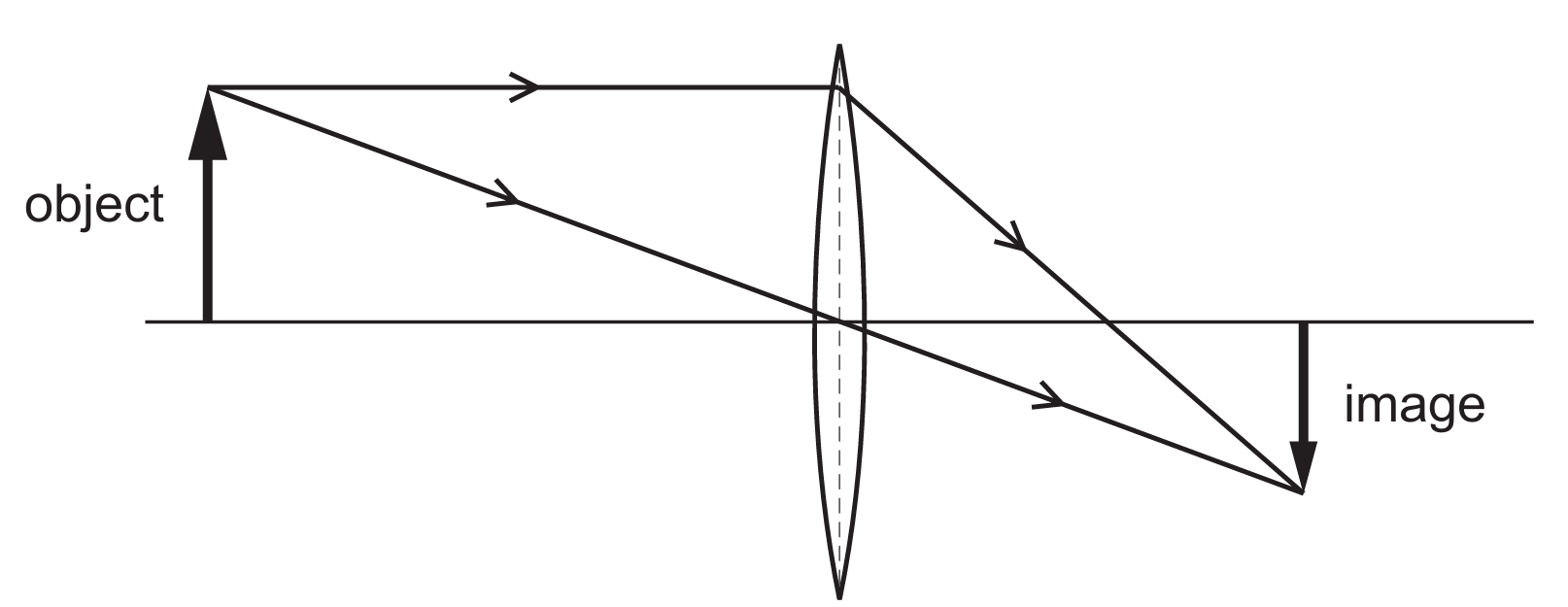
Which description of the image formed by the lens is correct?
(B) real, upright and enlarged
(C) virtual, inverted and diminished
(D) virtual, upright and enlarged
▶️ Answer/Explanation
Correct Answer: \( \boxed{\mathrm{A}} \)
A converging lens forms a real image when the refracted light rays actually meet on the opposite side of the lens.
In the ray diagram, the rays from the top of the object converge and intersect after passing through the lens, showing that the image is real.
The image arrow points downward whereas the object arrow points upward, indicating that the image is inverted.
Comparing the heights of the object and image, the image is smaller than the object. Therefore, the image is diminished.
This situation occurs when the object is placed beyond twice the focal length of a converging lens, producing an image between \(F\) and \(2F\).
Hence, the image formed is real, inverted, and diminished.
Therefore, the correct answer is (A).
Question
The diagram shows an image being formed by a converging lens.
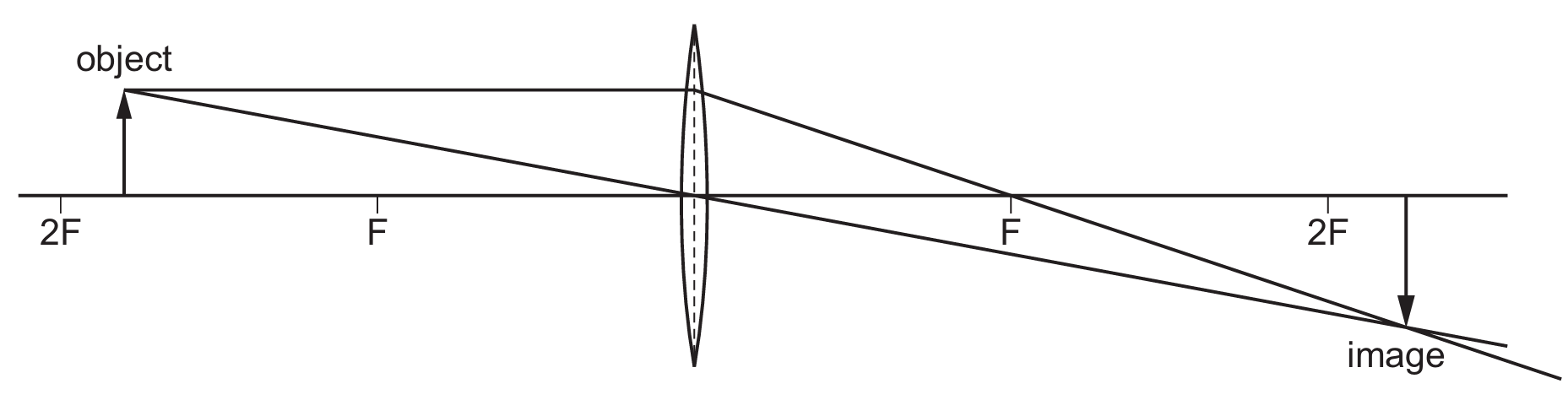
Which description of the image formed is correct?
(B) enlarged and upright
(C) diminished and inverted
(D) diminished and upright
▶️ Answer/Explanation
Correct Answer: \( \boxed{\mathrm{A}} \)
The object is positioned between \(F\) and \(2F\) on the left side of a converging lens.
For a converging lens, when the object lies between \(F\) and \(2F\), the image formed is:
• Real
• Inverted
• Enlarged
• Formed beyond \(2F\) on the opposite side of the lens
The ray diagram shows the image below the principal axis, confirming that it is inverted.
The image is also taller than the object, indicating that it is enlarged with magnification \(M > 1\).
Therefore, the image formed is enlarged and inverted.
Hence, the correct answer is (A).
Question
The diagram shows the formation of an image by a thin converging lens.
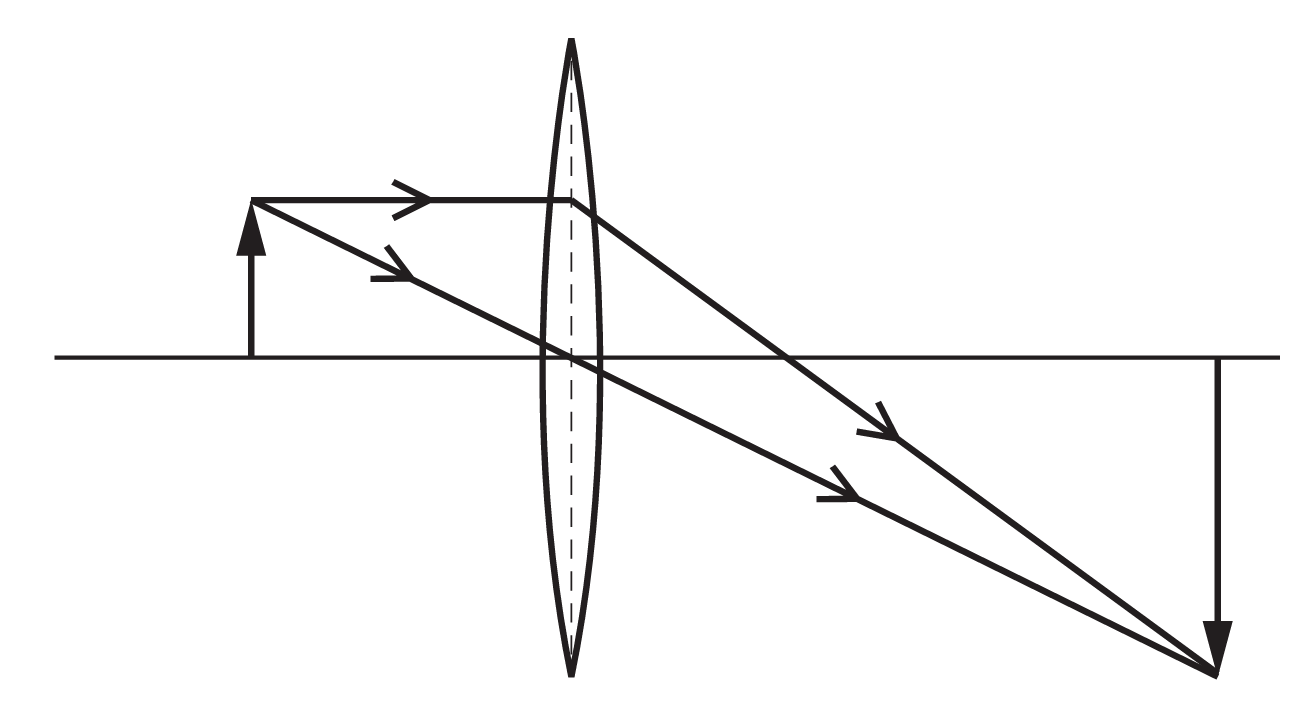
Which terms describe the image?
(B) real and inverted
(C) virtual and diminished
(D) virtual and inverted
▶️ Answer/Explanation
Correct Answer: \( \boxed{\mathrm{B}} \)
A converging lens forms a real image when the refracted rays actually meet on the opposite side of the lens.
In the diagram, the light rays emerging from the lens converge and intersect at a point on the right-hand side of the lens. Since the rays physically meet, the image is real.
The object is above the principal axis, while the image is formed below the principal axis. This indicates that the image is inverted.
Real images produced by converging lenses can be projected onto a screen, unlike virtual images.
The image in the diagram is also larger than the object, but the key characteristics asked for are its nature and orientation.
Therefore, the image is real and inverted.
Hence, the correct answer is (B).