Home / IIT-JEE-Main-04042024-Physics-Paper-With-Solution-Evening

                                                                                                         SECTION-A

Question 31
The translational degrees of freedom (\(f_t\)) and rotational degrees of freedom (\(f_r\)) of \(\mathrm{CH}_4\) molecule are:
(1) \(f_t = 2\) and \(f_r = 2\)    (2) \(f_t = 3\) and \(f_r = 3\)   
(3) \(f_t = 3\) and \(f_r = 2\)    (4) \(f_t = 2\) and \(f_r = 3\)
▶️ Answer/Explanation
Ans.
(2)
Sol.
Since \(\mathrm{CH}_4\) is polyatomic and non-linear:
Degrees of freedom (D.O.F) for \(\mathrm{CH}_4\):
Translational D.O.F \(= 3\)
Rotational D.O.F \(= 3\)
So \(f_t = 3\), \(f_r = 3\).
Question 32
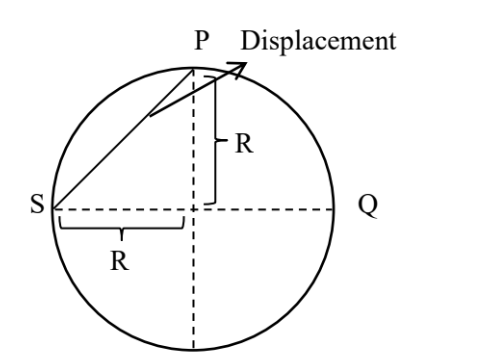
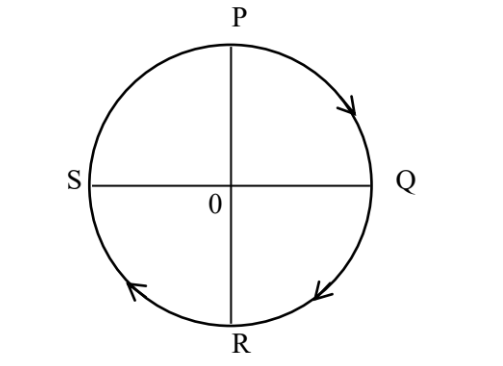
Cyclist on circular ground Q32 A cyclist starts from the point \( P \) of a circular ground of radius \( 2 \) km and travels along its circumference to the point \( S \). The displacement of a cyclist is:
(1) 6 km    (2) \( \sqrt{8} \) km    (3) 4 km    (4) 8 km
▶️ Answer/ExplanationQ32 displacment calculation image
Ans.
(2)
Sol.
The displacement is the straight-line distance from P to S, which are at perpendicular ends of a diameter of the circle.
By the Pythagorean theorem, displacement = \( R\sqrt{2} = 2\sqrt{2} = \sqrt{8} \) km.
Question 33
The magnetic moment of a bar magnet is \(0.5\ \text{Am}^2\). It is suspended in a uniform magnetic field of \(8 \times 10^{-2}\) T. The work done in rotating it from its most stable to most unstable position is:
(1) \(16 \times 10^{-2}\) J    (2) \(8 \times 10^{-2}\) J    (3) \(4 \times 10^{-2}\) J    (4) Zero
▶️ Answer/Explanation
Ans.
(2)
Sol.
At stable equilibrium: \[ U = -mB \cos 0^\circ = -mB \] At unstable equilibrium: \[ U = -mB \cos 180^\circ = +mB \] Work done (\(W\)) equals change in potential energy: \[ W = \Delta U = 2mB = 2 \times 0.5 \times 8 \times 10^{-2} = 8 \times 10^{-2}\ \text{J} \]
Question 34
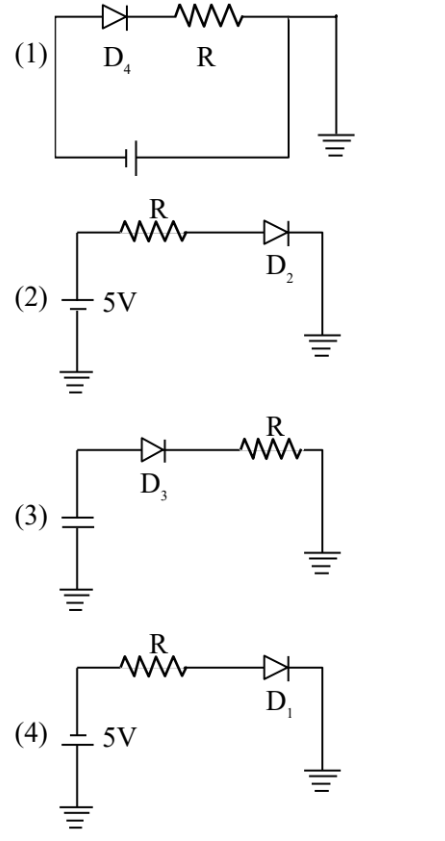
Diode circuit Q34 Which of the diode circuit shows correct biasing used for the measurement of dynamic resistance of p-n junction diode:
(1) D4 with resistor R – forward biased    (2) 5V source, resistor, D2 diode    (3) D3 and resistor in series    (4) 5V source, resistor, D1 diode
▶️ Answer/Explanation
Ans.
(2)
Sol.
Diode should be forward biased to allow calculation of dynamic resistance.
Among options, Only (2) represents correct forward biasing.
Hence, option (2) is correct.
Question 35
Arrange the following in the ascending order of wavelength:
(A) Gamma rays (\(\lambda_1\)), (B) X-ray (\(\lambda_2\)), (C) Infrared waves (\(\lambda_3\)), (D) Microwaves (\(\lambda_4\))
Choose the most appropriate answer from the options below:
(1) \( \lambda_4 < \lambda_3 < \lambda_1 < \lambda_2 \) (2) \( \lambda_4 < \lambda_3 < \lambda_2 < \lambda_1 \) (3) \( \lambda_1 < \lambda_2 < \lambda_3 < \lambda_4 \) (4) \( \lambda_2 < \lambda_1 < \lambda_4 < \lambda_3 \)
▶️ Answer/Explanation
Ans.
(3)
Sol.
The correct order is: \[ \lambda_1 < \lambda_2 < \lambda_3 < \lambda_4 \] That is, Gamma rays < X-rays < Infrared waves < Microwaves.
Question 36
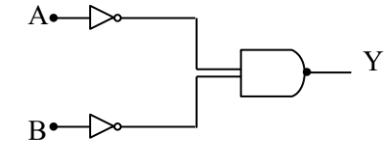
Logic gate Q36 Identify the logic gate given in the circuit:
(1) NAND gate    (2) OR gate    (3) AND gate    (4) NOR gate
▶️ Answer/Explanation
Ans.
(2)
Sol.
\[ Y = \overline{\overline{A} \cdot \overline{B}} \] By De-Morgan’s Law: \[ Y = \overline{\overline{A} \cdot \overline{B}} = \overline{\overline{A}} + \overline{\overline{B}} = A + B \] Hence, it is an OR gate.
The correct answer is option (2).
Question 37
The width of one of the two slits in a Young’s double slit experiment is 4 times that of the other slit. The ratio of the maximum to the minimum intensity in the interference pattern is:
(1) 9 : 1    (2) 16 : 1    (3) 1 : 1    (4) 4 : 1
▶️ Answer/Explanation
Ans.
(1)
Sol.
Since intensity is proportional to slit width (\( \omega \)), take \( I_1 = I \), \( I_2 = 4I \), then:
\[ I_{\text{min}} = \left(\sqrt{I_1} – \sqrt{I_2}\right)^2 = (\sqrt{I} – 2\sqrt{I})^2 = I \\ I_{\text{max}} = \left(\sqrt{I_1} + \sqrt{I_2}\right)^2 = (\sqrt{I} + 2\sqrt{I})^2 = 9I \\ \] Hence, \[ \frac{I_{\text{max}}}{I_{\text{min}}} = \frac{9I}{I} = 9 : 1 \]
Question 38
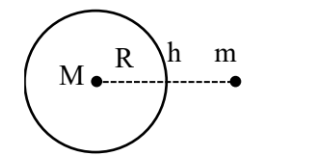
Correct formula for height of a satellite from earth’s surface is:
(1) \( \left(\frac{T^2 R^2 g}{4 \pi} \right)^{1/2} – R \)    (2) \( \left(\frac{T^2 R^2 g}{4 \pi^2} \right)^{1/3} – R \)    (3) \( \left(\frac{T^2 R^2}{4 \pi^2 g} \right)^{1/3} – R \)    (4) \( \left(\frac{T^2 R^2}{4 \pi^2} \right)^{-1/3} + R \)
▶️ Answer/ExplanationSatellite height solution
Ans.
(2)
Sol.
Using gravitational and centripetal force balance:
\[ \frac{GMm}{(R+h)^2} = \frac{mv^2}{R+h} \] \[ \implies \frac{GM}{R+h} = v^2 \] Velocity \( v = (R+h) \omega = (R+h) \frac{2\pi}{T} \)
Also, \( \frac{GM}{R^2} = g \implies GM = g R^2 \)
Substitute: \[ \frac{g R^2}{R+h} = (R+h) \left( \frac{2\pi}{T} \right)^2 \implies \frac{T^2 R^2 g}{(2\pi)^2} = (R+h)^3 \] \[ \therefore h = \left( \frac{T^2 R^2 g}{4 \pi^2} \right)^{1/3} – R \]
Question 39
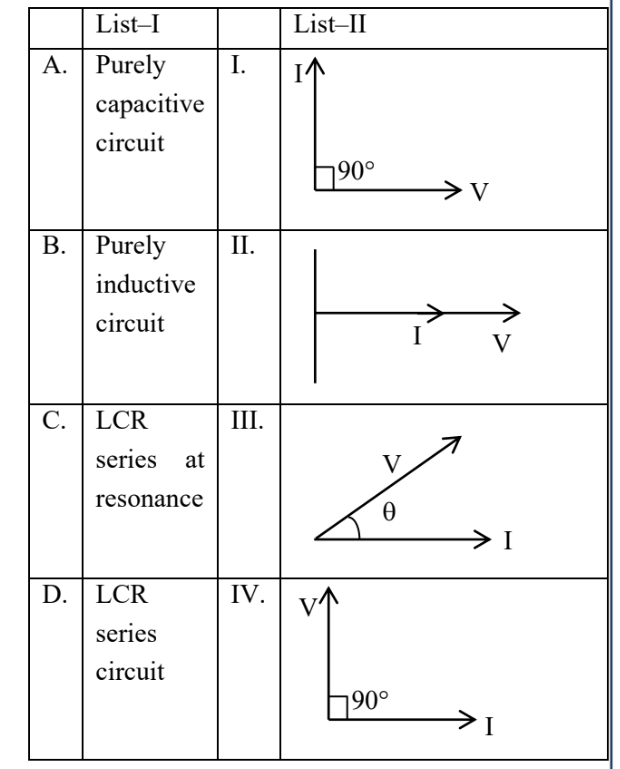
Match List I with List II:
Question 39 matching image
▶️ Answer/Explanation
Ans.
(4)
Sol.
  • A – V lags by \(90^\circ\) from I, so option (I) is correct.
  • B – V leads by \(90^\circ\) from I, so option (IV) is correct.
  • C – At LCR resonance \(X_L = X_C\), so circuit is purely resistive, option (II) is correct.
  • D – In LCR series, V is at angle \(\theta\) from I, so option (III) is correct.
Hence option (4) is correct.
Question 40
Given below are two statements :
Statement I: The contact angle between a solid and a liquid is a property of the material of the solid and liquid as well.
Statement II: The rise of a liquid in a capillary tube does not depend on the inner radius of the tube.
In the light of the above statements, choose the correct answer:
(1) Both Statement I and Statement II are false.
(2) Statement I is false but Statement II is true.
(3) Statement I is true but Statement II is false.
(4) Both Statement I and Statement II are true.
▶️ Answer/Explanation
Ans.
(3)
Sol.
Statement I is correct: contact angle depends on cohesion and adhesion forces.
Statement II is incorrect because the height \( h \) to which liquid rises is given by:
\[ h = \frac{2T\cos\theta_c}{\rho g r} \] where \( r \) is the capillary radius, so height depends on radius.
Hence option (3) is correct.
Question 41
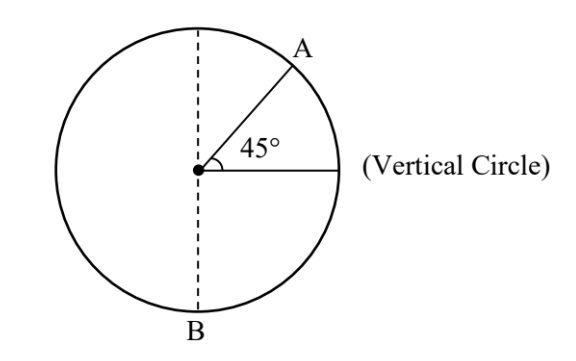
Vertical Circle Q41 A body of \(m\) kg slides from rest along the curve of a vertical circle from point A to B in frictionless path. The velocity of the body at B is:
(Given \( R = 14 \) m,\( g = 10 \) m/s\(^2\), \( \sqrt{2} = 1.4 \))
(1) 19.8 m/s    (2) 21.9 m/s    (3) 16.7 m/s    (4) 10.6 m/s
▶️ Answer/ExplanationVertical Circle Q41 Solution
Ans.
(2)
Sol.
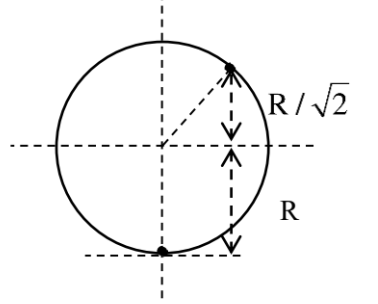
Apply work-energy theorem from A to B:
\[ W_{mg} = K_B – K_A \\ mg\left(\frac{R}{\sqrt{2}}+R\right) = \frac{1}{2} m v_B^2 \\ mgR \frac{(\sqrt{2}+1)}{\sqrt{2}} = \frac{1}{2} m v_B^2 \\ v_B = \sqrt{ gR \frac{2(\sqrt{2}+1)}{\sqrt{2}} } \\ v_B = \sqrt{ \frac{10 \times 14 \times 2 \times 2.4}{1.4} } \approx 21.9\ \text{m/s} \] Hence, option (2) is correct.
Question 42
An electric bulb rated \(50\ \text{W} – 200\ \text{V}\) is connected across a 100 V supply. The power dissipation of the bulb is:
(1) 12.5 W    (2) 25 W    (3) 50 W    (4) 100 W
▶️ Answer/Explanation
Ans.
(1)
Sol.
Rated power and voltage gives resistance: \[ R = \frac{V^2}{P} = \frac{(200)^2}{50} = 800\ \Omega \] When 100 V is applied, \[ P = \frac{(V_{\text{applied}})^2}{R} = \frac{(100)^2}{800} = 12.5\ \text{W} \] Hence option (1) is correct.
Question 43
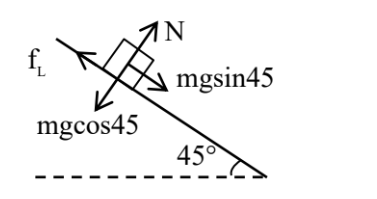
A 2 kg brick begins to slide over a surface which is inclined at an angle of \(45^\circ\) with respect to horizontal axis. The coefficient of static friction between their surfaces is:
(1) 1    (2) \( \frac{1}{\sqrt{3}} \)    (3) 0.5    (4) 1.7
▶️ Answer/ExplanationInclined plane friction Q43
Ans.
(1)
Sol.
\( mg\sin45^\circ = f_L \)
\( mg\cos45^\circ = N \)
\( f_L = \mu_s N \implies \mu_s = \tan45^\circ = 1 \)
Or, tan(angle of repose) = coefficient of static friction.
Option (1) is correct.
Question 44
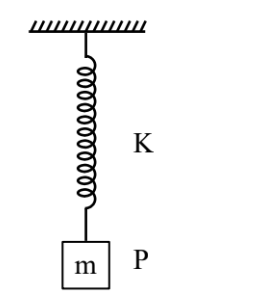
SHM spring Q44 In simple harmonic motion, the total mechanical energy of given system is \( E \). If the mass of oscillating particle \( P \) is doubled, then the new energy of the system for same amplitude is:
(1) \( \dfrac{E}{\sqrt{2}} \)    (2) \( E \)    (3) \( E\sqrt{2} \)    (4) \( 2E \)
▶️ Answer/Explanation
Ans.
(2)
Sol.
T.E. \( = \frac{1}{2} kA^2 \)
Since amplitude \( A \) is same, total energy remains unchanged regardless of mass.
The correct answer is option (2).
Question 45
Given below are two statements: one is labelled as Assertion A and the other as Reason R.
Assertion A: Number of photons increases with increase in frequency of light.
Reason R: Maximum kinetic energy of emitted electrons increases with the frequency of incident radiation.
Choose the most appropriate answer:
(1) Both A and R are correct and R is NOT the correct explanation of A.
(2) A is correct but R is not correct.
(3) Both A and R are correct and R is the correct explanation of A.
(4) A is not correct but R is correct.
▶️ Answer/Explanation
Ans.
(4)
Sol.
Intensity of light \( I = \frac{nhv}{A} \), where \( n \) is the number of photons per unit time.
So, \( n = \frac{IA}{hv} \): at constant intensity, increasing \( \nu \) decreases \( n \). Thus, assertion is false.
For photoelectric effect, \( K_{\text{max}} = h \nu – \phi \): so as \( \nu \) increases, kinetic energy increases (reason is true).
Therefore, option (4) is correct.
Question 46
According to Bohr’s theory, the moment of momentum of an electron revolving in the 4th orbit of hydrogen atom is:
(1) \( \frac{8h}{\pi} \)   (2) \( \frac{h}{\pi} \)   (3) \( \frac{2h}{\pi} \) (4) \( \frac{h}{2\pi} \)
▶️ Answer/Explanation
Ans.
(3)
Sol.

Bohr’s moment of momentum: \( L = n\frac{h}{2\pi} \).
For \( n=4 \): \[ L = 4\frac{h}{2\pi} = \frac{4h}{2\pi} = \frac{2h}{\pi} \] So option (3) is correct.

Question 47
A sample of gas at temperature \(T\) is adiabatically expanded to double its volume. Adiabatic constant for the gas is \( \gamma = 3/2 \). The work done by the gas in the process is (\( \mu = 1 \) mole):
(1) \( RT[\sqrt{2} – 2] \)   (2) \( RT[1-2\sqrt{2}] \)   (3) \( RT[2\sqrt{2}-1] \)   (4) \( RT[2-\sqrt{2}] \)
▶️ Answer/Explanation
Ans.
(4)
Sol.
\[ W = \frac{nR\Delta T}{1-\gamma} \] From \( TV^{\gamma-1} = \text{cst} \), \( T_f = \frac{T}{\sqrt{2}} \) (since \( 2^{\gamma-1} = 2^{1/2}=\sqrt{2} \))
So, \[ W = \frac{R\left( \frac{T}{\sqrt{2}} – T\right)}{1-\tfrac{3}{2}} = 2RT \frac{(\sqrt{2}-1)}{\sqrt{2}} = RT (2 – \sqrt{2}) \] Option (4) is correct.
Question 48
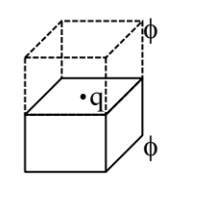
A charge \(q\) is placed at the center of one of the surfaces of a cube. The flux linked with the cube is:
(1) \( \frac{q}{4\epsilon_0} \)   (2) \( \frac{q}{2\epsilon_0} \)   (3) \( \frac{q}{8\epsilon_0} \)   (4) Zero
▶️ Answer/ExplanationQ48 Cube flux
Ans.
(2)
Sol.

As the charge lies at the center of one face, the flux through the entire cube is twice the flux through one face (that face is shared between two cubes).
\[ 2\Phi = \frac{q}{\epsilon_0} \implies \Phi = \frac{q}{2\epsilon_0} \] Hence, option (2) is correct.

Question 49
Applying the principle of homogeneity of dimensions, which is correct?
(1) \( T^2 = \frac{4\pi^2 r}{GM^2} \) (2) \( T^2 = 4\pi^2 r^3 \) (3) \( T^2 = \frac{4\pi^2 r^3}{GM} \) (4) \( T^2 = \frac{4\pi^2 r^2}{GM} \)
▶️ Answer/Explanation
Ans.
(3)
Sol.
Principle of homogeneity requires dimensions on both sides of the equation match.
For \( T^2 = \frac{4\pi^2 r^3}{GM} \), dimensions are: \[ [T^2] = \frac{[L^3]}{[M^{-1}L^3T^{-2}][M]} = [T^2] \] Thus, option (3) is the correct relation.
Question 50
A 90 kg body placed at 2R distance from the surface of earth experiences gravitational pull of:
(1) 300 N (2) 225 N (3) 120 N (4) 100 N
(Given: R = Radius of earth, \(g = 10\) m/s\(^2\))
▶️ Answer/Explanation
Ans.
(4)
Sol.
\[ g = g_s\left(1+\frac{h}{R}\right)^{-2} = g_s(1+2)^{-2} = \frac{g_s}{9} \] Therefore, \[ F = mg = 90 \times \frac{10}{9} = 100~\text{N} \] Option (4) is correct.

                                                                                    SECTION -B

Question 51
The displacement of a particle in SHM is \( x = 10\sin\left(\omega t + \frac{\pi}{3}\right) \) m. The period is 3.14 s. The velocity at \( t = 0 \) is ____ m/s.
▶️ Answer/Explanation
Ans.
(10)
Sol.
\( T = 3.14 = \frac{2\pi}{\omega} \implies \omega = 2 \) rad/s
\( x = 10\sin(\omega t + \frac{\pi}{3}) \)
\( v = \frac{dx}{dt} = 10\omega \cos(\omega t + \frac{\pi}{3}) \)
At \( t = 0 \):
\( v = 10 \cdot 2 \cdot \cos\left(\frac{\pi}{3}\right) = 20 \cdot \frac{1}{2} = 10 \) m/s
Question 52
A bus moving at 72 km/h is brought to a halt in 4 s after the brakes. The distance travelled during this time (assume uniform retardation) is _______ m.
▶️ Answer/Explanation
Ans.
(40)
Sol.
\( u = 72 \) km/h \( = 20 \) m/s, \( v = 0 \), \( t = 4 \) s
\( v = u + at \implies a = -5~\text{m/s}^2 \)
Using \( s = ut + \frac{1}{2}at^2 \) or \( v^2 = u^2 + 2as \): \[ 0^2 = 20^2 + 2a s \implies s = 40~\text{m} \] So, the bus travels 40 m before stopping.
Question 53
A parallel plate capacitor of capacitance 12.5 pF is charged by a battery connected between its plates to potential difference of 12.0 V. The battery is now disconnected and a dielectric slab \((\varepsilon_r = 6)\) is inserted between the plates. The change in its potential energy after inserting the dielectric slab is _______ \( \times 10^{-12} \) J.
▶️ Answer/Explanation
Ans.
(750)
Sol.
Capacitor dielectric energy Q53 Before inserting dielectric, capacitance: \( C_0 = 12.5\, \text{pF} \), charge \( Q = C_0 V \).
After inserting, capacitance becomes \( \varepsilon_r C_0 \).
Change in potential energy: \[ \Delta U = E_i – E_f = \frac{Q^2}{2C_0} – \frac{Q^2}{2 C_0 \varepsilon_r} = \frac{Q^2}{2C_0} \left[ 1 – \frac{1}{\varepsilon_r} \right] \] Since \( Q = C_0 V \), substitute: \[ \Delta U = \frac{(C_0 V)^2}{2C_0} \left[ 1 – \frac{1}{\varepsilon_r} \right] = \frac{1}{2} C_0 V^2 \left[ 1 – \frac{1}{\varepsilon_r} \right] \] Plug in the numbers \( C_0 = 12.5\times10^{-12}\,\text{F} \), \( V = 12\,\text{V} \), \( \varepsilon_r = 6 \): \[ \Delta U = \frac{1}{2}\times12.5\times12^2 \times \left(1-\frac{1}{6}\right)\times10^{-12} = \frac{1}{2}\times12.5\times144\times \frac{5}{6}\times10^{-12} = 750 \times 10^{-12} \text{J} \] Hence, the correct answer is \( 750 \).
Question 54
In a system two particles of masses \( m_1 = 3\,\mathrm{kg} \) and \( m_2 = 2\,\mathrm{kg} \) are placed at certain distance from each other. The particle of mass \( m_1 \) is moved towards the center of mass of the system through a distance \( 2\,\mathrm{cm} \). To keep the center of mass at original position, the particle \( m_2 \) should move towards the center of mass by ____ cm.
▶️ Answer/Explanation
Ans.
(3)
Sol.
\[ \Delta X_{\text{COM}} = \frac{m_1 \Delta x_1 + m_2 \Delta x_2}{m_1 + m_2} \] To keep COM fixed: \( 0 = \frac{3 \cdot 2 + 2 \cdot (-x)}{5} \implies 6 – 2x = 0 \implies x = 3~\mathrm{cm} \)
Question 55
The disintegration energy Q for the nuclear fission of \(^{235}\mathrm{U} \rightarrow ^{140}\mathrm{Ce} + ^{94}\mathrm{Zr} + n \) is ____ MeV.
Given atomic masses:
\( ^{235}\mathrm{U}: 235.0439\,u \), \( ^{140}\mathrm{Ce}: 139.9054\,u \),
\( ^{94}\mathrm{Zr}: 93.9063\,u \), \( n: 1.0086\,u \),
\( c^2 = 931\,\mathrm{MeV}/u \).
▶️ Answer/Explanation
Ans.
(208)
Sol.
\[ Q = (m_R – m_P) c^2\\ m_R = 235.0439\\ m_P = 139.9054 + 93.9063 + 1.0086 = 234.8203\\ Q = (235.0439 – 234.8203) \times 931\\ Q = 0.2236 \times 931 \approx 208~\mathrm{MeV} \]
Question 56
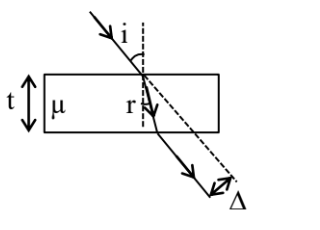
A light ray is incident on a glass slab of thickness \( 4\sqrt{3} \,\mathrm{cm} \) and refractive index \( \sqrt{2} \). The angle of incidence is equal to the critical angle for the glass slab with air. What is the lateral displacement after passing through the glass slab? (Given \( \sin 15^\circ = 0.25 \))
▶️ Answer/ExplanationLateral displacement through slab Q56
Ans.
(2)
Sol.
Critical angle: \( i = \theta_c = \sin^{-1}(1/\mu) = 45^\circ \)
By Snell’s Law: \( \sin 45^\circ = \sqrt{2} \sin r \implies r = 30^\circ \)
Lateral displacement: \[ \Delta = \frac{t\,\sin(i-r)}{\cos r} = \frac{4\sqrt{3} \cdot \sin 15^\circ}{\cos 30^\circ} = \frac{4\sqrt{3} \cdot 0.25}{\sqrt{3}/2} = 2\,\mathrm{cm} \]
Question 57
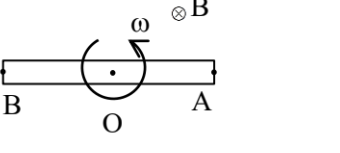
A rod of length 60 cm rotates with a uniform angular velocity 20 rad/s about its perpendicular bisector in a uniform magnetic field 0.5 T. The magnetic field is parallel to the axis of rotation. The potential difference between the two ends of the rod is ____ V.
▶️ Answer/ExplanationRotating rod in B field Q57
Ans.
(0)
Sol.
For axis along the magnetic field, induced emf at both ends:
\[ V_0 – V_A = \frac{B \omega \ell^2}{2} \] This potential is same for both halves, so \( V_A = V_B \implies V_A – V_B = 0 \).
Question 58
Two wires A and B are made of the same material and mass. Wire A radius = 2.0 mm, wire B radius = 4.0 mm. Resistance of wire B is \(2~\Omega\). What is resistance of wire A?
▶️ Answer/Explanation
Ans.
(32)
Sol.
\[ R = \rho \frac{\ell}{A} \] For same mass, \( \ell \propto \frac{1}{A} \) so \( R \propto \frac{1}{A^2} \propto \frac{1}{r^4} \), \[ \frac{R_A}{R_B} = \left( \frac{r_B}{r_A} \right)^4 = \left( \frac{4}{2} \right)^4 = 16 \] \( R_A = 16 \times 2 = 32~\Omega \)
Question 59
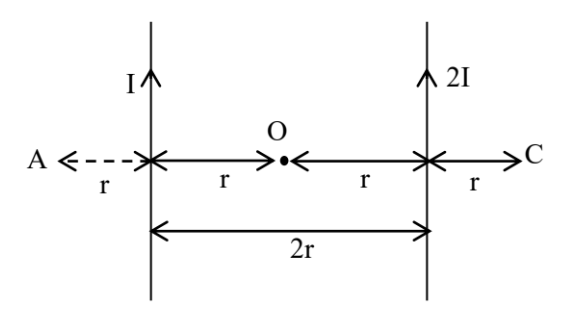
Parallel wires B field Q59 Two long parallel wires I and 2I, separated by 2r, as shown. The ratio of magnetic field at A to that at C is \( \frac{x}{7} \). Value of \(x\) is ____.
▶️ Answer/Explanation
Ans.
(5)
Sol.
\[ B_A = \frac{\mu_0 I}{2\pi r} + \frac{\mu_0 2I}{2\pi (3r)} = \frac{5\mu_0 I}{6\pi r} \] \[ B_C = \frac{\mu_0 2I}{2\pi r} + \frac{\mu_0 I}{2\pi (3r)} = \frac{7\mu_0 I}{6\pi r} \] \[ \frac{B_A}{B_C} = \frac{5}{7} \implies x = 5 \]
Question 60
Mercury is filled in a tube of radius 2 cm up to 30 cm height. What is the force by mercury at the bottom?
(Atmos. pressure \( = 10^5\;\mathrm{N/m^2} \), density \( = 1.36\times 10^4~\mathrm{kg/m^3} \), \( g = 10\;\mathrm{m/s^2} \), \( \pi = \frac{22}{7} \))
▶️ Answer/Explanation
Ans.
(177)
Sol.
Total force: \( F = P_0 A + \rho g h A \)
\[ A = \pi r^2 = \frac{22}{7} \times (2 \times 10^{-2})^2 \] \[ F = 10^5 \times A + 1.36 \times 10^4 \times 10 \times 0.3 \times A \] \[ = 51.29 + 125.71 = 177\,N \]
Scroll to Top