Home / IIT-JEE-Main-05042024-Chemistry-Paper-With-Solution-Morning

                                   CHEMISTRY PAPER WITH SOLUTION 

                                                                                                           SECTION- A

Question 61
The incorrect postulates of Dalton’s atomic theory are :
  • (A) Atoms of different elements differ in mass.
  • (B) Matter consists of divisible atoms.
  • (C) Compounds are formed when atoms of different element combine in a fixed ratio.
  • (D) All the atoms of a given element have different properties including mass.
  • (E) Chemical reactions involve reorganisation of atoms.
Choose the correct answer from the options given below:
  1. (B), (D), (E) only
  2. (A), (B), (D) only
  3. (C), (D), (E) only
  4. (B), (D) only
▶️ Answer/Explanation
Ans. (4)
Sol.
(B), (D) are not correct.
Question 62
The following reaction occurs in the Blast furnace where iron ore is reduced to iron metal:
Fe2O3(s) + 3CO(g) ↔ 2Fe(l) + 3CO2(g)
Using Le-chatelier’s principle, predict which one of the following will not disturb the equilibrium.
  1. Addition of Fe2O3
  2. Addition of CO2
  3. Removal of CO
  4. Removal of CO2
▶️ Answer/Explanation
Ans. (1)
Sol.
When a solid (Fe2O3) is added, it does not affect the equilibrium position.
Question 63
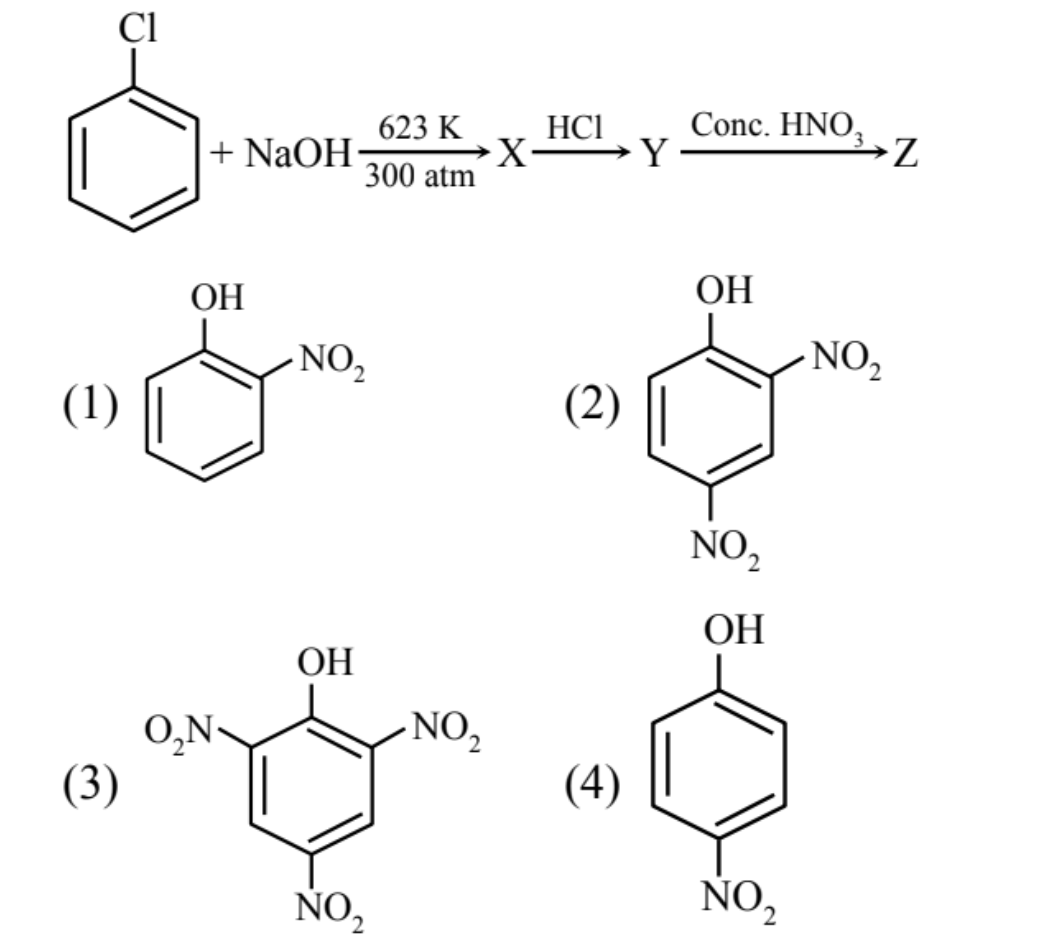
Identify compound (Z) in the following reaction sequence.
Q63 Question reaction sequence
▶️ Answer/Explanation
Ans. (3)
Sol.
X: sodium phenoxide
Y: phenol
Z: 2,4,6-trinitrophenol (picric acid).
The correct compound Z is (3).
Question 64
Given below are two statements: One is labelled as Assertion (A) and the other is labelled as Reason (R).
Assertion (A): Enthalpy of neutralisation of strong monobasic acid with strong monoacidic base is always –57 kJ mol–1
Reason (R): Enthalpy of neutralisation is the amount of heat liberated when one mole of H+ ions furnished by acid combine with one mole of OH ions furnished by base to form one mole of water.
In the light of the above statements, choose the correct answer from the options below:
  1. (A) is true but (R) is false
  2. Both (A) and (R) are true and (R) is the correct explanation of (A)
  3. (A) is false but (R) is true
  4. Both (A) and (R) are true but (R) is not the correct explanation of (A)
▶️ Answer/Explanation
Ans. (2)
Sol.
Both are true and (R) explains (A). For strong acid + strong base neutralisation, enthalpy is always –57 kJ/mol by the given definition.
Question 65
The statement(s) that are correct about the species O2–, F, Na+ and Mg2+:
  • (A) All are isoelectronic.
  • (B) All have the same nuclear charge.
  • (C) O2– has the largest ionic radii.
  • (D) Mg2+ has the smallest ionic radii.
Choose the most appropriate answer:
  1. (B), (C) and (D) only
  2. (A), (B), (C), (D)
  3. (C), (D) only
  4. (A), (C), (D) only
▶️ Answer/Explanation
Ans. (4)
Sol.
All are isoelectronic; O2– has largest, Mg2+ smallest radii. Nuclear charge is different.
Question 66
For the compounds:
(A) H3C–CH2–O–CH2–CH2–CH3
(B) H3C–CH2–CH2–CH2–CH3
(C) CH3–CH2–C(=O)–CH2–CH3
(D) H3C–CH–CH2–CH2–CH3 (with –OH on 2nd C)
The increasing order of boiling point is:
  1. (A) < (B) < (C) < (D)
  2. (B) < (A) < (C) < (D)
  3. (D) < (C) < (A) < (B)
  4. (B) < (A) < (D) < (C)
▶️ Answer/Explanation
Ans. (2)
Sol.
Alcohol (–OH) > acid/ether > alkane
Boiling point: hydrogen bonding > high polarity > low polarity > non-polar.
Question 67
Given below are two statements:
Statement I: In group 13, the stability of +1 oxidation state increases down the group.
Statement II: The atomic size of gallium is greater than that of aluminium.
Choose the most appropriate answer:
  1. Statement I is incorrect but Statement II is correct
  2. Both Statement I and Statement II are correct
  3. Both Statement I and Statement II are incorrect
  4. Statement I is correct but Statement II is incorrect
▶️ Answer/Explanation
Ans. (4)
Sol.
Due to poor shielding by d and f electrons, lower oxidation state is more stable down the group; atomic size of Al > Ga.
Question 68
Number of σ and π bonds present in ethylene molecule is respectively:
  1. 3 and 1
  2. 5 and 2
  3. 4 and 1
  4. 5 and 1
Solution:
Ethylene is
H         σ
 
H—C ≡πσ—C—H
         σ
So it has 5 σ bonds and 1 π bond.
Ans. (4)
Question 69
Identify ‘A’ in the following reaction:
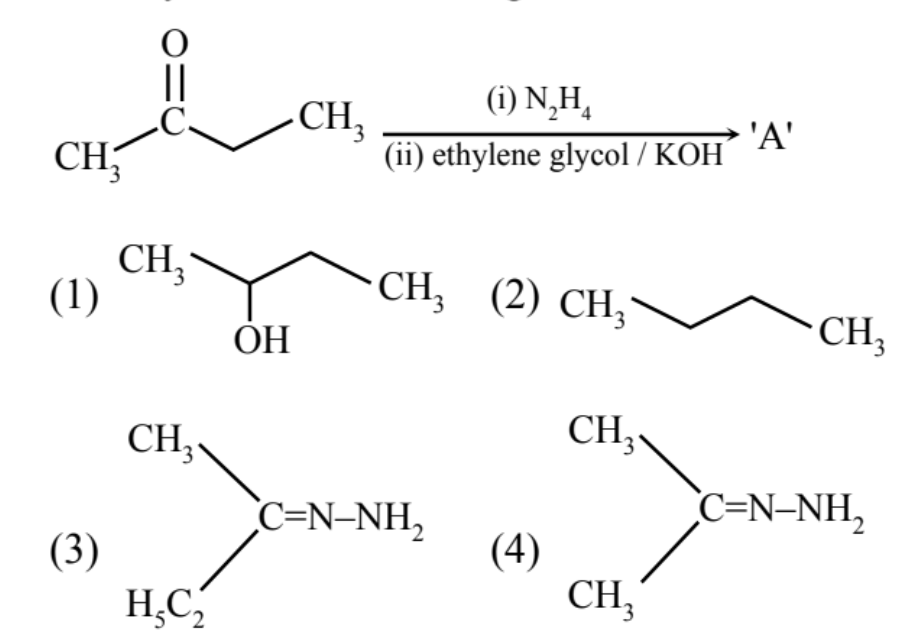
Q69 Reaction sequence
  1. CH3CH(OH)CH3
  2. CH3CH2CH3
  3. CH3CH=N–NH2
  4. C2H5CH=N–NH2
▶️ Answer/Explanation
Ans. (2)
Sol.
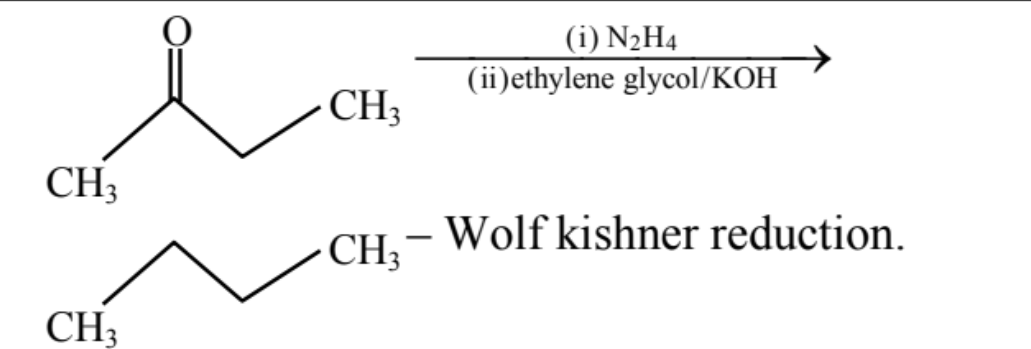
Q69 Solution steps
Question 70
The reaction at cathode in the cells commonly used in clocks involves.
  1. reduction of Mn from +4 to +3
  2. oxidation of Mn from +3 to +4
  3. reduction of Mn from +7 to +2
  4. oxidation of Mn from +2 to +7
▶️ Answer/Explanation
Ans. (1)
Sol.
In the cathode reaction, manganese (Mn) is reduced from the +4 oxidation state to the +3 state.
Question 71
Which one of the following complexes will exhibit the least paramagnetic behaviour?
[Atomic number, Cr = 24, Mn = 25, Fe = 26, Co = 27]
  1. [Co(H2O)6]2+
  2. [Fe(H2O)6]2+
  3. [Mn(H2O)6]2+
  4. [Cr(H2O)6]2+
▶️ Answer/Explanation
Ans. (1)
Sol.
ComplexNumber of unpaired eμ = √n(n + 2) B.M.
[Co(H2O)6]2+33.87
[Fe(H2O)6]2+44.89
[Mn(H2O)6]2+55.92
[Cr(H2O)6]2+44.89
Least paramagnetic behaviour: [Co(H2O)6]2+
Question 72
Given below are two statements: one is labelled as Assertion (A) and the other is labelled as Reason (R).
Assertion (A): Cis form of alkene is found to be more polar than the trans form.
Reason (R): Dipole moment of trans isomer of 2-butene is zero.

In the light of the above statements, choose the correct answer:
  1. Both (A) and (R) are true but (R) is NOT the correct explanation of (A)
  2. (A) is true but (R) is false
  3. Both (A) and (R) are true and (R) is the correct explanation of (A)
  4. (A) is false but (R) is true
▶️ Answer/Explanation
Ans. (3)
Sol.
Dipole moment is a vector quantity and for a compound the net dipole moment is the vector sum of all dipoles. Hence, dipole moment of cis form is greater than trans form.

Cis (μ > 0)      >      Trans (μ = 0)
Question 73

Given below are two statements:
Statement I: Nitration of benzene involves the following step –
  H
  |
H–O–NO2 ⇌ H2O + NO2+
Statement II: Use of Lewis base promotes the electrophilic substitution of benzene.
In the light of the above statements, choose the most appropriate answer:

  1. Both Statement I and Statement II are incorrect
  2. Statement I is correct but Statement II is incorrect
  3. Both Statement I and Statement II are correct
  4. Statement I is incorrect but Statement II is correct
▶️ Answer/Explanation
Ans. (2)
Sol.

In nitration of benzene, concentrated H2SO4 and HNO3 generate the electrophile NO2+ in steps:
H2SO4 + HNO3 ⇌ HSO4 + H–O–NO2+
HSO4 + H2O + NO2+

Lewis acids—not Lewis bases—promote the formation of electrophiles.

Question 74
The correct order of ligands arranged in increasing field strength.
  1. Cl < OH < Br < CN
  2. F < Br < I < NH3
  3. Br < F < H2O < NH3
  4. H2O < OH < CN < NH3
▶️ Answer/Explanation
Ans. (3)
Sol.
Experimental order: Br < F < H2O < NH3
Question 75
Which of the following gives a positive test with ninhydrin?
  1. Cellulose
  2. Starch
  3. Polyvinyl chloride
  4. Egg albumin
▶️ Answer/Explanation
Ans. (4)
Sol.
Ninhydrin test is a test of amino acids. Egg albumin contains protein which is a natural polymer of amino acids and will show positive ninhydrin test.
Question 76
The metal that shows highest and maximum number of oxidation states is:
  1. Fe
  2. Mn
  3. Ti
  4. Co
▶️ Answer/Explanation
Ans. (2)
Sol.
Mn shows the highest oxidation state (Mn+7) in 3d series metals.
Question 77
An organic compound has 42.1% carbon, 6.4% hydrogen and the remainder is oxygen. If its molecular weight is 342, then its molecular formula is:
  1. C11H18O12
  2. C12H20O12
  3. C14H20O10
  4. C12H22O11
▶️ Answer/Explanation
Ans. (4)
Sol.
Only C12H22O11 has 42.1% carbon, 6.4% hydrogen and 51.5% oxygen.
Question 78
Given below are two statements:
Statement I: Bromination of phenol in solvent with low polarity such as CHCl3 or CS2 requires Lewis acid catalyst.
Statement II: The Lewis acid catalyst polarises the bromine to generate Br+.
In the light of the above statements, choose the correct answer:
  1. Statement I is true but Statement II is false
  2. Both Statement I and Statement II are true
  3. Both Statement I and Statement II are false
  4. Statement I is false but Statement II is true
▶️ Answer/Explanation
Ans. (4)
Sol.
Phenol is a highly activated compound which can undergo bromination directly with bromine, without any Lewis acid.
Question 79
Molar ionic conductivities of divalent cation and anion are 57 S cm2 mol–1 and 73 S cm2 mol–1 respectively. The molar conductivity of solution of an electrolyte with the above cation and anion will be:
  1. 65 S cm2 mol–1
  2. 130 S cm2 mol–1
  3. 187 S cm2 mol–1
  4. 260 S cm2 mol–1
▶️ Answer/Explanation
Ans. (2)
Sol.
Λ+2C = 57 S cm2mol–1
Λ+2A = 73 S cm2mol–1
ΛSolution = 57 + 73 = 130 S cm2mol–1
Question 80
The number of neutrons present in the more abundant isotope of boron is ‘x’. Amorphous boron upon heating with air forms a product, in which the oxidation state of boron is ‘y’. The value of x + y is …
  1. 4
  2. 6
  3. 3
  4. 9
▶️ Answer/Explanation
Ans. (4)
Sol.
More abundant isotope is B11 [Number of neutrons = 6, x = 6]
B + O2 → B2O3 (oxidation state +3, y = 3)
x + y = 6 + 3 = 9

                                                                                               SECTION-B

Question 81
The value of Rydberg constant (RH) is 2.18×10⁻¹⁸ J.
The velocity of electron having mass 9.1×10⁻³¹ kg in Bohr’s first orbit of hydrogen atom = ……… × 105 ms–1 (nearest integer)
▶️ Answer/Explanation
Ans. (22)
Sol.
V = 2.18 × 10⁶ × (Z/n)
For hydrogen, n = 1, Z = 1
V = 2.18 × 106 × 1/1 = 2.18 × 10⁶ ms–1 = 21.8 × 10522 × 105 ms–1 (nearest integer)
Question 82
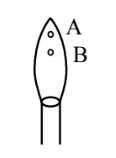
Borax bead flame diagram In a borax bead test under hot condition, a metal salt (one from the given) is heated at point B of the flame, resulted in green colour salt bead. The spin-only magnetic moment value of the salt is ……….. BM (Nearest integer)
[Given atomic number of Cu = 29, Ni = 28, Mn = 25, Fe = 26]
▶️ Answer/Explanation
Ans. (6)
Sol.
Fe3+ will give green coloured bead when heated at point B. Number of unpaired e in Fe3+ is 5; μ = 5.92; nearest integer = 6.
Question 83
The heat of combustion of solid benzoic acid at constant volume is –321.30 kJ at 27°C. The heat of combustion at constant pressure is (–321.30 – xR) kJ, the value of x is ……………
▶️ Answer/Explanation
Ans. (150)
Sol.
ΔH = ΔU + ΔngRT
Δng = –0.5;
ΔH = –321.30 – (1/2 × 300) = –321.30 – 150R
So x = 150.
Question 84
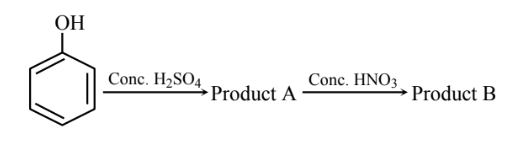
Phenol to picric acid reaction
Total sum of oxygen atoms in Product A and Product B are ………
▶️ Answer/Explanation
Ans. (14)
Sol.
Product A contains 6 O atoms, Product B contains 8 O atoms (picric acid), so total is 14.
Question 85
The spin only magnetic moment value of the ion among Ti2+, V2+, Co3+ and Cr2+, that acts as strong oxidising agent in aqueous solution is ………… BM (Nearest integer).
(Given atomic numbers: Ti : 22, V : 23, Cr : 24, Co : 27)
▶️ Answer/Explanation
Ans. (5)
Sol.
Strong oxidising agent = Co3+
No. of unpaired e in Co3+ (3d6) = 4
μ = √n(n+2) = √24 = 4.89 ≈ 5
Question 86
During Kinetic study of reaction 2A + B → C + D, the following results were obtained:
A[M]B[M]initial rate of formation of D
0.10.16.0 × 10–3
0.30.27.2 × 10–2
0.30.42.88 × 10–1
0.40.12.40 × 10–2
Based on the above data, overall order of the reaction is ……….
▶️ Answer/Explanation
Ans. (3)
Sol.
x (order wrt A) = 1, y (order wrt B) = 2 → overall: 1 + 2 = 3.
Question 87
An artificial cell is made by encapsulating 0.2 M glucose solution within a semipermeable membrane. The osmotic pressure developed when the cell is placed within a 0.05 M solution of NaCl at 300 K is ______ × 10–1 bar. (Nearest Integer)
[Given: R = 0.083 L bar mol–1 K–1]
Assume complete dissociation of NaCl.
▶️ Answer/Explanation
Ans. (25)
Sol.
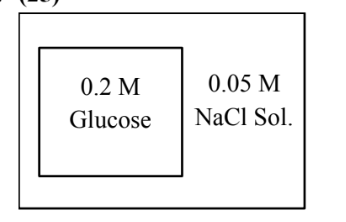
Q87 Solution calculation and schematic
Question 88
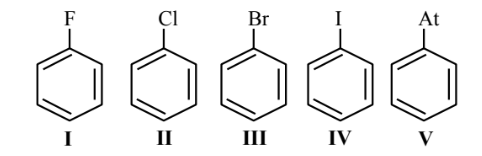
Sandmeyer halobenzene options
The number of halobenzenes from the following that can be prepared by Sandmeyer’s reaction is ….
▶️ Answer/Explanation
Ans. (2)
Sol.
Only bromobenzene and chlorobenzene can be prepared by Sandmeyer’s reaction.
Question 89
In the Lewis dot structure for NO2, total number of valence electrons around nitrogen is …….
▶️ Answer/Explanation
Ans. (8)
Sol.
Number of valence electrons around N atom = 8.
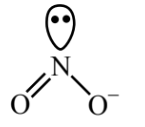
NO2- Lewis structure
Question 90
9.3 g of pure aniline is treated with bromine water at room temperature to give a white precipitate of product ‘P’. The mass of product ‘P’ obtained is 26.4 g. The percentage yield is ……….. %.
▶️ Answer/Explanation
Ans. (80)
Sol.
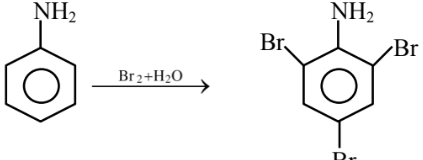
Q90 aniline tribromo reaction & yield 93 g aniline produces 330 g of tribromoaniline.
9.3 g aniline → 33 g tribromoaniline.
% yield = 26.4/33 × 100 = 80%
Scroll to Top