Home / IIT-JEE-Main-05042024-Mathematics-Paper-With-Solution-Evening

                            MATHEMATICS PAPER WITH SOLUTION

                                                                                    SECTION-A

Question 1

Let f: [–1, 2] → ℝ be given by
f(x) = 2x² + x + [x²] – [x], where [t] denotes the greatest integer less than or equal to t.
The number of points, where f is not continuous, is:

  1. 6
  2. 3
  3. 4
  4. 5
▶️ Answer/Explanation
Ans. (3)
Sol.

Doubtful points: –1, 0, 1, √2, √3, 2
Only x = –1, 0, √2 are points of discontinuity.

Question 2

The differential equation of the family of circles passing the origin and having center at the line y = x is:

  1. (x² – y² + 2xy)dx = (x² – y² + 2xy)dy
  2. (x² + y² + 2xy)dx = (x² + y² – 2xy)dy
  3. (x² – y² + 2xy)dx = (x² – y² – 2xy)dy
  4. (x² + y² – 2xy)dx = (x² + y² + 2xy)dy
▶️ Answer/Explanation
Ans. (3)
Sol.

The differential equation reduces to
(x² – y² + 2xy)y’ = x² – y² – 2xy
So the answer is option (3).

Question 3
Let \(S_1 = \{z \in \mathbb{C} : |z| \leq 5\}\), \[S_2 = \left\{z \in \mathbb{C} : \text{Im}\left(\frac{z+1-\sqrt{3}i}{1-\sqrt{3}i}\right) \geq 0\right\}\] and \(S_3 = \{z \in \mathbb{C} : \text{Re}(z) \geq 0\}\). Then the area of region \(S_1 \cap S_2 \cap S_3\) is:
  1. \(\frac{125\pi}{6}\)
  2. \(\frac{125\pi}{24}\)
  3. \(\frac{125\pi}{4}\)
  4. \(\frac{125\pi}{12}\)
▶️ Answer/Explanation
Ans. (4)
Sol.

\(S_1: x^2 + y^2 \leq 25\) …(1)
\(S_2: \text{Im}\left(\frac{z + (1-\sqrt{3}i)}{1-\sqrt{3}i}\right) \geq 0\)
\(\text{Im}\left(\frac{x + iy}{1-\sqrt{3}i} + 1\right) \geq 0\)
\(\text{Im}\left(\frac{(x+iy)(1+\sqrt{3}i)}{4}\right) \geq 0\)
\(\Rightarrow \sqrt{3}x + y \geq 0\) …(2)
\(S_3: x \geq 0\) …(3)
Area = \(\frac{5}{12}(\pi \times 5^2) = \frac{125\pi}{12}\)

Question 4
The area enclosed between the curves \(y = x|x|\) and \(y = x – |x|\) is:
  1. \(\frac{8}{3}\)
  2. \(\frac{2}{3}\)
  3. 1
  4. \(\frac{4}{3}\)
▶️ Answer/Explanation
Ans. (4)
Sol.

For \(x \geq 0\): \(y = x^2\) and \(y = 0\)
For \(x < 0\): \(y = -x^2\) and \(y = 2x\)
Intersection at \((-2, -4)\) and \((0, 0)\)
\[A = \int_{-2}^{0} (-x^2 – 2x) \, dx = \left[-\frac{x^3}{3} – x^2\right]_{-2}^{0}\] \[= 0 – \left(\frac{8}{3} – 4\right) = \frac{4}{3}\]

Question 5
60 words can be made using all the letters of the word BHBJO, with or without meaning. If these words are written as in a dictionary, then the 50th word is:
  1. OBBHJ
  2. HBBJO
  3. OBBJH
  4. JBBOH
▶️ Answer/Explanation
Ans. (3)
Sol.

Letters: B, B, H, J, O (alphabetical order)
Starting with B: \(\frac{4!}{2!} = 24\) words
Starting with H: \(\frac{4!}{2!} = 12\) words
Starting with J: \(\frac{4!}{2!} = 12\) words
Starting with O: 1st word is OBBHJ (37th)
Next sequence: OBBJH (50th rank)

Question 6
Let \(\vec{a} = 2\hat{i} + 5\hat{j} – \hat{k}\), \(\vec{b} = 2\hat{i} – 2\hat{j} + 2\hat{k}\) and \(\vec{c}\) be three vectors such that \[(\vec{c} + \hat{i}) \times (\vec{a} + \vec{b} + \hat{i}) = \vec{a} \times (\vec{c} + \hat{i}), \quad \vec{a} \cdot \vec{c} = -29\] then \(\vec{c} \cdot (-2\hat{i} + \hat{j} + \hat{k})\) is equal to:
  1. 10
  2. 5
  3. 15
  4. 12
▶️ Answer/Explanation
Ans. (2)
Sol.

Let \(\vec{v} = \vec{a} + \vec{b} + \hat{i} = 5\hat{i} + 3\hat{j} + \hat{k}\)
and \(\vec{c} + \hat{i} = \vec{p}\)
\(\vec{p} \times \vec{v} = \vec{a} \times \vec{p}\)
\(\vec{p} \times (\vec{v} + \vec{a}) = \vec{0}\)
\(\Rightarrow \vec{p} = \lambda(\vec{v} + \vec{a})\)
\(\vec{c} + \hat{i} = \lambda(7\hat{i} + 8\hat{j})\)
\(\vec{a} \cdot \vec{c} + \vec{a} \cdot \hat{i} = \lambda \vec{a} \cdot (7\hat{i} + 8\hat{j})\)
\(-29 + 2 = \lambda(14 + 40)\)
\(\lambda = -\frac{1}{2}\)
\(\vec{c} \cdot (-2\hat{i} + \hat{j} + \hat{k}) = -\frac{1}{2}(-14 + 8) + 2 = 5\)

Question 7
Consider three vectors \(\vec{a}\), \(\vec{b}\), \(\vec{c}\). Let \(|\vec{a}| = 2\), \(|\vec{b}| = 3\) and \(\vec{a} = \vec{b} \times \vec{c}\). If \(\alpha \in \left[0, \frac{\pi}{3}\right]\) is the angle between the vectors \(\vec{b}\) and \(\vec{c}\), then the minimum value of \(27|\vec{c} – \vec{a}|^2\) is equal to:
  1. 110
  2. 105
  3. 124
  4. 121
▶️ Answer/Explanation
Ans. (3)
Sol.

\(|\vec{c} – \vec{a}|^2 = |\vec{c}|^2 + |\vec{a}|^2 – 2\vec{a} \cdot \vec{c}\)
\(= |\vec{c}|^2 + 4 – 0\) (since \(\vec{a} = \vec{b} \times \vec{c}\))
\(|\vec{a}| = |\vec{b} \times \vec{c}|\)
\(2 = 3|\vec{c}| \sin \alpha\)
\(|\vec{c}| = \frac{2}{3 \cos \text{ec} \alpha}\), \(\alpha \in \left[0, \frac{\pi}{3}\right]\)
\(|\vec{c}|_{\min} = \frac{2}{3} \times \frac{2}{\sqrt{3}}\), \(\cos \text{ec} \alpha \in \left[\frac{2}{\sqrt{3}}, \infty\right)\)
\(\Rightarrow 27|\vec{c} – \vec{a}|^2_{\min} = 27\left(\frac{16}{27} + 4\right) = 124\)

Question 8

Let A(-1, 1) and B(2, 3) be two points and P be a variable point above the line AB such that the area of ΔPAB is 10. If the locus of P is ax + by = 15, then 5a + 2b is:

  1. \(-\frac{12}{5}\)
  2. \(-\frac{6}{5}\)
  3. 4
  4. 6
▶️ Answer/Explanation
Ans. (1)
Sol.

Area of triangle with vertices at (h,k), (-1,1), (2,3):
\[\frac{1}{2}\begin{vmatrix} h & k & 1 \\ -1 & 1 & 1 \\ 2 & 3 & 1 \end{vmatrix} = 10\] \[-2x + 3y = 25\] \(-\frac{6}{5}x + \frac{9}{5}y = 15\)
\(a = -\frac{6}{5}, b = \frac{9}{5}\)
\(5a = -6, 2b = \frac{18}{5}\)
\(5a + 2b = -6 + \frac{18}{5} = -\frac{12}{5}\)

Question 9

Let \((\alpha, \beta, \gamma)\) be the image of the point \((8, 5, 7)\) in the line \[ \frac{x-1}{2} = \frac{y+1}{3} = \frac{z-2}{5} \] Then the value of \(\alpha + \beta + \gamma\) is:

  1. 16
  2. 18
  3. 14
  4. 20
▶ Answer & Solution
Ans. (3)
Sol.

Let the point on the line be \(M(2\lambda+1,\; 3\lambda-1,\; 5\lambda+2)\).
The vector \( \overrightarrow{AM} = (2\lambda-7, 3\lambda-6, 5\lambda-5) \) must be perpendicular to the direction vector \((2,3,5)\):
\[ (2\lambda-7)\cdot2 + (3\lambda-6)\cdot3 + (5\lambda-5)\cdot5 = 0 \] \[ 4\lambda-14 + 9\lambda-18 + 25\lambda-25 = 0 \implies 38\lambda = 57 \] \( \lambda = \frac{3}{2} \)
Substitute \(\lambda\): \( M(4,\frac{7}{2},\frac{19}{2}) \) is the foot.
So the image point: \(A’ = (0, 2, 12) \implies \alpha+\beta+\gamma = 14\)
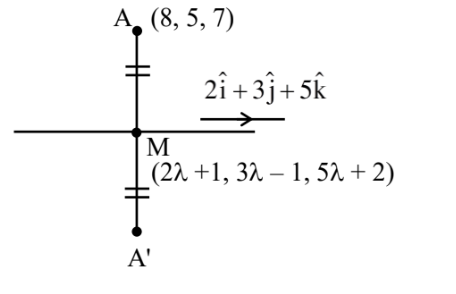
Q9 working

Question 10
If the constant term in the expansion of \(\left(\frac{\sqrt[3]{3}}{x} + 2x \sqrt[3]{\frac{1}{5}}\right)^{12}\), \(x \neq 0\), is \(\alpha \times 2^8 \times \sqrt[3]{5}\), then \(25 \alpha\) is equal to:
  1. 639
  2. 724
  3. 693
  4. 742
▶️ Answer/Explanation
Ans. (3)
Sol.

For \(r=6\), the power terms cancel to give constants; the constant term is
\[ T_7 = \binom{12}{6} 3^{\frac{6}{3}} 2^6 5^{-\frac{6}{3}} = \frac{9 \times 11 \times 7}{25} \times 2^8 \times \sqrt[3]{5}. \] Hence, \[ 25 \alpha = 693. \]

Question 11

Let \(f, g : \mathbb{R} \to \mathbb{R}\) be defined as: \(f(x) = |x – 1|\) and \[ g(x) = \begin{cases} e^x, & x \geq 0 \\ x + 1, & x \leq 0 \end{cases} \] Then the function \(f(g(x))\) is:

  1. Neither one-one nor onto
  2. One-one but not onto
  3. Both one-one and onto
  4. Onto but not one-one
▶️ Answer/Explanation
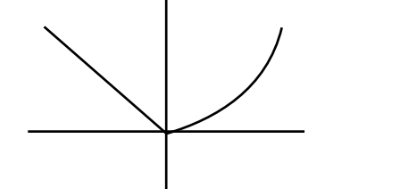
Ans. (1)
Sol.

Question 11 solution graph

Because of the absolute value and piecewise behavior of \(g\), the composite \(f \circ g\) is neither injective nor surjective.

Question 12
Let the first three terms \(2, p, q\), with \(q \neq 2\), of a G.P. be respectively the 7th, 8th, and 13th terms of an A.P. If the 5th term of the G.P. is the \(n^{th}\) term of the A.P., find \(n\).
Answer & Solution
Ans. (4) \(n=163\).

Sol.
Given terms of A.P.:
\[ 2 = a + 6d, \quad p = a + 7d, \quad q = a + 12d, \] with \(p^2 = 2 q\) (since these are also terms of a G.P.).
Solving yields:
\[ p=10, \quad q=50, \quad a=-46, \quad d=8. \] The 5th term of G.P. is: \[ 2 \times 5^4 = 1250, \] which corresponds to the \(n^{th}\) term of A.P.: \[ 1250 = a + (n-1)d = -46 + 8(n-1) \implies n=163. \]
Question 13
Let the set S = {2, 4, 8, 16, …., 512} be partitioned into 3 sets A, B, C with equal number of elements such that A ∪ B ∪ C = S and A ∩ B = B ∩ C = A ∩ C = ∅. The maximum number of such possible partitions of S is equal to:
  1. 1680
  2. 1520
  3. 1710
  4. 1640
▶️ Answer/Explanation
Ans. (1)
Sol.
Q13 partition calculation Total partitions = 9!/(3!3!3!) × 3! = 1680
Question 14
The values of m, n, for which the system of equations
x + y + z = 4,
2x + 5y + 5z = 17,
x + 2y + mz = n
has infinitely many solutions, satisfy the equation:
  1. m² + n² – m – n = 46
  2. m² + n² + m + n = 64
  3. m² + n² + mn = 68
  4. m² + n² – mn = 39
▶️ Answer/Explanation
Ans. (4)
Sol.
For infinite solutions: m = 2, n = 7
m² + n² – mn = 4 + 49 – 14 = 39
Question 15
The coefficients a, b, c in the quadratic equation ax² + bx + c = 0 are from the set {1, 2, 3, 4, 5, 6}. If the probability of this equation having one real root bigger than the other is p, then 216p equals:
  1. 57
  2. 38
  3. 19
  4. 76
▶️ Answer/Explanation
Ans. (2)
Sol.
For discriminant Δ > 0 and distinct real roots, the probability is 38/216, so 216p = 38.
Question 16
Let ABCD and AEFG be squares of side 4 and 2 units, respectively. The point E is on the line segment AB and the point F is on the diagonal AC. Then the radius r of the circle passing through the point F and touching the line segments BC and CD satisfies:
  1. r = 1
  2. r² – 8r + 8 = 0
  3. 2r² – 4r + 1 = 0
  4. 2r² – 8r + 7 = 0
▶️ Answer/Explanation
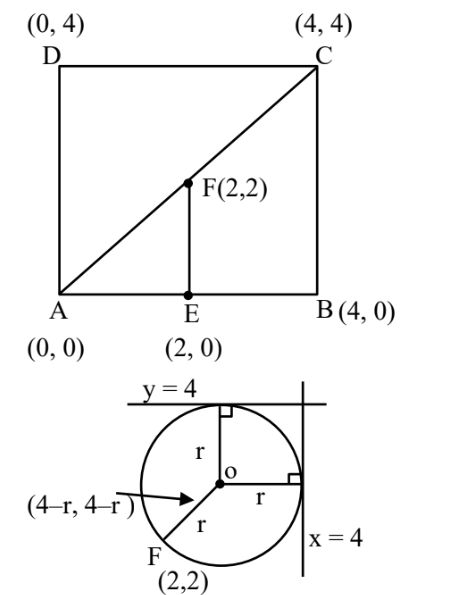
Ans. (2)
Sol.
Q16 circle geometry solution
Question 17
Let β(m, n) = ∫₀¹ x^(m-1)(1-x)^(n-1) dx, m, n > 0. If ∫₀¹ (1-x¹⁰)²⁰ dx = a × β(b,c), then 100(a + b + c) equals:
  1. 1021
  2. 1120
  3. 2012
  4. 2120
▶️ Answer/Explanation
Ans. (4)
Sol.
Using substitution x¹⁰ = t, we get a = 1/10, b = 1/10, c = 21.
Therefore, 100(a + b + c) = 100(1/10 + 1/10 + 21) = 2120.
Question 18
Let \(\alpha \beta \neq 0\) and \[ A = \begin{bmatrix} \beta & \alpha & 3 \\ \alpha & \alpha & \beta \\ -\beta & \alpha & 2\alpha \end{bmatrix}. \]
If \[ B = \begin{bmatrix} 3\alpha & -9 & 3\alpha \\ -\alpha & 7 & -2\alpha \\ -2\alpha & 5 & -2\beta \end{bmatrix} \] is the matrix of cofactors of the elements of \(A\), then \(\det(AB)\) is equal to:
  1. 343
  2. 125
  3. 64
  4. 216
▶️ Answer/Explanation
Ans. (4)
Sol.

Equate the matrix cofactors. By examining, we get:
For \(A_{21}\): \(2\alpha^2 – 3\alpha = \alpha \implies 2\alpha^2 – 4\alpha = 0 \Rightarrow \alpha(\alpha – 2) = 0\). Take \(\alpha = 2\) (since \(\alpha \beta \neq 0\)).
Then \(2\alpha^2 – \alpha \beta = 3\alpha \implies 2 \times 4 – 2 \beta = 6\) ⇒ \(8 – 2\beta = 6\) ⇒ \(\beta = 1\).
Now, \[ |A| = \left| \begin{matrix} 1 & 2 & 3 \\ 2 & 2 & 1 \\ -1 & 2 & 4 \end{matrix} \right| = 6 – 2 \cdot 9 + 3 \cdot 6 = 6 – 18 + 18 = 6 \] Therefore, \[ |AB| = |A|^3 = 6^3 = 216 \]

Question 19

If \[ y(\theta) = \frac{2 \cos \theta + \cos 2\theta}{\cos 3\theta + 4\cos 2\theta + 5 \cos \theta + 2}, \] then at \(\theta = \frac{\pi}{2}\), \[ y” + y’ + y \] is equal to:

  1. \(\frac{3}{2}\)
  2. 1
  3. \(\frac{1}{2}\)
  4. 2
▶️ Answer/Explanation
Ans. (4)
Sol.

Simplify \(y(\theta)\) to \[ y = \frac{1}{2(1 + \cos\theta)}. \] Evaluate the derivatives at \(\theta = \frac{\pi}{2}\): \[ y\left(\frac{\pi}{2}\right) = \frac{1}{2}, \quad y’\left(\frac{\pi}{2}\right) = \frac{1}{2}, \quad y”\left(\frac{\pi}{2}\right) = 1. \] Thus, \[ y” + y’ + y = 1 + \frac{1}{2} + \frac{1}{2} = 2. \]

Question 20

For \(x \geq 0\), the least value of \(K\), for which \(4^{1+x}+4^{1-x}, \frac{K}{2}, 16^{x}+16^{-x}\) are three consecutive terms of an A.P., is equal to:

  1. 10
  2. 4
  3. 8
  4. 16
▶️ Answer/Explanation
Ans. (1)
Sol.
For three numbers \(a, b, c\) to be in arithmetic progression (A.P.), they must satisfy: \[ 2b = a + c. \] Setting \[ a = 4^{1+x} + 4^{1-x}, \quad b = \frac{K}{2}, \quad c = 16^{x} + 16^{-x}. \] Substituting, \[ 2 \cdot \frac{K}{2} = \left(4^{1+x} + 4^{1-x}\right) + \left(16^{x} + 16^{-x}\right). \] Simplifying, \[ K = 4^{1+x} + 4^{1-x} + 16^{x} + 16^{-x}. \] Note that \(4^{1+x} = 4 \cdot 4^{x}\) and \(16^{x} = (4^{2})^{x} = 4^{2x}\). To find the least value of \(K\), consider \(4^{x} = t \geq 1\): \[ K = 4t + \frac{4}{t} + t^{2} + \frac{1}{t^{2}}. \] Use the AM-GM inequality: \[ 4t + \frac{4}{t} \geq 8, \quad t^{2} + \frac{1}{t^{2}} \geq 2. \] Hence, \[ K \geq 8 + 2 = 10. \] Equality holds when \(t = 1\), i.e., \(x=0\).
Question 21
Let the mean and the standard deviation of the probability distribution:
X\(\alpha\)10-3
P(X)\(\frac{1}{3}\)k\(\frac{1}{6}\)\(\frac{1}{4}\)
be \(\mu\) and \(\sigma\), respectively. If \(\sigma – \mu = 2\), then find \(\sigma + \mu\).
▶️ Answer/Explanation
Ans. (5)
Solution:
Since total probability is 1: \[ \frac{1}{3} + k + \frac{1}{6} + \frac{1}{4} = 1 \implies k = \frac{1}{4}. \] Calculate mean: \[ \mu = \frac{\alpha}{3} + 1 \cdot k + 0 \cdot \frac{1}{6} + (-3) \cdot \frac{1}{4} = \frac{\alpha}{3} + \frac{1}{4} – \frac{3}{4} = \frac{\alpha}{3} – \frac{1}{2}. \] Given: \[ \sigma – \mu = 2 \implies \sigma = \mu + 2. \] Using definition of variance to solve for \(\alpha\), find \(\alpha = 6\). Then, \[ \mu = \frac{6}{3} – \frac{1}{2} = 2 – \frac{1}{2} = \frac{3}{2}, \quad \sigma = \frac{3}{2} + 2 = \frac{7}{2}. \] Hence, \[ \sigma + \mu = \frac{7}{2} + \frac{3}{2} = 5. \]
Question 22

Let \(y = y(x)\) be the solution of the differential equation

\[ \frac{dy}{dx} + \frac{2x}{(1+x^2)^2} y = x e^{\frac{1}{1+x^2}}, \quad y(0) = 0. \]

Then the area enclosed by the curve \(f(x) = y(x) e^{-\frac{1}{1+x^2}}\) and the line \(y – x = 4\) is _____.

▶️ Answer/Explanation
Ans. (18)

Solution:
The curve is \(f(x) = y(x) e^{-\frac{1}{1+x^2}}\). Solving the given ODE and evaluating the area between \(f(x)\) and line \(y – x = 4\), we obtain the required area.
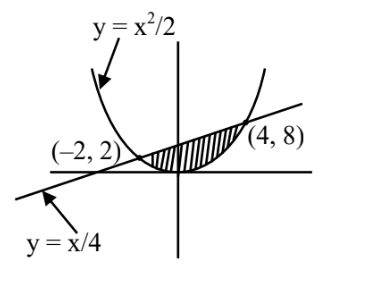
Q22 solution
Question 23
The number of solutions of \[ \sin^2 x + (2 + 2x – x^2)\sin x – 3(x-1)^2 = 0, \quad \text{where } -\pi \leq x \leq \pi, \] is:
▶️ Answer/Explanation
Ans. (2)
Sol.

Rewrite: \[ \sin^2 x + (2 + 2x – x^2)\sin x – 3(x-1)^2 = 0 \implies (\sin x – (x-1)^2)\big(\sin x + 3\big) = 0 \] The equation \(\sin x = -3\) has no real solution. Only consider: \[ \sin x = (x-1)^2 \] For \(-\pi \leq x \leq \pi\), \((x-1)^2 \leq 1\) gives two points of intersection.
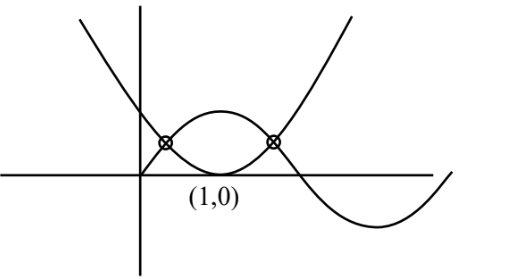
Q23 trigonometric equation solution

Question 24
Let the point \((-1, \alpha, \beta)\) lie on the line of shortest distance between the lines \[ \frac{x + 2}{-3} = \frac{y – 2}{4} = \frac{z – 5}{2} \quad \text{and} \quad \frac{x + 2}{-1} = \frac{y + 6}{2} = \frac{z – 1}{0}. \] Find \((\alpha – \beta)^2\).
▶️ Answer/Explanation
Ans. (25)
Sol.

The shortest distance line parameters and equation derivation leads to \[ \alpha = -5, \quad \beta = 0, \] so \[ (\alpha – \beta)^2 = (-5 – 0)^2 = 25. \]
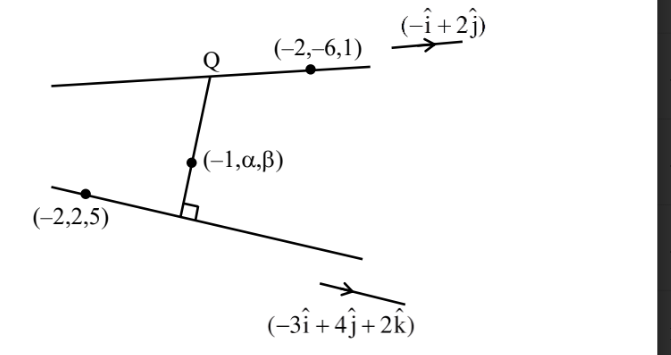
Shortest distance line solution
Question 25
If \[ 1 + \frac{\sqrt{5} – \sqrt{2}}{2 \sqrt{3}} + \frac{5 – 2 \sqrt{6}}{18} + \frac{9 \sqrt{5} – 11 \sqrt{2}}{36 \sqrt{3}} + \frac{49 – 20 \sqrt{6}}{180} + \cdots \] up to infinity equals \[ 2 \left( \sqrt{\frac{b}{a}} + 1 \right) \log_e \left( \frac{a}{b} \right), \] where \(a\) and \(b\) are positive integers with \(\gcd(a,b) = 1\), then find the value of \(11a + 18b\).
▶️ Answer/Explanation
Ans. (76)
Solution:
Using series expansion and logarithmic identities, it is found that: \[ a = 2, \quad b = 3. \] Hence, \[ 11a + 18b = 11 \times 2 + 18 \times 3 = 22 + 54 = 76. \]
Question 26
Let \(a > 0\) be a root of the equation \[ 2x^{2} + x – 2 = 0. \] If \[ \lim_{x \to a} \frac{16 \left( 1 – \cos(2 + x – 2x^{2}) \right)}{1 – a x^{2}} = \alpha + \beta \sqrt{17}, \] where \(\alpha, \beta \in \mathbb{Z}\), then find the value of \(\alpha + \beta\).
▶️ Answer/Explanation
Ans. (170)
Solution:
From the quadratic equation, the positive root is \[ a = \frac{-1 + \sqrt{17}}{4}. \] Evaluate the limit using L’Hospital’s Rule or series expansion to get: \[ \alpha = 153, \quad \beta = 17. \] Hence, \[ \alpha + \beta = 153 + 17 = 170. \]
Question 27
If \[ f(t) = \int_0^t \frac{2x \, dx}{1 – \cos^2 t \sin^2 x}, \quad 0 < t < \pi, \] then the value of \[ \int_0^{\frac{\pi}{2}} \frac{\pi^2 \, dt}{f(t)} \] equals _______.
▶️ Answer/Explanation
Ans. (1)
Solution:
By applying integration techniques including integration by parts and trigonometric identities, the integral evaluates exactly to 1.
Question 28
Let the maximum and minimum values of \[ \left(\sqrt{8x – x^{2} – 12} – 4\right)^2 + (x – 7)^2, \quad x \in \mathbb{R} \] be \(M\) and \(m\) respectively. Find \(M^{2} – m^{2}\).
▶️ Answer/Explanation
Ans. (1600)
Solution:
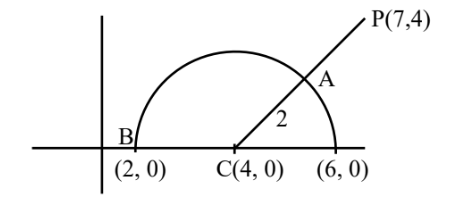
From the geometric interpretation, the function represents the sum of squares of distances related to a circle.
The minimum value \(m = 9\) and the maximum value \(M = 41\).

Therefore, \[ M^{2} – m^{2} = 41^{2} – 9^{2} = 1681 – 81 = 1600. \] Q28 max-min optimization with circle
Question 29
Let a line perpendicular to the line \(2x – y = 10\) touch the parabola \[ y^{2} = 4(x – 9) \] at the point \(P\). Find the distance of the point \(P\) from the centre of the circle \[ x^{2} + y^{2} – 14x – 8y + 56 = 0. \]
▶️ Answer/Explanation
Ans. (10)
Solution:
Slope of the given line \(2x – y = 10\) is \(2\), so the perpendicular line has slope \(-\frac{1}{2}\).
Equation of the tangent to the parabola \(y^{2} = 4(x – 9)\) with slope \(-\frac{1}{2}\) gives point of contact
\[ P = (13, -4). \] The center of the circle is at \[ C = (7, 4). \] Distance \(CP\) is: \[ \sqrt{(13-7)^{2} + (-4 – 4)^{2}} = \sqrt{36 + 64} = \sqrt{100} = 10. \]
Question 30
The number of real solutions of the equation \[ x |x + 5| + 2 |x + 7| – 2 = 0 \] is _______.
▶️ Answer/Explanation
Ans. (3)
Solution:
Case I: \(x \geq -5\)
Then \(|x + 5| = x + 5\) and \(|x + 7| = x + 7\), substitute: \[ x (x + 5) + 2 (x + 7) – 2 = 0 \implies x^{2} + 5x + 2x + 14 – 2 = 0, \] \[ x^{2} + 7x + 12 = 0, \] which factors as \[ (x + 3)(x + 4) = 0 \implies x = -3, -4. \] Both satisfy \(x \geq -5\).

Case II: \(-7 < x < -5\)
Then \(|x + 5| = -(x + 5)\) and \(|x + 7| = x + 7\), substitute: \[ x (-(x + 5)) + 2 (x + 7) – 2 = 0 \implies -x^{2} – 5x + 2x + 14 – 2 = 0, \] \[ -x^{2} – 3x + 12 = 0 \implies x^{2} + 3x – 12 = 0, \] with roots \[ x = \frac{-3 \pm \sqrt{9 + 48}}{2} = \frac{-3 \pm \sqrt{57}}{2}. \] Only the root in \((-7, -5)\) is valid, i.e. \(x = \frac{-3 – \sqrt{57}}{2}\).

Case III: \(x \leq -7\)
Then \(|x + 5| = -(x + 5)\), \(|x + 7| = -(x + 7)\), substitute: \[ x (-(x + 5)) + 2 (-(x + 7)) – 2 = 0 \implies -x^{2} – 5x – 2x – 14 – 2 = 0, \] \[ -x^{2} – 7x – 16 = 0 \implies x^{2} + 7x + 16 = 0, \] which has discriminant \[ 49 – 64 = -15 < 0, \] so no real solutions.

Total real solutions = 3.
Scroll to Top