If the distance of the earth from sun is \(1.5 \times 10^6 \text{km}\). Then the distance of an imaginary planet from Sun, if its period of revolution is 2.83 years is :
(A) \(6 \times 10^6 \text{km}\)
(B) \(3 \times 10^6 \text{km}\)
(C) \(6 \times 10^7 \text{km}\)
(D) \(3 \times 10^7 \text{km}\)
▶️ Answer/Explanation
\[ T^2 \propto a^3 \] \[ \Rightarrow T \propto a^{3/2} \] \[ \Rightarrow 1 \propto \left( 1.5 \times 10^6 \right)^{3/2} \] \[ 2.83 \propto (a)^{3/2} \] \[ \Rightarrow \frac{1}{2.83} = \left( \frac{1.5 \times 10^6}{a} \right)^{3/2} \] \[ \Rightarrow \frac{1}{\left( 2.83 \right)^{2/3}} = \frac{1.5 \times 10^6}{a} \Rightarrow a = 1.5 \times \left( 2.83 \right)^{2/3} \times 10^6 \] \[ = 3 \times 10^6 \, \text{km}\]
Thus, the correct option is (B).
Let \(y_1\) be the ratio of molar specific heat at constant pressure and molar specific heat at constant volume of a monoatomic gas and \(y_2\) be the similar ratio of diatomic gas. Considering the diatomic gas molecule as a rigid rotator, the ratio, \(\frac{y_1}{y_2}\) is :
(A) \(\frac{27}{35}\)
(B) \(\frac{35}{27}\)
(C) \(\frac{25}{21}\)
(D) \(\frac{21}{25}\)
▶️ Answer/Explanation
\( y_1 = \frac{5}{3} \), \( y_2 = \frac{7}{5} \)
\( \frac{y_1}{y_2} = \frac{25}{21} \)
Thus, the correct option is (C).
Given below are two statements : one is labelled as Assertion A and other is labelled as Reason R
Assertion A : Steel is used in the construction of buildings and bridges.
Reason R : Steel is more elastic and its elastic limit is high.
In the light of above statements, choose the most appropriate answer from the given below
(A) Both A and R are correct and R is the correct explanation of A
(B) Both A and R are correct but R is NOT the correct explanation of A
(C) A is not correct but R is correct
(D) A is correct but R is not correct
▶️ Answer/Explanation
Steel is used in the construction of buildings and bridges.
Steel is more elastic and its elastic limit is high.
Thus, the correct option is (A).
When a beam of white light is allowed to pass through convex lens parallel to principal axis, the different colours of light converge at different point on the principle axis after refraction. This is called :
(A) Scattering
(B) Spherical aberration
(C) Polarisation
(D) Chromatic aberration
▶️ Answer/Explanation
This is called chromatic aberration.
Thus, the correct option is (D).
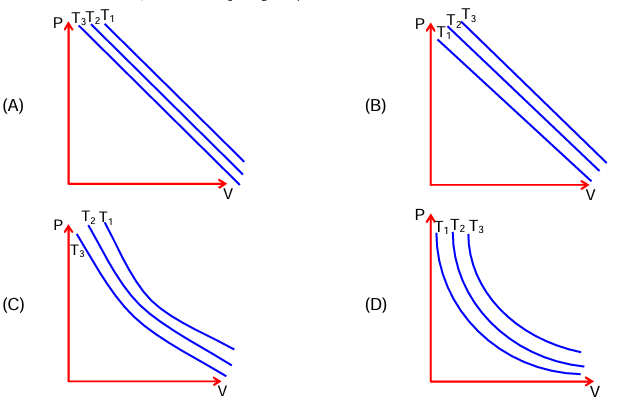
▶️ Answer/Explanation
For isothermal process: P₃ > P₂ > P₁ at constant volume and graph will be hyperbolic in nature.
Thus, the correct option is (A).
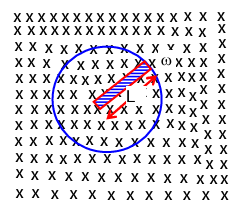
An metallic rod of length ‘L’ is rotated with an angular speed of ‘ω’ normal to a uniform magnetic field ‘B’ about an axis passing through one end of rod as shown in figure. The induced emf will be:
(A) \(\frac{1}{2} \text{Bl}^2 \omega\)
(B) \(\frac{1}{4} \text{Bl}^2 \omega\)
(C) \(\frac{1}{4} \text{B}^2\text{l}\omega\)
(D) \(\frac{1}{2} \text{B}^2\text{l}^2\omega\)
▶️ Answer/Explanation
Emf across its end = \(\frac{1}{2} \text{Bl}^2 \omega\)
Thus, the correct option is (A).
If two vectors \(\vec{P}\) = \(\hat{i}\) + 2m\(\hat{j}\) + m\(\hat{k}\) and \(\vec{Q}\) = 4\(\hat{i}\) – 2\(\hat{j}\) + m\(\hat{k}\) are perpendicular to each other. Then, the value of m will be:
(A) -1
(B) 2
(C) 1
(D) 3
▶️ Answer/Explanation
\( \vec{P} \cdot \vec{Q} = 0 \)
\( (1+2m)(4) + (m)(-2) + (m)(m) = 0 \)
\( 4 + 8m – 2m + m^2 = 0 \)
\( m^2 + 6m + 4 = 0 \Rightarrow (m+2)^2 = 0 \Rightarrow m = 2 \)
Thus, the correct option is (B).
Given below are two statements : one is labelled as Assertion A and the other is labelled as Reason R.
Assertion A : A pendulum clock when taken to Mount Everest becomes fast.
Reason R : The value of g (acceleration due to gravity) is less at Mount Everest than its value on the surface of earth.
In the light of the above statements. choose the most appropriate answer from the options given below
(A) A is correct but R is not correct
(B) A is not correct but R is correct
(C) Both A and R are correct and R is the correct explanation of A
(D) Both A and R are correct but R is NOT the correct explanation of A
▶️ Answer/Explanation
At Mount Everest g decreases, so time period increases and clock becomes slow (not fast).
Thus, A is not correct but R is correct.
The correct option is (B).
An \(\alpha\)-particle, a proton and an electron have the same kinetic energy. Which one of the following is correct in case of their de-Broglie wavelength :
(A) \(\lambda_a < \lambda_p < \lambda_e\)
(B) \(\lambda_a > \lambda_p < \lambda_e\)
(C) \(\lambda_a = \lambda_p = \lambda_e\)
(D) \(\lambda_a > \lambda_p > \lambda_e\)
▶️ Answer/Explanation
\( \lambda = \frac{h}{\sqrt{2mK}} \Rightarrow \lambda \propto \frac{1}{\sqrt{m}} \)
Mass: α-particle > proton > electron
Wavelength: \(\lambda_a < \lambda_p < \lambda_e\)
Thus, the correct option is (A).
▶️ Answer/Explanation
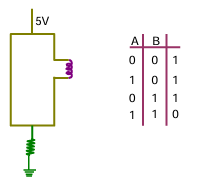
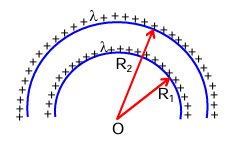
\( V = \frac{K(\lambda \pi R_1)}{R_1} + \frac{K(\lambda \pi R_2)}{R_2} = 2K\lambda\pi = \frac{\lambda}{2\varepsilon_0} \)
Thus, the correct option is (D).
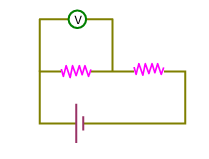
A cell of emf 90V is connected across series combination of two resistors each of 100\(\Omega\) resistance. A voltmeter of resistance 400\(\Omega\) is used to measure the potential difference across each resistor. The reading of the voltmeter will be :
(A) 40 V
(B) 80 V
(C) 90 V
(D) 45 V
A body of mass 200g is tied to a spring constant 12.5 N/m, while the other end of spring is fixed at point O. If the body moves about O in a circular path on a smooth horizontal surface with constant angular speed 5 rad/s. Then the ratio of extension in the spring to its natural length will be :
(A) 2 : 5
(B) 1 : 1
(C) 1 : 2
(D) 2 : 3
▶️ Answer/Explanation
\( K \Delta x = m\omega^2 (\ell + \Delta x) \)
\( 12.5 \Delta x = 0.2 \times 25 (\ell + \Delta x) \)
\( \frac{\Delta x}{\ell+\Delta x} = \frac{5}{15.5} = \frac{2}{5} \)
\(5\Delta x = 2\ell + 2\Delta \)
\( \frac{\Delta x}{\ell} = 2 : 3 \)
Thus, the correct option is (D).
The frequency (\(\nu\)) of an oscillating liquid drop may depend upon radius (\(r\)) of the drop, density (\(\rho\)) of liquid and the surface tension (\(s\)) of the liquid as : \(\nu = r^a \rho^b s^c\). The value of a, b, c respectively are
(A) \(\left( \frac{3}{2}, \frac{1}{2}, -\frac{1}{2} \right)\)
(B) \(\left( -\frac{3}{2}, -\frac{1}{2}, \frac{1}{2} \right)\)
(C) \(\left( -\frac{3}{2}, \frac{1}{2}, \frac{1}{2} \right)\)
(D) \(\left( \frac{3}{2}, -\frac{1}{2}, \frac{1}{2} \right)\)
▶️ Answer/Explanation
\( V = r^a s^b s^c \)
\(\Rightarrow T^{-1} = (L^a)(ML^{-3})^b (MT^{-2})^c \)
\( b + c = 0 \;\;\Rightarrow\;\; b = -c \)
\( a – 3b = 0 \)
\(-1 = 2c \;\;\Rightarrow\;\; c = \dfrac{1}{2} \)
Given below are two statements :
Statement I : Acceleration due to earth’s gravity decreases as you go ‘up’ or ‘down’ from earth’s surface.
Statement II : Acceleration due to earth’s gravity is same at a height ‘h’ and depth ‘d’ from earth’s surface, if h = d.
In the light of above statements, choose the most appropriate answer from the options given below
(A) Statement I is incorrect but statement II is correct
(B) Both Statement I and Statement II are incorrect
(C) Statement I is correct but statement II is incorrect
(D) Both Statement I and II are correct
▶️ Answer/Explanation
\( g = \dfrac{GM}{r^2} \quad \text{for outside} \)
\( g = \dfrac{GMr}{R^3} \quad \text{for inside} \)
The electric field and magnetic field components of an electromagnetic wave going through vacuum is described by
\(E_x = E_0 \sin(kz – \omega t)\)
\(B_y = B_0 \sin(kz – \omega t)\)
Then the correct relation \( E_0 \) and \( B_0 \) is given by
(A) \( E_0 B_0 = \omega k \)
(B) \( \omega E_0 = kB_0 \)
(C) \( E_0 = kB_0 \)
(D) \( kE_0 = \omega B_0 \)
▶️ Answer/Explanation
For electromagnetic waves: \( E_0 = cB_0 \) and \( c = \frac{\omega}{k} \)
Thus, \( E_0 = \frac{\omega}{k} B_0 \Rightarrow kE_0 = \omega B_0 \)
Thus, the correct option is (D).
A photon is emitted in transition from n = 4 to n = 1 level in hydrogen atom. The corresponding wavelength for this transition is (given, h = 4 × 10{-15} eV s) :
(A) 94.1 nm
(B) 974 nm
(C) 99.3 nm
(D) 941 nm
▶️ Answer/Explanation
\( \Delta E = 13.6 \left(1 – \frac{1}{16}\right) = 13.6 \times \frac{15}{16} \, \text{eV} \)
\( \lambda = \frac{hc}{\Delta E} = \frac{4 \times 10^{-15} \times 3 \times 10^8}{13.6 \times \frac{15}{16}} \approx 94.1 \, \text{nm} \)
Thus, the correct option is (A).
▶️ Answer/Explanation
Correct matching: A-II, B-I, C-IV, D-III
Thus, the correct option is (C).
A long solenoid is formed by winding 70 turns cm\(^{-1}\). If 2.0A current flows, then magnetic field produced inside the solenoid is ______ (\( \mu_0 = 4\pi \times 10^{-7} \text{TmA}^{-1} \))
(A) \( 176 \times 10^{-4} \text{T} \)
(B) \( 88 \times 10^{-4} \text{T} \)
(C) \( 352 \times 10^{-4} \text{T} \)
(D) \( 1232 \times 10^{-4} \text{T} \)
▶️ Answer/Explanation
\( n = 70 \, \text{turns/cm} = 7000 \, \text{turns/m} \)
\( B = \mu_0 n I = 4\pi \times 10^{-7} \times 7000 \times 2 = 176 \times 10^{-4} \, \text{T} \)
Thus, the correct option is (A).
▶️ Answer/Explanation
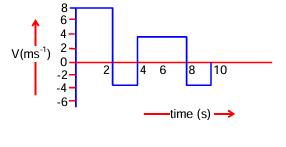
Displacement = \(8\times2-2\times4+4\times4-2\times4 = 32-16 =16\) m,
Distance =\(8\times2+2\times4+4\times4+2\times4 = 48\) m
Ratio = 16 : 48 = 1 : 3
Thus, the correct option is (C).
▶️ Answer/Explanation
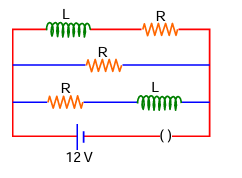
3
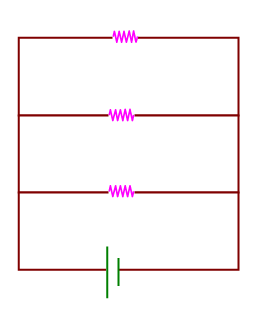
Long after the switch is closed, the inductors behave like short circuits (zero resistance). The circuit reduces to three resistors in parallel.
Equivalent resistance: \( \frac{1}{R_{eq}} = \frac{1}{12} + \frac{1}{12} + \frac{1}{12} = \frac{3}{12} = \frac{1}{4} \) ⇒ \( R_{eq} = 4 \Omega \)
Current through battery: \( I = \frac{V}{R_{eq}} = \frac{12}{4} = 3 \text{A} \).
A parallel plate capacitor with air between the plate has a capacitance of 15pF. The separation between the plate become twice and the space between them is filled with a medium of dielectric constant 3.5. Then the capacitance becomes \(\frac{x}{4}\) pF. The value of \( x \) is ______.
▶️ Answer/Explanation
\( C_o = \dfrac{\varepsilon A}{d} = 15 \, \text{pf} \)
\( C = \dfrac{K \varepsilon_0 A}{2d} = \dfrac{K}{2} \left( \dfrac{\varepsilon_0 A}{d} \right) = \dfrac{105}{4} \, \text{pf} \)
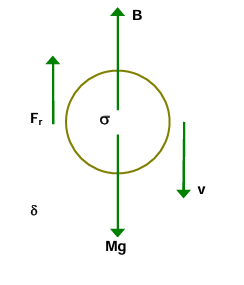
A Spherical ball of radius 1mm and density 10.5g/cc is dropped in glycerine of coefficient of viscosity 9.8 poise and density 1.5 g/cc. Viscous force on the ball when it attains constant velocity is \(3696 \times 10^x\) N. The value of \( x \) is (Given, \( g = 9.8 \text{m/s}^2 \) and \( \pi = \frac{22}{7} \))
▶️ Answer/Explanation
3696×10-7
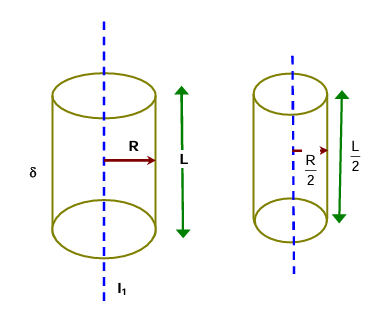
A uniform solid cylinder with radius \( R \) and length \( L \) has moment inertia \( I_1 \), about the axis of the cylinder. A concentric solid cylinder of radius \( R’ = \frac{R}{2} \) and length \( L’ = \frac{L}{2} \) is carved out of the original cylinder. If \( I_2 \) is the moment of inertia of the carved out portion of the cylinder then \( \frac{I_1}{I_2} = \) (Both \( I_1 \) and \( I_2 \) are about the axis of the cylinder)
▶️ Answer/Explanation
32
Let mass density be ρ.
Mass of original cylinder \(M = ρ × πR²L\)
I1 =\((\frac{1}{2})MR²\) = \( (\frac{1}{2})ρπR²L × R²\) =\( (\frac{1}{2})ρπR⁴L\)
Mass of carved cylinder\( m = ρ × π(R/2)²(L/2) = ρ × π(R²/4)(L/2) = (1/8)ρπR²L = M/8\)
I2 (for carved part) = \( (\frac{1}{2})m(R’)² =(\frac{1}{2}) × (M/8) × (R/2)² = (\frac{1}{2})×(M/8)×(R²/4) = (1/64)MR²\)
But I1 = \((\frac{1}{2}) MR²\)
So, \( \frac{I_1}{I_2} = \frac{(1/2)MR²}{(1/64)MR²} = \frac{64}{2} = 32 \).
A convex lens of refractive index 1.5 and focal length 18cm in air is immersed in water. The change of focal length of the lens will be ______ cm. (Given refractive index of water = \(\frac{4}{3}\))
▶️ Answer/Explanation
54
Lens maker’s formula: \( \frac{1}{f} = (\mu – 1)\left( \frac{1}{R_1} – \frac{1}{R_2} \right) \)
In air: \( \frac{1}{18} = (1.5 – 1)\left( \frac{1}{R_1} – \frac{1}{R_2} \right) = 0.5K \) ⇒ \( K = \frac{1}{18 \times 0.5} = \frac{1}{9} \)
In water: \( \frac{1}{f_w} = \left( \frac{\mu_g}{\mu_w} – 1 \right)K = \left( \frac{1.5}{4/3} – 1 \right) \times \frac{1}{9} = \left( \frac{4.5}{4} – 1 \right) \times \frac{1}{9} = \left( \frac{0.5}{4} \right) \times \frac{1}{9} = \frac{1}{8} \times \frac{1}{9} = \frac{1}{72} \)
So, fw = 72 cm.
Change in focal length = fw – fair = 72 – 18 = 54 cm.
A body of mass 1kg begins to move under the action of a time dependent force \( \vec{F} = (t\hat{i} + 3t^2\hat{j})N \), where \( \hat{i} \) and \( \hat{j} \) are the unit vectors along \( x \) and \( y \) axis. The power developed by above force, at the time \( t = 2s \), will be ______ W.
▶️ Answer/Explanation
100
\(\vec{f} = (ti + 3t^2 j)\,\text{N}\)
\(\vec{a} = ti + 3t^2 j\)
\(\vec{v} = \dfrac{t^2}{2} i + \dfrac{3t^3}{3} j = \dfrac{t^2}{2} i + t^3 j\)
\(p = \vec{f} \cdot \vec{v} = \dfrac{t^3}{3} + 3t^5 = \dfrac{8}{2} + 3(2)^5 = 4 + 96 = 100\)
If a copper wire is stretched to increase its length by 20% . The percentage increase in resistance of the wire is ______%.
▶️ Answer/Explanation
44%
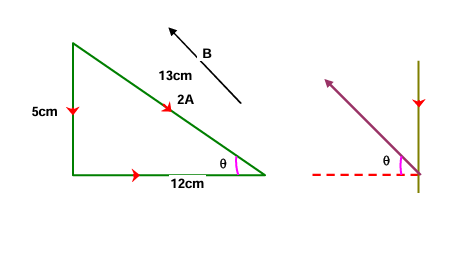
A single turn current loop in the shape of a right angle triangle with sides 5cm, 12cm, 13cm is carrying a current of 2A. The loop is in a uniform magnetic field of magnitude 0.75 T whose direction is parallel to the current in the 13cm side of the loop. The magnitude of the magnetic force on the 5cm side will be \(\frac{x}{130}\) N. The value of \( x \) is ______.
The energy released per fission of nucleus of \(^{240}X\) is 200 MeV. The energy released if all the atoms in 120g of pure \(^{240}X\) undergo fission is ______ × \(10^{25}\) MeV.
▶️ Answer/Explanation
6
Molar mass of \(^{240}X\) = 240 g/mol.
Number of moles in 120 g = 120 / 240 = 0.5 mol.
Number of atoms N = 0.5 × NA = 0.5 × 6.022 × 1023 = 3.011 × 10²³
Energy released = N × 200 MeV = 3.011 × 1023 × 200 = 6.022 × 1025 MeV ≈ 6 × 1025 MeV.
So, the value is 6.
A mass m attached to free end of a spring executes SHM with a period of 1s. If the mass is increased by 3kg the period of oscillation increases by one second, the value of mass m is ______ kg.
▶️ Answer/Explanation
1
Time period T = \( 2\pi\sqrt{\frac{m}{k}} \)
Case 1: 1 = \( 2\pi\sqrt{\frac{m}{k}} \) ⇒ \( \frac{m}{k} = \frac{1}{4\pi^2} \) …(1)
Case 2: 2 = \( 2\pi\sqrt{\frac{m+3}{k}} \) ⇒ \( \frac{m+3}{k} = \frac{4}{4\pi^2} = \frac{1}{\pi^2} \) …(2)
Divide (2) by (1): \( \frac{m+3}{m} = \frac{1/\pi^2}{1/(4\pi^2)} = 4 \) ⇒ m + 3 = 4m ⇒ 3m = 3 ⇒ m = 1 kg.