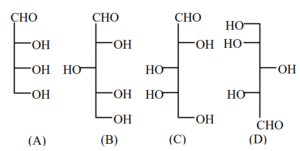
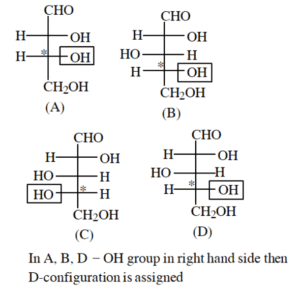
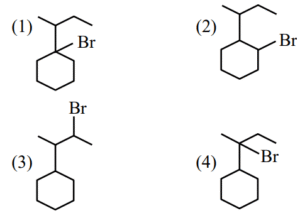
(1) 5
(2) 4
(3) 3
(4) 8
▶ Answer/Explanation
Sol. $(x + \sqrt{x} – 1)^5 (x – \sqrt{x} – 1)^5$
= 2$\{^5C_0.x^5 + ^5C_2.x^3(x^3 – 1) + ^5C_4.x(x^3 – 1)^2\}$
= 2$\{5x^7 + 10x^6 + x^5 – 10x^4 – 10x^3 + 5x\}$
$\Rightarrow$ $\alpha = 10$, $\beta = 2$, $\gamma = -20$, $\delta = 10$
Now, $10u + 2v = 18$
$-20u + 10v = 20$
$\Rightarrow u = 1$, $v = 4$
$u + v = 5$
(1) 144
(2) 72
(3) 96
(4) 120
▶ Answer/Explanation
Sol. Total – when $B_1$ and $B_2$ are together
= 2!(3! 4!) – 2! (3!(3! 2!)) = 144
(1) $\frac{263\sqrt{3}}{8}$
(2) $17\sqrt{3}$
(3) $\frac{343\sqrt{3}}{8}$
(4) $\frac{34\sqrt{3}}{3}$
▶ Answer/Explanation
Sol. $S$ $O$ $N$ $Q$ $M$
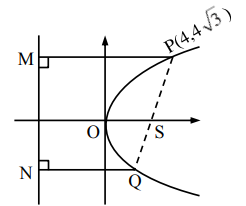
$(4, 4\sqrt{3})$ lies on $y^2 = 4ax$ $\Rightarrow 48 = 4a.4$
$4a = 12$ $\Rightarrow y^2 = 12x$ is equation of parabola
Now, parameter of $P$ is $t_1 = 2\sqrt{3}$
$\Rightarrow$ Parameters of $Q$ is $t_2 = -\frac{\sqrt{3}}{2}$ $\Rightarrow Q (\frac{9}{4}, -3\sqrt{3})$
Area of trapezium $PQNM$
= $\frac{1}{2} MN.(PM + QN)$
= $\frac{1}{2} MN.(PS + QS)$
= $\frac{1}{2} MN.PQ$
= $\frac{1}{2} \frac{49}{4} \sqrt{3}.7\sqrt{3}$
($\frac{343}{2} \frac{1}{4} \frac{1}{8}$ = $\frac{343\sqrt{3}}{8}$ = 3 )
(1) 56
(2) 132
(3) 174
(4) 280
▶ Answer/Explanation
Sol. $|A|= \frac{1}{2}$, trace$(A) = 3$, $B = \text{adj}(\text{adj}(2A))=|2A|^{n-2}(2A)$
$n = 3$, $B = |2A|(2A) = 2^3.|A|(2A) = 8A$
$|B| = |8A| = 8^3.|A| = 2^8 = 256$
trace$(B) = 8 \text{ trace}(A) = 24$
$|B| + \text{trace}(B) = 280$
(1) 5
(2) 8
(3) 6
(4) 4
▶ Answer/Explanation
Sol. $a_1, a_2, a_3,\ldots, a_{2k}$ $\rightarrow$ A.P.
$\sum_{r=1}^{k} a_{2r-1} = 40$,
$\sum_{r=1}^{k} a_{2r} = 55$, $a_{2k} – a_1 = 27$
$\frac{k}{2} [2a_1 + (k – 1)2d] = 40$, $\frac{k}{2} [2a_2 + (k – 1)2d] = 55$,
$d = \frac{27}{2k-1}$
$a_1 = \frac{40}{k} – (k – 1)d = \frac{55}{k} – kd$
$d = \frac{15}{k}$ $\Rightarrow \frac{27}{2k-1} = \frac{15}{k}$ $\Rightarrow 9k = 10k – 5$
$\therefore k = 5$
(1) 136
(2) 140
(3) 144
(4) 148
▶ Answer/Explanation
Sol. $PQ$ parallel to $3\hat{i} + 2\hat{j} + 2\hat{k}$, $R(1, 3, 3)$
$\Rightarrow Q(3\lambda – 2, 2\lambda – 1, 2\lambda + 3)$, $\lambda \in \mathbb{R} – \{0\}$
$QR = 5 = \sqrt{(3\lambda – 3)^2 + (2\lambda – 4)^2 + (2\lambda)^2}$
$\therefore 17\lambda^2 – 34\lambda + 25 = 25$ $\Rightarrow \lambda = 2$ ($\lambda \neq 0$)
$\therefore Q(4, 3, 7)$, $P(-2, -1, 3)$, $R(1, 3, 3)$
Area of $\Delta PQR = [PQR] = \frac{1}{2} \times PQ \times PR$
$[PQR] =\frac{1}{2} \begin{vmatrix} \hat{i} & \hat{j} & \hat{k} \\ 6 & 4 & 4 \\ 3 & 4 & 0 \end{vmatrix}$
$[PQR] = |-8\hat{i} – 6\hat{j} + 6\hat{k}| = \sqrt{136}$
$\therefore [PQR]^2 = 136$
(1) $e$
(2) $e^{-2}$
(3) $e^2$
(4) $e^{-1}$
▶ Answer/Explanation
Sol. $\alpha = \lim_{x \to \infty} \frac{x}{e^x – 1} \frac{1}{x} \left( \frac{1}{e} + \frac{1}{e^x} \right)$
($1^\infty$ form)
$\therefore \alpha = e^L$
Where $L = \lim_{x \to \infty} \frac{\frac{x}{e^x – 1}}{x} \frac{1}{1 – \frac{1}{e} – \frac{1}{e^x}}$
$\Rightarrow L = \lim_{x \to \infty} \frac{\frac{x}{e^x – 1}}{x} \frac{1}{1 – \frac{1}{e} – \frac{1}{e^x}}$
$\Rightarrow L = \lim_{x \to \infty} \frac{\frac{x}{e^x – 1}}{1 – \frac{1}{e} – \frac{1}{e^x}}$
$\Rightarrow L = \frac{e}{1 – \frac{1}{e}}$
$\therefore \alpha = \frac{e}{e – 1}$ $\Rightarrow \log \alpha = \frac{e}{e – 1}$
$\therefore$ Required value = $e^{\frac{1}{e} \log (1 + \alpha) + \log \alpha} = e$
(1) 2 and 3
(2) 3 and 2
(3) 1 and 3
(4) 2 and 2
▶ Answer/Explanation
Sol. $f'(x) = \frac{x^2}{8x^2 – 15} e^{-x} (2x)$
= $\frac{x^2 (x – 3)(x + 5)(2x)}{e^x}$
– 0 + + + – –
Maxima at $x \in \{-\sqrt{3}, \sqrt{3}\}$
Minima at $x \in \{-5, 0, 5\}$
2 points of maxima and 3 points of minima.
(1) 6
(2) $5\sqrt{2}$
(3) $3\sqrt{5}$
(4) $4\sqrt{3}$
▶ Answer/Explanation
Sol.
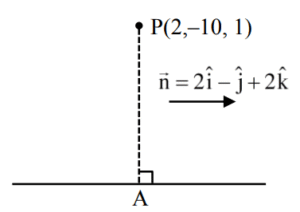
$\frac{x-1}{2} = \frac{y-2}{1} = \frac{z-3}{-2}$ (let)
$(2\lambda + 1, -\lambda – 2, 2\lambda – 3)$
$PA.n = 0$
$\Rightarrow (2\lambda – 1)2 + (-\lambda + 8)(-1) + (2\lambda – 4)2 = 0$
$\Rightarrow 4\lambda – 2 + \lambda – 8 + 4\lambda – 8 = 0$
$\Rightarrow 9\lambda – 18 = 0$ $\Rightarrow \lambda = 2$
$\therefore A(5, -4, 1)$
$\therefore AP = \sqrt{3^2 + 6^2 + 0^2} = \sqrt{45} = 3\sqrt{5}$
(1) $e^{\pi/4}$
(2) $e^{\pi/12}$
(3) $e^{\pi/3}$
(4) $e^{\pi/6}$
▶ Answer/Explanation
\( \frac{dx}{dy} + \frac{x}{1 + y^2} = \frac{2e^{\tan^{-1}y}}{1 + y^2} \)
\( \text{I.F.} = e^{\tan^{-1}y} \)
\( x e^{\tan^{-1}y} = \int \frac{2(e^{\tan^{-1}y})^2}{1 + y^2} \, dy \)
\(\text{Put } \tan^{-1}y = t, \, \frac{dy}{1 + y^2} = dt \)
\( x e^{\tan^{-1}y} = \int 2e^{2t} \, dt \)
\( x e^{\tan^{-1}y} = e^{2t} + c \)
\( x = e^{t – \tan^{-1}y} + c e^{-\tan^{-1}y} \)
\(\text{When } y = 0, \, x = 1: \, 1 = 1 + c \Rightarrow c = 0 \)
\( y = \frac{1}{\sqrt{3}}, \, x = e^{\pi/6} \)
(1) $\frac{e^{\pi}}{2\sqrt{6}}$
(2) $\frac{e^{\pi}}{2\sqrt{4}}$
(3) $\frac{e^{\pi}}{3\sqrt{6}}$
(4) $\frac{e^{\pi}}{3\sqrt{4}}$
▶ Answer/Explanation
Ans. (3)
\(
\therefore \frac{d}{dx} \left( \frac{x \sin^{-1} x}{\sqrt{1 – x^2}} \right)
= \frac{\sin^{-1} x}{(1 – x^2)^{3/2}} + \frac{x}{1 – x^2}
\)
\(
\Rightarrow \int e^x \left( \frac{x \sin^{-1} x}{\sqrt{1 – x^2}}
+ \frac{\sin^{-1} x}{(1 – x^2)^{3/2}} + \frac{x}{1 – x^2} \right) dx
\)
\(
= e^x \cdot \frac{x \sin^{-1} x}{\sqrt{1 – x^2}} + c = g(x) + C
\)
\(
\text{Note : assuming } g(x) = \frac{x e^x \sin^{-1} x}{\sqrt{1 – x^2}}
\)
\(
g\left( \frac{1}{2} \right) = \frac{e^{1/2}}{2} \cdot \frac{\pi/6 \times 2}{\sqrt{3}}
= \frac{\pi}{6} \sqrt{\frac{e}{3}}
\)
Comment : In this question we will not get a unique function } g(x),
but in order to match the answer we will have to assume
\(g(x) = \frac{x e^x \sin^{-1} x}{\sqrt{1 – x^2}}.\)
(1) 24
(2) 25
(3) 27
(4) 17
▶ Answer/Explanation
Sol. $(\alpha^2 + \beta^2)^2 – 2\alpha^2\beta^2$
$[(\alpha + \beta)^2 – 2\alpha\beta]^2 – 2(\alpha\beta)^2$
$\frac{(\cos \theta)^2 + 1}{4} – \frac{1}{2}$
$\frac{(\cos \theta)^2 + 1 – 2}{4} = \frac{\cos^2 \theta – 1}{4}$
$M = \frac{25}{16} – 1 = \frac{9}{16}$
$m = \frac{1}{2}$, $16(M + m) = 25$
(1) 127
(2) 151
(3) 163
(4) 139
▶ Answer/Explanation
Sol. Total = $4^4$
One-one = $4!$
Many-one = $256 – 24 = 232$
Many-one which $1 \notin f(A)$
= $3.3.3.3 = 81$
232 – 81 = 151
$x + y + 2z = 6$,
$2x + 3y + az = a + 1$,
$-x – 3y + bz = 2b$,
where $a, b \in \mathbb{R}$, has infinitely many solutions, then $7a + 3b$ is equal to :
(1) 9
(2) 12
(3) 16
(4) 22
▶ Answer/Explanation
Sol. $\Delta = \begin{vmatrix} 1 & 1 & 2 \\ 2 & 3 & a \\ -1 & -3 & b \end{vmatrix} = 0$
$\Rightarrow 2a + b – 6 = 0$ $\cdots$(1)
$\Delta_1 = \begin{vmatrix} 1 & 1 & 6 \\ 2 & 3 & a + 1 \\ -1 & -3 & 2b \end{vmatrix} = 0$
$\Rightarrow a + b – 8 = 0$ $\cdots$(2)
Solving (1) + (2) $a = -2$, $b = 10$
$\Rightarrow 7a + 3b = 16$
(1) 3
(2) 2
(3) 1
(4) 0
▶ Answer/Explanation
Sol.
\(\hat{a}.\hat{b} = \frac{1}{2}\)
\(\text{Now } (\lambda\hat{a} + 2\hat{b}).(3\hat{a} – \lambda\hat{b}) = 0\)
\(3\lambda\hat{a}.\hat{a} – \lambda^2\hat{a}.\hat{b} + 6\hat{a}.\hat{b} – 2\lambda\hat{b}.\hat{b} = 0\)
\(3\lambda – \frac{\lambda^2}{2} + 3 – 2\lambda = 0\)
\(\lambda^2 – 2\lambda – 6 = 0\)
\(\lambda = 1 \pm \sqrt{7}\)
\(\Rightarrow \text{number of values} = 0\)
(1) 10
(2) 7
(3) 8
(4) 9
▶ Answer/Explanation
Sol. $\frac{x^2}{a^2} + \frac{y^2}{b^2} = 1$ foci are $(ae, 0)$ and $(-ae, 0)$
$\frac{x^2}{A^2} – \frac{y^2}{B^2} = 1$ foci are $(Ae’, 0)$ and $(-Ae’, 0)$
$\Rightarrow 2ae = 2\sqrt{3}$ $\Rightarrow ae = \sqrt{3}$
and $2Ae’ = 2\sqrt{3}$ $\Rightarrow Ae’ = \sqrt{3}$
$\Rightarrow ae = Ae’$ $\Rightarrow \frac{e’}{e} = \frac{a}{A}$
$\Rightarrow \frac{1}{A} = \frac{1}{3a}$ $\Rightarrow a = 3A$
Now $a – A = 2$ $\Rightarrow a – \frac{a}{3} = 2$ $\Rightarrow a = 3$ and $A = 1$
$Ae = \sqrt{3}$ $\Rightarrow e = \frac{1}{\sqrt{3}}$ and $e’ = \sqrt{3}$
$b^2 = a^2(1 – e^2)$ $b^2 = 6$
and $B^2 = A^2((e’)^2 – 1) = (2)$ $\Rightarrow B^2 = 2$
sum of LR = $\frac{2b^2}{a} + \frac{2B^2}{A} = 8$
(1) $\frac{5}{3}$
(2) $\frac{4}{3}$
(3) $\frac{9}{4}$
(4) $\frac{7}{4}$
▶ Answer/Explanation
Sol. $12x^2 – 7x + 1 = 0$
$x = \frac{1}{3}, \frac{1}{4}$
Let $P(\frac{A}{B}) = \frac{1}{3}$ & $P(\frac{B}{A}) = \frac{1}{4}$
$P(A \cap B) = \frac{1}{3} P(B)$ & $P(A \cap B) = \frac{1}{4} P(A)$
$\Rightarrow P(B) = 0.3$ & $P(A) = 0.4$
$P(A \cup B) = P(A) + P(B) – P(A \cap B)$
= $0.3 + 0.4 – 0.1 = 0.6$
Now $\frac{P(A \mid B)}{P(A \mid B)} = \frac{P(A \cap B)}{P(A \cap B)}$
$\frac{1 – P(A \cap B)}{1 – P(A \cup B)} = \frac{1 – 0.1}{1 – 0.6} = \frac{9}{4}$
(1) $\frac{2\pi}{3}$
(2) $4\pi$
(3) $\frac{5\pi}{6}$
(4) $\pi$
▶ Answer/Explanation
Sol. $2\sin^2 2\theta = \cos 2\theta$
$2\sin^2 2\theta = 1 – 2\sin^2 2\theta$
$4\sin^2 2\theta = 1$
$\sin 2\theta = \frac{1}{2}$
$\sin \theta = \pm \frac{1}{2}$
$2\cos^2 2\theta = 3\sin \theta$
$2 – 2\sin^2 2\theta + 3\sin \theta – 2 = 0$
$(2\sin \theta – 1)(2\sin \theta – 2) = 0$
$\sin \theta = \frac{1}{2}$
so common equation which satisfy both equations is $\sin \theta = \frac{1}{2}$
$\theta = \frac{\pi}{6}, \frac{5\pi}{6}$ ($\theta \in [0, 2\pi]$)
Sum = $\pi$
(1) $\pi + \frac{1}{2}$
(2) $\pi + \frac{1}{3}$
(3) $\pi + \frac{1}{4}$
(4) $\pi + \frac{1}{6}$
▶ Answer/Explanation
Sol.
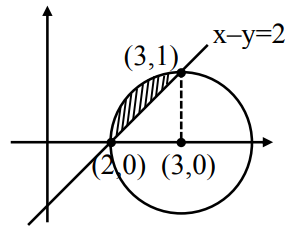
Let $z = x + iy$
$(x + iy)(1 + i) + (x – iy)(1 – i) = 4$
$x + ix + iy – y + x – ix – iy – y = 4$
$2x – 2y = 4$
$x – y = 2$
$|z – 3| \leq 1$
$(x – 3)^2 + y^2 \leq 1$
\(\text{Area of shaded region} = \frac{\pi .1^2}{4} – \frac{1}{2} . 1 . 1 = \frac{\pi}{4} – \frac{1}{2}\)
\(\text{Area of unshaded region inside the circle} = \frac{3}{4} . \pi .1^2 + \frac{1}{2} . 1 . 1 = \frac{3\pi}{4} + \frac{1}{2}\)
\(\text{: difference of area} = \left(\frac{3\pi}{4} + \frac{1}{2}\right) – \left(\frac{\pi}{4} – \frac{1}{2}\right)\)
\(= \frac{\pi}{2} + 1\)
(1) $\frac{8}{3}$
(2) $\frac{4}{3}$
(3) 5
(4) 8
▶ Answer/Explanation
Sol.
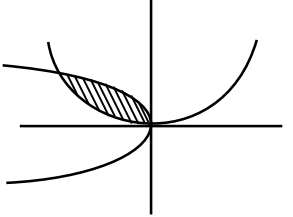
$y = x^2$, $y^2 = -8x$
\(\frac{16ab}{3} = \frac{16 \times \frac{1}{4} \times 2}{3} = \frac{8}{3}\)
▶ Answer/Explanation
\( \text{I.F.} = e^{-\frac{1}{2} \int \frac{2x}{1 – x^2} \, dx} = e^{-\frac{1}{2} \ln(1 – x^2)} = \sqrt{1 – x^2} \)
\( y \sqrt{1 – x^2} = \int (x^6 + 4x) \, dx = \frac{x^7}{7} + 2x^2 + c \)
\(\text{Given } y(0) = 0 \Rightarrow c = 0 \)
\( y = \frac{\frac{x^7}{7} + 2x^2}{\sqrt{1 – x^2}} \)
\(\text{Now, } 6 \int_{0}^{\frac{1}{2}} \frac{\frac{x^7}{7} + 2x^2}{\sqrt{1 – x^2}} \, dx = 6 \int_{0}^{\frac{1}{2}} \frac{2x^2}{\sqrt{1 – x^2}} \, dx \)
\( = 24 \int_{0}^{\frac{1}{2}} \frac{x^2}{\sqrt{1 – x^2}} \, dx \)
\text{Put } \( x = \sin \theta \)
\( dx = \cos \theta \, d\theta \)
\( = 24 \int_{0}^{\frac{\pi}{6}} \frac{\sin^2 \theta}{\cos \theta} \cos \theta \, d\theta \)
\( = 24 \int_{0}^{\frac{\pi}{6}} \frac{1 – \cos 2\theta}{2} \, d\theta = 12 \left[ \theta – \frac{\sin 2\theta}{2} \right]_{0}^{\frac{\pi}{6}} \)
\( = 12 \left( \frac{\pi}{6} – \frac{\sqrt{3}}{4} \right) \)
\( = 2\pi – 3\sqrt{3} \)
\( \alpha^2 = (3\sqrt{3})^2 = 27 \)
▶ Answer/Explanation
Sol. All the three points $A$, $B$, $C$ lie on the circle $x^2 + y^2 = 100$ so circumcentre is $(0, 0)$
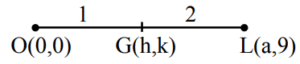
$a = 3h$
and $9 = 0 + \frac{k}{3}$ $\Rightarrow k = 3$
also centroid $6 + \frac{10\cos \alpha – 10\sin \alpha}{3} = h$
$\Rightarrow 10(\cos \alpha – \sin \alpha) = 3h – 6$ $\cdots$(i)
and $8 + \frac{10\cos \alpha – 10\sin \alpha}{3} = k$
$\Rightarrow 10(\cos \alpha – \sin \alpha) = 3k – 8 = 9 – 8 = 1$ $\cdots$(ii)
on squaring $100(1 – \sin^2 \alpha) = 1$
$\Rightarrow 100\sin^2 \alpha = 99$
from equ. (i) and (ii) we get $h = \frac{7}{3}$
Now $5a – 3h + 6k + 100 \sin^2 \alpha$
= $15h – 3h + 6k + 100 \sin^2 \alpha$
= $12 \times \frac{7}{3} + 18 + 99$
= 145
▶ Answer/Explanation
Sol.
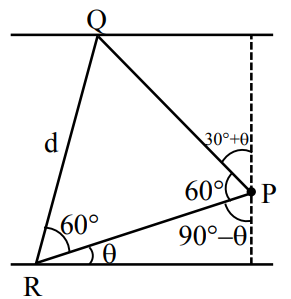
For equilateral $d = PR = PQ$
$\Rightarrow \cos(\theta + 30^\circ) = 4\sin \theta$
$\Rightarrow \frac{\sqrt{3} – 1}{2} = \frac{1 – \tan \theta}{2\sqrt{3}}$
$\Rightarrow \tan \theta = \frac{1 – \sqrt{3}}{3}$
$QR^2 = d^2 = \csc^2 \theta = 28$
▶ Answer/Explanation
\( \sum_{r=1}^{30} \frac{r^2 \left( {}^{30}C_r \right)^2}{{}^{30}C_{r-1}} \)
\( = \sum_{r=1}^{30} r^2 \frac{ \left( \frac{31 – r}{r} \right) 30! }{ r! (30 – r)! } \)
\( \because \frac{{}^{30}C_r}{{}^{30}C_{r-1}} = \frac{30 – r + 1}{r} = \frac{31 – r}{r} \)
\( = \sum_{r=1}^{30} (31 – r) \frac{30!}{(r – 1)! (30 – r)!} \)
\( = 30 \sum_{r=1}^{30} \frac{(31 – r) 29!}{(r – 1)! (30 – r)!} \)
\( = 30 \sum_{r=1}^{30} (30 – r + 1) \, {}^{29}C_{30 – r} \)
\( = 30 \left( \sum_{r=1}^{30} (31 – r) \, {}^{29}C_{30 – r}
+ \sum_{r=1}^{30} {}^{29}C_{30 – r} \right) \)
\( = 30 (29 \times 2^{28} + 2^{29}) = 30 (29 + 2) 2^{28} \)
\( = 15 \times 31 \times 2^{29} \)
\( = 465 (2^{29}) \)
\( \alpha = 465 \)
▶ Answer/Explanation
Sol. Transitivity
$(1, 2) \in R$, $(2, 3) \in R$ $\Rightarrow (1, 3) \in R$
For reflexive $(1, 1)$, $(2, 2)$, $(3, 3) \in R$
Now $(2, 1)$, $(3, 2)$, $(3, 1)$
$(3, 1)$ cannot be taken
(1) $(2, 1)$ taken and $(3, 2)$ not taken
(2) $(3, 2)$ taken and $(2, 1)$ not taken
(3) Both not taken
therefore
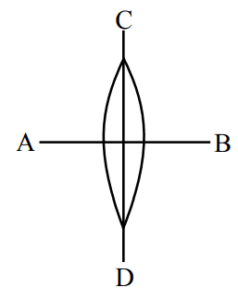
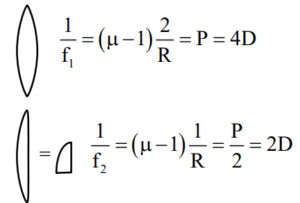
A symmetric thin biconvex lens is cut into four equal parts by two planes AB and CD as shown in figure. If the power of original lens is 4D then the power of a part of the divided lens is
![]()
(1) 8D (2) 4D (3) D (4) 2D
<strong▶️ Answer/Explanation
Ans. (4)
Explanation:![]()
A small rigid spherical ball of mass M is dropped in a long vertical tube containing glycerine. The velocity of the ball becomes constant after some time. If the density of glycerine is half of the density of the ball, then the viscous force acting on the ball will be (consider g as acceleration due to gravity)
(1) \(\frac{3}{2}\text{Mg}\) (2) \(\frac{\text{Mg}}{2}\) (3) \(\text{Mg}\) (4) \(2\text{Mg}\)
▶️ Answer/Explanation
Ans. (2)
Explanation:![]()
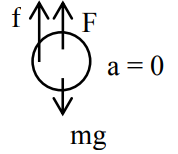
\[ mg – F_b – f = 0 \] \[ mg – \frac{mg}{2} – f = 0 \quad \text{(since density of glycerine is half)} \] \[ \therefore f = \frac{mg}{2} \]
The maximum percentage error in the measurement of density of a wire is [Given, mass of wire = (0.60 ± 0.003)g radius of wire = (0.50 ± 0.01)cm length of wire (10.00 ± 0.05)cm]
(1) 4 (2) 5 (3) 8 (4) 7
▶️ Answer/Explanation
Ans. (2)
Explanation:
\[ \rho = \frac{m}{\pi R^2 \ell} \Rightarrow \frac{\Delta \rho}{\rho} = \frac{\Delta m}{m} + \frac{2\Delta R}{R} + \frac{\Delta \ell}{\ell} \] \[ \frac{\Delta \rho}{\rho} = \left(\frac{0.003}{0.6} + \frac{2 \times 0.01}{0.5} + \frac{0.05}{10}\right) \times 100 = 5\% \]
(1) \(I_o\) (2) \(\frac{I_o}{2}\) (3) \(\frac{I_o}{\sqrt{2}}\) (4) \(2I_o\)
▶️ Answer/Explanation
Explanation:
Initially, \( I_o = \frac{\epsilon_m}{R} \)
Finally, \( I_o’ = \frac{\epsilon_m}{2R} = \frac{I_o}{2} \)
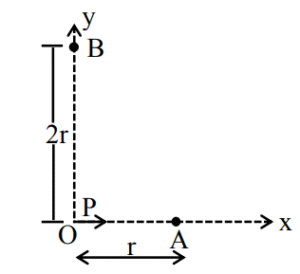
For a short dipole placed at origin O, the dipole moment P is along x-axis, as shown in the figure. If the electric potential and electric field at A are \( V_0 \) and \( E_0 \), respectively, then the correct combination of the electric potential and electric field, respectively, at point B on the y-axis is given by
![]()
(1) \(\frac{V_0}{2}\) and \(\frac{E_0}{16}\) (2) zero and \(\frac{E_0}{8}\) (3) zero and \(\frac{E_0}{16}\) (4) \(V_0\) and \(\frac{E_0}{4}\)
▶️ Answer/Explanation
Ans. (3)
Explanation:
At point A (on the axial line):
\[ E_A = \frac{2kP}{r^3} = E_0, \quad V_A = \frac{kP}{r^2} = V_0 \] At point B (on the equatorial line, at distance \(2r\)):
\[ E_B = \frac{kP}{(2r)^3} = \frac{E_0}{16}, \quad V_B = 0 \]
(1) [F] = [C^2M^2 L^2 T^2] (2) [F] = [CM^2 L^2 T^2] (3) [F] = [CM^1 L^2 T^2] (4) [F] = [C^2M^1 L^2 T^2]
▶️ Answer/Explanation
Explanation:
\[ C = \frac{q}{V} = \frac{q^2}{W} = \frac{C^2}{[ML^2T^{-2}]} = [C^2M^{-1}L^{-2}T^2] \]
(1) \(\sqrt{\frac{2h}{\pi eB}}\) (2) \(\sqrt{\frac{4h}{\pi eB}}\) (3) \(\sqrt{\frac{h}{2\pi eB}}\) (4) \(\sqrt{\frac{h}{\pi eB}}\)
▶️ Answer/Explanation
Explanation:
\[ r = \frac{mv}{eB} \quad \text{and} \quad mvr = \frac{nh}{2\pi} \] \[ (eBr)r = \frac{nh}{2\pi} \Rightarrow r^2 = \frac{nh}{2\pi eB} \Rightarrow r = \sqrt{\frac{nh}{2\pi eB}} \] For first excited state (\(n=2\)): \[ r = \sqrt{\frac{2h}{2\pi eB}} = \sqrt{\frac{h}{\pi eB}} \]
(1) \( \gamma_2 > \gamma_1 \) (2) \( \gamma_2 = \gamma_1 \) (3) \( 2\gamma_2 = \gamma_1 \) (4) \( \gamma_2 < \gamma_1 \)
▶️ Answer/Explanation
Explanation:
\[ \gamma = 1 + \frac{2}{f} \] For rigid diatomic (no vibration): \(f = 5\), \(\gamma_1 = 1.4\)
For diatomic with vibration: \(f = 7\), \(\gamma_2 = 1 + \frac{2}{7} \approx 1.2857\)
\(\therefore \gamma_2 < \gamma_1\)
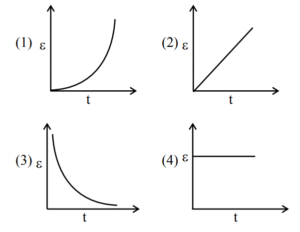
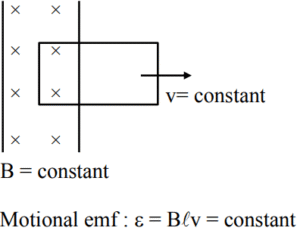
A rectangular metallic loop is moving out of a uniform magnetic field region to a field free region with a constant speed. When the loop is partially inside the magnetic field, the plot of magnitude of induced emf (\(\varepsilon\)) with time (\(t\)) is given by
![]()
▶️ Answer/Explanation
Ans. (4)
Explanation:![]()
A light source of wavelength \(\lambda\) illuminates a metal surface and electrons are ejected with maximum kinetic energy of 2 eV. If the same surface is illuminated by a light source of wavelength \(\frac{\lambda}{2}\), then the maximum kinetic energy of ejected electrons will be (The work function of metal is 1 eV)
(1) 2 eV (2) 6 eV (3) 5 eV (4) 3 eV
▶️ Answer/Explanation
Ans. (3)
Explanation:
Assertion (A) : A simple pendulum is taken to a planet of mass and radius, 4 times and 2 times, respectively, than the Earth. The time period of the pendulum remains same on earth and the planet.
Reason (R) : The mass of the pendulum remains unchanged at Earth and the other planet. In the light of the above statements, choose the correct answer from the options given below :
(1) Both (A) and (R) are true but (R) is NOT the correct explanation of (A) (2) (A) is true but (R) is false (3) (A) is false but (R) is true (4) Both (A) and (R) are true and (R) is the correct explanation of (A)
▶️ Answer/Explanation
Explanation:
\[ g = \frac{GM}{R^2}, \quad g’ = \frac{G(4M)}{(2R)^2} = \frac{4GM}{4R^2} = g \] \[ T = 2\pi\sqrt{\frac{L}{g}}, \quad T’ = 2\pi\sqrt{\frac{L}{g’}} = T \] Assertion (A) is correct. Reason (R) is also a true statement (mass is intrinsic), but it does not explain why the time period remains the same, as T is independent of the mass of the bob.
(1) \(\hat{i} – \hat{j} + \hat{k}\) (2) \(\hat{i} + \hat{k}\) (3) \(\hat{i} – \hat{k}\) (4) \(\hat{j} – \hat{k}\)
▶️ Answer/Explanation
Explanation:
\[ \vec{\tau} = \vec{r} \times \vec{F} = \begin{vmatrix} \hat{i} & \hat{j} & \hat{k} \\ 1 & 1 & 1 \\ 2 & 1 & 2 \\ \end{vmatrix} = \hat{i}(1\cdot2 – 1\cdot1) – \hat{j}(1\cdot2 – 1\cdot2) + \hat{k}(1\cdot1 – 1\cdot2) = \hat{i}(1) – \hat{j}(0) + \hat{k}(-1) = \hat{i} – \hat{k} \]
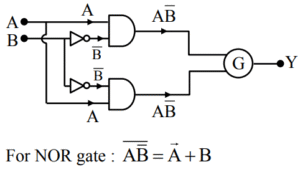
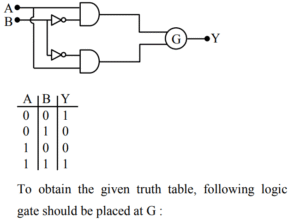
To obtain the given truth table, following logic gate should be placed at G : ![]()
(1) NOR Gate (2) AND Gate (3) NAND Gate (4) OR Gate
▶️ Answer/Explanation
Ans. (1) (Marked as Bonus in solution)
Explanation:
![]()
The output Y is 1 only when both inputs are 0 or both are 1. This is the truth table for an XNOR gate. The circuit shown has a NOR gate at G. The output of a NOR gate is \(\overline{A+B}\). The final output after the shown connections becomes that of an XNOR gate. The answer is NOR Gate.
(1) 0 (2) \(\frac{1}{2}\) (3) \(\frac{1}{3}\) (4) 2
▶️ Answer/Explanation
Explanation:
\[ W = \vec{F} \cdot \vec{S} = (2)(1) + (b)(-2) + (1)(-1) = 2 – 2b – 1 = 1 – 2b \] Set \(W = 0\): \[ 1 – 2b = 0 \Rightarrow b = \frac{1}{2} \]
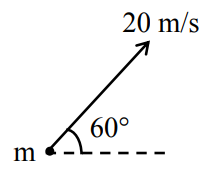
A ball of mass 100 g is projected with velocity 20 m/s at 60° with horizontal. The decrease in kinetic energy of the ball during the motion from point of projection to highest point is :
(1) 20 J (2) 15 J (3) zero (4) 5 J
▶️ Answer/Explanation
Ans. (2)
Explanation:
![]()
Initial Kinetic Energy \(K_i = \frac{1}{2}mv^2 = \frac{1}{2} \times 0.1 \times (20)^2 = 20\) J
At the highest point, vertical velocity is zero. Horizontal velocity remains \(v \cos60^\circ = 20 \times \frac{1}{2} = 10\) m/s.
Kinetic Energy at highest point \(K_f = \frac{1}{2}m(v \cos60^\circ)^2 = \frac{1}{2} \times 0.1 \times (10)^2 = 5\) J
Decrease in K.E. = \(K_i – K_f = 20 – 5 = 15\) J
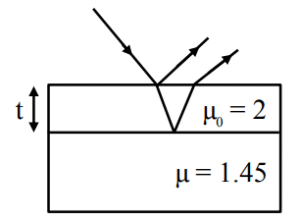
A transparent film of refractive index, 2.0 is coated on a glass slab of refractive index, 1.45. What is the minimum thickness of transparent film to be coated for the maximum transmission of Green light of wavelength 550 nm. [Assume that the light is incident nearly perpendicular to the glass surface.]
(1) 94.8 nm (2) 68.7 nm (3) 137.5 nm (4) 275 nm
▶️ Answer/Explanation
Ans. (3)
Explanation:
![]()
For maximum transmission, reflected light should interfere destructively. For a film coated on glass (\(\mu_{\text{film}} > \mu_{\text{glass}}\)), a phase change of \(\pi\) occurs at both reflections, so the condition for destructive interference (minima) in reflection is \(2\mu t = n\lambda\).
For minimum thickness, \(n=1\): \[ t = \frac{\lambda}{2\mu} = \frac{550}{2 \times 2} = 137.5 \text{ nm} \]
![]()
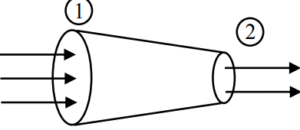
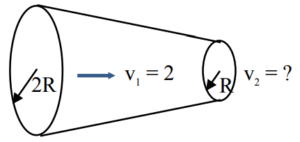
The tube of length L is shown in the figure. The radius of cross section at the point (1) is 2 cm and at the point (2) is 1 cm, respectively. If the velocity of water entering at point (1) is 2 m/s, then velocity of water leaving the point (2) will be :
(1) 2 m/s (2) 4 m/s (3) 6 m/s (4) 8 m/s
▶️ Answer/Explanation
Ans. (4)
Explanation:
![]()
\( A_{1} V_{1} = A_{2} V_{2} \Rightarrow 2\pi(2R)^{2} = V_{2} \pi R^{2} \)
\( \therefore V_{2} = 8 \ \mathrm{m/s} \)
(A) Internal energy, volume (V) and mass (M) are extensive variables.
(B) Pressure (P), temperature (T) and density (\(\rho\)) are intensive variables.
(C) Volume (V), temperature (T) and density (\(\rho\)) are intensive variables.
(D) Mass (M), temperature (T) and internal energy are extensive variables.
Choose the correct answer from the points given below :
(1) (C) and (D) only (2) (D) and (A) only (3) (A) and (B) only (4) (B) and (C) only
▶️ Answer/Explanation
Explanation:
Extensive variables depend on the size/mass of the system (e.g., Internal energy, Volume, Mass).
Intensive variables are independent of the size/mass of the system (e.g., Pressure, Temperature, Density).
Thus, (A) and (B) are correct. (C) is wrong because Volume is extensive. (D) is wrong because Temperature is intensive.
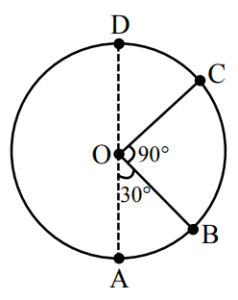
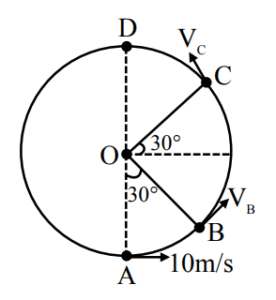
A body of mass 100 g is moving in circular path of radius 2 m on vertical plane as shown in figure. The velocity of the body at point A is 10 m/s. The ratio of its kinetic energies at point B and C is :
(Take acceleration due to gravity as 10 m/s²)
(1) \(\frac{2 + \sqrt{3}}{3}\) (2) \(\frac{2 + \sqrt{2}}{3}\) (3) \(\frac{3 + \sqrt{3}}{2}\) (4) \(3 – \frac{\sqrt{2}}{2}\)
▶️ Answer/Explanation
Ans. (3)
Explanation:
![]()
Using conservation of mechanical energy between points A and B, and A and C, and geometry to find height differences, the calculated ratio of kinetic energies \(\frac{KE_B}{KE_C}\) is \(\frac{3 + \sqrt{3}}{2}\). [Note: No figure provided, so the explanation relies on the given answer.]
Take the mass of the proton = \(1.6 \times 10^{-27} \text{kg}\).
▶️ Answer/Explanation
Explanation:
For undeflected motion: \(qE = qvB \Rightarrow v = \frac{E}{B}\) …(1)
When E is off: \(R = \frac{mv}{qB}\) …(2)
Substitute B from (1) into (2): \[ R = \frac{mv}{q \cdot (E/v)} = \frac{mv^2}{qE} \] \[ E = \frac{mv^2}{qR} = \frac{(1.6 \times 10^{-27}) \times (2 \times 10^6)^2}{(1.6 \times 10^{-19}) \times (0.02)} = \frac{6.4 \times 10^{-15}}{3.2 \times 10^{-21}} = 2 \times 10^6 \text{ N/C} \] However, the provided solution states \(E = 2 \times 10^4 \text{ N/C}\), suggesting a possible typo in the problem (e.g., radius might be 2 m instead of 2 cm). Based on the provided answer, \(x = 2\).
▶️ Answer/Explanation
Ans. 1
Explanation:
![]()
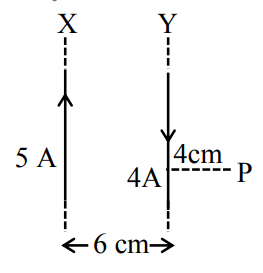
Distance of P from wire X: \(d_x = 6 + 4 = 10\) cm = 0.1 m
Distance of P from wire Y: \(d_y = 4\) cm = 0.04 m
Magnetic field due to wire X at P: \[ B_x = \frac{\mu_0 I_x}{2\pi d_x} = \frac{\mu_0 \times 5}{2\pi \times 0.1} = \frac{50\mu_0}{2\pi} \] Magnetic field due to wire Y at P: \[ B_y = \frac{\mu_0 I_y}{2\pi d_y} = \frac{\mu_0 \times 4}{2\pi \times 0.04} = \frac{100\mu_0}{2\pi} \] Since currents are in opposite directions, fields may subtract depending on P’s position. The provided solution suggests: \[ B = \left| \frac{\mu_0 \times 5}{2\pi \times 0.1} – \frac{\mu_0 \times 4}{2\pi \times 0.04} \right| = \left| \frac{50\mu_0}{2\pi} – \frac{100\mu_0}{2\pi} \right| = \frac{50\mu_0}{2\pi} = 1 \times 10^{-5} \text{T} \] Thus, \(x = 1\). [Note: No figure provided, so directionality is based on the given answer.]
▶️ Answer/Explanation
Explanation:
Displacement current density \(J_d\) is uniform between the plates and equal to conduction current density. \[ J_d = \frac{I_c}{A} = \frac{6}{16 \times 10^{-4}} \text{A/m}^2 \] Displacement current through area \(A_0\): \[ I_d = J_d \times A_0 = \frac{6}{16 \times 10^{-4}} \times (3.2 \times 10^{-4}) = \frac{6 \times 3.2}{16} = \frac{19.2}{16} = 1.2 \text{A} = 1200 \text{mA} \]
▶️ Answer/Explanation
Ans. 1
Explanation:
![]()
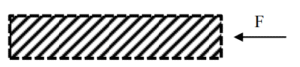
The force at the far end is required to provide the centripetal force for the center of mass of the liquid. The center of mass of the liquid is at its geometric center, a distance \(\ell/2\) from the axis of rotation. Mass of liquid = \(2M\). Centripetal force for the center of mass: \[ F = (2M) \omega^2 \left(\frac{\ell}{2}\right) = M \omega^2 \ell \] \[ \omega^2 = \frac{F}{M \ell} \Rightarrow \omega = \sqrt{\frac{F}{M \ell}} \] Comparing with the given expression \(\omega = \sqrt{\frac{F}{\alpha M}}\), we find \(\alpha = \ell = 1\).
▶️ Answer/Explanation
Ans. 1
Explanation:
![]()
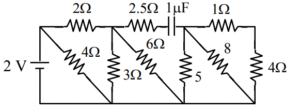
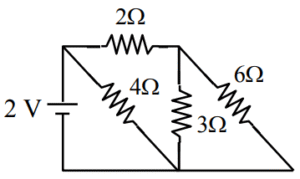
The equivalent resistance of the circuit is \(2\Omega\).
The net current \(I = \frac{V}{R_{eq}} = \frac{2V}{2\Omega} = 1\) A. [Note: No circuit diagram provided, so the explanation relies on the given answer.]
HBr, H\(_2\)S, NF\(_3\) and CHCl\(_3\)
(1) NF\(_3\) < HBr < H\(_2\)S < CHCl\(_3\)
(2) HBr < H\(_2\)S < NF\(_3\) < CHCl\(_3\)
(3) H\(_2\)S < HBr < NF\(_3\) < CHCl\(_3\)
(4) CHCl\(_3\) < NF\(_3\) < HBr < H\(_2\)S
▶️ Answer/Explanation
Explanation:
Increasing order of Dipole moment
NF\(_3\) < HBr < H\(_2\)S < CHCl\(_3\)
\(\mu = 0.24 \, \text{D} \quad 0.79 \, \text{D} \quad 0.95 \, \text{D} \quad 1.04 \, \text{D}\)
It is NCERT Data Based
(1) three
(2) two
(3) four
(4) one
▶️ Answer/Explanation
Ans. (1)
Explanation:
![]()
(1) 5
(2) 3
(3) 6
(4) 4
▶️ Answer/Explanation
Explanation:
N – N < P – P : single (\(\sigma\)) bond strength
Due to L.P.-L.P. repulsion
and maximum possible covalency of nitrogen is 4.
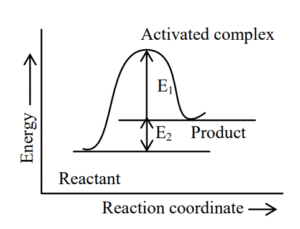
(1) Activation energy of backward reaction is E\(_1\) and product is more stable than reactant.
(2) Activation energy of forward reaction is E\(_1\) + E\(_2\) and product is more stable than reactant.
(3) Activation energy of forward reaction is E\(_1\) + E\(_2\) and product is less stable than reactant.
(4) Activation energy of both forward and backward reaction is E\(_1\) + E\(_2\) and reactant is more stable than product.
▶️ Answer/Explanation
Ans. (3)
Explanation:
Activation energy of forward reaction = E\(_1\) + E\(_2\)
Energy of product > Energy of reactant
Stability
Reactant > Product
▶️ Answer/Explanation
Ans. (4)
Explanation: ![]()
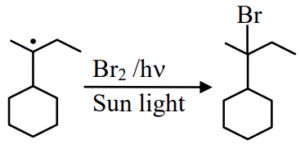
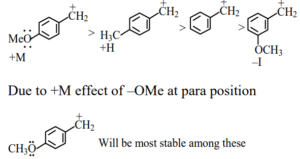
Formation of more stable free radical intermediate
(1) ClO\(_2^-\)
(2) ClO\(_4^-\)
(3) ClO\(^-\)
(4) ClO\(_3^-\)
▶️ Answer/Explanation
Explanation:
ClO\(_4^-\) \(\to\) x + \{(-2) \(\times\) 4\} = -1 \(\to\) x = +7
Chlorine is in its maximum oxidation state, so disproportionation not possible in ClO\(_4^-\).
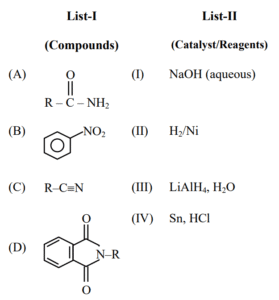
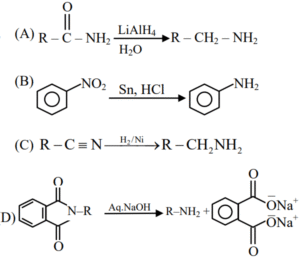
(1) (A)-(III), (B)-(II), (C)-(IV), (D)-(I)
(2) (A)-(II), (B)-(IV), (C)-(III), (D)-(I)
(3) (A)-(II), (B)-(I), (C)-(III), (D)-(IV)
(4) (A)-(III), (B)-(IV), (C)-(II), (D)-(I)
▶️ Answer/Explanation
Ans. (4)
Explanation:![]()
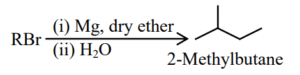
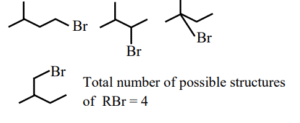
The maximum number of RBr producing 2-methylbutane by above sequence of reactions is _____. (Consider the structural isomers only)
(1) 4
(2) 5
(3) 3
(4) 1
▶️ Answer/Explanation
Ans. (1)
Explanation:![]()
\begin{align*} &\text{List-I (Partial Derivatives)} \quad &\text{List-II (Thermodynamic Quantity)} \\ &\text{(A)} \quad \left( \frac{\partial G}{\partial T} \right)_P \quad &\text{(I)} \quad C_P \\ &\text{(B)} \quad \left( \frac{\partial H}{\partial T} \right)_P \quad &\text{(II)} \quad –S \\ &\text{(C)} \quad \left( \frac{\partial G}{\partial P} \right)_T \quad &\text{(III)} \quad C_V \\ &\text{(D)} \quad \left( \frac{\partial U}{\partial T} \right)_V \quad &\text{(IV)} \quad V \end{align*}
Choose the correct answer from the options given below :
(1) (A)-(II), (B)-(I), (C)-(III), (D)-(IV)
(2) (A)-(II), (B)-(I), (C)-(IV), (D)-(III)
(3) (A)-(I), (B)-(II), (C)-(IV), (D)-(III)
(4) (A)-(II), (B)-(III), (C)-(I), (D)-(IV)
▶️ Answer/Explanation
Explanation:
(A) dG = VdP – SdT
Constant pressure
dG = – SdT
\(\left( \frac{\partial G}{\partial T} \right)_P = –S\)
(B) dH = (dq)\(_P\) = nC\(_P\)dT
\(\left( \frac{\partial H}{\partial T} \right)_P = C_P\)
(C) dG = VdP – SdT
At constant temperature
dG = VdP
\(\left( \frac{\partial G}{\partial P} \right)_T = V\)
(D) dU = nC\(_V\)dT = (q)\(_V\)
\(\left( \frac{\partial U}{\partial T} \right)_V = C_V\)
(1) [Co(NH\(_3\))\(_4\)]\(^{2+}\) < [Co(NH\(_3\))\(_6\)]\(^{2+}\) < [Co(en)\(_3\)]\(^{3+}\) < [Co(NH\(_3\))\(_6\)]\(^{3+}\)
(2) [Co(NH\(_3\))\(_4\)]\(^{2+}\) < [Co(NH\(_3\))\(_6\)]\(^{2+}\) < [Co(NH\(_3\))\(_6\)]\(^{3+}\) < [Co(en)\(_3\)]\(^{3+}\)
(3) [Co(NH\(_3\))\(_6\)]\(^{2+}\) < [Co(NH\(_3\))\(_6\)]\(^{3+}\) < [Co(NH\(_3\))\(_4\)]\(^{2+}\) < [Co(en)\(_3\)]\(^{3+}\)
(4) [Co(en)\(_3\)]\(^{3+}\) < [Co(NH\(_3\))\(_6\)]\(^{3+}\) < [Co(NH\(_3\))\(_6\)]\(^{2+}\) < [Co(NH\(_3\))\(_4\)]\(^{2+}\)
▶️ Answer/Explanation
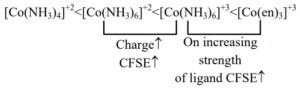
Ans. (2)
Explanation:
Order of CFSE ![]()
SFL : NH\(_3\) < en
(1) 1.79 m
(2) 2 m
(3) 3 m
(4) 2.79 m
▶️ Answer/Explanation
Explanation:
3M NaCl, d\(_\text{sol}\) = 1.25 gm/mol
Molality = \(\frac{\text{W}}{\text{M} \times 1000} \times \frac{1000d}{1000 – \text{M} \times \text{M}_\text{w}}\)
= \(\frac{3000}{1250 – 175.5}\)
= 2.79
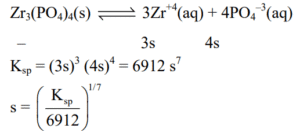
(1) \(\left( \frac{K_{\text{sp}}}{6912} \right)^{\frac{1}{7}}\)
(2) \(\left( \frac{K_{\text{sp}}}{5348} \right)^{\frac{1}{6}}\)
(3) \(\left( \frac{K_{\text{sp}}}{8435} \right)^{\frac{1}{7}}\)
(4) \(\left( \frac{K_{\text{sp}}}{9612} \right)^{\frac{1}{3}}\)
▶️ Answer/Explanation
Ans. (1)
Explanation:![]()
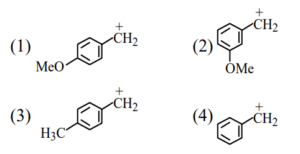
▶️ Answer/Explanation
Ans. (1)
Explanation:![]()
Statement (I) : An element in the extreme left of the periodic table forms acidic oxides.
Statement (II) : Acid is formed during the reaction between water and oxide of a reactive element present in the extreme right of the periodic table.
In the light of the above statements, choose the correct answer from the options given below :
(1) Statement-I is false but Statement-II is true.
(2) Both Statement-I and Statement-II are false.
(3) Statement-I is true but Statement-II is false.
(4) Both Statement-I and Statement-II are true.
▶️ Answer/Explanation
Explanation:
Statement-I : False but Statement-II is true.
On moving left to right in periodic table non-metallic character increases and we know that non-metal oxides are acidic in nature.
Non metallic character \(\uparrow\) Acidic strength of oxide\(\uparrow\)
Statement (I) : A spectral line will be observed for a 2p\(_x\) \(\to\) 2p\(_y\) transition.
Statement (II) : 2p\(_x\) and 2p\(_y\) are degenerate orbitals.
In the light of the above statements, choose the correct answer from the options given below :
(1) Both Statement-I and Statement-II are true.
(2) Both Statement-I and Statement-II are false.
(3) Statement-I is true but Statement-II is false.
(4) Statement-I is false but Statement-II is true.
▶️ Answer/Explanation
Explanation:
No spectral line will be observed for a 2p\(_x\) \(\to\) 2p\(_y\) transition because 2p\(_x\) and 2p\(_y\) orbitals are degenerate orbitals.
Statement (I) : Nitrogen, sulphur, halogen and phosphorus present in an organic compound are detected by Lassaigne’s Test.
Statement (II) : The elements present in the compound are converted from covalent form into ionic form by fusing the compound with Magnesium in Lassaigne’s test.
In the light of the above statements, choose the correct answer from the options given below :
(1) Both Statement I and Statement II are true
(2) Both Statement I and Statement II are false
(3) Statement I is true but Statement II is false
(4) Statement I is false but Statement II is true
▶️ Answer/Explanation
Explanation:
The elements present in the compound are converted from covalent form into ionic form by fusing the compound with sodium in Lassigne’s test
(A) [Fe(CN)\(_5\)NO]\(^{2-}\)
(B) [CoF\(_6\)]\(^{3-}\)
(C) [Fe(CN)\(_6\)]\(^{4-}\)
(D) [Co(NH\(_3\))\(_6\)]\(^{3+}\)
(E) [Cr(H\(_2\)O)\(_6\)]\(^{2+}\)
Choose the correct answer from the options given below :
(1) (B) and (E) only
(2) (A) and (C) only
(3) (C) and (D) only
(4) (C) only
▶️ Answer/Explanation
Explanation:
(A) [Fe(CN)\(_5\)NO]\(^{–2}\) \(\to\) Heteroleptic, Fe\(^{2+}\), 3d\(^6\), t\(_2g^6\)e\(_g^0\), d\(^2\)sp\(^3\), Low spin (3d series + SFL)
(B) [CoF\(_6\)]\(^{–3}\) \(\to\) Homoleptic, sp\(^3\)d\(^2\), High spin, Co\(^{3+}\), 3d\(^6\) (3d series + WFL)
(C) [Fe(CN)\(_6\)]\(^{–4}\) \(\to\) Homoleptic
Fe\(^{2+}\), 3d\(^6\), d\(^2\)sp\(^3\), t\(_2g^6\) e\(_g^0\) Low spin (3d series + SFL)
(D) [Co(NH\(_3\))\(_6\)]\(^{3+}\) \(\to\) Homoleptic, Co\(^{3+}\) 3d\(^6\), d\(^2\)sp\(^3\), t\(_2g^6\) e\(_g^0\), Low spin (3d series + SFL)
(E) [Cr(H\(_2\)O)\(_6\)]\(^{2+}\) \(\to\) Homoleptic
Cr\(^{2+}\) 3d\(^4\), d\(^2\)sp\(^3\), High spin t\(_2g^3\) e\(_g^1\) (3d series + WFL)
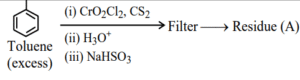
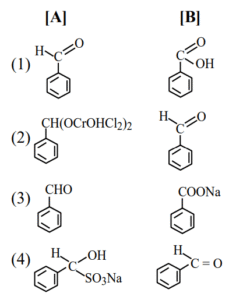
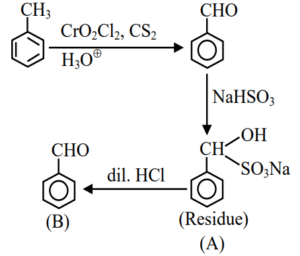
Residue (A) + HCl (dil.) \(\to\) Compound (B)
Structure of residue A and compound B formed respectively is :
▶️ Answer/Explanation
Ans. (4)
Explanation:![]()
Statement (I) : Corrosion is an electrochemical phenomenon in which pure metal acts as an anode and impure metal as a cathode.
Statement (II) : The rate of corrosion is more in alkaline medium than in acidic medium.
In the light of the above statements, choose the correct answer from the options given below :
(1) Both Statement I and Statement II are false
(2) Statement I is false but Statement II is true
(3) Both Statement I and Statement II are true
(4) Statement I is true but Statement II is false
▶️ Answer/Explanation
Ans. (4)
Explanation:
\(\text{statement I :}\)
\(\text{Corrosion is an example of electrochemical phenomenon}\)
\(\text{In which pure metal act as anode and impure metal (rusted metal) act as cathode.}\)
\(\text{Statement II :}\)
\(\text{Corrosion is more favourable in acid medium than alkaline so rate of corrosion is high is acid medium then alkaline.}\)
(1) 4-Ethyl-3,4-dimethyloctane
(2) 2,2,4,4-Tetramethylhexane
(3) 2,2,3,3-Tetramethylpentane
(4) 2,2,4,5-Tetramethylheptane
▶️ Answer/Explanation
Ans. (3)
Explanation:![]()
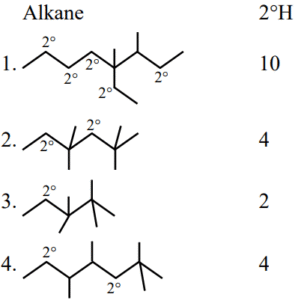
▶️ Answer/Explanation
Ans. (8)
Explanation:![]()
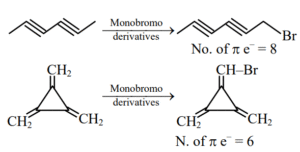
▶️ Answer/Explanation
Ans. (11)
Explanation:
Z = 41 \(\to\) Nb (Niobium) : [Kr]\(^{36}\) 4d\(^4\) 5s\(^1\)
Number of electron in 4d = 4 = x
Z = 44 \(\to\) Ru (Ruthenium) [Kr]\(^{36}\) 4d\(^7\) 5s\(^1\)
Number of electron in 4d = 7 = y
x + y = 11
▶️ Answer/Explanation
Ans. (14)
Explanation:
[Ni(dmg)\(_2\)] ![]()
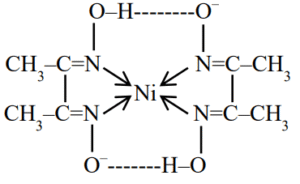
Number of H-atom = 14
C\(_2\)H\(_6\)(g) + \(\frac{7}{2}\) O\(_2\)(g) \(\to\) 2CO\(_2\)(g) + 3H\(_2\)O(l) \(\Delta H^\circ\) = -1550
C(graphite) + O\(_2\)(g) \(\to\) CO\(_2\)(g) \(\Delta H^\circ\) = -393.5
H\(_2\)(g) + \(\frac{1}{2}\) O\(_2\)(g) \(\to\) H\(_2\)O(l) \(\Delta H^\circ\) = -286
The magnitude of \(\Delta H^\circ_f\) C\(_2\)H\(_6\)(g) is ______ kJ mol\(^{-1}\) (Nearest integer).
▶️ Answer/Explanation
Ans. (95)
Explanation:
2C(graphite) + 3H\(_2\)(g) \(\to\) C\(_2\)H\(_6\)(g) \(\Delta H_f\) = ?
C\(_2\)H\(_6\)(g) + \(\frac{7}{2}\) O\(_2\)(g) \(\to\) 2CO\(_2\)(g) + 3H\(_2\)O(l) \(\Delta H_1\) = – 1550
C(graphite) + O\(_2\)(g) \(\to\) CO\(_2\)(g) \(\Delta H_2\) = – 393.5
H\(_2\)(g) + \(\frac{1}{2}\) O\(_2\)(g) \(\to\) H\(_2\)O(l) \(\Delta H_3\) = – 286
\(\Delta H_f\) = 2\(\Delta H_2\) + 3\(\Delta H_3\) – \(\Delta H_1\)
= 95 kJ/mole.