
Chemistry Section-A
Question 1
(Atomic mass : Cl = 35.5 amu, H = 1 amu)
(B) 12.5 M
(C) 14.0 M
(D) 18.2 M
▶️ Answer/Explanation
Let total volume = 1000 mL = 1L
Total mass of solution = 1460 g
Mass of HCl = \( \frac{35}{100} \times 1460 \) g
Moles of HCl = \( \frac{35 \times 1460}{100 \times 36.5} \)
So molarity = \( \frac{35 \times 1460}{100 \times 36.5} = 14 \text{ M} \)
✅ Answer: (C)
Question 2
(Given : R = 0.082 L atm K–1 mol–1)
(B) 50
(C) 75
(D) 125
▶️ Answer/Explanation
Mass of liquid = 135 – 40 = 95 g
Volume of liquid = \( \frac{95}{0.95} \) mL = 100 mL = 0.1 L
Mass of ideal gas = 40.5 – 40 = 0.5 g
Using PV = nRT:
\( 0.82 \times 0.1 = \frac{0.5}{M} \times 0.082 \times 250 \)
Solving for M: M = 125
✅ Answer: (D)
Question 3
(B) \( \frac{r_4}{r_3} = \frac{16}{9} \)
(C) \( \frac{r_4}{r_3} = \frac{3}{4} \)
(D) \( \frac{r_4}{r_3} = \frac{4}{3} \)
▶️ Answer/Explanation
Radius formula: \( r = \frac{n^2}{z} \times 0.529 \) Å
\( r_3 = 0.529 \times \frac{3^2}{1} \)
\( r_4 = 0.529 \times \frac{4^2}{1} \)
\( \frac{r_4}{r_3} = \frac{4^2}{3^2} = \frac{16r_2}{9} \)
✅ Answer: (B)
Question 4
For increasing bond order the correct option is :
(B) O2– < O22– < O2 < O2+
(C) O2– < O22– < O2+ < O2
(D) O2– < O2+ < O22– < O2
▶️ Answer/Explanation
| ion/molecule | Number of e⁻ in BMO | Number of e⁻ in ABMO | Bond order |
|---|---|---|---|
| O₂⁺ | 10 | 5 | 2.5 |
| O₂ | 10 | 6 | 2 |
| O₂⁻ | 10 | 7 | 1.5 |
| O₂²⁻ | 10 | 8 | 1 |
Bond order \( O_2^{2-} < O_2^- < O_2 < O_2^+ \)
✅ Answer: (A)
Question 5
A: \( 1 \times 10^{-4} \), B: \( 2 \times 10^{-4} \), C: \( 0.1 \times 10^{-4} \), D: \( 0.2 \times 10^{-4} \)
(Where E is the electromotive force)
Which of the above half cells would be preferred to be used as reference electrode?
(B) B
(C) C
(D) D
▶️ Answer/Explanation
A cell with less variation in EMF with temperature is preferred as reference electrode because it can be used for wider range of temperature without much derivation from standard value so a cell with less \( \left( \frac{\partial E}{\partial T} \right)_P \) is preferred.
✅ Answer: (C)
Question 6
(B) Tl < In < Ga < Al
(C) Al < Ga < Tl < In
(D) Al < Tl < Ga < In
▶️ Answer/Explanation
Moving down the group stability of lower oxidation state increases: Al < Ga < In < Tl
✅ Answer: (A)
Question 7
Statement I : According to the Ellingham diagram, any metal oxide with higher ΔG° is more stable than the one with lower ΔG°.
Statement II : The metal involved in the formation of oxide placed lower in the Ellingham diagram can reduce the oxide of a metal placed higher in the diagram.
In the light of the above statements, choose the most appropriate answer from the options given below:
(B) Both Statement I and Statement II are incorrect.
(C) Statement I is correct but Statement II is incorrect.
(D) Statement I is incorrect but Statement II is correct.
▶️ Answer/Explanation
Metal oxide with lower ΔG° is more stable. Statement I is incorrect.
Statement II is correct: The metal involved in the formation of oxide placed lower in the Ellingham diagram can reduce the oxide of a metal placed higher in the diagram.
✅ Answer: (D)
Question 8

(B) 111.5°
(C) 90.2°
(D) 111.0°
▶️ Answer/Explanation

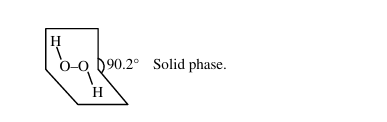
✅ Answer: (C)
Question 9
(B) Sr > Ca > Mg > Be
(C) Be > Ca > Mg > Sr
(D) Be > Ca > Sr > Mg
▶️ Answer/Explanation
Melting points:
Be: 1560 K
Mg: 924 K
Ca: 1124 K
Sr: 1062 K
Order: Be > Ca > Sr > Mg
✅ Answer: (D)
Question 10
(B) H2O < H2S < H2Se < H2Te
(C) H2S < H2Te < H2Se < H2O
(D) H2Se < H2S < H2Te < H2O
▶️ Answer/Explanation
Melting points:
H2O: 273 K
H2S: 188 K
H2Se: 208 K
H2Te: 222 K
Order: H2S < H2Se < H2Te < H2O
✅ Answer: (A)
Question 11
A + alkali → B (Major Product)
If B is an oxoacid of phosphorus with no P–H bond, then A is:
(B) Red P4
(C) P2O3
(D) H3PO3
▶️ Answer/Explanation
Red P4 + Alkali → H4P2O6 (No P–H bond)
✅ Answer: (B)
Question 12
(B) HOCl
(C) ClO
(D) CH4
▶️ Answer/Explanation
Polar stratospheric clouds provide surface on which hydrolysis of CIONO2 takes place to form HOCl (Hypochlorous acid)
CIONO2 (g) + H2O(g) → HOCl(g) + HNO3(g)
✅ Answer: (B)
Question 13
Statement I : In ‘Lassaigne’s Test, when both nitrogen and sulphur are present in an organic compound, sodium thiocyanate is formed.
Statement II : If both nitrogen and sulphur are present in an organic compound, then the excess of sodium used in sodium fusion will decompose the sodium thiocyanate formed to give NaCN and Na2S.
In the light of the above statements, choose the most appropriate answer from the options given below:
(B) Both Statement I and Statement II are incorrect.
(C) Statement I is correct but Statement II is incorrect.
(D) Statement I is incorrect but Statement II is correct.
▶️ Answer/Explanation
Both statement I & statement II are correct.
✅ Answer: (A)
Question 14
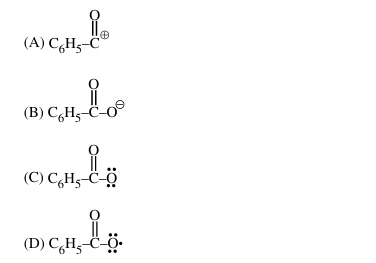
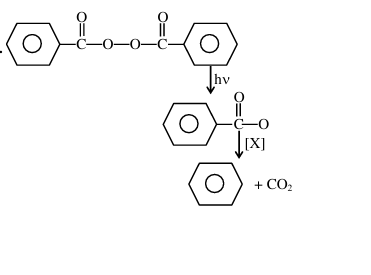
Consider the above reaction and identify the intermediate ‘X’
▶️ Answer/Explanation
✅ Answer: (D)
Question 15
▶️ Answer/Explanation
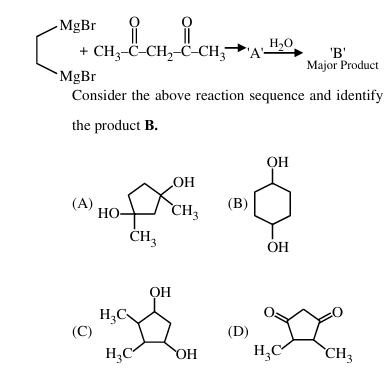
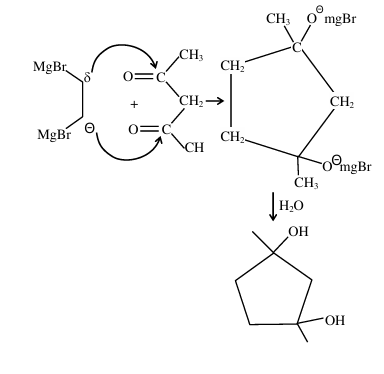
Although Acetyl Acetone predominantly gives Acid base reaction with G.R due to Active methylene group but according to given option ans should be based on nucleophilic addition reaction (NAR).
✅ Answer: (A)
Question 16
▶️ Answer/Explanation
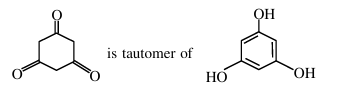
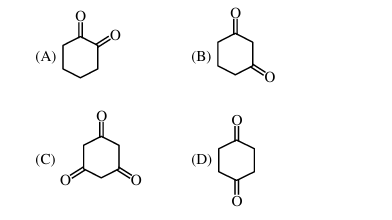
Which is aromatic in nature.
✅ Answer: (C)
Question 17
▶️ Answer/Explanation
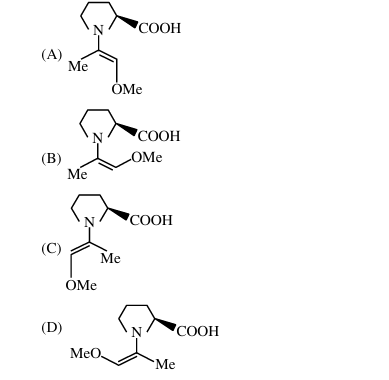
All these enamines are interconvertible through their resonating structures. So most stable form is ‘C’ due to steric factor.
✅ Answer: (C)
Question 18
(A) Copolymer : Buna–S
(B) Condensation polymer : Nylon–6,6
(C) Fibre : Nylon–6,6
(D) Thermosetting polymer : Terylene
(E) Homopolymer : Buna–N
Choose the correct answer from given options below:
(A) (A), (B) and (C) are correct
(B) (B), (C) and (D) are correct
(C) (A), (C) and (E) are correct
(D) (A), (B) and (D) are correct
▶️ Answer/Explanation
Buna-S is a copolymer of butadiene and styrene. Nylon-6,6 is a condensation polymer of adipic acid and hexamethylenediamine. Nylon-6,6 is a fiber. Terylene is a fiber, not a thermosetting polymer. Buna-N is a copolymer, not a homopolymer.
✅ Answer: (A)
Question 19
(A) Anti histamine
(B) Cimetidine
(C) Histamine
(D) Zantac
▶️ Answer/Explanation
Histamine stimulates the secretion of pepsin and HCl in the stomach.
✅ Answer: (C)
Question 20
(A) A dark brown ring is formed at the junction of two solutions.
(B) Ring is formed due to nitroferrous sulphate complex.
(C) The brown complex is [Fe(H\(_2\)O)\(_5\)(NO)]SO\(_4\).
(D) Heating the nitrate salt with conc. H\(_2\)SO\(_4\), light brown fumes are evolved.
▶️ Answer/Explanation
The brown ring is formed due to the formation of nitrosoferrous sulphate, not nitroferrous sulphate.
✅ Answer: (B)
Section-B
Question 1
(Given : R = 8.3 JK\(^{-1}\) mol\(^{-1}\))
▶️ Answer/Explanation
\(\Delta U = -726 \, \text{kJ/mol}\)
\(\Delta n_g = 1 – \frac{3}{2} = -\frac{1}{2}\)
\(\Delta H = \Delta U + \Delta n_gRT\)
\(= -726 – \frac{1}{2} \times \frac{8.3 \times 300}{1000}\)
\(= -727.245\)
Nearest integer is 727.
✅ Answer: 727
Question 2
(Molal depression constant for water is 1.80 K kg mol\(^{-1}\) and molar mass of KCl is 74.6 g mol\(^{-1}\))
▶️ Answer/Explanation
0.5% solution of KCl means 0.5 g KCl in 100 g solution, so mass of solvent ≈ 99.5 g = 0.0995 kg.
Molality, \(m = \frac{0.5}{74.6} \times \frac{1}{0.0995}\)
\(\Delta T_f = i \times m \times K_f\)
\(0.24 = i \times \frac{0.5}{74.6 \times 0.0995} \times 1.80\)
\(i \approx 1.979\)
For KCl, \(i = 1 + \alpha\)
\(1.979 = 1 + \alpha\)
\(\alpha = 0.979\)
Percentage dissociation = \(97.9\% \approx 98\%\)
✅ Answer: 98
Question 3
(Given : pK\(_a\) (CH\(_3\)COOH) = 4.76)
\(\log 2 = 0.30\), \(\log 3 = 0.48\), \(\log 5 = 0.69\), \(\log 7 = 0.84\), \(\log 11 = 1.04\)
▶️ Answer/Explanation
Moles of CH\(_3\)COOH = \(50 \times 0.1 = 5\) mmol
Moles of NaOH = \(25 \times 0.1 = 2.5\) mmol
After reaction:
CH\(_3\)COOH left = \(5 – 2.5 = 2.5\) mmol
CH\(_3\)COONa formed = 2.5 mmol
This is a buffer solution.
pH = pK\(_a\) + \(\log \frac{[\text{Salt}]}{[\text{Acid}]}\) = 4.76 + \(\log \frac{2.5/75}{2.5/75}\) = 4.76
So, pH = \(476 \times 10^{-2}\)
✅ Answer: 476
Question 4
(Given : ln 2 = 0.693)
▶️ Answer/Explanation
\(k_A = \frac{\ln 2}{100}\), \(k_B = \frac{\ln 2}{50}\)
\(A_t = A_0 e^{-k_A t}\), \(B_t = B_0 e^{-k_B t}\)
Given \(A_0 = B_0\) and \(A_t = 4B_t\)
So, \(A_0 e^{-k_A t} = 4 B_0 e^{-k_B t}\)
\(e^{-k_A t} = 4 e^{-k_B t}\)
\(e^{(k_B – k_A)t} = 4\)
\((\frac{\ln 2}{50} – \frac{\ln 2}{100})t = \ln 4\)
\(\frac{\ln 2}{100}t = 2 \ln 2\)
\(t = 200\) s
✅ Answer: 200
Question 5
(Given : \( R = 0.083 \, \text{L bar K}^{-1} \, \text{mol}^{-1} \))
▶️ Answer/Explanation
Moles of H\(_2\) = \(\frac{2.0}{2} = 1.0\) mol
Volume of H\(_2\) = \(\frac{nRT}{P} = \frac{1.0 \times 0.083 \times 300}{1} = 24.9\) L = 24900 mL
Volume adsorbed per gram of adsorbent = \(\frac{24900}{2.5} = 9960\) mL
✅ Answer: 9960
Question 6
▶️ Answer/Explanation
The most basic oxide is \( V_2O_3 \).
V\(^{3+}\) has electronic configuration [Ar] 3d\(^2\).
Number of unpaired electrons, n = 2.
Spin-only magnetic moment, \(\mu = \sqrt{n(n+2)} = \sqrt{2 \times 4} = \sqrt{8} \approx 2.83\) B.M. ≈ 3 B.M.
✅ Answer: 3
Question 7
▶️ Answer/Explanation
CoCl₃, 4NH₃ → [Co(NH₃)₄ Cl₂]Cl
NiCl₂,6H₂O → [Ni(H₂O)₆]Cl₂
PtCl₄, 2HCl → H₂[PtCl₆]
[Ni(H₂O)₆]Cl₂ → \( ^{2AgNO₃} \) → 2AgCl ↓ + [Ni(H₂O)₆](NO₃)₂
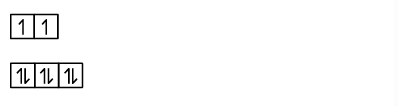
\( \mu = \sqrt{2(2+2)} \text{B.M} = 2.84 \text{B.M} \approx 3 \)
✅ Answer: 3
Question 8
▶️ Answer/Explanation
\( C_xH_YO_z + \left( x + \frac{y}{4} – \frac{z}{2} \right) O_2 \rightarrow xCO_2 + \frac{y}{2} H_2O \) 0.3g 0.2g 0.1g \( \frac{n_{CO_2}}{n_{H_2O}} = \frac{x}{y/2} = \frac{0.2/44}{0.1/18} \) \( \frac{2x}{y} = \frac{36}{44} = \frac{9}{11} \) \( x = \frac{9y}{22} \) \( \frac{n_{C_xH_YO_z}}{n_{CO_2}} = \frac{1}{x} \) \( \frac{0.3}{12x + y + 16z} \times \frac{44}{0.2} = \frac{1}{x} \) 66x = 12x + y + 16z
54x = y + 16z
54 × \(\frac{9y}{22}\) – y = 16z \( \frac{464y}{22} = 16z \)
\( z = \frac{29y}{22} \) \( C_xH_yO_z = C_xH_yO_z \) \( C_{9y}H_yO_{29y} \) \( C_9H_{22}O_{29} \) % of \( C = \frac{12 \times 9}{(12 \times 9 + 22 + 29 \times 16)} \times 100 = \frac{108}{594} \times 100 \) 18.1%
✅ Answer: 18
Question 9
▶️ Answer/Explanation
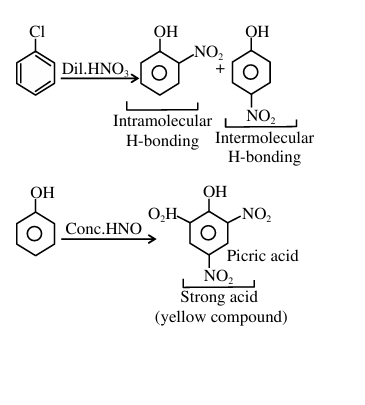
✅ Answer: 7
Question 10
▶️ Answer/Explanation
The base present only in RNA is uracil.
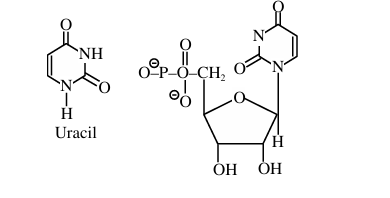
✅ Answer: 9