
Mathematics Section-A
Question 1
(B) \(-\frac{3}{2}\)
(C) \(\frac{7}{12}\)
(D) \(-\frac{11}{12}\)
▶️ Answer/Explanation
\( f(x) = \frac{x-1}{x+1} \)
\( f^2(x) = f(f(x)) = \frac{\frac{x-1}{x+1}-1}{\frac{x-1}{x+1}+1} = -\frac{1}{x} \)
\( f^3(x) = f(f^2(x)) = f\left(-\frac{1}{x}\right) = \frac{-\frac{1}{x}-1}{-\frac{1}{x}+1} = \frac{x+1}{1-x} \)
\( f^4(x) = f(f^3(x)) = f\left(\frac{x+1}{1-x}\right) = \frac{\frac{x+1}{1-x}-1}{\frac{x+1}{1-x}+1} = -\frac{1}{x} \)
So \( f^6(x) = f^4(f^2(x)) = -\frac{1}{x} \Rightarrow f^6(6) = -\frac{1}{6} \)
\( f^7(x) = f(f^6(x)) = f\left(-\frac{1}{x}\right) = \frac{x+1}{1-x} \Rightarrow f^7(7) = \frac{8}{-6} = -\frac{4}{3} \)
\( f^6(6) + f^7(7) = -\frac{1}{6} – \frac{4}{3} = -\frac{1}{6} – \frac{8}{6} = -\frac{9}{6} = -\frac{3}{2} \)
✅ Answer: (B)
Question 2
(B) a portion of a circle centred at \(\left(0, -\frac{1}{\sqrt{3}}\right)\) that lies in the second quadrant only
(C) an empty set
(D) a portion of a circle of radius \(\frac{2}{\sqrt{3}}\) that lies in the third quadrant only
▶️ Answer/Explanation
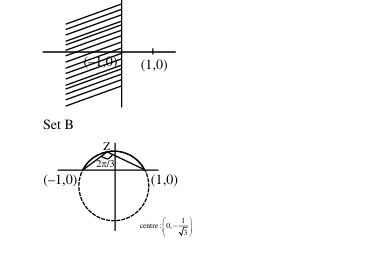
Set A: \( \left| \frac{z+1}{z-1} \right| < 1 \Rightarrow |z+1| < |z-1| \Rightarrow (x+1)^2 + y^2 < (x-1)^2 + y^2 \Rightarrow x < 0 \)
Set B: \( \arg\left(\frac{z-1}{z+1}\right) = \frac{2\pi}{3} \)
Let \( z = x + iy \). Then \( \frac{z-1}{z+1} = \frac{(x-1)+iy}{(x+1)+iy} \).
Using argument formula: \( \tan^{-1}\left(\frac{y}{x-1}\right) – \tan^{-1}\left(\frac{y}{x+1}\right) = \frac{2\pi}{3} \)
\( x^2 + y^2 + \frac{2y}{\sqrt{3}} – 1 = 0 \)
Centre: \( \left(0, -\frac{1}{\sqrt{3}}\right) \)
✅ Answer: (B)
Question 3
(B) \( 2^{12} \)
(C) \( 2^6 \)
(D) 1
▶️ Answer/Explanation
Using properties: \( |\operatorname{adj}(kA)| = |kA|^{n-1} = k^{n(n-1)} |A|^{n-1} \) for an \( n \times n \) matrix.
Here \( n = 3 \).
LHS: \( |\operatorname{adj}(24A)| = |24A|^{2} = (24^3 |A|)^2 = 24^6 |A|^2 \)
RHS: \( |\operatorname{adj}(3\operatorname{adj}(2A))| = |3\operatorname{adj}(2A)|^{2} = (3^3 |\operatorname{adj}(2A)|)^2 = 3^6 |\operatorname{adj}(2A)|^2 \)
Now \( |\operatorname{adj}(2A)| = |2A|^{2} = (2^3 |A|)^2 = 2^6 |A|^2 \)
So RHS = \( 3^6 \times (2^6 |A|^2)^2 = 3^6 \times 2^{12} |A|^4 \)
Equating LHS and RHS: \( 24^6 |A|^2 = 3^6 \times 2^{12} |A|^4 \)
\( 24^6 = (8 \times 3)^6 = 8^6 \times 3^6 = 2^{18} \times 3^6 \)
So \( 2^{18} \times 3^6 |A|^2 = 3^6 \times 2^{12} |A|^4 \)
\( 2^{6} = |A|^2 \)
\( |A|^2 = 64 = 2^6 \)
✅ Answer: (C)
Question 4
(B) \(\left( -3, \frac{1}{3} \right)\)
(C) \(\left( -3, -\frac{1}{3} \right)\)
(D) \(\left( 3, -\frac{1}{3} \right)\)
▶️ Answer/Explanation
For no solution, \( \Delta = 0 \) and at least one \( \Delta_i \ne 0 \).
\( \Delta = \begin{vmatrix} 3 & -2 & 1 \\ 5 & -8 & 9 \\ 2 & 1 & a \end{vmatrix} = 0 \)
Expanding: \( 3(-8a – 9) + 2(5a – 18) + 1(5 + 16) = -24a – 27 + 10a – 36 + 21 = -14a – 42 = 0 \)
\( \Rightarrow a = -3 \)
Now check \( \Delta_1, \Delta_2, \Delta_3 \). Use \( \Delta_2 = \begin{vmatrix} 3 & b & 1 \\ 5 & 3 & 9 \\ 2 & -1 & a \end{vmatrix} \) with \( a = -3 \).
\( \Delta_2 = \begin{vmatrix} 3 & b & 1 \\ 5 & 3 & 9 \\ 2 & -1 & -3 \end{vmatrix} = 3( -9 + 9 ) – b( -15 – 18 ) + 1( -5 – 6 ) = 0 + 33b – 11 = 33b – 11 \)
For no solution, \( \Delta_2 \ne 0 \Rightarrow 33b – 11 \ne 0 \Rightarrow b \ne \frac{1}{3} \).
Among options with \( a = -3 \), only (C) has \( b = -\frac{1}{3} \ne \frac{1}{3} \).
✅ Answer: (C)
Question 5
(B) 2
(C) 5
(D) 6
▶️ Answer/Explanation
\( 2021 \equiv 2021 – 7\times288 = 2021 – 2016 = 5 \pmod{7} \)
So \( 2021^{2023} \equiv 5^{2023} \pmod{7} \)
By Fermat’s little theorem, \( 5^6 \equiv 1 \pmod{7} \).
\( 2023 = 6\times337 + 1 \)
So \( 5^{2023} = (5^6)^{337} \cdot 5^1 \equiv 1^{337} \cdot 5 \equiv 5 \pmod{7} \)
Remainder is 5.
✅ Answer: (C)
Question 6
(B) \(-\sqrt{2}\)
(C) \(\frac{1}{\sqrt{2}}\)
(D) \(-\frac{1}{\sqrt{2}}\)
▶️ Answer/Explanation
Let \( t = \cos^{-1}x \Rightarrow x = \cos t \). As \( x \to \frac{1}{\sqrt{2}} \), \( t \to \frac{\pi}{4} \).
\( \sin(\cos^{-1}x) = \sin t = \sqrt{1 – x^2} \)
\( \tan(\cos^{-1}x) = \tan t = \frac{\sqrt{1 – x^2}}{x} \)
Limit becomes: \( \lim_{x \to \frac{1}{\sqrt{2}}} \frac{\sqrt{1 – x^2} – x}{1 – \frac{\sqrt{1 – x^2}}{x}} = \lim_{x \to \frac{1}{\sqrt{2}}} \frac{\sqrt{1 – x^2} – x}{\frac{x – \sqrt{1 – x^2}}{x}} = \lim_{x \to \frac{1}{\sqrt{2}}} (-x) = -\frac{1}{\sqrt{2}} \)
✅ Answer: (D)
Question 7
(B) \( 2(2e^4 + 1) \)
(C) \( 4e^4 \)
(D) \( 2(2e^4 – 1) \)
▶️ Answer/Explanation
First, simplify \( f(x) \):
For \( x < -3 \), \( |x+3| = -(x+3) \Rightarrow f(x) = -(-(x+3)) = x+3 \)
For \( -3 \le x < 0 \), \( |x+3| = x+3 \Rightarrow f(x) = -(x+3) \)
For \( x \ge 0 \), \( f(x) = e^x \)
So:
\( f(x) = \begin{cases} x+3, & x < -3 \\ -(x+3), & -3 \le x < 0 \\ e^x, & x \ge 0 \end{cases} \)
Now \( g(f(x)) \):
For \( x < -3 \), \( f(x) = x+3 < 0 \), so \( g(f(x)) = (x+3)^2 + k_1(x+3) \)
For \( -3 \le x < 0 \), \( f(x) = -(x+3) \le 0 \), so \( g(f(x)) = (x+3)^2 – k_1(x+3) \)
For \( x \ge 0 \), \( f(x) = e^x > 0 \), so \( g(f(x)) = 4e^x + k_2 \)
For differentiability at \( x=0 \), continuity and equal derivatives from left and right.
Continuity at 0: \( \lim_{x \to 0^-} g(f(x)) = 9 – 3k_1 \), \( g(f(0)) = 4 + k_2 \)
So \( 9 – 3k_1 = 4 + k_2 \Rightarrow 3k_1 + k_2 = 5 \) …(1)
Derivative from left: \( \frac{d}{dx}[(x+3)^2 – k_1(x+3)] = 2(x+3) – k_1 \), at \( x=0^- \): \( 6 – k_1 \)
Derivative from right: \( \frac{d}{dx}[4e^x + k_2] = 4e^x \), at \( x=0^+ \): 4
So \( 6 – k_1 = 4 \Rightarrow k_1 = 2 \)
Then from (1): \( 3(2) + k_2 = 5 \Rightarrow k_2 = -1 \)
Now compute:
\( (g \circ f)(-4) \): for \( x=-4 < -3 \), \( g(f(x)) = (x+3)^2 + 2(x+3) = (-1)^2 + 2(-1) = 1 – 2 = -1 \)
\( (g \circ f)(4) \): for \( x=4 \ge 0 \), \( g(f(x)) = 4e^4 – 1 \)
Sum: \( -1 + 4e^4 – 1 = 4e^4 – 2 = 2(2e^4 – 1) \)
✅ Answer: (D)
Question 8
(B) \( \frac{\sqrt{17} + 5}{2} \)
(C) 5
(D) \( \frac{9 – \sqrt{17}}{2} \)
▶️ Answer/Explanation
\( f'(x) = 2x – 4 = 0 \Rightarrow x = 2 \)
\( f'(x) = 2(x – 2) \Rightarrow f'(x) \) is always \(\downarrow\)
\( f(2) = 2 \)
\( f(-1) = 3 \)
\( f\left( \frac{3-\sqrt{17}}{2} \right) = \frac{\sqrt{17}-3}{2} \) \( f'(x) \) when \( x \in \left( \frac{3-\sqrt{17}}{2}, 2 \right) \)
\( f'(x) = -2x + 2 \)
\( f'(x) = -2(x – 1) \)
\( f'(x) = 0 \) when \( x = 1 \)
\( f(1) = 3 \)
absolute minimum value = \(\frac{\sqrt{17}-3}{2}\)
absolute maximum value = 3
✅ Answer: (A)
Question 9
(B) n(S) = 1
(C) S = {2k : k ∈ N}
(D) S = N
▶️ Answer/Explanation
Curve: \( \left( \frac{x}{a} \right)^n + \left( \frac{y}{b} \right)^n = 2 \) passes through (a,b) since \( 1^n + 1^n = 2 \).
Differentiate implicitly: \( n\left( \frac{x}{a} \right)^{n-1} \cdot \frac{1}{a} + n\left( \frac{y}{b} \right)^{n-1} \cdot \frac{1}{b} \cdot y’ = 0 \)
At (a,b): \( n(1)^{n-1} \cdot \frac{1}{a} + n(1)^{n-1} \cdot \frac{1}{b} \cdot y’ = 0 \)
\( \frac{n}{a} + \frac{n}{b} y’ = 0 \Rightarrow y’ = -\frac{b}{a} \)
Tangent line at (a,b): \( y – b = -\frac{b}{a}(x – a) \Rightarrow \frac{y}{b} – 1 = -\frac{1}{a}(x – a) \Rightarrow \frac{y}{b} – 1 = -\frac{x}{a} + 1 \Rightarrow \frac{x}{a} + \frac{y}{b} = 2 \)
So the given line is indeed the tangent for all n ∈ N.
Thus S = N.
✅ Answer: (D)
Question 10
(B) \(4 \left( 4\sqrt{3} + \sqrt{6} – 4 \right)\)
(C) \(8 \left( 4\sqrt{3} + 3\sqrt{6} – 9 \right)\)
(D) \(8 \left( 4\sqrt{3} + \sqrt{6} – 9 \right)\)
▶️ Answer/Explanation
Area of shaded region \[= 2 \int_{0}^{3} ( \sqrt{9 + y} – \sqrt{9 – y} ) dy + 2 \int_{3}^{9} ( \sqrt{9 – y} ) dy\] \[= 2 \left[ \int_{0}^{3} (9 + y)^{1/2} dy – \int_{0}^{3} (9 – y)^{1/2} dy + \int_{3}^{9} (9 – y)^{1/2} dy \right]\] \[= 2 \left[ \frac{2}{3} [ (9 + y)^{3/2}]_{0}^{3} + \frac{2}{3} [ (9 – y)^{3/2}]_{0}^{3} – \frac{2}{3} [ (9 – y)^{3/2}]_{0}^{3} \right]\] \[= \frac{4}{3} \left[ 12 \sqrt{12} – 27 + 6 \sqrt{6} – 27 – \left( 0 – 6 \sqrt{6} \right) \right]\]\
\[ = \frac { 4 } { 3 } [ 24 \sqrt { 3 } + 12 \sqrt { 6 } – 54 ] \] \[ = 8 \Big ( 4 \sqrt { 3 } + 2 \sqrt { 6 } – 9 \Big ) \]
✅ Answer: Official Ans. by NTA (DROP)
Question 11
(B) \(\frac{25\sqrt{3}}{2}\)
(C) \(\frac{25}{\sqrt{3}}\)
(D) \(\frac{25}{2\sqrt{3}}\)
▶️ Answer/Explanation
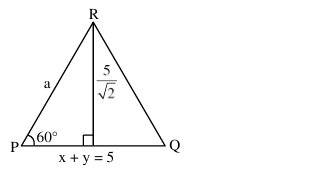
\(\sin 60^\circ = \frac{5\sqrt{2}}{a}\)
\(\Rightarrow a = \frac{5\sqrt{2}}{3}\)
Area = \(\frac{\sqrt{3}}{4}a^2 = \frac{25\sqrt{3}}{6}\)
\(\frac{25}{2\sqrt{3}}\) ✓
✅ Answer: (D)
Question 12
(B) \(\frac{65}{2}\)
(C) \(\frac{61}{2}\)
(D) 30
▶️ Answer/Explanation
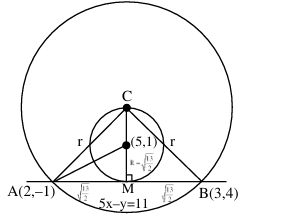
Let center be O(h,k) lying on \((x-5)^2+(y-1)^2=\frac{13}{2}\)
Also OA = OB = r
Midpoint M of AB = \(\left(\frac{5}{2}, \frac{3}{2}\right)\)
AB = \(\sqrt{(3-2)^2+(4+1)^2} = \sqrt{1+25} = \sqrt{26}\)
Using the given solution approach: r² = CM² + AM² where C is center
r² = \(\left(2 \times \frac{\sqrt{13}}{2}\right)^2 + \left(\sqrt{\frac{13}{2}}\right)^2\)
\(r^2\)=\(\frac{65}{2}\)
✅ Answer: (B)
Question 13
(B) \(-\frac{9}{4}\)
(C) \(-\frac{5}{2}\)
(D) \(-2\)
▶️ Answer/Explanation
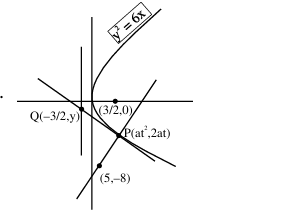
Parabola: \(y^2 = 6x \Rightarrow a = \frac{3}{2}\)
Parametric form: \(P = (at^2, 2at) = \left(\frac{3}{2}t^2, 3t\right)\)
Equation of normal: \(y = -tx + 2at + at^3 = -tx + 3t + \frac{3}{2}t^3\)
Passes through (5,-8): \(-8 = -5t + 3t + \frac{3}{2}t^3\)
\(-8 = -2t + \frac{3}{2}t^3\)
Multiply by 2: \(-16 = -4t + 3t^3\)
\(3t^3 – 4t + 16 = 0\)
Try t = -2: \(3(-8) -4(-2) + 16 = -24 + 8 + 16 = 0\) ✓
So t = -2
Point P = \(\left(\frac{3}{2}(4), 3(-2)\right) = (6, -6)\)
Equation of tangent at P: \(yy_1 = 3(x + x_1)\) or using parametric form:
Tangent at \(t=-2\): \(y(-6) = 3(x + 6) \Rightarrow -6y = 3x + 18 \Rightarrow x + 2y + 6 = 0\)
Directrix: \(x = -\frac{a}{2} = -\frac{3}{2}\)
Substitute in tangent: \(-\frac{3}{2} + 2y + 6 = 0 \Rightarrow 2y + \frac{9}{2} = 0 \Rightarrow y = -\frac{9}{4}\)
✅ Answer: (B)
Question 14
(B) \(\sec^{-1}\left(\frac{29}{4}\right)\)
(C) \(\cos^{-1}\left(\frac{2}{29}\right)\)
(D) \(\cos^{-1}\left(\frac{2}{\sqrt{29}}\right)\)
▶️ Answer/Explanation
\(l_1: \frac{x-2}{3} = \frac{y+1}{-2} = \frac{z-2}{0}\), direction ratios: (3, -2, 0)
\(l_2: \frac{x-1}{1} = \frac{y+3/2}{\alpha/2} = \frac{z+5}{2}\), direction ratios: (1, α/2, 2)
Perpendicular: \(3\cdot1 + (-2)\cdot(\alpha/2) + 0\cdot2 = 0\)
\(3 – \alpha = 0 \Rightarrow \alpha = 3\)
So \(l_2\) direction ratios: (1, 3/2, 2)
\(l_3: \frac{x-1}{-3} = \frac{y-1/2}{-2} = \frac{z-0}{4}\), direction ratios: (-3, -2, 4)
Angle between \(l_2\) and \(l_3\):
\(\cos\theta = \frac{|1\cdot(-3) + (3/2)\cdot(-2) + 2\cdot4|}{\sqrt{1^2+(3/2)^2+2^2}\sqrt{(-3)^2+(-2)^2+4^2}}\)
\(= \frac{|-3 – 3 + 8|}{\sqrt{1+9/4+4}\sqrt{9+4+16}} = \frac{|2|}{\sqrt{29/4}\sqrt{29}} = \frac{2}{\frac{\sqrt{29}}{2}\cdot\sqrt{29}} = \frac{2}{29/2} = \frac{4}{29}\)
\(\theta = \cos^{-1}\left(\frac{4}{29}\right) = \sec^{-1}\left(\frac{29}{4}\right)\)
✅ Answer: (B)
Question 15
(B) \(\frac{a}{4} = \frac{b}{5} = \frac{c}{-2}\)
(C) \(\frac{a}{8} = \frac{b}{-5} = \frac{c}{4}\)
(D) \(\frac{a}{4} = \frac{b}{5} = \frac{c}{2}\)
▶️ Answer/Explanation
Family of planes through line of intersection:
\((2x+3y+z+20) + \lambda(x-3y+5z-8) = 0\)
\((2+\lambda)x + (3-3\lambda)y + (1+5\lambda)z + (20-8\lambda) = 0\)
This plane is perpendicular to original plane \(2x+3y+z+20=0\):
\((2+\lambda)\cdot2 + (3-3\lambda)\cdot3 + (1+5\lambda)\cdot1 = 0\)
\(4+2\lambda + 9-9\lambda + 1+5\lambda = 0\)
\(14 – 2\lambda = 0 \Rightarrow \lambda = 7\)
Rotated plane: \((2+7)x + (3-21)y + (1+35)z + (20-56) = 0\)
\(9x – 18y + 36z – 36 = 0\) or \(x – 2y + 4z – 4 = 0\)
Mirror of A(2, -1/2, 2) in this plane:
Line through A perpendicular to plane: \(\frac{x-2}{1} = \frac{y+1/2}{-2} = \frac{z-2}{4} = k\)
B = \((2+k, -1/2-2k, 2+4k)\)
Midpoint M = \((2+k/2, -1/2-k, 2+2k)\) lies on plane:
\((2+k/2) – 2(-1/2-k) + 4(2+2k) – 4 = 0\)
\(2+k/2 + 1+2k + 8+8k – 4 = 0\)
\(7 + (21/2)k = 0 \Rightarrow k = -\frac{2}{3}\)
B = \(\left(2-\frac{2}{3}, -\frac{1}{2}+\frac{4}{3}, 2-\frac{8}{3}\right) = \left(\frac{4}{3}, \frac{5}{6}, -\frac{2}{3}\right) = \left(\frac{8}{6}, \frac{5}{6}, -\frac{4}{6}\right)\)
So \(\frac{a}{8} = \frac{b}{5} = \frac{c}{-4}\)
✅ Answer: (A)
Question 16
(B) \(-6\vec{a} \cdot (\vec{b} \times \vec{c})\)
(C) \(12\vec{c} \cdot (\vec{a} \times \vec{b})\)
(D) \(-12\vec{b} \cdot (\vec{c} \times \vec{a})\)
▶️ Answer/Explanation
\[ a \times (b \times c) = (a \cdot c)b – (a \cdot b)c = 3b – c \] \[ b \times (c \times a) = (b \cdot a)c – (b \cdot c)a = c – 2a \] \[ c \times (b \times a) = (c \cdot a)b – (c \cdot b)a = 3b – 2a \] \[ [3b – c, c – 2a, 3b – 2a] \] \[ (3b – c) \cdot [(c – 2a) \times (3b – 2a)] \] \[ (3b – c) \cdot [3(c \times b) – 2(c \times a) – 6(a \times b)] \] \[ -6[b c a] + 6[c a b] \]
✅ Answer: (A)
Question 17
(B) \(\frac{36}{5^4}\)
(C) \(\frac{181}{5^5}\)
(D) \(\frac{46}{6^4}\)
▶️ Answer/Explanation
Let P(H) = p, P(T) = 1-p
P(4 heads) = \(^5C_4 p^4 (1-p) = 5p^4(1-p)\)
P(5 heads) = \(^5C_5 p^5 = p^5\)
Given: \(5p^4(1-p) = p^5\)
If p ≠ 0: \(5(1-p) = p \Rightarrow 5 – 5p = p \Rightarrow 5 = 6p \Rightarrow p = \frac{5}{6}\)
P(at most 2 heads) = P(0H) + P(1H) + P(2H)
= \(^5C_0 (1/6)^5 + ^5C_1 (5/6)(1/6)^4 + ^5C_2 (5/6)^2 (1/6)^3\)
= \(\frac{1}{6^5}[1 + 25 + 10\times25] = \frac{1}{6^5}[1 + 25 + 250] = \frac{276}{6^5} = \frac{46}{6^4}\)
✅ Answer: (D)
Question 18
(B) 55
(C) 50
(D) 45
▶️ Answer/Explanation
Mean = 6 ⇒ \(\frac{a+b+8+5+10}{5} = 6 \Rightarrow a+b+23=30 \Rightarrow a+b=7\)
Variance = 6.8 ⇒ \(\frac{(a-6)^2+(b-6)^2+(8-6)^2+(5-6)^2+(10-6)^2}{5} = 6.8\)
\((a-6)^2+(b-6)^2+4+1+16 = 34\)
\((a-6)^2+(b-6)^2 = 13\)
Let b = 7-a: \((a-6)^2+(1-a)^2 = 13\)
\(a^2-12a+36 + 1-2a+a^2 = 13\)
\(2a^2-14a+37=13 \Rightarrow 2a^2-14a+24=0 \Rightarrow a^2-7a+12=0\)
\((a-3)(a-4)=0 \Rightarrow a=3,4\) (so b=4,3 respectively)
Mean deviation M = \(\frac{|a-6|+|b-6|+|8-6|+|5-6|+|10-6|}{5}\)
For a=3,b=4: M = \(\frac{3+2+2+1+4}{5} = \frac{12}{5}\)
For a=4,b=3: M = \(\frac{2+3+2+1+4}{5} = \frac{12}{5}\)
25M = \(25 \times \frac{12}{5} = 60\)
✅ Answer: (A)
Question 19
(B) 11 – π
(C) 11 + π
(D) 15 – π
▶️ Answer/Explanation
\(f'(x) = -\frac{2}{\sqrt{1-x^2}} – \frac{4}{1+x^2} – 6x – 2\)
For x ∈ [-1,1], all terms are negative ⇒ f'(x) < 0 ⇒ f is strictly decreasing
f(1) = \(2\cos^{-1}(1) + 4\cot^{-1}(1) – 3 – 2 + 10 = 2(0) + 4(\frac{\pi}{4}) + 5 = \pi + 5\)
f(-1) = \(2\cos^{-1}(-1) + 4\cot^{-1}(-1) – 3 + 2 + 10 = 2(\pi) + 4(\frac{3\pi}{4}) + 9 = 2\pi + 3\pi + 9 = 5\pi + 9\)
Range: [f(1), f(-1)] = [π+5, 5π+9]
So a = π+5, b = 5π+9
4a – b = 4(π+5) – (5π+9) = 4π+20-5π-9 = 11 – π
✅ Answer: (B)
Question 20
(B) (p \(\Delta\) r) \(\land\) q
(C) (p \(\land\) r) \(\land\) q
(D) (p \(\nabla\) r) \(\land\) q
▶️ Answer/Explanation
Test the 4 possible combinations:
Case 1: Δ = ∧, ∇ = ∧
p∧q ⇒ ((p∧q)∧r) is not a tautology (counterexample: p=T,q=T,r=F)
Case 2: Δ = ∨, ∇ = ∨
p∨q ⇒ ((p∨q)∨r) is a tautology (since A ⇒ A∨B is always true)
Then (p∨q)∨r ≡ p∨q∨r ≡ (p∨r)∨q
Case 3: Δ = ∨, ∇ = ∧
p∧q ⇒ ((p∨q)∧r) is not a tautology (counterexample: p=T,q=T,r=F)
Case 4: Δ = ∧, ∇ = ∨
p∨q ⇒ ((p∧q)∨r) is not a tautology (counterexample: p=T,q=F,r=F)
Only Case 2 works, giving (p∨q)∨r ≡ (p∨r)∨q ≡ (pΔr)∨q
✅ Answer: (A)
Section-B
Question 1
▶️ Answer/Explanation
\(x^4 – 3x^3 – 2x^2 + 3x + 1 = 10\)
\(x = 0\) is not the root of this equation so divide it by \(x^2\)
\(x^2 – 3x – 2 + \frac{3}{x} + \frac{1}{x^2} = 0\)
\(x^2 + \frac{1}{x^2} – 2 + 2 – 3 \left( x – \frac{1}{x} \right) – 2 = 0\)
\(\left( x – \frac{1}{x} \right)^2 – 3 \left( x – \frac{1}{x} \right) = 0\)
\(x – \frac{1}{x} = 0, \quad x – \frac{1}{x} = 3\)
\(x^2 – 1 = 0 \quad x^2 – 3x – 1 = 0\)
\(x = \pm 1 \quad y + \delta = 3\)
\(\alpha = 1, \beta = -1 \quad \gamma \delta = -1\)
\(\alpha^3 + \beta^3 + \gamma^3 + \delta^3\)
\(1 – 1 + (\gamma + \delta)((\gamma + \delta)^2 – 3\gamma\delta)\)
\(0 + 3(9 – 3(-1))\)
\(+ 3(12) = 36\)
✅ Answer: 36
Question 2
▶️ Answer/Explanation
\(n(B) = 10\)
\(n(a) = 5\)
The number of ways of forming a group of 3 girls of 3 boys.
\(= \frac{10C_3 \times 5C_3}{10 \times 9 \times 8 \times 5 \times 4} = \frac{1200}{3 \times 2} = 1200\)
The number of ways when two particular boys \(B_1\) of \(B_2\) be the member of group together
\(= \frac{8C_1 \times 5C_3}{8 \times 10} = 80\)
Number of ways when boys \(B_1\) of \(B_2\) hot in the same group together
\(= 1200 \times 80 = 1120\)
✅ Answer: 1120
Question 3
▶️ Answer/Explanation
\(x^2 + y^2 = \frac{9}{4} \quad y = 4x\)
Equation tangent in slope form
\(y = mx \pm \frac{3}{2} \sqrt{(1 + m^2)} \quad … (1)\)
\(y = mx + \frac{1}{m} \quad … (2)\)
compare (1) & (2)
\(\pm \frac{3}{2} \sqrt{(1 + m^2)} = \frac{1}{m^2}\)
\(9m^2 (1 + m^2) = 4\)
\(9m^4 + 9m^2 – 4 = 0\)
\(9m^4 + 12m^2 – 3m^2 – 4 = 0\)
\(3m^2 (3m^2 + 4) – (3m^2 + 4) = 0\)
\(m^2 = -\frac{4}{3} \quad (Rejected)\)
\(m^2 = \frac{1}{3} \Rightarrow m = \pm \frac{1}{\sqrt{3}}\)
Equation of common tangent
\(y = \frac{1}{\sqrt{3}} x + \sqrt{3}\)
on X axis y = 0
OQ = -3
b = |OQ| = 3
a = 6
\( b^2 = a^2(1 – e^2) \Rightarrow e^2 = 1 – \frac{9}{36} = \frac{3}{4} \)
\( e = \frac{2b^2}{a} = \frac{2 \times 9}{6} = 3 \)
\( e = \frac{3}{e^2} = \frac{3}{3/4} = 4 \)
✅ Answer: 4
Question 4
▶️ Answer/Explanation
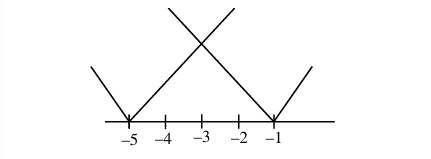
\( f(x) = \max\{|x+1|, |x+2|, |x + 3|, |x + 4|, |x + 5|\} \)
\(\int_{-6}^{0} f(x) \, dx = \int_{-6}^{-3} |x+1| \, dx + \int_{-3}^{0} |x+5| \, dx\)
\(= -\int_{-6}^{-3} (x+1) \, dx + \int_{-3}^{0} (x+5) \, dx\)
\(= -\left[ \frac{x^2}{2} + x \right]_{-6}^{-3} + \left[ \frac{x^2}{2} + 5x \right]_{-3}^{0}\)
\(= -\left[ \frac{9}{2} – 3 \right]_{-6}^{-3} – (18 – 6) + \left[ 0 – \left( \frac{9}{2} – 15 \right) \right]\)
\(= -\left[ \frac{3}{2} – 12 \right] + \frac{21}{2} = \frac{21}{2} + \frac{21}{2} = 21\)
✅ Answer: 21
Question 5
▶️ Answer/Explanation
(4 + x^2)dy – 2x(x^2 + 3y + 4)dx
\[\frac{(x^2 + 4)}{dx} = 2x^3 + 6xy + 8x\]
\[(x^2 + 4) \frac{dy}{dx} – 6xy = 2x^3 + 8x\]
\[\frac{dy}{dx} – \frac{6x}{x^2 + 4} y = \frac{2x^3 + 8x}{x^2 + y}\]
L.I. \(\frac{dy}{dx} + py = \phi\)
\[p = \frac{-6x}{x^2 + 4} \quad \phi = \frac{2x^3 + 8x}{x^2 + 4}\]
I.F. \[ e^{-\int_{x^2 + 4}^{6x} dx} = e^{-31 \log_2 (x^2 + 4)} \]
\[= e^{\log_2 (x^2 + 4)^3} = \frac{1}{(x^2 + 4)^3}\]
Sol.
\[y. \frac{1}{(x^2 + 4)^3} = \int_{-2}^{2x^3} \frac{2x^3 + 8x}{(x^2 + 4)^3 (x^2 + 4)} \, dx\]
\[\frac{y}{(x^2 + 4)^3} = \int_{-2}^{2x^3} \frac{2x(x^2 + 4)}{(x^2 + 4)^3 (x^2 + 4)} \, dx\]
\[x^2 + 4 = t\]
\[2xdx = dt\]
\[\frac{y}{(x^2 + 4)^3} = \int_{-1}^{t} \frac{dt}{t^3}\]
\[\frac{y}{(x^2 + 4)^3} = \frac{-1}{2(x^2 + 4)^2} + C\]
passes through origin (0, 0)
\[0 = \frac{-1}{2 \times 16} + C\]
\[\frac{y}{(x^2 + 4)^3} = \frac{-1}{2(x^2 + 4)^2} + \frac{1}{32}\]
\[y = \frac{-(x^2 + 4)}{2} + \frac{(x^2 + 4)^3}{32}\]
\[y(2) = \frac{8}{2} + \frac{8 \times 8 \times 8}{32} = 12\]
✅ Answer: 12
Question 6
▶️ Answer/Explanation
\[\sin 10^\circ \left( \frac{1}{2} 2 \sin 20^\circ \sin 40^\circ \right) \cdot \sin 10^\circ \sin (60^\circ – 10^\circ) \sin (60^\circ + 10^\circ)\]
\[\sin 10^\circ \left( \frac{1}{2} (\cos 20^\circ – \cos 60^\circ) \cdot \frac{1}{4} \sin 30^\circ \right)\]
\[\frac{1}{2} \cdot \frac{1}{4} \cdot \frac{1}{2} \cdot \sin 10^\circ \left( \cos 20^\circ – \frac{1}{2} \right)\]
\[= \frac{1}{32} \left( 2 \sin 10^\circ \cos 20^\circ – \sin 10^\circ \right)\]
\[= \frac{1}{32} \left( \sin 30^\circ – \sin 10^\circ – \sin 10^\circ \right)\]
\[= \frac{1}{32} \left( \frac{1}{2} – 2 \sin 10^\circ \right)\]
\[= \frac{1}{64} \left( 1 – 4 \sin 10^\circ \right)\]
\[= \frac{1}{64} \cdot \frac{1}{16} \cdot \sin 10^\circ\]
Hence \(\alpha = \frac{1}{64}\)
16 + \(\alpha^{-1}\) = 80
✅ Answer: 80
Question 7
▶️ Answer/Explanation
Sum of elements in A ∩ B
\[= \left( 2 + 4 + 6 + … + 200 \right) – \left( 6 + 12 + … + 198 \right)\]
Multiple of 2 Multiple of 2 & 3 i.e. 6
\[- \left( 10 + 20 + … + 200 \right) + \left( 30 + 60 + … + 180 \right)\]
Multiple of 5 & 2 i.e. 10 Multiple of 2, 5 & 3 i.e. 30
\[= 5264\]
✅ Answer: 5264
Question 8
▶️ Answer/Explanation
\[I = \frac{48}{\pi^4} \int_0^{\pi} \left( \frac{3 \pi x^2}{2} – x^3 \right) \frac{\sin x}{1 + \cos^2 x} dx \ldots (1)\]
Apply king property
\[I = \frac{48}{\pi^4} \int_0^{\pi} \left( \pi – x \right)^2 \left( \frac{\pi}{2} + x \right) \frac{\sin x}{1 + \cos^2 x} dx \ldots (2)\]
(1) + (2)
\[I = \frac{12}{\pi^3} \int_0^{\pi} \frac{\sin x}{1 + \cos^2 x} \left[ \pi^2 + (\pi – 2)x \cdot (\pi – 2x) \right] dx \ldots (3)\]
Apply king again
\[I = \frac{12}{\pi^3} \int_0^{\pi} \frac{\sin x}{1 + \cos^2 x} \left[ \pi^2 + (\pi – 2)(\pi – x)(2x – \pi) \right] dx \ldots (4)\]
(3) + (4)
\[I = \frac{6}{\pi^2} \int_0^{\pi} \frac{\sin x}{1 + \cos^2 x} \left[ 2\pi + (\pi – 2)(\pi – 2x) \right] dx \ldots (5)\]
Apply king
\[I = \frac{6}{\pi^2} \int_0^{\pi} \frac{\sin x}{1 + \cos^2 x} \left[ 2\pi + (\pi – 2)(2x – \pi) \right] dx \ldots (6)\]
(5) + (6)
\[I = \frac{12}{\pi} \int_0^{\pi} \frac{\sin x}{1 + \cos^2 x} dx\]
Let \(\cos x = t \Rightarrow \sin x dx = -dt\)
\[I = \frac{12}{\pi} \int_0^{\pi} \frac{-dt}{1 + t^2} = 6\]
✅ Answer: 6
Question 9
▶️ Answer/Explanation
A = \(\sum_{i=1}^{10} \sum_{j=1}^{10} \min \{i, j\}\)
\[B = \sum_{i=1}^{10} \sum_{j=1}^{10} \max \{i, j\}\]
\[A = \sum_{j=1}^{10} \min (i, 1) + \min (j, 2) + \ldots \min (i, 10)\]
\[= \left( 1 + 1 + 1 + \ldots + 1 \right) + \left( 2 + 2 + 2 \ldots + 2 \right) + \left( 3 + 3 + 3 \ldots + 3 \right)\]
+ … (1) 1 times
\[ B = \sum_{j=1}^{10} \max(i,1) + \max(j,2) + … \max(i,10) \]
\[ = (10 + 10 + … + 10) + (9 + 9 + … + 9) + … + 11 \text{ times} \]
A + B = 20(1 + 2 + 3 + … + 10)
\[ = 20 \times \frac{10 \times 11}{2} = 10 \times 110 = 1100 \]
✅ Answer: 1100
Question 10
▶️ Answer/Explanation
\[\frac{dy}{dx} = \frac{1}{1 + \sin 2x}\]
\[\int dy = \int \frac{dx}{(\sin x + \cos x)^2}\]
\[\int dy = \int \frac{\sec^2 x}{(1 + \tan x)^2}\]
\[y(x) = -\frac{1}{1 + \tan x} + C\]
\[y \left( \frac{\pi}{4} \right) = \frac{1}{2} = -\frac{1}{2} + C\]
C = 1
\[y(x) = \frac{-1}{1 + \tan x} + 1\]
\[y(x) = \frac{-1 + 1 + \tan x}{1 + \tan x} = \frac{\tan x}{1 + \tan x}\]
\[y(x) = \frac{\sin x}{\cos x + \sin x}\]
\[y = \sqrt{2} \sin x\]
\[\frac{\sin x}{\sin x + \cos x} = \sqrt{2} \sin x\]
\[\sin x \left( \frac{1}{\sin x + \cos x} – \sqrt{2} \right) = 0\]
Case 1: \(\sin x = 0\)
\(x = \pi\)
Case 2: \(\frac{1}{\sin x + \cos x} = \sqrt{2}\)
\(\sin x + \cos x = \frac{1}{\sqrt{2}}\)
\(\sin \left( x + \frac{\pi}{4} \right) = \frac{1}{2}\)
\(x + \frac{\pi}{4} = \frac{\pi}{6}, \frac{5\pi}{6}, \frac{13\pi}{6}, \frac{17\pi}{6}\)
\(x = \frac{\pi}{6} – \frac{\pi}{4}, \frac{5\pi}{6} – \frac{\pi}{4}, \frac{13\pi}{6} – \frac{\pi}{4}, \frac{17\pi}{6} – \frac{\pi}{4}\)
\(x = -\frac{\pi}{12}, \frac{7\pi}{12}, \frac{23\pi}{12}, \frac{31\pi}{12}\)
In (0, 2π) valid \(x = \frac{7\pi}{12}, \frac{23\pi}{12}\)
Sum of abscissas = \(\pi + \frac{7\pi}{12} + \frac{23\pi}{12} = \frac{12\pi + 7\pi + 23\pi}{12} = \frac{42\pi}{12} = \frac{7\pi}{2}\)
\(k = 42\)
✅ Answer: 42