
Mathematics (Section A)
Question 1
(B) \( R_2 \) is an equivalence relation but not \( R_1 \)
(C) both \( R_1 \) and \( R_2 \) are equivalence relations
(D) neither \( R_1 \) nor \( R_2 \) is an equivalence relation
▶️ Answer/Explanation
\( R_1 = \{ xy \geq 0, x, y \in R \} \)
For reflexive \( x \times x \geq 0 \) which is true.
For symmetric: If \( xy \geq 0 \Rightarrow yx \geq 0 \)
If \( x = 2, y = 0 \) and \( z = -2 \), then \( x, y \geq 0 \) or \( y, z \geq 0 \) but \( x, z \geq 0 \) is not true ⇒ not transitive relation.
⇒ \( R_1 \) is not equivalence
\( R_2 \) if \( a \geq b \) it does not implies \( b \geq a \) ⇒ \( R_2 \) is not equivalence relation
⇒ \( D \)
✅ Answer: (D)
Question 2
(B) onto but not one-one
(C) both one-one and onto
(D) neither one-one nor onto
▶️ Answer/Explanation
\( f : N – \{1\} \rightarrow N \), \( f(a) = \alpha \) where \( \alpha \) is max of powers of prime \( P \) such that \( p^\alpha \) divides a. Also \( g(a) = a + 1 \)
\( f(2) = 1 \), \( g(2) = 3 \)
\( f(3) = 1 \), \( g(3) = 4 \)
\( f(4) = 2 \), \( g(4) = 5 \)
\( f(5) = 1 \), \( g(5) = 6 \)
⇒ \( f(2) + g(2) = 4 \)
\( (f(3) + g(3)) = 5 \)
\( f(4) + g(4) = 7 \)
\( f(5) + g(5) = 7 \)
∴ Many one \( f(x) + g(x) \) does not retain 1 ⇒ into function
∴ Ans. (D) [neither one-one nor onto]
✅ Answer: (D)
Question 3
(B) 1024
(C) 1105
(D) 1196
▶️ Answer/Explanation
\( z_0 = \left(\frac{0 + 3 + 0}{3}, \frac{0 + 6 + 0}{3}\right) = (1, 2) \)
\( v_0 = |1 + 2i|^2 + |1 + 2i – 3|^2 + |1 + 2i – 6i|^2 = 30 \)
Then \( \left| 2z_0^2 – z_0^3 + 3\right|^2 + v_0^2 \)
\( = \left| 2(1 + 2i)^2 – (1 + 2i)^3 + 3\right|^2 + 900 \)
\( = \left| 2(1 – 4 + 4i) – (1 – 4 – 4i)(1 + 2i) + 3\right|^2 + 900 \)
\( = \left| 8 + 6i\right|^2 + 900 = 100 + 900 = 1000 \)
✅ Answer: (A)
Question 4
(B) -6
(C) 6
(D) 10
▶️ Answer/Explanation
Characteristic equation of matrix A: \( |A – \lambda I| = 0 \)
\( \begin{vmatrix} 1-\lambda & 2 \\ -2 & -5-\lambda \end{vmatrix} = 0 \)
⇒ \( \lambda^2 + 4\lambda = 1 \)
⇒ \( A^2 + 4A = I \)
⇒ \( 2A^2 + 8A = 2I ……………………………(1) \)
Given \( \alpha A^2 + \beta A = 2I …………………………….(2)\)
Comparing equation (1) & (2) we get
⇒ \( \alpha = 2 \), \( \beta = 8 \)
\( \alpha + \beta = 10 \)
✅ Answer: (D)
Question 5
(B) 1
(C) 2
(D) 6
▶️ Answer/Explanation
\( (2021)^{2022} + (2022)^{2021} = (2023 – 2)^{2022} + (2023 – 1)^{2021} \)
\( = 7n_1 + 2^{2022} + 7n_2 – 1 \)
\( = 7(n_1 + n_2) + 8^{674} – 1 \)
\( = 7(n_1 + n_2) + (7-1)^{674} – 1 \)
\( = 7(n_1 + n_2) + 7n_3 +1 – 1 \)
\( = 7(n_1 + n_2 + n_3) \)
So remainder = \( 1 – 1 = 0 \)
✅ Answer: (A)
Question 6
(B) 380
(C) 460
(D) 510
▶️ Answer/Explanation
\( \frac{S_5}{S_9} = \frac{\frac{5}{2}[2a + 4d]}{\frac{9}{2}[2a + 8d]} = \frac{5}{17} \)
⇒ \( \frac{5(a + 2d)}{9(a + 4d)} = \frac{5}{17} \)
⇒ \( 17(a + 2d) = 9(a + 4d) \)
⇒ \( 17a + 34d = 9a + 36d \)
⇒ \( 8a = 2d \) ⇒ \( d = 4a \)
\( a_{15} = a + 14d = a + 56a = 57a \)
Given \( 110 < 57a < 120 \) ⇒ \( a = 2 \)
∴ \( d = 8 \)
\( S_{10} = \frac{10}{2}[2 \times 2 + 9 \times 8] = 5[4 + 72] = 380 \)
✅ Answer: (B)
Question 7
(B) -2
(C) 1
(D) 2
▶️ Answer/Explanation
\[ \lim_{x \to -1^+} a \sin \left( \pi \frac{[x]}{2} \right) + [2 – x] = -a + 2 \] \[ \lim_{x \to -1^-} a \sin \left( \pi \frac{[x]}{2} \right) + [2 – x] = 0 + 3 = 3 \] \[ \lim_{x \to -1} f(x) \text{ exist when } a = -1 \] Now, \[ \int_0^4 f(x) dx = \int_0^1 f(x) dx + \int_1^2 f(x) dx + \int_2^3 f(x) dx + \int_3^4 f(x) dx \] \[ = \int_0^1 (0 + 1) dx + \int_1^2 (-1 + 0) dx + \int_2^3 (0 – 1) dx + \int_3^4 (1 – 2) dx \] \[ = 1 – 1 – 1 – 1 = -2 \]
✅ Answer: (B)
Question 8
(B) \( \frac{5\pi}{12} < I < \frac{5\pi^2}{12} \)
(C) \( \frac{5\pi^2}{12} < I < \frac{2\pi^2}{3} \)
(D) \( \frac{3\pi}{4} < I < \pi \)
▶️ Answer/Explanation
\( f(x) = 8 \sin x – \sin 2x \)
\( f'(x) = 8 \cos x – 2 \cos 2x \)
\( f”(x) = -8 \sin x + 4 \sin 2x \)
\( = -8 \sin x (1 – \cos x) \)
∴ \( f”(x) < 0 \) for \( x \in \left( \frac{\pi}{4}, \frac{\pi}{3} \right) \)
∴ \( f'(x) \) is decreasing function
\( f’ \left( \frac{\pi}{3} \right) < f'(x) < f’ \left( \frac{\pi}{4} \right) \) \( 5 < f'(x) < 4\sqrt{2} \) \( 5 < \frac{f(x)}{x} < 4\sqrt{2} \) \( \int_{\pi/4}^{\pi/3} 5 dx < \int_{\pi/4}^{\pi/3} \frac{f(x)}{x} dx < \int_{\pi/4}^{\pi/3} 4\sqrt{2} dx \) \( \frac{5\pi}{12} < I < \frac{\sqrt{2}\pi}{3} \)
✅ Answer: (C)
Question 9
(B) \( \frac{1}{3} \left( 2 – 12\sqrt{3} + 6\pi \right) \)
(C) \( \frac{1}{3} \left( 4 – 12\sqrt{3} + 8\pi \right) \)
(D) \( \frac{1}{3} \left( 4 – 12\sqrt{3} + 6\pi \right) \)
▶️ Answer/Explanation
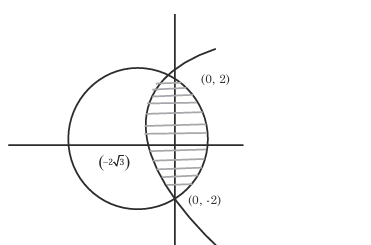
Given curves:
\( y^2 = 8x + 4 \) and \( x^2 + y^2 + 4\sqrt{3}x – 4 = 0 \)
Point of intersections are \((0, 2)\) & \((0, -2)\)
Both curves are symmetric about x-axis
Area = \( 2 \int_0^2 \left[ \sqrt{16 – y^2 – 2\sqrt{3}} – \left( \frac{y^2 – 4}{8} \right) \right] dy \)
On solving:
\( \text{Area} = \frac{1}{3} \left( 8\pi + 4 – 12\sqrt{3} \right) = \frac{1}{3} \left( 4 – 12\sqrt{3} + 8\pi \right) \)
✅ Answer: (C)
Question 10
(B) 1
(C) 2
(D) 3
▶️ Answer/Explanation
\( \frac{dy}{dx} = x + y \Rightarrow \frac{dy}{dx} – y = x \)
Integrating factor: \( e^{-x} \)
Solution: \( ye^{-x} = \int xe^{-x} dx = -xe^{-x} – e^{-x} + c \)
⇒ \( y = -x – 1 + ce^x \)
\( y_1(0) = 0 \Rightarrow c = 1 \) ⇒ \( y_1 = -x – 1 + e^x \)
\( y_2(0) = 1 \Rightarrow c = 2 \) ⇒ \( y_2 = -x – 1 + 2e^x \)
\( y_2 – y_1 = e^x > 0 \) ∴ \( y_2 \neq y_1 \)
Number of points of intersection is zero
✅ Answer: (A)
Question 11
(B) 25
(C) 40
(D) 65
▶️ Answer/Explanation
P(a, b) on \( y^2 = 8x \) ⇒ \( b^2 = 8a \)
Tangent at P: \( yb = 4(x + a) \)
Passes through centre (5, 7) of circle
7b = 4(5 + a) ⇒ 7b = 20 + 4a
Also b² = 8a
Solving: \( \left(\frac{7b – 20}{4}\right)^2 = 8a \)
Substitute and solve: b = 4, 10 ⇒ a = 2, 25/2
A = 2 × 25/2 = 25, B = 4 × 10 = 40
A + B = 65
✅ Answer: (D)
Question 12
(B) \( \frac{39}{5} \)
(C) 9
(D) \( \frac{46}{5} \)
▶️ Answer/Explanation
Let \( \vec{a} = \alpha \hat{i} + \hat{j} + \beta \hat{k} \), \( \vec{b} = 3\hat{i} – 5\hat{j} + 4\hat{k} \)
\( \vec{a} \times \vec{b} = -\hat{i} + 9\hat{j} + 12\hat{k} \)
⇒ \( \begin{vmatrix} \hat{i} & \hat{j} & \hat{k} \\ \alpha & 1 & \beta \\ 3 & -5 & 4 \end{vmatrix} = -\hat{i} + 9\hat{j} + 12\hat{k} \)
⇒ \( (4 + 5\beta)\hat{i} + (3\beta – 4\alpha)\hat{j} + (-5\alpha – 3)\hat{k} = -\hat{i} + 9\hat{j} + 12\hat{k} \)
Comparing coefficients:
\( 4 + 5\beta = -1 \) ⇒ \( \beta = -1 \)
\( 3\beta – 4\alpha = 9 \) ⇒ \( -3 – 4\alpha = 9 \) ⇒ \( \alpha = -3 \)
\( -5\alpha – 3 = 12 \) ⇒ \( 15 – 3 = 12 \) ✓
∴ \( \vec{a} = -3\hat{i} + \hat{j} – \hat{k} \), \( \vec{b} = 3\hat{i} – 5\hat{j} + 4\hat{k} \)
\( \vec{b} – 2\vec{a} = (3\hat{i} – 5\hat{j} + 4\hat{k}) – 2(-3\hat{i} + \hat{j} – \hat{k}) = 9\hat{i} – 7\hat{j} + 6\hat{k} \)
\( \vec{b} + \vec{a} = (3\hat{i} – 5\hat{j} + 4\hat{k}) + (-3\hat{i} + \hat{j} – \hat{k}) = -4\hat{j} + 3\hat{k} \)
Projection = \( \frac{(\vec{b} – 2\vec{a}) \cdot (\vec{b} + \vec{a})}{|\vec{b} + \vec{a}|} = \frac{(9)(0) + (-7)(-4) + (6)(3)}{\sqrt{0^2 + (-4)^2 + 3^2}} = \frac{28 + 18}{5} = \frac{46}{5} \)
✅ Answer: (D)
Question 13
(B) 5
(C) \( \sqrt{21} \)
(D) \( \sqrt{17} \)
▶️ Answer/Explanation
\( \vec{a} = 2\hat{i} – \hat{j} + 5\hat{k} \), \( \vec{b} = \alpha \hat{i} + \beta \hat{j} + 2\hat{k} \)
Using vector triple product: \( (\vec{a} \times \vec{b}) \times \hat{i} = (\vec{a} \cdot \hat{i})\vec{b} – (\vec{b} \cdot \hat{i})\vec{a} \)
\( \vec{a} \cdot \hat{i} = 2 \), \( \vec{b} \cdot \hat{i} = \alpha \)
∴ \( (\vec{a} \times \vec{b}) \times \hat{i} = 2\vec{b} – \alpha\vec{a} \)
Given \( \left( (\vec{a} \times \vec{b}) \times \hat{i} \right) \cdot \hat{k} = \frac{23}{2} \)
⇒ \( (2\vec{b} – \alpha\vec{a}) \cdot \hat{k} = \frac{23}{2} \)
⇒ \( 2(2) – \alpha(5) = \frac{23}{2} \)
⇒ \( 4 – 5\alpha = \frac{23}{2} \)
⇒ \( 5\alpha = 4 – \frac{23}{2} = -\frac{15}{2} \)
⇒ \( \alpha = -\frac{3}{2} \)
Now, \( \vec{b} \times 2\hat{j} = 2 \begin{vmatrix} \hat{i} & \hat{j} & \hat{k} \\ \alpha & \beta & 2 \\ 0 & 1 & 0 \end{vmatrix} = 2[-\hat{i}(0) + \hat{j}(0) + \hat{k}(\alpha)] = 2\alpha\hat{k} \)
\( |\vec{b} \times 2\hat{j}| = |2\alpha\hat{k}| = 2|\alpha| = 2 \times \frac{3}{2} = 3 \)
Wait, let me recalculate:
\( \vec{b} \times 2\hat{j} = \begin{vmatrix} \hat{i} & \hat{j} & \hat{k} \\ -\frac{3}{2} & \beta & 2 \\ 0 & 2 & 0 \end{vmatrix} = \hat{i}(0-4) – \hat{j}(0-0) + \hat{k}(-3-0) = -4\hat{i} – 3\hat{k} \)
\( |\vec{b} \times 2\hat{j}| = \sqrt{(-4)^2 + (-3)^2} = \sqrt{16 + 9} = 5 \)
✅ Answer: (B)
Question 14
(B) 1.2085
(C) 1.0285
(D) 1.1521
▶️ Answer/Explanation
\( n(S) = 9 \times 10^4 = 90000 \) (all 5-digit numbers)
Smallest 5-digit number divisible by 7: 10003
Largest 5-digit number divisible by 7: 99995
Number of 5-digit numbers divisible by 7: \( \frac{99995 – 10003}{7} + 1 = \frac{89992}{7} + 1 = 12856 + 1 = 12857 \)
Smallest 5-digit number divisible by 35: 10010
Largest 5-digit number divisible by 35: 99995
Number of 5-digit numbers divisible by 35: \( \frac{99995 – 10010}{35} + 1 = \frac{89985}{35} + 1 = 2571 + 1 = 2572 \)
Numbers divisible by 7 but not by 35: \( 12857 – 2572 = 10285 \)
\( p = \frac{10285}{90000} \)
\( 9p = \frac{10285}{10000} = 1.0285 \)
✅ Answer: (C)
Question 15
(B) \( \sqrt{3} – 1 \)
(C) \( \sqrt{7} – 2 \)
(D) \( \sqrt{7} – \sqrt{3} \)
▶️ Answer/Explanation
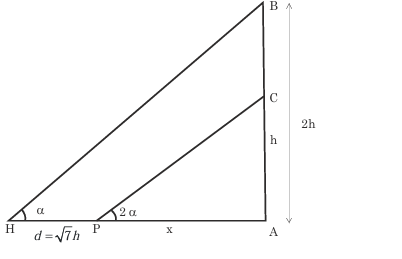
Let AP = x
From first position: \( \tan 2\alpha = \frac{h}{x} \)
From second position: \( \tan \alpha = \frac{2h}{x + \sqrt{7}h} \)
Using double angle formula: \( \tan 2\alpha = \frac{2\tan \alpha}{1 – \tan^2 \alpha} = \frac{h}{x} \)
Also \( \tan \alpha = \frac{2h}{x + \sqrt{7}h} \) ⇒ \( x = \frac{2h}{\tan \alpha} – \sqrt{7}h \)
Substitute in first equation:
\( \frac{2\tan \alpha}{1 – \tan^2 \alpha} = \frac{h}{\frac{2h}{\tan \alpha} – \sqrt{7}h} = \frac{1}{\frac{2}{\tan \alpha} – \sqrt{7}} \)
Let \( t = \tan \alpha \)
\( \frac{2t}{1 – t^2} = \frac{1}{\frac{2}{t} – \sqrt{7}} = \frac{t}{2 – \sqrt{7}t} \)
Cross multiply: \( 2t(2 – \sqrt{7}t) = t(1 – t^2) \)
Divide by t (t ≠ 0): \( 4 – 2\sqrt{7}t = 1 – t^2 \)
\( t^2 – 2\sqrt{7}t + 3 = 0 \)
\( t = \frac{2\sqrt{7} \pm \sqrt{28 – 12}}{2} = \frac{2\sqrt{7} \pm 4}{2} = \sqrt{7} \pm 2 \)
Since \( \alpha \) is acute, \( \tan \alpha = \sqrt{7} – 2 \)
✅ Answer: (C)
Question 16
(B) \( \neg p \)
(C) \( q \)
(D) \( \neg q \)
▶️ Answer/Explanation
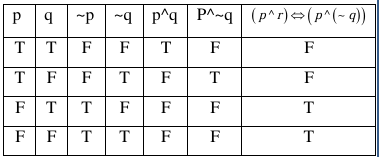
Given: \( (p \land r) \Leftrightarrow (p \land (\neg q)) \equiv (\neg p) \)
Taking r = q:
The truth values match ¬p exactly.
✅ Answer: (C)
Question 17
(B) \( \frac{5}{11} \)
(C) 6
(D) 7
▶️ Answer/Explanation
Given planes are perpendicular:
\( (2)(3k) + (k)(-k) + (-5)(1) = 0 \)
\( 6k – k^2 – 5 = 0 \)
\( k^2 – 6k + 5 = 0 \)
\( (k – 1)(k – 5) = 0 \)
\( k = 1 \) or \( k = 5 \)
Given \( k < 3 \) ⇒ \( k = 1 \)
Plane through intersection: \( (2x + y – 5z – 1) + \lambda(3x – y + z – 5) = 0 \)
⇒ \( (2 + 3\lambda)x + (1 – \lambda)y + (-5 + \lambda)z + (-1 – 5\lambda) = 0 \)
x-intercept = 1 ⇒ put y = 0, z = 0:
\( (2 + 3\lambda)x + (-1 – 5\lambda) = 0 \)
\( x = \frac{1 + 5\lambda}{2 + 3\lambda} = 1 \)
\( 1 + 5\lambda = 2 + 3\lambda \)
\( 2\lambda = 1 \) ⇒ \( \lambda = \frac{1}{2} \)
Plane: \( (2 + \frac{3}{2})x + (1 – \frac{1}{2})y + (-5 + \frac{1}{2})z + (-1 – \frac{5}{2}) = 0 \)
⇒ \( \frac{7}{2}x + \frac{1}{2}y – \frac{9}{2}z – \frac{7}{2} = 0 \)
Multiply by 2: \( 7x + y – 9z – 7 = 0 \)
y-intercept: put x = 0, z = 0:
\( y – 7 = 0 \) ⇒ \( y = 7 \)
✅ Answer: (D)
Question 18
(B) \( \frac{3}{4} \)
(C) \( \frac{1}{2} \)
(D) 1
▶️ Answer/Explanation
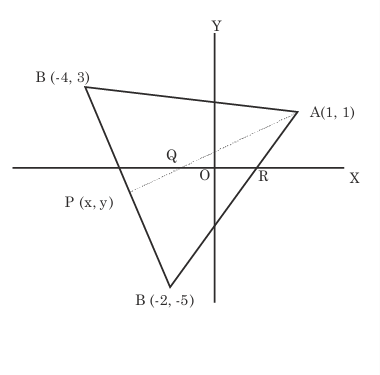
Area of triangle ABC:
\( \Delta_2 = \frac{1}{2} \begin{vmatrix} 1 & 1 & 1 \\ -4 & 3 & 1 \\ -2 & -5 & 1 \end{vmatrix} = \frac{1}{2}[1(3+5) – 1(-4+2) + 1(20+6)] = \frac{1}{2}[8 + 2 + 26] = 18 \)
Area of triangle APB = \( \frac{1}{2} \begin{vmatrix} x & y & 1 \\ 1 & 1 & 1 \\ -4 & 3 & 1 \end{vmatrix} = \frac{1}{2}[x(1-3) – y(1+4) + 1(3+4)] = \frac{1}{2}[-2x – 5y + 7] \)
Given \( \frac{\Delta_1}{\Delta_2} = \frac{4}{7} \) ⇒ \( \frac{-2x – 5y + 7}{36} = \frac{4}{7} \)
\( -2x – 5y + 7 = \frac{144}{7} \)
\( 14x + 35y = 49 – 144 = -95 \)
Equation of BC: \( \frac{y – 3}{-5 – 3} = \frac{x + 4}{-2 + 4} \) ⇒ \( \frac{y – 3}{-8} = \frac{x + 4}{2} \)
\( y – 3 = -4(x + 4) \) ⇒ \( y = -4x – 13 \)
Solving: \( 14x + 35(-4x – 13) = -95 \)
\( 14x – 140x – 455 = -95 \)
\( -126x = 360 \) ⇒ \( x = -\frac{20}{7} \)
\( y = -4(-\frac{20}{7}) – 13 = \frac{80}{7} – 13 = -\frac{11}{7} \)
P = \( \left(-\frac{20}{7}, -\frac{11}{7}\right) \)
Lines: AP and AC intersect x-axis at Q and R respectively.
Area of triangle AQR = \( \frac{1}{2} \)
✅ Answer: (C)
Question 19
(B) 4
(C) 3
(D) \( 2\sqrt{23} \)
▶️ Answer/Explanation
Circle: \( x^2 + y^2 – 2gx + 6y – 19c = 0 \)
Centre: (g, -3)
Passes through (6, 1): \( 36 + 1 – 12g + 6 – 19c = 0 \)
\( 43 – 12g – 19c = 0 \) ⇒ \( 12g + 19c = 43 \) …(1)
Centre lies on \( x – 2cy = 8 \): \( g – 2c(-3) = 8 \)
\( g + 6c = 8 \) …(2)
From (2): \( g = 8 – 6c \)
Substitute in (1): \( 12(8 – 6c) + 19c = 43 \)
\( 96 – 72c + 19c = 43 \)
\( -53c = -53 \) ⇒ \( c = 1 \)
\( g = 8 – 6 = 2 \)
Circle: \( x^2 + y^2 – 4x + 6y – 19 = 0 \)
Length of intercept on x-axis = \( 2\sqrt{g^2 – c} = 2\sqrt{4 – (-19)} = 2\sqrt{23} \)
✅ Answer: (D)
Question 20
(B) \( f'(3) + f'(5) = \frac{35}{4} \)
(C) \( f \) is increasing in \( \left(-\infty, \frac{1}{8}\right] \cup (8, \infty) \)
(D) \( f \) has a local minima at \( x = \frac{1}{8} \)
▶️ Answer/Explanation
For continuity at x = 4:
\( \lim_{x \to 4^-} f(x) = 16 + 4b \)
\( \lim_{x \to 4^+} f(x) = \int_{0}^{4}(5 – |t – 3|)dt \)
Split integral: \( \int_{0}^{3}(5 – (3 – t))dt + \int_{3}^{4}(5 – (t – 3))dt \)
= \( \int_{0}^{3}(2 + t)dt + \int_{3}^{4}(8 – t)dt \)
= \( [2t + \frac{t^2}{2}]_{0}^{3} + [8t – \frac{t^2}{2}]_{3}^{4} \)
= \( (6 + \frac{9}{2}) + [(32 – 8) – (24 – \frac{9}{2})] = \frac{21}{2} + [24 – (24 – \frac{9}{2})] = \frac{21}{2} + \frac{9}{2} = 15 \)
So \( 16 + 4b = 15 \) ⇒ \( b = -\frac{1}{4} \)
Now check each option:
(A) LHD at x = 4: \( 2x + b = 8 – \frac{1}{4} = \frac{31}{4} \)
RHD at x = 4: \( 5 – |4 – 3| = 4 \)
LHD ≠ RHD ⇒ not differentiable ✓
(B) \( f'(3) = 2(3) – \frac{1}{4} = \frac{23}{4} \)
\( f'(5) = 5 – |5 – 3| = 3 \)
Sum = \( \frac{23}{4} + 3 = \frac{35}{4} \) ✓
(C) For x ≤ 4: \( f'(x) = 2x – \frac{1}{4} \)
This is increasing for x > 1/8, not in the given interval ✗
(D) For x ≤ 4: \( f'(x) = 2x – \frac{1}{4} = 0 \) ⇒ \( x = \frac{1}{8} \)
\( f”(x) = 2 > 0 \) ⇒ local minima ✓
✅ Answer: (C)
(Section B)
Question 1
▶️ Answer/Explanation
\(\cos \left( \sin^{-1} x \right) = \cos \left( \cos^{-1} \sqrt{1-x^2} \right) = \sqrt{1-x^2}\)
\[\cot \left( \tan^{-1} \sqrt{1-x^2} \right) = \cot \cot^{-1} \left( \sqrt{\frac{1}{\sqrt{1-x^2}}} \right) = \frac{1}{\sqrt{1-x^2}}\]
\[\Rightarrow \cos \left( \sin^{-1} \left( \frac{x}{\sqrt{1-x^2}} \right) \right) = \frac{\sqrt{1-2x^2}}{\sqrt{1-x^2}}\]
\[\Rightarrow \frac{\sqrt{1-2x^2}}{\sqrt{1-x^2}} = k\]
\[\Rightarrow 1-2x^2 = k^2 \left( 1-x^2 \right)\]
\[\Rightarrow \left( k^2 – 2 \right)x^2 = k^2 – 1\]
\[x^2 = \frac{k^2 – 1}{k^2 – 2}\]
\[\alpha = \frac{k^2 – 1}{\sqrt{k^2 – 2}} \Rightarrow \alpha^2 = \frac{k^2 – 1}{k^2 – 2}\]
\[\beta = \sqrt{\frac{k^2 – 1}{k^2 – 2}} \Rightarrow \beta^2 = \frac{k^2 – 1}{k^2 – 2}\]
\[\frac{1}{\alpha^2} + \frac{1}{\beta^2} = 2 \left( \frac{k^2 – 2}{k^2 – 1} \right) \cdot \frac{\alpha}{\beta} = -1\]
Sum of roots = \(\frac{1}{\alpha^2} + \frac{1}{\beta^2} + \frac{\alpha}{\beta} = b\)
\[\Rightarrow \frac{2(k^2 – 2)}{k^2 – 1} – 1 = b \ldots (1)\]
Product of roots = \(\left( \frac{1}{\alpha^2} + \frac{1}{\beta^2} \right) \frac{\alpha}{\beta} = -5\)
\[\Rightarrow \frac{2(k^2 – 2)}{k^2 – 1} (-1) = -5\]
\[\Rightarrow 2k^2 – 4 = 5k^2 – 5\]
\[\Rightarrow 3k^2 = 1 \Rightarrow k^2 = \frac{1}{3} \ldots \text{Put in (1)}\]
\[\Rightarrow b = \frac{2(k^2 – 2)}{k^2 – 1} – 1 = 5 – 1 = 4\]
\[\frac{b}{k^2} = \frac{4}{1} = 12\]
✅ Answer: 12
Question 2
▶️ Answer/Explanation
n = 10, \(\bar{x} = \frac{\sum x_i}{10} = 15\)
\[6^2 = \frac{\sum x_i^2}{10} – (\bar{x})^2 = 15\]
\[\Rightarrow \sum_{i=1}^{10} x_i = 150\]
\[\Rightarrow \sum_{i=1}^{9} x_i + 25 = 150\]
\[\Rightarrow \sum_{i=1}^{9} x_i = 125\]
\[\Rightarrow \sum_{i=1}^{9} x_i + 15 = 140\]
Actual mean = \(\frac{140}{10}\) = \(14 = \overline{x}_{new}\)
\[\sum_{i=1}^{9} \frac{x_i^2 + 25^2 – 15^2}{10} = 15\]
\[\Rightarrow \sum_{i=1}^{9} x_i^2 + 625 = 2400\]
\[\sum_{i=1}^{9} x_i^2 = 1775\]
\[\sum_{i=1}^{9} x_i^2 + 15^2 = 2000 = \left( \sum_{i=1}^{9} x_i^2 \right)_{actual}\]
\[6^2_{actual} = \left( \sum_{i=1}^{9} x_i^2 \right)_{actual} – \left( \overline{x}_{new} \right)^2\]
\[= \frac{2000}{10} – 14^2\]
\[= 200 \cdot 196 = 4\]
(S.D)\(_{actual}\) = 6 = 2
✅ Answer: 2
Question 3
▶️ Answer/Explanation
Equation of plane
\(4ax – y + 5z – 7a + \lambda (2x – 5y – z – 3) = 0\)
this satisfy (4, -1, 0)
\(16a + 1 – 7a + \lambda (8 + 5 – 3) = 0\)
\(9a + 1 + 10\lambda = 0 \ldots (1)\)
Normal vector of the plane A is \((4a + 2\lambda, -1 – 5\lambda, 5 – \lambda)\) vector along the line which contained the plane A is \(i – 2j + k\)
\(: 4a + 2\lambda + 2 + 10\lambda + 5 – \lambda = 0\)
\(11\lambda + 4a + 7 = 0 \ldots (2)\)
Solve (1) and (2) to get a = 1, \(\lambda = -1\)
Now equation of plane
\(x + 2y + 3z – 2 = 0\)
Let the point in the line \(\frac{x-3}{7} = \frac{y-2}{-1} = \frac{z-3}{-4} = t\)
is \((7t + 3, -t + 2, -4t + 3)\) satisfy the equation of plane A
\(7t + 3 – 2t + 4 + 9 \cdot 12t – 2 = 0\)
t = 2
So \(\alpha + \beta + \gamma = 2t + 8 = 12\)
✅ Answer: 12
Question 4
▶️ Answer/Explanation
Hyp : \(\frac{y^2}{64} – \frac{x^2}{49} = 1\)
An ellipse \(E : \frac{x^2}{a^2} + \frac{y^2}{b^2} = 1\) passes through the vertices of the hyperbola \(H : \frac{x^2}{49} – \frac{y^2}{64} = -1\).
So \( b^2 = 64 \)
\[ e_H = \sqrt{1 + \frac{a^2}{b^2}} = \sqrt{1 + \frac{49}{64}} \]
Ellipse \(\frac{x^2}{a^2} + \frac{y^2}{b^2} = 1\)
\[ e_E = \sqrt{1 – \frac{a^2}{b^2}} = \sqrt{1 – \frac{a^2}{64}} \]
\[ b = 8, \sqrt{\frac{1 – a^2}{64}} \times \sqrt{\frac{113}{8}} = \frac{1}{2} \Rightarrow \sqrt{64 – a^2} \times \sqrt{113} = 32 \]
\[\left( 64 – a^2 \right) = \frac{32^2}{113}\]
\[\Rightarrow a^2 = 64 – \frac{32^2}{113}\]
\[ l = \frac{2a^2}{b} = \frac{2}{8} \left( 64 – \frac{32^2}{113} \right) = \frac{1552}{113} \]
\[ 113l = 1552 \]
✅ Answer: 1552
Question 5
▶️ Answer/Explanation
\[\sin \left( 2x^2 \right) \ln \left( \tan x^2 \right) dy + \left( 4xy – 4\sqrt{2}x \sin \left( x^2 – \frac{\pi}{4} \right) \right) dx = 0\]
\[\ln \left( \tan x^2 \right) dy + \frac{4xydx}{\sin \left( 2x^2 \right)} – \frac{4\sqrt{2}x \sin \left( x^2 – \frac{\pi}{4} \right)}{\sin \left( 2x^2 \right)} dx = 0\]
\[d \left( y. \ln \left( \tan x^2 \right) \right) – 4\sqrt{2}x \frac{\left( \sin x^2 – \cos x^2 \right)}{\sqrt{2} – 2\sin x^2 \cos x^2} dx = 0\]
\[d \left( y \ln \left( \tan x^2 \right) \right) – \frac{4x \left( \sin x^2 – \cos x^2 \right)}{\left( \sin x^2 + \cos^2 \right) – 1} dx = 0\]
\[\Rightarrow \int d \left( y \ln \left( \tan x^2 \right) \right) + 2 \int \frac{dt}{t^2 – 1} = \int 0\]
\[\Rightarrow y \ln \left( \tan x^2 \right) + 2. \frac{1}{2} \ln \left| \frac{t – 1}{t + 1} \right| = c\]
\[y \ln \left( \tan x^2 \right) + \ln \left( \frac{\sin x^2 + \cos x^2 – 1}{\sin x^2 + \cos x^2 + 1} \right) = c\]
Put \( y = 1 \) and \( x = \sqrt{\frac{\pi}{6}} \)
\[1 \ln \left( \frac{1}{\sqrt{3}} \right) + \ln \left( \frac{\frac{1}{2} + \frac{\sqrt{3}}{2} – 1}{\frac{1}{2} + \frac{\sqrt{3}}{2} + 1} \right) = c\]
Now
\[x = \sqrt{\frac{\pi}{3}} \Rightarrow y \ln \left( \sqrt{3} \right) + \ln \left( \frac{\frac{1}{2} + \frac{\sqrt{3}}{2} – 1}{\frac{1}{2} + \frac{\sqrt{3}}{2} + 1} \right) = \ln \left( \frac{1}{\sqrt{3}} \right) + \ln \left( \frac{\sqrt{3} – 1}{\sqrt{3} + 3} \right)\]
\[y \left( \ln \sqrt{3} \right) = \ln \left( \frac{1}{\sqrt{3}} \right)\]
\[\Rightarrow y = -1\]
\[|y| = 1\]
✅ Answer: 1
Question 6
▶️ Answer/Explanation
\( y^5 – 9xy + 2x = 0 \)
\(5y^4 \frac{dy}{x} – 9x \frac{dy}{dx} – 9y + 2 = 0\)
\(\frac{dy}{dx} \left( 5y^4 – 9x \right) = 9y – 2\)
\(\frac{dy}{dx} = \frac{9y – 2}{5y^4 – 9x} = 0 \quad (\text{for horizontal tangent})\)
\(y = \frac{2}{9} \Rightarrow \text{Which does not satisfy the original equation} \Rightarrow M = 0.\)
Now \(5y^4 – 9x = 0\) (for vertical tangent)
\(5y^4 (9y – 2) – 9y^5 = 0\)
\(y^4 [45y – 10 – 9y] = 0\)
\(y = 0 \ (\text{Or}) \ 36y = 10\)
\(y = \frac{5}{18}\)
\(y = 0 \Rightarrow x = 0 \ \& \ y = \frac{5}{18} \Rightarrow x =\)
\(\begin{pmatrix} 0, 0 \\ x, \frac{5}{18} \end{pmatrix}\)
N = 2
M + N = 0 + 2 = 2
✅ Answer: 2
Question 7
▶️ Answer/Explanation
\(f(x) = 2x^2 – x – 1\)
If \((x) \leq 800\)
\(2n^2 – n – 801 \leq 0\)
\(n^2 – \frac{1}{2} n – \frac{801}{2} \leq 0\)
\(\left( n – \frac{1}{4} \right)^2 – \frac{801}{2} – \frac{1}{16} \leq 0\)
\(\left( n – \frac{1}{4} \right)^2 – \frac{6409}{16} \leq 0\)
\(\left( n – \frac{1}{4} – \sqrt{6409} \right) \left( n – \frac{1}{4} + \sqrt{6409} \right) \leq 0\)
\(\frac{1 – \sqrt{6409}}{4} \leq n \leq \frac{1 + \sqrt{6409}}{4}\)
\(n = \{-19, -18 – 17, …, 0, 1, 2, …, 20\}\)
\(\sum_{x \in S} f(x) = \sum \left( 2x^2 – x – 1 \right)\)
\(= 2 \left[ 19^2 + 18^2 + … + 1^2 + 1^2 + 2^2 + … + 19^2 + 20^2 \right]\)
\(= 4 \left[ 1^2 + 2^2 + … + 19^2 \right] + 2 \left[ 20^2 \right] – 20 – 40\)
\(= \frac{4 \times 19 \times 20 \times \left( 2 \times 19 + 1 \right)}{6} + 2 \times 400 – 60\)
\(= \frac{4 \times 19 \times 20 \times 39}{6} + 800 – 60 – 9880 + 800 – 60\)
\(= 10620\)
✅ Answer: 10620
Question 8
▶️ Answer/Explanation
\(Tr \left( AA^T \right) = 6\)
\(AA^T = \begin{bmatrix} a & d & g \\ b & e & h \\ c & f & i \end{bmatrix} \begin{bmatrix} a & b & c \\ d & e & f \\ g & h & i \end{bmatrix}\)
Now given \(a^2 + d^2 + g^2 + b^2 + e^2 + h^2 + c^2 + f^2 + i^2 = 6\)
\(= ^9 C_3 \times 2^6\)
\(= 5376\)
✅ Answer: 5376
Question 9
▶️ Answer/Explanation
\( \lambda + \ell = 75 \)
\(x^2 + 4y^2 + 2x + 8y – \lambda = 0\)
\(\frac{(x+1)^2}{\lambda + 5} + \frac{(y+1)^2}{\lambda + 5} = 1\)
\(a^2 = \lambda + 5, b^2 = \frac{\lambda + 5}{4}\)
\(e^2 = 1 – \frac{b^2}{a^2} = \frac{3}{4}\)
L.R = \(\frac{2b^2}{a} = 4\)
\(\frac{2 \times \frac{\lambda + 5}{4}}{\sqrt{\lambda + 5}} = 4\)
\(\frac{\sqrt{\lambda + 5}}{2} = 4\)
\(\lambda + 5 = 64 \Rightarrow \lambda = 59\)
\(\ell = 2a = 2 \times 8 = 16\)
\(\lambda + \ell = 59 + 16 = 75\)
✅ Answer: 75
Question 10
▶️ Answer/Explanation
\( S = \{ z \in C : z^2 + \overline{z} = 0 \} \)
Let \( z = x + iy \)
\(z^2 = x^2 – y^2 + 2ixy\)
\(\overline{z} = x – iy\)
\(z^2 + \overline{z} = x^2 – y^2 + x + i(2xy – y) = 0\)
\(\Rightarrow x^2 + x – y^2 = 0 \) & \( 2xy – y = 0\)
\( y = 0 \) or \( x = \frac{1}{2} \)
If \( y = 0; x = 0, -1 \)
If \( x = \frac{1}{2}; y = \frac{\sqrt{3}}{2}, -\frac{\sqrt{3}}{2} \)
\(\sum_{z \in S} \left( \operatorname{Re}(z) + \operatorname{Im}(z) \right) = \left( 0 – 1 + \frac{1}{2} + \frac{1}{2} \right) + \left( 0 + 0 + \frac{\sqrt{3}}{2} – \frac{\sqrt{3}}{2} \right) = 0\)
✅ Answer: 0