Mathematics Section-A
Question 1
(B) \(\left( \frac{5 – \sqrt{5}}{2}, \frac{5 + \sqrt{5}}{2} \right)\)
(C) \(\left( 1, \frac{5 – \sqrt{5}}{2} \right)\)
(D) \(\left( 1, \frac{5 + \sqrt{5}}{2} \right)\)
▶️ Answer/Explanation
\(f(x) = \sin^{-1} [2x^2 – 3] + \log_2 \left( \log_{\frac{1}{2}} \left( x^2 – 5x + 5 \right) \right)\)
\(P_1 : -1 \leq \left[ 2x^2 – 3 \right] < 1\)
\(\Rightarrow -1 \leq 2x^2 – 3 < 2\)
\(\Rightarrow 2 < 2x^2 < 5\)
\(\Rightarrow 1 < x^2 < \frac{5}{2}\)
\(\Rightarrow P_1 : x \in \left( \sqrt{5}, \frac{5}{2}, -1 \right) \cup \left( 1, \sqrt{5}, \frac{5}{2} \right)\)
\(P_2 : x^2 – 5x + 5 > 0\)
\(\Rightarrow \left( x – \left( \frac{5 – \sqrt{5}}{2} \right) \right) \left( x – \left( \frac{5 + \sqrt{5}}{2} \right) \right) > 0\)
\(P_3 : \log_1 \left( x^2 – 5x + 5 \right) > 0\)
\(\Rightarrow x^2 – 5x – 5 < 1\)
\(\Rightarrow x^2 – 5x + 4 < 0\)
\(\Rightarrow P_3 : x \in (1, 4)\)
\(S_0, P_1 \cap P_2 \cap P_3 = \left( 1, \frac{5 – \sqrt{5}}{2} \right)\)
✅ Answer: (C)
Question 2
(B) 3 i
(C) 1
(D) 2 – i
▶️ Answer/Explanation
Official Ans. by NTA (C)
\(\pi < \alpha, \beta < 2\pi\)
\(\frac{1 – i \sin \alpha}{1 + i (2 \sin \alpha)} = \text{Purely imaginary}\)
\(\Rightarrow \frac{(1 – i \sin \alpha)(1 – i (2 \sin \alpha))}{1 + 4 \sin^2 \alpha} = \text{Purely imaginary}\)
\(\Rightarrow \frac{1 – 2 \sin^2 \alpha}{1 + 4 \sin^2 \alpha} = 0\)
\(\Rightarrow \sin^2 \alpha = \frac{1}{2}\)
\(\Rightarrow \alpha = \left( \frac{5 \pi}{4}, \frac{7 \pi}{4} \right)\)
\(\& \frac{1 + i \cos \beta}{1 + i (-2 \cos \beta)} = \text{Purely real}\)
\(\Rightarrow \frac{(1 + i \cos \beta)(1 + 2i \cos \beta)}{1 + 4 \cos^2 \beta} = \text{Purely real}\)
\(\Rightarrow 3 \cos \beta = 0\)
\(\Rightarrow \beta = \frac{3 \pi}{2}\)
\(\Rightarrow Z_{\alpha \beta} = \sin \frac{5 \pi}{2} + i \cos 3 \pi = 1 – i\)
or
\(Z_{\alpha \beta} = \sin \frac{7 \pi}{2} + i \cos 3 \pi = -1 – i\)
Required value = \([i(1-i)+ \frac{1}{i(1+i)}]+[i(-1-i)+\frac{1}{i(-1+i)}]\)
\(= i(-2i) + \frac{1}{i} \cdot \frac{2i}{(-2)} \Rightarrow 2 – 1 = 1\)
✅ Answer: (C)
Question 3
(B) \(3x^2 – 10x – 4 = 0\)
(C) \(3x^2 – 10x + 2 = 0\)
(D) \(3x^2 – 20x + 16 = 0\)
▶️ Answer/Explanation
Bonus because ‘x’ is missing the correct will be,
\(x^2 – \left( 5 + 3^\sqrt{\log_3 5} – 5^\sqrt{\log_5 3} \right) x + 3^\left( 3(\log_3 5)^{\frac{1}{3}} – 5^(\log_5 3)^{\frac{2}{3}} – 1 \right) = 0\)
\(3^\sqrt{\log_3 5} = 3^{\sqrt{\log_3 5}. \sqrt{\log_3 5}. \sqrt{\log_5 3}} = 3^{\log_3 5. \sqrt{\log_3 3}}\)
\( = (3^{\log_35})^{\sqrt{\log_5 3}} = 5^{\sqrt{\log_5 3}} \)
\( 3^{\sqrt[3]{\log_3 5}} = 3^{\log_3 5 \cdot \sqrt[3]{\left(\log_5 3\right)^2}} = (3^{\log_3 5})^{\left(\log_5 3\right)^{2/3}} \) \( = 5^{\left(\log_5 3\right)^{2/3}} \)
So, equation is \(x^2 – 5x – 3 = 0\) and roots are \(\alpha \& \beta\)
\(\{\alpha + \beta = 5; \alpha \beta = -3\}\)
New roots are \(\alpha + \frac{1}{\beta} \& \beta + \frac{1}{\alpha}\)
i.e., \(\frac{\alpha \beta + 1}{\beta} \& \frac{\alpha \beta + 1}{\alpha}\) i.e., \(\frac{-2}{\beta} \& \frac{-2}{\alpha}\)
Let \(\frac{-2}{\alpha} = t \Rightarrow \alpha = \frac{-2}{t}\)
As \(\alpha^2 – 5\alpha – 3 = 0\)
\(\Rightarrow \left( \frac{-2}{t} \right)^2 – 5\left( \frac{-2}{t} \right) – 3 = 0\)
\(\Rightarrow \frac{4}{t^2} + \frac{10}{t} – 3 = 0\)
\(\Rightarrow 4 + 10t – 3t^2 = 0\)
\(\Rightarrow 3t^2 – 10t – 4 = 0\)
i.e., \(3x^2 – 10x – 4 = 0\)
✅ Answer: (B)
Question 4
(B) 18
(C) -50
(D) 50
▶️ Answer/Explanation
Official Ans. by NTA (B)
The characteristic equation for A is \(|A – \lambda I| = 0\)
\(\Rightarrow \begin{vmatrix} 4 – \lambda & -2 \\ \alpha & \beta – \lambda \end{vmatrix} = 0\)
\(\Rightarrow (4 – \lambda)(\beta – \lambda) + 2\alpha = 0\)
\(\Rightarrow \lambda^2 – (\beta + 4)\lambda + 4\beta + 2\alpha = 0\)
Put \(\lambda = A\)
\(A^2 – (\beta + 4)A + (4\beta + 2\alpha)I = 0\)
On comparison
\(-9(\beta + 4) = \gamma \& 4\beta + 2\alpha = 18\)
and \(|A| = 4\beta + 2\alpha = 18\)
✅ Answer: (B)
Question 5
(B) \(63q f(0) – p^2 = 0\)
(C)\( 21q f(0) – p^2 = 0\)
(D) \(7pq f(0) – 9 = 0\)
▶️ Answer/Explanation
Official Ans. by NTA (B)
\(f(0) = \lim_{x \to 0} f(x)\)
Limit should be \(\frac{0}{0}\) form
So, \(\sqrt[7]{p.729} – 3 = 0 \Rightarrow p.3^6 = 3^7 \Rightarrow p = 3\)
Now, \(f(0) = \lim_{x \to 0} \frac{\sqrt[7]{3(3^6 + x)} – 3}{\sqrt[3]{3^6 + qx} – 9}\)
\(= \lim_{x \to 0} \frac{3\left( 1 + \frac{x}{3^6} \right)^{1/7} – 1}{9\left( 1 + \frac{qx}{3^6} \right)^{1/3}} = \frac{3}{9} \times \frac{1}{7.3^6} \times \frac{1}{3.3^6}\)
\(\Rightarrow f(0) = \frac{1}{3} \times \frac{3}{7q} = \frac{1}{7q}\)
\(\Rightarrow 7qf(0) – 1 = 0\)
\(\Rightarrow 7.p^2.qf(0) – p^2 = 0 \quad (\text{for option})\)
\(\Rightarrow 63qf(0) – p^2 = 0\)
✅ Answer: (B)
Question 6
(B) both (S1) and (S2) are wrong
(C) only (S1) is correct
(D) only (S2) is correct
Question 7
(B) \(22 a_{11}\)
(C) \(15 a_{16}\)
(D) \(14 a_{16}\)
▶️ Answer/Explanation
\(S_{21} = \frac{21}{2}[2 \times 10ar + 20 \times 10ar^2]\)
\(= \frac{21}{2}[20ar + 200ar^2]\)
\(= 21[10ar + 100ar^2]\)
\(= 21. a_{11}\)
✅ Answer: (A)
Question 8
(B) \(\frac{56}{3}\)
(C) \(\frac{112}{3}\)
(D) \(\frac{80}{3}\)
▶️ Answer/Explanation
Official Ans. by NTA (D)

\(\Delta = 2 \cdot \int_{0}^{4} \left( 3\sqrt{y} – \frac{\sqrt{y}}{2} \right) dy\)\(= 2 \cdot \int_{0}^{4} \frac{5}{2} \sqrt{y} dy = \frac{80}{3}\)
✅ Answer: (D)
Question 9
(B) \(\frac{19}{12}\)
(C) \(\frac{31}{12}\)
(D) \(\frac{3}{2}\)
▶️ Answer/Explanation
\(\int_{0}^{2} \left[ 2x^2 – 3x \right] dx\)
\(= \int_{0}^{\frac{3}{2}} \left( 3x – 2x^2 \right) dx + \int_{\frac{3}{2}}^{2} \left( 2x^2 – 3x \right) dx = \frac{19}{12}\)
\(\int_{0}^{2} \left[ x – \frac{1}{2} \right] dx = \int_{\frac{-1}{2}}^{\frac{3}{2}} [t] dt\)
\(= \int_{\frac{-1}{2}}^{0} (-1) dt + \int_{0}^{1} 0 \cdot dt + \int_{1}^{\frac{3}{2}} 1 \cdot dt = 0.\)
✅ Answer: (B)
Question 10
▶️ Answer/Explanation
Given that\( A_1 = 2A_2\)
from the graph \(A_1 + A_2 = xy – 8\)
\(\Rightarrow \frac{3}{2}A_1 = xy – 8\)
\(\Rightarrow A_1 = \frac{2}{3}(xy – 8)\)
Also, \(A_1 = \int_{4}^{x} f(x) dx = \frac{2}{3}(xy – 8)\)
Differentiate both sides w.r.t. x:
\(f(x) = \frac{2}{3}(y + x \frac{dy}{dx})\)
Given slope of normal = -6, so slope of tangent = 1/6
\(\frac{dy}{dx} = \frac{1}{6}\)
Substitute into the equation:
\(y = \frac{2}{3}(y + \frac{x}{6})\)
Solving gives \(y^2 = x\)
Equation of normal: \(y + 6x = 57\)
Check options and (C) does not satisfy.
✅ Answer: (C)
Question 11
(B)\( (AC)^2 + p^2 = 136\)
(C) 32 < area (ΔABC) < 36
(D) 34 < area (ΔABC) < 38
▶️ Answer/Explanation
Official Ans. by NTA (D)
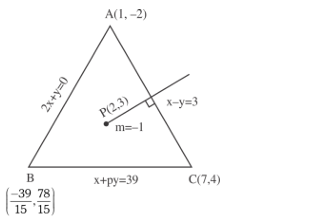
Perpendicular bisector of AB
\( x + y = 5 \)
Take image of A
\( \frac{x – 1}{1} = \frac{y + 2}{1} = \frac{-2(-6)}{2} = 6 \)
(7, 4)
\( 7 + 4p = 39 \)
p = 8
solving \( x + 8y = 39 \) and \( y = -2x \)
\( x = \frac{-39}{15} \quad y = \frac{78}{15} \)
AC\(^2\) = 72 = 9p
AC\(^2\) + p\(^2\) = 72 + 64 = 136
\( \Delta ABC = \frac{1}{2} \begin{vmatrix} 1 & -2 & 1 \\ 7 & 4 & 1 \\ -\frac{39}{15} & \frac{78}{15} & 1 \end{vmatrix} \) \( = \frac{1}{2} \left[ 4 – \frac{78}{15} + 2 \left( 7 + \frac{39}{15} \right) + 7 \left( \frac{78}{15} \right) + \frac{4 \times 39}{15} \right] \) \( = \frac{1}{2} \left[ 18 + 18 \times \frac{13}{5} \right] \) \( = 9 \left[ \frac{18}{5} \right] = \frac{162}{5} = 32.4 \)
✅ Answer: (D)
Question 12
(B) 1:5
(C) 2:5
(D) 1:3
▶️ Answer/Explanation
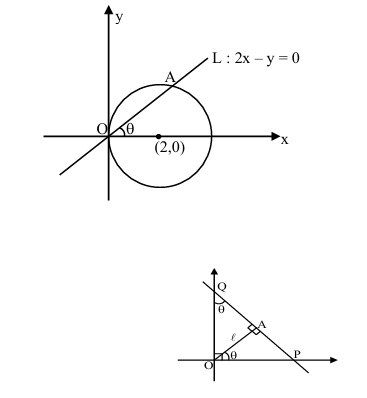
\(C_1 : x + y – 4x = 0\)
\(\tan \theta = 2\)
\( C_2 \) is a circle with OA as diameter.
So, tangent at A on \( C_2 \) is perpendicular to OR.
Let \( OA = \ell \)
\(\therefore \frac{QA}{AP} = \frac{\ell \cot \theta}{\ell \tan \theta}\)
\(= \frac{1}{\tan^2 \theta} = \frac{1}{4}\)
✅ Answer: (A)
Question 13
(B) \( 2\sqrt{3} \)
(C) \( 4\sqrt{2} \)
(D) 4
Question 14
(B) 8
(C) 12
(D) 14
▶️ Answer/Explanation
\((2\lambda-1, 3\lambda+3, -\lambda+1)\)
\((2\lambda-1-a)2+(3\lambda-1)3+(-\lambda-1)(-1)=0\)
\(\Rightarrow 4\lambda-2-2a+9\lambda-3+\lambda+1=0\)
\(\Rightarrow 14\lambda-4-2a=0\)
\(\Rightarrow 7\lambda-2-a=0\)
and,
\((2\lambda-1-a)^2+(3\lambda-1)^2+(\lambda+1)^2=24\)
\(\Rightarrow (5\lambda-1)^2+(3\lambda-1)^2+(\lambda+1)^2=24\)
\(\Rightarrow 35\lambda^2-14\lambda-21=0\)
\(\Rightarrow (\lambda-1)(35\lambda+21)=0\)
For, \(\lambda = 1\) \(\Rightarrow a = 5\)
Let \( (\alpha_1, \alpha_2, \alpha_3) \) be reflection of point P
\(\alpha_1 + 5 = 2 \quad \alpha_2 + 4 = 12 \quad \alpha_3 + 2 = 0\)
\(\alpha_1 = -3 \quad \alpha_2 = 8 \quad \alpha_3 = -2\)
\(a + \alpha_1 + \alpha_2 + \alpha_3 = 8\)
✅ Answer: (B)
Question 15
(B) \( \frac{1}{\sqrt{2}}, -\frac{1}{\sqrt{2}}, 0 \)
(C) \( \frac{1}{\sqrt{5}}, -\frac{2}{\sqrt{5}}, 0 \)
(D) \( \frac{1}{2}, -\frac{\sqrt{3}}{2}, 0 \)
▶️ Answer/Explanation
Official Ans. by NTA (B)
\[\bar{n} = \begin{vmatrix} i & j & k \\ a & b & 0 \\ a & b & c \end{vmatrix}\]
\[= bc\hat{i} – ac\hat{j}\]
Direction ratios of line are \(b, -a, 0\)
Direction ratios of normal of the plane are \(0, 1, -1\)
\[\cos60^\circ = \frac{-a}{\sqrt{2}\sqrt{b^2 + a^2}} = \frac{1}{2}\]
\[\Rightarrow \left| \frac{a}{\sqrt{a^2 + b^2}} \right| = \frac{1}{\sqrt{2}}\]
\[\Rightarrow b = \pm a\]
So, D.R.’s can be \((\pm a, -a, 0)\)
∴ D.C.’s can be \(\pm \left( \frac{\pm 1}{\sqrt{2}}, -\frac{1}{\sqrt{2}}, 0 \right)\)
✅ Answer: (B)
Question 16
(B) 529
(C) 629
(D) 630
▶️ Answer/Explanation
Let \(\alpha = \text{Mean}\) & \(\beta = \text{Variance} (\alpha > \beta)\)
So, \(\alpha + \beta = 24\), \(\alpha \beta = 128\)
\[\Rightarrow \alpha = 16 \quad \& \quad \beta = 8\]
\[\Rightarrow np = 16 \quad npq = 8 \Rightarrow q = \frac{1}{2}\]
\[\therefore p = \frac{1}{2}, n = 32\]
\[p(x > n – 3) = \frac{1}{2^n}(^n C_{n-2} + ^n C_{n-1} + ^n C_n)\]
\[\therefore k = ^{32} C_{30} + ^{32} C_{31} + ^{32} C_{32} = \frac{32 \times 31}{2} + 32 + 1\]
\[= 496 + 33 = 529\]
✅ Answer: (B)
Question 17
(B) \(\frac{5}{11}\)
(C) \(\frac{7}{11}\)
(D) \(\frac{8}{11}\)
▶️ Answer/Explanation
Official Ans. by NTA (D)
Let
\(\frac{P(a\text{ prime number})}{2} = \frac{P(a\text{ composite})}{1} = \frac{P(1)}{3} = k\)
So, P(a prime number) = 2k,
P(a composite number) = k,
\(\&\) P(1) = 3k
\(\&\) 3 × 2k + 2 × k + 3k = 1
\(\Rightarrow k = \frac{1}{11}\)
P(success) = P(1 or 4) = 3k + k = \(\frac{4}{11}\)
Number of trials, n = 2
∴ mean = np = 2 × \(\frac{4}{11}\) = \(\frac{8}{11}\)
✅ Answer: (D)
Question 18
(B) \((\left( 10 \sqrt{3} – 1 \right), \frac{25}{2})\)
(C) \((\left( 10 \sqrt{3} + 1 \right), 25)\)
(D) \((\left( 10 \sqrt{3} + 1 \right), \frac{25}{2})\)
▶️ Answer/Explanation
QA = 10 RA = dcos30° = \(\frac{\sqrt{3}d}{2}\)
QR = 10 – \(\frac{\sqrt{3}d}{2}\)
BR = dsin30° = \(\frac{d}{2}\)
tan60° = \(\frac{PQ – BR}{QR}\) = \(\frac{10 – \frac{d}{2}}{10 – \frac{\sqrt{3}d}{2}}\)
⇒ \(\sqrt{3}\) = \(\frac{20 – d}{20 – \sqrt{3}d}\)
⇒ \(20\sqrt{3} – 3d = 20 – d\)
⇒ \(2d = 20(\sqrt{3} – 1)\)
⇒ \(d = 10(\sqrt{3} – 1)\)
ar(PQRB) = α = \(\frac{1}{2}\) (PQ + BR)·QR
= \(\frac{1}{2}(10 + \frac{d}{2})\)·(10 – \(\frac{\sqrt{3}d}{2})\)
= \(\frac{1}{2}(10 + 5\sqrt{3} – 5)(10 – 15 + 5\sqrt{3})\)
= \(\frac{1}{2}(5\sqrt{3} + 5)(5\sqrt{3} – 5)\) = \(\frac{1}{2}(75 – 25)\) = 25
✅ Answer: (A)
Question 19
(B) \(S=\frac{2\pi}{3}\)
(C) \(\sum_{0 \leq S} \theta =\frac{\pi}{2}\)
(D) \(\sum_{0 \leq S} \theta = \frac{3\pi}{4}\)
▶️ Answer/Explanation
Official Ans. by NTA (C)
Let \( \alpha = \theta + (m – 1) \frac{\pi}{6} \)
\(\begin{aligned} & \beta = \theta + m \frac{\pi}{6} \\ & \text{So, } \beta – \alpha = \frac{\pi}{6} \\ \end{aligned}\)
Here,
\(\sum_{m=1}^9 \sec \alpha \cdot \sec \beta = \sum_{m=1}^9 \frac{1}{\cos \alpha \cdot \cos \beta} = 2 \sum_{m=1}^9 \frac{\sin (\beta – \alpha)}{\cos \alpha \cdot \cos \beta} = 2 \sum_{m=1}^9 (\tan \beta – \tan \alpha) =\) \( 2 \sum_{m=1}^9 \left( \tan \left( \theta + m \frac{\pi}{6} \right) – \tan \left( \theta + (m – 1) \frac{\pi}{6} \right) \right) = 2 \left( \tan \left( \theta + \frac{9\pi}{6} \right) – \tan \theta \right) = 2 \left( -\cot \theta – \tan \theta \right) = -\frac{8}{\sqrt{3}} \tag{Given}\)
\(\therefore \tan \theta + \cot \theta = \frac{4}{\sqrt{3}}\)
\(\Rightarrow \tan \theta = \frac{1}{\sqrt{3}} \text{ or } \sqrt{3}\)
So,
\(S = \left( \frac{\pi}{6}, \frac{\pi}{3} \right)\)
\(\sum_{\theta \leq S} \theta = \frac{\pi}{6} + \frac{\pi}{3} = \frac{\pi}{2}\)
✅ Answer: (C)
Question 20
(B) \( R \lor Q \rightarrow \neg P \)
(C) \(\neg (P \lor Q) \rightarrow \neg R \)
(D) \(\neg (R \lor Q) \rightarrow \neg P\)
▶️ Answer/Explanation
Official Ans. by NTA (D)
X \(\Rightarrow\) Y is a false when X is true and Y is false
So, \( P \rightarrow T, Q \rightarrow F, R \rightarrow F \)
(A) \( P \lor Q \rightarrow \neg R \) is T
(B) \( R \lor Q \rightarrow \neg P \) is T
(C) \(\neg (P \lor Q) \rightarrow \neg R \) is T
(D) \(\neg (R \lor Q) \rightarrow \neg P \) is F
✅ Answer: (D)
Section-B
Question 1
▶️ Answer/Explanation
\(A = \begin{bmatrix} \alpha & \beta & \gamma \\ \alpha^2 & \beta^2 & \gamma^2 \\ \beta + \gamma & \gamma + \alpha & \alpha + \beta \end{bmatrix} \)
\( R_3 \rightarrow R_3 + R_1 \) \(\Rightarrow |A| = |\alpha + \beta + \gamma| \begin{vmatrix} \alpha & \beta & \gamma \\ \alpha^2 & \beta^2 & \gamma^2 \\ 1 & 1 & 1 \end{vmatrix}\) \(\Rightarrow |A| = (\alpha + \beta + \gamma)(\alpha – \beta)(\beta – \gamma)(\gamma – \alpha)\)
\( |adj A| = |A|^{n-1} \] \[ |adj(adj A)| = |A|^{(n-1)^2} \] \[ |adj(adj(adj A))| = |A|^{(n-1)^4} = |A|^{16} \)
\( \frac{|A|^{16}}{(\alpha – \beta)^{16}(\beta – \gamma)^{16}(\gamma – \alpha)^{16}} = 2^{32} \cdot 3^{16} \) \( \Rightarrow (\alpha + \beta + \gamma)^{16} = 2^{32} \cdot 3^{16} \) \( \Rightarrow (\alpha + \beta + \gamma)^{16} = (2^2 \cdot 3)^{16} = (12)^{16} \) \( \Rightarrow \alpha + \beta + \gamma = 12 \) \( \therefore \alpha, \beta, \gamma \in \mathbb{N} \)
\((\alpha – 1) + (\beta – 1) + (\gamma – 1) = 9\) number of all tuples (\(\alpha, \beta, \gamma\)) = \( ^{11}C_2 = 55\)
1 case for \(\alpha = \beta = \gamma\) & 12 cases when any two of these are equal
So, No. of distinct tuples (\(\alpha, \beta, \gamma\)) = \(55 – 13 = 42\)
✅ Answer: 42
Question 2
▶️ Answer/Explanation
\( (x^2 – 10x + 9) \leq 0 \Rightarrow (x – 1)(x – 9) \leq 0 \) \(\Rightarrow x \in [1, 9] \Rightarrow A = \{1, 2, 3, 4, 5, 6, 7, 8, 9\}\) \( f(x) \leq (x – 3)^2 + 1 \)
\( x = 1: f(1) \leq 5 \Rightarrow 1^2, 2^2 \) \( x = 2: f(2) \leq 2 \Rightarrow 1^2 \) \( x = 3: f(3) \leq 1 \Rightarrow 1^2 \) \( x = 4: f(4) \leq 2 \Rightarrow 1^2 \) \( x = 5: f(5) \leq 5 \Rightarrow 1^2, 2^2 \) \( x = 6: f(6) \leq 10 \Rightarrow 1^2, 2^2, 3^2 \) \( x = 7: f(7) \leq 17 \Rightarrow 1^2, 2^2, 3^2, 4^2 \) \( x = 8: f(8) \leq 26 \Rightarrow 1^2, 2^2, 3^2, 4^2, 5^2 \) \( x = 9: f(9) \leq 37 \Rightarrow 1^2, 2^2, 3^2, 4^2, 5^2, 6^2 \)
Total number of such functions = \(2 \times 6! = 2 \times 720 = 1440\)
✅ Answer: 1440
Question 3
▶️ Answer/Explanation
\[(3 + 6x)^n = C_0 3^n + C_1 3^{n-1}(6x)^1 + \ldots\] \[T_{r+1} = {}^nC_r 3^{n-r}(6x)^r = {}^nC_r 3^{n-r} \cdot 6^r \cdot x^r\] For \( x = \frac{3}{2} \), \(T_{r+1} = {}^nC_r 3^{n-r} \cdot 6^r \cdot \left(\frac{3}{2}\right)^r = {}^nC_r 3^{n}\)
\( T_9 \) is greatest at \( x = \frac{3}{2} \), so \( T_9 > T_{10} \) and \( T_9 > T_8 \)
\[ \frac{T_9}{T_{10}} > 1 \Rightarrow \frac{{}^nC_8 \cdot 3^8}{{}^nC_9 \cdot 3^9} > 1 \Rightarrow \frac{n – 8}{9} > \frac{1}{3} \Rightarrow n > 11 \] \[ \frac{T_9}{T_8} > 1 \Rightarrow \frac{{}^nC_8 \cdot 3^8}{{}^nC_7 \cdot 3^7} > 1 \Rightarrow \frac{n – 7}{8} > \frac{1}{3} \Rightarrow n > \frac{29}{3} \] So, \( n = 10 = n_0 \)
For \(n = n_0 = 10\), in \((3 + 6x)^{10}\): \[ T_7 = {}^{10}C_6 \cdot 3^4 \cdot 6^6 \cdot x^6 \] \[ T_4 = {}^{10}C_3 \cdot 3^7 \cdot 6^3 \cdot x^3 \] \[ k = \frac{\text{coefficient of } x^6}{\text{coefficient of } x^3} = \frac{{}^{10}C_6 \cdot 3^4 \cdot 6^6}{{}^{10}C_3 \cdot 3^7 \cdot 6^3} = \frac{210}{120} \cdot \frac{1}{3^3} \cdot 6^3 = \frac{7}{4} \cdot 8 = 14 \] \[ k + n_0 = 14 + 10 = 24 \]
✅ Answer: 24
Question 4
▶️ Answer/Explanation
\( T_n = \frac{\sum_{r=1}^{n} [(2r)^3 – (2r-1)^3]}{n(4n+3)} \] \[ T_n = \frac{\sum_{r=1}^{n} [8r^3 – (8r^3 – 12r^2 + 6r – 1)]}{n(4n+3)} = \frac{\sum_{r=1}^{n} [12r^2 – 6r + 1]}{n(4n+3)} \) \( = \frac{12 \cdot \frac{n(n+1)(2n+1)}{6} – 6 \cdot \frac{n(n+1)}{2} + n}{n(4n+3)} \) \( = \frac{2n(n+1)(2n+1) – 3n(n+1) + n}{n(4n+3)} = \frac{n[2(n+1)(2n+1) – 3(n+1) + 1]}{n(4n+3)} \) \( = \frac{4n^2 + 6n + 2 – 3n – 3 + 1}{4n+3} = \frac{4n^2 + 3n}{4n+3} = n \) \( \sum_{n=1}^{15} T_n = \sum_{n=1}^{15} n = \frac{15 \times 16}{2} = 120 \)
✅ Answer: 120
Question 5
▶️ Answer/Explanation
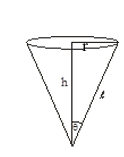
\( \tan \theta = \frac{3}{4} = \frac{r}{h} \Rightarrow r = \frac{3}{4}h \) \( V = \frac{1}{3} \pi r^2 h = \frac{1}{3} \pi \left(\frac{3}{4}h\right)^2 h = \frac{3\pi}{16} h^3 \) \( \frac{dV}{dt} = \frac{3\pi}{16} \cdot 3h^2 \cdot \frac{dh}{dt} = 6 \Rightarrow \left( \frac{dh}{dt} \right)_{h=4} = \frac{2}{3\pi} \text{ m/hr} \)
Slant height \( l = \sqrt{r^2 + h^2} = \sqrt{\left(\frac{3}{4}h\right)^2 + h^2} = \frac{5}{4}h \)
Wet curved surface area \( S = \pi r l = \pi \cdot \frac{3}{4}h \cdot \frac{5}{4}h = \frac{15\pi}{16} h^2 \)
\( \frac{dS}{dt} = \frac{15\pi}{16} \cdot 2h \cdot \frac{dh}{dt} \) \( \left( \frac{dS}{dt} \right)_{h=4} = \frac{15\pi}{16} \cdot 8 \cdot \frac{2}{3\pi} = 5 \text{ m}^2/\text{hr} \)
✅ Answer: 5
Question 6
▶️ Answer/Explanation
\((\alpha, \alpha)\) lies on \(C\): \( \alpha^2 + \alpha^2 – 3 + (\alpha^2 – \alpha^2 – 1)^5 = 0 \Rightarrow 2\alpha^2 – 3 + (-1)^5 = 0 \Rightarrow 2\alpha^2 – 4 = 0 \Rightarrow \alpha = \sqrt{2} \)
Differentiate \(C\) w.r.t. \(x\): \( 2x + 2y y’ + 5(x^2 – y^2 – 1)^4 (2x – 2y y’) = 0 \quad \text{(1)} \) At \((\sqrt{2}, \sqrt{2})\), \(x^2 – y^2 – 1 = -1\): \( 2\sqrt{2} + 2\sqrt{2} y’ + 5(1)(2\sqrt{2} – 2\sqrt{2} y’) = 0………….(1) \) \( \sqrt{2}(1 + y’) + 5\sqrt{2}(1 – y’) = 0 \Rightarrow 6 – 4y’ = 0 \Rightarrow y’ = \frac{3}{2}……………(2) \)
Diff. (1) w.r.t. x
Again, Diff. (1) w.r.t. x
\( 1 + (y’)^2 + yy” + 20 \left( x^2 – y^2 – 1 \right)^3 (x – yy’)^2 \cdot 2 \) \( + 5 \left( x^2 – y^2 – 1 \right)^4 \left( 1 – (y’)^2 – yy” \right) = 0 \) At \(\left( \sqrt{2}, \sqrt{2} \right)\) and \(y’ = \frac{3}{2}\)
We have, \( \left( 1 + \frac{9}{4} \right) + \sqrt{2}y” – 40 \left( \sqrt{2} – \sqrt{2} \cdot \frac{3}{2} \right)^2 \) \( + 5 \left( 1 \right) \left( 1 – \frac{9}{4} – \sqrt{2}y” \right) = 0 \) \(\Rightarrow\) \( 4\sqrt{2}y” = -23 \) ∴ \( 3y’ – y^3y” = \frac{9}{2} + \frac{23}{2} = 16 \)
✅ Answer: 16
Question 7
▶️ Answer/Explanation
f(x) = [x] – 10
\( \int_{0}^{10}f(x)dx = \int_{0}^{10}([x] – 10)dx = -10 – 9 – 8 – \ldots – 1 = -\frac{10 \cdot 11}{2} = -55 \)\( \int_{0}^{10}(f(x))^2dx = 10^2 + 9^2 + 8^2 + \ldots + 1^2 = \frac{10 \cdot 11 \cdot 21}{6} = 385 \) \( \int_{0}^{10}|f(x)|dx = 10 + 9 + 8 + \ldots + 1 = \frac{10 \cdot 11}{2} = 55 \) Sum = \(-55 + 385 + 55 = 385\)
✅ Answer: 385
Question 8
▶️ Answer/Explanation
Let \( \frac{\lambda^2 x}{3} = t \Rightarrow \lambda = \sqrt{\frac{3t}{x}} \Rightarrow d\lambda = \frac{\sqrt{3}}{2\sqrt{x}} \cdot \frac{dt}{\sqrt{t}} \)
\[ f(x) = \frac{2}{\sqrt{3}} \int_{0}^{x} f(t) \cdot \frac{\sqrt{3}}{2\sqrt{x}} \cdot \frac{dt}{\sqrt{t}} = \frac{1}{\sqrt{x}} \int_{0}^{x} \frac{f(t)}{\sqrt{t}} dt \] Differentiate w.r.t. \(x\): \[ f'(x) = -\frac{1}{2x^{3/2}} \int_{0}^{x} \frac{f(t)}{\sqrt{t}} dt + \frac{1}{\sqrt{x}} \cdot \frac{f(x)}{\sqrt{x}} = -\frac{1}{2x} f(x) + \frac{f(x)}{x} \] \[ \Rightarrow f'(x) = \frac{f(x)}{2x} \Rightarrow \frac{dy}{y} = \frac{dx}{2x} \Rightarrow \ln y = \frac{1}{2} \ln x + c \] \[ \Rightarrow y = k\sqrt{x}, \quad f(1) = \sqrt{3} \Rightarrow k = \sqrt{3} \Rightarrow f(x) = \sqrt{3x} \] \[ f(\alpha) = 6 \Rightarrow \sqrt{3\alpha} = 6 \Rightarrow 3\alpha = 36 \Rightarrow \alpha = 12 \]
✅ Answer: 12
Question 9
▶️ Answer/Explanation
Tangent to \(C_1\): \( y = mx \pm \sqrt{4m^2 + 9} \)
Tangent to \(C_2\): \( y = mx \pm \sqrt{42m^2 – 143} \)
For common tangent: \( \sqrt{4m^2 + 9} = \sqrt{42m^2 – 143} \)
\( \Rightarrow 4m^2 + 9 = 42m^2 – 143 \Rightarrow 38m^2 = 152 \Rightarrow m^2 = 4 \Rightarrow m = \pm 2 \)
T does not pass through IV quadrant ⇒ slope positive ⇒ m = 2
Equation of tangent: \( y = 2x \pm \sqrt{25} = 2x \pm 5 \)
Point of contact on \(C_1\): \( \frac{xx_1}{4} + \frac{yy_1}{9} = 1 \)
Compare with \( y = 2x + 5 \): \( \frac{x_1}{4} = \frac{2y_1}{9} \) and \( \frac{y_1}{9} = \frac{1}{5} \)
\( \Rightarrow y_1 = \frac{9}{5}, x_1 = \frac{-8}{5} \)
Point of contact on \(C_2\): \( \frac{xx_2}{42} – \frac{yy_2}{143} = 1 \)
Compare with \( y = 2x + 5 \): \( \frac{x_2}{42} = \frac{2y_2}{143} \) and \( \frac{y_2}{143} = \frac{1}{5} \)
\( \Rightarrow y_2 = \frac{143}{5}, x_2 = \frac{-84}{5} \)
\( |2x_1 + x_2| = |\frac{-100}{5}| = 20 \)
✅ Answer: 20
Question 10
▶️ Answer/Explanation
Given: \[ \vec{a} \times \vec{b} = 4 \vec{c}, \quad \vec{b} \times \vec{c} = 9 \vec{a}, \quad \vec{c} \times \vec{a} = \alpha \vec{b} \]
From \(\vec{a} \times \vec{b} = 4 \vec{c}\): \(\vec{a} \cdot \vec{c} = 0 = \vec{b} \cdot \vec{c}\)
From \(\vec{b} \times \vec{c} = 9 \vec{a}\): \(\vec{a} \cdot \vec{b} = 0 = \vec{a} \cdot \vec{c}\)
\(\therefore \vec{a}, \vec{b}, \vec{c}\) are mutually perpendicular vectors.
From the given equations: \[ |\vec{a}| |\vec{b}| = 4|\vec{c}| \quad ……….\text{(1)} \] \[ |\vec{b}| |\vec{c}| = 9|\vec{a}| \quad ………\text{(2)} \] \[ |\vec{c}| |\vec{a}| = \alpha |\vec{b}| \quad ………\text{(3)} \]
From (1) and (2): \[ \frac{|\vec{a}|}{|\vec{c}|} = \frac{4|\vec{c}|}{9|\vec{a}|} \Rightarrow |\vec{a}|^2 = \frac{4}{9}|\vec{c}|^2 \Rightarrow |\vec{c}| = \frac{3}{2}|\vec{a}| \]
From (1): \(|\vec{b}| = \frac{4|\vec{c}|}{|\vec{a}|} = \frac{4 \cdot \frac{3}{2}|\vec{a}|}{|\vec{a}|} = 6\)
Given: \(|\vec{a}| + |\vec{b}| + |\vec{c}| = \frac{1}{36}\) \[ |\vec{a}| + 6 + \frac{3}{2}|\vec{a}| = \frac{1}{36} \Rightarrow \frac{5}{2}|\vec{a}| + 6 = \frac{1}{36} \] \[ \Rightarrow \frac{5}{2}|\vec{a}| = \frac{1}{36} – 6 = -\frac{215}{36} \Rightarrow |\vec{a}| = -\frac{43}{18} \] This gives negative magnitude which is not possible.
But if \(|\vec{a}| + |\vec{b}| + |\vec{c}| = 36\): \[ \frac{5}{2}|\vec{a}| + 6 = 36 \Rightarrow \frac{5}{2}|\vec{a}| = 30 \Rightarrow |\vec{a}| = 12 \] \[ |\vec{c}| = \frac{3}{2} \times 12 = 18 \]
From (3): \[ \alpha = \frac{|\vec{c}| |\vec{a}|}{|\vec{b}|} = \frac{18 \times 12}{6} = 36 \]
✅ Answer: 36