Home / JEE_Main_2023_JAN 25_ FIRST_SHIFT_PAPER_Chemistry
Chemistry Section-A
Question 1

Which of the following statements is incorrect for antibiotics?

(A) An antibiotic should be effective in low concentrations.

(B) An antibiotic must be a product of metabolism.

(C) An antibiotic should promote the growth or survival of microorganisms

(D) An antibiotic is a synthetic substance produced as a structural analogue of naturally occurring antibiotic.

▶️ Answer/Explanation
Markscheme

Answer: (C) An antibiotic should promote the growth or survival of microorganisms

Explanation:

Antibiotics is an antimicrobial substance, it inhibits the growth of microbes. It should not promote growth or survival of microorganism. Low concentration of antibiotics is enough to increase antimicrobial resistance.

Question 2

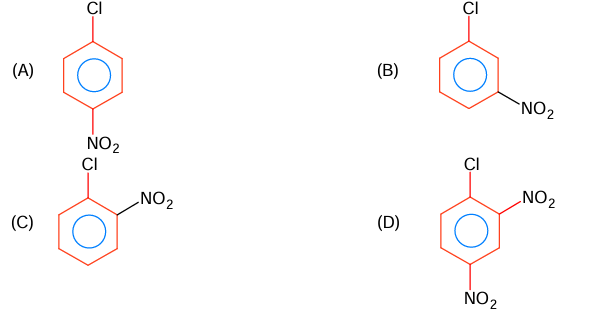
The compound which will have the lowest rate towards nucleophilic aromatic substitution on treatment with OH⁻ is

▶️ Answer/Explanation
Markscheme


Answer: (A) Cl-NO₂ (meta)

Explanation:

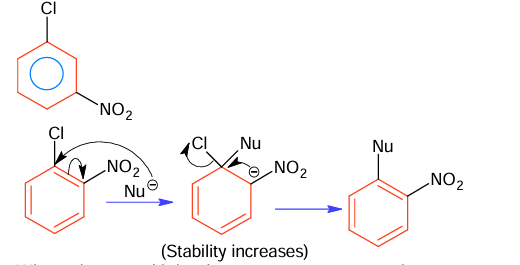
When electron withdrawing group present at meta position it will have lowest rate of nucleophilic aromatic substitution. When electron withdrawing group present at ortho & para position it increases the rate of nucleophilic aromatic substitution.
Question 3

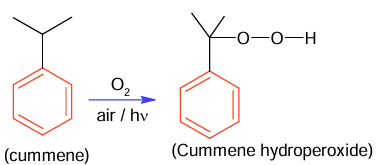
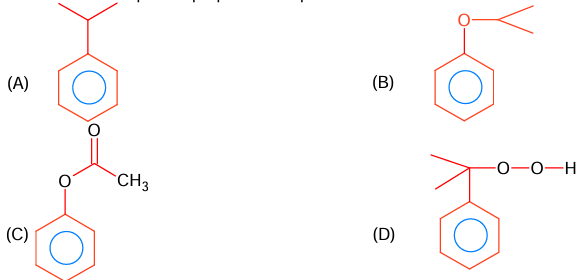
In the cumene to phenol preparation in presence of air, the intermediate is

▶️ Answer/Explanation
Markscheme


Answer: (A) Cumene hydroperoxide

Explanation:

Cumene hydroperoxide is an intermediate formed during phenol formation from cumene.
Question 4

’25 volume’ hydrogen peroxide means

(A) 1 L marketed solution contains 250g of H₂O₂.

(B) 1 L marketed solution contains 25g of H₂O₂.

(C) 100 mL marketed solution contains 25 g of H₂O₂.

(D) 1 L marketed solution contains 75 g of H₂O₂.

▶️ Answer/Explanation
Markscheme

Answer: (D) 1 L marketed solution contains 75 g of H₂O₂.

Explanation:

\( 2H_2O_2 \longrightarrow H_2O + O_2 \)
25 “V” means
1 volume of \( H_2O_2 \) gives 25 volume \( H_2O_2 \)
\[ \therefore M = \frac{V.S}{11.2} = \frac{25}{11.2} \]
\[ g/L = \frac{25}{11.2} \times 34 = 75.89 \approx 76 \]
Or

Strength in g/L = N × Eq.wt = (V.S/5.6) × Eq.wt = (25/5.6) × 17 = 75.89 ≈ 76 g/L

Question 5

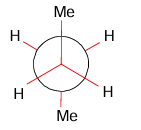
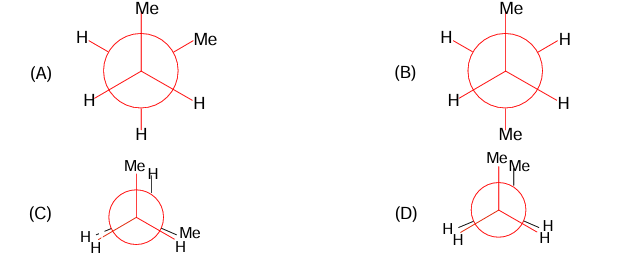
Which of the following conformations will be the most stable?

▶️ Answer/Explanation
Markscheme


Answer: (A) Anti conformation

Explanation:

Anti form is most stable conformer. It has lowest Vanderwaal & torsional strain.
Question 6

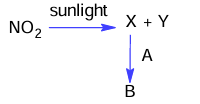
Some reactions of NO₂ relevant to photochemical smog formation are:

Identify A, B, X and Y

(A) X = N₂O, Y= [O], A = O₃, B= NO

(B) X = ½O₂, Y = NO₂, A = O₃, B = O₂

(C) X = NO, Y= [O], A = O₂, B=N₂O₃

(D) X= [O], Y= NO, A = O₂, B = O₃

▶️ Answer/Explanation
Markscheme

Answer: (D) X= [O], Y= NO, A = O₂, B = O₃

Explanation:

Photochemical smog formation reactions are:
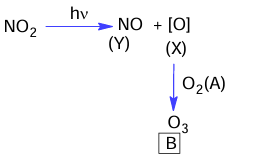


Thus X = [O], Y = NO, A = O₂, B = O₃
Question 7

Match List I with List II

List-I (Elements)List-II (Colour imparted to the flame)
A. KI. Brick Red
B. CaII. Violet
C. SrIII. Apple Green
D. BaIV. Crimson Red

Choose the correct answer from the options given below:

(A) A- IV, B-III, C-II, D- I

(B) A-II, B-I, C-III, D-IV

(C) A-II, B-IV, C-I, D-III

(D) A-II, B-I, C-IV, D-III

▶️ Answer/Explanation
Markscheme

Answer: (D) A-II, B-I, C-IV, D-III

Explanation:

K – Violet

Ca – Brick Red

Sr – Crimson Red

Ba – Apple Green

Question 8

Match List I with List II

List-I (Cations)List-II (Group reagents)
A. Pb²⁺, Cu²⁺I. H₂S gas in presence of dilute HCl
B. Al³⁺, Fe³⁺II. (NH₄)₂CO₃ in presence of NH₄OH
C. Co²⁺, Ni²⁺III. NH₄OH in presence of NH₄Cl
D. Ba²⁺, Ca²⁺IV. H₂S in presence of NH₄OH

Choose the correct answer from the options given below:

(A) A- III, B-I, C-IV, D- II

(B) A-I, B-III, C-II, D-IV

(C) A-I, B-III, C-IV, D-II

(D) A-IV, B-II, C-III, D-I

▶️ Answer/Explanation
Markscheme

Answer: (C) A-I, B-III, C-IV, D-II

Explanation:

Pb²⁺, Cu²⁺ – H₂S gas in presence of dilute HCl

Al³⁺, Fe³⁺ – NH₄OH in presence of NH₄Cl

Co²⁺, Ni²⁺ – H₂S in presence of NH₄OH

Ba²⁺, Ca²⁺ – (NH₄)₂CO₃ in presence of NH₄OH

Question 9

The correct order in aqueous medium of basic strength in case of methyl substituted amines is:

(A) Me₂NH > MeNH₂ > Me₃N > NH₃

(B) Me₂NH > Me₃N > MeNH₂ > NH₃

(C) NH₃ > Me₃N > MeNH₂ > Me₂NH

(D) Me₃N > Me₂NH > MeNH₂> NH₃

▶️ Answer/Explanation
Markscheme

Answer: (A) Me₂NH > MeNH₂ > Me₃N > NH₃

Explanation:

Basic strength order of methyl substituted amines are 2° > 1° > 3° > NH₃

Basic strength in aqueous solutions decided by (i) I-effect (ii) H-bonding (iii) steric factor.

Question 10

Reaction of thionyl chloride with white phosphorus forms a compound [A], which on hydrolysis gives [B], a diabasic acid. [A] and [B] are respectively.

(A) P₄O₆ and H₃PO₃

(B) POCl₃ and H₃PO₄

(C) PCl₃ and H₃PO₃

(D) PCl₅ and H₃PO₄

▶️ Answer/Explanation
Markscheme

Answer: (C) PCl₃ and H₃PO₃

Explanation:

P₄ + SOCl₂ → PCl₃ + SO₂ + S₂Cl₂ (white P)

PCl₃ + H₂O → H₃PO₃ + 3HCl

H₃PO₃ is a dibasic acid.

Question 11

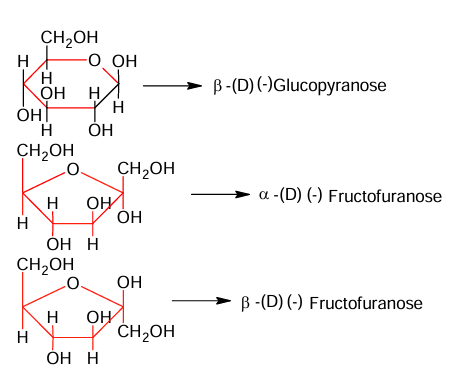
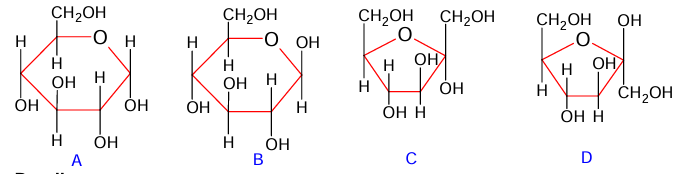
Match items of Row I with those of Row II

Row I: 


Row II:

(i) α-D-(-)-Fructofuranose

(ii) β-D-(-)-Fructofuranose

(iii) α-D-(-)-Glucopyranose

(iv) β-D-(-)-Glucopyranose

Correct match is:

(A) A-iii, B-iv, C-ii, D-i

(B) A-iv, B-iii, C-i, D-ii

(C) A-iii, B-iv, C-i, D-ii

(D) A-i, B-ii, C-iii, D-iv

▶️ Answer/Explanation
Markscheme

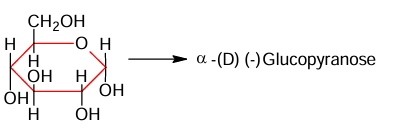
Answer: (C) A-iii, B-iv, C-i, D-ii

Explanation:
Question 12

The radius of the 2nd orbit of Li²⁺ is x. The expected radius of the 3rd orbit of Be³⁺ is

(A) \(\frac{27x}{16}\)

(B) \(\frac{16x}{27}\)

(C) \(\frac{4x}{9}\)

(D) \(\frac{9x}{4}\)

▶️ Answer/Explanation
Markscheme

Answer: (A) \(\frac{27x}{16}\)

Explanation:

For Li²⁺: r₂ = x = (r₁)ₕ × (2²/3) = 4(r₁)ₕ/3 ⇒ (r₁)ₕ = 3x/4

For Be³⁺: r₃ = (r₁)ₕ × (3²/4) = (r₁)ₕ × 9/4 = (3x/4) × (9/4) = 27x/16

Question 13

Inert gases have positive electron gain enthalpy. Its correct order is

(A) He < Ne < Kr < Xe

(B) He < Xe < Kr < Ne

(C) Xe < Kr < Ne < He

(D) He < Kr < Xe < Ne

▶️ Answer/Explanation
Markscheme

Answer: (B) He < Xe < Kr < Ne

Explanation:

(+ve) electron gain enthalpy of inert gases because octet is complete. When size increase (+ve) electron gain enthalpy decreases.

He (+48 kJ/mole) < Xe (+77 kJ/mole) < Kr (+96 kJ/mole) < Ne (+116 kJ/mole)

He has smallest size therefore highest tendency to accept e⁻.

Question 14

Given below are two statements: One is labelled as Assertion A and the other is labelled as Reason R:

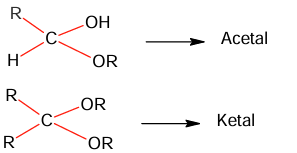
Assertion A: Acetal / Ketal is stable in basic medium.

Reason R: The light leaving tendency of alkoxide ion gives the stability to acetal / ketal in basic medium.

In the light of the above statements, choose the correct answer from the options given below:

(A) A is true but R is false

(B) A is false but R is true

(C) Both A and R are true but R is NOT the correct explanation of A

(D) Both A and R are true and R is the correct explanation of A

▶️ Answer/Explanation
Markscheme


Answer: (A) A is true but R is false

Explanation:

Acetals and ketals are stable in basic medium because R-O group is not a good leaving group, not because of “light leaving tendency of alkoxide ion”.
Question 15

A cubic solid is made up of two elements X and Y. Atoms of X are present on every alternate corner and one at the center of cube. Y is at 1/3 of the total faces. The empirical formula of the compound is.

(A) X₂Y₁.₅

(B) XY₂.₅

(C) X₂.₅Y

(D) X₁.₅Y₂

▶️ Answer/Explanation
Markscheme

Answer: (D) X₁.₅Y₂ or X₃Y₂

Explanation:

Atoms of X = (1/8 × 4) + (1 × 1) = 3/2

Atoms of Y = (1/3 × 6) × 1/2 = 1

Formula = X₃/₂Y₁ = X₃Y₂

Question 16

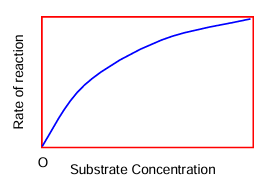
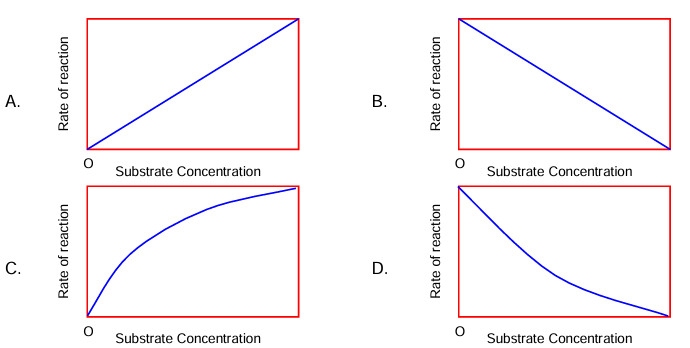
The variation of the rate of an enzyme catalyzed reaction with substrate concentration is correctly represented by graph

(A) C

(B) D

(C) B

(D) A

▶️ Answer/Explanation
Markscheme


Answer: (A) Hyperbolic curve

Explanation:

Rate ∝ substrate concentration due to (i) More & more active sites occupied by substrate

(ii) Higher number of collisions between substrate molecules. Thus hyperbolic graph.

Question 17

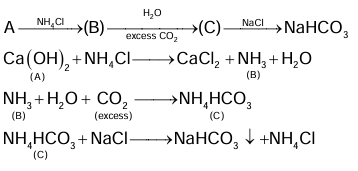
Compound A reacts with NH₄Cl and forms a compound B. Compound B reacts with H₂O and excess of CO₂ to form compound C which on passing through or reaction with saturated NaCl solution forms sodium hydrogen carbonate. Compound A, B and C, are respectively.

(A) Ca(OH)₂, NH₃, NH₄HCO₃

(B) CaCl₂, NH₃, NH₄HCO₃

(C) Ca(OH)₂, NH₄⁺, (NH₄)₂CO₃

(D) CaCl₂, NH₄⁺, (NH₄)₂CO₃

▶️ Answer/Explanation
Markscheme

Answer: (A) Ca(OH)₂, NH₃, NH₄HCO₃

Explanation:
Question 18

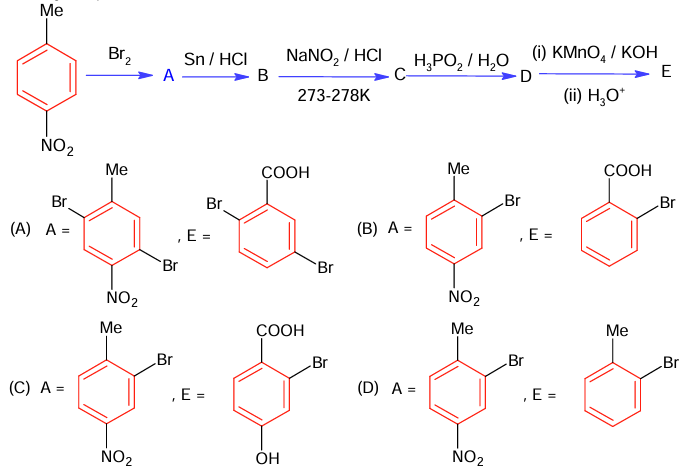
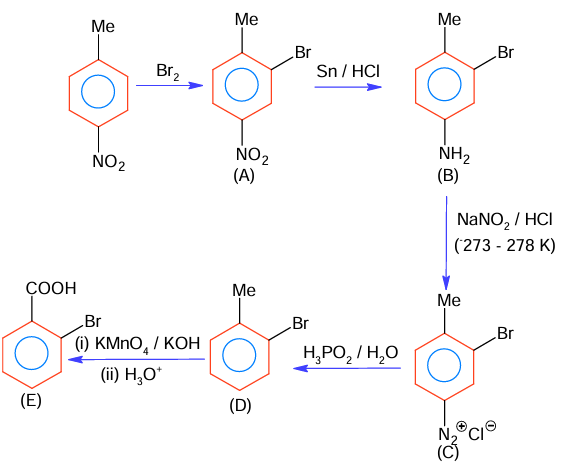
Identify the product formed (A and E)

▶️ Answer/Explanation
Markscheme

Answer: (A) A = NO₂-Me-Br, E = COOH-Br

Explanation:
Question 19

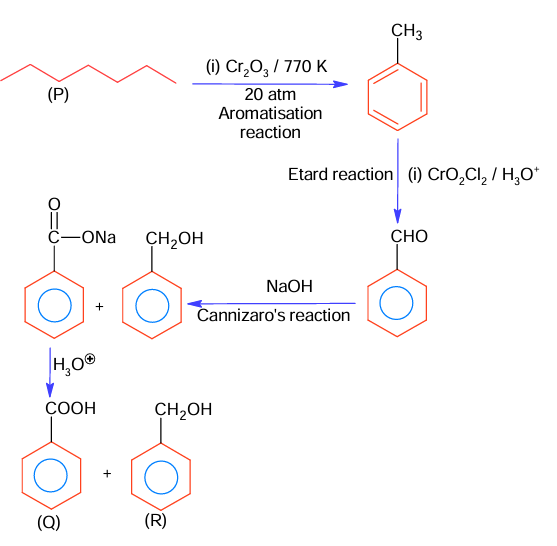
The correct sequence of reagent for the preparation of Q and R is

(A) (i) KMnO₄, OH⁻ ; (ii) Mo₂O₃, Δ ; (iii) NaOH ; (iv) H₃O⁺

(B) (i) CrO₂Cl₂, H₃O⁺, (ii) Cr₂O₃, 770K , 20 atm (iii) NaOH ; (iv) H₃O⁺

(C) (i) Cr₂O₃, 770K , 20 atm; (ii) CrO₂Cl₂, H₃O⁺, (iii) NaOH ; (iv) H₃O⁺

(D) (i) Mo₂O₃, Δ ; (ii) CrO₂Cl₂, H₃O⁺, (iii) NaOH ; (iv) H₃O⁺

▶️ Answer/Explanation
Markscheme

Answer: (B) (i) CrO₂Cl₂, H₃O⁺, (ii) Cr₂O₃, 770K , 20 atm (iii) NaOH ; (iv) H₃O⁺

Explanation:
Question 20

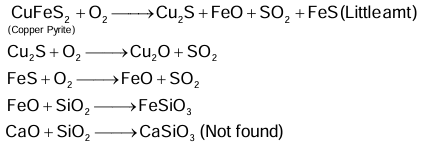
Which one of the following reaction does not occur during extraction of copper?

(A) FeO + SiO₂ → FeSiO₃

(B) 2FeS + 3O₂ → 2FeO + 2SO₂

(C) 2Cu₂S+3O₂ → 2Cu₂O+2SO₂

(D) CaO+SiO₂ → CaSiO₃

▶️ Answer/Explanation
Markscheme

Answer: (D) CaO+SiO₂ → CaSiO₃

Explanation:
Section-B
Question 1

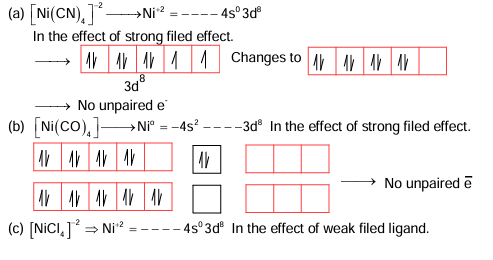
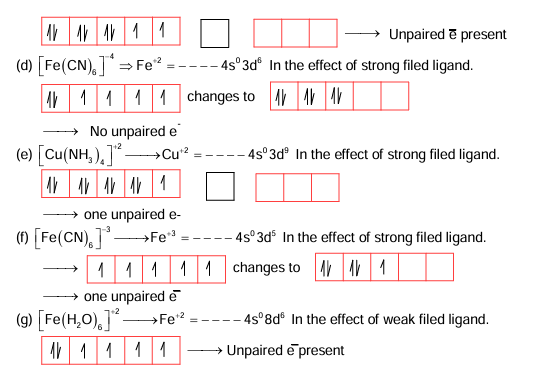
The number of paramagnetic species from the following is ______.

\[ \left[ Ni(CN)_4 \right]^{2-}, \left[ Ni(CO)_4 \right], \left[ NiCl_4 \right]^{2-} \]

\[ \left[ Fe(CN)_6 \right]^{4-}, \left[ Cu(NH_3)_4 \right]^{2+} \]

\[ \left[ Fe(CN)_6 \right]^{3-} \text{ and } \left[ Fe(H_2O)_6 \right]^{2+} \]

▶️ Answer/Explanation
Markscheme
Question 2

Consider the cell

\[ Pt(s) | H_2(g)(1atm)| H_{(aq)}^+, [H^+] = 1) || Fe_{(aq)}^{3+}, Fe_{(aq)}^{2+} | Pt(s) \]

Given \( E^0 \) \[ Fe^{3+/Fe^{2+}} = 0.771 \, V \text{ and } E^0 = 0V, T = 298K \]

If the potential of the cell is 0.712 V, the ratio of concentration of \( Fe^{2+} \) to \( Fe^{3+} \) is ______ (Nearest integer)

▶️ Answer/Explanation
Markscheme


\[ E = E^0 – \frac{0.059}{n} \log \frac{\left[ Fe^{2+} \right]}{\left[ Fe^{3+} \right]} \]

\[ 0.712 = 0.771 – 0.059 \log \frac{\left[ Fe^{2+} \right]}{\left[ Fe^{3+} \right]} \]

\[ 0.059 \log \frac{\left[ Fe^{2+} \right]}{\left[ Fe^{3+} \right]} = 0.059 \]

\[ \log \frac{\left[ Fe^{2+} \right]}{\left[ Fe^{3+} \right]} = 1 \]

\[ \frac{\left[ Fe^{2+} \right]}{\left[ Fe^{3+} \right]} = 10 \]
Question 3

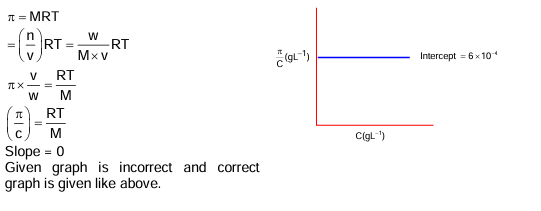
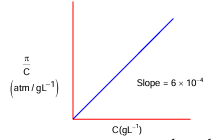
The osmotic pressure of solutions of PVC in cyclohexanone at 300K are plotted on the graph. The molar mass of PVC is ______ g mol\(^{-1}\)(Nearest integer)


Given: R = 0.083L atm K\(^{-1}\) mol\(^{-1}\), Slope = 6 × 10\(^{-4}\)

▶️ Answer/Explanation
Markscheme


\[ \frac{\pi}{c} = \frac{RT}{M} \]

\[ \text{Slope} = \frac{RT}{M} = 6 \times 10^{-4} \]

\[ M = \frac{RT}{6 \times 10^{-4}} = \frac{0.083 \times 300}{6 \times 10^{-4}} = 41500 \]

Question 4

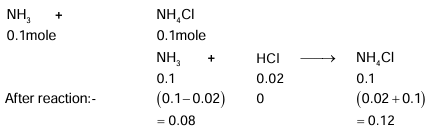
A litre of buffer solution contains 0.1 mole of each of NH\(_3\) and NH\(_4\)Cl. On the addition of 0.02 mole of HCl by dissolving gaseous HCl, the pH of the solution is found to be ______×10\(^{-3}\)(Nearest integer)

Given: pKb(NH\(_3\)) = 4.745, log2 = 0.301, log3 = 0.477, T = 298 K

▶️ Answer/Explanation
Markscheme


\[ pOH = pK_b + \log \frac{[\text{NH}_4^+]}{[\text{NH}_3]} = 4.745 + \log \frac{0.12}{0.08} \]

\[ = 4.745 + \log 1.5 = 4.745 + 0.176 = 4.921 \]

\[ pH = 14 – 4.921 = 9.079 = 9079 \times 10^{-3} \]

Nearest integer: 9080 × 10\(^{-3}\)

Question 5

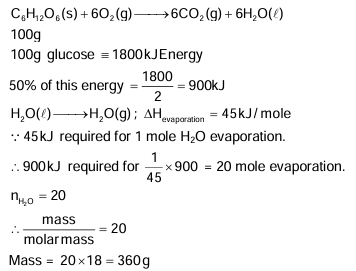
An athlete is given 100g of glucose (C\(_6\)H\(_{12}\)O\(_6\)) for energy. This is equivalent to 1800 kJ of energy. The 50% of this energy gained is utilized by the athlete for sports activities at the event. In order to avoid storage of energy, the weight of extra water be would need to perspire is ______ g (Nearest integer)

Given: The enthalpy of evaporation of water is 45 kJ mol\(^{-1}\), Molar mass of C, H & O are 12, 1 and 16 g mol\(^{-1}\).

▶️ Answer/Explanation
Markscheme

Question 6

For the first order reaction A→B, the half life is 30 min. The time taken for 75% completion of the reaction is ______ min. (Nearest integer)

Given: log2 = 0.3010, log3 = 0.4771, log5 = 0.6989

▶️ Answer/Explanation
Markscheme

\[t1/2=30 min

k = \frac{0.693}{t_{1/2}} = \frac{0.693}{30} \text{ min}^{-1} \]

For 75% completion, \[ t = \frac{2.303}{k} \log \frac{100}{25} = \frac{2.303 \times 30}{0.693} \log 4 \]

\[ = \frac{69.09}{0.693} \times 0.602 = 99.7 \times 0.602 = 60 \text{ min} \]

Question 7

The density of a monobasic strong acid (Molar mass 24.2 g/mol) is 1.21 kg/L. The volume of its solution required for the complete neutralization of 25mL of 0.24 NaOH is ______ ×10\(^{-2}\)mL (Nearest integer)

▶️ Answer/Explanation
Markscheme
Monobasic acid
d = 1.21kg/L = 1.21g/mℓ
Molar mass = 24.2 g / mole
Millimole of acid = millimole of base
= 25 × 0.24 = 6
Mass of acid = \(\frac{mm}{1000}\) × molar mass
= \(\frac{6 × 24.2}{1000}\) g
∴ Volume = \(\frac{mass}{density}\)
= \(\frac{6 × 24.2}{1.21} × 10^{-3}\) = \(\frac{145.2}{1.21} × 10^{-3}\)
= \(120 × 10^{-3}\) mℓ
= \(12 × 10^{-2}\) mℓ
Question 8

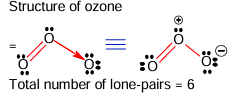
The total number of lone pairs of electrons on oxygen atoms of ozone is ______.

▶️ Answer/Explanation
Markscheme

Question 9

In sulphur estimation, 0.471 g of an organic compound gave 1.4439 g of barium sulphate. The percentage of sulphur in the compound is ______ (Nearest integer)

Given: Atomic mass Ba: 137u, S: 32u, O:16u

▶️ Answer/Explanation
Markscheme
 %of S = \(\frac{32}{233}\) × \(\frac{wt. of BaSO_4}{wt. of organic compound}\) × 100
= \(\frac{32}{233} × \frac{1.4439}{0.471} × 100\)
= \(\frac{32}{233} × \frac{144.39}{0.471}\)
= \(\frac{4620.48}{109.743} = 42.10\)
≈ 42
Question 10

How many of the following metal ions have similar value of spin magnetic moment in gaseous state? ______.

Given: Atomic number : V:23; Cr:24; Fe: 26; Ni:28

V\(^{3+}\) , Cr\(^{3+}\) ,Fe\(^{2+}\) , Ni\(^{3+}\)

▶️ Answer/Explanation
Markscheme


V\(^{3+}\) (d\(^2\)): 2 unpaired electrons

Cr\(^{3+}\) (d\(^3\)): 3 unpaired electrons

Fe\(^{2+}\) (d\(^6\)): 4 unpaired electrons

Ni\(^{3+}\) (d\(^7\)): 3 unpaired electrons

Cr\(^{3+}\) and Ni\(^{3+}\) both have 3 unpaired electrons → similar spin magnetic moment

Answer: 2

Scroll to Top