Home / May_Nov.2020-P1R-QP
Question 1

Plant and animal cells have some features in common and some differences.

(a) (i) Which of these structures is not found in animal cells?

  • A) cell membrane
  • B) cell wall
  • C) mitochondrion
  • D) nucleus

(a) (ii) Which of these substances is a carbohydrate stored in plant cells?

  • A) chlorophyll
  • B) glucose
  • C) glycogen
  • D) starch

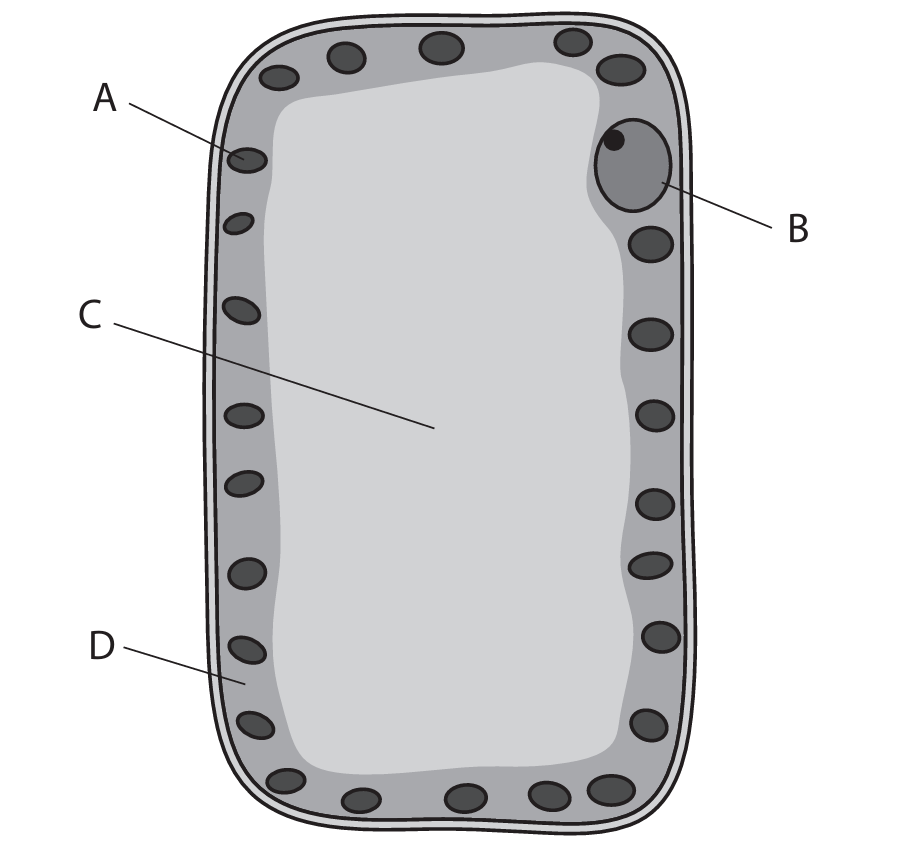
(b) The diagram shows a leaf palisade mesophyll cell.

(i) Describe the function of the parts labelled A, B, C and D.

(ii) Explain two ways that the structure of this palisade mesophyll cell is adapted for its function.

Most-appropriate topic codes (Edexcel IGCSE Biology):

1(b): Variety of living organisms — part (a)(ii)
2(b): Cell structure — parts (a)(i), (b)(i), (b)(ii)
2(c): Biological molecules — part (a)(ii)
2(e): Nutrition (in plants) — part (b)(ii)
▶️ Answer/Explanation
Solution

(a)(i) B (cell wall)
A is incorrect because it is not the cell membrane.
C is incorrect because it is not mitochondria.
D is incorrect because it is not the nucleus.

(a)(ii) D (starch)
A is incorrect because it is not chlorophyll.
B is incorrect because it is not glucose.
C is incorrect because it is not glycogen.

(b)(i) An answer that makes reference to the following points:

  • A: (chloroplasts absorb light) for photosynthesis / absorb light energy to make carbohydrate / eq 
  • B: (nucleus) controls protein synthesis / contains DNA / contains genes / controls cell / eq 
  • C: (vacuole) contains cell sap eq 
  • D: (cytoplasm) where chemical reactions occur 

Additional guidance: Allow starch / glucose / sugar for A; allow maintains turgor / stores water / salts / pigments / toxins for C; allow where protein synthesis occurs / respiration occurs / medium for reactions for D.

(b)(ii) An answer that makes reference to two of the following points:

  • contains chloroplasts to absorb light / for photosynthesis eq
  • long / arranged in a vertical plane / large surface area / rectangular shape, to absorb most light / eq 
  • large vacuole to store water
Question 2

Bacteria are genetically modified to make human proteins.

(a) Which part of a bacterium is used in genetic modification?

  • A) cell wall
  • B) nucleoid
  • C) plasmid
  • D) RNA

(b) The passage describes the use of an industrial fermenter to grow genetically modified bacteria.

Complete the passage by writing a suitable word in each blank space.

The hormone called ______ is needed to control the blood glucose levels in humans.

Bacteria have been genetically modified to produce this hormone.

The fermenter is cleaned with ______ before adding a nutrient broth that contains the genetically modified bacteria.

This cleaning provides aseptic conditions that prevent ______ from other bacteria.

Paddles are used to ______ the contents.

A gas called ______ is bubbled into the fermenter.

The ______ is controlled by using a cooling jacket.

Most-appropriate topic codes (Edexcel IGCSE Biology):

6(c): Genetic modification (genetic engineering) — part (a)
6(a): Use of an industrial fermenter — part (b)
3(j): Co-ordination and response (hormones) — part (b), first blank
▶️ Answer/Explanation
Solution

(a) C (plasmid)
A is incorrect because it is not the cell wall
B is incorrect because it is not the nucleoid
D is incorrect because it is not RNA

(b)
The hormone called insulin is needed to control the blood glucose levels in humans.
Bacteria have been genetically modified to produce this hormone.
The fermenter is cleaned with steam / hot water before adding a nutrient broth that contains the genetically modified bacteria.
This cleaning provides aseptic conditions that prevent contamination / competition from other bacteria.
Paddles are used to mix / stir / agitate the contents.
A gas called oxygen / \(O_2\) is bubbled into the fermenter.
The temperature is controlled by using a cooling jacket.

Acceptable alternatives for blank 2: disinfectant, bleach, sterilising fluid, alcohol, ethanol.
Acceptable alternatives for blank 3: infection.

Question 3

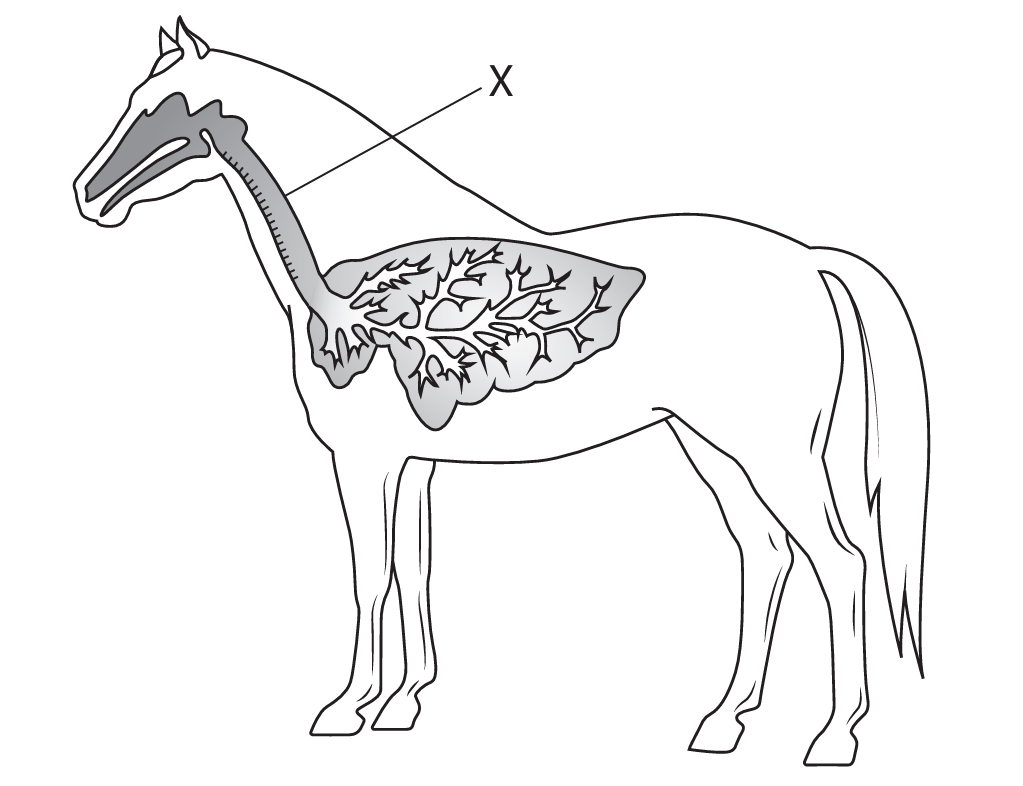
The diagram shows the location of the lungs in a horse.

(a) (i) The part labelled X is the

  • A) bronchiole
  • B) bronchus
  • C) oesophagus
  • D) trachea

(a) (ii) Which blood vessel transports blood to the horse’s lungs?

  • A) aorta
  • B) pulmonary artery
  • C) pulmonary vein
  • D) vena cava

(a) (iii) Which row of the table describes what happens when the horse breathes in?

 DiaphragmExternal intercostal muscles
Acontractcontract
Bcontractrelax
Crelaxcontract
Drelaxrelax

(b) The table shows the percentage of total blood flow in different body parts of a horse at rest and when running.

Body partPercentage of total blood flow (%)
 at restwhen running
leg muscle1582
intestine303

Comment on the changes in the percentage of total blood flow in these body parts.

(c) The horse breathes faster and deeper when running.

Explain why the horse continues to breathe faster and deeper for a period of time after it has stopped running.

Most-appropriate topic codes (Edexcel IGCSE Biology):

2(g): Gas exchange — parts (a)(i), (a)(iii), (c)
3(h): Transport — parts (a)(ii), (b)
2(f): Respiration — parts (b), (c)
▶️ Answer/Explanation
Solution

(a)(i) D (trachea)
A is incorrect because it is not the bronchiole
B is incorrect because it is not the bronchus
C is incorrect because it is not the oesophagus

(a)(ii) B (pulmonary artery)
A is incorrect because it is not the aorta
C is incorrect because it is not the pulmonary vein
D is incorrect because it is not the vena cava

(a)(iii) A (contract, contract)
B is incorrect because the external intercostals do not relax
C is incorrect because the diaphragm does not relax
D is incorrect because the diaphragm and the intercostals do not relax

(b) An answer that makes reference to four of the following points:
• more blood to muscles / less blood to intestine (during exercise) / eq 
• supply oxygen / oxygenated blood / glucose 
• respiration 
• energy / ATP 
• muscle contraction 
• less absorption of food / eq, in intestine when running / 

Example full answer: When the horse runs, a much greater percentage of its total blood flow is directed to the leg muscles (increasing from 15% to 82%) to supply oxygen and glucose for aerobic respiration, which releases energy (ATP) for muscle contraction. Conversely, blood flow to the intestine decreases sharply (from 30% to 3%) because processes like digestion and absorption of food are less critical during intense physical activity. This redistribution ensures that the working muscles receive the oxygen and nutrients they need.

(c) An explanation that makes reference to two of the following points:
• (supply (more)) oxygen / there was a shortage of oxygen 
• breakdown / remove lactic acid 
• repay oxygen debt 
• anaerobic respiration had occurred 

Example full answer: The horse continues to breathe faster and deeply after running to repay an oxygen debt. During intense exercise, some muscles respire anaerobically, producing lactic acid. The continued high rate of breathing supplies extra oxygen to break down this lactic acid and to fully oxidise the remaining respiratory substrates.

Question 4

The plants in a woodland are eaten by mice and caterpillars. The mice also eat the caterpillars. The mice are eaten by birds called owls.

(a) Draw a food web showing these feeding relationships.

(b) Give the term that describes the trophic level of a caterpillar.

(c) The woodland covered a total area of \(5 \text{ km}^2\). A scientist investigates the number of mice and owls in the woodland. He counts the number of mice and owls on the same summer day each year for five years. The table shows the scientist’s results.

(c) (i) Calculate the number of mice in the total area of woodland in year 3. 

(c) (ii) Suggest why there were more mice in year 4 than in the other years. 

(c) (iii) Suggest why the number of owls was fairly constant each year.

(c) (iv) Suggest a method you would use to estimate the number of mice in the woodland.

Most-appropriate topic codes (Edexcel IGCSE Biology):

5(b): Feeding relationships — parts (a), (b)
5(a): The organism in the environment — parts (c)(ii), (c)(iii), (c)(iv)
Appendix 3: Mathematical skills — part (c)(i)
▶️ Answer/Explanation
Solution

(a) An answer that makes reference to the following points:
• Arrows in correct direction (e.g., plants → caterpillars → mice → owls; plants → mice).
• Food web includes all four organisms in correct feeding relationships.
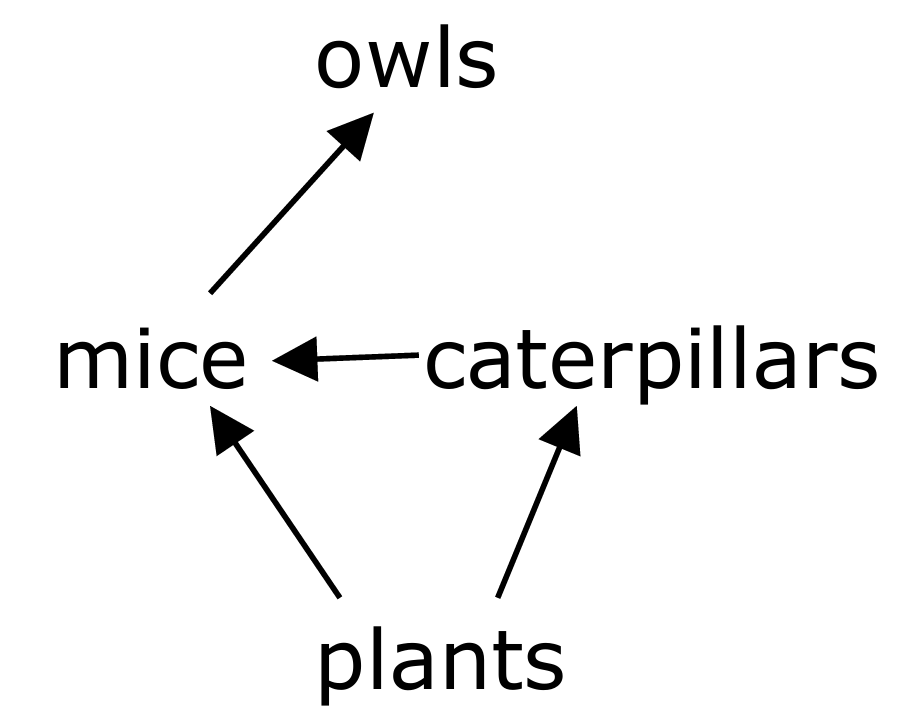

Example web: Plants have arrows to mice and caterpillars. Caterpillars have an arrow to mice. Mice have an arrow to owls.

(b) • Primary consumer / 1° consumer

(c)(i) • \(3 \times 10^3 = 3000\) per \(\text{km}^2\) 
• \(3000 \times 5 = 15000\)
Answer: \(15000\) or \(1.5 \times 10^4\) mice.

(c)(ii) An answer that makes reference to three of the following points:
• More food / plants / caterpillars / other sources of food available.
• Warmer weather.
• Fewer other predators / owls ate other species. 
• Less disease / infection. 
• Higher birth rate than death rate. 

(c)(iii) An answer that makes reference to two of the following points:
• Owls feed on other prey (not just mice). 
• Insufficient food / energy to maintain more owls (carrying capacity reached).
• Owls have no (or few) predators. 
• Birth rate ≈ death rate.
• Owls produce few offspring (so population changes slowly).

(c)(iv) An answer that makes reference to three of the following points:
• Use a trap / use filming / use a sample area / use a quadrat. 
• Random sampling.
• Repeat.
• Count number of mice / faeces (in sample area).
• Calculate average. 
• Multiply up to total area.
Question 5

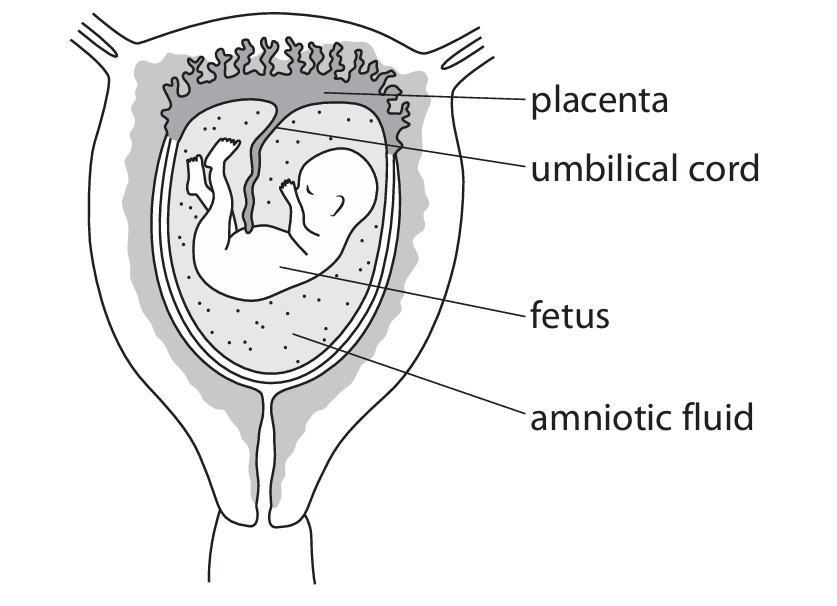
The diagram shows a fetus in the uterus of a woman.

The umbilical cord transports blood from the placenta to the fetus.
This blood contains molecules from the mother that are needed by the developing fetus.

(a) (i) Explain how some of these molecules allow active transport to occur in cells of the fetus.

(a) (ii) Explain how one type of molecule from the mother helps to protect the fetus from infection.

(b) The amniotic fluid contains cells from the fetus.
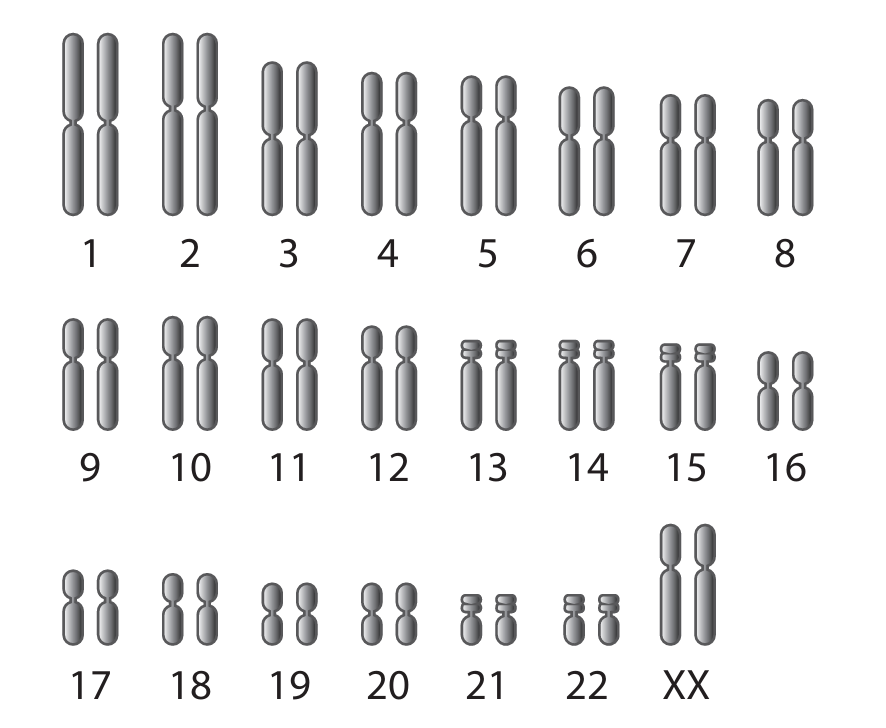
It is possible to look at chromosomes in these cells.
A diagram of the chromosomes is called a karyotype.
The diagram shows the karyotype of a fetus cell.

Give two conclusions you can make from this karyotype.

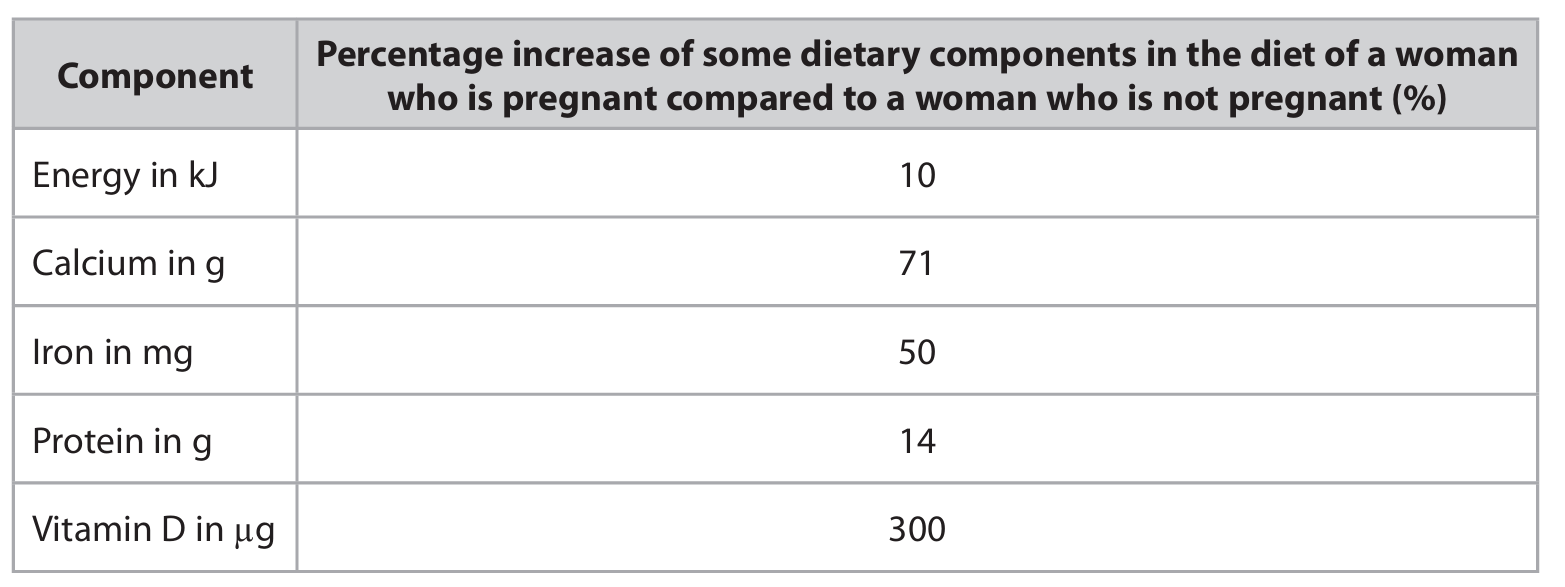
(c) Doctors recommend that pregnant women obtain more of some dietary components than women who are not pregnant.
The table shows the recommended percentage increase of some dietary components in the diet of a woman who is pregnant compared to a woman who is not pregnant.

(c) (i) Explain why a woman who is pregnant requires more of each of the dietary components listed in the table.

(c) (ii) The actual mass of additional iron needed by the pregnant woman was \(9.0 \text{ mg}\) per day.
Calculate the actual total mass of iron needed by the pregnant woman.

Most-appropriate topic codes (Edexcel IGCSE Biology):

2(d): Movement of substances into and out of cells — part (a)(i)
3(h): Transport — part (a)(ii)
4(b): Inheritance — part (b)
4(a): Reproduction — part (c)(i) in context of pregnancy
2(e): Nutrition — part (c)(i)
Appendix 3: Mathematical skills — part (c)(ii)
▶️ Answer/Explanation
Solution

(a)(i) An explanation that makes reference to three of the following points:
• oxygen
• glucose 
• respiration 
• energy / ATP 
Example answer: The blood contains glucose and oxygen. These are used by the fetus’s cells in respiration to release energy in the form of ATP. This ATP provides the energy required for active transport processes to occur.

(a)(ii) An explanation that makes reference to two of the following points:
• antibodies (from mother) 
• (bind to) antigens
• to kill bacteria / pathogen / virus eq 
Example answer: Antibodies from the mother’s blood cross the placenta. These antibodies bind to antigens on pathogens, marking them for destruction or neutralizing them, which helps protect the fetus from infection.

(b) An answer that makes reference to two of the following points:
• fetus is female / a girl
• cells contain 46 chromosomes / 23 pairs / has a diploid number / has two sets of chromosomes / normal number of chromosomes / eq 
• chromosomes have different lengths / sizes / shapes 
Example answer: 1. The fetus is female because the sex chromosomes are XX. 2. The cell has the normal diploid number of 46 chromosomes (23 pairs).

(c)(i) An answer that makes reference to four of the following points:
• calcium for bone / teeth growth / bone / teeth development / prevent rickets 
• protein to grow / for enzymes / antibodies / eq 
• iron for haemoglobin / red blood cells / prevent anaemia 
• vitamin D for bone growth / bone development / calcium absorption / strong bones 
• more energy as baby is heavy / mother becomes heavy / more energy for fetal development / to carry baby / eq 
Example answer: Extra calcium and vitamin D are required for the development of the fetus’s bones and teeth. Additional iron is needed to make haemoglobin for the increased blood volume and to prevent anaemia. More protein is required for the growth of fetal tissues and the production of enzymes and antibodies. Increased energy is needed as the mother’s body works harder and carries extra weight.

(c)(ii)
• \(9.0 \text{ mg} = 50\%\) more 
• \(100\% = 9.0 \times 2 = 18 \text{ mg}\) 
• Total needed \(= 18 + 9 = 27 \text{ mg}\) 
Award full marks for correct numerical answer without working.
Final Answer: \(27 \text{ mg}\)
Question 6

Lichens are organisms that grow well on stone walls in unpolluted air. Lichens grow less well in polluted air. Car exhaust fumes contain sulfur dioxide that pollutes air.

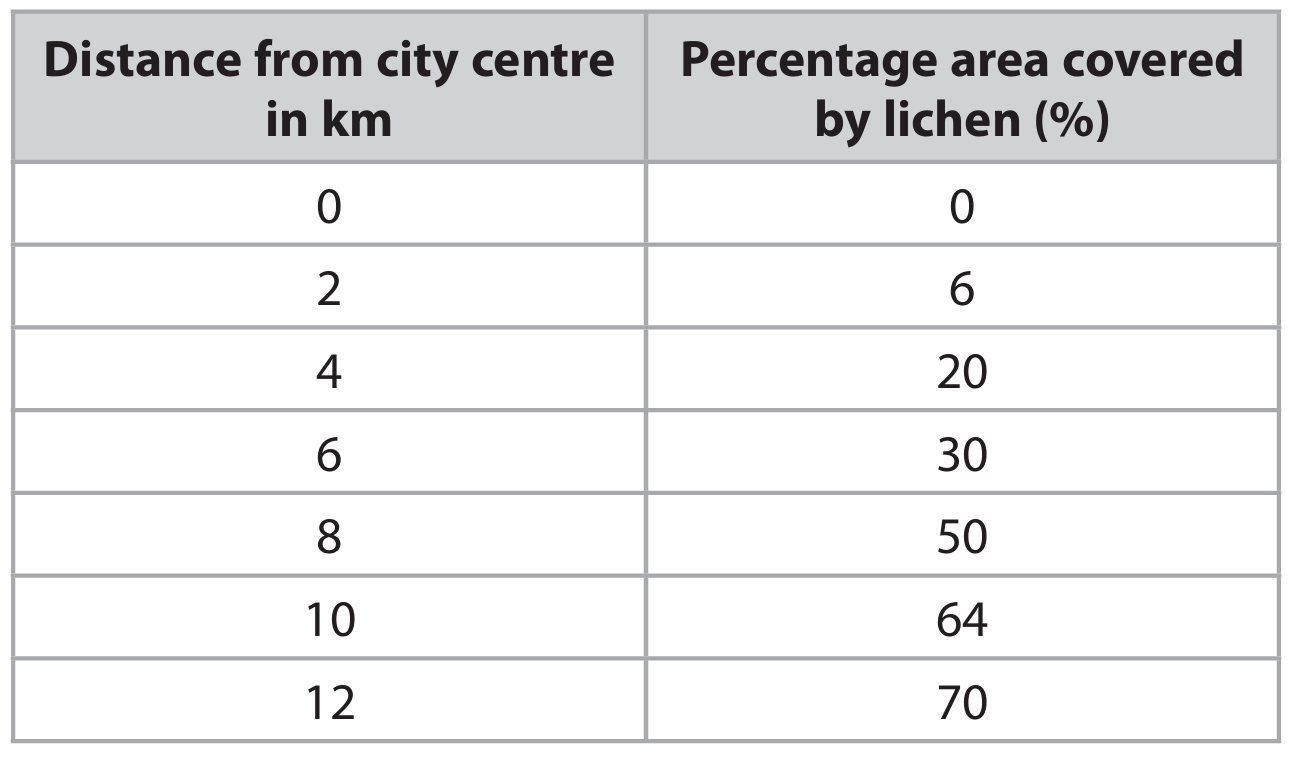
A scientist investigates the effect of pollution by cars in a city. This is her method:

  • measure the percentage area of a stone wall in the city centre covered by lichen
  • repeat this measurement at different distances from the city centre

The table shows her results.

(a) Explain the results shown in the table.

(b) Describe a method to measure the percentage of a stone wall covered by lichen. 

(c) Adding water to a powder called sodium metabisulphite will release sulfur dioxide gas. Devise a laboratory investigation to find out the effect of sulfur dioxide gas on the heat released by germinating seeds. Include experimental details in your answer and write in full sentences.

Most-appropriate topic codes (Edexcel IGCSE Biology):

5(d): Human influences on the environment — parts (a), (b), (c)
2(f): Respiration — part (c)
3: Assessment Information / Experimental Skillsparts (b), (c)
▶️ Answer/Explanation
Solution

(a) An explanation that makes reference to two of the following points:
• As distance from the city centre increases, the percentage area covered by lichen increases.
• There are more cars/pollution/sulfur dioxide in the city centre, which inhibits lichen growth.
Allow converse statements (e.g., lichen coverage decreases closer to the city centre).

(b) An answer that makes reference to three of the following points:
• Measure the area covered by lichen. Allow using a grid/quadrat to count squares with lichen.
• Measure the total area of the stone wall.
• Divide the lichen-covered area by the total area and multiply by \(100\) to get the percentage.
• Repeat the measurements in different places on the wall to find a mean.

(c) An answer that makes reference to six of the following points:
C (Change): Expose one set of germinating seeds to sulfur dioxide (\(SO_2\)) from sodium metabisulphite and another set to air without \(SO_2\) (or use different concentrations of \(SO_2\)).
O (Organisms): Use the same species/type/age/variety of seeds.
R (Repeat): Use a large number of seeds/repeat the experiment.
M1 (Measurement 1): Measure the temperature change.
M2 (Measurement 2): Use a thermometer.
S1 (Same 1): Use a thermos flask (or insulated container) to contain the seeds and prevent heat loss.
S2 (Same 2): Control other variables (e.g., same moisture, oxygen, starting temperature, light, time, disinfect seeds).

Answer must be in full sentences and include experimental details to access the marks.

Question 7

Bread contains starch. A student investigates how temperature affects the digestion of bread. This is the apparatus he uses in his method.

This is the student’s method:

  • add amylase to a sample of bread
  • put this bread in the filter funnel
  • pour water onto the bread
  • do a Benedict’s test on the solution from the digested bread that collects in the beaker
  • repeat the method at different temperatures

(a) Explain the results of Benedict’s test if the amylase digests the starch.

(b) The student’s method lacks detail. Rewrite the method so that the student could make a valid conclusion about the effect of temperature on amylase.

(c) The student predicted that the rate of digestion of starch would keep increasing as temperature increased. Comment on this prediction.

Most-appropriate topic codes (Edexcel IGCSE Biology):

2(e): Nutrition — Digestive enzymes (amylase, starch digestion)
2(c): Biological molecules — Role of enzymes, effect of temperature on enzyme activity
A03: Experimental skills — Designing valid experiments, controlling variables
▶️ Answer/Explanation
Solution

(a) An explanation that makes reference to the following points:

  • Amylase digests/catalyzes the breakdown of starch into maltose / glucose.
  • These are reducing sugars, so the Benedict’s test will turn from blue to a red / green / yellow / orange precipitate.

(b) Rewritten method should include reference to at least four of the following control variables (1 mark each, max 4):

  • Use the same volume and concentration of amylase solution.
  • Use the same mass / size / volume / piece of bread.
  • Use the same volume of water poured onto the bread.
  • Allow the same amount of time for digestion before collecting the solution for testing.
  • Use the same volume / concentration of Benedict’s reagent.
  • Heat the Benedict’s test tubes for the same length of time and at the same temperature (e.g., in a water bath at \(80^\circ C\) for 2 minutes).
  • Test a specific, stated range of temperatures (e.g., \(20^\circ C, 30^\circ C, 40^\circ C, 50^\circ C, 60^\circ C\)).
  • Repeat each temperature and calculate a mean result.

(c) An answer that makes reference to four of the following points:

  • Initially, as temperature increases, the rate of digestion increases.
  • This is because particles (enzyme and substrate) have more kinetic energy, move faster, and collide more frequently.
  • This continues until the optimum temperature is reached, where the rate is highest.
  • Above the optimum temperature, the rate decreases rapidly.
  • At high temperatures, the enzyme (amylase) denatures – the active site changes shape and the substrate (starch) can no longer bind.
  • Therefore, the prediction is incorrect because the rate does not keep increasing indefinitely; it peaks and then falls (implied in the points above).
Question 8

An electronic cigarette (e-cigarette) has been invented. E-cigarettes are held in the hand like normal cigarettes. Instead of burning tobacco, e-cigarettes heat a liquid that contains nicotine and flavourings to produce a vapour that is inhaled.

Scientists carried out an investigation to see how the smoking habits of students changed between 2011 and 2016. Each year they determined the percentage of students who used e-cigarettes and the percentage of students who smoked normal cigarettes during the year. The results are shown in the table.

(a) Plot a line graph to show how the percentage of students who used e-cigarettes and the percentage of students who smoked normal cigarettes changed between 2011 and 2016.
       Join the points with straight lines.

(b) Describe the changes in the percentages of students smoking cigarettes and using e-cigarettes between 2011 and 2016.

(c) The scientists interviewed 60 000 students each year during the period of the investigation. Calculate the change in the number of students who were smoking normal cigarettes from 2011 to 2016.

(d) Some people are promoting e-cigarettes as a healthier alternative to smoking normal cigarettes.

(i) Suggest why using e-cigarettes may be thought to be less harmful than smoking normal cigarettes. 

(ii) Suggest why many doctors are concerned about promoting the use of e-cigarettes to young people. 

Most-appropriate topic codes (Edexcel IGCSE Biology):

2(g): Gas exchange — Smoking and health (parts d(i), d(ii))
Appendix 3: Mathematical skills — Calculations, graphs, and data handling (parts a, b, c)
Appendix 4: Command word taxonomy — Applying ‘describe’, ‘calculate’, and ‘suggest’ (all parts)
▶️ Answer/Explanation
Solution

(a) A correct line graph should show:
• Linear scales on both axes, covering at least half the grid.
• Axes plotted the correct way round (Year on x-axis, Percentage on y-axis).
• Straight lines joining each consecutive data point for both e-cigarettes and normal cigarettes.
• Axes labelled ‘Year’ and ‘Percentage of students’.
• All points plotted accurately (within one small square of the correct position).
• A key or labelled lines to distinguish between ‘e-cigarettes’ and ‘normal cigarettes’.

(b) A description that makes reference to two of the following points:
• E-cigarette use increased (from 2011) up to 2015 then decreased / decreased in 2016.
• Smoking normal cigarettes decreased (from 2011 to 2016).
• At the start, e-cigarette use was lower than smoking / significantly low; by the end, e-cigarette use was higher than smoking / significantly high.

(c)
Method 1:
• Difference in percentage: \(15.8 – 8.0 = 7.8\%\) 
• Change in number: \(\frac{7.8}{100} \times 60,000 = 4680\) students
OR Method 2:
• Number in 2011: \(\frac{15.8}{100} \times 60,000 = 9480\)
• Number in 2016: \(\frac{8.0}{100} \times 60,000 = 4800\)
• Change: \(9480 – 4800 = 4680\) students (2)
Award full marks for correct numerical answer (4680) without working.

(d)(i) An explanation that makes reference to four of the following points:
• Less tar.
• Fewer carcinogens / less risk of cancer.
• Less risk of emphysema / lung disease / damage to alveoli / chronic bronchitis / damage to cilia.
• Less carbon monoxide.
• Less risk of heart disease / strokes. 
• Less risk of addiction / can control nicotine levels. 

(d)(ii) An answer that makes reference to two of the following points:
• Non-smokers may start using e-cigarettes.
• E-cigarettes may lead to taking up smoking. 
• E-cigarettes are addictive as they contain nicotine. 
• Nicotine can increase risk of blood clots / increase blood pressure. 
• E-cigarettes may also be harmful / damage lungs / long-term risks not yet known. 

Question 9

Cleft chin is a phenotype believed to be controlled by a single gene that has two alleles.

The dominant allele, \( N \), codes for cleft chin and the recessive, \( n \), allele codes for the absence of the cleft chin.

(a) With reference to the example of cleft chin, state what is meant by the following terms

(i) phenotype

(ii) gene

(iii) allele.

(b) A woman with a cleft chin has a child with a man who also has a cleft chin. The child does not have a cleft chin.

(i) Use a genetic diagram to show the genotypes of the parents, the gametes they can produce and all the possible genotypes and phenotypes of their children.

(ii) The parents then have a second child. Calculate the probability that this child will be female and not have a cleft chin.

(iii) Sometimes a cleft chin does not develop even if the individual inherits the dominant allele. Suggest what might cause this.

(c) Most inherited conditions are not controlled by a single gene, but by many genes. Describe how a scientist could distinguish between a genetic condition in rats controlled by a single gene and one controlled by many genes.

Most-appropriate topic codes (Edexcel IGCSE Biology Modular):

4(b): Inheritance — all parts
▶️ Answer/Explanation
Solution

(a)(i) • cleft chin or not / appearance of chin / eq

(a)(ii) An answer that makes reference to one of the following points: (section of) DNA / eq that codes for cleft chin characteristic / protein / trait / eq

(a)(iii) • (different) version(s) of the (cleft chin) gene / alternative forms of the gene

(b)(i) An answer that makes reference to the following points:
• both parents \( Nn \) 
• gametes produced \( N \) or \( n \) from each parent 
• offspring genotypes shown \( NN\ Nn\ Nn\ nn \) 
• offspring phenotypes shown 3 cleft 1 without cleft chin 

Genetic Diagram (example):
Parents: \( Nn \) (Cleft) × \( Nn \) (Cleft)
Gametes: \( N, n \) × \( N, n \)
Offspring genotypes: \( NN, Nn, Nn, nn \)
Offspring phenotypes: 3 Cleft chin, 1 No cleft chin

(b)(ii) Probability of child being female = \( 0.5 \)
Probability of child not having cleft chin (\( nn \)) from \( Nn \) × \( Nn \) cross = \( 0.25 \)
Combined probability = \( 0.5 \times 0.25 = 0.125 \) / \( \frac{1}{8} \) / 12.5%

(b)(iii) An answer that makes reference to one of the following points:
• environment / diet / eq means different shaped chin
• mutation
(Accept: incomplete penetrance, interaction with other genes, epigenetic factors.)

(c) A description that makes reference to three of the following points:
• use crosses between different rats / test cross / pedigree analysis to predict outcomes / look at pedigree diagrams / family trees / family history
• if single gene, offspring show simple pattern / shows 3:1 ratios / look like one parent / eq 
• single gene shows discontinuous variation / two or three phenotypes
• polygenic leads to continuous variation / intermediate expression / many different phenotypes / much more variation / three or more phenotypes

Question 10

Farmers may add chemical fertilisers to their soil.

(a) Explain how chemical fertilisers can increase crop yield.

(b) These fertilisers may leak into rivers.

A scientist measures the oxygen content of water in two different locations of the same river during the month of April.

In location A he finds that the mean dissolved oxygen was 6 mg per litre and at location B he finds that the mean dissolved oxygen was 3 mg per litre.

He concludes that the use of fertiliser in the field has affected the oxygen content of the river.

Discuss his conclusion.

(c) Some farmers use alternative substances to chemical fertilisers.

Suggest one alternative substance that a farmer may use.

Most-appropriate topic codes (Edexcel IGCSE Biology):

5(d): Human influences on the environment — parts (b), (c)
6(a): Food production — part (a)
2(e): Nutrition (Plants) — part (a)
▶️ Answer/Explanation
Solution

(a) An explanation that makes reference to four of the following points:

  • nitrates (for growth)
  • for amino acids
  • for protein 
  • magnesium for chlorophyll / chloroplasts 
  • so more photosynthesis 
  • more glucose 
  • phosphates used for ATP / DNA / eq 
  • potassium for control of water movement / eq 

(b) An answer that makes reference to four of the following points:

  • fertiliser leaches into river / washed into river / eq 
  • fertiliser would cause algal / plant growth / algal bloom / eutrophication 
  • dead algae are decomposed / broken down by bacteria / decomposers 
  • (bacterial) respiration would reduce oxygen 
  • means were calculated / readings repeated so experiment is reliable / valid 
  • measurements taken at same time of year / in April (so are valid) 
  • direction of river is past farm 
  • reduced oxygen could be due to other factors / sources of fertiliser from other fields 

(c) • manure / faeces / dung / compost / seaweed / bone / blood / animal wastes / eq 

Scroll to Top