
IB DP Biology Mock Exam HL Paper 1A Set 5 - 2025 Syllabus
IB DP Biology Mock Exam HL Paper 1A Set 5
Prepare for the IB DP Biology Exam with our comprehensive IB DP Biology Exam Mock Exam HL Paper 1A Set 5. Test your knowledge and understanding of key concepts with challenging questions covering all essential topics. Identify areas for improvement and boost your confidence for the real exam
Question
Which property of water helps aquatic habitats maintain stable temperatures throughout the year?
A. High specific heat capacity because covalent bonding restricts molecular motion
B. Low specific heat capacity because covalent bonding restricts molecular motion
C. Low specific heat capacity because hydrogen bonding restricts molecular motion
D. High specific heat capacity because hydrogen bonding restricts molecular motion
▶️ Answer/Explanation
✅ Answer: (D) High specific heat capacity because hydrogen bonding restricts molecular motion
Question
Which diagram(s) below best represent the process of semi-conservative DNA replication?
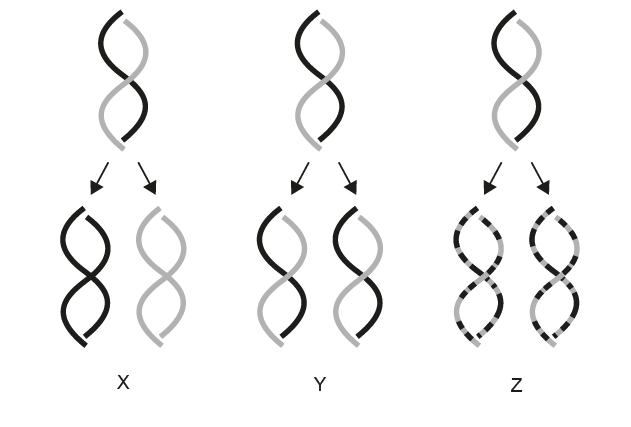
B. Y only
C. Z only
D. X and Y only
▶️ Answer/Explanation
In semi-conservative replication, each new DNA molecule contains one original strand and one newly synthesized strand.
Only diagram Y shows this pattern correctly.
✅ Correct Answer: B
Question
The table shows the concentrations of potassium and sodium ions found inside and outside human cells.
| Ions | Intracellular | Extracellular |
|---|---|---|
| Potassium | 135 | 4 |
| Sodium | 10 | 145 |
What process best explains how these ion concentrations are maintained?
B. Facilitated diffusion using a vesicle
C. Simple diffusion using a protein channel
D. Osmosis using an aquaporin
▶️ Answer/Explanation
✅ Answer: (A)