
▶️ Answer/Explanation
(a)
\(6\)
(b)
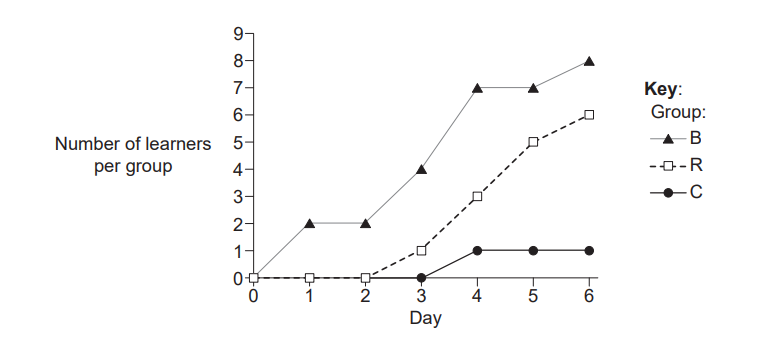
• Similarity: Both groups show a rising number of learners across the six days.
• Difference: Group B begins gaining learners immediately, while group R does not produce any learners until day 3. Group B consistently has more learners than group R throughout the period.
(c)
Day 3 learners: \(1\)
Day 6 learners: \(6\)
Percentage increase:
\[ \frac{(6 – 1)}{1} \times 100 = 500\% \]
(d)
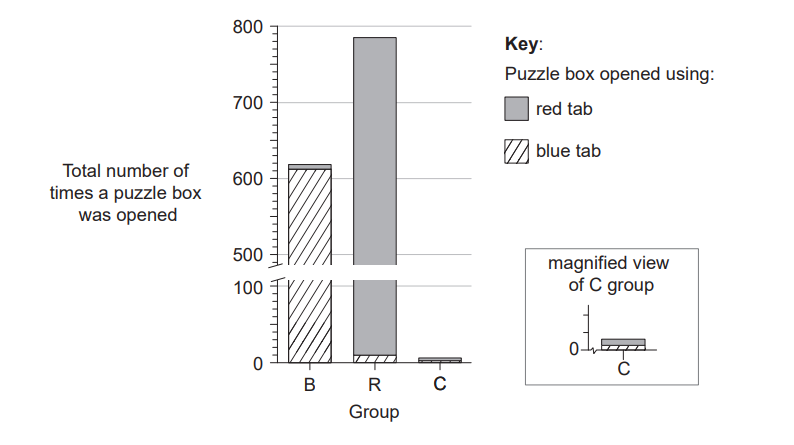
Estimated 5–8 openings using the red tab (very small bar slightly above the red value in the control group).
(e)
Group R appears more efficient overall. Although group R produced fewer learners than group B (6 vs 8 by day 6), the R group recorded a much higher total number of box openings (~790 vs ~615), indicating greater overall proficiency.
(f)
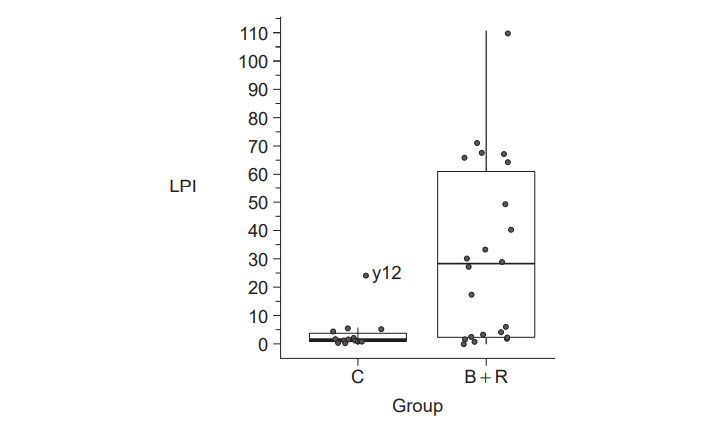
The median for the \(B+R\) learners is at an LPI of about 28. Therefore, 50% of bees in the combined group had an LPI of 28 or lower.
(g)
(i) The LPI for bee y12 is approximately 24 (shown as an outlier point).
(ii) \[ \text{Days to learn} = \frac{216}{24} = 9 \] So y12 took 9 days to become a learner.
(h)
• The control group demonstrates that spontaneous learning is possible: bee y12 learned without any demonstration and produced 216 openings.
• However, bees in the trained groups (B and R) were far more proficient. Their median LPI (~28) was dramatically higher than that of the control (~2).
• Trained groups produced more learners sooner, and opened the box far more frequently, showing that social learning made bees significantly more effective at solving the task.