
▶️ Answer/Explanation
Detailed solution
(a)
(i)
\(\text{Cl}_2 \xrightarrow{\text{UV}} 2\text{Cl}^\bullet\)
\(\text{Cl}_2 \xrightarrow{\text{UV}} 2\text{Cl}^\bullet\)
(ii)
Homolytic fission.
Homolytic fission.
(iii)
Bonds broken:
\(\text{C}\equiv\text{O} + \text{Cl}-\text{Cl} = 1077 + 242 = 1319\ \text{kJ mol}^{-1}\)
Bonds formed (in \(\text{Cl}_2\text{C}=\text{O}\)):
\(\text{C}=\text{O} + 2(\text{C}-\text{Cl}) = 804 + 2(324) = 1452\ \text{kJ mol}^{-1}\)
\(\Delta H = 1319 – 1452 = \mathbf{-133\ \text{kJ mol}^{-1}}\)
Bonds broken:
\(\text{C}\equiv\text{O} + \text{Cl}-\text{Cl} = 1077 + 242 = 1319\ \text{kJ mol}^{-1}\)
Bonds formed (in \(\text{Cl}_2\text{C}=\text{O}\)):
\(\text{C}=\text{O} + 2(\text{C}-\text{Cl}) = 804 + 2(324) = 1452\ \text{kJ mol}^{-1}\)
\(\Delta H = 1319 – 1452 = \mathbf{-133\ \text{kJ mol}^{-1}}\)
(iv)
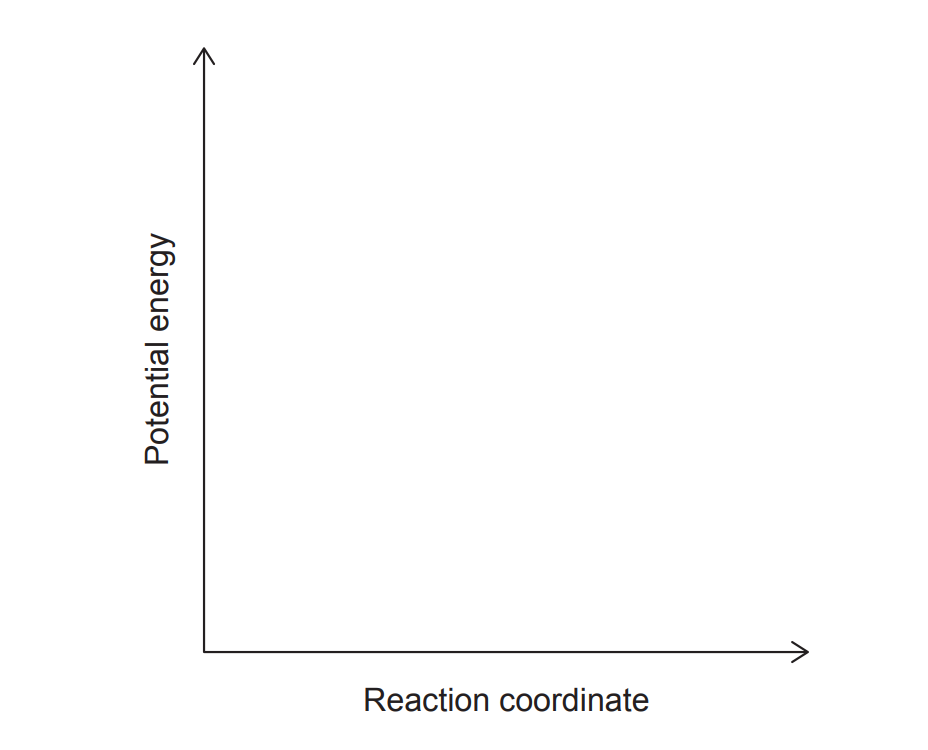
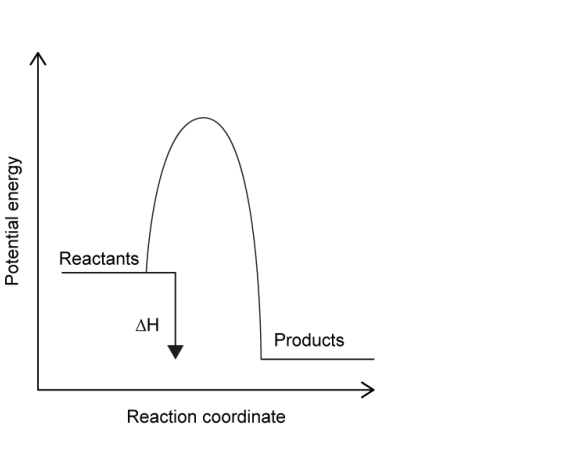
Exothermic profile: reactants higher than products; \(\Delta H\) shown as a downward energy difference.
(v)
\(\Delta S^\ominus = S^\ominus_{\text{products}} – S^\ominus_{\text{reactants}}\)
\(\Delta S^\ominus = 284 – (198 + 223) = 284 – 421 = \mathbf{-137\ \text{J mol}^{-1}\text{K}^{-1}}\)
\(\Delta S^\ominus = S^\ominus_{\text{products}} – S^\ominus_{\text{reactants}}\)
\(\Delta S^\ominus = 284 – (198 + 223) = 284 – 421 = \mathbf{-137\ \text{J mol}^{-1}\text{K}^{-1}}\)
(vi)
Convert \(\Delta S^\ominus\) to \(\text{J mol}^{-1}\text{K}^{-1}\) form inside the calculation and keep units consistent:
\(\Delta G^\ominus = \Delta H^\ominus – T\Delta S^\ominus\)
\(\Delta G^\ominus = -133000 – \big(298 \times (-137)\big) = -133000 + 40826 = -92174\ \text{J mol}^{-1}\)
\(\Delta G^\ominus = -RT\ln K \Rightarrow \ln K = -\Delta G^\ominus/(RT)\)
\(\ln K = \dfrac{92174}{8.31 \times 298} = 37.2\)
\(K = e^{37.2} \approx \mathbf{1.4 \times 10^{16}}\)
Since \(K \gg 1\), the reaction proceeds essentially to completion at \(298\ \text{K}\).
Convert \(\Delta S^\ominus\) to \(\text{J mol}^{-1}\text{K}^{-1}\) form inside the calculation and keep units consistent:
\(\Delta G^\ominus = \Delta H^\ominus – T\Delta S^\ominus\)
\(\Delta G^\ominus = -133000 – \big(298 \times (-137)\big) = -133000 + 40826 = -92174\ \text{J mol}^{-1}\)
\(\Delta G^\ominus = -RT\ln K \Rightarrow \ln K = -\Delta G^\ominus/(RT)\)
\(\ln K = \dfrac{92174}{8.31 \times 298} = 37.2\)
\(K = e^{37.2} \approx \mathbf{1.4 \times 10^{16}}\)
Since \(K \gg 1\), the reaction proceeds essentially to completion at \(298\ \text{K}\).
(b)
(i)
Follow the rate by monitoring gas pressure (or gas volume) at constant temperature, since total moles of gas increase from \(2\) to \(3\).
Follow the rate by monitoring gas pressure (or gas volume) at constant temperature, since total moles of gas increase from \(2\) to \(3\).
(ii)
Some collisions fail because particles may collide with the wrong orientation and/or with kinetic energy less than \(E_a\).
Some collisions fail because particles may collide with the wrong orientation and/or with kinetic energy less than \(E_a\).
(iii)
If first order in each reactant:
\(\text{Rate} = k[\text{Cl}_2\text{CO}][\text{H}_2\text{O}]\)
If first order in each reactant:
\(\text{Rate} = k[\text{Cl}_2\text{CO}][\text{H}_2\text{O}]\)
(iv)
In dilute aqueous solution, \(\text{H}_2\text{O}\) is the solvent and its concentration is effectively constant.
So \(\text{Rate} = k[\text{Cl}_2\text{CO}][\text{H}_2\text{O}] = k'[\text{Cl}_2\text{CO}]\), giving pseudo-first-order behaviour overall.
In dilute aqueous solution, \(\text{H}_2\text{O}\) is the solvent and its concentration is effectively constant.
So \(\text{Rate} = k[\text{Cl}_2\text{CO}][\text{H}_2\text{O}] = k'[\text{Cl}_2\text{CO}]\), giving pseudo-first-order behaviour overall.
(v)
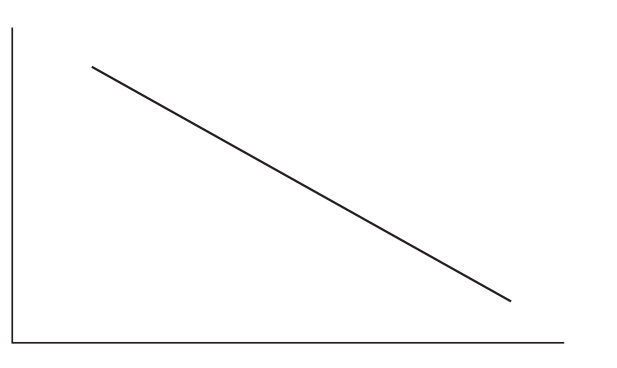
Arrhenius plot (linear form):
\(y\)-axis: \(\ln k\)
\(x\)-axis: \(1/T\)
Arrhenius plot (linear form):
\(y\)-axis: \(\ln k\)
\(x\)-axis: \(1/T\)
(vi)
Gradient of \(\ln k\) vs \(1/T\) is \(-E_a/R\).
\(E_a = 12\ \text{kJ mol}^{-1} = 12000\ \text{J mol}^{-1}\)
Gradient \(= -\dfrac{12000}{8.31} = \mathbf{-1444\ \text{K}}\)
Gradient of \(\ln k\) vs \(1/T\) is \(-E_a/R\).
\(E_a = 12\ \text{kJ mol}^{-1} = 12000\ \text{J mol}^{-1}\)
Gradient \(= -\dfrac{12000}{8.31} = \mathbf{-1444\ \text{K}}\)
(vii)
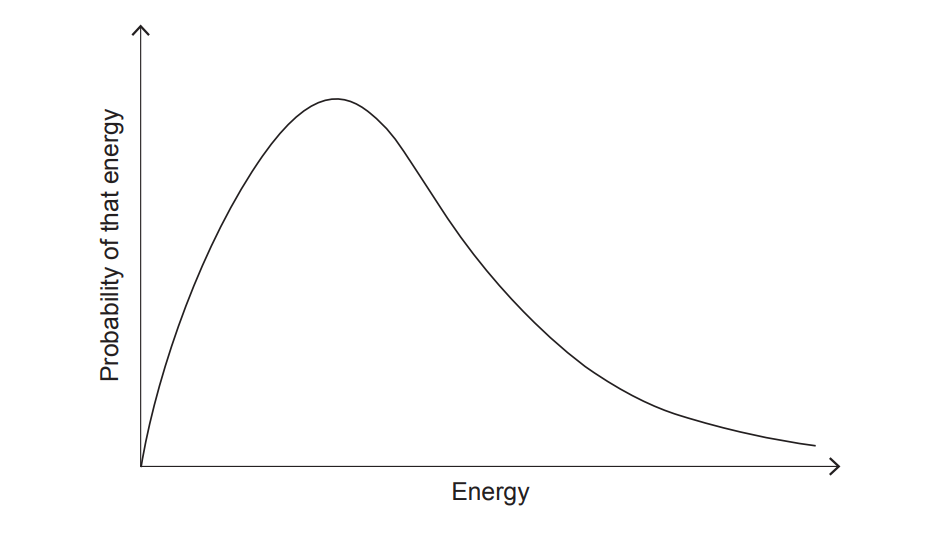
At higher temperature, the curve becomes lower and broader, with the peak shifted to the right (higher energy). The area under the curve stays the same.
At higher temperature, the curve becomes lower and broader, with the peak shifted to the right (higher energy). The area under the curve stays the same.
(viii)
Increasing temperature increases the fraction of molecules with energy \(\ge E_a\).
On the Maxwell–Boltzmann plot, the shaded area to the right of \(E_a\) is larger at higher temperature, so there are more successful collisions per second.
Increasing temperature increases the fraction of molecules with energy \(\ge E_a\).
On the Maxwell–Boltzmann plot, the shaded area to the right of \(E_a\) is larger at higher temperature, so there are more successful collisions per second.
(ix)
Two confirming observations (any two):
• The reaction is faster when the solid is present.
• The solid is not used up (mass/appearance essentially unchanged after the reaction).
• The catalyst can be recovered at the end of the reaction.
Two confirming observations (any two):
• The reaction is faster when the solid is present.
• The solid is not used up (mass/appearance essentially unchanged after the reaction).
• The catalyst can be recovered at the end of the reaction.
(c)
(i)
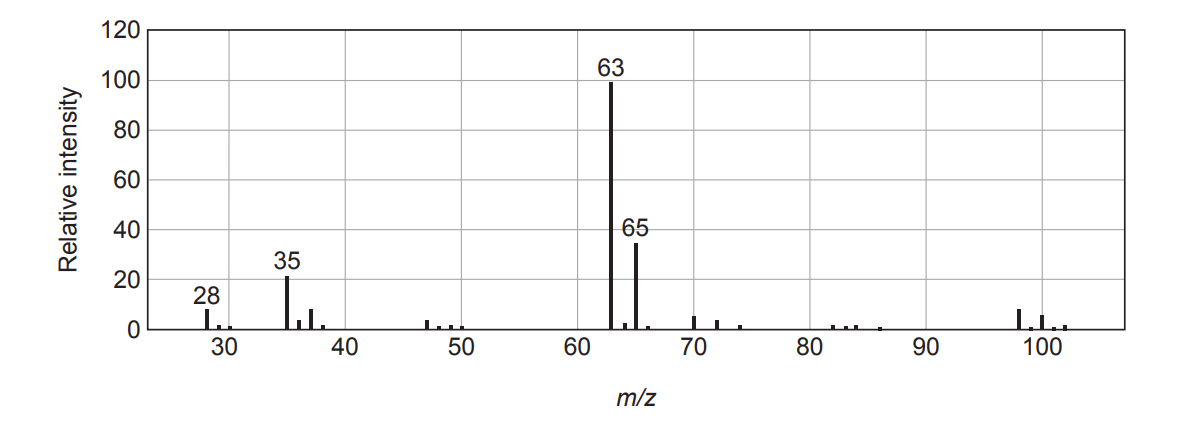
Peaks at lower \(m/z\) occur because the molecular ion fragments into smaller ions in the mass spectrometer.
Peaks at lower \(m/z\) occur because the molecular ion fragments into smaller ions in the mass spectrometer.
(ii)
Approximate molecular mass of phosgene: \(\approx 98\) (using \(\text{Cl}\approx 35\)).
\(98 – 35 = 63\), so this is consistent with loss of \(\text{Cl}\cdot\).
Fragment at \(m/z=63\): \(\mathbf{\text{COCl}^+}\).
Approximate molecular mass of phosgene: \(\approx 98\) (using \(\text{Cl}\approx 35\)).
\(98 – 35 = 63\), so this is consistent with loss of \(\text{Cl}\cdot\).
Fragment at \(m/z=63\): \(\mathbf{\text{COCl}^+}\).
(iii)
IR:
Strong \(\text{C}=\text{O}\) absorption around \(\mathbf{1700\text{–}1750\ \text{cm}^{-1}}\); \(\text{C}-\text{Cl}\) absorptions in the \(\mathbf{600\text{–}800\ \text{cm}^{-1}}\) region.
\(^1\text{H}\) NMR:
No \(^1\text{H}\) signals, because \(\text{Cl}_2\text{CO}\) contains no hydrogen atoms.
IR:
Strong \(\text{C}=\text{O}\) absorption around \(\mathbf{1700\text{–}1750\ \text{cm}^{-1}}\); \(\text{C}-\text{Cl}\) absorptions in the \(\mathbf{600\text{–}800\ \text{cm}^{-1}}\) region.
\(^1\text{H}\) NMR:
No \(^1\text{H}\) signals, because \(\text{Cl}_2\text{CO}\) contains no hydrogen atoms.