Home / Mock Exam IB DP Chemistry HL Paper 2 Set 5

IB DP Chemistry Mock Exam HL Paper 2 Set 5 - 2025 Syllabus

IB DP Chemistry Mock Exam HL Paper 2 Set 5

Prepare for the IB DP Chemistry Exam with our comprehensive IB DP Chemistry Exam Mock Exam HL Paper 2 Set 5. Test your knowledge and understanding of key concepts with challenging questions covering all essential topics. Identify areas for improvement and boost your confidence for the real exam

IB DP Chemistry Mock Tests -All Sets

Question 

Strychnine, \(\mathrm{C_{21}H_{22}N_2O_2}\) \(\bigl(M_r = 334.4\bigr)\), is a white crystalline solid obtained from plant sources.
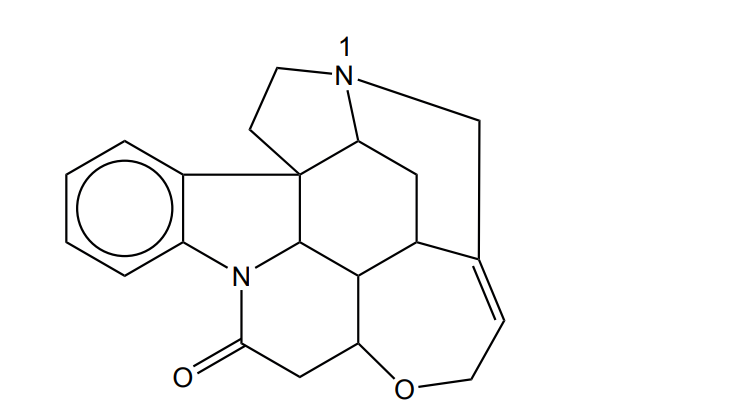
(a) The structural formula of strychnine is shown below.
(i) State the name of the functional group that contains the nitrogen atom labelled “\(1\)”.
(ii) Outline how the functional group containing \(\mathrm{N_1}\) affects the pH when strychnine is dissolved in water.
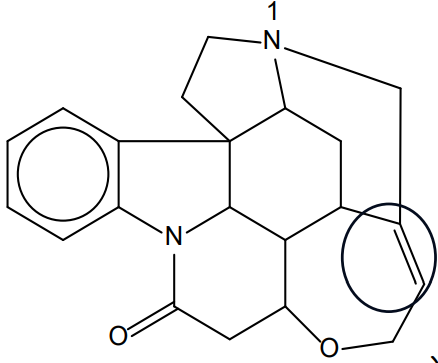
(iii) On the structure in (a), circle a functional group that would react with bromine in the dark.
(iv) State the number of rings present in the structure of strychnine.
(v) The structure of strychnine contains chiral carbon atoms. Outline what is meant by a chiral carbon atom.
(b) \(48.73\,\text{g}\) of strychnine was converted into its sulfate according to the reaction:
\[ 2\mathrm{C_{21}H_{22}N_2O_2(aq)} + \mathrm{H_2SO_4(aq)} \rightarrow \bigl(\mathrm{C_{21}H_{23}N_2O_2}\bigr)_2\mathrm{SO_4(aq)} \]
Determine the percentage yield if \(51.41\,\text{g}\) of product was obtained.
Use section \(7\) of the data booklet (molar masses: \(\mathrm{H}=1.01\), \(\mathrm{C}=12.01\), \(\mathrm{N}=14.01\), \(\mathrm{O}=16.00\), \(\mathrm{S}=32.07\)).
▶️ Answer/Explanation
Detailed solution

(a)(i)
The functional group containing \(\mathrm{N_1}\) is a tertiary amine.

(a)(ii)
The amine nitrogen has a lone pair and can accept a proton from water. As a result, strychnine acts as a base in aqueous solution and increases the pH.

(a)(iii)
The alkene \(\mathrm{C{=}C}\) functional group reacts with bromine in the dark by electrophilic addition.
(a)(iv)
The structure of strychnine contains \(\boxed{7}\) rings.

(a)(v)
A chiral carbon atom is bonded to four different atoms or groups, leading to non-superimposable mirror images.

(b)
Moles of strychnine: \[ n = \frac{48.73}{334.4} = 0.1457\,\text{mol} \] Reaction ratio: \(2\) mol strychnine produce \(1\) mol sulfate product. \[ n(\text{product}) = \frac{0.1457}{2} = 0.07286\,\text{mol} \] Using section \(7\) of the data booklet: \[ M_r(\mathrm{H_2SO_4}) = 2(1.01) + 32.07 + 4(16.00) = 98.08 \] Molar mass of sulfate product: \[ M_r = 2(334.4) + 98.08 = 766.88\,\text{g mol}^{-1} \] Theoretical mass of product: \[ m = 0.07286 \times 766.88 = 55.88\,\text{g} \] Percentage yield: \[ \%\,\text{yield} = \frac{51.41}{55.88} \times 100 = \boxed{92.00\%} \]

Scroll to Top