
▶️ Answer/Explanation
Detailed solution
(a)
An element contains only one type of atom (atoms with the same number of protons) and cannot be broken down by chemical means.
A compound contains two or more different elements chemically bonded together in a fixed ratio.
An element contains only one type of atom (atoms with the same number of protons) and cannot be broken down by chemical means.
A compound contains two or more different elements chemically bonded together in a fixed ratio.
(b)
From the data booklet (section 9), the electronegativity values are \(\chi(\mathrm{S}) = 2.6\) and \(\chi(\mathrm{Fe}) = 1.8\).
So, \(\Delta \chi = 2.6 – 1.8 = 0.8\), and the average electronegativity is \(\dfrac{2.6 + 1.8}{2} = 2.2\).
Using the triangular bonding diagram (section 17), a moderate \(\Delta \chi\) with a relatively high average electronegativity places the bonding in the polar covalent region rather than fully ionic.
From the data booklet (section 9), the electronegativity values are \(\chi(\mathrm{S}) = 2.6\) and \(\chi(\mathrm{Fe}) = 1.8\).
So, \(\Delta \chi = 2.6 – 1.8 = 0.8\), and the average electronegativity is \(\dfrac{2.6 + 1.8}{2} = 2.2\).
Using the triangular bonding diagram (section 17), a moderate \(\Delta \chi\) with a relatively high average electronegativity places the bonding in the polar covalent region rather than fully ionic.
(c)
(i)

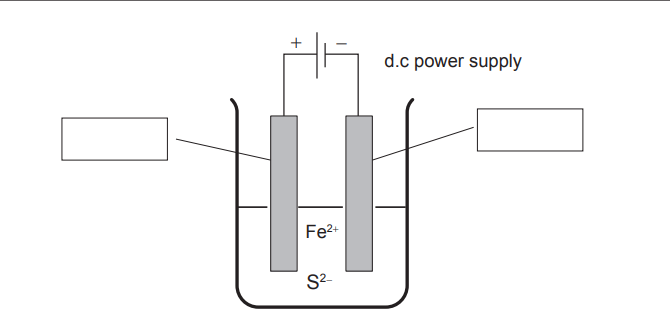
• Left Electrode (Positive): Anode. \(\text{S}^{2-}\) ions move towards it.
• Right Electrode (Negative): Cathode. \(\text{Fe}^{2+}\) ions move towards it.
(i)
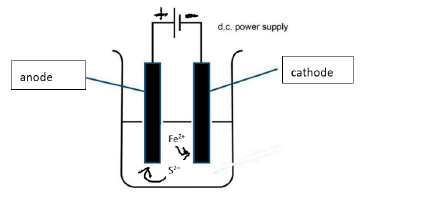
• Left Electrode (Positive): Anode. \(\text{S}^{2-}\) ions move towards it.
• Right Electrode (Negative): Cathode. \(\text{Fe}^{2+}\) ions move towards it.
(ii)
• Negative electrode (Cathode): \(\text{Fe}^{2+} + 2\text{e}^- \rightarrow \text{Fe}\)
• Positive electrode (Anode): \(\text{S}^{2-} \rightarrow \text{S} + 2\text{e}^-\)
• Negative electrode (Cathode): \(\text{Fe}^{2+} + 2\text{e}^- \rightarrow \text{Fe}\)
• Positive electrode (Anode): \(\text{S}^{2-} \rightarrow \text{S} + 2\text{e}^-\)
(iii)
Iron is a good conductor of electricity/heat (or is malleable/ductile/magnetic), whereas iron(II) sulfide is a non-conductor (or brittle/non-magnetic).
Iron is a good conductor of electricity/heat (or is malleable/ductile/magnetic), whereas iron(II) sulfide is a non-conductor (or brittle/non-magnetic).