
▶️ Answer/Explanation
(a)
(i)
\(\text{Cl}_2(g) \xrightarrow{\text{UV}} 2\text{Cl}^\bullet(g)\).
(ii)
The chlorine–chlorine bond undergoes homolytic fission.
(iii)
Bonds broken: \(\text{C}\equiv\text{O} = 1077\), \(\text{Cl}–\text{Cl} = 242\). Total = \(1319 \text{ kJ mol}^{-1}\).
Bonds formed: \(\text{C}=\text{O} = 804\), \(2 \times \text{C}–\text{Cl} = 648\). Total = \(1452 \text{ kJ mol}^{-1}\).
\(\Delta H = 1319 – 1452 = \mathbf{-133 \text{ kJ mol}^{-1}}\).
(iv)
The energy profile shows reactants at a higher energy than products, indicating an exothermic reaction, with \(\Delta H\) shown as a downward arrow. 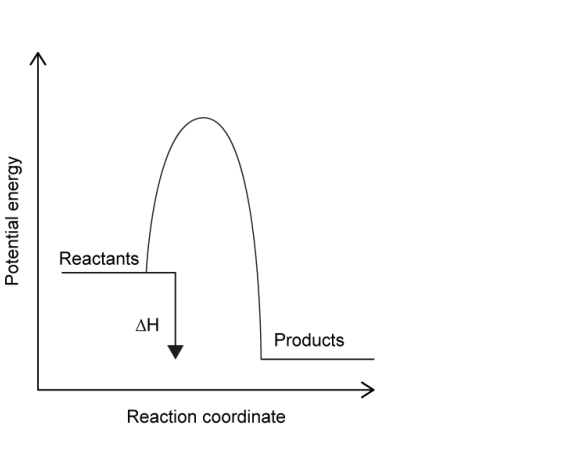
(b)
(i)
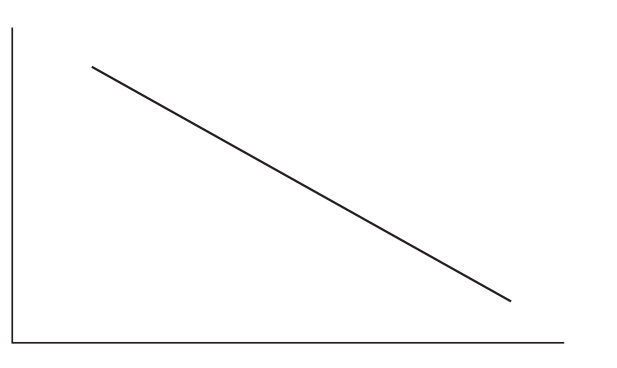
The rate may be followed by measuring the change in gas pressure at constant volume or the change in volume at constant pressure.
(ii)
Some collisions are unsuccessful because the particles collide with incorrect orientation or with energy less than the activation energy.
(iii)
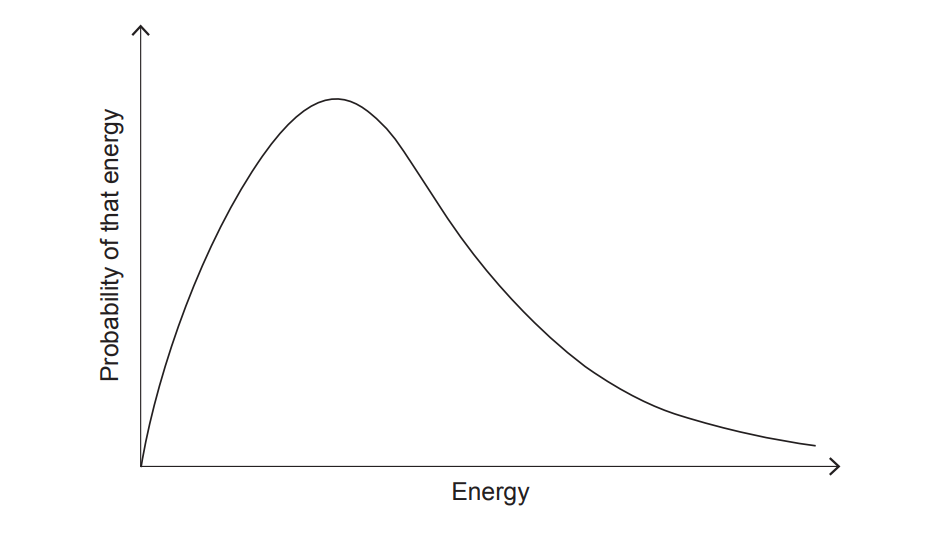
At higher temperature, the Maxwell–Boltzmann curve is broader, lower in height, and shifted to the right.
(iv)
Increasing temperature increases the proportion of particles with energy greater than or equal to the activation energy, resulting in more successful collisions per unit time.
(v)
The solid remains chemically unchanged and the reaction proceeds at a faster rate.
▶️ Answer/Explanation
(a)
(i)
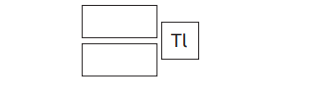
From section 7, thallium has atomic number \(81\).
Isotope has \(122\) neutrons, so mass number \(A = 81 + 122 = 203\).
Nuclear symbol: \(\boxed{{}^{203}\text{Tl}}\)
(ii)
Two isotopes: \({}^{203}\text{Tl}\) (30%) and \({}^{205}\text{Tl}\) (70%) since \(81+124=205\).
\[ A_r = (0.30 \times 203) + (0.70 \times 205) \] \[ A_r = 60.9 + 143.5 = \boxed{204.40} \]
(iii)
Lead has a higher nuclear charge (\(Z=82\)) than thallium (\(Z=81\)).
The shielding of the outer electron is similar (both are period 6 with many inner shells), so the effective nuclear attraction is slightly lower in thallium.
Therefore, the outer electron in thallium is held less strongly, so its first ionization energy is lower than that of lead.
(b)
(i)
• Covalent bonds: within the sulfate ion, between \(\text{S}\) and \(\text{O}\) atoms in \(\text{SO}_4^{2-}\).
• Ionic bonds: between \(\text{Tl}^+\) ions and \(\text{SO}_4^{2-}\) ions.
(ii)
• Covalent bonding: atoms share pairs of valence electrons.
• Ionic bonding: electrons are transferred (forming cations and anions), then ions are held by electrostatic attraction.
(iii)
\[ 2\text{TlOH}(s) + \text{H}_2\text{SO}_4(aq) \rightarrow \text{Tl}_2\text{SO}_4(aq) + 2\text{H}_2\text{O}(l) \]
(iv)
From section 7: \(\text{Tl} = 204.38\), \(\text{O} = 16.00\), \(\text{H} = 1.01\).
\[ M_r(\text{TlOH}) = 204.38 + 16.00 + 1.01 = 221.39\ \text{g mol}^{-1} \] \[ n(\text{TlOH}) = \frac{10.0}{221.39} = 0.0452\ \text{mol} \] From the equation, \(2\ \text{mol TlOH}\) react with \(1\ \text{mol H}_2\text{SO}_4\):
\[ n(\text{H}_2\text{SO}_4) = \frac{0.0452}{2} = 0.0226\ \text{mol} \] \[ V = \frac{n}{c} = \frac{0.0226}{2.00} = 0.0113\ \text{dm}^3 = \boxed{11.3\ \text{cm}^3} \]
(v)
No. Thallium is a metal (group 13, lower down the group shows strong metallic character), so \(\text{TlOH}\) is expected to be mainly basic rather than amphoteric.
(vi)
Set up two displacement tests:
• Place thallium metal in aqueous copper(II) sulfate and observe whether copper is displaced (copper deposits / solution colour decreases).
• Place copper metal in aqueous thallium(I) sulfate and observe whether thallium is displaced.
The metal that displaces the other metal from its sulfate solution is the more reactive metal.