Home / Mock Exam IB DP Physics HL Paper 1 Set 1

IB DP Physics Mock Exam HL Paper 1A Set 1 - 2025 Syllabus

IB DP Physics Mock Exam HL Paper 1A Set 1

Prepare for the IB DP Physics Mock Exam HL Paper 1A Set 1 with our comprehensive mock exam set 1. Test your knowledge and understanding of key concepts with challenging questions covering all essential topics. Identify areas for improvement and boost your confidence for the real exam

IB DP Physics Mock Tests -All Sets

Question 

Which of the following best defines instantaneous velocity?
(A) Total displacement divided by total time taken
(B) The rate at which an object’s position changes
(C) Total distance traveled divided by total time taken
(D) The rate at which an object’s distance from a point changes
▶️ Answer/Explanation
Detailed solution

Instantaneous velocity is defined as the rate of change of position with respect to time at a specific instant.
Option (A) defines average velocity, (C) defines average speed, and (D) refers to the rate of change of distance (speed), not velocity.
Answer: (B)

Question 

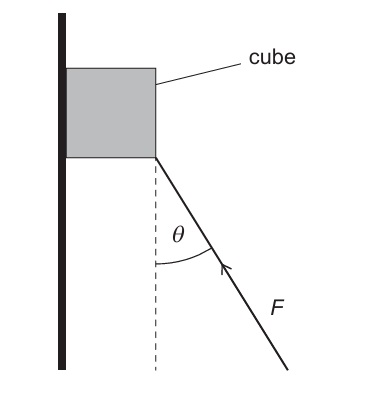
A cube of mass \( m \) is accelerated upwards along a smooth vertical surface by a force \( F \) applied at an angle \( \theta \) to the vertical. What is the magnitude of the cube’s acceleration?


(A) \(\frac{F \cos \theta – mg}{m}\)
(B) \(\frac{F \sin \theta – mg}{m}\)
(C) \(\frac{F \cos \theta – g}{m}\)
(D) \(\frac{F \sin \theta – g}{m}\)
▶️ Answer/Explanation
Detailed solution

Resolving the force \( F \) into components:
– Vertical component: \( F \cos \theta \) (upwards)
– Horizontal component: \( F \sin \theta \) (perpendicular to the surface)

Since the surface is frictionless and vertical, only the vertical forces affect the upward acceleration.
Using Newton’s second law in the vertical direction:
\( F \cos \theta – mg = ma \)
Rearranging for acceleration \( a \):
\( a = \frac{F \cos \theta – mg}{m} \)
Answer: (A)

Question 

A 5.0 kg object initially at rest experiences an impulse of 2.0 N·s. What is its final kinetic energy?
(A) 0.40 J
(B) 10 J
(C) 20 J
(D) 40 J
▶️ Answer/Explanation
Detailed solution

Impulse = change in momentum: \( J = m\Delta v \)
\( 2.0 = 5.0 \times v \) ⇒ \( v = 0.4 \, \text{m/s} \)
Kinetic energy: \( KE = \frac{1}{2}mv^2 = \frac{1}{2} \times 5.0 \times (0.4)^2 = 0.4 \, \text{J} \)
Answer: (A)

Scroll to Top