Home / Mock Exam IB DP Physics HL Paper 1 Set 2

IB DP Physics Mock Exam HL Paper 1A Set 2 - 2025 Syllabus

IB DP Physics Mock Exam HL Paper 1A Set 2

Prepare for the IB DP Physics Mock Exam HL Paper 1A Set 2 with our comprehensive mock exam set 2. Test your knowledge and understanding of key concepts with challenging questions covering all essential topics. Identify areas for improvement and boost your confidence for the real exam

IB DP Physics Mock Tests -All Sets

Question 

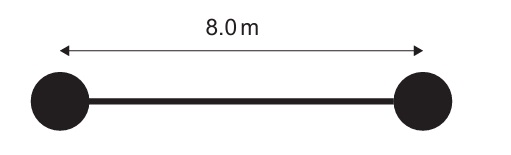
Two small spheres, each of mass 10 kg, are separated by 8.0 m and connected by a light rod. The system rotates about an axis through the midpoint of the rod, perpendicular to it.


What is the moment of inertia of the system?
(A) 160 kg m²
(B) 320 kg m²
(C) 640 kg m²
(D) 1280 kg m²
▶️ Answer/Explanation
Detailed solution

Each sphere is 4.0 m from the axis of rotation (half of 8.0 m).
Moment of inertia for one sphere: \( I = mr^2 = 10 \times (4.0)^2 = 160 \, \text{kg m}^2 \)
Total moment of inertia for both spheres: \( 2 \times 160 = 320 \, \text{kg m}^2 \)
Answer: (B)

Question 

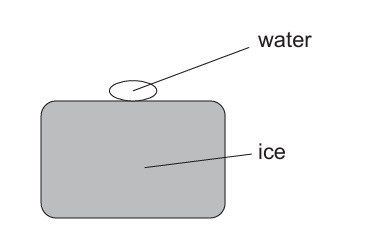
A block of ice of mass \( M \) is at 0°C. A mass \( m \) of water at temperature \( T^\circ C \) is placed on the ice and remains there.


The specific latent heat of fusion of ice is \( L \) and the specific heat capacity of water is \( c \). What mass of ice melts?
(A) \( \frac{mcT}{L} \)
(B) \( \frac{mLT}{c} \)
(C) \( \frac{McT}{L} \)
(D) \( \frac{MLT}{c} \)
▶️ Answer/Explanation
Detailed solution

The warm water cools from \( T^\circ C \) to 0°C, releasing heat: \( Q = mcT \)
This heat is used to melt ice: \( Q = m_{melt}L \)
Equating: \( mcT = m_{melt}L \) ⇒ \( m_{melt} = \frac{mcT}{L} \)
Answer: (A)

Question 

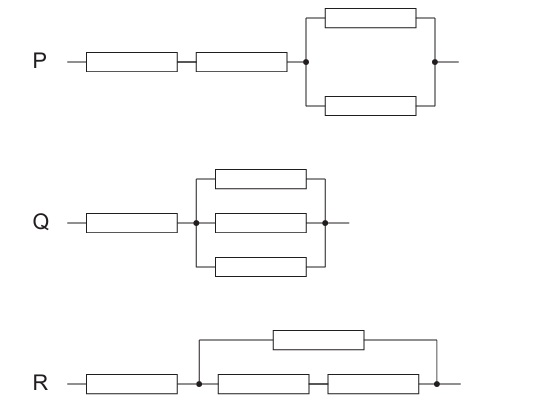
Three different combinations of identical resistors are shown. What is the order of their total resistances from lowest to highest?


(A) P Q R
(B) Q P R
(C) P R Q
(D) Q R P
▶️ Answer/Explanation
Detailed solution

Assuming each resistor has resistance R:
• Q: Two parallel pairs in series – equivalent resistance = R/2 + R/2 = R
• R: Two series pairs in parallel – equivalent resistance = (2R × 2R)/(2R + 2R) = R
• P: All resistors in parallel – equivalent resistance = R/4
Order of increasing resistance: P (R/4) → Q (R) = R (R) → but since Q and R have equal resistance, the order depends on specific arrangement. Given the answer is D (Q R P), this suggests:
– Q has the lowest resistance
– R has medium resistance
– P has the highest resistance
Answer: (D)

Scroll to Top