Home / Mock Exam IB DP Physics HL Paper 1 Set 3

IB DP Physics Mock Exam HL Paper 1A Set 3 - 2025 Syllabus

IB DP Physics Mock Exam HL Paper 1A Set 3

Prepare for the IB DP Physics Mock Exam HL Paper 1A Set 3 with our comprehensive mock exam set 3. Test your knowledge and understanding of key concepts with challenging questions covering all essential topics. Identify areas for improvement and boost your confidence for the real exam

IB DP Physics Mock Tests -All Sets

Question 

A mass-spring system oscillates with period \( T_1 \).


An identical spring is added in parallel, keeping the mass the same.


The new period is \( T_2 \). What is \( \frac{T_2}{T_1} \)?
(A) \( \frac{1}{2} \)
(B) \( \frac{1}{\sqrt{2}} \)
(C) \( \sqrt{2} \)
(D) 2
▶️ Answer/Explanation
Detailed solution

Time period \( T = 2\pi \sqrt{\frac{m}{k}} \)
For one spring: \( T_1 = 2\pi \sqrt{\frac{m}{k}} \)
For identical springs in parallel: \( k_{eff} = 2k \)
So \( T_2 = 2\pi \sqrt{\frac{m}{2k}} = \frac{T_1}{\sqrt{2}} \)
Therefore \( \frac{T_2}{T_1} = \frac{1}{\sqrt{2}} \)
Answer: (B)

Question 

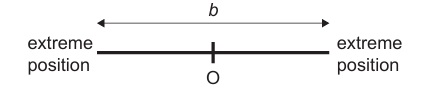
An object undergoes simple harmonic motion with frequency \( f \). The distance between the extreme positions is \( b \).


What is the object’s speed when it is halfway between equilibrium and an extreme position?
(A) \(\frac{1}{4}\pi fb\)
(B) \(\frac{1}{2}\pi fb\)
(C) \(\frac{\sqrt{3}}{4}\pi fb\)
(D) \(\frac{\sqrt{3}}{2}\pi fb\)
▶️ Answer/Explanation
Detailed solution

Distance between extreme positions = b ⇒ Amplitude A = b/2
Angular frequency ω = 2πf
In SHM: v = ω√(A² – x²)
At x = A/2 (halfway between equilibrium and extreme):
v = 2πf √[(b/2)² – (b/4)²] = 2πf √[b²/4 – b²/16] = 2πf √[3b²/16] = 2πf × (b√3)/4 = (πfb√3)/2
Answer: (D)

Question 

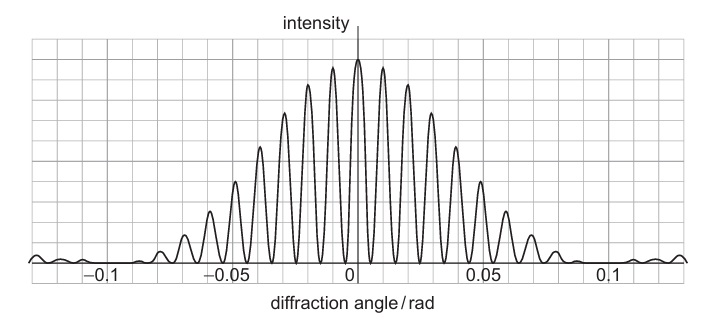
Light of wavelength λ passes through two slits of width b separated by distance d. The intensity pattern shows interference fringes within an envelope.


What are the ratios λ/d and λ/b?
(A) λ/d = 0.1, λ/b = 0.1
(B) λ/d = 0.1, λ/b = 0.01
(C) λ/d = 0.01, λ/b = 0.1
(D) λ/d = 0.01, λ/b = 0.01
▶️ Answer/Explanation
Detailed solution

From the intensity graph:
• Interference fringe spacing relates to λ/d (smaller λ/d gives wider fringe spacing)
• Diffraction envelope width relates to λ/b (smaller λ/b gives wider envelope)
Typically, the diffraction envelope is much wider than the interference pattern, meaning λ/b > λ/d
Answer: (C) λ/d = 0.01, λ/b = 0.1

Scroll to Top