Home / Mock Exam IB DP Physics SL Paper 1 Set 1

IB DP Physics Mock Exam SL Paper 1A Set 1 - 2025 Syllabus

IB DP Physics Mock Exam SL Paper 1A Set 1

Prepare for the IB DP Physics Mock Exam SL Paper 1A Set 1 with our comprehensive mock exam set 1. Test your knowledge and understanding of key concepts with challenging questions covering all essential topics. Identify areas for improvement and boost your confidence for the real exam

IB DP Physics Mock Tests -All Sets

Question 

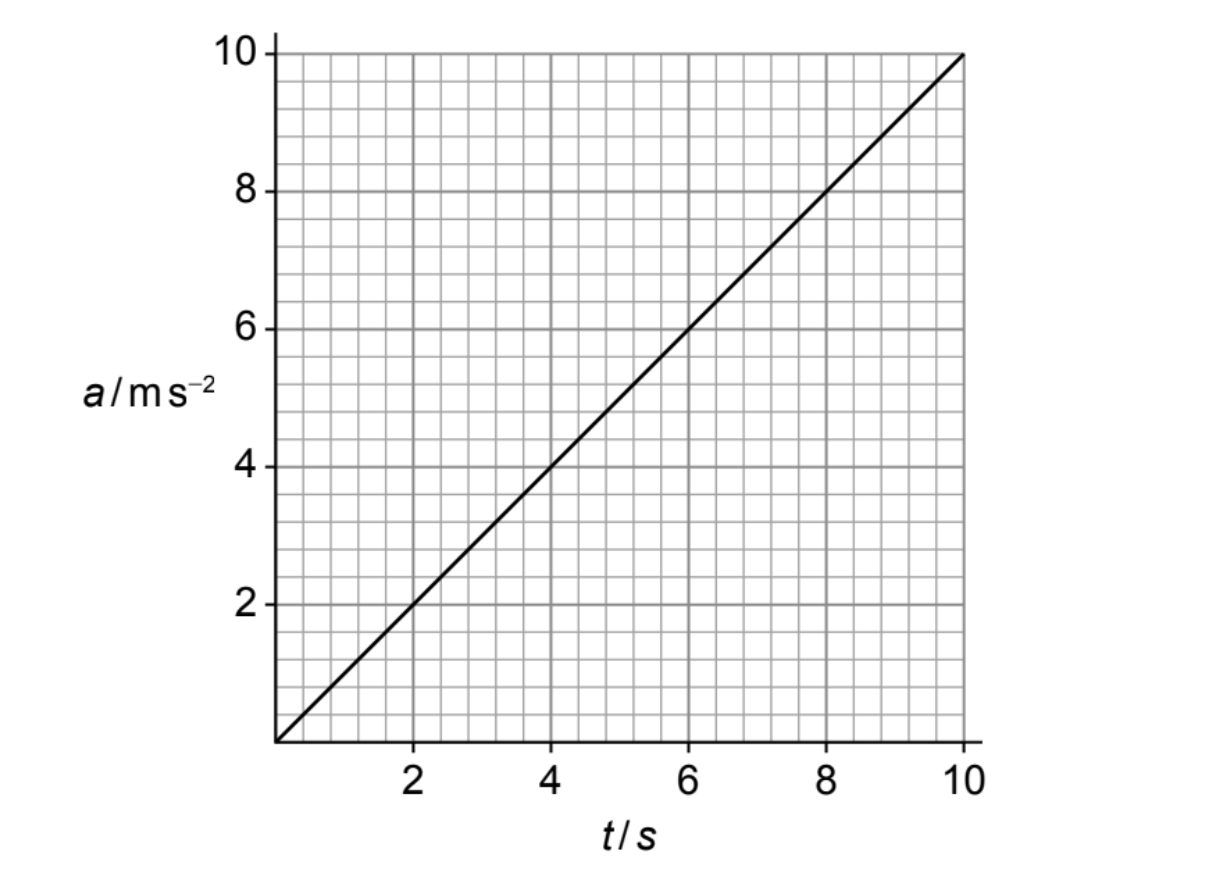
 The variation with time \(t\) of the acceleration \(a\) of an object is shown in graph below. At \(t=0\) the object is at rest. What will be e speed of the object when \(t=8.0\) s?
(A) \(1.0\) ms\(^{-1}\)
(B) \(32\) ms\(^{-1}\)
(C) \(50\) ms\(^{-1}\)
(D) \(64\) ms\(^{-1}\)
▶️ Answer/Explanation
Detailed solution

1. Relate Acceleration and Velocity:
The change in velocity (\(\Delta v\)) is equal to the area under the acceleration-time graph. Since the object starts at rest (\(u=0\)), the final speed \(v\) is equal to this area.

2. Calculate Area (Triangle):
The graph is a straight line passing through the origin. At \(t=8.0\) s, read the acceleration from the graph. It corresponds to \(a=8.0\) ms\(^{-2}\).
Area = \(\frac{1}{2} \times \text{base} \times \text{height}\)
Area = \(\frac{1}{2} \times 8.0 \text{ s} \times 8.0 \text{ ms}^{-2}\)
Area = \(32\) ms\(^{-1}\).
Answer: (B)

Question 

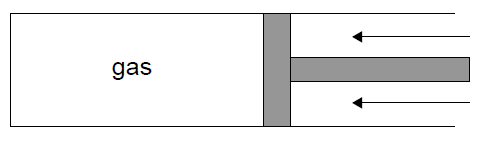
An ideal gas is held in a cylinder by a piston as shown in picture below. The piston compresses the gas rapidly.
Which one of below is correct .
The average speed of the gas molecules increases because the gas molecules…
(A) have a smaller volume available in which they can move.
(B) receive thermal energy transferred from outside the cylinder.
(C) receive energy from the piston as they collide with it.
(D) make more collisions every second with each other.
▶️ Answer/Explanation
Detailed solution

1. Analyze Process:
Rapid compression implies an adiabatic process (no time for heat transfer, so Q=0). The work is done on the gas.

2. Microscopic View:
When a molecule collides with a moving wall (the piston moving inward), it rebounds with a higher speed than it struck with (similar to a tennis ball hit by a racket). This gain in kinetic energy increases the average speed (and temperature) of the gas.
Answer: (C)

Question 

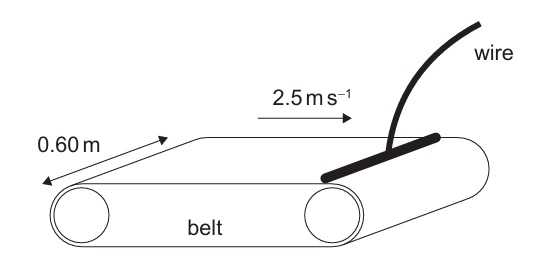
A moving belt has a width of \(0.60\) m and travels steadily at a speed of \(2.5\) ms\(^{-1}\). Its surface carries a uniform charge density of \(5.0\) mC m\(^{-2}\). As the belt passes a fixed point, all of the charge is removed and transferred into a wire as an electric current.
What is the magnitude of the current in the wire?
(A) \(1.2\) mA
(B) \(7.5\) mA
(C) \(19\) mA
(D) \(21\) mA
▶️ Answer/Explanation
Detailed solution

1. Define Current:
Current \(I = \frac{\Delta Q}{\Delta t}\) (charge transferred per unit time).

2. Determine Charge Flow Rate:
In one second, a length of belt \(L = v \times 1 \text{ s} = 2.5\) m passes the point.
The area of this section is \(A = \text{width} \times L = 0.60 \text{ m} \times 2.5 \text{ m} = 1.5 \text{ m}^2\).

3. Calculate Total Charge in that Area:
Charge \(Q = \sigma \times A\)
\(Q = 5.0 \text{ mC m}^{-2} \times 1.5 \text{ m}^2 = 7.5 \text{ mC}\).

4. Calculate Current:
This charge flows each second, so
\(I = 7.5 \text{ mC} / 1 \text{ s} = 7.5 \text{ mA}\).
Answer: (B)

Scroll to Top