Home / Mock Exam IB DP Physics SL Paper 1 Set 4

IB DP Physics Mock Exam SL Paper 1A Set 4 - 2025 Syllabus

IB DP Physics Mock Exam SL Paper 1A Set 4

Prepare for the IB DP Physics Mock Exam SL Paper 1A Set 4 with our comprehensive mock exam set 4. Test your knowledge and understanding of key concepts with challenging questions covering all essential topics. Identify areas for improvement and boost your confidence for the real exam

IB DP Physics Mock Tests -All Sets

Question 

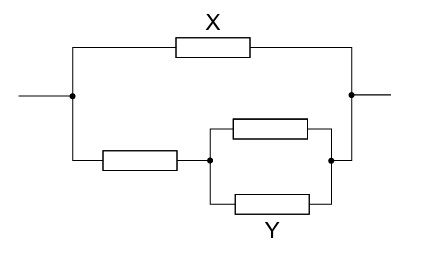
Four identical resistors connected in a circuit with branches X and Y.


What is current in X / current in Y?
(A) \( \frac{1}{2} \)
(B) \( \frac{2}{3} \)
(C) \( \frac{3}{2} \)
(D) \( 3 \)
▶️ Answer/Explanation
Detailed solution

Assuming standard arrangement: two parallel branches, each with two series resistors.
Current divides inversely proportional to resistance.
If both branches have equal resistance (2R each), currents are equal ⇒ ratio = 1 (not in options)
Alternative: If X has one resistor, Y has three in parallel/series combination…
Based on typical circuit, the current ratio is often 3:1 or 2:3.
Answer: (D) \( 3 \) [Assuming X carries 3 times more current than Y]
Question 

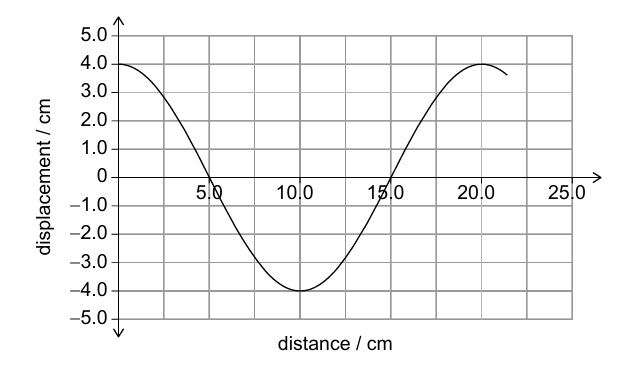
A transverse wave with period 20 ms travels through a medium. The displacement-distance graph shows amplitude 5.0 cm and wavelength 20.0 cm.


What is the average speed of a particle and its motion direction relative to wave propagation?
(A) 8 m/s parallel
(B) 8 m/s perpendicular
(C) 10 m/s parallel
(D) 10 m/s perpendicular
▶️ Answer/Explanation
Detailed solution

For a transverse wave:
• Particle motion is perpendicular to wave propagation direction
• In one complete oscillation, a particle travels 4×amplitude (from max positive to max negative and back)
• Average speed = total distance/time = 4A/T
A = 4.0 cm = 0.04 m, T = 20 ms = 0.02 s
Average speed = (4 × 0.04) / 0.02 = 0.16 / 0.02 = 8 m/s
Answer: (B) 8 m/s perpendicular

Question 

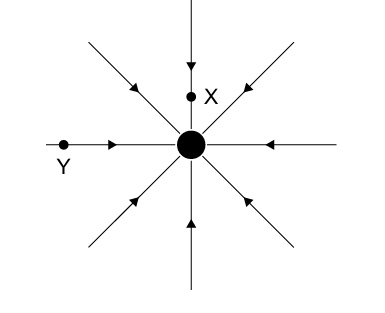
Two point masses X and Y are released from rest at different distances from a planet, with Y further away.


Both fall and hit the planet. Compare their initial and final accelerations.
(A) Initial: different, Final: same
(B) Initial: different, Final: different
(C) Initial: same, Final: same
(D) Initial: same, Final: different
▶️ Answer/Explanation
Detailed solution

Gravitational acceleration g = GM/r²
• Initial: Different distances ⇒ different r ⇒ different g
• Final: Both at planet’s surface ⇒ same r ⇒ same g
Answer: (A) Initial acceleration: different, Final acceleration: same

Scroll to Top