
Five Kingdom Classification
📌 Introduction
Living organisms show great diversity in structure, nutrition, and reproduction
To study this diversity in a scientific and systematic way, biologists developed biological classification.
Older systems had limitations, so a more logical system called the Five Kingdom Classification was proposed.
🧬 Biological Classification
Definition: Biological classification is the process of grouping organisms based on similarities and differences such as structure and organization.
- Makes study easy and systematic
- Helps in identification
- Helps understand relationships among organisms
🌱 Two Kingdom Classification (Linnaeus)
Concept:
- Proposed by Carolus Linnaeus
- Organisms divided into two kingdoms:
- Plantae
- Animalia
⚠️ Demerits of Two Kingdom Classification
- No distinction between prokaryotes and eukaryotes
- No separation of unicellular and multicellular organisms
- Photosynthetic and non photosynthetic organisms not separated
- Bacteria, fungi, and Euglena do not fit properly
Hence, a better system was required.
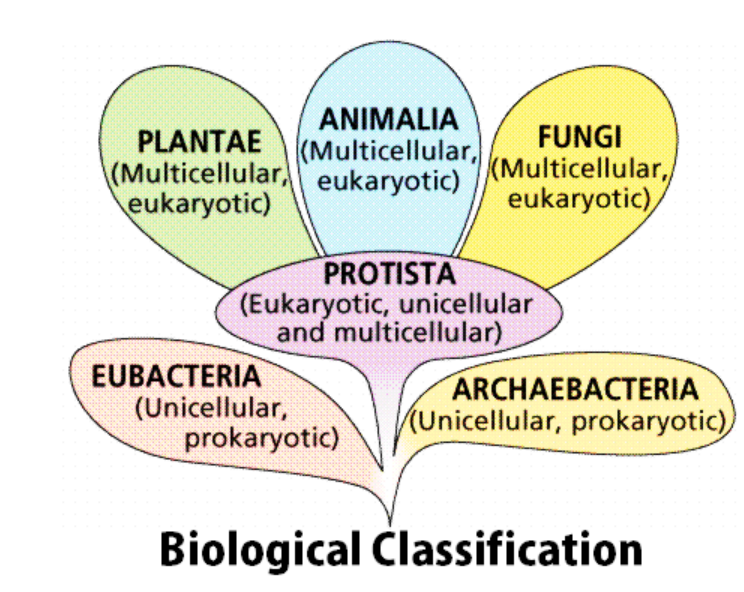
🌍 Five Kingdom Classification (R.H. Whittaker)
Proposal:
- Proposed by R.H. Whittaker in 1969
- Organisms divided into five kingdoms:
- Monera
- Protista
- Fungi
- Plantae
- Animalia
🧪 Basis of Five Kingdom Classification
- Cell structure
- Thallus organization
- Mode of nutrition
- Reproduction
- Phylogenetic relationships
🦠 Kingdom Monera
- Prokaryotic organisms
- Mostly unicellular
- No true nucleus or membrane bound organelles
- Cell wall usually present
Mode of Nutrition:
- Autotrophic (photosynthetic or chemosynthetic)
- Heterotrophic (saprophytic or parasitic)
Examples: Bacteria, Cyanobacteria
🧫 Kingdom Protista
- Eukaryotic and unicellular
- True nucleus present
- Mostly aquatic
Mode of Nutrition: Autotrophic or heterotrophic
Examples: Amoeba, Paramecium, Euglena
🍄 Kingdom Fungi
- Eukaryotic and mostly multicellular
- Cell wall made of chitin
- Body made of hyphae forming mycelium
Mode of Nutrition:
- Heterotrophic and absorptive
- Saprophytic, parasitic, or symbiotic
Examples: Mushroom, Yeast, Rhizopus
🌿 Kingdom Plantae
- Eukaryotic and multicellular
- Cell wall made of cellulose
- Chlorophyll present
Mode of Nutrition: Autotrophic by photosynthesis
Examples: Algae, Ferns, Flowering plants
🐾 Kingdom Animalia
- Eukaryotic and multicellular
- Cell wall absent
- Well-developed organ systems
Mode of Nutrition: Heterotrophic and ingestive
Examples: Human, Frog, Birds
📊 Summary Table: Five Kingdom Classification
| Kingdom | Cell Type | Organization | Nutrition |
|---|---|---|---|
| Monera | Prokaryotic | Unicellular | Auto / Heterotrophic |
| Protista | Eukaryotic | Unicellular | Auto / Heterotrophic |
| Fungi | Eukaryotic | Multicellular | Heterotrophic |
| Plantae | Eukaryotic | Multicellular | Autotrophic |
| Animalia | Eukaryotic | Multicellular | Heterotrophic |
📦 Quick Recap
Biological classification groups organisms scientifically.
Two kingdom system had many limitations.
R.H. Whittaker proposed the Five Kingdom Classification in 1969.
Basis includes cell structure, nutrition, reproduction, and evolution.
Five kingdoms: Monera, Protista, Fungi, Plantae, Animalia.
Salient Features of Kingdom Monera
📌 Introduction
Kingdom Monera includes the simplest and most primitive living organisms.
The most important members are bacteria.
All organisms of this kingdom are prokaryotic, meaning they lack a true nucleus and membrane bound organelles.
This kingdom includes:
- Bacteria
- Blue green algae (Cyanobacteria)
Members of Monera are highly adaptable and survive in extreme conditions such as:
- Hot springs
- Deserts
- Snow covered regions
- Deep oceans
They may live freely or show parasitism, symbiosis, or commensalism.
🌱 Salient Features of Kingdom Monera
Prokaryotic Nature
- All monerans are prokaryotes
- Most primitive organisms
- True nucleus absent
- Nuclear membrane absent
- Genetic material present as naked DNA
- DNA lies in cytoplasm forming nucleoid
Cell Structure
- Cell wall present in most members
- Provides protection and shape
- Composition varies among groups
- Mycoplasma lacks cell wall completely
Mode of Nutrition
Monerans show wide diversity:
- Autotrophic
- Photosynthetic
- Chemosynthetic
- Heterotrophic
- Saprophytic
- Parasitic
They may also show:
- Symbiosis
- Commensalism
Respiration
- Aerobic
- Anaerobic
Locomotion
- Motile forms move by flagella
Transport Mechanism
- No circulatory system
- Exchange of gases and nutrients by diffusion
🧪 Classification of Kingdom Monera
Kingdom Monera is divided into two main groups: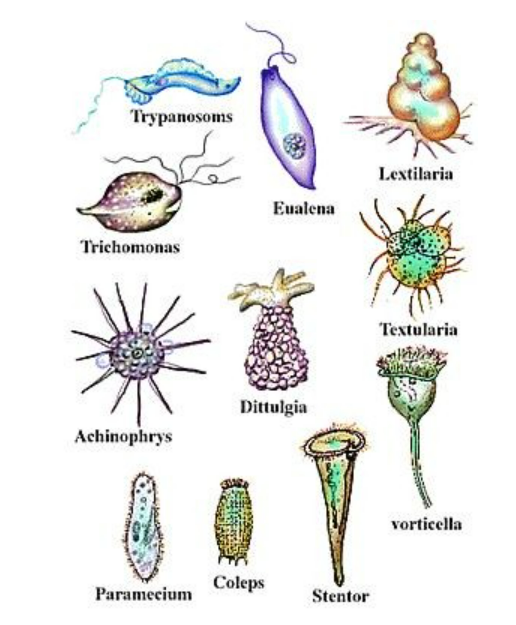
- Archaebacteria
- Eubacteria
🧬 Archaebacteria
General Features:
- Ancient bacteria
- Live in extreme environmental conditions
- Cell wall structure different from other bacteria
- This helps them survive harsh habitats
Types of Archaebacteria
- Halophiles
- Live in high salt concentration
- Example: salt lakes
- Thermoacidophiles
- Live in hot springs and acidic environments
- Methanogens
- Found in marshy areas and sewage
- Present in gut of ruminants like cow and buffalo
- Help in digestion of cellulose
- Used in biogas production
🧬 Eubacteria (True Bacteria)
General Features: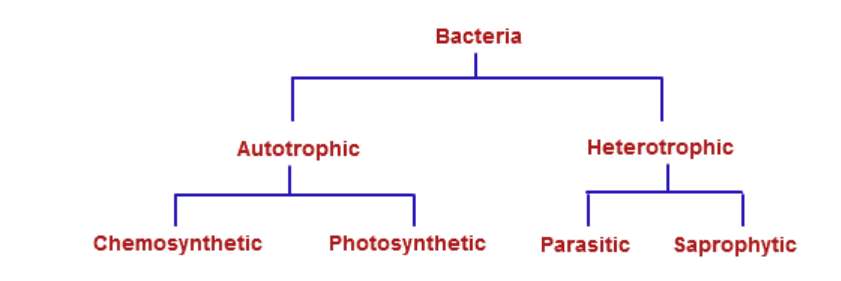
- Called true bacteria
- Rigid cell wall present
- Many are motile with flagella
- Widely distributed in nature
Cyanobacteria (Blue Green Algae)
- Belong to eubacteria
- Contain chlorophyll a
- Photosynthetic autotrophs
Characteristics:
- May be unicellular or filamentous
- Form colonies with gelatinous sheath
 Some fix atmospheric nitrogen
- Have special cells called heterocysts
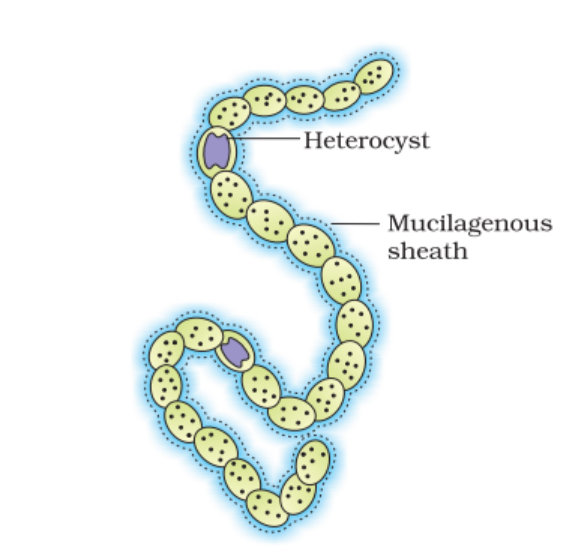 Some fix atmospheric nitrogen
Example: Nostoc
Chemosynthetic Autotrophic Bacteria
- Obtain energy by oxidation of inorganic substances
- Substances include nitrites and nitrates
- Energy released is used for ATP synthesis
Heterotrophic Bacteria
- Most abundant bacteria
- Important roles:
- Milk to curd conversion
- Antibiotic production
- Nitrogen fixation in legume roots
Reproduction in Monera
- Mainly by binary fission
- Under unfavorable conditions, spores are formed
Mycoplasma
- Included in Kingdom Monera
- Completely lack cell wall
- Can survive without oxygen
- Smallest living organisms
📊 Summary Table: Kingdom Monera
| Feature | Description |
|---|---|
| Cell type | Prokaryotic |
| Nucleus | Absent |
| DNA | Nucleoid |
| Cell wall | Present, absent in Mycoplasma |
| Nutrition | Autotrophic / Heterotrophic |
| Respiration | Aerobic / Anaerobic |
| Reproduction | Binary fission, spores |
📦 Quick Recap
Monera includes bacteria and cyanobacteria.
All members are prokaryotic and primitive.
DNA present as nucleoid, nucleus absent.
Classified into Archaebacteria and Eubacteria.
Cyanobacteria perform photosynthesis and nitrogen fixation.
Mycoplasma is wall less and the smallest living organism.
Kingdom Protista & Kingdom Fungi
🧫 Kingdom Protista
Kingdom Protista includes single-celled eukaryotic organisms.
Most protists are aquatic and play key roles in ecosystems.
Photosynthetic protists like algae act as primary producers in aquatic food chains.
🌱 General Characteristics of Protista
- Unicellular and eukaryotic
- True nucleus and membrane bound organelles present
- Locomotion by cilia or flagella
- Respiration may be aerobic or anaerobic
- Reproduction is asexual and sexual
- Many form cysts in unfavorable conditions
🧪 Major Groups of Protista
- Chrysophytes
- Dinoflagellates
- Euglenoids
- Slime moulds
- Protozoans
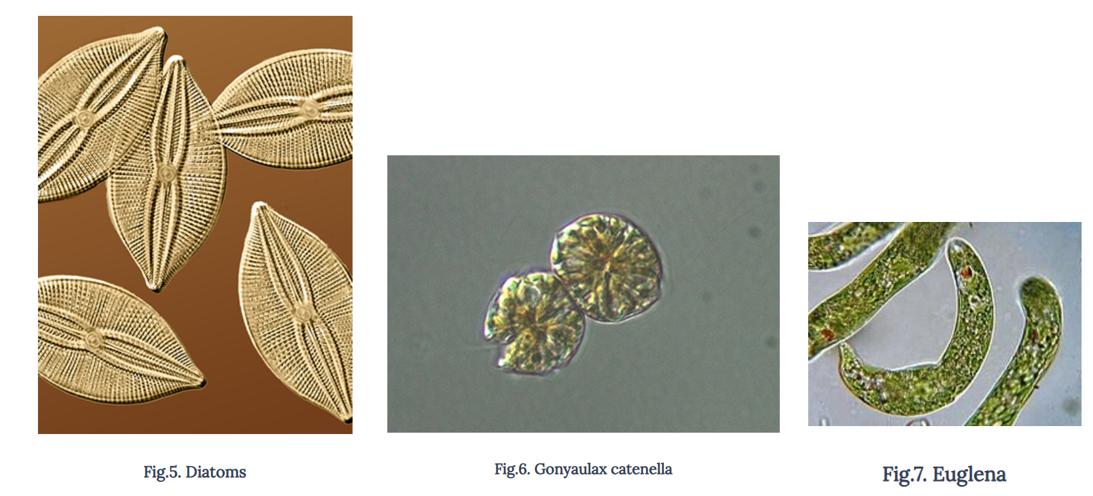
1. Chrysophytes
- Includes diatoms and golden algae
- Freshwater or marine habitat
- Mostly photosynthetic
- Cell wall impregnated with silica forming hard shells
- Major producers in oceans
Structure:
- Mostly unicellular
- Some are flagellated or amoeboid
Example: Diatoms
2. Dinoflagellates
- Mostly marine and photosynthetic
- Appear yellow, brown, red, or blue
- Color due to different pigments
- Cell wall has cellulose plates
Structure:
- Two flagella present
- One longitudinal and one transverse
Examples: Gonyaulax catenella, Noctiluca scintillans
3. Euglenoids
- Found in freshwater stagnant water
- No cell wall
- Outer covering called pellicle
Locomotion:
- Two flagella, one long and one short
Nutrition:
- Autotrophic in sunlight
- Heterotrophic in absence of sunlight
Special Points:
- Chloroplast present
- Reserve food is Paramylon
Example: Euglena
4. Slime Moulds
- Saprophytic in nature
- Form aggregates called plasmodium in favorable conditions
- Produce fruiting bodies in unfavorable conditions
- Spores are resistant to adverse conditions
- True cell wall present
5. Protozoan-like Protists
Heterotrophic protists living as predators or parasites.
a) Amoeboid Protozoans
- Found in water or moist soil
- Movement by pseudopodia
Example: Amoeba
b) Flagellated Protozoans
- Free living or parasitic
- Cause diseases
Example: Trypanosoma (sleeping sickness)
c) Ciliated Protozoans
- Have numerous cilia
- Cilia help in movement and feeding
Example: Paramecium
d) Sporozoans
- Parasitic and pathogenic
- Spore forming
- Sexual and asexual reproduction
Example: Plasmodium (malaria)
🍄 Kingdom Fungi
Fungi are heterotrophic eukaryotic organisms.
They obtain nutrition from organic matter.
🌱 General Characteristics of Fungi
- Heterotrophic
- Saprophytic, parasitic, or symbiotic
Symbiotic Association
- Lichens are association between fungi and algae
- Mycorrhiza is association between fungi and roots of higher plants
🔁 Reproduction in Fungi
Vegetative Reproduction
- Budding
- Fragmentation
- Fission
Asexual Reproduction
- Conidia
- Zoospores
- Sporangiospores
Sexual Reproduction
- Oospores
- Ascospores
- Basidiospores
Sexual Cycle in Fungi
- Plasmogamy → fusion of protoplasm
- Karyogamy → fusion of nuclei
- Meiosis → formation of spores
Structure of Fungi
- Vegetative body called mycelium
- Mycelium made of hyphae
- Diploid stage formed during sexual reproduction
🧪 Classification of Fungi
1. Phycomycetes
- Lower fungi
- Mycelium is coenocytic and multinucleate
- Asexual spores inside sporangium
- Sexual reproduction forms zygospore
Examples: Mucor, Rhizopus, Albugo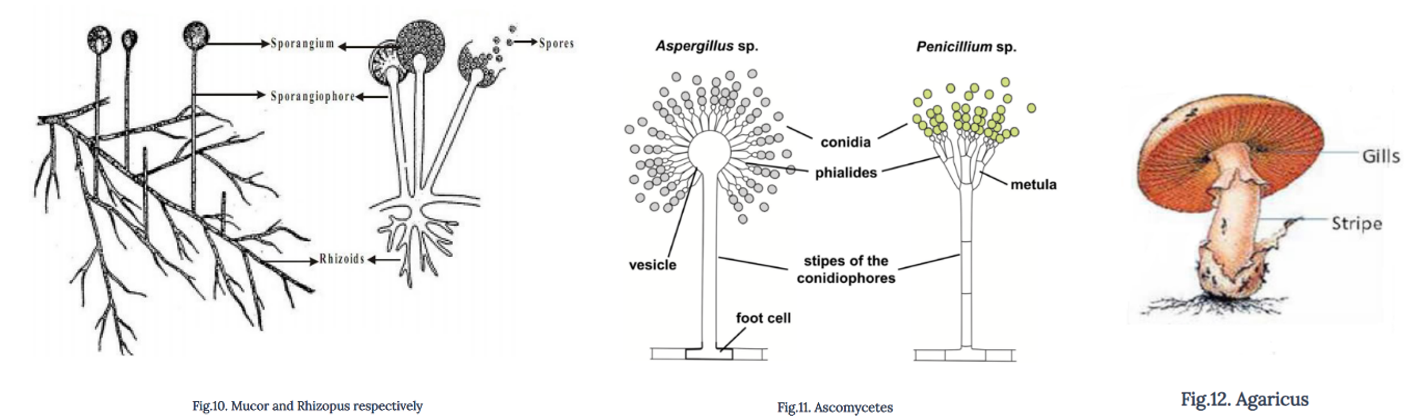
2. Ascomycetes
- Sac fungi
- Branched and septate mycelium
- Asexual reproduction by conidia
- Sexual spores are ascospores
Examples: Penicillium, Aspergillus, Claviceps
3. Basidiomycetes
- Club fungi
- Sex organs absent
- Basidium forms basidiospores
Examples: Agaricus, Ustilago
4. Deuteromycetes
- Imperfect fungi
- Sexual reproduction absent
- Asexual reproduction by conidia
Examples: Alternaria, Trichoderma
5. Zygomycetes
- Primitive fungi
- Non motile sporangiospores
Example: Rhizopus
📦 Quick Recap
Protista: Unicellular eukaryotes, aquatic, five groups, diverse nutrition
Fungi: Heterotrophic eukaryotes, mycelium of hyphae, asexual and sexual reproduction, five major classes
Lichens
📌 Introduction
Lichens are unique organisms formed by a close and stable association between algae and fungi.
This association benefits both partners, making lichens a classic example of mutualism.
🔬 What are Lichens?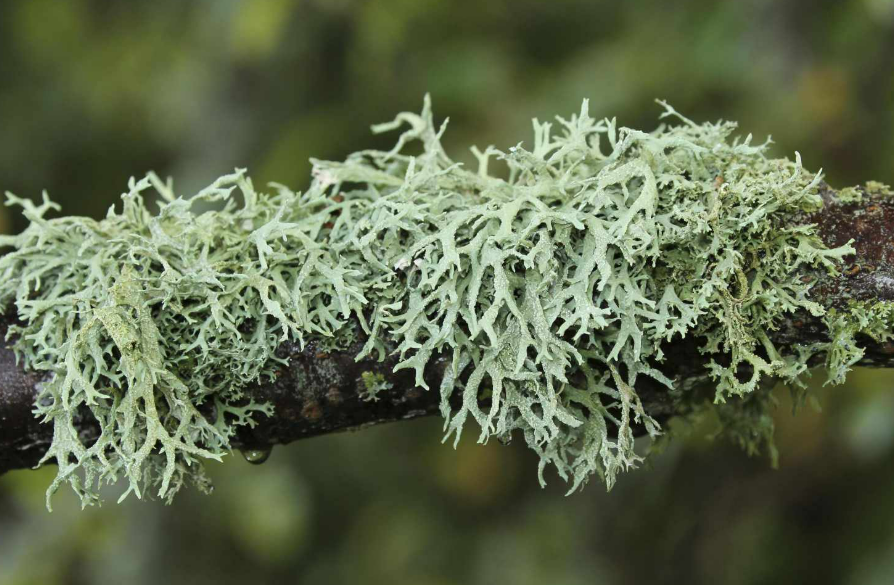
- Lichens are composite organisms
- They consist of two partners living together
🧬 Components of Lichens
- Algal partner called Phycobiont
- Fungal partner called Mycobiont
Algae and fungi can live independently, but together they form a more stable and successful unit.
🌱 Role of Algal Partner (Phycobiont)
- Performs photosynthesis
- Prepares food for the lichen
- Supplies organic nutrients to the fungal partner
🍄 Role of Fungal Partner (Mycobiont)
- Provides shelter and protection to algae
- Absorbs water and minerals from surroundings
- Helps in attachment to rocks, tree bark, and walls
Nature of Association
- The relationship is symbiotic and mutualistic
- Both partners depend on each other
Dependency:
- Algae → food
- Fungi → shelter, moisture, minerals
Habitat of Lichens
- Grow on rocks
- Tree bark
- Walls
Lichens can survive in extreme conditions like cold, heat, and dryness.
📌 Importance of Lichens
- Act as pioneer species on bare rocks
- Help in soil formation by weathering rocks
- Highly sensitive to air pollution
- Absence of lichens indicates polluted air
📦 Quick Recap
Lichens are formed by algae and fungi
Algae perform photosynthesis
Fungi provide shelter, water, and minerals
Relationship is mutualistic
Lichens indicate clean air and help in soil formation
Viruses and Viroids
📌 Introduction
Viruses and viroids are acellular infectious agents.
They show characteristics of both living and non-living organisms.
They are studied separately because they do not fit into any kingdom of the five-kingdom classification.
🧬 Viruses
What are Viruses?
- Viruses are infectious agents active only inside a living host cell
- Outside the host, they remain inactive
- They can infect:
- Bacteria
- Plants
- Animals
Viruses infecting bacteria are called Bacteriophages
Structure of Viruses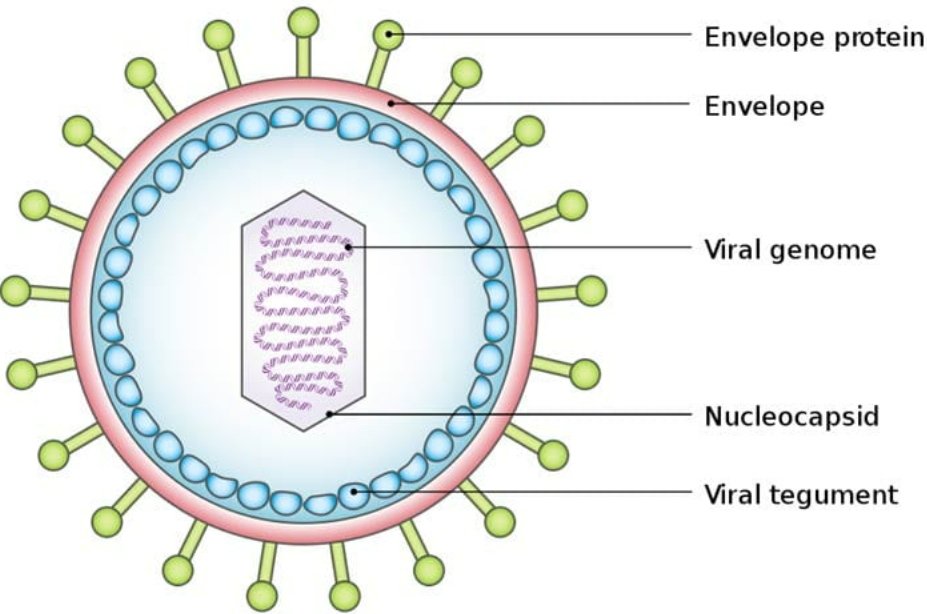
A virus has two main components:
- Genetic Material
- Either DNA or RNA
- Never both together
- Protein Coat (Capsid)
- Protects genetic material
- Gives shape to virus
Some viruses also possess an outer envelope.
Nature of Viruses
- Outside host:
- Inert
- Can be crystallized
- Inside host:
- Show reproduction
- Use host metabolism
Hence, viruses are obligate parasites
🦠 Types of Viruses (Based on Host)
| Type | Host |
|---|---|
| Bacteriophages | Bacteria |
| Plant viruses | Plants |
| Animal viruses | Animals |
Genetic Material in Viruses
- Plant viruses → Mostly RNA
- Animal viruses → DNA or RNA
- Bacteriophages → Mostly DNA
Diseases Caused by Viruses
- Plants: Mosaic disease
- Animals: Rabies, Polio
- Humans: Common cold, Influenza
🧠 Living and Non-living Characters of Viruses
| Living Characters | Non-living Characters |
|---|---|
| Reproduce inside host | No cellular structure |
| Contain genetic material | No metabolism outside host |
| Show mutation | Can be crystallized |
🧬 Viroids
What are Viroids?
- Viroids are extremely small infectious agents
- Composed only of single-stranded RNA
- They lack a protein coat
Key Features of Viroids
- Smaller than viruses
- No capsid
- Infect plants only
Diseases Caused by Viroids
- Potato spindle tuber disease
- Citrus exocortis disease
🔗 Difference Between Viruses and Viroids
| Feature | Viruses | Viroids |
|---|---|---|
| Size | Larger | Extremely small |
| Genetic material | DNA or RNA | Only RNA |
| Protein coat | Present | Absent |
| Host | Bacteria, plants, animals | Plants only |
| Structure | Complex | Very simple |
📦 Quick Recap
Viruses are acellular and active only inside host cells.
They contain either DNA or RNA, never both.
Bacteriophages infect bacteria.
Viroids are smaller than viruses and lack protein coat.
Viroids consist only of single-stranded RNA.