
Organisms and Environment: Population Interactions
🌱 Introduction
Organisms live in complex environments with abiotic (temperature, water, light, soil) and biotic (predators, parasites, competitors) components.
These interactions influence survival, reproduction, and ecosystem stability.
Population interactions explain how individuals of the same or different species affect each other.
🔬 Types of Population Interactions
1. Mutualism ( + , + )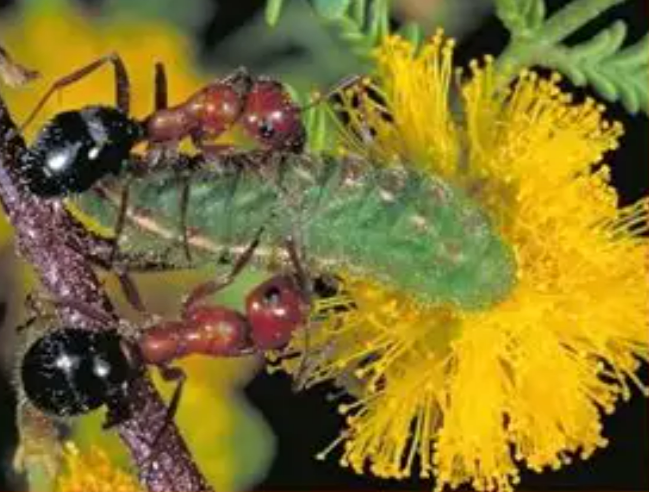
Definition: Both species benefit from the interaction.
Key Point: Can be obligatory (essential for survival) or facultative (beneficial but not essential).
Examples:
| Interaction | Benefit to Species A | Benefit to Species B |
|---|---|---|
| Lichen (fungus + algae/cyanobacteria) | Shelter and water | Photosynthates (food) |
| Rhizobium + Legume roots | Carbohydrates & shelter | Nitrogen fixation |
| Mycorrhizal fungi + Plants | Sugars from plant | Enhanced phosphorus absorption |
2. Competition ( − , − )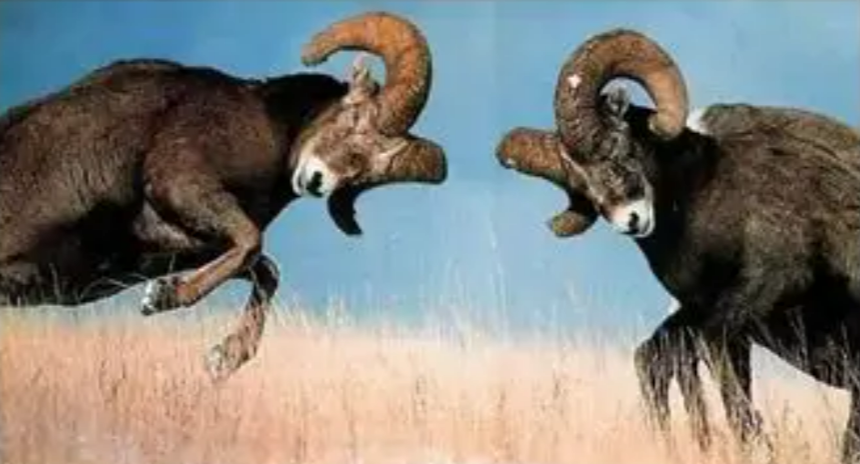
Definition: Interaction where both species are harmed as they compete for the same limited resource (food, space, light, mates).
- Intraspecific: Between individuals of the same species (e.g., two trees competing for sunlight).
- Interspecific: Between different species (e.g., lions and hyenas hunting the same prey).
- Outcome: Can lead to competitive exclusion or resource partitioning.
- Example: Barnacles on rocky shores competing for space.
3. Predation ( + , − )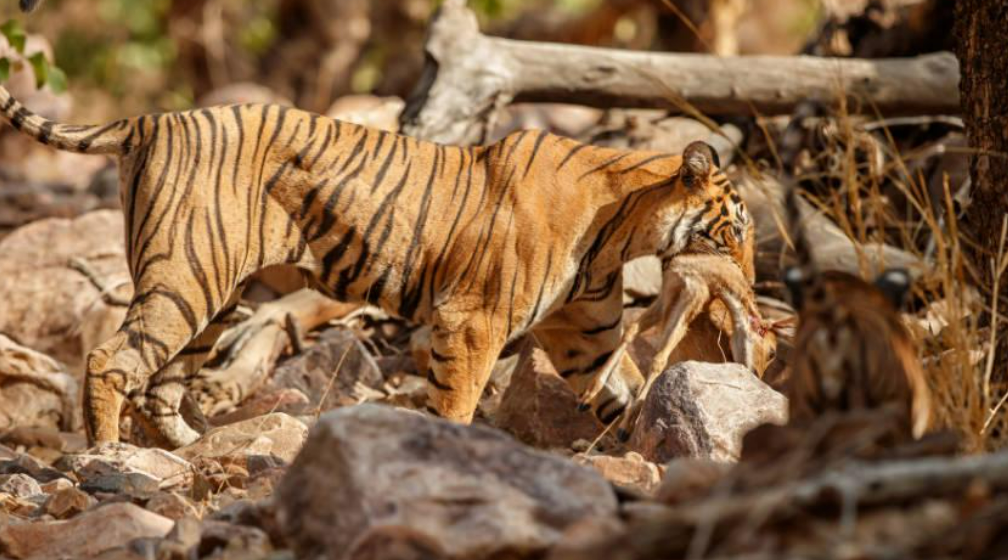
Definition: Interaction where one species (predator) benefits by feeding on the other (prey).
Key Point: Helps regulate prey population and maintain ecosystem balance.
Adaptations:
- Predator: Sharp teeth, claws, camouflage, speed.
- Prey: Camouflage, warning coloration, defensive structures, speed.
Examples:
- Lion → Zebra
- Hawk → Rodent
- Fungi (parasitoids) → Insect larvae
4. Parasitism ( + , − )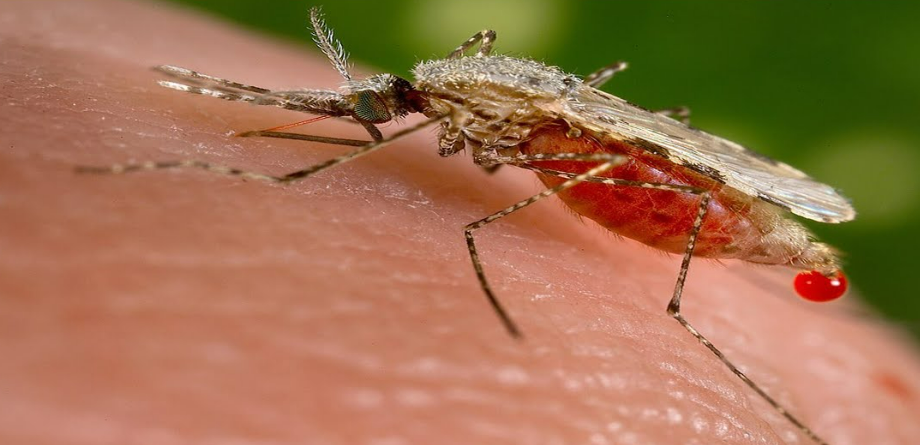
Definition: Interaction where parasite benefits at the expense of host, often without immediate killing.
Key Point: Parasites rely on hosts for food and shelter; can weaken or transmit diseases.
- Ectoparasites: Live on host surface (e.g., lice, ticks).
- Endoparasites: Live inside host (e.g., tapeworm, Plasmodium).
- Host Response: Immune defenses, grooming, avoidance behavior.
🌿 Response to Abiotic Factors (Link to Population Interactions)
Environmental factors shape interactions:
Temperature, water, light, and soil influence resource availability, affecting competition and mutualism.
Extreme conditions may force migration, dormancy, or behavioral adaptation.
Adaptation Examples:
- Desert reptiles (behavioral thermoregulation → move between sun and shade)
- Polar bears (thick fur and blubber → survive cold predation pressures)
⚡ Summary Table: Population Interactions
| Interaction | Effect on Species A | Effect on Species B | Examples | Key Points |
|---|---|---|---|---|
| Mutualism | + | + | Lichen, Rhizobium-legume, Mycorrhiza | Both benefit; can be obligatory or facultative |
| Competition | − | − | Trees for sunlight, Lions & Hyenas | Fights for resources; may cause exclusion or partitioning |
| Predation | + | − | Lion → Zebra, Hawk → Rodent | Predator feeds on prey; maintains ecosystem balance |
| Parasitism | + | − | Tapeworm → Human, Tick → Dog | Parasite exploits host; may weaken or transmit disease |
📝 Quick Recap
– Mutualism (+,+): Both benefit → Lichen, Rhizobium-legume.
– Competition (−,−): Both harmed → Trees competing for light.
– Predation (+,−): Predator benefits, prey harmed → Lion-Zebra.
– Parasitism (+,−): Parasite benefits, host harmed → Tapeworm-Human.
– Abiotic factors (temp, water, soil, light) → influence resource availability and interactions.
– Adaptations (behavioral, morphological, physiological) help organisms survive and influence interactions.
Population Attributes: Growth, Birth Rate, Death Rate, Age Distribution
🔬 Introduction
Population: A group of individuals of the same species living in a defined geographic area, sharing resources, and potentially interbreeding.
Population Attributes: Include population size (density), birth rate, death rate, sex ratio, and age distribution.
Understanding these attributes helps in ecology, wildlife management, and conservation biology.
📌 Key Population Attributes
1. Population Density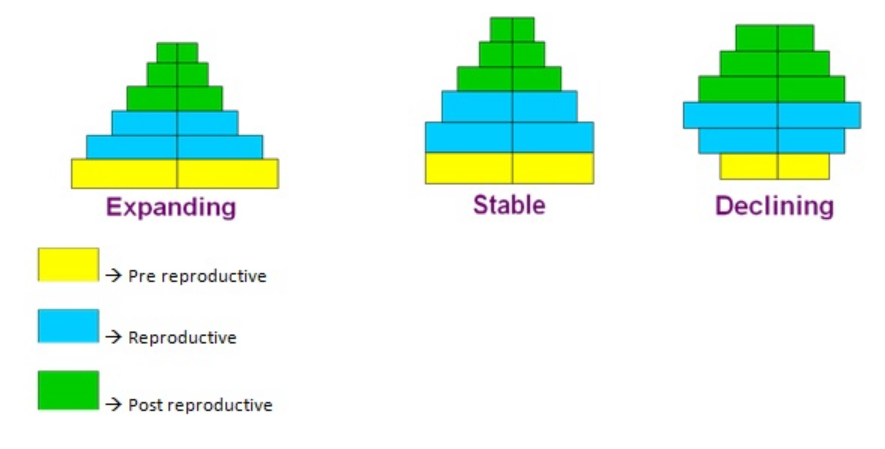
Refers to the number of individuals per unit area or volume.
- Methods of measurement:
- Percent cover: Proportion of area occupied by species (plants).
- Direct counting: Counting individuals in quadrats or transects.
- Indirect methods: Tracks, pug marks, fecal pellets (e.g., tiger census).
- Biomass: Total mass of organisms in a given area.
2. Birth Rate (Natality)
Definition: Number of births per individual (per capita) in a given time period.
Increases population density.
3. Death Rate (Mortality)
Definition: Number of deaths per individual in a population over a given period.
Reduces population density.
4. Sex Ratio
Ratio of males to females in a population.
Determines reproductive potential.
Example: A 1:1 sex ratio is ideal for maximum breeding.
5. Age Distribution
Represents the proportion of individuals in different age groups.
Graphical representation: Age pyramid.
- Types of age pyramids:
- Expanding (Broad base): Developing population, high birth rate.
- Stable (Uniform shape): Birth rate = Death rate.
- Declining (Narrow base): Low birth rate, aging population.
🌿 Population Growth
Population size changes due to four main processes:
| Process | Effect on Population Density |
|---|---|
| Natality (Births) | Increase |
| Immigration | Increase |
| Mortality (Deaths) | Decrease |
| Emigration | Decrease |
Population change equation: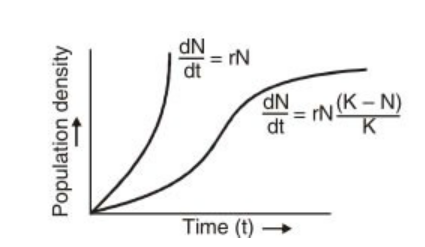
\[ N_{t+1} = N_t + [(B + I) – (D + E)] \]
Where:
\( N_t \) = population density at time t
\( B \) = number of births
\( D \) = number of deaths
\( I \) = number of immigrants
\( E \) = number of emigrants
🔹 Exponential Growth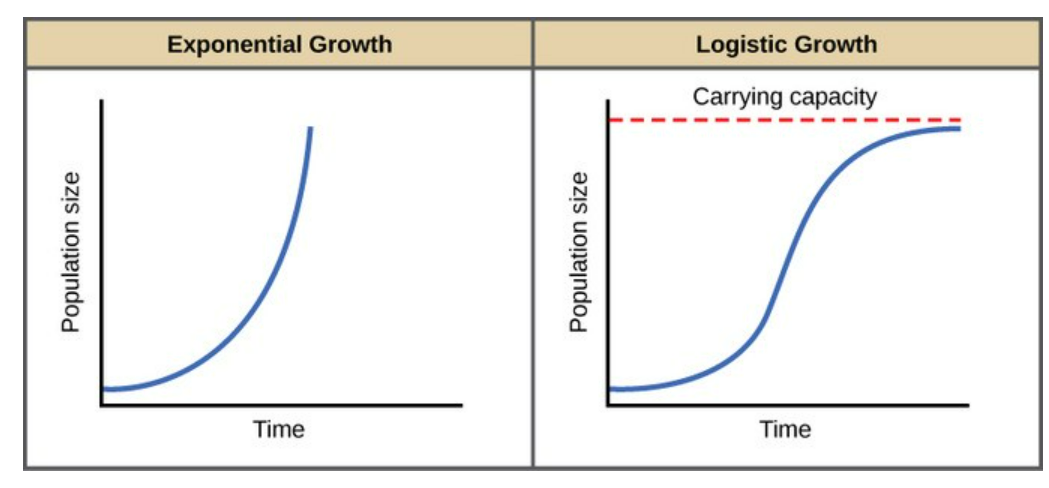
Occurs when resources are unlimited.
Population grows rapidly → J-shaped curve.
Equation:
\[ N_t = N_0 e^{rt} \]
Where:
\( N_0 \) = initial population density
\( N_t \) = population at time t
\( r \) = intrinsic rate of increase
\( e \) = base of natural logarithms (~2.718)
Limitation: Unsustainable in nature because resources are always limited.
🔹 Logistic Growth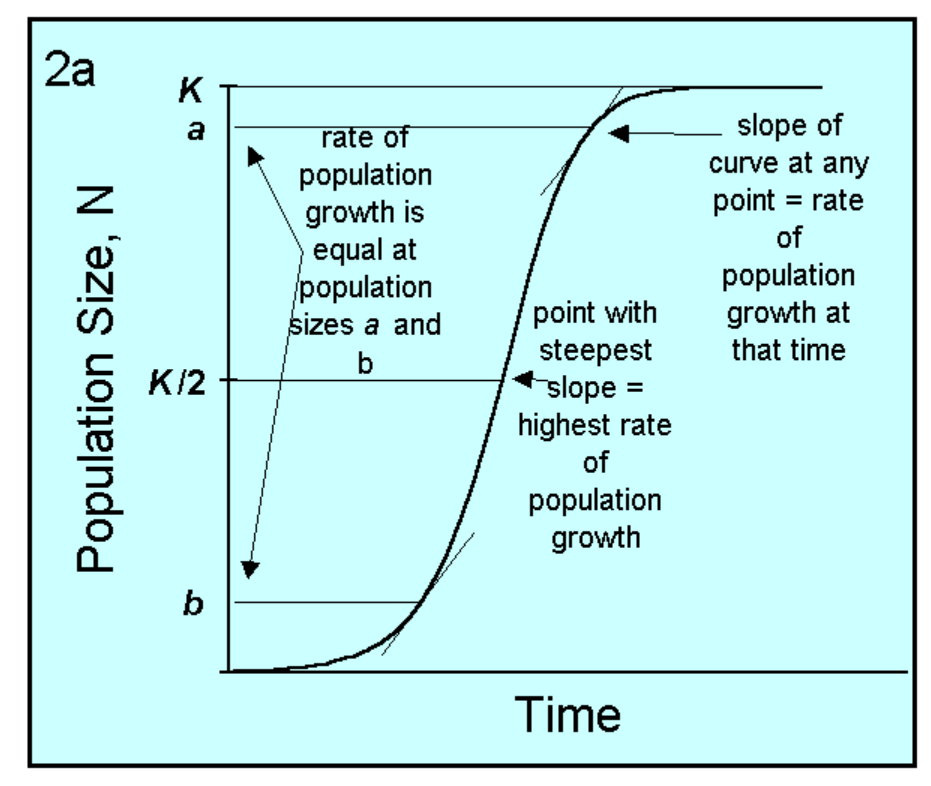
Occurs when resources are limited.
Population growth slows as it approaches carrying capacity (K) → S-shaped (sigmoid) curve.
Equation (Verhulst-Pearl model):
\[ \frac{dN}{dt} = r N \left( \frac{K – N}{K} \right) \]
Where:
\( K \) = Carrying capacity (max population environment can support)
\( r \) = intrinsic rate of natural increase
\( N \) = population density at time t
Significance: Reflects more realistic population dynamics in nature.
🧬 Factors Affecting Population Growth
- Food availability → Limits or promotes growth.
- Predation → Controls prey population; regulates ecosystem balance.
- Disease and parasites → Increase mortality.
- Environmental conditions → Temperature, water, light, soil quality.
⚡ Age Structure and Population Growth
| Pyramid Type | Shape | Characteristics | Example |
|---|---|---|---|
| Expanding | Broad base | High birth rate, growing population | India |
| Stable | Rectangular | Birth rate ≈ death rate | USA |
| Declining | Narrow base | Low birth rate, aging population | Japan |
📝 Quick Recap
Population = Group of individuals in a defined area.
Key attributes: Density, Birth rate (natality), Death rate (mortality), Sex ratio, Age distribution.
Population growth models:
Exponential (J-shaped): Unlimited resources.
Logistic (S-shaped): Limited resources, realistic.
Age pyramids: Indicate growth trends – expanding, stable, declining.
Population change formula: \[ N_{t+1} = N_t + [(B + I) – (D + E)] \]
Mnemonic for Attributes: “Dense Birds Die And Age” → Density, Birth, Death, Age, Sex ratio.