
Animal Tissues
📌 Introduction
Multicellular animals show a high level of structural and functional organization.
In such organisms, cells become specialized to perform specific functions.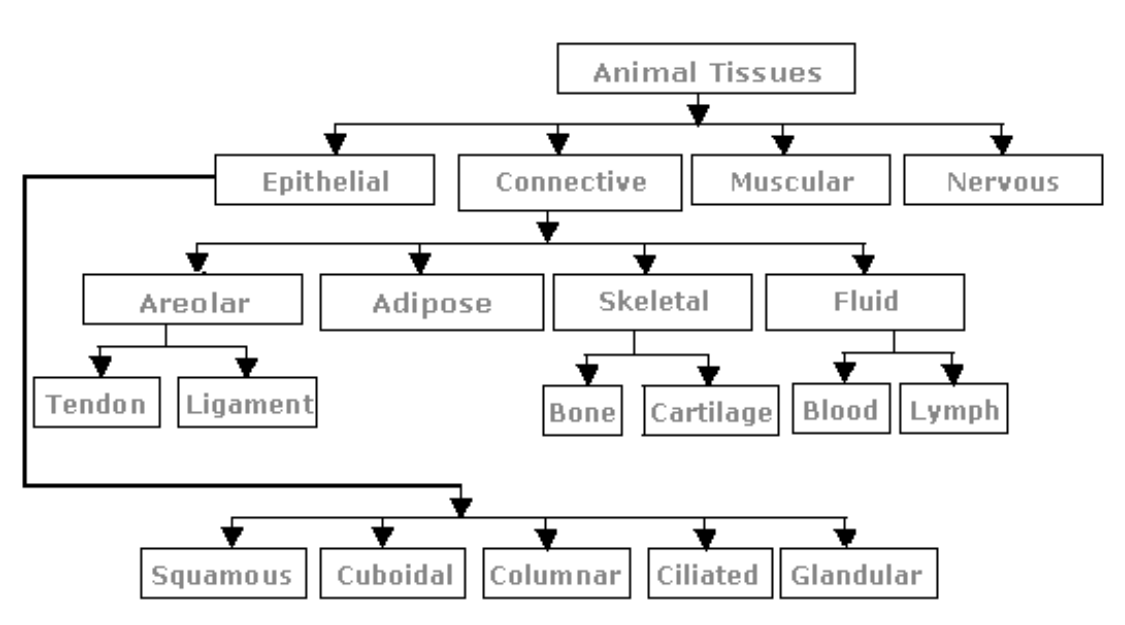
A tissue is a group of similar cells of common origin, along with intercellular substance, that work together to perform a specific function.
Animal tissues are more specialized than plant tissues because animals require:
- Faster coordination
- Active movement
- Complex organ systems
📖 Definition
Animal tissue is a group of similar cells of common origin that work together to perform a particular function.
🧱 Classification of Animal Tissues
Animal tissues are classified into four major types:
- Epithelial tissue
- Connective tissue
- Muscular tissue
- Nervous tissue
1. Epithelial Tissue
Introduction
Epithelial tissue forms:
- Outer covering of the body
- Inner lining of organs, cavities, ducts, and blood vessels
- Secretory parts of glands
🌟 General Characteristics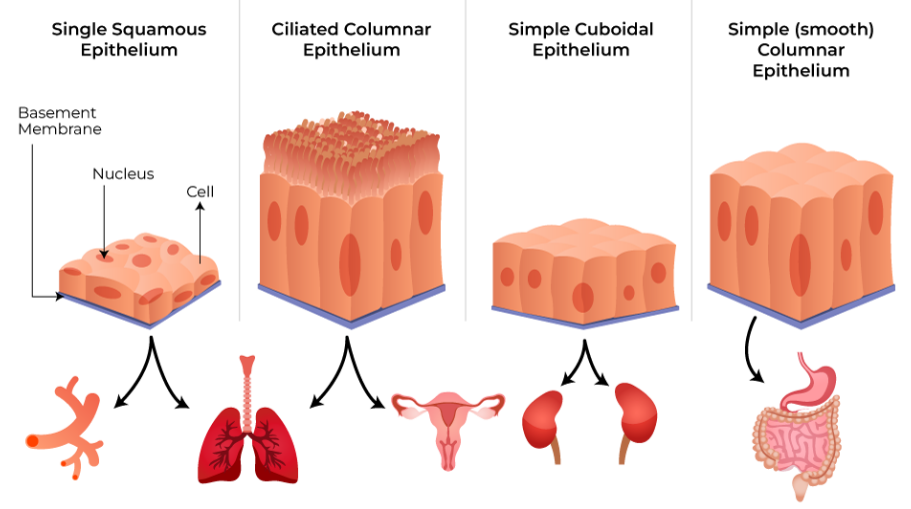
- Cells are closely packed
- Very little intercellular space
- Cells rest on a basement membrane
- Avascular (no blood vessels)
- Richly innervated
- High regenerative capacity
- Shows polarity
- Free (apical) surface
- Basal surface
🔬 Types of Epithelial Tissue
| Type | Structure | Location | Function | Special Point |
|---|---|---|---|---|
| Simple squamous | Thin, flat single layer | Alveoli, capillaries, Bowman’s capsule | Diffusion, filtration | Pavement epithelium |
| Stratified squamous | Many layers | Skin, mouth | Protection | Keratinized or non-keratinized |
| Cuboidal | Cube-shaped cells | Kidney tubules, glands | Absorption, secretion | Germinal epithelium in ovary |
| Columnar | Tall cells, basal nucleus | Intestine, stomach | Absorption | Microvilli present |
| Ciliated | Cilia on free surface | Trachea, oviduct | Movement | Directional ciliary beat |
| Glandular | Secretory cells | Sweat, salivary glands | Secretion | Endocrine & exocrine |
| Pseudostratified | Appears multilayered | Trachea | Mucus movement | Goblet cells |
| Transitional | Stretchable layers | Urinary bladder | Stretching | Cells flatten on stretch |
2. Connective Tissue
Introduction
Connective tissue connects, supports, binds, protects, and transports materials in the body.
🧬 Basic Components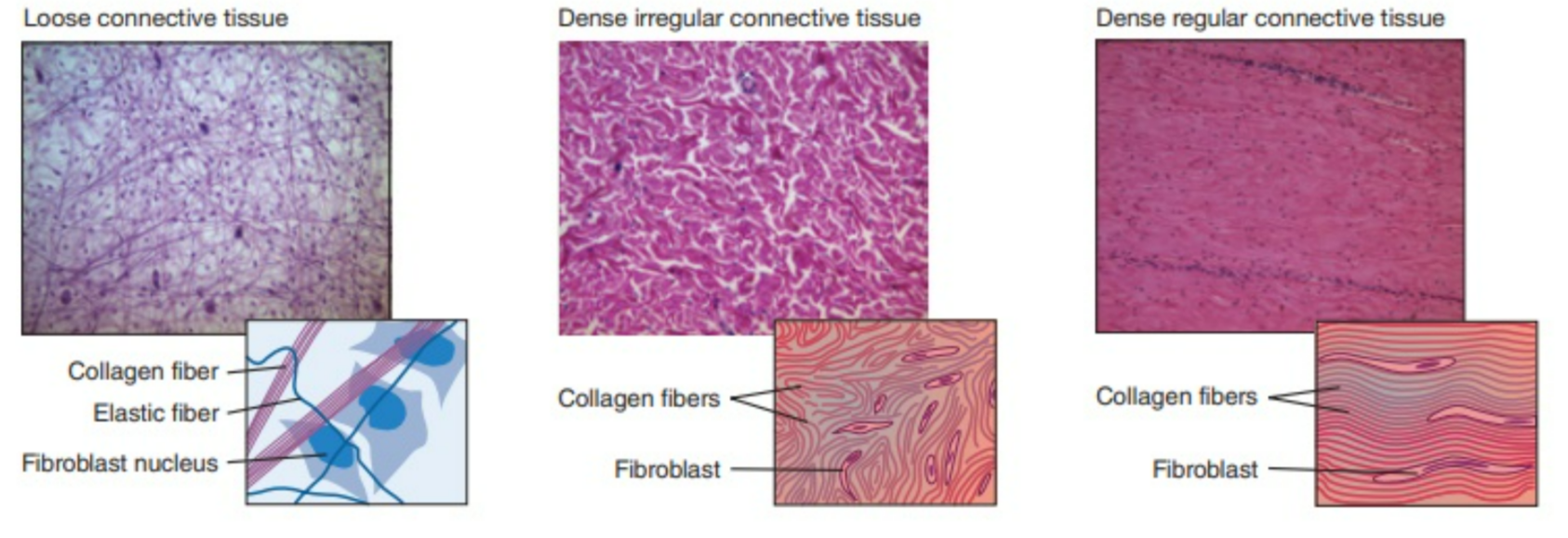
- Cells
- Fibres
- Collagen
- Elastic
- Reticular
- Matrix (ground substance)
🧱 Types of Connective Tissue
A. Loose Connective Tissue
| Type | Location | Function |
|---|---|---|
| Areolar | Beneath skin, between organs | Packing, binding |
| Adipose | Under skin, around organs | Fat storage, insulation |
| Reticular | Spleen, lymph nodes | Framework |
B. Dense Connective Tissue
| Type | Location | Function |
|---|---|---|
| Dense regular | Tendons, ligaments | Strong attachment |
| Dense irregular | Dermis | Strength |
| Elastic tissue | Arteries, lungs | Elasticity |
C. Supporting Connective Tissue
Cartilage
- Cells called chondrocytes
- Matrix firm and flexible
- Types:
- Hyaline → Trachea, ribs
- Elastic → Ear pinna
- Fibrocartilage → Intervertebral discs
Bone
- Cells called osteocytes
- Matrix hardened with calcium salts
- Types:
- Compact bone
- Spongy bone
D. Fluid Connective Tissue
| Type | Function |
|---|---|
| Blood | Transport of gases, nutrients and wastes; body defense |
| Lymph | Immunity and maintenance of fluid balance |
🌟 Key Features of Fluid Connective Tissue
- Cells are suspended in a fluid matrix
- Matrix is plasma in blood and lymph fluid in lymph
- Involved mainly in transport and defense
- Helps in maintaining internal environment
Key Features
- Cells widely spaced
- Abundant matrix
- Mostly vascular
- Mesodermal origin
3. Muscular Tissue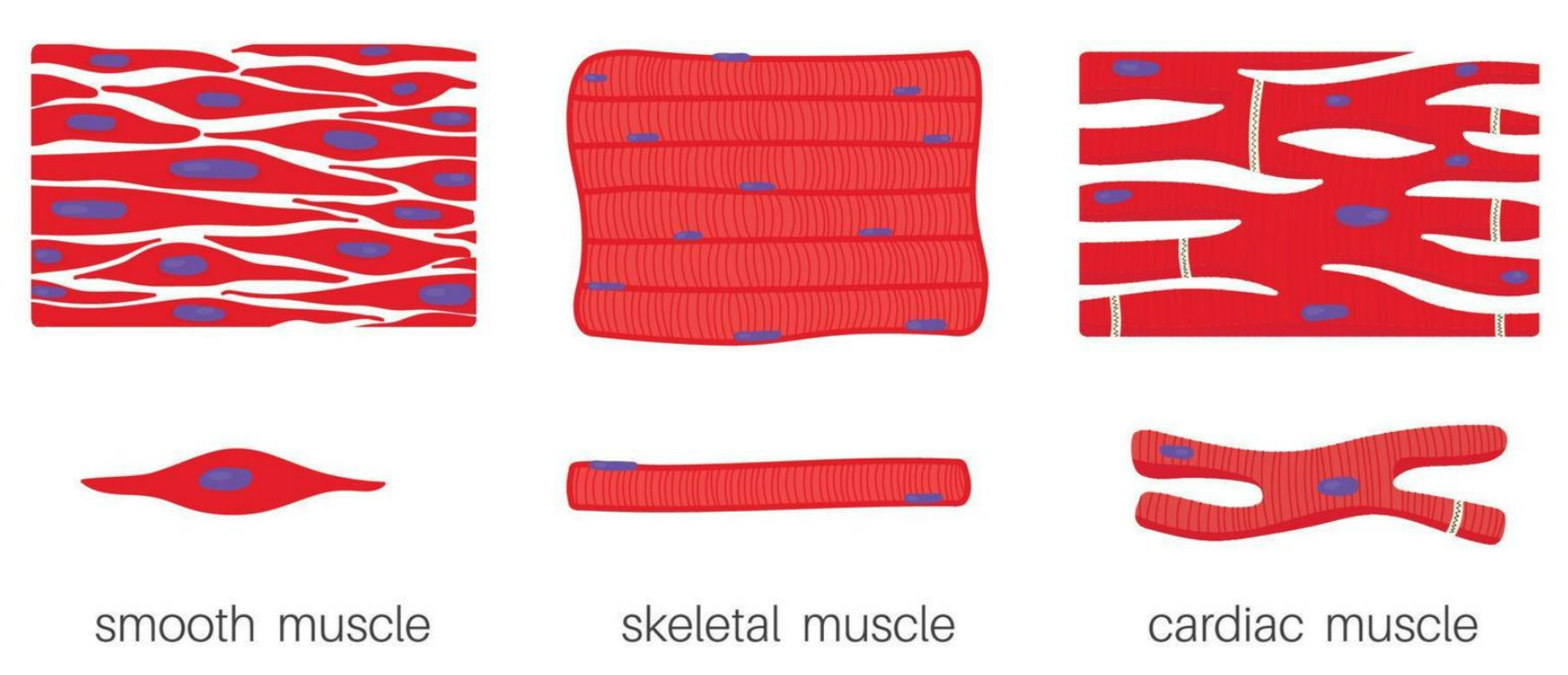
Introduction
Muscular tissue consists of elongated muscle fibres capable of contraction and relaxation.
Main property → Contractility
🧱 Types of Muscular Tissue
| Type | Control | Location | Features |
|---|---|---|---|
| Skeletal | Voluntary | Attached to bones | Striated, multinucleate |
| Smooth | Involuntary | Viscera | Non-striated |
| Cardiac | Involuntary | Heart | Striated, branched |
Special Features:
- Cardiac muscle has intercalated discs
- Shows autorhythmicity
- Does not fatigue
4. Nervous Tissue
Introduction
Nervous tissue is specialized for:
- Receiving stimuli

- Conducting impulses
- Control and coordination
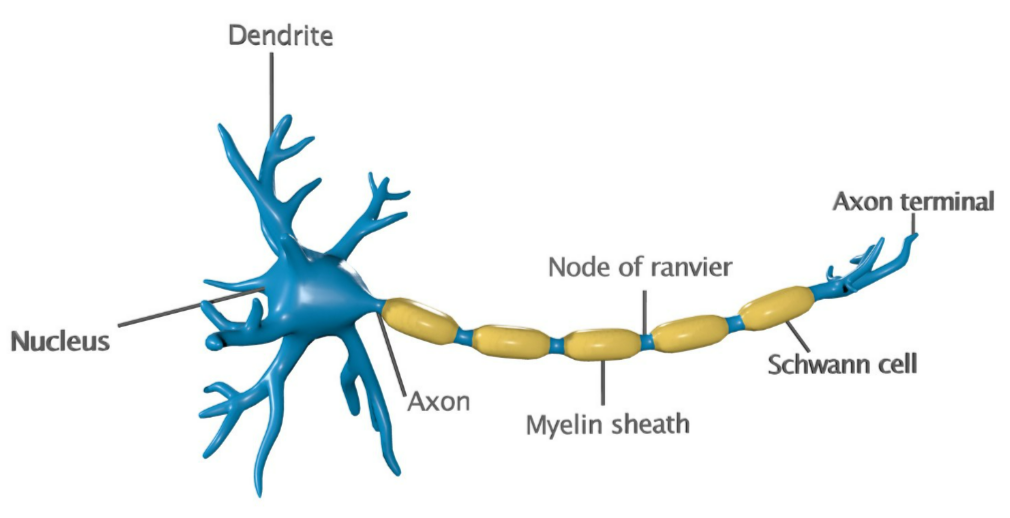
🧬 Neuron Structure
- Dendrites → Receive impulses
- Cell body → Metabolic center
- Axon → Conducts impulses
🧠 Functions
- Control of body activities
- Transmission of nerve impulses
- Coordination between organs
📦 Quick Recap
Four animal tissues present
Epithelial tissue is avascular
Connective tissue has matrix
Blood is fluid connective tissue
Skeletal muscle is voluntary
Cardiac muscle has intercalated discs
Nervous tissue conducts impulses
Frog: Morphology, Anatomy & Functions of Different Systems
📌 Introduction
Frog is a cold-blooded (poikilothermic), amphibious vertebrate.
It lives both on land and in water and shows organ system level of organization.
Scientific name commonly used in: Rana tigrina / Hoplobatrachus tigerinus.
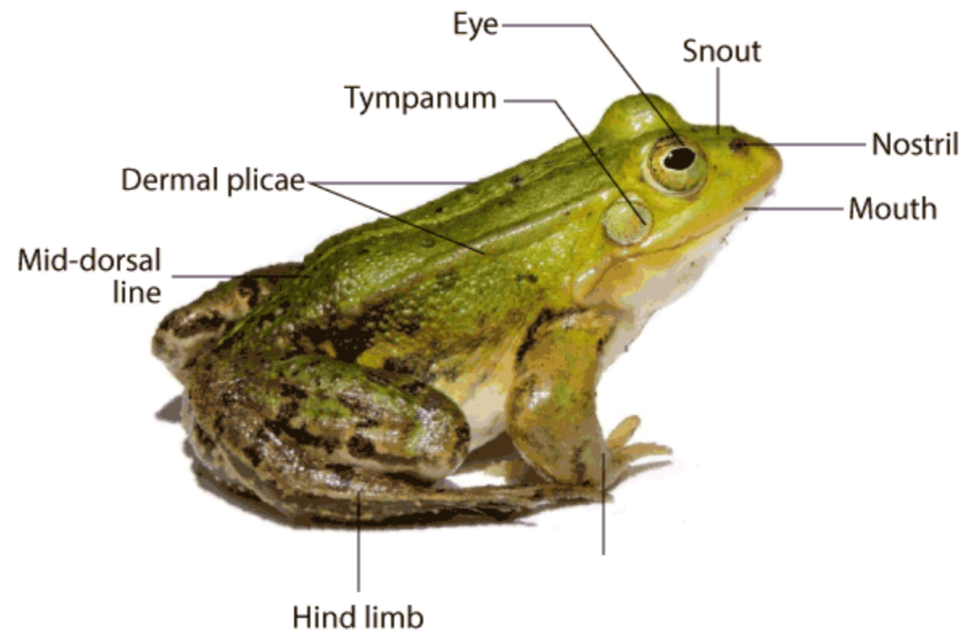
🧩 Morphology of Frog
- Body is divided into head and trunk (neck and tail absent).
- Skin is smooth, moist, glandular, and without scales.
- Two pairs of limbs
- Forelimbs → shorter, 4 digits
- Hindlimbs → long, muscular, 5 webbed digits (for swimming)
- Eyes prominent with nictitating membrane
- Tympanum present behind eyes (hearing organ)
- Cloaca present at posterior end
🍽️ Digestive System
🧠 Anatomy
Includes:
- Mouth with maxillary teeth and bifid tongue
- Buccopharyngeal cavity
- Oesophagus → Stomach → Intestine
- Rectum → Cloaca
Associated glands:
- Liver (largest gland)
- Pancreas
⚙️ Functions
- Ingestion of food (insects)
- Digestion and absorption of nutrients
- Egestion through cloaca
❤️ Circulatory System
Anatomy
- Closed circulatory system
- Heart is three-chambered
- Two atria
- One ventricle
- Blood vessels: arteries, veins, capillaries
- Blood contains RBCs with nucleus
Functions
- Transport of oxygen, nutrients, hormones
- Removal of waste materials
- Helps in temperature regulation
🌬️ Respiratory System
Anatomy
Frog shows multiple modes of respiration:
- Cutaneous respiration → through moist skin (in water, hibernation)
- Buccopharyngeal respiration → through buccal cavity
- Pulmonary respiration → lungs (on land)
Functions
- Exchange of oxygen and carbon dioxide
- Adaptation to both aquatic and terrestrial life
🧠 Nervous System
Anatomy
- Central nervous system (CNS)
- Brain
- Spinal cord
- Peripheral nervous system (PNS)
- Cranial nerves
- Spinal nerves
Brain has:
- Forebrain
- Midbrain
- Hindbrain
Functions
- Control and coordination
- Response to stimuli
- Regulation of body activities
🧬 Reproductive System
Anatomy
Male Frog
- Pair of testes
- Vasa efferentia → kidneys → cloaca
Female Frog
- Pair of ovaries
- Oviducts open into cloaca
Functions
- Production of gametes
- External fertilization
- Development through tadpole larva
- Shows metamorphosis
📊 Summary Table
| System | Key Feature | Main Function |
|---|---|---|
| Digestive | Complete alimentary canal | Digestion & absorption |
| Circulatory | 3-chambered heart | Transport |
| Respiratory | Skin, buccal cavity, lungs | Gas exchange |
| Nervous | Brain + spinal cord | Coordination |
| Reproductive | External fertilization | Continuity of species |
📦 Quick Recap
Frog is an amphibian vertebrate
Skin is moist and glandular
Heart is three-chambered
Respiration is cutaneous + pulmonary
Fertilization is external
Development includes metamorphosis