
Cell Division: Cell Cycle, Mitosis, Meiosis and Their Significance
📌 Introduction
- Cell division is the process by which a parent cell divides to produce daughter cells.
- It ensures growth, repair, and reproduction in living organisms.
- Types: Mitosis (for growth & repair) and Meiosis (for gamete formation).
🔹 Cell Cycle
Defined as the series of events that a cell undergoes leading to division.
Duration: ~1 hour for fast-dividing cells; variable in others.
Phases:
- Interphase (preparation for division)
- M-phase (Mitosis) (nuclear division)
🟢 Interphase
The cell grows and prepares for division. DNA is replicated.
Sub-phases:
- G1 Phase (First Gap) – Rapid biosynthesis: proteins, mitochondria, ribosomes increase.
- S Phase (Synthesis) – DNA replication occurs → each chromosome has 2 sister chromatids. DNA content doubles; ploidy remains same.
- G2 Phase (Second Gap) – Preparation for mitosis: enzymes & organelles synthesized. Some cells enter G0 phase: exit the cycle, do not divide (e.g., neurons).
🔹 Mitosis (Equational Division)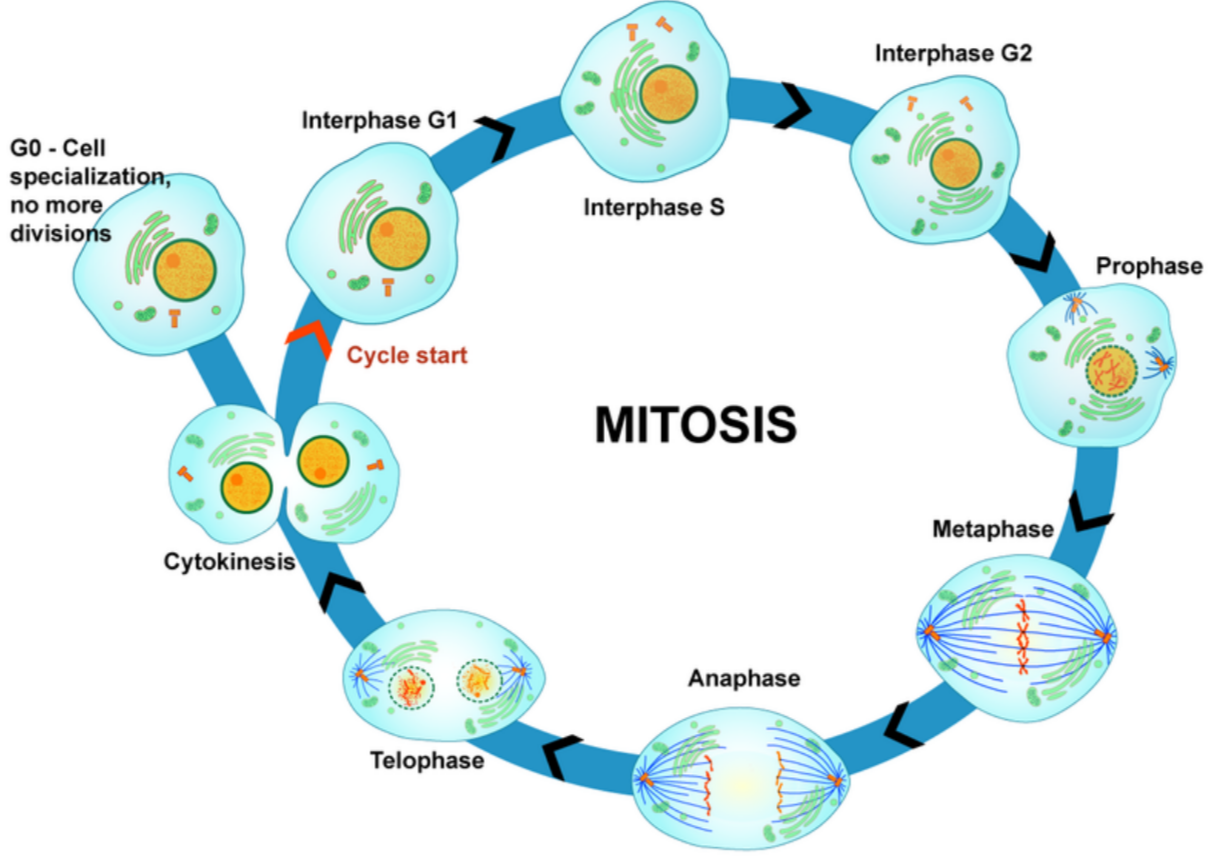
Purpose: Produce two genetically identical daughter cells.
Process of nuclear division = karyokinesis.
Phases:
- Prophase – Chromatin condenses into visible chromosomes (2 sister chromatids per chromosome). Nuclear membrane and nucleolus disintegrate. Centrosomes move to opposite poles; spindle fibers form.
- Metaphase – Chromosomes align at the equatorial/metaphase plate. Used in cytogenetics to study chromosome abnormalities.
- Anaphase – Sister chromatids separate → move to opposite poles. Shortest phase; chromosomes appear Y-shaped.
- Telophase – Chromosomes decondense → chromatin. Nuclear membrane and nucleolus reappear. Marks the end of karyokinesis.
- Cytokinesis – Division of cytoplasm and organelles → forms two daughter cells identical to parent.
🔹 Meiosis (Reductional Division)
Purpose: Produce gametes with half the chromosome number (haploid).
Two divisions: Meiosis I and Meiosis II.
🟢 Meiosis I (Reductional Division)
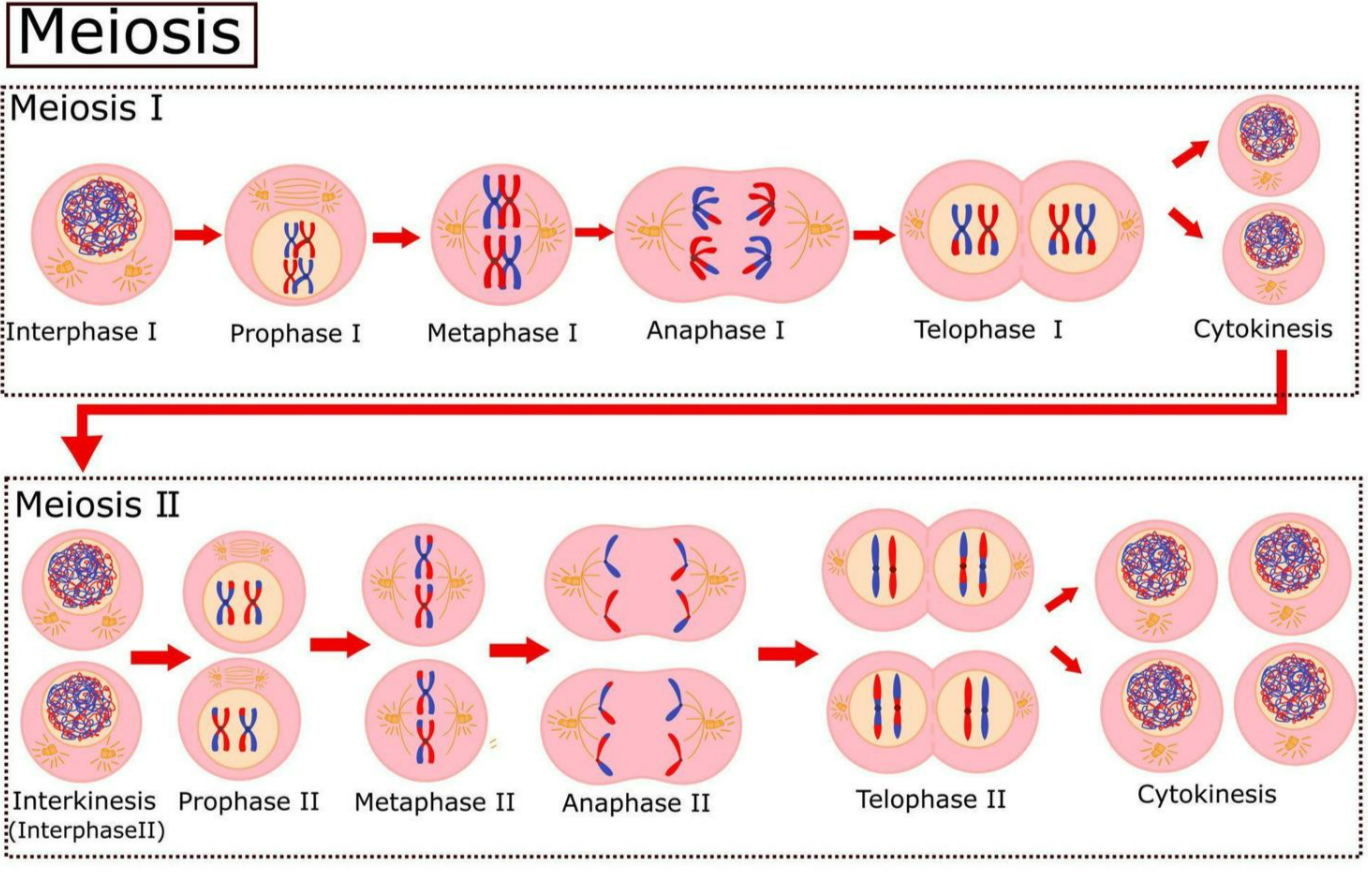
Homologous chromosomes separate, reducing chromosome number by half.
Phases of Prophase I (Longest stage)
- Leptotene: Chromosomes condense; synaptonemal complex starts forming.
- Zygotene: Homologous chromosomes pair (synapsis); forms bivalents/tetrads.
- Pachytene: Crossing over occurs at chiasmata → genetic recombination.
- Diplotene: Homologous chromosomes start to separate; remain connected at chiasmata.
- Diakinesis: Chromosomes condense further; nuclear envelope disappears; spindle forms.
- Metaphase I – Homologous chromosomes align at metaphase plate; sister chromatids remain together.
- Anaphase I – Homologous chromosomes move to opposite poles; sister chromatids still attached.
- Telophase I – Chromosomes decondense; spindle disappears; two haploid daughter cells formed.
🟢 Meiosis II (Equational Division)
Similar to mitosis, separates sister chromatids. Produces four haploid cells from two haploid cells.
Phases:
- Prophase II: Nuclear envelope disappears; spindle forms.
- Metaphase II: Chromosomes align at metaphase plate (perpendicular to Meiosis I).
- Anaphase II: Sister chromatids separate → move to opposite poles.
- Telophase II: Chromosomes decondense; nuclear envelopes form; cytokinesis → four haploid gametes.
🔹 Significance of Cell Division
- Mitosis – Growth and development of multicellular organisms; repair and regeneration; maintains chromosome number.
- Meiosis – Formation of gametes for sexual reproduction; genetic variation via crossing over and independent assortment; reduces chromosome number by half → maintains species chromosome number after fertilization.
📝 Quick Recap
Cell cycle = Interphase + Mitosis.
Interphase: G1 (growth), S (DNA replication), G2 (preparation), G0 (resting).
Mitosis: Prophase → Metaphase → Anaphase → Telophase + Cytokinesis.
Meiosis I: Homologous chromosomes separate → crossing over occurs in Prophase I.
Meiosis II: Sister chromatids separate → produces 4 haploid gametes.
Significance: Mitosis = identical cells; Meiosis = genetic diversity & gamete formation.