
Photosynthesis: A Means of Autotrophic Nutrition
🌱 Introduction
Plants cannot eat food like animals. Instead, they make their own food using sunlight. This self-feeding ability is called autotrophic nutrition, and the process responsible for it is photosynthesis.
It helps plants survive and also supports all life on Earth because it produces both food (carbohydrates) and oxygen.
🧬 What is Photosynthesis?
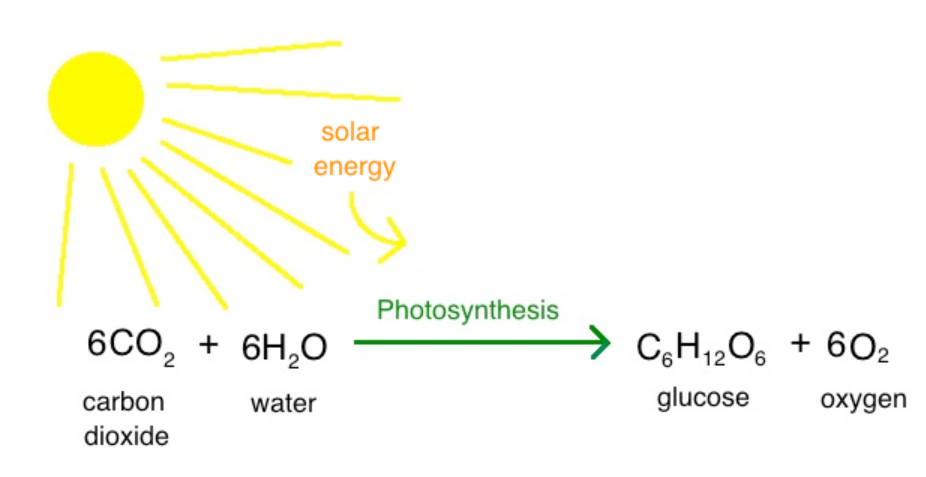
- It is the conversion of light energy into chemical energy.
- This chemical energy is stored as carbohydrates like glucose, sucrose and starch.
- Raw materials: Carbon dioxide (CO2) + Water (H2O)
- Products: Carbohydrates + Oxygen (O2)
📌 Overall reaction
CO2 + H2O → Carbohydrates + O2 (in presence of light and chlorophyll)
This single reaction supports almost all food chains on Earth.
🌞 Why is Photosynthesis Called Autotrophic Nutrition?
Autotrophy means
- An organism can synthesize its own food using simple raw materials available in the environment.
Why plants are autotrophs
- They use sunlight as an energy source.
- They absorb CO2 from air and water from soil.
- They convert these into food molecules inside chloroplasts.
- No external food is required for survival.
Photosynthesis is the basis of autotrophic nutrition because
- It provides plants with glucose, which is used for:
- Respiration
- Growth
- Repair
- Storage (starch)
- Formation of proteins, fats, cellulose etc
- It also releases oxygen, essential for aerobic life.
📌 Key Features of Photosynthesis
- Occurs in chloroplasts (mainly in mesophyll cells).
- Uses chlorophyll pigments to capture sunlight.
- Involves two linked phases:
- Light reactions (need sunlight)
- Dark reactions/Calvin cycle (light-independent)
- Produces ATP, NADPH, and carbohydrates.
- Supports food chains and maintains atmospheric oxygen.
✨ Importance of Autotrophic Nutrition
- Makes plants self-sustaining.
- Forms the food base for heterotrophs (animals, humans).
- Converts inorganic substances into organic matter.
- Regulates global carbon and oxygen balance.
- Enables plants to store extra food as starch, which becomes a source of energy for other organisms.
📚 Summary Table
| Concept | Key Points |
|---|---|
| Autotrophic nutrition | Organism makes its own food. |
| Why plants are autotrophs | Make food using sunlight, CO2, and water. |
| Definition of photosynthesis | Conversion of light energy into chemical energy stored in carbohydrates. |
| Products of photosynthesis | Carbohydrates + Oxygen. |
| Raw materials | CO2 and H2O. |
| Location | Chloroplast (mesophyll cells). |
| Why essential | Food production, oxygen release, energy source for all living beings. |
📦 Quick Recap
Plants are autotrophs because they prepare food by photosynthesis.
Photosynthesis uses CO2 + H2O + sunlight + chlorophyll.
Produces glucose (energy source) and oxygen.
Occurs in chloroplasts.
Essential for maintaining life, oxygen level, and food chains.
Site of Photosynthesis
🌱 Introduction
Photosynthesis does not occur everywhere in a plant. It takes place in special cell organelles that contain green pigments. These structures help plants absorb sunlight and convert it into chemical energy.
🧬 Where Does Photosynthesis Occur?
Chloroplasts – The Main Site
Photosynthesis happens inside chloroplasts, which are found mostly in the mesophyll cells of leaves.
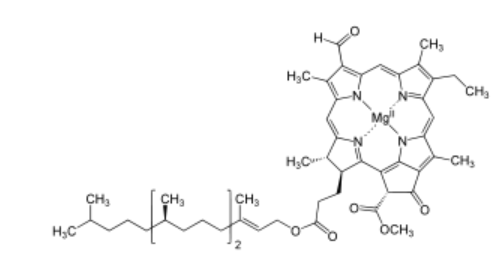
Key points about chloroplasts:
- Double membrane organelle
- Contains chlorophyll pigments
- Number per cell: about 10 to 100 chloroplasts
- Present in:
- Mesophyll cells of leaves (main site)
- Green stems
- Unripe fruits
Chloroplasts have two important regions:
A. Grana (for Light Reactions)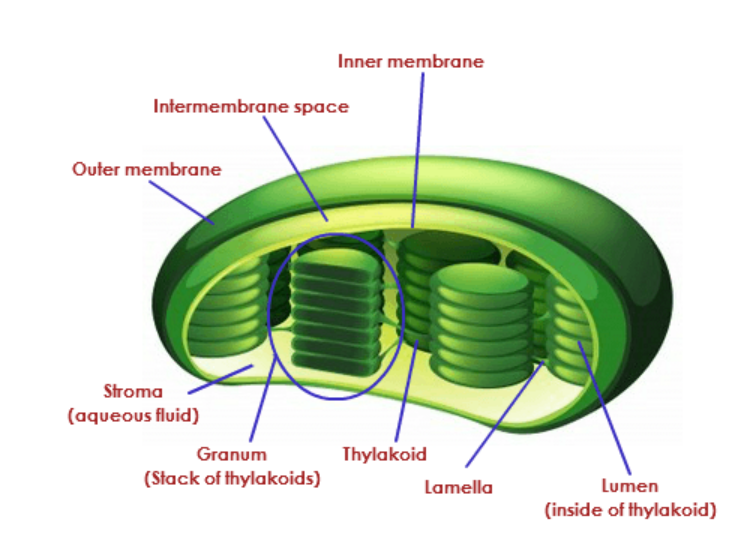
- Made of stacks of thylakoids
- Each granum is connected by stroma lamellae
- Contains photosystems I and II
- Light dependent reactions occur here
- ATP and NADPH are produced in this region
B. Stroma (for Dark Reactions / Calvin Cycle)
- Colorless fluid-filled matrix
- Contains enzymes needed for CO2 fixation
- Dark reactions (light-independent reactions) occur here
- Forms glucose using ATP and NADPH
🌿 Why Leaves Are the Main Site
- They have many mesophyll cells filled with chloroplasts.
- Broad surface helps capture more sunlight.
- Stomata allow CO2 entry, which is needed for photosynthesis.
- Thin structure helps in quick gas exchange.
📌 Additional Sites in Some Plants
Although leaves are the major site, some photosynthesis also occurs in:
- Green stems
- Sepals
- Young green fruits
- Certain specialized tissues in algae
🧬 Summary Table
| Region | What Happens Here | Key Structures |
|---|---|---|
| Grana | Light reactions (ATP, NADPH formation) | Thylakoids, Photosystems I and II |
| Stroma | Dark reactions (Calvin cycle, sugar formation) | Enzymes, RuBisCO |
| Mesophyll cells | Main location of chloroplasts | Palisade and spongy mesophyll |
| Stomata | CO2 entry for photosynthesis | Guard cells |
📦 Quick Recap
Chloroplasts are the main site of photosynthesis.
Grana do light reactions.
Stroma performs dark reactions.
Mostly seen in mesophyll cells of leaves.
Some photosynthesis also happens in green stems and unripe fruits.
Pigments Involved in Photosynthesis (Elementary Idea)
🌱 Introduction
Photosynthesis starts when plant pigments absorb sunlight. These pigments are located inside the thylakoid membranes of chloroplasts. Each pigment absorbs light at specific wavelengths, which allows plants to trap maximum solar energy.
🎨 Types of Photosynthetic Pigments
1. Chlorophylls
These are the major light-absorbing pigments.
a) Chlorophyll a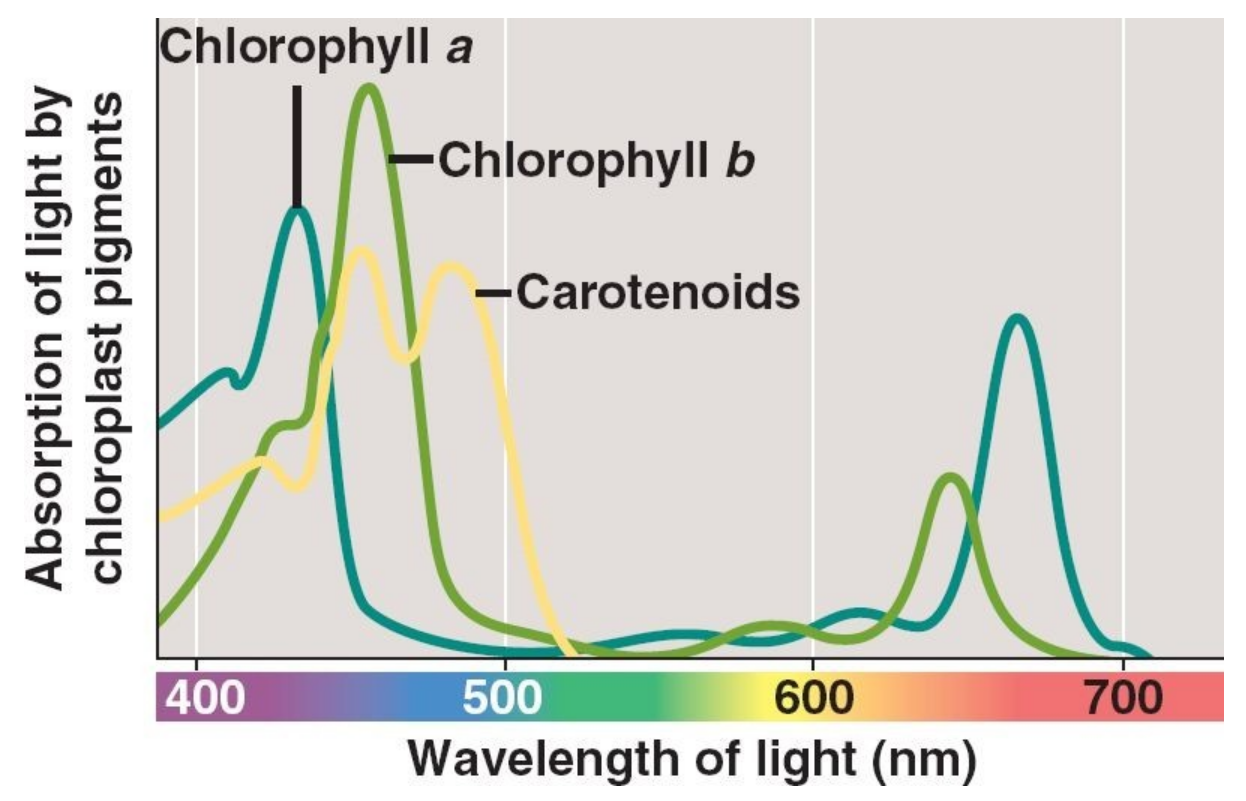
- The primary pigment in all photosynthetic organisms.
- Directly involved in light reactions.
- Blue green in colour.
- Absorbs mainly blue-violet and red light.
- All other pigments pass their absorbed energy to chlorophyll a.
b) Chlorophyll b
- Accessory pigment; helps chlorophyll a.
- Yellow green in colour.
- Absorbs blue and orange light.
- Expands the range of light that plants can use.
2. Carotenoids
These are yellow to orange pigments.
a) Carotenes
- Orange coloured hydrocarbon pigments.
- Protect chlorophyll from photo-damage.
- Absorb blue and green light.
b) Xanthophylls
- Yellow coloured pigments.
- Contain oxygen.
- Help in light harvesting and photoprotection.
🌞 Why Do We Need Accessory Pigments?
- Chlorophyll a cannot absorb all wavelengths efficiently.
- Accessory pigments capture extra wavelengths and pass the energy to chlorophyll a.
- This ensures maximum use of sunlight.
- They also protect the plant from excess light, preventing damage.
🎯 Color and Appearance in Chromatography
If pigments are separated (like in paper chromatography), they appear as:
- Chlorophyll a – Blue green
- Chlorophyll b – Yellow green
- Xanthophylls – Yellow
- Carotenes – Yellow orange
These differences help identify pigments in labs.
📚 Summary Table
| Pigment Type | Colour | Main Function | Absorption Range |
|---|---|---|---|
| Chlorophyll a | Blue green | Primary pigment; drives light reaction | Blue-violet & red |
| Chlorophyll b | Yellow green | Accessory pigment; expands absorption | Blue & orange |
| Carotenes | Orange | Light harvesting & protection | Blue & green |
| Xanthophylls | Yellow | Photoprotection, accessory role | Blue |
📦 Quick Recap
Four key pigment groups: Chlorophyll a, Chlorophyll b, Carotenes, Xanthophylls.
Chlorophyll a is the main pigment; others assist it.
Accessory pigments broaden the absorption spectrum.
Pigments protect plants from excess light and help capture more energy.
Photochemical and Biosynthetic Phases of Photosynthesis
🌱 Introduction
Photosynthesis is not a single-step process. It occurs in two main phases:
- Photochemical phase (Light Reactions) – depends on sunlight.
- Biosynthetic phase (Dark Reactions / Calvin Cycle) – does not require light directly.
Both phases are linked because energy molecules (ATP, NADPH) formed in light reactions are used in dark reactions to make carbohydrates.
☀️ 1. Photochemical Phase (Light Reactions)
Location
Occurs in grana (thylakoid membranes) of chloroplasts.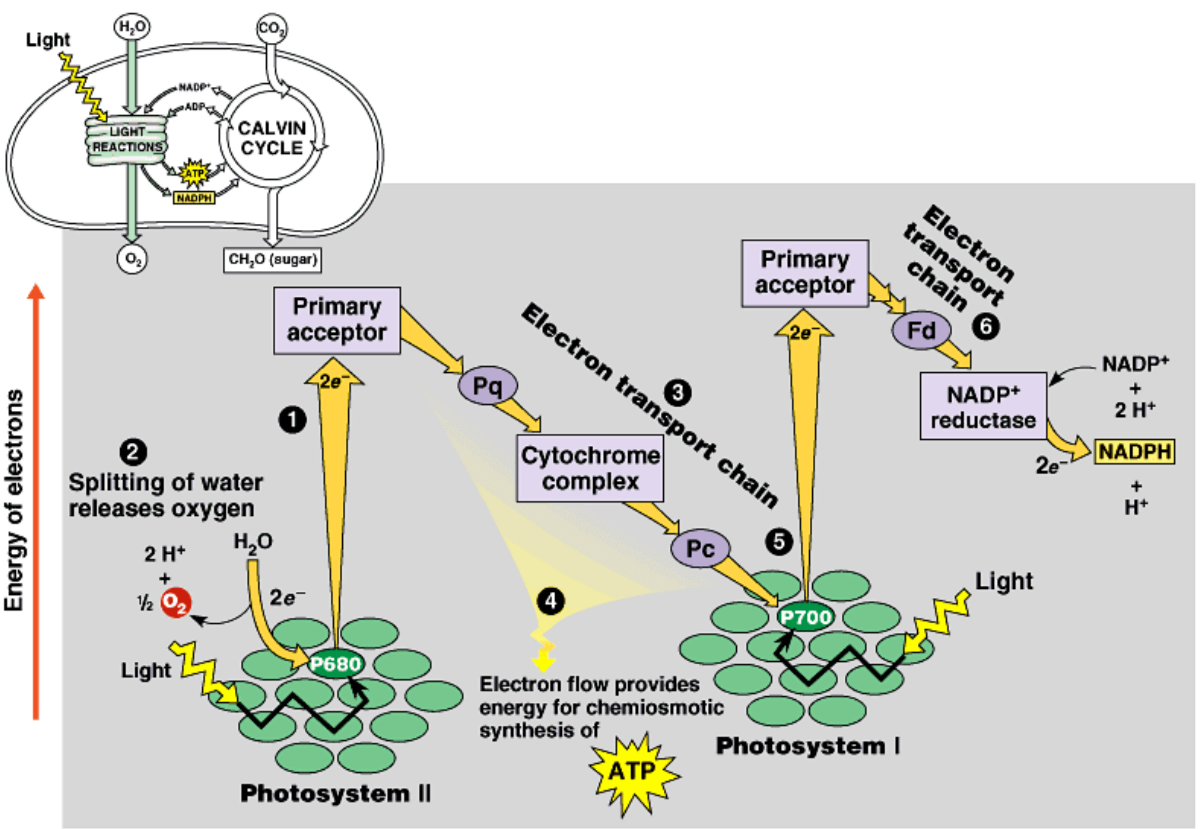
Main Steps
- Absorption of light by chlorophyll pigments.
- Excitation of electrons – chlorophyll loses electrons after absorbing light.
- Electron transport chain (ETC) – electrons pass through a series of carriers to form ATP and NADPH.
- Photolysis of water – water splits into:
- Electrons → replace lost electrons in chlorophyll
- Protons (H+) → contribute to proton gradient
- Oxygen (O2) → released into the atmosphere
⚡ Types of Photophosphorylation
- Non-cyclic photophosphorylation – involves PSI & PSII, produces ATP + NADPH + O2.
- Cyclic photophosphorylation – involves only PSI, produces ATP only, no NADPH or O2.
🧪 Summary of Light Reaction Products
| Molecule | Function |
|---|---|
| ATP | Energy currency for dark reactions |
| NADPH | Provides reducing power (H+ + electrons) for carbon fixation |
| O2 | Released as byproduct |
2. Biosynthetic Phase (Dark Reactions / Calvin Cycle)
Location
Occurs in stroma of chloroplast.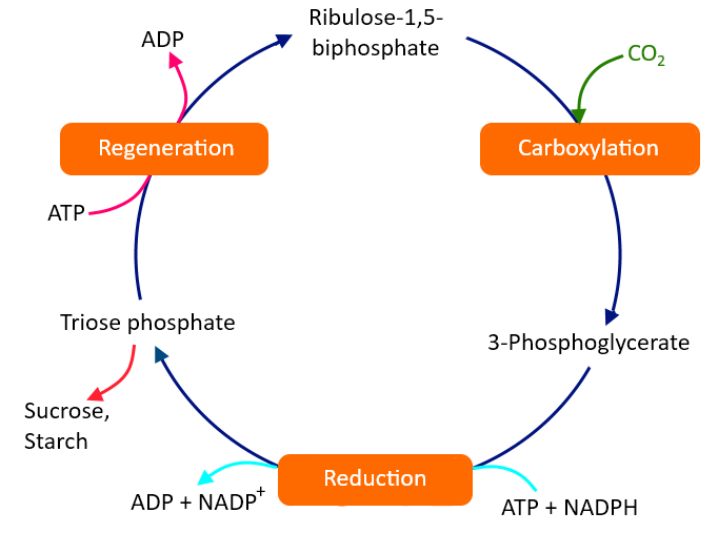
Main Steps
- Carbon Fixation
- CO2 combines with Ribulose-1,5-bisphosphate (RuBP)
- Catalyzed by RuBisCO
- Forms 3-phosphoglyceric acid (3-PGA)
- Reduction
- 3-PGA is converted into glyceraldehyde-3-phosphate (G3P)
- Uses ATP + NADPH from light reactions
- Regeneration of RuBP
- Some G3P molecules are used to regenerate RuBP
- Requires ATP
- Ensures the cycle continues
Energy Requirement
- 1 CO2 molecule → 3 ATP + 2 NADPH
- 6 CO2 molecules → 18 ATP + 12 NADPH → 1 glucose molecule
🔗 Connection Between Phases
- Light reactions: Make energy-rich molecules (ATP, NADPH)
- Dark reactions: Use that energy to synthesize carbohydrates
- Light-independent reactions can happen in darkness if ATP and NADPH are available.
📚 Summary Table
| Phase | Location | Requires Light? | Main Events | Products |
|---|---|---|---|---|
| Photochemical (Light) | Grana / Thylakoids | Yes | Photon absorption, electron transport, photolysis of water | ATP, NADPH, O2 |
| Biosynthetic (Dark / Calvin) | Stroma | No (needs products of light reaction) | Carbon fixation, reduction, RuBP regeneration | Glucose (C6H12O6) |
📦 Quick Recap
Two phases of photosynthesis: Light (photochemical) and Dark (biosynthetic).
Light reactions → occur in grana, produce ATP, NADPH, O2.
Dark reactions → occur in stroma, use ATP + NADPH to fix CO2 → form glucose.
Both phases are interdependent for completing photosynthesis.
Cyclic and Non-Cyclic Photophosphorylation
🌱 Introduction
Photosynthesis is divided into two main phases: light (photochemical) and dark (biosynthetic).
The light reactions occur in thylakoid membranes and involve conversion of light energy into chemical energy. This chemical energy is stored as ATP (adenosine triphosphate) and NADPH (reduced nicotinamide adenine dinucleotide phosphate).
Photophosphorylation = the formation of ATP using light energy.
It occurs via electron transport chains and chemiosmosis. There are two types:
- Non-cyclic photophosphorylation
- Cyclic photophosphorylation
⚡ 1. Non-Cyclic Photophosphorylation
Location
Occurs in grana (thylakoid membranes).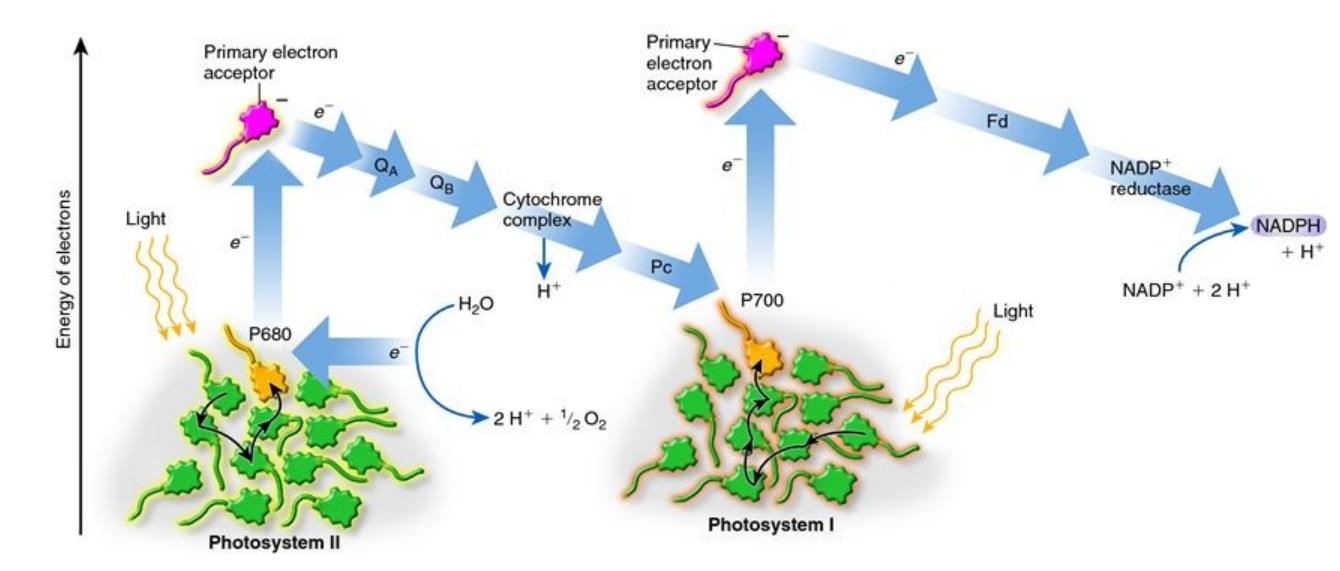
Key Features
- Involves both photosystems:
- PSII (680 nm) – absorbs red light
- PSI (700 nm) – absorbs far-red light
- Electrons flow in a linear (non-cyclic) manner from water to NADP+
- Produces ATP, NADPH, and O2 simultaneously
🧬 Stepwise Mechanism
- Photon absorption by PSII
- Light energy excites chlorophyll a at the reaction center of PSII.
- Electrons in chlorophyll reach higher energy levels.
- Primary electron acceptor (Pheophytin)
- Excited electrons are passed to pheophytin, the first electron acceptor.
- Electron transport chain (ETC)
- Electrons move through a series of carriers: Pheophytin → Plastoquinone (QA → QB) → Cytochrome b6f → Plastocyanin → PSI
- Photon absorption by PSI
- Electrons from PSII reach PSI via plastocyanin.
- PSI absorbs light and re-excites electrons.
- NADPH formation
- Excited electrons from PSI are transferred to ferredoxin (Fe-S protein).
- Finally, electrons reduce NADP+ to NADPH via ferredoxin-NADP+ reductase.
- Photolysis of water
- PSII replaces lost electrons by splitting water: 2 H2O → 4 H+ + 4 e− + O2
- Provides electrons to PSII
- Releases oxygen as byproduct
- ATP formation (Chemiosmosis)
- Protons (H+) accumulate inside thylakoid lumen → creates proton gradient.
- H+ flow back into stroma via ATP synthase (F0-F1 complex) → ATP forms from ADP + Pi.
Products of Non-Cyclic Photophosphorylation
| Molecule | Function |
|---|---|
| ATP | Energy for Calvin cycle |
| NADPH | Reducing power for carbon fixation |
| O2 | Released into atmosphere |
⚡ 2. Cyclic Photophosphorylation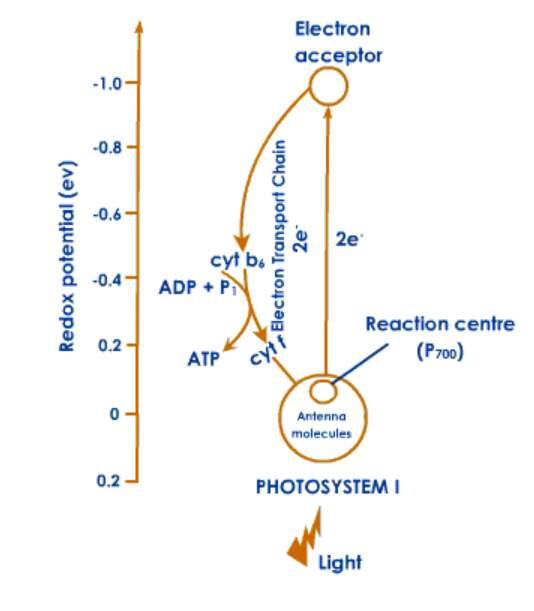
Location
Occurs in thylakoid membranes
Key Features
- Involves only PSI (700 nm)
- Electrons return to the same chlorophyll molecule → cycle repeats
- Produces ATP only, no NADPH or O2
🧬 Stepwise Mechanism
- Light excites electrons in PSI.
- Electrons are transferred to ferredoxin → cytochrome b6f → plastocyanin → back to PSI.
- Proton gradient forms → ATP synthesized via ATP synthase.
- No photolysis of water → no O2 produced
- No NADPH formation
Products of Cyclic Photophosphorylation
- ATP → used in Calvin cycle
- No NADPH
- No O2
🔗 Differences Between Cyclic & Non-Cyclic Photophosphorylation
| Feature | Cyclic | Non-Cyclic |
|---|---|---|
| Photosystem | PSI only | PSII + PSI |
| Electron flow | Cyclic; returns to PSI | Linear; goes to NADP+ |
| ATP produced | Yes | Yes |
| NADPH produced | No | Yes |
| O2 released | No | Yes (from photolysis of water) |
| Water required | No | Yes |
| Purpose / Function | Balances ATP/NADPH ratio | Provides energy + reducing power for Calvin cycle |
💡 Chemiosmotic Hypothesis in Photophosphorylation
- ATP synthesis is powered by proton gradient across thylakoid membrane.

- Steps in creating gradient:
- Photolysis of water → H+ in lumen
- Electron transport → pumps more H+ into lumen
- NADP+ reductase also helps H+ accumulation
- Protons flow back to stroma via ATP synthase → energy released forms ATP
- Requirements for chemiosmosis:
- Membrane (thylakoid)
- Proton pump (ETC)
- Proton gradient
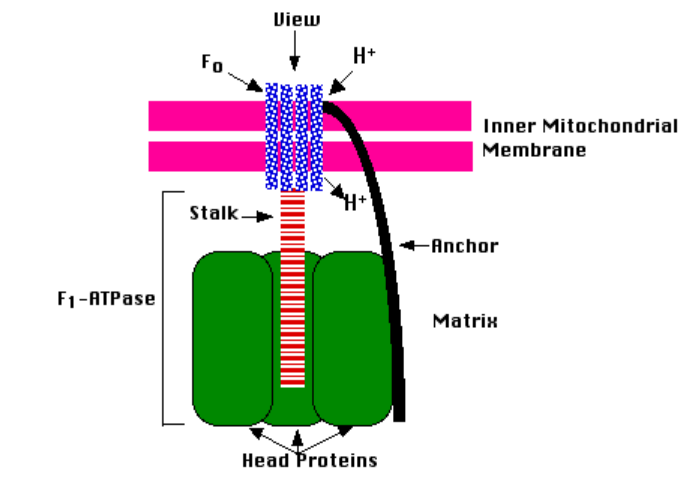
- ATP synthase (F0-F1 complex)
Importance of Both Photophosphorylations
- Non-cyclic: Provides both ATP & NADPH, produces O2, fuels Calvin cycle
- Cyclic: Supplements extra ATP when Calvin cycle requires more than NADPH, maintains energy balance
📚 Summary Table
| Feature | Cyclic | Non-Cyclic |
|---|---|---|
| Photosystem | PSI | PSII + PSI |
| Electron flow | Returns to PSI | To NADP+ |
| ATP | Yes | Yes |
| NADPH | No | Yes |
| O2 | No | Yes |
| Water required | No | Yes |
| Function | Balance ATP/NADPH | Energy & reducing power |
📦 Quick Recap
Photophosphorylation → ATP formation in light reactions
Non-cyclic: PSI + PSII → ATP + NADPH + O2
Cyclic: PSI only → ATP only
Chemiosmosis: Proton gradient drives ATP synthesis
Extra ATP from cyclic balances energy for Calvin cycle
Chemiosmotic Hypothesis
🌱 Introduction
The chemiosmotic hypothesis explains how ATP is synthesized during photosynthesis and cellular respiration. It was proposed by Peter Mitchell (1961).
According to this hypothesis, ATP synthesis is powered by the flow of protons (H+) across a membrane, which creates a proton-motive force.
In photosynthesis, this occurs during light reactions in the thylakoid membrane of chloroplasts.
⚡ Key Idea
Light energy excites electrons in photosystems → electrons pass through electron transport chain (ETC).
During electron transport, protons (H+) are pumped from the stroma into the thylakoid lumen.
This creates a proton gradient (high H+ inside lumen, low H+ in stroma) → also a pH difference.
Protons flow back into the stroma via ATP synthase (F0-F1 complex) → energy released drives ATP formation from ADP + Pi.
🌿 Steps of Chemiosmotic ATP Synthesis in Photosynthesis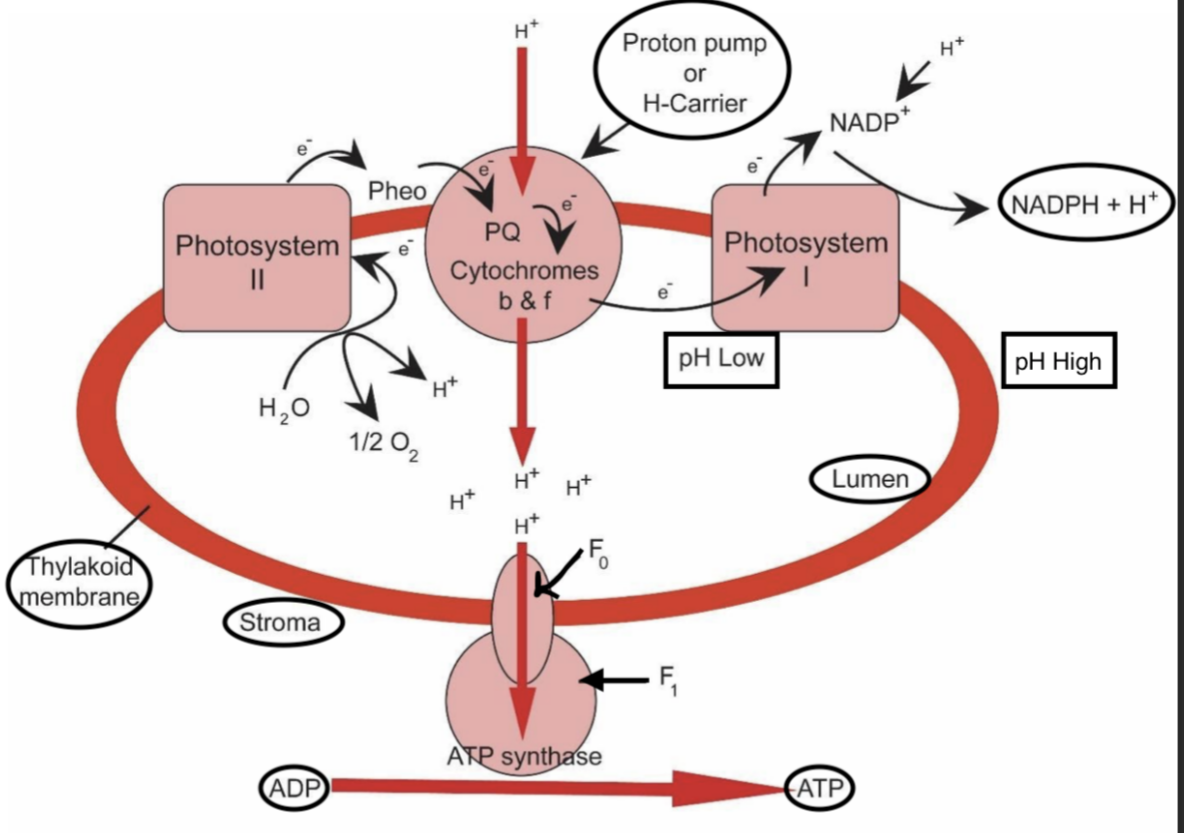
- Proton accumulation inside thylakoid lumen
- Photolysis of water at PSII: 2 H2O → 4 H+ + 4 e− + O2
- Protons from water increase H+ concentration in lumen.
- Proton pumping by electron transport
- As electrons move from PSII → PSI → NADP+, cytochrome b6f complex pumps additional H+ into lumen.
- NADP reductase contribution
- Reduction of NADP+ to NADPH consumes electrons but helps maintain proton gradient indirectly.
- Proton flow through ATP synthase
- Protons move back into the stroma through ATP synthase (F0-F1 complex)
- Energy released by proton movement is used to phosphorylate ADP → ATP
🧬 Structure of ATP Synthase (F0-F1 Complex)
| Part | Location | Function |
|---|---|---|
| F0 | Embedded in thylakoid membrane | Provides a channel for H+ flow |
| F1 | Faces stroma | Catalyzes formation of ATP from ADP + Pi |
Analogy: Protons moving through F0 → F1 works like water turning a turbine to generate electricity.
🌟 Requirements for Chemiosmosis
- Membrane: Thylakoid membrane acts as barrier for proton separation
- Proton gradient: H+ high in lumen, low in stroma
- Electron transport chain: Drives proton pumping
- ATP synthase: Converts proton flow into ATP
🔗 Importance in Photosynthesis
- Provides ATP for Calvin cycle (carbon fixation)
- Explains coupling of light energy to chemical energy
- Demonstrates how electron flow and proton gradient are linked to energy conversion
- Ensures efficient energy capture and storage in plants
📚 Summary Table
| Feature | Details |
|---|---|
| Proposed by | Peter Mitchell, 1961 |
| Site | Thylakoid membrane (chloroplast) |
| Principle | Proton gradient → ATP synthesis |
| Mechanism | Electron transport → proton pumping → proton flow through ATP synthase → ATP formation |
| ATP synthase structure | F0 (proton channel), F1 (catalytic) |
| Importance | Produces ATP for Calvin cycle, links light energy to chemical energy |
📦 Quick Recap
Chemiosmotic hypothesis = ATP formed by proton gradient across membrane
Thylakoid lumen = high H+; stroma = low H+
Protons flow through ATP synthase → energy used to make ATP
Essential for Calvin cycle and overall energy conversion in photosynthesis
Photorespiration, C3 and C4 Pathways
🌱 Introduction
Photosynthesis is not always 100% efficient. Some plants show wasteful processes under certain conditions, while others have adaptations to avoid this waste.
C3 pathway: The standard Calvin cycle; occurs in most plants.
C4 pathway: An adaptation in some plants to avoid photorespiration, especially in hot and dry environments.
Photorespiration: A wasteful pathway that occurs in C3 plants under high oxygen or high temperature.
📌 What is Photorespiration?
Process in which RuBisCO enzyme binds O2 instead of CO2.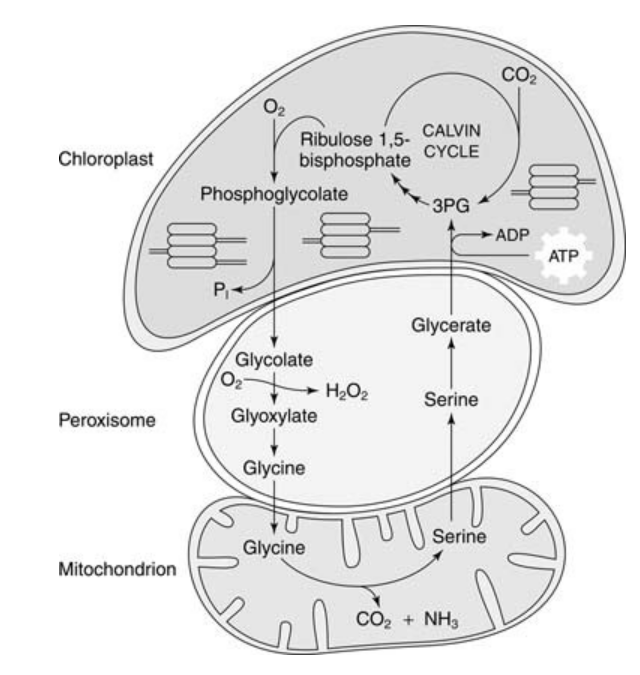
Produces:
1 molecule of 3-phosphoglycerate (3-PGA)
1 molecule of phosphoglycolate (a toxic 2-carbon compound)
Occurs in chloroplast, peroxisomes, and mitochondria.
Key Features
- Consumes ATP without producing sugar → wasteful
- Releases CO2 → decreases carbon fixation
- Triggered by high O2/low CO2 ratio, high temperature, or closed stomata
Mechanism
- RuBisCO binds O2 → produces 3-PGA + phosphoglycolate
- Phosphoglycolate converted to CO2 in peroxisomes + mitochondria
- No net sugar is formed
- Uses ATP → lowers efficiency of photosynthesis
Importance of Photorespiration
- May help protect plants from photodamage under high light intensity
- Not beneficial for productivity; reduces yield in C3 plants
C3 Pathway (Calvin Cycle)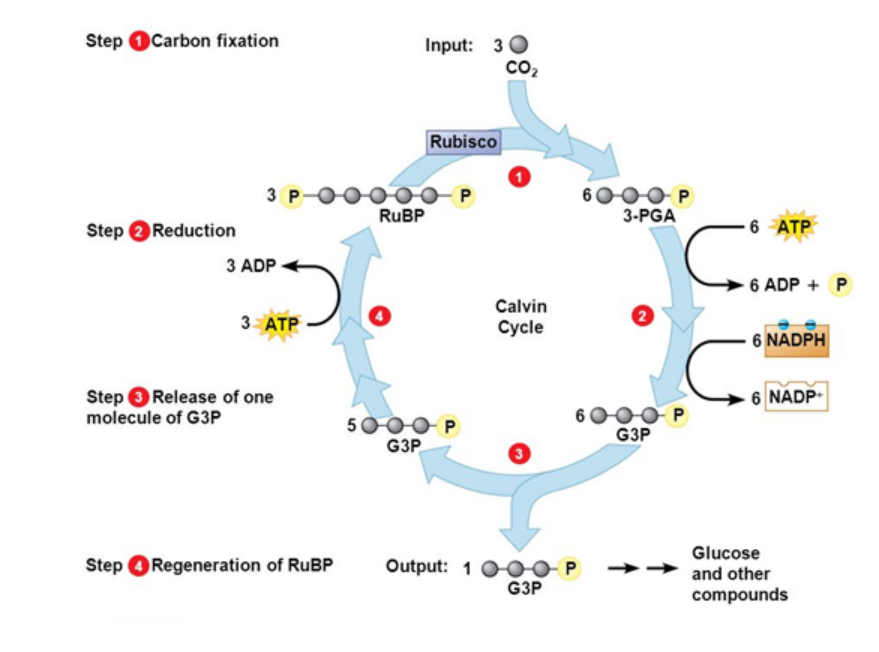
Features
- Most common pathway; occurs in mesophyll cells
- CO2 fixation forms a 3-carbon compound (3-PGA) → hence “C3”
- Catalyzed by RuBisCO
- Susceptible to photorespiration in high temperature or low CO2
Steps
- CO2 + RuBP → 2 molecules of 3-PGA (catalyzed by RuBisCO)
- 3-PGA → G3P using ATP + NADPH
- Regeneration of RuBP using ATP
- Net glucose formation requires 6 CO2, 18 ATP, 12 NADPH
Limitation
- RuBisCO can bind O2 → leads to photorespiration
- Productivity decreases under hot, dry conditions
C4 Pathway (Hatch-Slack Pathway)
Features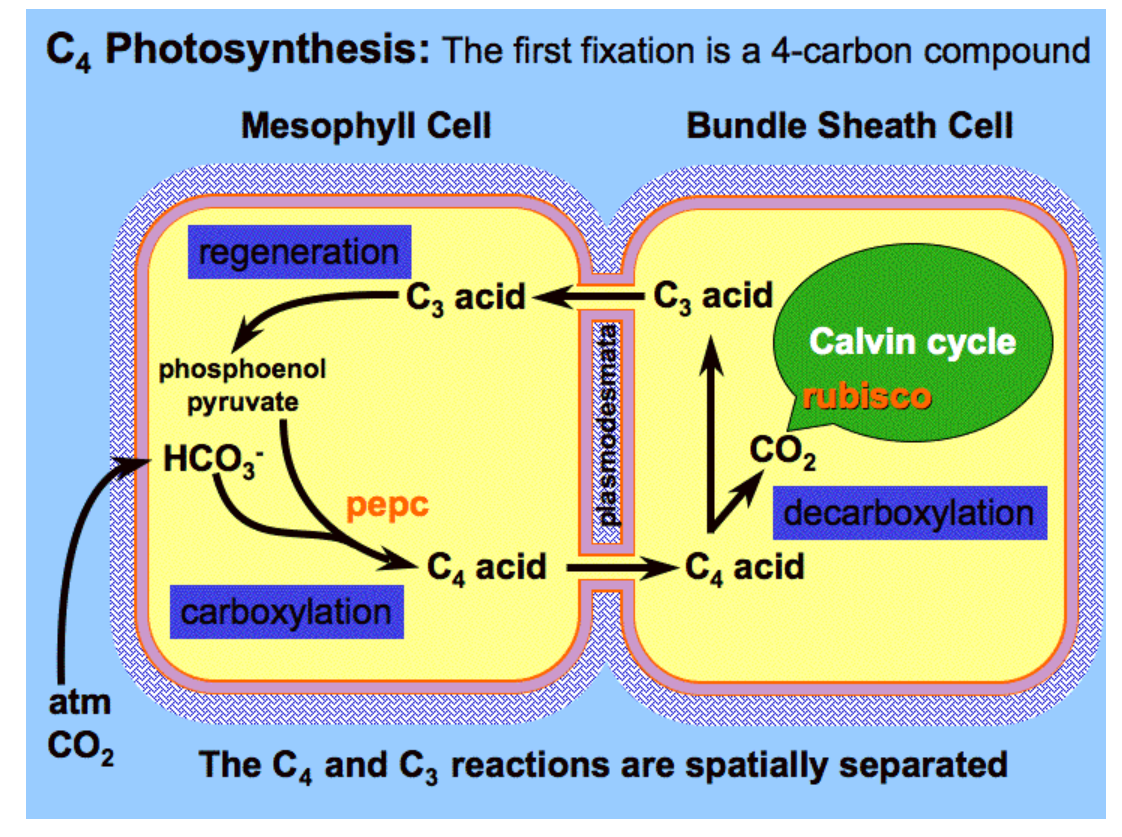
- Adaptation in tropical, dry regions (e.g., maize, sugarcane, sorghum)
- Avoids photorespiration → more efficient CO2 fixation
- Characteristic Kranz anatomy:
- Mesophyll cells surround bundle sheath cells
- CO2 initially fixed in mesophyll cells, Calvin cycle occurs in bundle sheath cells
Steps
- CO2 + Phosphoenolpyruvate (PEP) → Oxaloacetic acid (4C compound) in mesophyll cells
- Oxaloacetic acid → Malic acid → transported to bundle sheath cells
- Malic acid → releases CO2 → enters Calvin cycle (C3 cycle) in bundle sheath cells
- Pyruvate regenerated → returns to mesophyll → converted back to PEP
Advantages of C4 Pathway
- CO2 concentrated in bundle sheath → RuBisCO binds CO2, not O2
- Reduces photorespiration
- More efficient at high temperature, intense light, low CO2
- High productivity and water-use efficiency
🔗 Comparison Table: C3 vs C4 vs Photorespiration
| Feature | C3 Pathway | C4 Pathway | Photorespiration |
|---|---|---|---|
| Initial CO2 product | 3-PGA (3C) | Oxaloacetic acid (4C) | 3-PGA + phosphoglycolate |
| Enzyme | RuBisCO | PEP carboxylase + RuBisCO | RuBisCO (binds O2) |
| Cells involved | Mesophyll only | Mesophyll + bundle sheath | Mesophyll + peroxisomes + mitochondria |
| Oxygen effect | Susceptible → lowers efficiency | Not susceptible | Wasteful, decreases sugar formation |
| Environment | Cool, moist | Hot, dry, high light | Hot, dry, high O2 |
| ATP requirement | Less | More (extra ATP for PEP regeneration) | Wastes ATP |
📦 Quick Recap
Photorespiration: RuBisCO binds O2 → wastes ATP, releases CO2, occurs in C3 plants
C3 pathway: Calvin cycle → 3-PGA, susceptible to photorespiration, mesophyll cells only
C4 pathway: CO2 initially fixed to 4C compound, bundle sheath cells carry Calvin cycle, avoids photorespiration, efficient in hot conditions