
Plant Growth and Development: Seed Germination
🌿 Introduction
Seed germination is the awakening of a resting seed into a young plant.
It begins when the dry seed absorbs water and ends when the radicle (first root) emerges.
It marks the starting point of active growth and development in plants.
- Water
- Oxygen
- Temperature
- Seed hormones
- Stored food inside the seed
🌾 What is Seed Germination?
Seed germination is the process by which a dormant seed resumes growth under suitable conditions and forms a seedling.
“A sleeping seed wakes up, absorbs water, activates enzymes, breaks the seed coat, and sends out the first root.”
🌱 Phases of Seed Germination
1. Imbibition (Water uptake)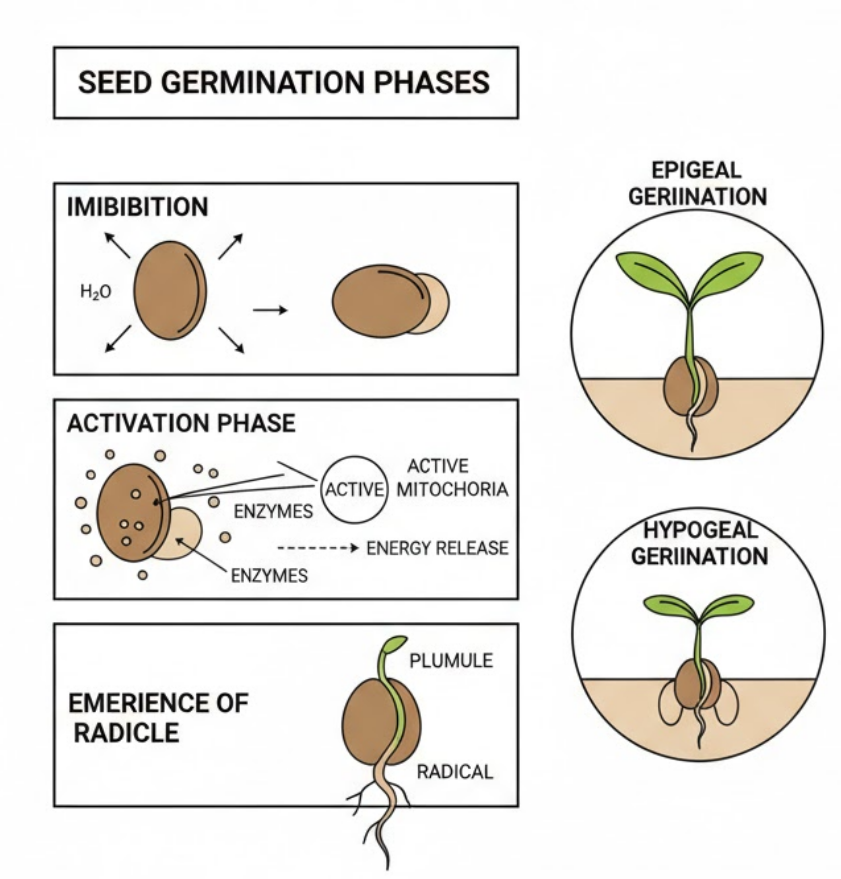
- Dry seed rapidly absorbs water
- Seed swells and becomes soft
- Seed coat becomes loose
- Metabolic activities restart
2. Activation Phase
- Hydrated cells activate enzymes
- Stored food gets ready for breakdown
- Mitochondria become active → respiration increases
- ATP production increases
3. Emergence of Radicle
- Radicle breaks through the seed coat
- It becomes the primary root
- Later the plumule (shoot) emerges and grows upward
- Seed officially becomes a seedling
🌱 Types of Germination
1. Epigeal Germination
- Cotyledons come above the soil
- Example: Beans, Castor
2. Hypogeal Germination
- Cotyledons remain below the soil
- Example: Maize, Pea
🧬 Internal Factors Influencing Germination
1. Seed viability
- Seeds must be alive and healthy
- Short lived seeds (onion) germinate quickly
2. Hormones
| Hormone | Effect |
|---|---|
| Gibberellins (GA) | Break dormancy, activate enzymes (alpha–amylase), promote germination |
| Cytokinins | Support cell division in embryo |
| Auxins | Help root growth |
| Abscisic acid (ABA) | Inhibits germination, promotes dormancy |
GA and ABA act like a tug of war: GA starts germination while ABA stops it.
☀️ External Factors Influencing Germination
1. Water
- Needed for imbibition
- Activates enzymes
- Dissolves stored food
2. Oxygen
- Required for aerobic respiration
- Gives ATP needed for growth
3. Temperature
- Moderate temperature supports enzyme activity
- Very low or very high temperature prevents germination
4. Light
- Some seeds require light (lettuce)
- Others require darkness
🌾 Role of Stored Food in Germination
Seeds store food in cotyledons or endosperm. During germination:
- GA activates alpha amylase
- Starch → Maltose → Glucose
- Glucose powers cell division and growth
- Food moves to the growing radicle and plumule
🌱 Seed Dormancy vs Germination
| Feature | Dormancy | Germination |
|---|---|---|
| State | Resting or inactive | Active growth |
| Trigger | ABA, hard seed coat | Water, GA, oxygen |
| Metabolism | Very slow | Rapid |
| Purpose | Survival during unfavourable period | Seedling formation |
Ways dormancy is broken:
- Low temperature treatment (vernalisation)
- Scarification (breaking seed coat)
- Water soaking
- Light exposure
📋 Summary Table: Seed Germination
| Step | What Happens |
|---|---|
| Imbibition | Water uptake, seed swells |
| Activation | Enzymes start working, respiration increases |
| Radicle emergence | Root breaks seed coat |
| Plumule growth | Shoot develops upward |
| Seedling formation | True leaves appear |
📦 Quick Recap
Seed germination = dormant seed becomes seedling
Needs water + oxygen + right temperature + GA
Phases: Imbibition → Activation → Radicle emergence
GA promotes germination, ABA inhibits it
Stored food digested by alpha amylase
Types: Epigeal and Hypogeal
Dormancy broken by cold, scarification, water or light
Plant Growth: Phases and Growth Rate
🌱 Introduction
Plant growth is a permanent, irreversible increase in size, mass, or cell number.
It happens because plants have meristems, which keep dividing throughout life.
Growth always includes:
- New protoplasm formation
- Cell division
- Cell enlargement
- Cell differentiation
To understand how plants grow, we study phases of growth and growth rates.
🌱 Phases of Plant Growth
Plant growth happens in three continuous phases, similar to how a seedling becomes a mature plant.
1. Phase of Cell Division (Formative Phase)
- Occurs in apical meristems
- Cells undergo mitosis
- Involves karyokinesis (nuclear division) and cytokinesis (cytoplasmic division)
- New cells are produced
- Cell number increases
- This phase lays the foundation for all growth
Example: Growth at the root tip or shoot tip.
2. Phase of Cell Enlargement
- Newly formed cells absorb water (hydration)
- Protoplasm increases
- Cell wall material is deposited
- Cells become larger and longer
- Major contributor to increase in size of tissues and organs
Example: Rapid elongation of a pollen tube.
3. Phase of Cell Differentiation (Maturation Phase)
- Enlarged cells become specialized
- Form tissues such as xylem, phloem, cortex, epidermis
- Structure and function become fixed
- Leads to development of organs like roots, leaves, flowers
Example: Formation of xylem vessels for conduction.
📊 Phases of Growth Curve (S-Shaped/Sigmoid Curve)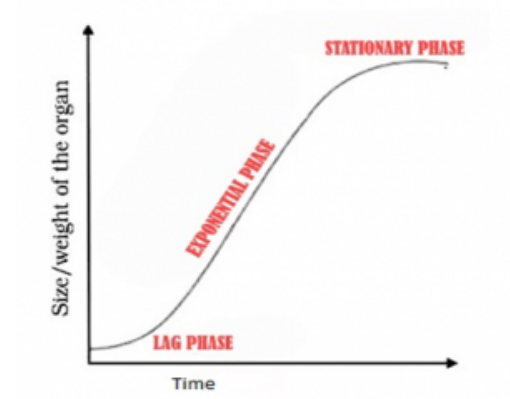
The combined activity of the three phases gives an S-shaped curve consisting of:
- Lag Phase → slow growth (cell division starts)
- Log/Exponential Phase → rapid growth (cell enlargement)
- Stationary Phase → growth slows due to nutrient depletion (differentiation and maturity)
This is the most common pattern in plants.
🌾 Plant Growth Rates
Growth rate tells how fast a plant grows with time.
It can be arithmetic or geometric.
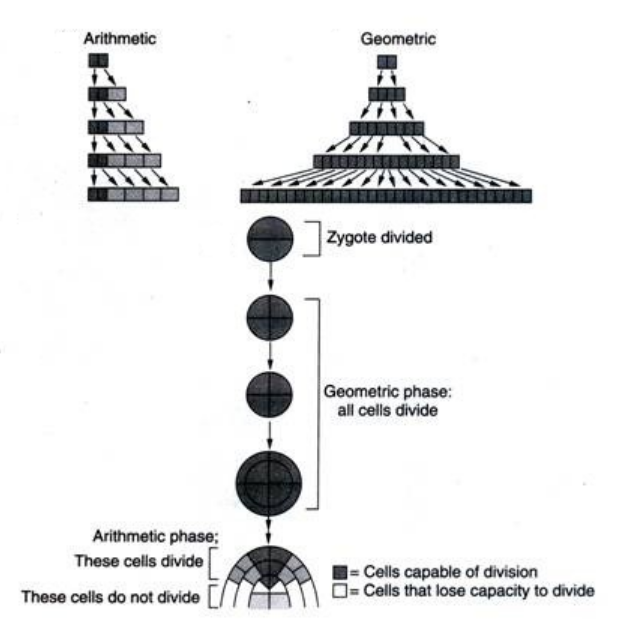
1. Arithmetic Growth
- Only one daughter cell continues to divide

- Other daughter cell differentiates
- Growth increases at a constant rate
Formula:
𝐿t = 𝐿0 + 𝑟𝑡
Where:
- 𝐿t = length at time t
- 𝐿0 = initial length
- 𝑟 = growth rate
- 𝑡 = time
Example:
Root grows exactly 1 cm per day.
2. Geometric (Exponential) Growth
- Both daughter cells continue to divide
- Resources must be plenty
- Growth becomes multiplicative
- Curve initially rises slowly then becomes steep
- Ends in a stationary phase when nutrients limit growth
Formula:
𝑊1 = 𝑊0 ert
Where:
- 𝑊1 = final size
- 𝑊0 = initial size
- 𝑟 = growth rate
- 𝑡 = time
- 𝑒 = base of natural logarithm
Example:
Moss protonema growing under ideal conditions.
📋 Summary Table
| Topic | Key Points |
|---|---|
| Phases of Growth | Division, Enlargement, Differentiation |
| Division Phase | Mitosis, new cells formed |
| Enlargement Phase | Hydration, protoplasm increase, wall deposition |
| Differentiation Phase | Cells specialize into tissues |
| Types of Growth | Arithmetic and Geometric |
| Arithmetic Growth | Constant rate, Lt = L0 + rt |
| Geometric Growth | Exponential, W1 = W0 e rt |
🧠 Quick Recap
Plant growth is irreversible and measurable
Three phases: Division → Enlargement → Differentiation
Enlargement phase contributes the most to visible growth
Growth rate can be arithmetic (constant) or geometric (multiplicative)
Geometric growth gives an S-shaped curve
Meristems make plant growth continuous
Conditions of Plant Growth
Plants don’t grow automatically. They need certain external conditions plus internal factors to support cell division, elongation, and differentiation. Think of these as the “essentials” that allow a plant to start, continue, and complete growth.
🌱 1. Water
- Required for cell enlargement because cells expand only when turgid.
- Acts as a medium for biochemical reactions.
- Needed for enzyme activity and nutrient transport.
Water stress leads to: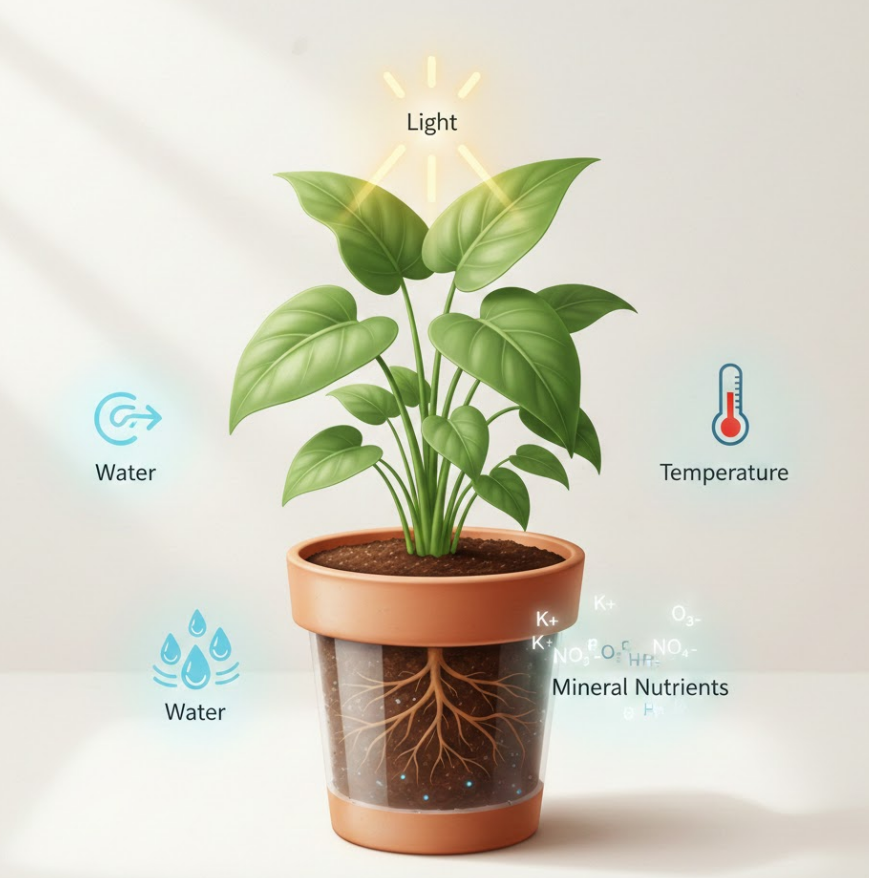
- Reduced growth
- Smaller leaves
- Stomatal closure (lower photosynthesis)
Memory tip:
No water, no turgor, no growth.
☀️ 2. Light
- Controls photosynthesis, hence energy availability.
Photoperiod affects:
- Flowering
- Seed germination
- Leaf fall
Light also influences:
- Auxin distribution (basis of phototropism)
- Development of chlorophyll
Too much light: Photooxidation of pigments
Too little light: Etiolation (tall, weak, yellow plants)
🌡️ 3. Temperature
- Affects enzyme activity, respiration, photosynthesis.
- Most plants grow best between 25 to 35°C.
Very low temperatures:
- Cause chilling injury
- Slow metabolic reactions
Very high temperatures:
- Denature enzymes
- Reduce growth rate
🧪 4. Mineral Nutrients
- Required for forming protoplasm, cell wall, enzymes, pigments, and energy compounds.
Essential nutrients:
- Macronutrients: N, P, K, Ca, Mg, S
- Micronutrients: Fe, Mn, Zn, Cu, Mo, B, Cl
Deficiency leads to:
- Chlorosis
- Necrosis
- Stunted growth
- Poor root/shoot development
💨 5. Oxygen
- Required for aerobic respiration to generate ATP for growth processes.
- Waterlogged soils → low oxygen → poor root growth.
🧬 6. Internal Factors
These operate inside the plant and directly influence growth:
a. Plant Hormones (Phytohormones)
- Auxins: Cell elongation
- Gibberellins: Stem elongation, seed germination
- Cytokinins: Cell division
- ABA: Dormancy, stress response
- Ethylene: Fruit ripening, senescence
Growth happens only when hormones are in proper ratio.
b. Genotype
Growth potential is genetically determined.
Example: Dwarf vs tall pea plants.
c. Nutrition Stored in Seed
During early stages (germination), stored food affects growth speed.
🧭 7. CO₂ Concentration
- More CO₂ → higher rate of photosynthesis (upto saturation point).
- Limiting CO₂ reduces carbohydrate supply for growth.
🌬️ 8. Mechanical Support
- Plants need proper support for upright growth.
- Strong stems and good root anchorage affect growth rate.
🌿 Summary Table
| Factor | How It Affects Growth |
|---|---|
| Water | Turgidity, nutrient transport, metabolic reactions |
| Light | Photosynthesis, photoperiod effects, pigment formation |
| Temperature | Enzyme activity, respiration, photosynthesis |
| Mineral Nutrients | Structure, enzymes, pigments, energy compounds |
| Oxygen | ATP production for growth activities |
| Phytohormones | Coordinate growth: elongation, division, dormancy |
| Genotype | Determines inherent growth potential |
| CO₂ | Controls photosynthetic rate |
| Mechanical Support | Helps maintain structure and growth direction |
⚡ Quick Recap
Growth needs water, light, temperature, minerals, oxygen.
Internal factors: hormones + genotype + stored food.
CO₂ boosts photosynthesis, hence growth.
Light and temperature have the most visible effects on plant form.
Poor water or mineral supply → stunted, weak plants.
Differentiation, Dedifferentiation and Redifferentiation
🌱 Introduction
Plants grow throughout life because their cells can divide, enlarge and mature into specialised structures.
During growth, cells change their shape, size, wall composition and internal chemistry to perform specific functions.
These changes are grouped under:
- Differentiation
- Dedifferentiation
- Redifferentiation
🌿 1. Differentiation
Meaning
Differentiation is the process by which a simple, newly formed cell becomes specialised to perform a specific function.
What happens during differentiation?
- Cell size increases
- Cell wall gets thickened or modified
- Vacuoles enlarge
- Protoplasm undergoes chemical changes
- Specific structures develop (xylem vessels, phloem sieve tubes, fibres etc.)
Examples
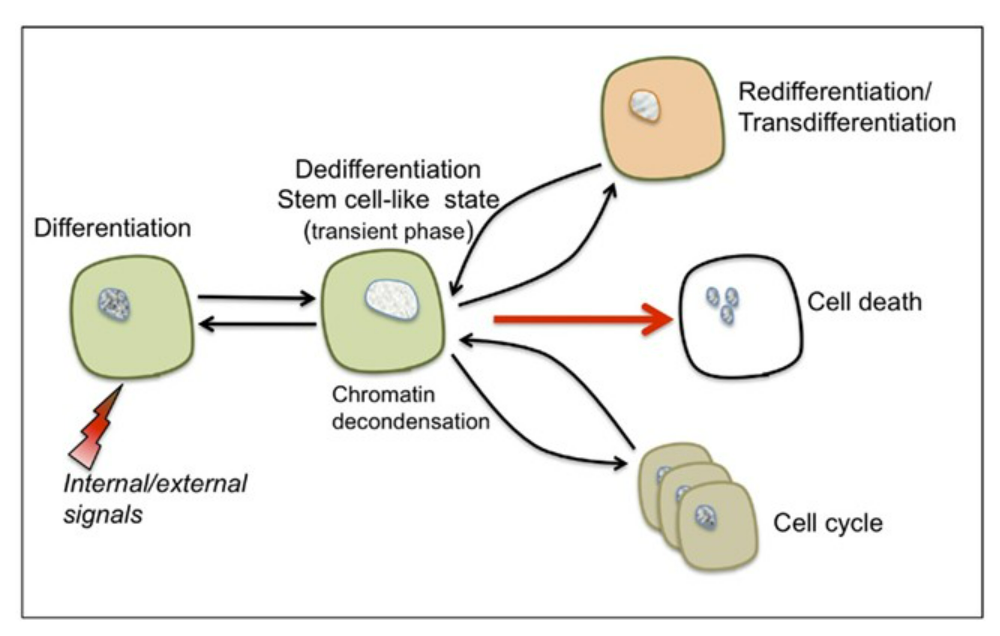
- Cambium cells differentiate into xylem and phloem
- Root apex cells differentiate into root hairs
- Leaf meristem cells differentiate into mesophyll cells
Why it’s important
Differentiation creates specialised tissues that allow plants to perform functions like conduction, support, protection, and photosynthesis.
🌿 2. Dedifferentiation
Meaning
Dedifferentiation is the process by which a mature, differentiated cell regains the ability to divide.
Why does this happen?
Plant cells are highly plastic. Some specialised cells can go backward and become meristematic again when needed.
Examples
- Interfascicular cambium formed from parenchyma cells
- Wound healing tissue (callus) formed from mature cells
- Cork cambium (phellogen) developing from fully mature cortical cells
Importance
Dedifferentiation allows:
- Secondary growth
- Tissue repair
- Formation of new meristems
- Regeneration
🌿 3. Redifferentiation
Meaning
Redifferentiation is the process in which dedifferentiated cells once again become specialised to perform a particular function.
Example
- Callus (formed during dedifferentiation) can redifferentiate into roots, shoots, or vascular tissues
- Cork cambium (dedifferentiated) produces cork cells which are specialised
Why it matters
Redifferentiation helps plants rebuild tissues according to need and environment, supporting plasticity and adaptability.
🌿 4. How the Three Processes Connect
- Differentiation: young cell → specialised cell
- Dedifferentiation: specialised cell → meristematic state
- Redifferentiation: meristematic state → specialised cell again
This cycle helps plants survive damage, grow continuously, and adapt to environmental changes.
🌿 Summary Table
| Process | Meaning | Ability to Divide | Examples |
|---|---|---|---|
| Differentiation | Formation of specialised cells | Lost | Xylem, phloem, root hair cells |
| Dedifferentiation | Mature cell regains divisional ability | Regained | Cork cambium, interfascicular cambium, callus |
| Redifferentiation | Dedifferentiated cells become specialised again | Lost again | Cork cells, vascular tissues from callus |
📦 Quick Recap
Differentiation: normal path of development where cells specialise
Dedifferentiation: specialised cells become meristematic again
Redifferentiation: meristematic cells again become specialised
These processes show plant plasticity, helping in regeneration, secondary growth, and adaptation
Sequence of Developmental Processes in a Plant Cell
🌱 Introduction
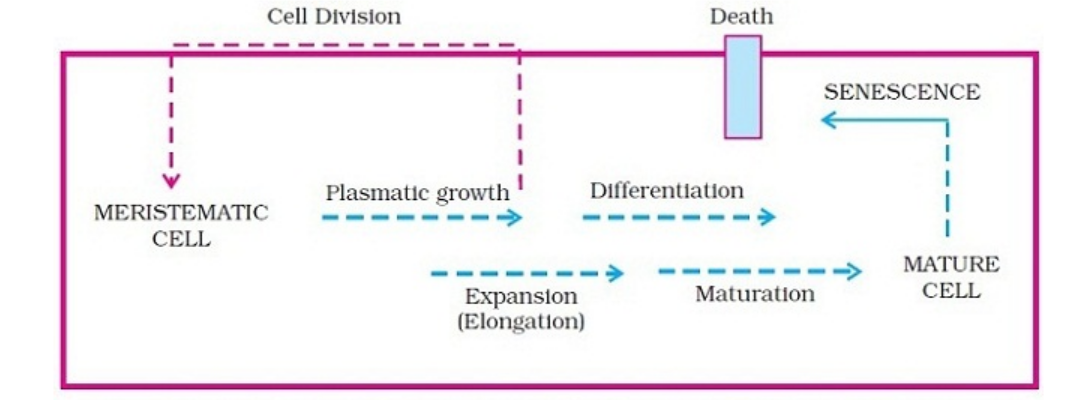
Plant cells go through a series of developmental stages from their formation in meristems to becoming fully functional, specialised cells.
This sequence ensures growth, differentiation, and adaptation throughout the life of the plant.
🌿 1. Cell Division (Formative Phase)
Description
- The first step in development.
- Mitosis is the type of cell division responsible for growth.
- Includes:
- Karyokinesis – division of nucleus
- Cytokinesis – division of cytoplasm
Phases of Mitosis
- Prophase – Chromosomes condense
- Metaphase – Chromosomes align at equatorial plane
- Anaphase – Chromatids separate
- Telophase – Nucleus reforms, cytokinesis follows
Cell division produces new cells for growth, tissue formation, and repair.
🌿 2. Cell Enlargement / Expansion
Description
- After division, cells increase in size.
- Involves:
- Uptake of water (turgor)
- Synthesis of more protoplasm and cell wall materials
- Stretching of existing cell wall
Importance
- Contributes to organ growth (roots, shoots, leaves)
- Enables cells to perform specialised functions effectively
🌿 3. Cell Differentiation / Maturation
Description
- Cells become specialised for a specific function.
- Structural and biochemical modifications occur.
- Cells form tissues like:
- Xylem → water transport
- Phloem → food transport
- Mesophyll → photosynthesis
Significance
- Ensures the plant organ functions efficiently
- Allows for division of labour in multicellular plants
🌿 4. Dedifferentiation
Some cells may regain meristematic ability to divide again.
Example: formation of callus or cork cambium during repair
🌿 5. Redifferentiation
Dedifferentiated cells may again specialise into new tissues.
Example: Callus → roots, shoots, vascular tissues
🌿 6. Growth Regulation
Plant growth regulators (PGRs) control the rate, direction, and type of growth:
- Auxins: cell elongation, apical dominance
- Gibberellins: seed germination, stem elongation
- Cytokinins: cell division, shoot formation
- Ethylene: fruit ripening, senescence
- Abscisic acid: dormancy, stress response
🌿 7. Development and Maturation
Development includes all structural and functional changes from cell formation to death.
Cells follow a predetermined genetic program but can also respond to environmental cues (plasticity).
Example: heterophylly → leaf shape changes from juvenile to mature phase
🌿 Sequence Flow
🌿 Summary Table
| Stage | Key Events | Function / Significance |
|---|---|---|
| Cell Division | Mitosis (karyokinesis + cytokinesis) | Produces new cells for growth |
| Cell Enlargement | Water uptake, protoplasm synthesis, wall stretching | Increases size of organs |
| Differentiation | Structural & biochemical specialization | Forms functional tissues |
| Dedifferentiation | Regains meristematic ability | Tissue repair & regeneration |
| Redifferentiation | Becomes specialised again | Restores functional tissues |
| Development | Structural & functional maturity | Ensures adaptation & plasticity |
📦 Quick Recap
Sequence: Division → Enlargement → Differentiation → (Dedifferentiation → Redifferentiation) → Maturation → Development
Differentiation: Cell becomes specialised
Dedifferentiation: Specialised cell regains division ability
Redifferentiation: Dedifferentiated cell becomes specialised again
PGRs regulate every step for proper growth, flowering, and fruiting
Plant Growth Regulators (PGRs)
🌱 Introduction
Plant growth regulators are small molecules that control growth, development, and responses to the environment.
They are naturally occurring (phytohormones) or synthetic analogues and act at very low concentrations.
PGRs are broadly classified as:
- Growth promoters – stimulate cell division, elongation, differentiation
- Growth inhibitors – suppress growth or induce dormancy
🌿 1. Auxins
Overview
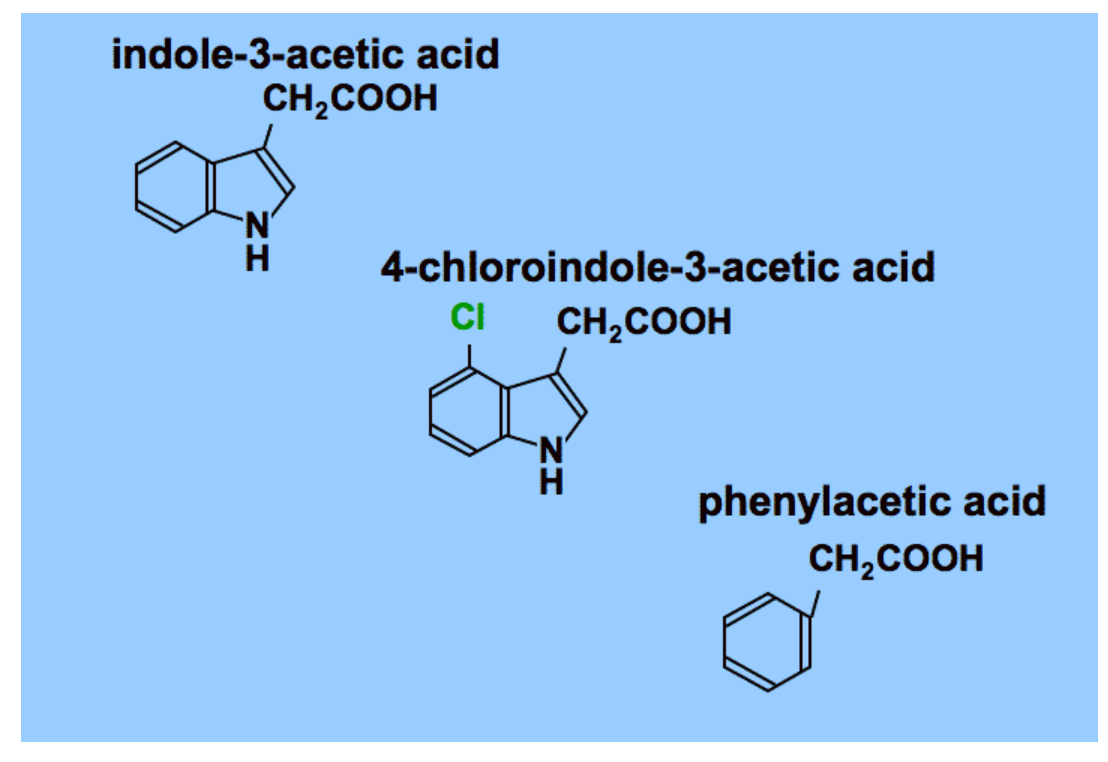
- Naturally occurring auxin: Indole-3-acetic acid (IAA)
- Synthetic auxins: 2,4-D, NAA (Naphthalene acetic acid)
- Highest concentration: shoot and root apices
Physiological Functions
- Stimulates cell elongation → elongation of stem and coleoptile
- Promotes root formation → adventitious and lateral roots
- Induces apical dominance → suppresses growth of lateral buds
- Promotes flowering → pineapple
- Stimulates vascular tissue differentiation
- Induces parthenocarpy → seedless fruits
Example Applications
- Horticulture: rooting of stem cuttings
- Agriculture: seedless fruit production
🌿 2. Gibberellins (GAs)
Overview
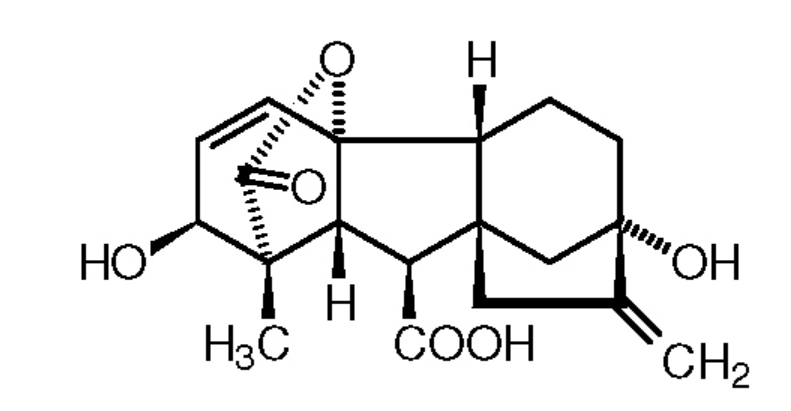
- Discovered in foolish seedling disease of rice caused by Gibberella fujikuroi
- Examples: GA1, GA3, GA4, GA7
Physiological Functions
- Breaks seed dormancy → promotes germination
- Stimulates alpha-amylase production → mobilizes food in germinating seeds
- Promotes stem elongation → internode growth
- Induces flowering in long-day plants
- Delays senescence → prolongs leaf life
- Promotes parthenocarpy → seedless fruit formation
🌿 3. Cytokinins
Overview
- Discovered in DNA extracts of herring sperm (kinetin)
- Naturally occurring: Zeatin, Kinetin
- Highest concentration: roots, shoot apices, young fruits
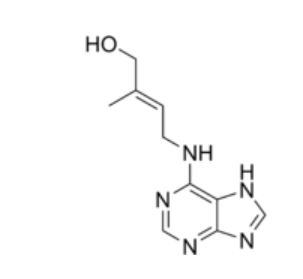
Physiological Functions
- Stimulates cell division (cytokinesis)
- High cytokinin + low auxin → shoot formation
- Promotes adventitious root formation
- Delays senescence → keeps leaves green
- Helps overcome apical dominance → lateral bud growth
🌿 4. Ethylene
Overview
- Gaseous hormone; precursor: methionine
- Concentrated in ripening fruits and senescing tissues
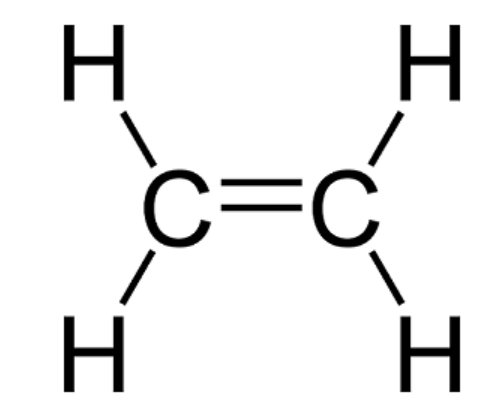
Physiological Functions
- Promotes fruit ripening
- Induces leaf senescence
- Inhibits flowering in some plants
- Promotes formation of female flowers
- Suppresses bud growth
- Breaks dormancy in buds and seeds
🌿 5. Abscisic Acid (ABA)
Overview
- Also called Dormin
- Derived from terpenoids (secondary metabolites)
- Often considered a growth inhibitor
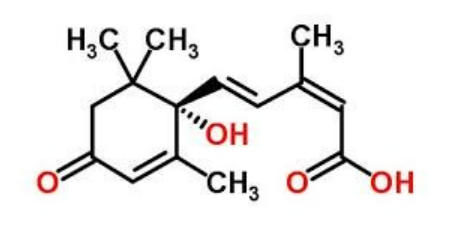
Physiological Functions
- Promotes stomatal closure → reduces water loss
- Delays cell division → slows growth
- Induces seed dormancy → prevents premature germination
- Inhibits fruit ripening → acts opposite to ethylene
- Downregulates photosynthetic enzymes → slows metabolism under stress
🌿 Summary Table of PGRs
| PGR | Type | Main Functions | Key Sites |
|---|---|---|---|
| Auxin (IAA, 2,4-D, NAA) | Growth promoter | Cell elongation, root formation, apical dominance, parthenocarpy | Shoot/root apices |
| Gibberellins (GA1, GA3) | Growth promoter | Stem elongation, seed germination, flowering, parthenocarpy, delay senescence | Young leaves, seeds |
| Cytokinins (Zeatin, Kinetin) | Growth promoter | Cell division, shoot formation, delay senescence, overcome apical dominance | Roots, shoot apices, young fruits |
| Ethylene | Growth inhibitor/modulator | Fruit ripening, leaf senescence, bud growth inhibition, dormancy breaking | Ripening fruits, senescing tissues |
| Abscisic Acid (ABA) | Growth inhibitor | Stomatal closure, seed dormancy, inhibit growth & fruit ripening | Leaves, seeds, stressed tissues |
📦 Quick Recap
Auxins: elongation, root formation, apical dominance
Gibberellins: germination, stem elongation, flowering
Cytokinins: cell division, shoot formation, delay senescence
Ethylene: ripening, senescence, dormancy break
ABA: stress response, seed dormancy, growth inhibition
Takeaway: Growth regulators act in specific tissues, often in combination, to control plant growth, development, and adaptation