
Chemical Coordination and Regulation: Endocrine Glands and Hormones
1. Introduction
- Endocrine glands are ductless, release hormones directly into bloodstream.
- Hormones are chemical messengers produced in small amounts.
- Regulate growth, metabolism, reproduction, stress response, and homeostasis.
- Endocrine system: slower than nervous system but long-lasting effects.
2. Human Endocrine System Overview
Major endocrine glands: Pituitary, Pineal, Thyroid, Parathyroid, Thymus, Adrenal, Gonads
Other hormone-secreting organs: Kidney, Heart, Liver, Gastrointestinal tract
Classification of Hormones:
- Peptide hormones → water-soluble, act on membrane receptors (e.g., insulin, glucagon)
- Steroid hormones → lipid-soluble, act on intracellular receptors (e.g., cortisol, estrogen)
- Amine hormones → derived from amino acids (e.g., adrenaline, thyroid hormones)
3. Hypothalamus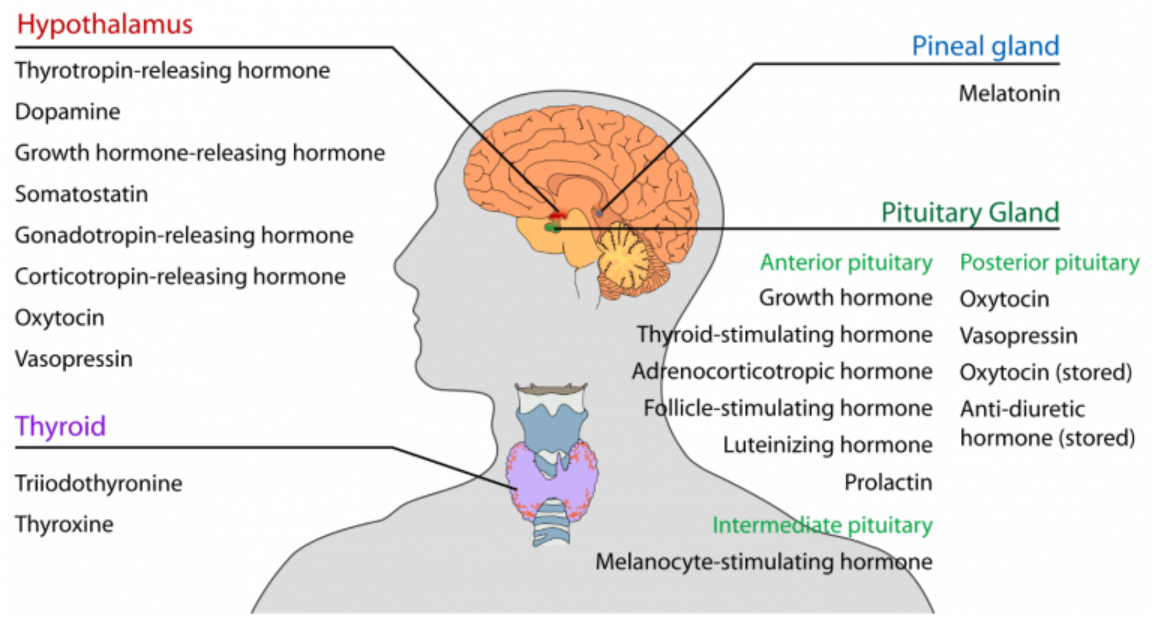
- Located at base of forebrain
- Nuclei produce hormones regulating pituitary
- Releasing hormones → stimulate pituitary (e.g., GnRH → FSH & LH)
- Inhibiting hormones → inhibit pituitary secretion
- Hormones reach pituitary via portal circulatory system
- Function: Integrates nervous & endocrine systems
4. Pituitary Gland (Master Gland)
- Located in sella turcica, connected to hypothalamus by stalk
A. Anterior Pituitary (Adenohypophysis)
- Growth Hormone (GH): growth, bone length, metabolism | Excess → Gigantism; Deficiency → Dwarfism
- TSH: stimulates thyroid hormone secretion
- ACTH: stimulates adrenal cortex
- FSH: spermatogenesis & ovarian follicle maturation
- LH: ovulation & testosterone secretion
- Prolactin (PRL): milk production
- MSH: skin pigmentation
B. Posterior Pituitary (Neurohypophysis)
- Oxytocin: milk ejection, uterine contraction
- Vasopressin (ADH): water reabsorption in kidneys
5. Pineal Gland
- Located dorsally in forebrain
- Melatonin → regulates circadian rhythm, sleep-wake cycle, body temperature
6. Thyroid Gland
- Two lobes on trachea, connected by isthmus
- Follicular cells secrete T3 (Triiodothyronine) & T4 (Thyroxine)
- Requires iodine for synthesis
- Functions: Regulates BMR, protein/carbohydrate/fat metabolism, RBC formation
- Disorders: Hypothyroidism → Goiter; Hyperthyroidism → Excess thyroid hormone
7. Parathyroid Glands
- Located behind thyroid
- Hormone: PTH → increases blood calcium, maintains calcium-phosphate balance
8. Thymus
- Located between lungs, behind sternum
- Thymosin → maturation of T-lymphocytes, immunity, antibody production
9. Adrenal Glands
- Paired glands on kidneys
- Adrenal Cortex → corticoids: Glucocorticoids (Cortisol), Mineralocorticoids (Aldosterone)
- Adrenal Medulla → Adrenaline & Noradrenaline | Fight-or-flight, alertness, pupil dilation, sweating
10. Pancreas
- Dual gland: endocrine & exocrine
- Islets of Langerhans: Alpha → Glucagon (raises blood glucose), Beta → Insulin (lowers blood glucose)
- Disorders: Hyperglycemia → Diabetes Mellitus
11. Gonads
- Testes: testosterone → spermatogenesis, male traits
- Ovaries: Estrogen & Progesterone → ovulation, menstruation, pregnancy
12. Other Hormone-Secreting Organs
| Organ | Hormone | Function |
|---|---|---|
| Heart | ANF | Lowers BP via vasodilation & Na⁺ excretion |
| Kidney | Erythropoietin | Stimulates RBC formation |
| Gastrointestinal tract | Gastrin, Secretin, CCK, GIP | Regulate digestion & secretion |
13. Mechanism of Hormone Action
- Hormones bind specific receptors → biochemical changes in target cells
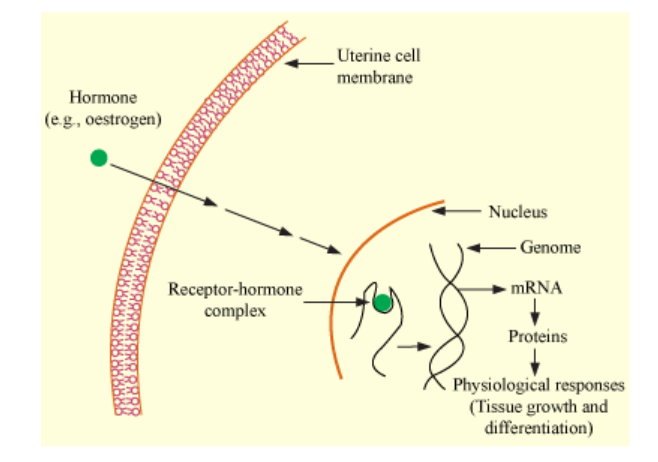
- Steroid hormones → intracellular receptors → gene expression changes
- Peptide hormones → membrane receptors → secondary messenger cascade (cAMP, Ca²⁺)
🧠 Quick Recap
Hypothalamus → Releasing/Inhibiting → controls pituitary
Pituitary → GH, TSH, ACTH, FSH, LH, PRL, MSH, Oxytocin, ADH → growth, metabolism, reproduction, water balance → Gigantism/Dwarfism
Pineal → Melatonin → sleep-wake cycle
Thyroid → T3, T4 → metabolism, BMR → Hypo/Hyperthyroidism
Parathyroid → PTH → calcium homeostasis
Thymus → Thymosin → immunity
Adrenal Cortex → Cortisol, Aldosterone → metabolism, water/electrolyte balance
Adrenal Medulla → Adrenaline, Noradrenaline → fight/flight response
Pancreas → Insulin, Glucagon → blood glucose regulation → Diabetes Mellitus
Gonads → Testes: testosterone; Ovaries: estrogen/progesterone → reproduction
Heart → ANF → blood pressure regulation
Kidney → Erythropoietin → RBC formation
Human Endocrine System
1. Introduction
- Endocrine system = ductless glands that secrete hormones into blood
- Hormones = chemical messengers regulating growth, metabolism, reproduction, and homeostasis
- Acts slower than nervous system but effects are long-lasting
2. Hypothalamus
- Location: Base of forebrain, above pituitary
- Structure: Group of secretory cells called nuclei
 Hormones:
- Releasing hormones → stimulate pituitary (e.g., GnRH → FSH & LH)
- Inhibiting hormones → inhibit pituitary secretion
- Function: Integrates nervous & endocrine systems
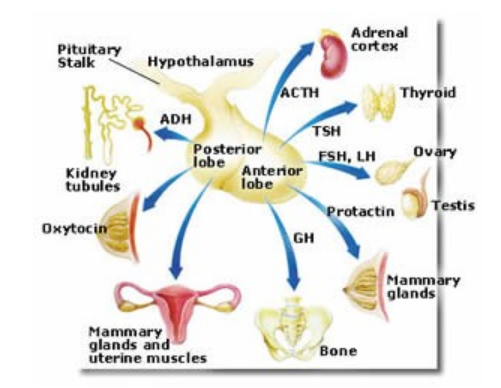
3. Pituitary Gland (Master Gland)
The pituitary gland is a small but powerful endocrine gland often called the master gland.
It controls several other glands and regulates major body functions.
It sits in the sella turcica of the skull and is connected to the hypothalamus through a thin stalk called the infundibulum.
A. Anterior Pituitary (Adenohypophysis)
The anterior pituitary produces and releases several important hormones that control growth, metabolism, reproduction, and stress response.
| Hormone | Function | Disorders (Excess / Deficiency) |
|---|---|---|
| GH | Body growth, bone elongation, protein synthesis, metabolism | Excess → Gigantism (children) / Acromegaly (adults) Deficiency → Dwarfism |
| TSH | Stimulates thyroid hormone release | Excess → Hyperthyroidism Deficiency → Hypothyroidism |
| ACTH | Stimulates adrenal cortex to release cortisol | Excess → Cushing’s syndrome Deficiency → Addison’s disease (low cortisol) |
| FSH | Ovarian follicle growth; spermatogenesis | Deficiency → Infertility issues |
| LH | Triggers ovulation; stimulates testosterone secretion | Deficiency → Infertility / low sex hormones |
| PRL | Milk production after childbirth | Excess → Galactorrhea, infertility Deficiency → Poor lactation |
| MSH | Increases skin pigmentation | Excess → Hyperpigmentation |
B. Posterior Pituitary (Neurohypophysis)
The posterior pituitary stores and releases hormones produced by the hypothalamus.
| Hormone | Function | Disorders (Excess / Deficiency) |
|---|---|---|
| ADH (Vasopressin) | Water reabsorption in kidneys, maintains blood pressure | Deficiency → Diabetes insipidus Excess → SIADH (water retention) |
| Oxytocin | Uterine contraction during childbirth; milk ejection | No major disorder directly linked, but deficiency may reduce milk let-down |
4. Pineal Gland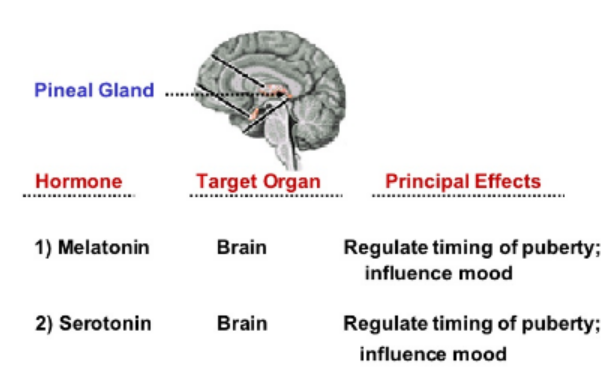
- Location: Dorsal side of forebrain
- Melatonin → regulates sleep-wake cycle & circadian rhythm
5. Thyroid Gland
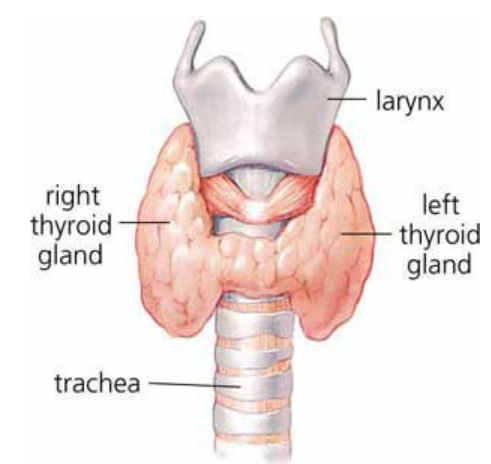
- Location: Two lobes on either side of trachea, connected by isthmus
- Hormones: T3 & T4
- Functions: Regulates BMR, protein/carbohydrate/fat metabolism, RBC formation
- Disorders: Hypothyroidism → Goiter; Hyperthyroidism → Excess thyroid hormone
6. Parathyroid Glands
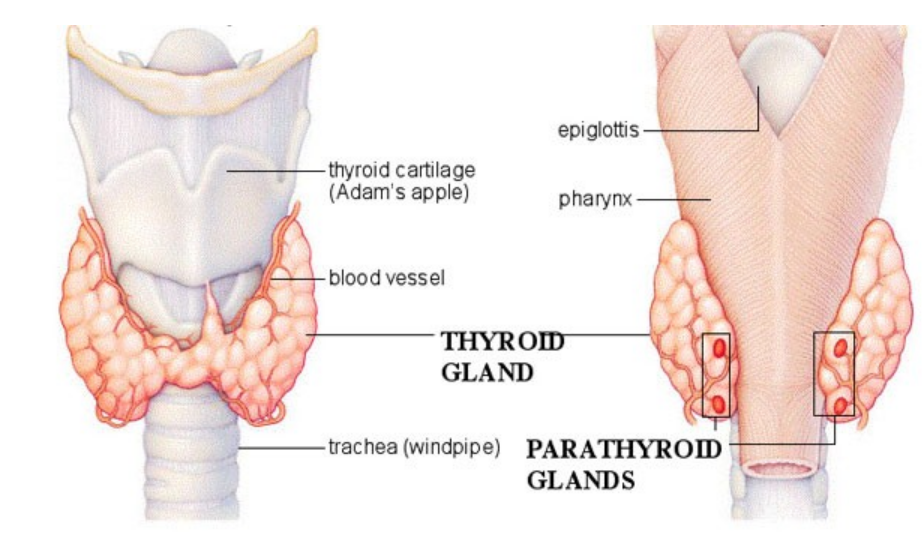
- Location: Back of thyroid gland
- Hormone: PTH → maintains calcium & phosphate balance, increases blood calcium
7. Adrenal Glands
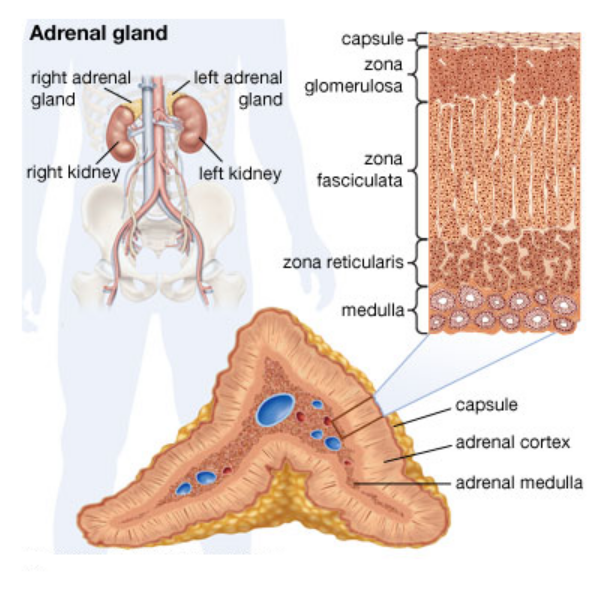
- Location: Above kidneys
- Structure:
- Adrenal Cortex → Glucocorticoids (Cortisol): metabolism, gluconeogenesis, anti-inflammatory
- Mineralocorticoids (Aldosterone): Na⁺ reabsorption, water balance
- Adrenal Medulla → Adrenaline & Noradrenaline: fight-or-flight, alertness, pupil dilation, sweating
8. Pancreas
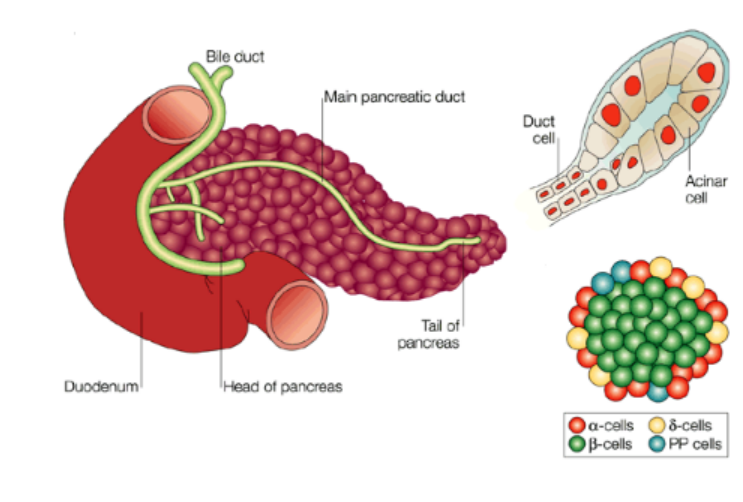
- Dual gland: endocrine & exocrine
- Islets of Langerhans:
- Alpha cells → Glucagon: raises blood glucose, promotes gluconeogenesis
- Beta cells → Insulin: lowers blood glucose
- Disorders: Hyperglycemia → Diabetes Mellitus
9. Gonads
- Testes (Male): Testosterone → spermatogenesis, male traits, accessory sex organ maturation
- Ovaries (Female): Estrogen → ovulation, menstruation; Progesterone → supports pregnancy
🧠 Quick Recap
Hypothalamus → Releasing/Inhibiting → controls pituitary
Pituitary → GH, TSH, ACTH, FSH, LH, PRL, MSH, Oxytocin, ADH → growth, metabolism, reproduction, water balance → Gigantism/Dwarfism
Pineal → Melatonin → sleep-wake cycle, circadian rhythm
Thyroid → T3, T4 → metabolism, BMR → Hypo/Hyperthyroidism
Parathyroid → PTH → calcium homeostasis
Adrenal Cortex → Cortisol, Aldosterone → metabolism, water/electrolyte balance
Adrenal Medulla → Adrenaline, Noradrenaline → fight/flight response
Pancreas → Insulin, Glucagon → blood glucose regulation → Diabetes Mellitus
Testes → Testosterone → spermatogenesis, male traits
Ovaries → Estrogen, Progesterone → ovulation, pregnancy
Mechanism of Hormone Action (Elementary Idea)
1. Introduction
- Hormones are chemical messengers secreted in small amounts
- They act on specific target cells or tissues to bring about a physiological response
- Each hormone has a specific receptor either on the cell surface or inside the cell
2. Hormone-Receptor Interaction
- Hormone binds to its receptor → forms hormone-receptor complex
- This complex triggers biochemical changes inside the target cell → produces the effect of hormone
3. Types of Hormone Receptors
| Hormone Type | Receptor Location | Mechanism | Example |
|---|---|---|---|
| Peptide/Protein hormones | Cell membrane | Cannot enter cell → bind to membrane receptor → activates second messenger inside cell → triggers response | Insulin, ADH |
| Steroid hormones | Inside cytoplasm or nucleus | Lipid-soluble → enter target cell → bind intracellular receptor → hormone-receptor complex binds DNA → activates gene transcription → produces protein → effect | Cortisol, Estrogen |
4. Second Messenger System (for Peptide Hormones)
- Hormone binds membrane receptor → activates enzyme (e.g., adenylate cyclase)
- Adenylate cyclase converts ATP → cAMP (cyclic AMP)
- cAMP activates protein kinases → phosphorylates proteins → changes cell activity
- Response occurs without the hormone entering the cell
5. Summary
- Hormone released from gland
- Hormone travels in blood → reaches target tissue
- Hormone binds to specific receptor
- Signal transduction inside cell (second messenger or gene activation)
- Target cell shows response (metabolic, growth, secretion, etc.)
🧠 Quick Recap
Hormones act via receptors → either on membrane or inside cell
Peptide hormones → membrane receptor → second messenger (cAMP)
Steroid hormones → intracellular receptor → gene activation → protein synthesis
Hormone → receptor → biochemical change → cellular response