
Neural Control and Coordination: Neuron and Nerves
1. What is Neural Control and Coordination?
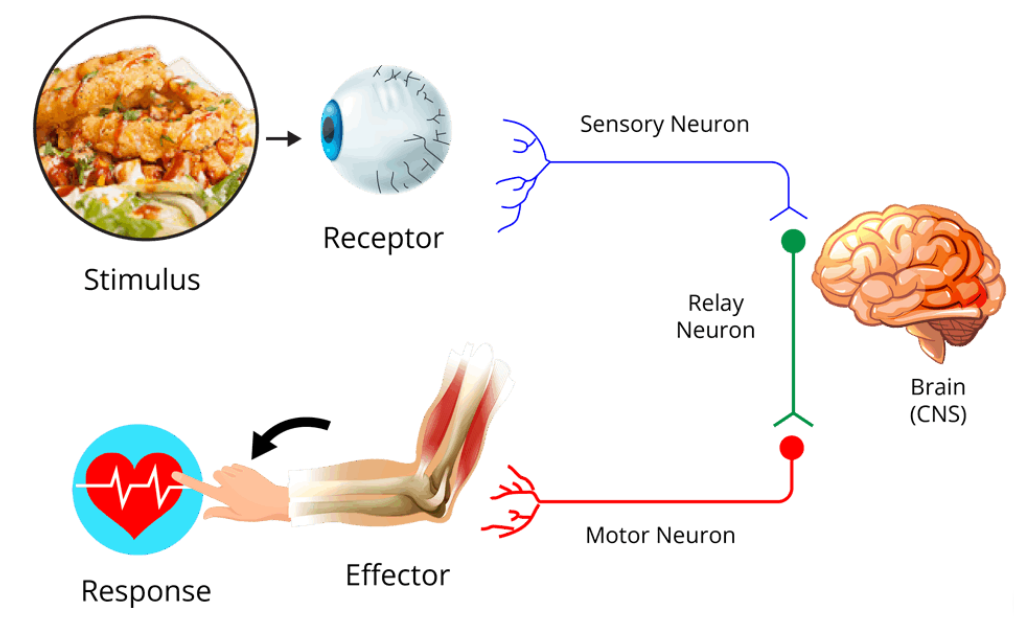
- The nervous system detects, receives, and transmits stimuli.
- Allows rapid communication between body parts.
- Enables response to external and internal changes.
2. Human Nervous System
- Divisions:
- Central Nervous System (CNS): Brain + Spinal cord
- Peripheral Nervous System (PNS): All nerves outside CNS
- PNS Fibers:
- Afferent (Sensory): Carry impulses from organs/tissues → CNS
- Efferent (Motor): Carry impulses from CNS → muscles/organs
PNS Subdivisions:
| Subdivision | Function |
|---|---|
| Somatic NS | Voluntary control of skeletal muscles |
| Autonomic NS | Involuntary control of smooth muscles and organs
|
3. Neuron – Structure and Function
- Neuron: Structural and functional unit of nervous system
- Parts of a neuron:
- Cell body (Soma): Cytoplasm with Nissl granules for protein synthesis
- Dendrites: Short, branched → carry impulses towards cell body
- Axon: Long fiber → carries impulses away from cell body, ends in synaptic knobs with neurotransmitters
- Myelin sheath (Schwann cells) → speeds conduction
- Nodes of Ranvier → gaps between sheaths; enable saltatory conduction
4. Types of Neurons
| Type | Structure | Example | Function |
|---|---|---|---|
| Multipolar | 1 axon + ≥2 dendrites | Cerebral cortex | Motor & integration |
| Bipolar | 1 axon + 1 dendrite | Retina | Sensory |
| Unipolar | 1 axon, no dendrite | Embryonic neurons | Early development |
5. Nerves
- Definition: Bundle of axons surrounded by connective tissue
- Function: Transmit impulses between CNS and organs
- Types of Nerve Fibers:
- Afferent (Sensory): Organs → CNS
- Efferent (Motor): CNS → Muscles/Glands
Summary Table:
| Feature | Nerve Fiber | Direction of Impulse |
|---|---|---|
| Afferent | Sensory | Towards CNS |
| Efferent | Motor | Away from CNS |
✅ Quick Recap
✔ Neuron = functional unit of NS → cell body + dendrites + axon
✔ Myelin sheath → speeds conduction; Nodes of Ranvier → saltatory conduction
✔ Types of neurons: Multipolar, Bipolar, Unipolar
✔ Nerves: Bundles of axons; afferent → CNS, efferent → organs
✔ PNS: Somatic (voluntary), Autonomic (involuntary → sympathetic & parasympathetic)
Nervous System in Humans
1. Overview
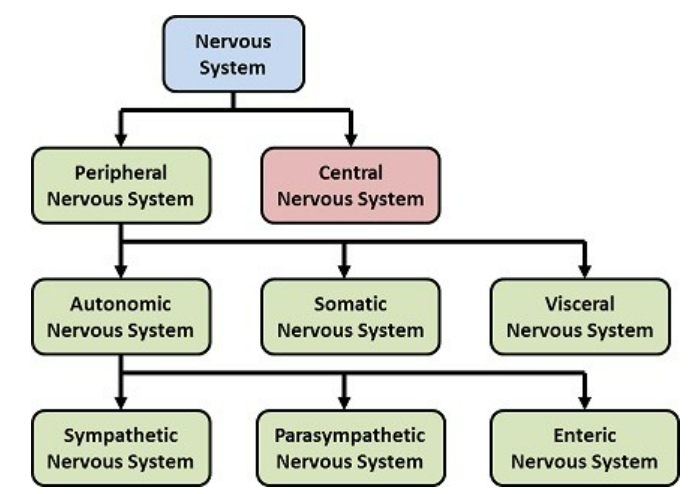
- The nervous system is the control and coordination system of the body.

- Detects stimuli (internal or external) and generates a response.
- Allows communication between different body parts.
- Structurally and functionally divided into:
- Central Nervous System (CNS)
- Peripheral Nervous System (PNS)
- Visceral (Autonomic) Nervous System (ANS)
2. Central Nervous System (CNS)
- Function: Acts as the control center; receives, processes information, and sends commands.
2.1 Brain
- Protected by skull and meninges (Dura mater, Arachnoid, Pia mater).
Divisions and Functions:
| Part | Structure | Function |
|---|---|---|
| Forebrain | Cerebrum, Thalamus, Hypothalamus | – Cerebrum: voluntary actions, intelligence, memory, reasoning, sensory perception, motor control – Thalamus: relay center for sensory and motor signals – Hypothalamus: hunger, thirst, temperature regulation, autonomic control |
| Midbrain | Corpora Quadrigemina | Visual and auditory reflexes, eye movement coordination |
| Hindbrain | Pons, Cerebellum, Medulla Oblongata | – Cerebellum: coordination, posture, balance – Pons: bridge between cerebrum and cerebellum, regulates breathing – Medulla Oblongata: involuntary actions like heart rate, respiration, blood pressure |
- Special Features:
- Cerebral Cortex: Outer layer of cerebrum, responsible for conscious actions
- Corpus Callosum: Connects left and right hemispheres
2.2 Spinal Cord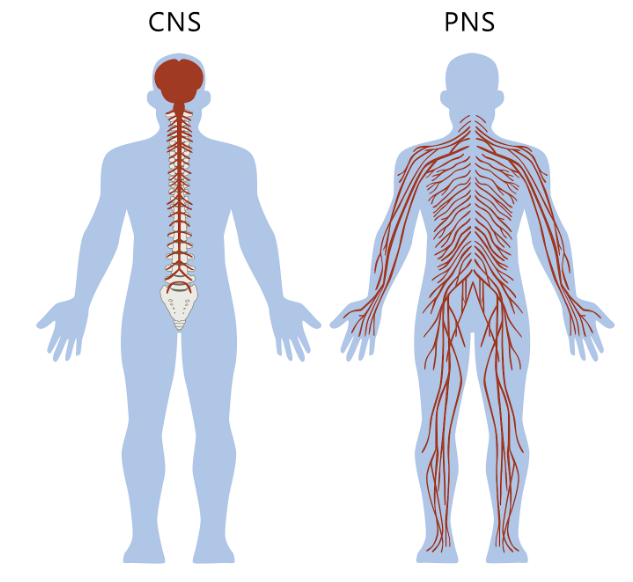
- Cylindrical structure inside vertebral column.
- Function:
- Conducts impulses between brain and body
- Acts as reflex center
- Protected by: Vertebrae, meninges, cerebrospinal fluid
3. Peripheral Nervous System (PNS)
- Function: Connects CNS to organs, muscles, and glands.
- Components: All nerves outside CNS (cranial + spinal nerves)
- Types of Nerve Fibers:
- Afferent (Sensory): Organs → CNS
- Efferent (Motor): CNS → target organs/muscles
3.3 Divisions of PNS:
| Division | Function | Target |
|---|---|---|
| Somatic Nervous System (SNS) | Voluntary control | Skeletal muscles |
| Autonomic Nervous System (ANS) | Involuntary control | Smooth muscles, cardiac muscles, glands |
4. Visceral (Autonomic) Nervous System
Controls internal organs automatically to maintain homeostasis.
| Division | Role | Examples |
|---|---|---|
| Sympathetic | “Fight or Flight” → prepares body for stress/emergency | Increases heart rate, dilates pupils, inhibits digestion |
| Parasympathetic | “Rest and Digest” → conserves energy | Stimulates digestion, reduces heart rate, constricts pupils |
✅ Quick Recap
✔ CNS → Processing & control → Brain + Spinal Cord
✔ PNS → Communication → Cranial + Spinal Nerves
✔ SNS → Voluntary → Skeletal muscles
✔ ANS → Involuntary → Smooth muscles, cardiac muscles, glands
✔ ANS divisions: Sympathetic → fight/flight, Parasympathetic → rest/digest
Generation and Conduction of Nerve Impulse
1. Overview
- Neurons are electrically excitable cells.
- They transmit information as nerve impulses (action potentials).
- Impulse transmission occurs due to ion movements across the neuron membrane.
2. Resting Membrane Potential (RMP)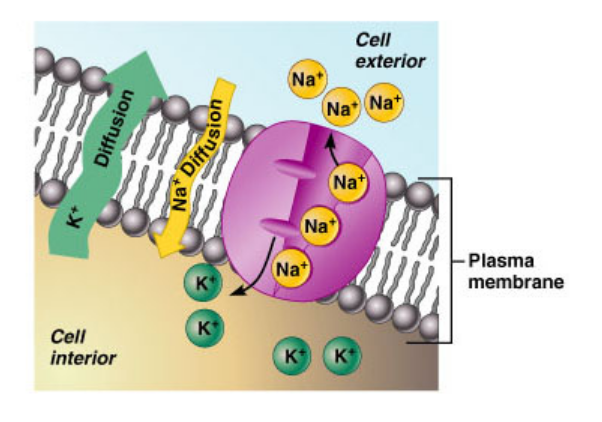
Definition: Electrical potential difference across the neuron membrane when no impulse is being transmitted.
Key Features:
- Inside neuron: negative relative to outside
- Outside neuron: positive (Na⁺ ions)
- Maintained by Sodium-Potassium Pump (Na⁺/K⁺ ATPase): Pumps 3 Na⁺ out, 2 K⁺ in
- Typical RMP: −70 mV
- Neuron is polarized at rest
3. Action Potential (Nerve Impulse)
Definition: Temporary reversal of membrane polarity caused by stimulus → generates electrical signal.
Steps of Action Potential:
- Stimulation: Stimulus makes membrane permeable to Na⁺ → Na⁺ influx → inside becomes positive, outside negative (depolarization)
- Propagation: Depolarization spreads along axon → impulse moves in one direction
- Repolarization: K⁺ channels open → K⁺ efflux → restores negative inside, positive outside
- Hyperpolarization (Optional): Membrane may temporarily become more negative than resting potential
- Restoration: Sodium-Potassium pump restores normal ion distribution → neuron returns to resting state
Key Features:
- All-or-None Law: Action potential is fully generated or not at all
- Impulse Speed: Myelinated axons → faster (saltatory conduction at Nodes of Ranvier)
4. Conduction of Impulse
| Type | Features | Example |
|---|---|---|
| Continuous Conduction | Along unmyelinated fibers, impulse spreads step by step | Small nerves, e.g., C fibers |
| Saltatory Conduction | Along myelinated fibers, impulse jumps between Nodes of Ranvier | Large motor neurons → faster transmission |
5. Transmission of Impulse at Synapse
Impulse moves from neuron → neuron or neuron → effector via synapses.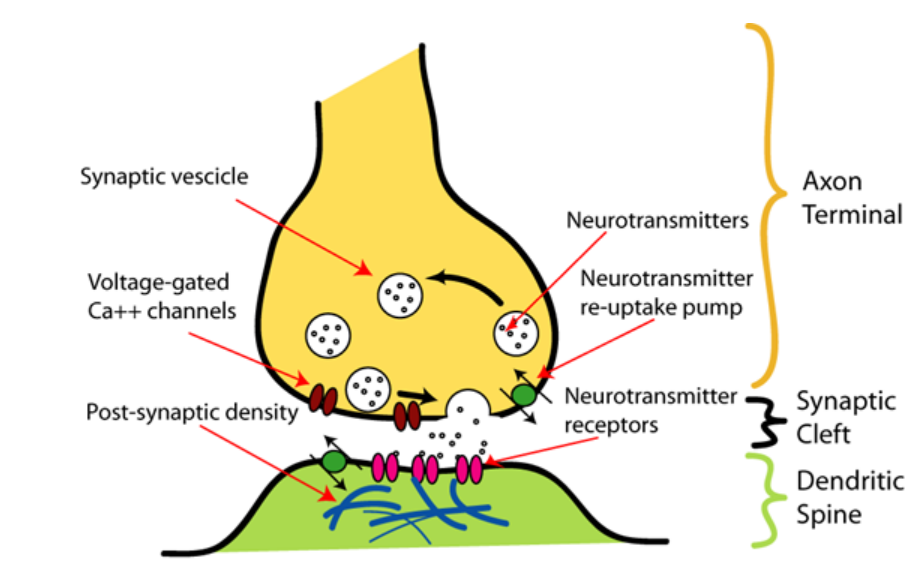
Types of Synapses:
- Electrical Synapse: Neurons in close contact → impulse flows directly via gap junctions; faster but less flexible
- Chemical Synapse: Neurons separated by synaptic cleft → neurotransmitters released from presynaptic neuron → bind to postsynaptic receptors → impulse transmitted
Examples of Neurotransmitters: Acetylcholine, Dopamine, Serotonin, GABA
6. Points to Remember
- Neuron polarized at rest → RMP = −70 mV
- Depolarization → Action potential → Repolarization → Resting state
- Myelination → saltatory conduction → faster impulse
- Synapses → chemical or electrical for neuron communication
🧠 Quick Recap
Resting neuron: Negative inside, positive outside → polarized
Stimulus: Na⁺ influx → depolarization
Repolarization: K⁺ efflux restores polarity
Impulse conduction: Unmyelinated → continuous, Myelinated → saltatory (faster)
Synapse: Junction between neurons → chemical (neurotransmitter) or electrical (direct)