
Sexual Reproduction in Flowering Plants: Flower Structure
📌 Introduction
Sexual reproduction in flowering plants involves the fusion of male and female gametes.
Flowers are the reproductive organs of angiosperms.
Each flower is specially adapted to produce gametes and facilitate pollination and fertilization.
🌱 Flower Structure
1. Definition of a Flower
A flower is a modified shoot for sexual reproduction.
It consists of whorls of specialized leaves arranged on a receptacle.
2. Parts of a Flower
| Whorl | Leaf Type | Structure & Function |
|---|---|---|
| Calyx | Sepals | Usually green; protect flower bud. Can be fused (gamosepalous) or free (polysepalous) |
| Corolla | Petals | Often colorful; attracts pollinators. Can be fused (gamopetalous) or free (polypetalous). Sometimes produces nectar |
| Androecium | Stamens | Male reproductive part. Filament + Anther → produces pollen grains (male gametes) |
| Gynoecium / Carpel | Carpels / Pistils | Female reproductive part. Stigma (receives pollen) + Style + Ovary (contains ovules → female gametes) |
3. Detailed Parts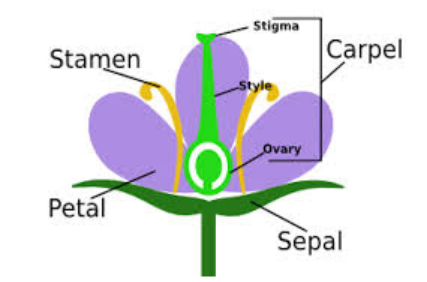
- A. Calyx (Sepals): Usually green; protect flower bud. Free = polysepalous, Fused = gamosepalous
- B. Corolla (Petals): Colorful; attracts insects/animals. May have nectaries
- C. Androecium (Stamens): Male part; Filament = stalk, Anther = pollen grains. Types: Monadelphous, Diadelphous, Polyadelphous
- D. Gynoecium (Carpels/Pistils): Female part; Stigma = receives pollen, Style = connects stigma to ovary, Ovary = contains ovules. Types: Monocarpous, Syncarpous, Apocarpous
4. Types of Flowers
- Complete flower → has all 4 whorls (calyx, corolla, androecium, gynoecium)
- Incomplete flower → missing one or more whorls
- Perfect flower → has both androecium and gynoecium
- Imperfect flower → only male or female
📝 Quick Summary Table
| Part | Type | Function |
|---|---|---|
| Calyx | Sepals | Protect bud |
| Corolla | Petals | Attract pollinators |
| Androecium | Stamens | Produce pollen (male gametes) |
| Gynoecium | Carpels/Pistil | Produce ovules (female gametes) |
🔑 Quick Recap
Flower → modified shoot for reproduction
4 whorls → Calyx (sepals), Corolla (petals), Androecium (stamens), Gynoecium (carpels)
Male = stamens, Female = carpels
Complete vs incomplete, Perfect vs imperfect flowers
Pedicel + Receptacle = support & attachment
Pollen → male gamete, Ovule → female gamete
Development of Male and Female Gametophytes
📌 Introduction
In flowering plants, the gametophyte generation is highly reduced and develops within the flower.
Male gametophyte → develops from microspores (in anther)
Female gametophyte → develops from megaspore (in ovule)
🌸 Male Gametophyte (Pollen Grain) Development
1. Site of Development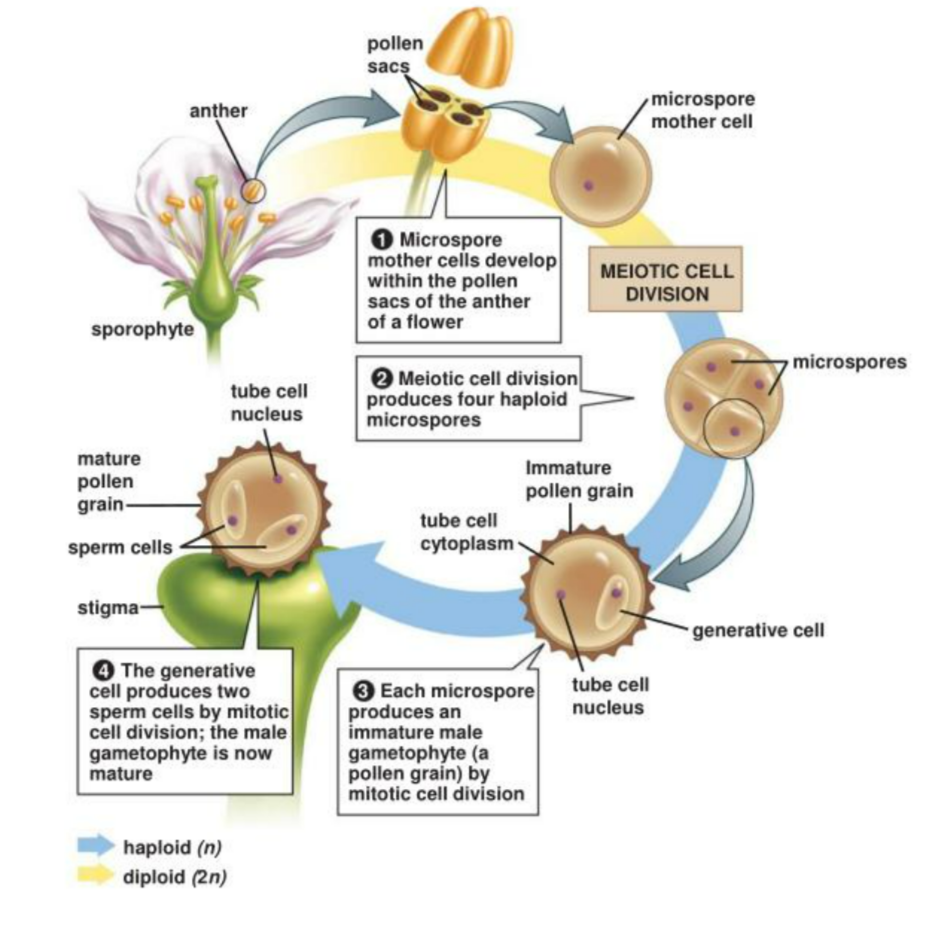
Occurs in the anther of the stamen.
Anther contains microsporangia (pollen sacs).
2. Process
- Microspore Mother Cells (MMC) in microsporangia undergo meiosis → produce haploid microspores (tetrads)
- Microspores separate → pollen grains develop
- Pollen grain structure:
- Exine → outer tough layer (contains sporopollenin)
- Intine → inner delicate layer
- Mitosis in pollen grain:
- Pollen grain divides into 2 cells:
- Generative cell → divides to form 2 sperm cells
- Tube cell → forms pollen tube
- Pollen grain divides into 2 cells:
3. Outcome
Each pollen grain is male gametophyte, containing 2 sperm cells + tube cell ready for fertilization.
🌸 Female Gametophyte (Embryo Sac) Development
1. Site of Development
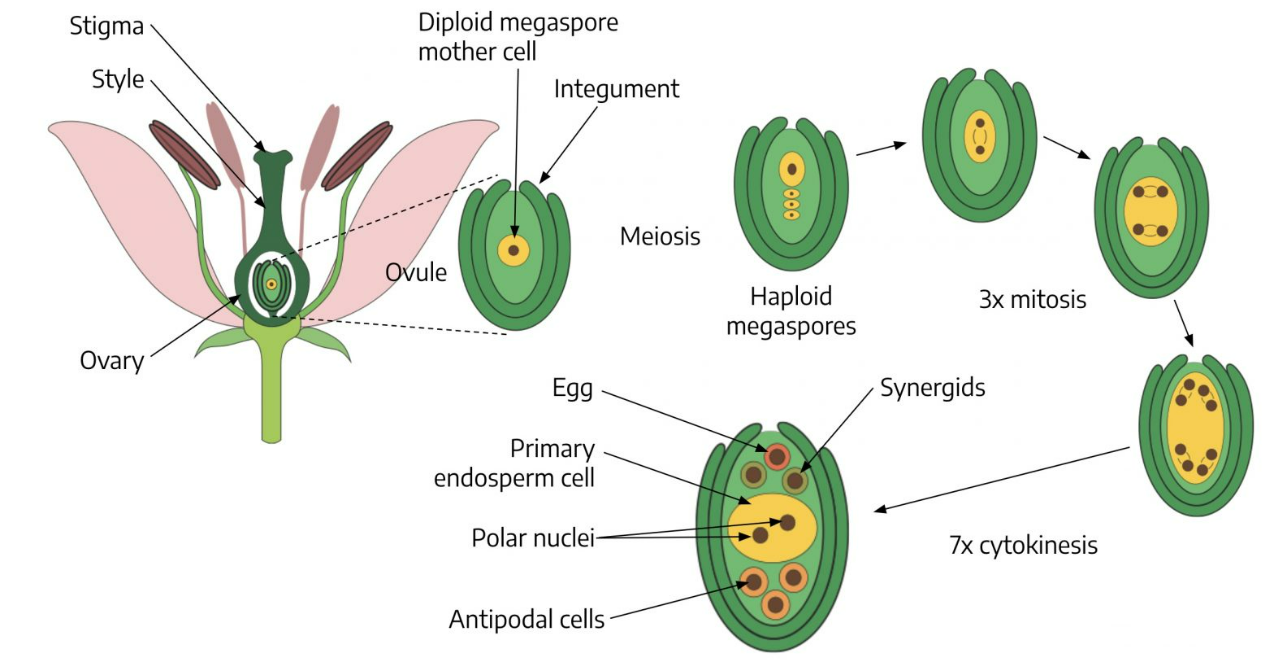
Occurs in ovule inside the ovary.
2. Process (Polygonum type, most common)
- Megaspore Mother Cell (MMC) in ovule undergoes meiosis → produces 4 haploid megaspores
- 3 megaspores degenerate → 1 functional megaspore remains
- Functional megaspore undergoes 3 successive mitotic divisions → forms 8 nuclei
- Arrangement of nuclei:
- 3 at micropylar end → egg apparatus (1 egg + 2 synergids)
- 3 at chalazal end → antipodal cells
- 2 in center → polar nuclei (fuse later → secondary nucleus)
- Cell wall formation around nuclei → mature embryo sac (female gametophyte)
3. Outcome
Female gametophyte = 7-celled, 8-nucleate embryo sac.
Ready for double fertilization:
- 1 sperm + egg → zygote
- 1 sperm + 2 polar nuclei → endosperm
📝 Summary Table: Male vs Female Gametophyte
| Feature | Male Gametophyte | Female Gametophyte |
|---|---|---|
| Site | Anther (microsporangia) | Ovule (megaspore) |
| Origin | Microspore mother cell | Megaspore mother cell |
| Division | Meiosis → microspores → mitosis | Meiosis → megaspores → mitosis |
| Cells | 2 sperm + 1 tube cell | 7 cells, 8 nuclei |
| Function | Fertilization (sperm delivery) | Egg cell + endosperm formation |
| Type | Haploid | Haploid |
🔑 Quick Recap
Male gametophyte = pollen grain → 2 sperm + tube cell
Female gametophyte = embryo sac → 7-celled, 8-nucleate
Male → anther; Female → ovule
Development involves meiosis + mitosis
Polygonum type = most common embryo sac
Double fertilization: 1 sperm + egg → zygote, 1 sperm + 2 polar nuclei → endosperm
Pollination in Flowering Plants
📌 Introduction
Pollination = transfer of pollen grains from anther (male) to stigma (female).
Essential for sexual reproduction in angiosperms.
Leads to fertilization once pollen reaches the ovule.
🌱 Types of Pollination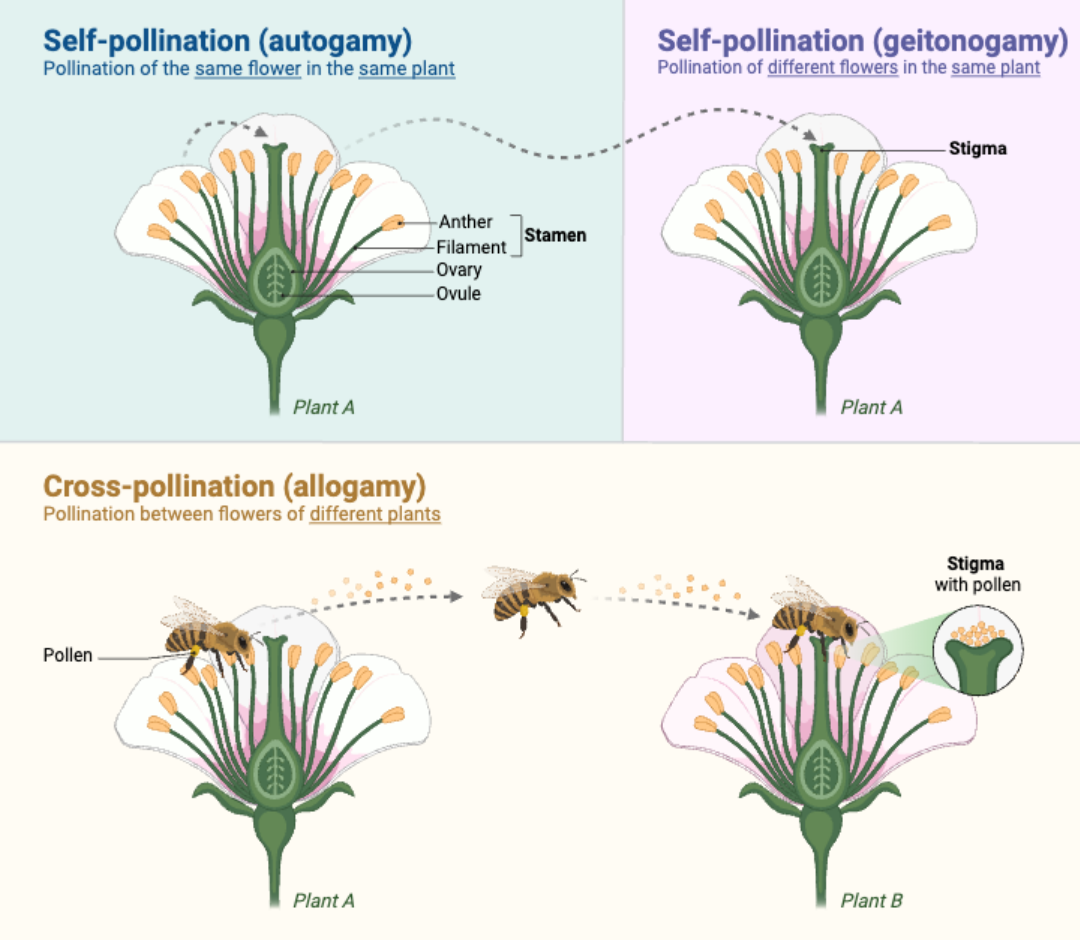
1. Self-Pollination (Autogamy)
- Pollen from anther lands on stigma of the same flower
- Characteristics:
- Usually cleistogamous flowers (never open)
- Ensures seed formation even without pollinators
- Examples: Pea (Pisum sativum), Wheat, Barley
2. Cross-Pollination (Allogamy)
- Pollen from anther of one flower lands on stigma of another flower of the same species
- Advantages: Increases genetic variability
- Examples: Hibiscus, Mustard, Sunflower
🌱 Agencies of Pollination
A. Abiotic Agents (Non-living)
- Wind (Anemophily)
- Pollen is light, dry, and smooth
- Flowers: small, inconspicuous, no nectar
- Examples: Maize, Wheat, Grass
- Water (Hydrophily)
- Pollen floats on water surface to reach stigma
- Mostly in aquatic plants
- Examples: Hydrilla, Zostera
B. Biotic Agents (Living)
- Insects (Entomophily)
- Flowers: bright, fragrant, nectar-producing
- Examples: Hibiscus, Mustard, Rose
- Birds (Ornithophily)
- Flowers: bright red/yellow, tubular, nectar-rich
- Examples: Hibiscus rosa-sinensis, Bauhinia
- Bats (Chiropterophily)
- Flowers: large, pale-colored, night-blooming, strong smell
- Examples: Cucumber, Banana
- Other animals (rare: mammals, lizards)
- Flowers usually ground-level, strong scent
📝 Summary Table: Types & Agencies of Pollination
| Type / Agent | Definition / Characteristics | Examples |
|---|---|---|
| Self-pollination | Pollen → same flower; Cleistogamous, no pollinators needed | Pea, Wheat |
| Cross-pollination | Pollen → different flower; Promotes variability | Hibiscus, Mustard |
| Wind | Abiotic; Light pollen, no nectar, small flowers | Maize, Wheat |
| Water | Abiotic; Pollen floats, aquatic flowers | Hydrilla, Zostera |
| Insects | Biotic; Bright, scented, nectar-producing | Mustard, Rose |
| Birds | Biotic; Bright red, tubular, nectar-rich | Hibiscus, Bauhinia |
| Bats | Biotic; Large, pale, night-blooming, strong smell | Banana, Cucumber |
🔑 Quick Recap
Pollination = transfer of pollen to stigma
Self-pollination (Autogamy) vs Cross-pollination (Allogamy)
Abiotic agents = Wind, Water
Biotic agents = Insects, Birds, Bats, others
Cross-pollination → increases genetic variability
Check flower adaptations for each pollination type
Pollen-Pistil Interaction
📌 Introduction
Pollen pistil interaction = series of events that occur after pollen lands on stigma and before fertilization.
Determines whether pollen germinates, grows, and reaches the ovule.
Ensures compatibility between male and female gametes.
🌱 Steps in Pollen Pistil Interaction
1. Pollen Adhesion
- Pollen grains stick to the stigma surface.

- Influenced by stigma type (dry or wet) and surface proteins/exudates.
- Example: Wet stigmas (Hibiscus) → pollen adheres easily
2. Pollen Germination
- Pollen absorbs water and nutrients from stigma.
- Tube cell elongates → forms pollen tube.
- Generative cell moves into pollen tube.
3. Pollen Tube Growth
- Tube grows through style toward ovule.
- Guided by chemical signals (chemotropism) and nutrients from style cells.
- Pollen tube contains tube cell cytoplasm + generative cell/2 sperm cells.
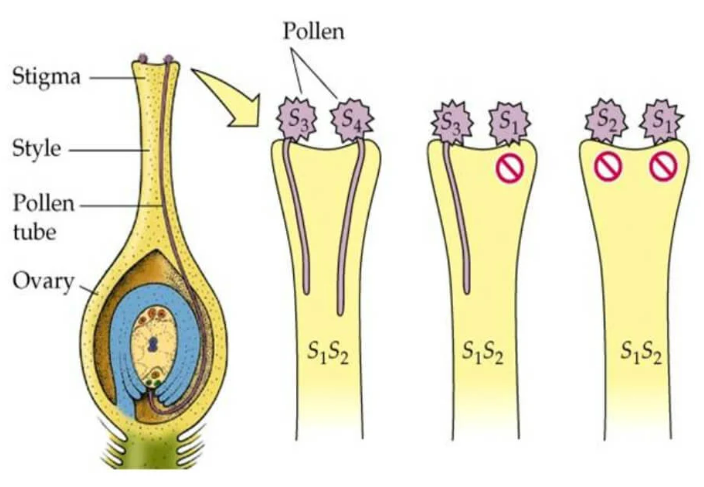
4. Pollen Recognition & Compatibility
- Self vs Non-self pollen recognition occurs.
- Self-incompatibility → pollen tube fails to grow if genetically similar.
- Prevents self-fertilization; ensures cross-pollination & genetic variation.
5. Entry into Ovule (Syngamy Readiness)
- Pollen tube enters ovule via micropyle.
- Releases 2 sperm cells:
- One fertilizes egg → zygote
- One fuses with polar nuclei → endosperm (double fertilization)
📝 Key Features
| Step | Event | Importance |
|---|---|---|
| Adhesion | Pollen sticks to stigma | Initiates interaction |
| Germination | Pollen tube formation | Allows sperm movement |
| Tube Growth | Guided to ovule | Ensures fertilization |
| Recognition | Self vs non-self | Prevents selfing |
| Entry & Release | Sperm enters ovule | Double fertilization occurs |
🔑 Quick Recap
Pollen–pistil interaction = sequence: adhesion → germination → tube growth → compatibility check → ovule entry.
Pollen tube carries sperm to ovule.
Self-incompatibility = stops self-fertilization.
Ensures successful double fertilization.
Double Fertilization (Angiosperms)
🌱 Introduction
Double fertilization is a special feature of flowering plants.
A single pollen tube brings two male gametes, and both take part in two separate fusion events inside the embryo sac.
Discovered by Nawaschin in Lilium and Fritillaria.
🌸 Stepwise Process of Double Fertilization
1. Entry of Pollen Tube
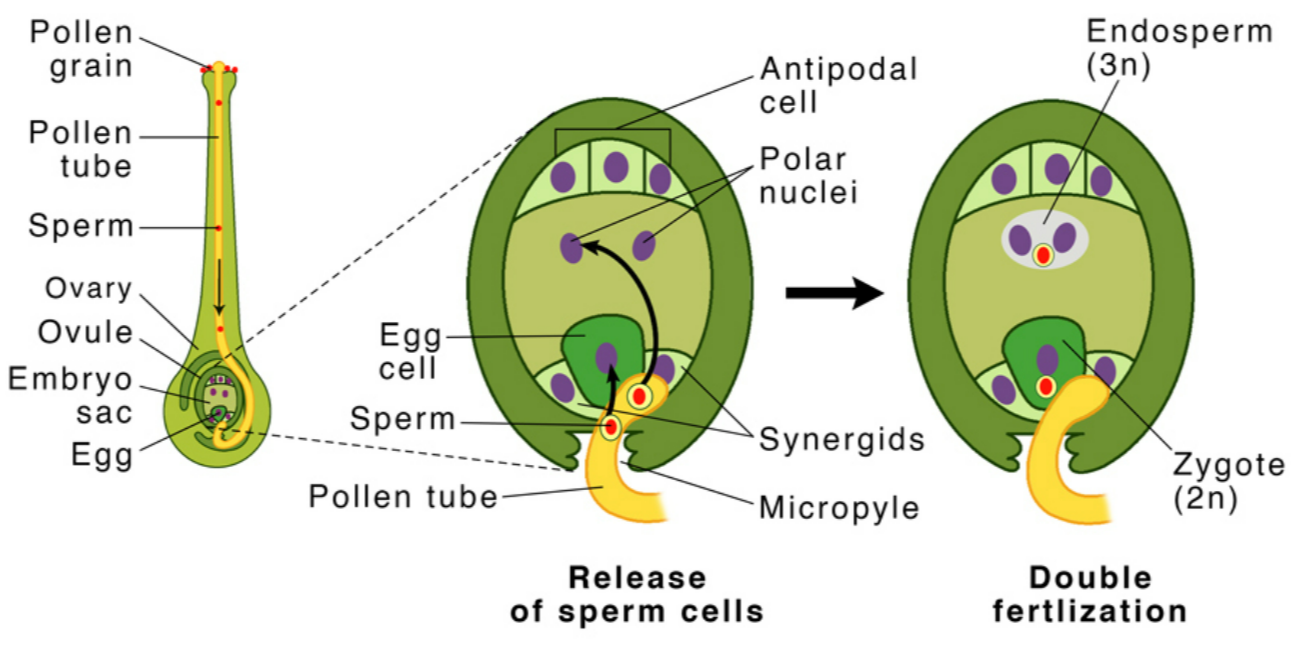
- Pollen tube enters ovule through micropyle.
- Reaches the embryo sac and enters through filiform apparatus of synergids.
- One synergid degenerates → creates space for male gametes.
2. Release of Two Male Gametes
- Pollen tube bursts and releases two non-motile male gametes into the embryo sac.
- These gametes are genetically different from female nuclei.
3. First Fusion: Syngamy
- One male gamete fuses with the egg cell.
- Forms zygote (2n).
- Zygote later develops into embryo.
- Syngamy = fertilization of the egg.
4. Second Fusion: Triple Fusion
- The other male gamete fuses with the two polar nuclei in the central cell.
- Forms Primary Endosperm Nucleus (PEN, 3n).
- This central cell becomes Primary Endosperm Cell → divides to form endosperm.
- Triple Fusion = male gamete + two polar nuclei.
5. Why Is It Called Double Fertilization?
- Because two fusion events occur using the two male gametes:
- Egg + male gamete → zygote
- Polar nuclei + male gamete → endosperm
🌾 Significance of Double Fertilization
- Endosperm forms only after fertilization → prevents wastage of resources.
- Ensures coordinated development of embryo and endosperm.
- Unique to angiosperms.
- Provides nutrition to the developing embryo.
- Confirms successful fertilization → leads to seed formation.
📊 Summary Table
| Event | Fusion | Product | Fate |
|---|---|---|---|
| Syngamy | Egg + male gamete | Zygote (2n) | Embryo |
| Triple Fusion | Polar nuclei + male gamete | PEN (3n) | Endosperm |
🔑 Quick Recap
Two male gametes → two fusions → Double Fertilization.
Syngamy = zygote (2n).
Triple fusion = endosperm (3n).
Endosperm nourishes embryo.
Unique and hallmark feature of angiosperms.
Post-Fertilization Events in Flowering Plants
📌 Introduction
Post-fertilization events begin after double fertilization in angiosperms.
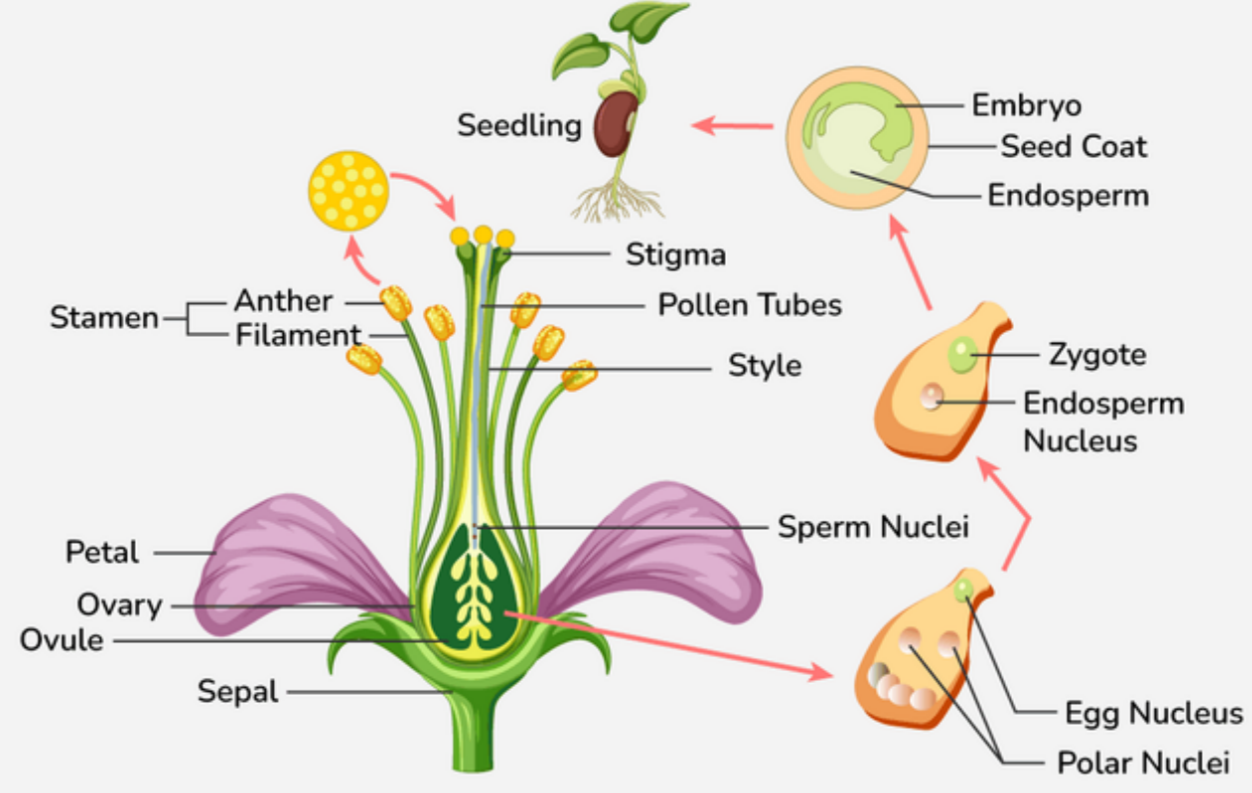
They involve development of zygote → embryo, primary endosperm nucleus → endosperm, ovule → seed, and ovary → fruit.
These steps ensure the plant produces viable seeds and disperses offspring.
🌸 1. Development of Endosperm
Endosperm develops from the primary endosperm nucleus (3n) formed by triple fusion.
| Type | Description | Example |
|---|---|---|
| Nuclear | Free-nuclear divisions → later cell walls form | Coconut, Ficus |
| Cellular | Cell walls form immediately after each nuclear division | Groundnut, Brinjal |
| Helobial | First division unequal → one chalazal cell (cellular) and one micropylar cell (nuclear) | Castor |
Function:
- Provides nutrition to the developing embryo.
- May be absorbed by cotyledons in dicots (e.g., Groundnut).
🌸 2. Development of Embryo
A. Zygote → Embryo
- Zygote divides by mitosis → proembryo.
- Suspensor forms → pushes embryo into endosperm.
- Embryo proper differentiates into radicle, plumule, and cotyledons.
B. Stages of Embryo Development
| Stage | Features | Example |
|---|---|---|
| Proembryo | Few cells; suspensor forms | – |
| Globular | Spherical embryo; cells undifferentiated | – |
| Heart-shaped | Cotyledons begin forming (dicots only) | Mustard, Pea |
| Torpedo | Cotyledons elongate; shoot & root meristems differentiate | – |
| Mature embryo | Fully formed radicle, plumule, cotyledons | Ready for seed dormancy |
C. Dicot vs Monocot Embryo
| Feature | Dicot | Monocot |
|---|---|---|
| Cotyledons | 2 | 1 |
| Shape | Heart → Torpedo | Linear / Scutellum |
| Nutrient Storage | Cotyledons absorb endosperm | Endosperm retained |
| Example | Mustard, Groundnut | Maize, Wheat |
🌸 3. Seed Formation
Ovule develops into a seed.
| Part of Seed | Origin | Function |
|---|---|---|
| Seed coat (Testa & Tegmen) | Integuments of ovule | Protect embryo |
| Embryo | Zygote | Forms new plant |
| Endosperm | Primary endosperm nucleus | Nutrition (may be absorbed by cotyledons) |
Types of Seeds based on Endosperm:
- Endospermic / Albuminous → Endosperm persists (e.g., Maize, Wheat).
- Non-endospermic / Exalbuminous → Cotyledons absorb endosperm (e.g., Groundnut, Mustard).
🌸 4. Fruit Formation
Ovary develops into fruit after fertilization. Other floral parts may also contribute → accessory fruits.
| Type | Origin | Examples |
|---|---|---|
| Simple | Single ovary | Mango, Pea |
| Aggregate | Many carpels of one flower | Guava, Strawberry |
| Multiple | Many flowers form one fruit | Pineapple, Ficus |
| Accessory | Other floral parts included | Apple |
Functions of Fruit:
- Protects seeds.
- Helps in seed dispersal by wind, water, and animals.
📝 Summary Table: Post-Fertilization Events
| Event | Process | Result / Significance |
|---|---|---|
| Endosperm development | Triple fusion → P.E.N → endosperm | Nutrition for embryo |
| Embryo development | Zygote → proembryo → globular → heart → torpedo → mature | Forms new plant |
| Seed formation | Ovule transforms | Contains embryo, endosperm, seed coat |
| Fruit formation | Ovary develops | Protects seeds; aids dispersal |
🔑 Quick Recap
Double fertilization → zygote + primary endosperm nucleus.
Endosperm = food for embryo; types: nuclear, cellular, helobial.
Embryo → radicle, plumule, cotyledons; dicot (2), monocot (1).
Seed = embryo + endosperm + seed coat.
Fruit = mature ovary; types: simple, aggregate, multiple, accessory.
Post-fertilization ensures viable seeds and successful dispersal.
Special Modes of Reproduction in Flowering Plants (Apomixis, Parthenocarpy, Polyembryony)
🌱 Introduction
Some flowering plants can reproduce without the usual process of fertilization.
These special modes help in seed formation, seedless fruit production, and even formation of multiple embryos in one seed.
They are extremely important in agriculture and plant breeding.
🌱 Apomixis
What is Apomixis?
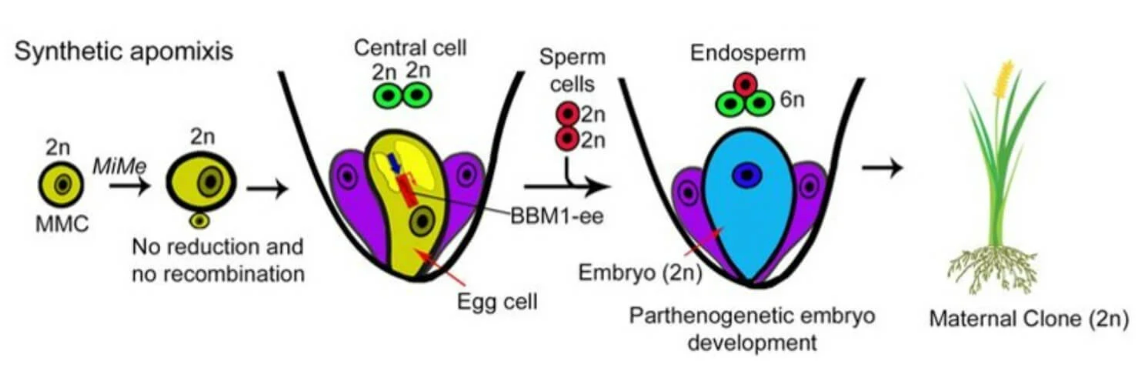
- Seeds form without fertilization
- Reproduction is asexual but resembles sexual reproduction
- Offspring are genetically identical clones
Types of Apomixis
1. Apospory
- Diploid embryo sac develops from nucellus or integuments
- No meiosis in megaspore mother cell
- Embryo forms without fertilization
- Example: Citrus, Hieracium
2. Diplospory
- Megaspore mother cell skips meiosis
- Directly forms diploid embryo sac
- Example: Taraxacum (dandelion)
3. Adventive Embryony (Nucellar Embryony)
- Embryos arise from nucellus or integuments
- Many embryos may form inside the same seed
- Example: Citrus, Mango
Importance of Apomixis (Exam favourite)
- Helps produce hybrid seeds without repeated crosses
- Preserves hybrid vigour for many generations
- Reduces seed production cost for farmers
🍏 Parthenocarpy
What is Parthenocarpy?
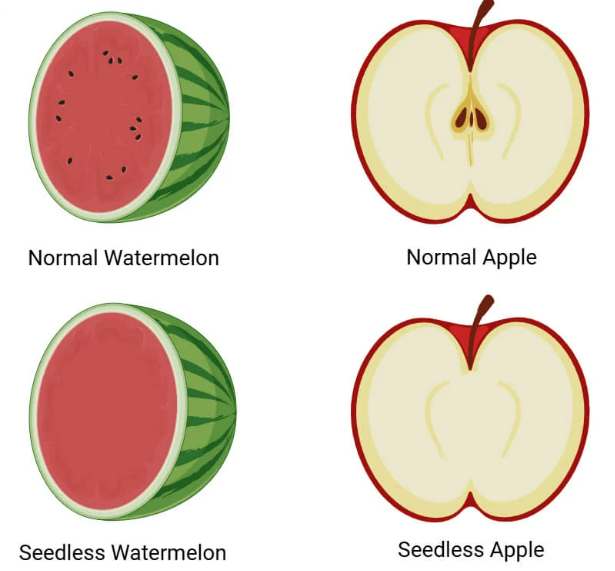
- Fruit develops without fertilization
- Fruit is seedless
Natural Parthenocarpy
- Occurs naturally
- Examples: Banana, some pineapples, some grapes
Induced Parthenocarpy
- Achieved using hormones like auxins and gibberellins
- Used widely in fruit industry
- Examples: Seedless watermelon, grapes, oranges
Importance of Parthenocarpy
- Produces seedless, more edible fruits
- High commercial value
🌱 Polyembryony
What is Polyembryony?
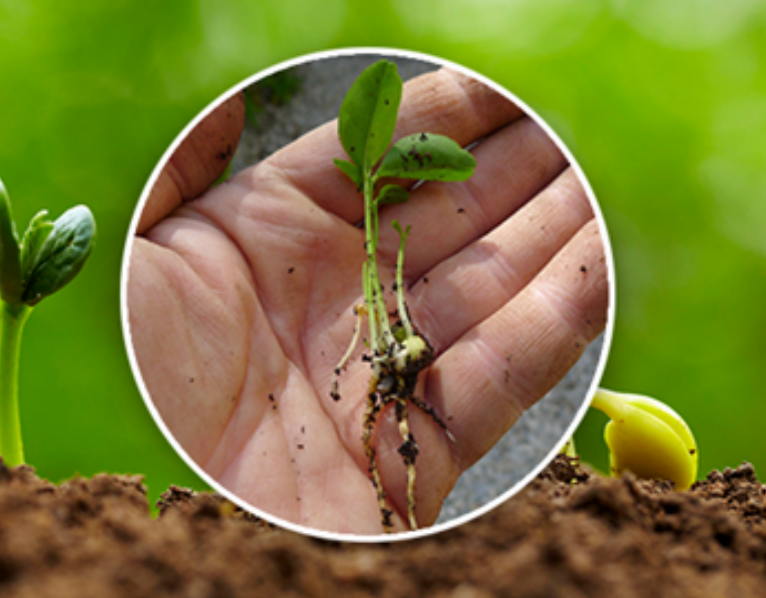
- More than one embryo forms in a single seed
Types of Polyembryony
1. Zygotic Polyembryony
- One zygote splits to form multiple embryos
2. Nucellar Polyembryony (Common)
- Extra embryos arise from nucellus
- Occurs along with normal zygotic embryo
- Examples: Citrus, Mango
3. Adventive Embryony
- Embryos originate from somatic tissues of ovule
Significance
- Many seedlings from one seed
- Maintains genetic uniformity (especially in Citrus)
- Useful in horticulture and breeding
📋 Summary Table
| Special Mode | Key Idea | Result | Example |
|---|---|---|---|
| Apomixis | Seed without fertilization | Clonal seeds | Citrus, Taraxacum |
| Parthenocarpy | Fruit without fertilization | Seedless fruits | Banana, Grapes |
| Polyembryony | Multiple embryos in one seed | Many seedlings | Citrus, Mango |
🔑 Quick Recap
Apomixis → Seeds without fertilization, preserves hybrid vigour
Parthenocarpy → Fruits without fertilization, produces seedless fruits
Polyembryony → Many embryos in one seed, common in Citrus and Mango