Home / tb-21-ap-precalculus-test-review-and-practice-questions

Question 1

In the \(xy\)-plane, two different angles \(\alpha\) and \(\beta\) are in standard position and share a terminal ray. Based on this information, which of the following gives possible values for \(\alpha\) and \(\beta\)?
(A) \(\alpha = -\frac{\pi}{4}\) and \(\beta = -\frac{7\pi}{4}\)
(B) \(\alpha = \frac{3\pi}{5}\) and \(\beta = -\frac{3\pi}{5}\)
(C) \(\alpha = \frac{2\pi}{3}\) and \(\beta = \frac{8\pi}{3}\)
(D) \(\alpha = \frac{5\pi}{6}\) and \(\beta = -\frac{\pi}{6}\)
▶️ Answer/Explanation
Detailed solution

Angles in standard position that share a terminal ray are called coterminal angles.
For two angles to be coterminal, their difference must be an integer multiple of a full rotation, \(2\pi\).
Let’s check the difference for option (C): \(\beta – \alpha = \frac{8\pi}{3} – \frac{2\pi}{3}\).
Subtracting the numerators gives \(\frac{6\pi}{3}\).
Simplifying the fraction results in \(2\pi\).
Since the difference is exactly \(2\pi\), the angles end at the same position.
Therefore, \(\alpha\) and \(\beta\) share a terminal ray.

Question 2

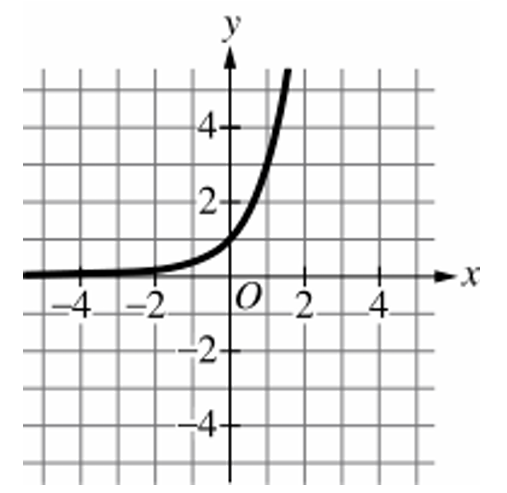
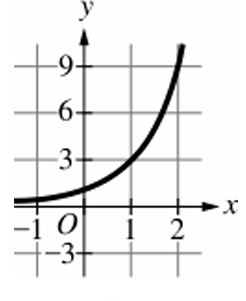
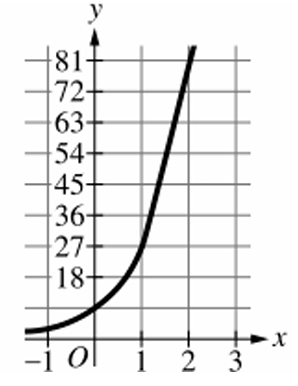
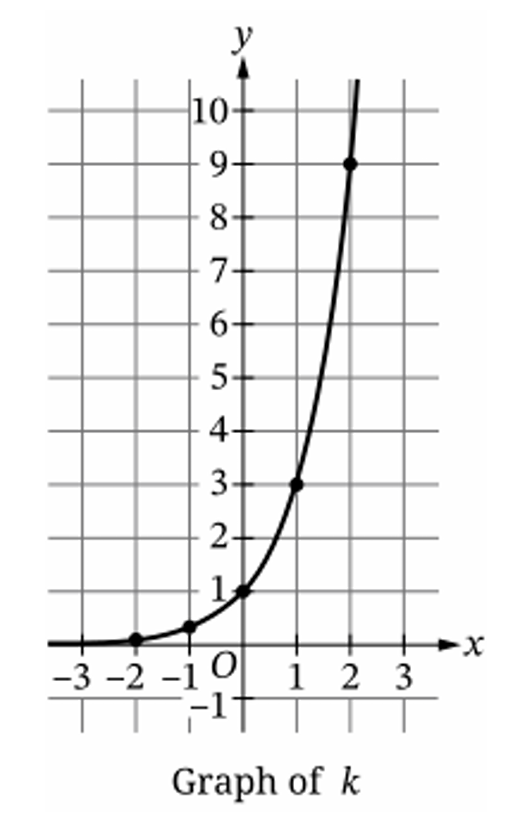
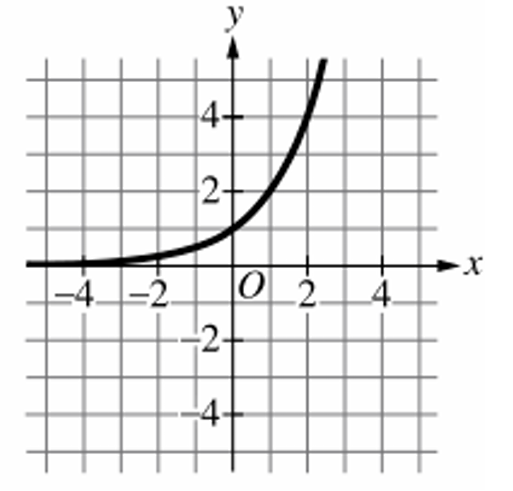
The figure shows the graph of an exponential function \(k\), where \(k(x) = b^x\) for \(b > 0\) and \(b \neq 1\). Consider the logarithmic function \(h\) (not shown) given by \(h(x) = \log_b x\). Of the following pairs of points, which are on the graph of \(h\)?
(A) \((-3, -1)\) and \((-9, -2)\)
(B) \((1, \frac{1}{3})\) and \((2, \frac{1}{9})\)
(C) \((1, 3)\) and \((2, 9)\)
(D) \((3, 1)\) and \((9, 2)\)
▶️ Answer/Explanation
Detailed solution

The correct option is (D).

1. First, identify the base \(b\) using a clear point on the graph of \(k(x)\). The graph passes through the point \((1, 3)\).
2. Substitute these coordinates into the exponential equation \(y = b^x\): \(3 = b^1\), which implies \(b = 3\).
3. The logarithmic function \(h(x) = \log_b x\) is the inverse of the exponential function \(k(x) = b^x\).
4. Since they are inverse functions, if a point \((x, y)\) lies on the graph of \(k\), then the point \((y, x)\) must lie on the graph of \(h\).
5. From the graph of \(k\), we can identify the points \((1, 3)\) and \((2, 9)\) because \(3^1 = 3\) and \(3^2 = 9\).
6. Swapping the coordinates for the inverse function \(h\), the corresponding points are \((3, 1)\) and \((9, 2)\).
7. Checking option (D): \(h(3) = \log_3(3) = 1\) and \(h(9) = \log_3(9) = 2\). These matches the points derived.
Question 3 (Calc allowed)

The function \( f \) is given by \( f(x) = 4 \cdot 3^{(x-2)} + 1 \). The function \( g \) is given by \( g(x) = f^{-1}(x) \). For which of the following values does \( g(x) = -3x \)?
(A) \( -0.426 \)
(B) \( 1.016 \)
(C) \( 1.025 \)
(D) \( 1.444 \)
▶️ Answer/Explanation
Detailed solution

The relationship \( g(x) = f^{-1}(x) \) implies that \( f(g(x)) = x \).
Substituting the given condition \( g(x) = -3x \) into this relationship, we get \( f(-3x) = x \).
Using the definition of \( f \), the equation becomes \( 4 \cdot 3^{(-3x – 2)} + 1 = x \).
Since \( 4 \cdot 3^{(-3x – 2)} \) is always positive, \( x \) must be greater than \( 1 \), eliminating option (A).
Testing option (B) with \( x = 1.016 \): \( 4 \cdot 3^{(-3(1.016) – 2)} + 1 = 4 \cdot 3^{-5.048} + 1 \).
Calculating the value: \( 4 \cdot (0.0039) + 1 \approx 1.0156 \), which is approximately \( 1.016 \).
Thus, the correct value is (B) 1.016.

Question 4

The functions \( f \) and \( g \) are given by \( f(x) = 4^{(5x-1)} \) and \( g(x) = 8^{(x/4)} \). When solving the equation \( f(x) = g(x) \), the functions can be rewritten in equivalent forms so that the equation can be solved without the use of technology. Which of the following are equivalent definitions of \( f \) and \( g \) that aid in solving \( f(x) = g(x) \) without the use of technology?
(A) \( f(x) = 2^{(\log_2 4 \cdot (5x-1))} \) and \( g(x) = 2^{(\log_2 8 \cdot (x/4))} \)
(B) \( f(x) = 2^{(\log_2 8 \cdot (5x-1))} \) and \( g(x) = 2^{(\log_2 4 \cdot (x/4))} \)
(C) \( f(x) = 4^{(\log_2 4 \cdot (5x-1))} \) and \( g(x) = 8^{(\log_2 8 \cdot (x/4))} \)
(D) \( f(x) = 2 \cdot 4^{(\log_2 4 \cdot (5x-1))} \) and \( g(x) = 8^{(\log_2 8 \cdot (x/4))} \)
▶️ Answer/Explanation
Detailed solution

The correct answer is (A). To solve the equation without technology, we must rewrite the functions using a common base. Both 4 and 8 are powers of 2.

1. Identify the common base: Since \( 4 = 2^2 \) and \( 8 = 2^3 \), we use base 2.
2. Rewrite base 4 using logarithms: \( 4 = 2^{\log_2 4} \).
3. Substitute into \( f(x) \) using the power rule \( (a^b)^c = a^{b \cdot c} \): \( f(x) = (2^{\log_2 4})^{(5x-1)} = 2^{(\log_2 4 \cdot (5x-1))} \).
4. Rewrite base 8 using logarithms: \( 8 = 2^{\log_2 8} \).
5. Substitute into \( g(x) \): \( g(x) = (2^{\log_2 8})^{(x/4)} = 2^{(\log_2 8 \cdot (x/4))} \).
6. This effectively sets up the equation \( 2^{2(5x-1)} = 2^{3(x/4)} \) for easy solving.

Question 5

The function $f$ is given by $f(x) = 4 \cdot 2^{(x-3)}$. If the function $g$ is the inverse of $f$, which of the following could define $g(x)$?
(A) $\log_{8} x + 3$
(B) $\log_{2}(4x) + 3$
(C) $\log_{2}\left(\frac{x}{4}\right) + 3$
(D) $\log_{2}\left(\frac{x-3}{4}\right)$
▶️ Answer/Explanation
Detailed solution

Set $y = 4 \cdot 2^{(x-3)}$ to represent the original function.
To find the inverse, swap $x$ and $y$: $x = 4 \cdot 2^{(y-3)}$.
Divide both sides by $4$: $\frac{x}{4} = 2^{(y-3)}$.
Convert the exponential equation to logarithmic form: $\log_{2}\left(\frac{x}{4}\right) = y – 3$.
Solve for $y$ by adding $3$ to both sides: $y = \log_{2}\left(\frac{x}{4}\right) + 3$.
Therefore, $g(x) = \log_{2}\left(\frac{x}{4}\right) + 3$.
The correct option is (C).

Question 6

The function $h$ is given by $h(x) = 8 \cdot 2^{x}$. For which of the following values of $x$ is $h(x) = 256$ ?
(A) $x = 2$
(B) $x = 5$
(C) $x = 8$
(D) $x = 16$
▶️ Answer/Explanation
Detailed solution

Set the function equal to the target value: $8 \cdot 2^{x} = 256$.
Divide both sides by $8$ to isolate the exponential term: $2^{x} = \frac{256}{8}$.
Simplify the division: $2^{x} = 32$.
Express $32$ as a power of $2$: $32 = 2^{5}$.
Equate the exponents since the bases are the same: $x = 5$.
Therefore, the correct option is (B).

Question 7 (Calc allowed)

The function $S$ is given by $S(t) = \frac{500,000}{1 + 0.4e^{kt}}$, where $k$ is a constant. If $S(4) = 300,000$, what is the value of $S(12)$?
(A) $175,325$
(B) $214,772$
(C) $343,764$
(D) $357,143$
▶️ Answer/Explanation
Detailed solution

Set up the equation $S(4) = 300,000$: $\frac{500,000}{1 + 0.4e^{4k}} = 300,000$.
Simplify to find $e^{4k}$: $1 + 0.4e^{4k} = \frac{500,000}{300,000} = \frac{5}{3}$.
Solve for the exponential term: $0.4e^{4k} = \frac{5}{3} – 1 = \frac{2}{3}$, so $e^{4k} = \frac{2/3}{0.4} = \frac{5}{3}$.
Express the target value $S(12)$ using $e^{4k}$: $S(12) = \frac{500,000}{1 + 0.4(e^{4k})^3}$.
Substitute $e^{4k} = \frac{5}{3}$ into the expression: $S(12) = \frac{500,000}{1 + 0.4(\frac{5}{3})^3}$.
Calculate the denominator: $1 + 0.4(\frac{125}{27}) = 1 + \frac{50}{27} = \frac{77}{27}$.
Final calculation: $S(12) = \frac{500,000 \times 27}{77} \approx 175,324.67$.
The correct option is (A).

Question 8

Consider the functions $g$ and $h$ given by $g(x) = 4^{x}$ and $h(x) = 16^{x+2}$. In the $xy$-plane, what is the $x$-coordinate of the point of intersection of the graphs of $g$ and $h$?
(A) $-4$
(B) $-2$
(C) $0$
(D) $2$
▶️ Answer/Explanation
Detailed solution

To find the intersection, set the functions equal: $g(x) = h(x)$.
Substitute the expressions: $4^{x} = 16^{x+2}$.
Rewrite $16$ as a power of $4$: $4^{x} = (4^{2})^{x+2}$.
Apply the power of a power rule: $4^{x} = 4^{2(x+2)}$.
Set the exponents equal to each other: $x = 2(x+2)$.
Distribute the $2$: $x = 2x + 4$.
Subtract $2x$ from both sides: $-x = 4$.
Solve for $x$: $x = -4$.
The correct option is (A).

Question 9

A data set that appears exponential is modeled by the function $k$ given by $k(t) = 7 \cdot 5^t$. The data are represented using a semi-log plot, where the vertical axis is logarithmically scaled with the natural logarithm. Which of the following could describe the appearance of the data in the semi-log plot?
(A) The data appear linear with a slope of $5$.
(B) The data appear linear with a slope of $\ln 5$.
(C) The data appear as an exponential curve that is concave up.
(D) The data appear as an exponential curve that is concave down.
▶️ Answer/Explanation
Detailed solution

The correct option is (B).
In a semi-log plot with a natural log scale, we transform the output as $y = \ln(k(t))$.
Substituting the given function: $y = \ln(7 \cdot 5^t)$.
Using log properties, this expands to $y = \ln 7 + \ln(5^t)$.
Applying the power rule: $y = \ln 7 + t \cdot \ln 5$.
This matches the linear form $y = mx + b$, where the variable is $t$.
The slope $m$ of this linear relationship is $\ln 5$.

Question 10

The function $f$ is given by $f(t) = e^{t}$, and the function $g$ is given by $g(t) = 7 \ln t$. If the function $h$ is given by $h(t) = (f \circ g)(t)$, which of the following is an expression for $h(t)$, for $t > 0$?
(A) $7t$
(B) $t^{7}$
(C) $te^{7}$
(D) $7^{t}$
▶️ Answer/Explanation
Detailed solution

The composition is defined as $h(t) = f(g(t))$.
Substitute $g(t) = 7 \ln t$ into $f(t)$, resulting in $h(t) = e^{7 \ln t}$.
Apply the power rule for logarithms: $7 \ln t = \ln(t^{7})$.
The expression becomes $h(t) = e^{\ln(t^{7})}$.
Using the identity $e^{\ln x} = x$, the expression simplifies to $t^{7}$.
Therefore, the correct expression for $h(t)$ is $t^{7}$.
The correct option is (B).

Question 11

Both nonzero functions $f$ and $g$ are invertible. The input values of $f$ are times, in hours, and the output values of $f$ are rates, in miles per hour. The input values of $g$ are rates, in miles per hour, and the output values of $g$ are costs, in dollars. For which of the following are the input values costs, in dollars, and the output values times, in hours?
(A) $y = f(g(x))$
(B) $y = g^{-1}(f^{-1}(x))$
(C) $y = f^{-1}(g^{-1}(x))$
(D) $y = g(f(x))$
▶️ Answer/Explanation
Detailed solution

For function $f$, the mapping is $\text{hours} \rightarrow \text{miles per hour}$.
For function $g$, the mapping is $\text{miles per hour} \rightarrow \text{dollars}$.
The inverse $g^{-1}$ reverses its mapping to $\text{dollars} \rightarrow \text{miles per hour}$.
The inverse $f^{-1}$ reverses its mapping to $\text{miles per hour} \rightarrow \text{hours}$.
To start with dollars, $g^{-1}(x)$ must be the inner function.
The output of $g^{-1}$ matches the required input for $f^{-1}$.
Thus, $y = f^{-1}(g^{-1}(x))$ maps dollars to hours.
The correct option is (C).

Question 12 (Calc allowed)

Two function models $k$ and $m$ are constructed to represent the sales of a product at a group of grocery stores. Both $k(t)$ and $m(t)$ represent the sales of the product, in thousands of units, after $t$ weeks for $t \geq 2$. If $k(t) = 14 – 2.885 \ln t$ and $m(t) = -t + 14$, what is the first time $t$ that sales predicted by the logarithmic model will be $0.1$ thousand units more than sales predicted by the linear model?
(A) $t = 6.318$
(B) $t = 4.324$
(C) $t = 3.577$
(D) $t = 2.289$
▶️ Answer/Explanation
Detailed solution

Set up the equation where the logarithmic model exceeds the linear model by $0.1$: $k(t) = m(t) + 0.1$.
Substitute the given functions: $14 – 2.885 \ln t = (-t + 14) + 0.1$.
Simplify the equation to: $-2.885 \ln t = -t + 0.1$.
Rearrange to form the function: $f(t) = t – 2.885 \ln t – 0.1 = 0$.
Use a graphing calculator to find the intersection of $y = 14 – 2.885 \ln t$ and $y = -t + 14.1$.
The first intersection point for $t \geq 2$ occurs at $t \approx 2.289$.
Thus, the correct option is (D).

Question 13

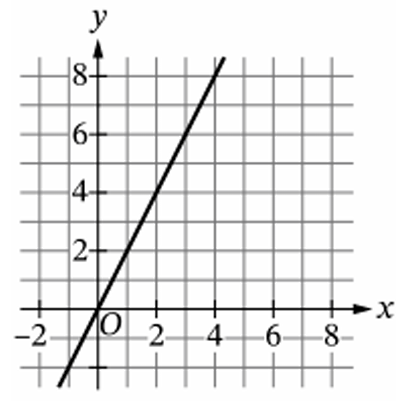
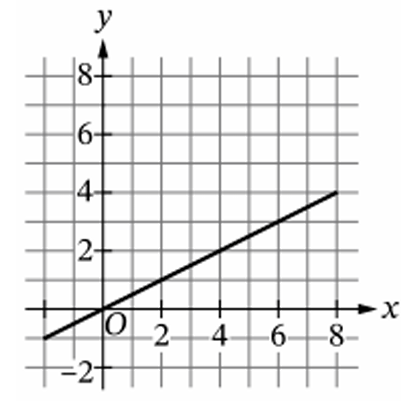
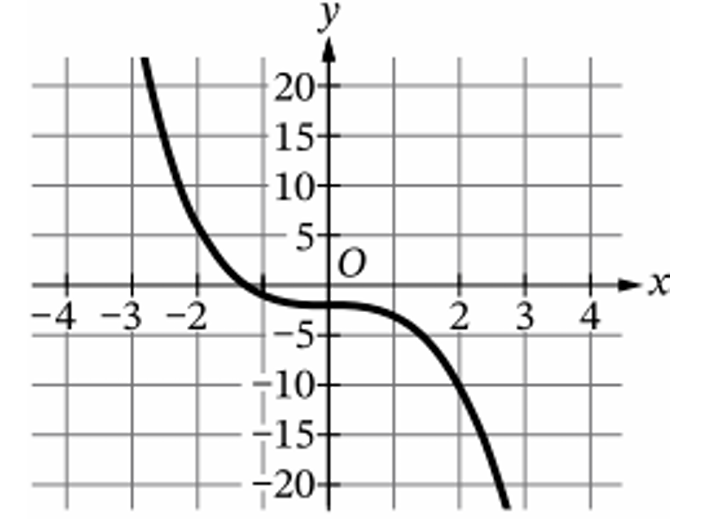
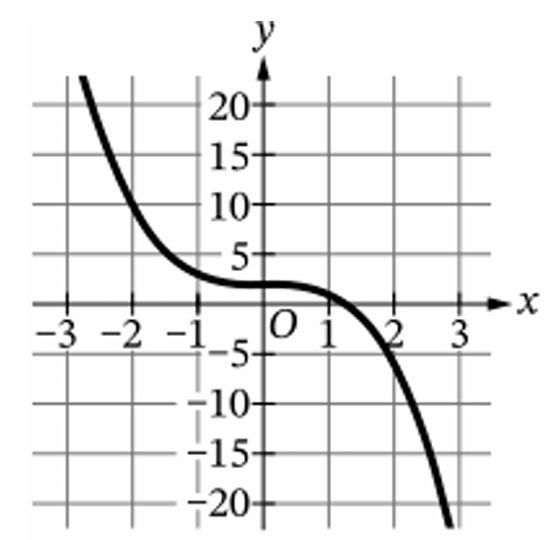
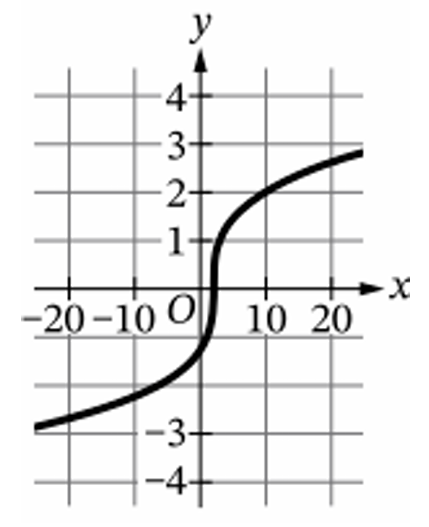
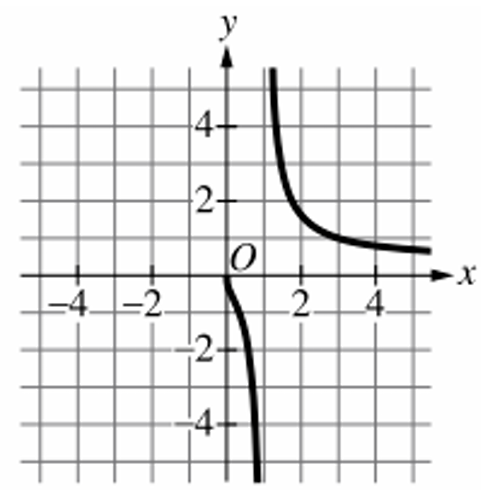
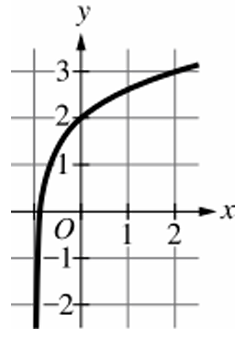
The function $g$ has the property that for each time the input values double, the output values increase by $1$. Which of the following could be the graph of $y = g(x)$ in the $xy$-plane?
(A)
(B)
(C)
(D)
▶️ Answer/Explanation
Detailed solution

The given property $g(2x) = g(x) + 1$ defines a logarithmic function base $2$.
In graph (B), when the input $x$ is $1$, the output $y$ is $0$.
Doubling the input to $x = 2$ results in an output of $y = 1$ (an increase of $1$).
Doubling the input again to $x = 4$ results in an output of $y = 2$ (an increase of $1$).
Doubling the input once more to $x = 8$ results in an output of $y = 3$ (an increase of $1$).
This constant arithmetic increase for a geometric change in input is unique to logarithmic curves.
Graphs (C) and (D) are linear, where output increases by a constant amount for a constant addition to the input.
Graph (A) is exponential, which is the inverse relationship where input increases by $1$ as output doubles.
The correct choice is (B).
Question 14

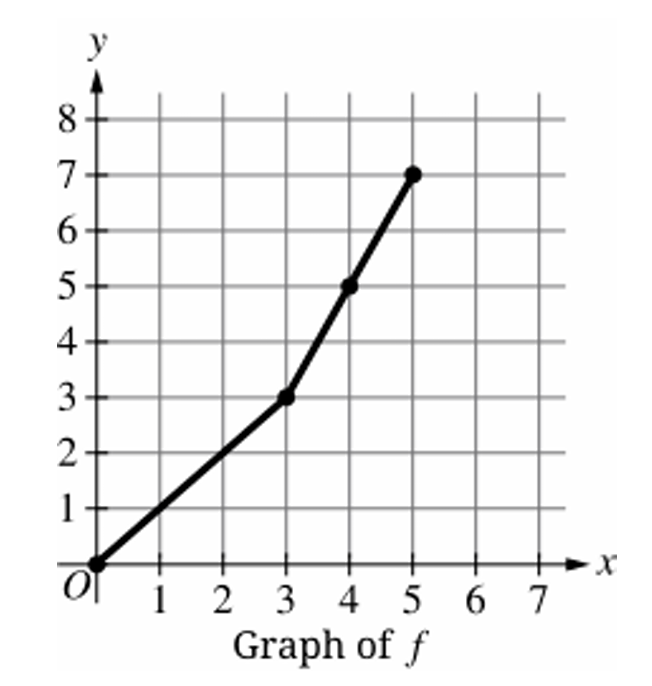
The graph of the piecewise-linear function $f$ is shown in the figure. Let $g$ be the inverse function of $f$. What is the maximum value of $g$?
(A) $\frac{1}{7}$
(B) $\frac{1}{5}$
(C) $5$
(D) $7$
▶️ Answer/Explanation
Detailed solution

The function $g$ is defined as the inverse of $f$, meaning $g = f^{-1}$.
By the property of inverse functions, the range of $f$ becomes the domain of $g$.
Similarly, the domain of $f$ becomes the range of $g$.
The maximum value of $g$ is the maximum value in its range, which is the maximum $x$-value of $f$.
Looking at the provided graph, the function $f$ is defined on the interval $x \in [0, 5]$.
The largest $x$-coordinate reached by the graph of $f$ is $5$.
Therefore, the maximum value of the inverse function $g$ is $5$.
The correct option is (C).
Question 15

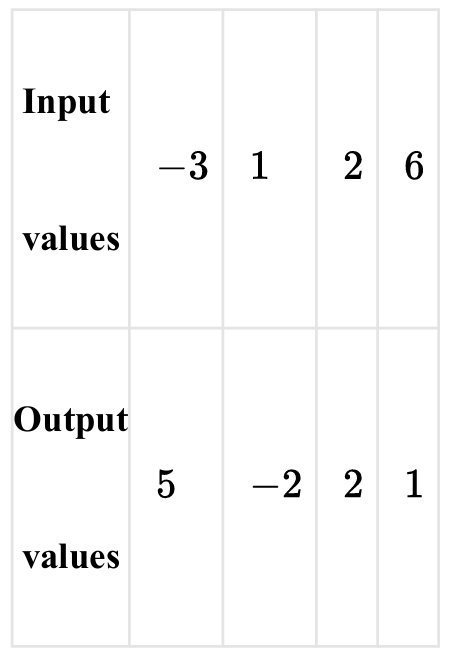
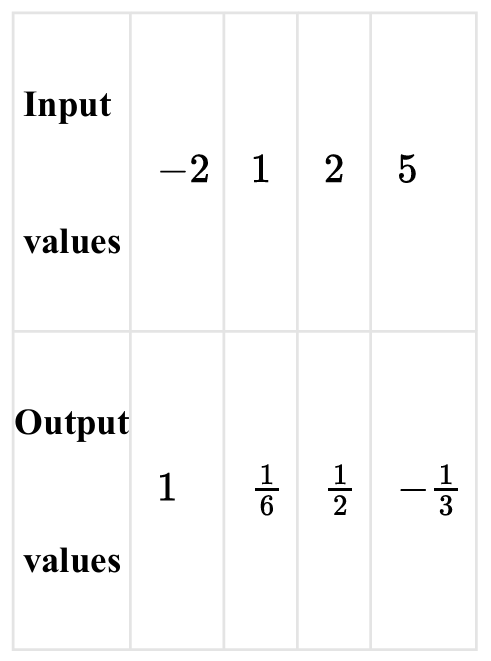
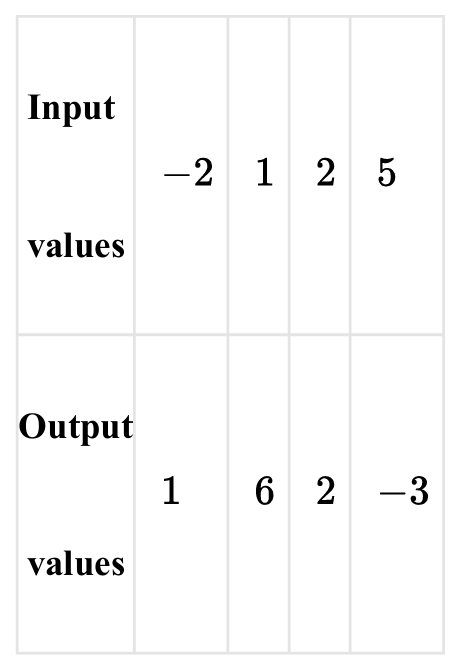
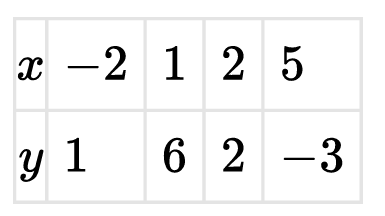
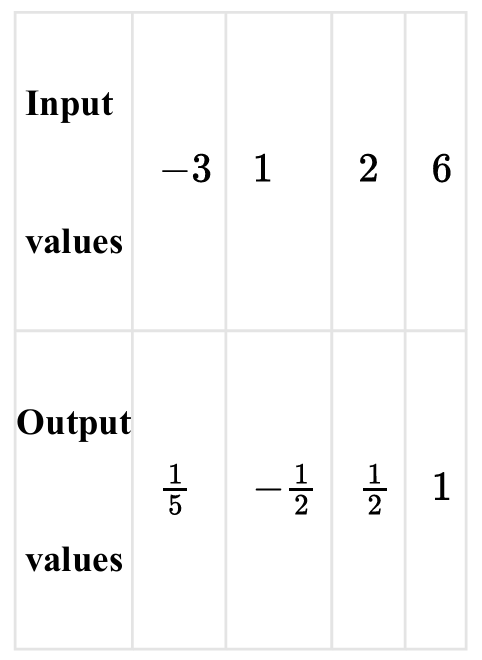
The table gives values for the invertible function $y = f(x)$ for selected values of $x$. Which of the following input-output pairs describes $f^{-1}$?

(A)

(B)

(C)

(D)

▶️ Answer/Explanation
Detailed solution

The inverse function $f^{-1}$ swaps the inputs and outputs of the original function $f$.
From the table, the original pairs $(x, y)$ are $(-2, 1)$, $(1, 6)$, $(2, 2)$, and $(5, -3)$.
The inverse pairs $(y, x)$ must be $(1, -2)$, $(6, 1)$, $(2, 2)$, and $(-3, 5)$.
Sorting these by input value, we get: $(-3, 5)$, $(1, -2)$, $(2, 2)$, and $(6, 1)$.
Option (B) lists these input values $\{-3, 1, 2, 6\}$ with corresponding outputs $\{5, -2, 2, 1\}$.
Therefore, (B) is the correct description of the inverse function $f^{-1}$.
Question 16

The function $f$ is defined by $f(x) = \sqrt{4 – x^2}$ for $-2 \le x \le 0$. Which of the following expressions defines $f^{-1}(x)$?
(A) $-\sqrt{4 – x^2}$ for $-2 \le x \le 0$
(B) $\sqrt{4 – x^2}$ for $-2 \le x \le 0$
(C) $-\sqrt{4 – x^2}$ for $0 \le x \le 2$
(D) $\sqrt{4 – x^2}$ for $0 \le x \le 2$
▶️ Answer/Explanation
Detailed solution

Let $y = \sqrt{4 – x^2}$. Since $-2 \le x \le 0$, the range of $f(x)$ is $0 \le y \le 2$.
The domain of $f^{-1}(x)$ is the range of $f(x)$, which is $0 \le x \le 2$.
To find the inverse, swap $x$ and $y$: $x = \sqrt{4 – y^2}$.
Square both sides: $x^2 = 4 – y^2$, which simplifies to $y^2 = 4 – x^2$.
Solving for $y$, we get $y = \pm\sqrt{4 – x^2}$.
Since the original domain was $x \le 0$, the inverse must satisfy $y \le 0$.
Therefore, $f^{-1}(x) = -\sqrt{4 – x^2}$ for $0 \le x \le 2$.
The correct option is (C).

Question 17

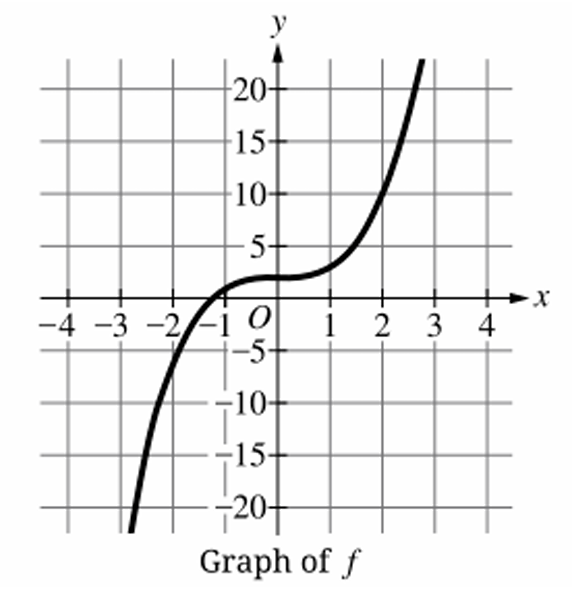
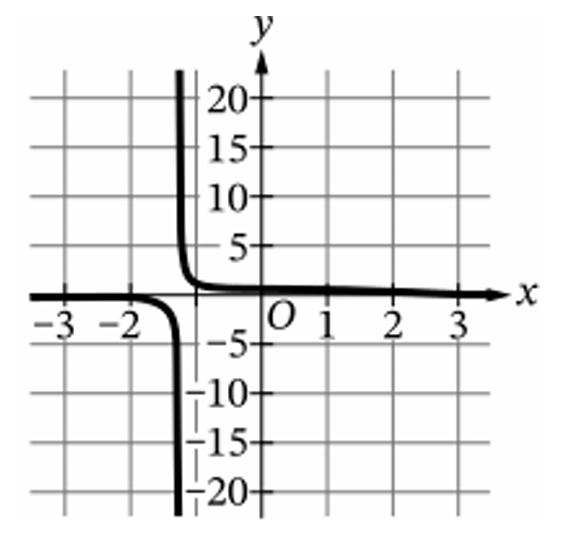
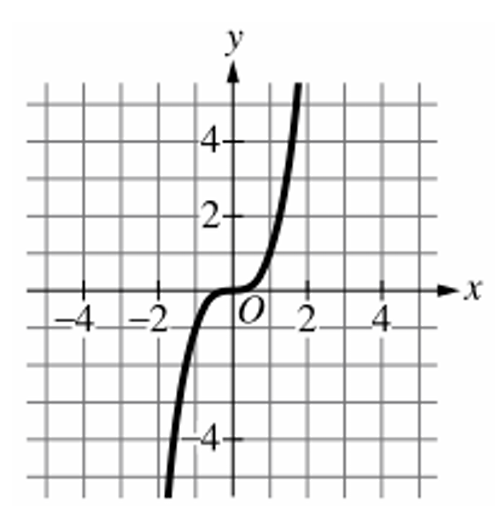
The graph of the function $y = f(x)$ is given. Which of the following is the graph of $y = f^{-1}(x)$?
(A)
(B)
(C)
(D)
▶️ Answer/Explanation
Detailed solution

The correct option is (D).
Identify key points on the graph of $y = f(x)$, such as $(-2, -10)$, $(0, 2)$, and $(2, 10)$.
For the inverse function $y = f^{-1}(x)$, the $x$ and $y$ coordinates are swapped.
The corresponding points on $f^{-1}(x)$ must be $(-10, -2)$, $(2, 0)$, and $(10, 2)$.
Graphically, $f^{-1}(x)$ is the reflection of $f(x)$ across the line $y = x$.
Option (D) is the only graph that contains these swapped points and reflects the original shape.
Notice the $x$-axis scale in (D) extends to $\pm 20$, matching the original $y$-axis range.
Question 18

The function $g$ is given by $g(x) = \frac{4x+6}{5}$. Which of the following defines $g^{-1}(x)$?
(A) $\frac{5}{4x+6}$
(B) $\frac{5x+6}{4}$
(C) $\frac{5x}{4} – 6$
(D) $\frac{5x-6}{4}$
▶️ Answer/Explanation
Detailed solution

Set the function $y = \frac{4x+6}{5}$.
Swap the variables $x$ and $y$ to get $x = \frac{4y+6}{5}$.
Multiply both sides by $5$ to obtain $5x = 4y + 6$.
Subtract $6$ from both sides: $5x – 6 = 4y$.
Divide by $4$ to solve for $y$: $y = \frac{5x-6}{4}$.
Therefore, $g^{-1}(x) = \frac{5x-6}{4}$, which matches option (D).

Question 19

The function $f$ is defined by $f(x) = 4x^2 + 3$ for $x \geq 0$. Which of the following expressions defines the inverse function of $f$?
(A) $f^{-1}(x) = \frac{x^2}{4} – 3$ for $x \geq 0$
(B) $f^{-1}(x) = \sqrt{\frac{x}{4} – 3}$ for $x \geq 0$
(C) $f^{-1}(x) = \sqrt{\frac{x-3}{4}}$ for $x \geq 3$
(D) $f^{-1}(x) = \frac{\sqrt{x-3}}{4}$ for $x \geq 3$
▶️ Answer/Explanation
Detailed solution

Set $y = 4x^2 + 3$ and solve for $x$ to find the inverse.
Subtract $3$ from both sides: $y – 3 = 4x^2$.
Divide both sides by $4$: $\frac{y-3}{4} = x^2$.
Take the square root of both sides: $x = \sqrt{\frac{y-3}{4}}$ (since $x \geq 0$).
Swap $x$ and $y$: $f^{-1}(x) = \sqrt{\frac{x-3}{4}}$.
The range of $f(x)$ is $y \geq 3$, so the domain of $f^{-1}(x)$ is $x \geq 3$.
Therefore, the correct choice is (C).

Question 20

A water tank is leaking water from a crack in its base. The amount of water, in hundreds of gallons, remaining in the tank $t$ hours after the crack formed can be modeled by $W$, a decreasing function of time $t$. Which of the following gives a verbal representation of the function $W^{-1}$, the inverse function of $W$?
(A) $W^{-1}$ is an increasing function of the amount of time after the crack formed.
(B) $W^{-1}$ is a decreasing function of the amount of time after the crack formed.
(C) $W^{-1}$ is an increasing function of the amount of water in the tank.
(D) $W^{-1}$ is a decreasing function of the amount of water in the tank.
▶️ Answer/Explanation
Detailed solution

The original function $W$ maps time $t$ to the amount of water $w$.
The inverse function $W^{-1}$ maps the amount of water $w$ back to time $t$.
Since $W$ is a decreasing function, as $t$ increases, $w$ decreases.
For any monotonic function, the inverse function $W^{-1}$ shares the same monotonicity as the original function.
Therefore, $W^{-1}$ must also be a decreasing function.
As the input of $W^{-1}$ is the “amount of water,” the correct description is that it is a decreasing function of the amount of water.
Thus, the correct option is (D).

Question 21

The function $f$ is given by $f(x) = \log_2(\log_3 x)$. Which of the following is an expression for $f^{-1}(x)$ ?
(A) $2^{(3^x)}$
(B) $3^{(2^x)}$
(C) $2 \cdot 3^x$
(D) $3 \cdot 2^x$
▶️ Answer/Explanation
Detailed solution

Set $y = \log_2(\log_3 x)$ to begin the inversion process.
Apply the base-2 exponential to both sides: $2^y = \log_3 x$.
Apply the base-3 exponential to isolate $x$: $3^{(2^y)} = x$.
Interchange $x$ and $y$ to find the inverse function.
The resulting expression is $f^{-1}(x) = 3^{(2^x)}$.
Therefore, the correct choice is (B).

Question 22

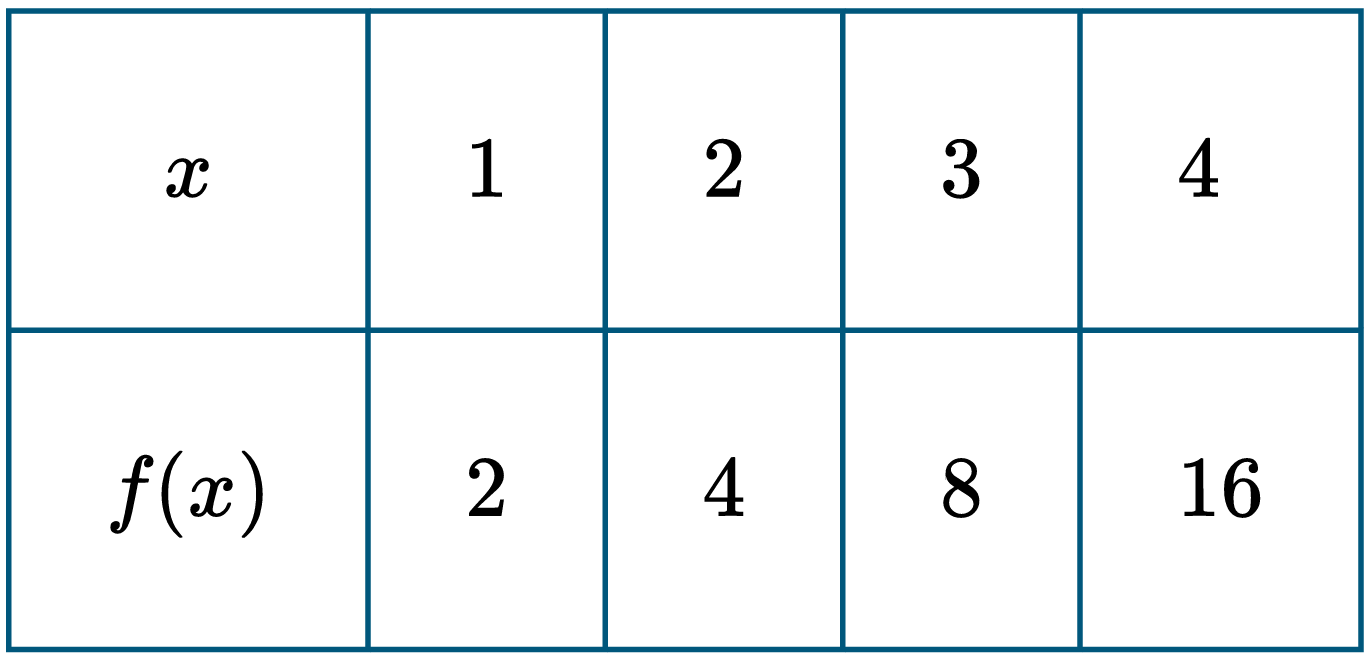
The table gives values of the function $f$ for selected values of $x$. Which of the following is a verbal representation of $f^{-1}(x)$, the inverse function of $f$?

(A) $f^{-1}(x)$ is logarithmic with input values increasing by $1$ every time output values double.
(B) $f^{-1}(x)$ is logarithmic with output values increasing by $1$ every time input values double.
(C) $f^{-1}(x)$ is exponential with input values increasing by $1$ every time output values double.
(D) $f^{-1}(x)$ is exponential with output values increasing by $1$ every time input values double.
▶️ Answer/Explanation
Detailed solution

The original function $f$ is exponential because as $x$ increases by $1$, $f(x)$ doubles ($2, 4, 8, 16$).
The inverse of an exponential function is a logarithmic function, ruling out (C) and (D).
For the inverse function $f^{-1}(x)$, the inputs and outputs of $f$ are swapped.
The inputs of $f^{-1}(x)$ are the values $\{2, 4, 8, 16\}$ and the outputs are $\{1, 2, 3, 4\}$.
As the input values of $f^{-1}(x)$ double, the output values increase by $1$.
This matches the description provided in option (B).
Therefore, $f^{-1}(x)$ is logarithmic with output values increasing by $1$ every time input values double.
Question 23

The exponential function $g$ is given by $g(x) = 5^{x}$. Which of the following expressions defines $g^{-1}(x)$?
(A) $\log_{5} x$
(B) $\log_{x} 5$
(C) $\sqrt[5]{x}$
(D) $\sqrt[x]{5}$
▶️ Answer/Explanation
Detailed solution

To find the inverse $g^{-1}(x)$, start by setting $y = 5^{x}$.
Switch the variables $x$ and $y$ to get $x = 5^{y}$.
Solve for $y$ by converting the exponential equation to logarithmic form.
The definition of a logarithm states that if $x = b^{y}$, then $y = \log_{b} x$.
Applying this here, we get $y = \log_{5} x$.
Therefore, $g^{-1}(x) = \log_{5} x$.
The correct option is (A).

Question 24

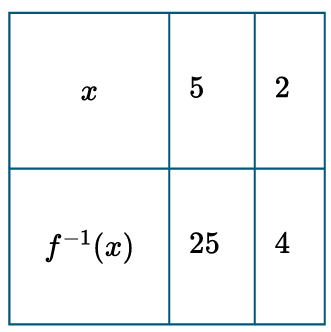
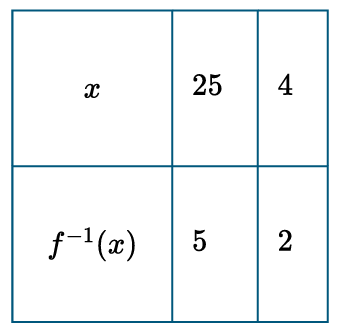
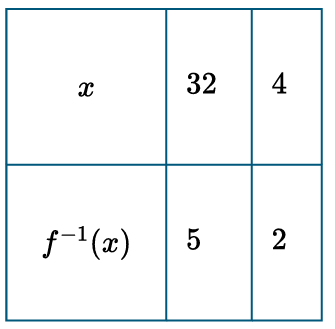
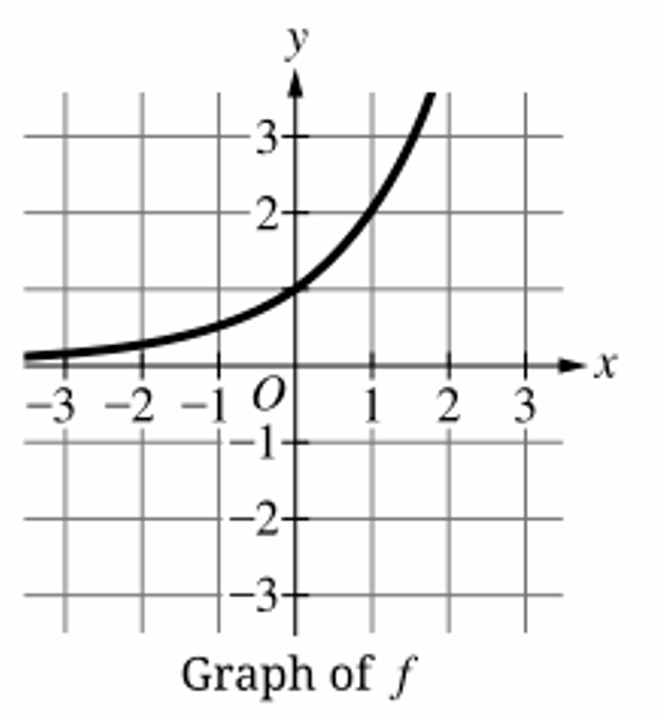
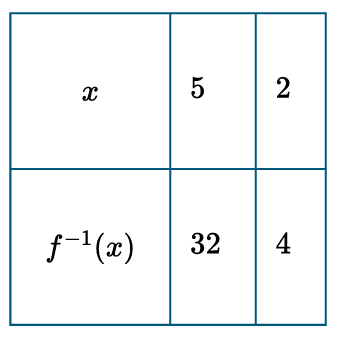
The graph of the exponential function $f$ is given. Which of the following could be a table of values for the inverse function of $f$?

(A)

(B)

(C)

(D)

▶️ Answer/Explanation
Detailed solution

The graph shows $f$ passes through $(0, 1)$, $(1, 2)$, and $(2, 4)$.
This indicates the exponential function is defined by $f(x) = 2^x$.
An inverse function $f^{-1}(x)$ swaps input and output: $(x, y) \rightarrow (y, x)$.
Since $f(2) = 4$, the inverse must contain the point $(4, 2)$.
Since $f(5) = 2^5 = 32$, the inverse must contain the point $(32, 5)$.
Table (D) is the only one correctly matching these coordinates.
Therefore, (D) is the correct table for the inverse function.
Question 25

The function $f$ is given by $f(x) = \log_{3} x$. Which of the following could be the graph of $y = f^{-1}(x)$?
(A)
(B)
(C)
(D)
▶️ Answer/Explanation
Detailed solution

The inverse of the logarithmic function $f(x) = \log_{3} x$ is found by switching $x$ and $y$, resulting in $y = 3^x$.
The graph of $y = 3^x$ must be an exponential growth curve that stays strictly above the $x$-axis.
The $y$-intercept occurs at $(0, 1)$ since $3^0 = 1$.
The graph must pass through the point $(1, 3)$ since $3^1 = 3$.
Graph B passes through $(0, 1)$ but appears to pass through $(1, 2)$, suggesting the function $y = 2^x$.
Graph C passes through $(0, 1)$ and reaches $y = 3$ when $x = 1$, matching the function $y = 3^x$.
Graph A represents a cubic-style function, and Graph D shows a reciprocal-style function.
Therefore, the correct choice is (C).
Question 26

The function $f$ is an increasing function such that every time the output values of the function $f$ increase by $1$, the corresponding input values multiply by $4$. Which of the following could define $f(x)$?
(A) $x^4$
(B) $4^x$
(C) $\sqrt[4]{x}$
(D) $\log_{4} x$
▶️ Answer/Explanation
Detailed solution

The problem states that if $f(x) = y$, then $f(4x) = y + 1$.
This relationship is a characteristic property of logarithmic functions.
For $f(x) = \log_{4} x$, if the input is multiplied by $4$, we get $f(4x) = \log_{4}(4x)$.
Using log properties: $\log_{4}(4x) = \log_{4} 4 + \log_{4} x$.
Since $\log_{4} 4 = 1$, the expression becomes $1 + f(x)$.
This matches the condition that the output increases by $1$ when the input is multiplied by $4$.
Therefore, the correct option is (D).

Question 27

The range of function $f$ is the positive real numbers. The function $g$ is given by $g(x) = \ln(f(x))$. Solutions to which of the following equations are useful in solving $g(x) = 2$?
(A) $f(x) = 2$
(B) $f(x) = e^2$
(C) $f(x) = 10^2
(D) $f(x) = \frac{2}{\ln x}$
▶️ Answer/Explanation
Detailed solution

The given equation is $g(x) = 2$.
Substitute the definition of $g(x)$ into the equation: $\ln(f(x)) = 2$.
Recall that the natural logarithm $\ln(y)$ has a base of $e$.
Rewrite the logarithmic equation in its equivalent exponential form.
If $\log_{b}(a) = c$, then $b^c = a$; here, $e^2 = f(x)$.
Therefore, solving $f(x) = e^2$ provides the values of $x$ that satisfy $g(x) = 2$.
The correct option is (B).

Question 28

28. To solve the equation $\log_{8}(x – 3) + \log_{8}(x + 4) = 1$, one method is to apply the properties of logarithms to write a new equation that can be used to identify possible solutions. Of the following, which is such an equation?
(A) $2x + 1 = 8$
(B) $\frac{x – 3}{x + 4} = 8$
(C) $x^{2} – 12 = 8$
(D) $x^{2} + x – 12 = 8$
▶️ Answer/Explanation
Detailed solution

The correct option is (D).
Use the product property of logarithms: $\log_{b}(m) + \log_{b}(n) = \log_{b}(m \cdot n)$.
Apply this to the given equation: $\log_{8}((x – 3)(x + 4)) = 1$.
Rewrite the logarithmic equation in exponential form: $(x – 3)(x + 4) = 8^{1}$.
Expand the left side using the FOIL method: $x^{2} + 4x – 3x – 12 = 8$.
Simplify the linear terms to get the final equation: $x^{2} + x – 12 = 8$.

Question 29

Which of the following is the inverse of the function $f$ given by $f(x) = 4 \log_{2}(x + 3) – 1$?
(A) $g(x) = \frac{1}{4}(2^{x} + 1) – 3$
(B) $g(x) = \frac{1}{4} \cdot 2^{(x+1)} – 3$
(C) $g(x) = 2^{(\frac{x}{4} + 1)} – 3$
(D) $g(x) = 2^{(\frac{x+1}{4})} – 3$
▶️ Answer/Explanation
Detailed solution

Set $y = 4 \log_{2}(x + 3) – 1$ and swap $x$ and $y$ to find the inverse.
$x = 4 \log_{2}(y + 3) – 1$
Add $1$ to both sides: $x + 1 = 4 \log_{2}(y + 3)$
Divide by $4$: $\frac{x + 1}{4} = \log_{2}(y + 3)$
Rewrite in exponential form: $2^{(\frac{x + 1}{4})} = y + 3$
Subtract $3$ to isolate $y$: $y = 2^{(\frac{x + 1}{4})} – 3$
The inverse function is $g(x) = 2^{(\frac{x + 1}{4})} – 3$, which matches option (D).

Question 30

What are all values of $x$ for which $\ln(x^3) – \ln x = 4$?
(A) $x = -2$ and $x = 2$
(B) $x = -e^2$ and $x = e^2$
(C) $x = e^2$ only
(D) $x = e^4$
▶️ Answer/Explanation
Detailed solution

The domain of $\ln x$ requires that $x > 0$.
Using the quotient rule for logarithms: $\ln\left(\frac{x^3}{x}\right) = 4$.
Simplify the fraction: $\ln(x^2) = 4$.
Convert the logarithmic equation to exponential form: $x^2 = e^4$.
Solve for $x$ by taking the square root: $x = \pm \sqrt{e^4} = \pm e^2$.
Checking the domain, $x$ must be positive, so $x = -e^2$ is extraneous.
Therefore, the only valid solution is $x = e^2$.
The correct option is (C).

Question 31

An equation involves the expression $\log_{9}(27^{x})$, which is equivalent to a rational multiple of $x$. By rewriting the expression in an equivalent form, the value of the rational number can be determined without use of a calculator or complicated calculations. Which of the following is an equivalent expression that satisfies this requirement?
(A) $x \ln\left(\frac{27}{9}\right)$
(B) $x \log_{3}\left(\frac{27}{9}\right)$
(C) $\frac{x \ln 27}{\ln 9}$
(D) $\frac{x \log_{3} 27}{\log_{3} 9}$
▶️ Answer/Explanation
Detailed solution

First, apply the power rule of logarithms: $\log_{9}(27^{x}) = x \log_{9} 27$.
Apply the change-of-base formula $\log_{a} b = \frac{\log_{c} b}{\log_{c} a}$ to rewrite the expression.
Choose base $3$ because both $27$ and $9$ are powers of $3$.
This gives the equivalent form: $\frac{x \log_{3} 27}{\log_{3} 9}$.
Since $\log_{3} 27 = 3$ and $\log_{3} 9 = 2$, the expression becomes $\frac{3}{2}x$.
This matches choice (D), allowing for simple mental calculation of the rational multiple.
Correct Option: (D)

Question 32

If $m = \log_{3} 81$, which of the following is also true?
(A) $3m = 81$
(B) $3^m = 81$
(C) $\sqrt[3]{m} = 81$
(D) $\sqrt[3]{81} = m$
▶️ Answer/Explanation
Detailed solution

The correct option is (B).
The given equation is $m = \log_{3} 81$.
By the definition of a logarithm, $\log_{b} x = y$ is equivalent to $b^y = x$.
In this case, the base $b$ is $3$, the result $y$ is $m$, and the argument $x$ is $81$.
Converting the logarithmic form to exponential form gives $3^m = 81$.
Since $3^4 = 81$, it also follows that $m = 4$.
Thus, the expression $3^m = 81$ is the true statement.

Question 33

The sales of a new product, in items per month, is modeled by the expression $225 + 500 \log_{10}(15t + 10)$, where $t$ represents the time since the product became available for purchase, in months. What is the number of items sold per month for time $t = 6$?
(A) $725$
(B) $1225$
(C) $1700$
(D) $5225$
▶️ Answer/Explanation
Detailed solution

Identify the given expression: $225 + 500 \log_{10}(15t + 10)$.
Substitute the given value $t = 6$ into the expression.
Calculate the inner term: $15(6) + 10 = 90 + 10 = 100$.
Evaluate the logarithm: $\log_{10}(100) = 2$, since $10^2 = 100$.
Multiply the logarithmic result by the coefficient: $500 \times 2 = 1000$.
Add the initial constant: $225 + 1000 = 1225$.
The number of items sold per month at $t = 6$ is $1225$.
Therefore, the correct option is (B).

Question 34 (Calc allowed)

The Richter scale is a numerical scale that uses base $10$ logarithms for measuring an earthquake’s magnitude. The larger the number, the more intense the earthquake. For example, an earthquake with a magnitude of $5.0$ is $10$ times more intense than an earthquake with a magnitude of $4.0$. Two well-known earthquakes occurred in the year $1906$. The San Francisco earthquake had a magnitude of $7.9$, and the Chile earthquake had a magnitude of $8.2$. Approximately how many times more intense was the Chile earthquake than the San Francisco earthquake?
(A) $0.3$
(B) $0.5$
(C) $2.0$
(D) $3.0$
▶️ Answer/Explanation
Detailed solution

The Richter scale is logarithmic, where intensity $I$ relates to magnitude $M$ by $M = \log_{10}(I)$.
The ratio of intensities between two earthquakes is given by $10^{M_1 – M_2}$.
The difference in magnitude is $8.2 – 7.9 = 0.3$.
The intensity ratio is $10^{0.3}$.
Since $10^{0.3} \approx 1.995$, the Chile earthquake was approximately $2.0$ times more intense.
Therefore, the correct choice is (C).

Question 35

Consider the constant function $f$ given by $f(x) = -1$ and the function $g$ given by $g(x) = \log_{3} x$. Let $h$ be the function given by $h(x) = g(x) – f(x)$. In the $xy$-plane, what is the $x$-intercept of the graph of $h$?
(A) $(-3, 0)$
(B) $(\frac{1}{3}, 0)$
(C) $(3, 0)$
(D) The graph of $h$ does not have an $x$-intercept.
▶️ Answer/Explanation
Detailed solution

First, define the function $h(x) = g(x) – f(x)$.
Substitute the given functions: $h(x) = \log_{3} x – (-1)$, which simplifies to $h(x) = \log_{3} x + 1$.
To find the $x$-intercept, set $h(x) = 0$.
This gives the equation $0 = \log_{3} x + 1$.
Subtract $1$ from both sides to get $\log_{3} x = -1$.
Rewrite the logarithmic equation in exponential form: $x = 3^{-1}$.
Solving for $x$ yields $x = \frac{1}{3}$.
The $x$-intercept is the point $(\frac{1}{3}, 0)$, which corresponds to option (B).

Question 36

The function $f$ is given by $f(x) = \log_{2} x$. What input value in the domain of $f$ yields an output value of $4$ ?
(A) $32$
(B) $16$
(C) $2$
(D) $\frac{1}{2}$
▶️ Answer/Explanation
Detailed solution

The given function is $f(x) = \log_{2} x$.
The problem asks for the input $x$ such that the output $f(x) = 4$.
Substitute the output value into the function: $\log_{2} x = 4$.
Convert the logarithmic form to exponential form using the rule: $\log_{b} a = c \Rightarrow b^{c} = a$.
This yields the equation $x = 2^{4}$.
Calculate the value of the exponent: $2 \times 2 \times 2 \times 2 = 16$.
Therefore, the input value is $16$, which corresponds to option (B).

Question 37

The function $f$ is given by $f(x) = 2 \log_{5} x$. Which of the following describes $f$?
(A) $f$ is an increasing function that increases at an increasing rate.
(B) $f$ is an increasing function that increases at a decreasing rate.
(C) $f$ is a decreasing function that decreases at an increasing rate.
(D) $f$ is a decreasing function that decreases at a decreasing rate.
▶️ Answer/Explanation
Detailed solution

The function is $f(x) = 2 \log_{5} x$, where the base $5 > 1$, making $f$ an increasing function.
To find the rate of change, we calculate the first derivative: $f'(x) = \frac{2}{x \ln 5}$.
Since $f'(x) > 0$ for all $x > 0$, the function is strictly increasing.
To find the rate of that increase, we look at the second derivative: $f”(x) = -\frac{2}{x^2 \ln 5}$.
Since $f”(x) < 0$ for all $x > 0$, the graph is concave down, meaning the rate is decreasing.
Therefore, $f$ increases at a decreasing rate.
The correct option is (B).

Question 38

Which of the following could describe a single logarithmic function $f$?
(A) $\lim_{x \to 0^+} f(x) = -\infty$ and $\lim_{x \to \infty} f(x) = -\infty$
(B) $\lim_{x \to 0^+} f(x) = -\infty$ and $\lim_{x \to \infty} f(x) = k$, where $k$ is a positive constant
(C) $\lim_{x \to 0^+} f(x) = \infty$ and $\lim_{x \to \infty} f(x) = 0$
(D) $\lim_{x \to 0^+} f(x) = \infty$ and $\lim_{x \to \infty} f(x) = -\infty$
▶️ Answer/Explanation
Detailed solution

A standard logarithmic function is $f(x) = \log_b(x)$.
If $0 < b < 1$, the function represents a logarithmic decay.
As $x$ approaches $0$ from the right, $\lim_{x \to 0^+} \log_b(x) = \infty$.
As $x$ increases toward infinity, $\lim_{x \to \infty} \log_b(x) = -\infty$.
This end behavior matches the conditions provided in option (D).
Other options fail because logs do not have horizontal asymptotes or return to $-\infty$.
Therefore, the correct description is given by choice (D).

Question 39

The logarithmic function $f$ is defined by $f(x) = \log_{3} x$ on a domain of $f$ is $0 < x \le 9$. Which of the following is true of $f$ ?
(A) $f$ has both a maximum and a minimum value.
(B) $f$ has a maximum value, but no minimum value.
(C) $f$ has a minimum value, but no maximum value.
(D) $f$ has neither a minimum value nor a maximum value.
▶️ Answer/Explanation
Detailed solution

The function $f(x) = \log_{3} x$ is strictly increasing over its entire domain.
At the right endpoint $x = 9$, the function reaches a maximum value of $f(9) = \log_{3} 9 = 2$.
As $x$ approaches the left boundary $0$ from the right, the function $f(x) \to -\infty$.
Because the interval is open at $x = 0$, the function decreases without bound.
Therefore, there is no minimum value because the function never reaches a lowest point.
The correct option is (B).

 Question 40

Consider the functions $f$ and $g$ given by $f(x) = \log_{10}(x – 1) + \log_{10}(x + 3)$ and $g(x) = \log_{10}(x + 9)$. In the $xy$-plane, what are all $x$-coordinates of the points of intersection of the graphs of $f$ and $g$?
(A) $x = 3$ only
(B) $x = 7$
(C) $x = -4$ and $x = 3$
(D) $x = -7$ and $x = -4$
▶️ Answer/Explanation
Detailed solution

Set the functions equal: $\log_{10}(x – 1) + \log_{10}(x + 3) = \log_{10}(x + 9)$.
Apply the product property: $\log_{10}((x – 1)(x + 3)) = \log_{10}(x + 9)$.
Remove logs and expand: $x^2 + 2x – 3 = x + 9$.
Rearrange into a quadratic equation: $x^2 + x – 12 = 0$.
Factor the quadratic: $(x + 4)(x – 3) = 0$, giving $x = -4$ and $x = 3$.
Check domain constraints: For $f(x)$, $x – 1 > 0$, so $x > 1$.
Reject $x = -4$ as it is outside the domain; thus, $x = 3$ only is the valid solution.
The correct option is (A).

Question 41

The function $g$ is given by $g(x) = \ln(3x + 1) – \ln(x^2 + x – 2)$. What are all values of $x$ for which $g(x) < 0$?
(A) $(-\infty, -1)$ and $(3, \infty)$
(B) $(-1, 3)$
(C) $(1, 3)$ only
(D) $(3, \infty)$ only
▶️ Answer/Explanation
Detailed solution

First, identify the domain: $3x + 1 > 0 \implies x > -\frac{1}{3}$ and $x^2 + x – 2 > 0 \implies (x+2)(x-1) > 0$.
The intersection of $x > -\frac{1}{3}$ and $(x < -2 \text{ or } x > 1)$ gives the domain $x > 1$.
Set $g(x) < 0$: $\ln(3x + 1) – \ln(x^2 + x – 2) < 0 \implies \ln(3x + 1) < \ln(x^2 + x – 2)$.
Since $\ln$ is increasing, $3x + 1 < x^2 + x – 2$.
Rearrange to $x^2 – 2x – 3 > 0$, which factors as $(x – 3)(x + 1) > 0$.
This inequality holds for $x < -1$ or $x > 3$.
Combining $x > 1$ (domain) and $(x < -1 \text{ or } x > 3)$ yields $x > 3$.
The correct option is (D).

Question 42

A decibel (dB) is a unit of measure for loudness of sound. The decibel scale is based in sound intensity $N$, in watts per square meter. A decibel value is given by the function $d$, where $d(N) = 10 \log_{10} \left( \frac{N}{10^{-12}} \right)$. Which of the following gives all intensities $N$, in watts per square meter, for which the decibel value is greater than $140$ decibels?
(A) $N > 14 \cdot 10^{-12}$
(B) $N > 2$
(C) $N > 100$
(D) $N > 10^{26}$
▶️ Answer/Explanation
Detailed solution

Set the decibel function $d(N) > 140$.
Substitute the formula: $10 \log_{10} \left( \frac{N}{10^{-12}} \right) > 140$.
Divide both sides by $10$ to get $\log_{10} \left( \frac{N}{10^{-12}} \right) > 14$.
Rewrite the logarithmic inequality in exponential form: $\frac{N}{10^{-12}} > 10^{14}$.
Multiply both sides by $10^{-12}$ to isolate $N$.
$N > 10^{14} \cdot 10^{-12}$.
Simplify the exponents by adding them: $N > 10^{14 + (-12)}$.
The final result is $N > 10^2$, which is $N > 100$.
Correct Option: (C)

Question 43

The function $f$ is given by $f(x) = \log_{2} x$. Which of the following is equivalent to $f(7)$?
(A) $\log_{10} \left( \frac{7}{2} \right)$
(B) $\frac{\log_{10} 2}{\log_{10} 7}$
(C) $\frac{\log_{7} 10}{\log_{2} 10}$
(D) $\frac{\log_{3} 7}{\log_{3} 2}$
▶️ Answer/Explanation
Detailed solution

The function is defined as $f(x) = \log_{2} x$, so we need to find an expression equivalent to $f(7) = \log_{2} 7$.
Using the Change of Base Formula: $\log_{b} a = \frac{\log_{c} a}{\log_{c} b}$ for any positive base $c$.
By applying this formula with a new base $c = 3$, we get $\log_{2} 7 = \frac{\log_{3} 7}{\log_{3} 2}$.
Option (A) is incorrect because $\log_{10} \left( \frac{7}{2} \right) = \log_{10} 7 – \log_{10} 2$.
Option (B) is the reciprocal of the correct change of base result using base $10$.
Option (C) is incorrect because $\frac{\log_{7} 10}{\log_{2} 10} = \frac{1/\log_{10} 7}{1/\log_{10} 2} = \frac{\log_{10} 2}{\log_{10} 7} = \log_{7} 2$.
Therefore, the correct equivalent expression is provided in option (D).
The final answer is (D).

Question 44

The function $g$ is given by $g(x) = \log_{7} x$, and the function $h$ is given by $h(x) = \log_{49} x$. Which of the following describes the relationships between $g$ and $h$?
(A) For equal input values, the output values of $h$ are half the output values of $g$.
(B) For equal input values, the output values of $h$ are twice the output values of $g$.
(C) For equal input values, the output values of $h$ are the square of the output values of $g$.
(D) For equal input values, the output values of $h$ are the square root of the output values of $g$.
▶️ Answer/Explanation
Detailed solution

The correct answer is (A).
Start with the function $h(x) = \log_{49} x$.
Recognize that the base $49$ can be written as $7^{2}$.
Apply the change of base formula: $\log_{a^n} x = \frac{1}{n} \log_{a} x$.
This gives $h(x) = \log_{7^{2}} x = \frac{1}{2} \log_{7} x$.
Substitute $g(x)$ into the equation to get $h(x) = \frac{1}{2} g(x)$.
Therefore, for the same $x$, the output of $h$ is half the output of $g$.

Question 45

The function $h$ is given by $h(x) = \log_{3} x$. Which of the following is equivalent to the expression $2 \cdot h(w) + h(p)$, where $w$ and $p$ are values in the domain of $h$?
(A) $\log_{3}((wp)^{2})$
(B) $(\log_{3} w)^{2} \cdot (\log_{3} p)$
(C) $\log_{3}(w^{2}p)$
(D) $\log_{3}(2wp)$
▶️ Answer/Explanation
Detailed solution

Given the function $h(x) = \log_{3} x$, substitute $w$ and $p$ into the expression: $2 \log_{3} w + \log_{3} p$.
Apply the Power Property of logarithms, $a \log_{b} c = \log_{b}(c^{a})$, to rewrite the first term as $\log_{3}(w^{2})$.
The expression becomes $\log_{3}(w^{2}) + \log_{3} p$.
Apply the Product Property of logarithms, $\log_{b} m + \log_{b} n = \log_{b}(mn)$.
Combining the terms results in $\log_{3}(w^{2} \cdot p)$.
This matches option (C).

Question 46

The function $f$ is given by $f(x) = \log_{10} x$. The function $g$ is given by $g(x) = \log_{10}(x^3)$. Which of the following describes a transformation for which the graph of $g$ is the image of the graph of $f$?
(A) A vertical dilation by a factor of $3$
(B) A vertical dilation by a factor of $\frac{1}{3}$
(C) A horizontal dilation by a factor of $3$
(D) A horizontal dilation by a factor of $\frac{1}{3}$
▶️ Answer/Explanation
Detailed solution

The function $g(x) = \log_{10}(x^3)$ can be rewritten using the logarithm power rule.
The power rule states that $\log_b(a^n) = n \cdot \log_b a$.
Applying this to $g(x)$, we get $g(x) = 3 \cdot \log_{10} x$.
Since $f(x) = \log_{10} x$, we can express $g$ as $g(x) = 3 \cdot f(x)$.
A transformation of the form $y = a \cdot f(x)$ represents a vertical dilation.
Because $a = 3$, the graph of $f$ is stretched vertically by a factor of $3$.
Therefore, the correct choice is (A).

Question 47

The function $f$ is given by $f(x) = \ln x$. Which of the following describes input values for which the output values of $f$ are integers?
(A) Integer powers of $e$
(B) Integer powers of $10$
(C) Integers raised to the power $e$
(D) Integers raised to the power $10$
▶️ Answer/Explanation
Detailed solution

The function is defined as $f(x) = \ln x$, where the base is $e$.
To find when the output is an integer, set $f(x) = n$, where $n$ is any integer.
This gives the equation $\ln x = n$.
By converting the logarithmic form to exponential form, we get $x = e^n$.
Therefore, the input values $x$ must be integer powers of $e$.
For example, if $x = e^2$, then $f(e^2) = \ln(e^2) = 2$, which is an integer.
This confirms that option (A) is the correct description.

Question 48

The function $g$ is given by $g(x) = a \log_{b} c$, where $a$, $b$, and $c$ are positive integers. Which of the following is an equivalent representation of $g(x)$?
(A) $\log_{b}(c^{a})$
(B) $(\log_{b} c)^{a}$
(C) $\log_{b}(c^{(1/a)})$
(D) $a \log_{10} b + a \log_{10} c$
▶️ Answer/Explanation
Detailed solution

The given function is $g(x) = a \log_{b} c$.
According to the power property of logarithms, $n \log_{x} y = \log_{x}(y^{n})$.
Applying this property, the coefficient $a$ becomes the exponent of the argument $c$.
This results in the equivalent expression $\log_{b}(c^{a})$.
Option (A) correctly matches this logarithmic identity.
Options (B), (C), and (D) violate standard logarithmic laws.
Therefore, the correct representation is option (A).

Question 49

The function $f$ is logarithmic, and the points $(2, 1)$ and $(4, 2)$ are on the graph of $f$ in the $xy$-plane. Which of the following could define $f(x)$?
(A) $\log_{4} x$
(B) $2 \log_{2} x$
(C) $2 \log_{4} x$
(D) $\log_{4} (x + 2)$
▶️ Answer/Explanation
Detailed solution

To find the correct function, we test the given points $(2, 1)$ and $(4, 2)$ in each option.
For (A): $f(2) = \log_{4} 2 = 0.5$, which does not equal $1$.
For (B): $f(2) = 2 \log_{2} 2 = 2(1) = 2$, which does not equal $1$.
For (C): $f(2) = 2 \log_{4} 2 = 2(0.5) = 1$, which matches the first point.
Checking (C) with the second point: $f(4) = 2 \log_{4} 4 = 2(1) = 2$, which matches $(4, 2)$.
For (D): $f(2) = \log_{4} (2 + 2) = \log_{4} 4 = 1$, but $f(4) = \log_{4} 6 \neq 2$.
Therefore, the correct function is (C) $f(x) = 2 \log_{4} x$.

Question 50 (Calc allowed)

The life expectancy for a human in the United States can be modeled by the function $L$ given by $L(x) = 42.53 + 13.86 \ln x$. $L(x)$ gives the life expectancy, in years, for $x$ decades after the year 1900. Based on the model, when is the first time that human life expectancy is predicted to be $80$ years? (Note: $1$ decade is $10$ years).
(A) Late 1914
(B) Early 2003
(C) Late 2040s
(D) Early 2050s
▶️ Answer/Explanation
Detailed solution

Set the life expectancy function equal to $80$: $80 = 42.53 + 13.86 \ln x$.
Subtract $42.53$ from both sides to get $37.47 = 13.86 \ln x$.
Divide by $13.86$ to isolate the natural log: $\ln x \approx 2.70346$.
Exponentiate both sides ($e^{2.70346}$) to find $x \approx 14.93$ decades.
Convert decades to years: $14.93 \times 10 = 149.3$ years after 1900.
Add the years to the base year: $1900 + 149.3 = 2049.3$.
The value $2049.3$ corresponds to the late 2040s.
Therefore, the correct choice is (C).

Question 51

In a certain town, the population in the year $2000$ was about $30,000$. The population grows at a rate of $2.3\%$ per year, and time is measured in years since $2000$. Which of the following functions gives output values, in years since $2000$, for input values of the town’s population $p$?
(A) $f(p) = 30,000 \cdot (1.023)^p$
(B) $g(p) = \log_{1.023} \left( \frac{p}{30,000} \right)$
(C) $h(p) = \frac{p – 30,000}{2.3}$
(D) $k(p) = 30,000 \cdot \log_{1.023} p$
▶️ Answer/Explanation
Detailed solution

The initial population at $t = 0$ is $P_0 = 30,000$.
The growth rate is $2.3\%$, so the growth factor is $1 + 0.023 = 1.023$.
The population $p$ after $t$ years is given by $p = 30,000 \cdot (1.023)^t$.
To find years $t$ as a function of population $p$, we solve for $t$:
Divide both sides by $30,000$ to get $\frac{p}{30,000} = (1.023)^t$.
Convert the exponential equation to logarithmic form: $t = \log_{1.023} \left( \frac{p}{30,000} \right)$.
Therefore, the correct function is $g(p) = \log_{1.023} \left( \frac{p}{30,000} \right)$.
The correct option is (B).

Question 52 (Calc allowed)

The Richter scale is a numerical scale that uses base $10$ logarithms for measuring an earthquake’s magnitude. The larger the number, the more intense the earthquake. As intensities increase multiplicatively by a factor of $10$, the Richter scale increases additively by $1$. Consider two earthquakes that occurred in the year $2022$. An earthquake in Indonesia had a magnitude of $5.1$, and an earthquake in Mexico had a magnitude of $2.5$. Approximately how many times more intense was the Indonesia earthquake than the Mexico earthquake?
(A) $2.6$
(B) $26$
(C) $100$
(D) $400$
▶️ Answer/Explanation
Detailed solution

The Richter scale is logarithmic, where a difference of $1$ in magnitude represents a $10$-fold difference in intensity.
Calculate the difference in magnitudes: $5.1 – 2.5 = 2.6$.
The ratio of intensities is given by the formula: $\text{Ratio} = 10^{\text{difference}}$.
Substitute the difference: $\text{Ratio} = 10^{2.6}$.
Break down the exponent: $10^{2.6} = 10^2 \times 10^{0.6}$.
Since $10^2 = 100$ and $10^{0.6}$ is approximately $3.98$ (nearly $4$), the result is $100 \times 4$.
The Indonesia earthquake was approximately $400$ times more intense.
Correct Option: (D)

Question 53

The initial population size of an animal species is measured to be $2000$. The population doubles every $8$ years. Which of the following functions gives the time, in years, as an output value, and a certain number $x$ for the population size as an input value?
(A) $f(x) = \frac{1}{8} \log_{2} \left( \frac{x}{2000} \right)$
(B) $g(x) = \log_{2} \left( \frac{8x}{2000} \right)$
(C) $h(x) = 8 \log_{2} \left( \frac{x}{2000} \right)$
(D) $k(x) = 2000 \log_{8} x$
▶️ Answer/Explanation
Detailed solution

The standard growth model is $x = 2000(2)^{\frac{t}{8}}$, where $x$ is population and $t$ is time.
Divide both sides by $2000$ to isolate the exponential term: $\frac{x}{2000} = 2^{\frac{t}{8}}$.
Convert the exponential equation into its logarithmic form: $\log_{2} \left( \frac{x}{2000} \right) = \frac{t}{8}$.
Multiply both sides by $8$ to solve for $t$: $t = 8 \log_{2} \left( \frac{x}{2000} \right)$.
Comparing this result to the given options, we find it matches function $h(x)$.
Therefore, the correct option is (C).

Question 54 (Calc allowed)

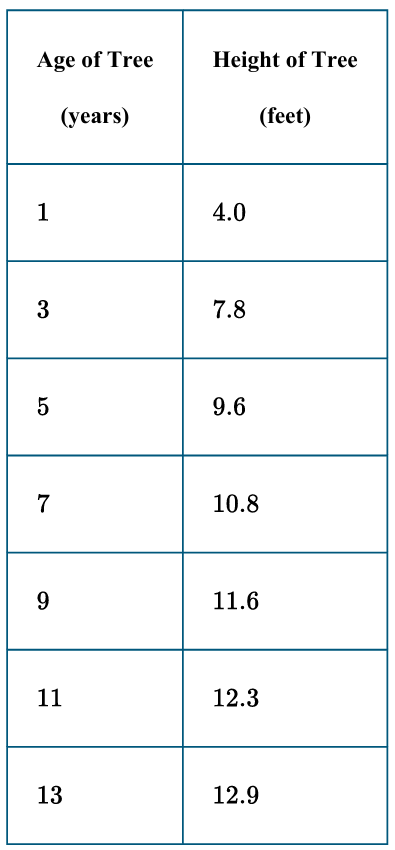
The table gives the height of a tree, in feet, for selected ages of the tree, in years. A logarithmic regression is used to produce a model of the form $f(x) = a + b \ln x$, where $f(x)$ gives the predicted height of a tree, in feet, at age $x$ years. Based on the model, what is the predicted height of the tree, in feet, at age $10$ years?
(A) $11.877$
(B) $11.889$
(C) $11.990$
(D) $12.341$
▶️ Answer/Explanation
Detailed solution

Input the given $(x, y)$ data pairs from the table into a graphing calculator’s list.
Perform a Logarithmic Regression (LnReg) to find the constants $a$ and $b$.
The resulting regression equation is approximately $f(x) \approx 4.071 + 3.397 \ln x$.
Substitute $x = 10$ into the model: $f(10) = 4.071 + 3.397 \ln(10)$.
Calculate the value: $f(10) \approx 4.071 + 3.397(2.3025) \approx 11.889$.
Therefore, the predicted height at age $10$ is $11.889$ feet.
The correct option is (B).
Question 55

Let $k$, $w$, and $z$ be positive constants. Which of the following is equivalent to $\log_{10}\left( \frac{kz}{w^2} \right)$ ?
(A) $\log_{10}(k + z) – \log_{10}(2w)$
(B) $\log_{10} k + \log_{10} z – 2\log_{10} w$
(C) $\log_{10} k + \log_{10} z – \frac{1}{2}\log_{10} w$
(D) $\log_{10} k – \log_{10} z + 2\log_{10} w$
▶️ Answer/Explanation
Detailed solution

The correct option is (B).
Apply the quotient rule: $\log_{10}\left(\frac{kz}{w^2}\right) = \log_{10}(kz) – \log_{10}(w^2)$.
Apply the product rule: $\log_{10}(kz) = \log_{10} k + \log_{10} z$.
Apply the power rule: $\log_{10}(w^2) = 2\log_{10} w$.
Combine the terms: $\log_{10} k + \log_{10} z – 2\log_{10} w$.
This matches the expression provided in option (B).

Question 56

Which of the following expressions is equivalent to $\log_{3}(x^{5})$?
(A) $\log_{3} 5 + \log_{3} x$
(B) $\log_{3} 5 \cdot \log_{3} x$
(C) $5 \log_{3} x$
(D) $\frac{\log_{3} x}{\log_{3} 5}$
▶️ Answer/Explanation
Detailed solution

The correct option is (C).
This problem uses the Power Property of Logarithms.
The rule states that $\log_{b}(m^{n}) = n \log_{b}(m)$.
In the expression $\log_{3}(x^{5})$, the base $b$ is $3$, the argument $m$ is $x$, and the exponent $n$ is $5$.
By moving the exponent to the front as a multiplier, we get $5 \log_{3} x$.
Therefore, $\log_{3}(x^{5})$ is equivalent to $5 \log_{3} x$.

Question 57

Let $x$ and $y$ be positive constants. Which of the following is equivalent to $2 \ln x – 3 \ln y$?
(A) $\ln\left(\frac{x^2}{y^3}\right)$
(B) $\ln(x^2 y^3)$
(C) $\ln(2x – 3y)$
(D) $\ln\left(\frac{2x}{3y}\right)$
▶️ Answer/Explanation
Detailed solution

The given expression is $2 \ln x – 3 \ln y$.
Apply the Power Property: $n \ln a = \ln(a^n)$ to get $\ln(x^2) – \ln(y^3)$.
Apply the Quotient Property: $\ln a – \ln b = \ln\left(\frac{a}{b}\right)$.
Combine the terms: $\ln\left(\frac{x^2}{y^3}\right)$.
This matches the expression in option (A).
Correct Option: (A)

Question 58 (Calc allowed)

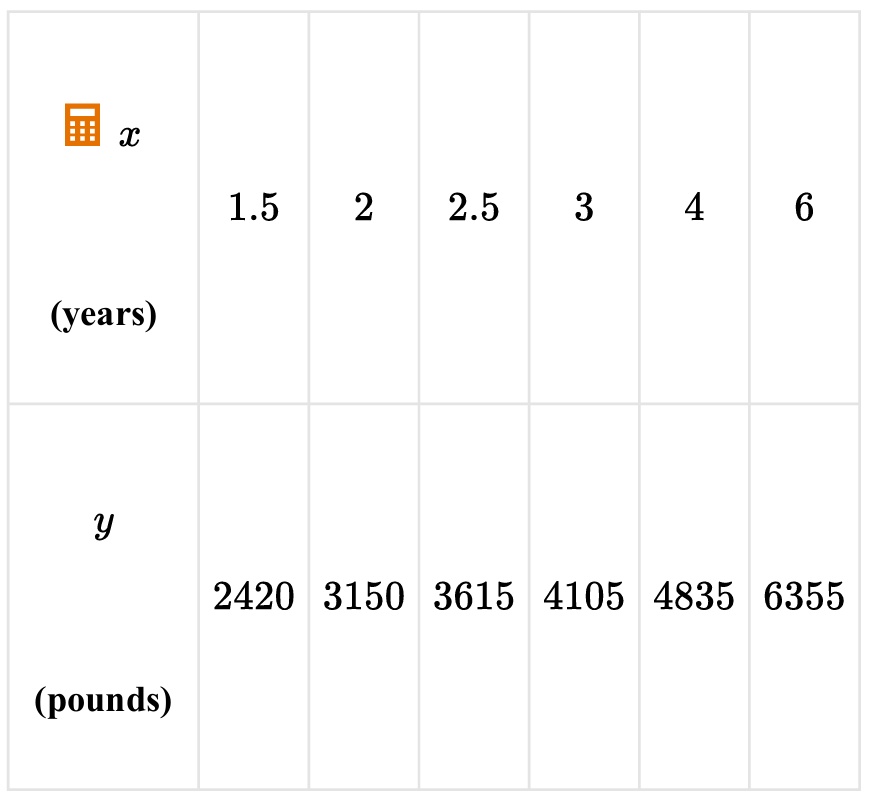
The table gives the weight $y$, in pounds, of an animal for selected ages $x$, in years. A logarithmic regression is used to model these data. What is the weight of the animal, to the nearest pound, predicted by the logarithmic function model at age $4.5$ years?
(A) $5073$
(B) $5203$
(C) $5333$
(D) $5345$
▶️ Answer/Explanation
Detailed solution

Input the given $(x, y)$ coordinates into a statistical calculator to perform a LnReg ($y = a + b \ln x$).
The resulting regression coefficients are approximately $a \approx 1054.45$ and $b \approx 2841.45$.
The logarithmic model is expressed as $y = 1054.45 + 2841.45 \ln(x)$.
Substitute the target age $x = 4.5$ into the derived regression equation.
$y = 1054.45 + 2841.45 \ln(4.5)$.
$y \approx 1054.45 + 2841.45(1.504077)$.
$y \approx 1054.45 + 4273.76 = 5328.21$.
Rounding to the nearest pound, the predicted weight is $5333$.
Correct Option: (C)
Question 59

A set of data is represented using a semi-log plot (not shown), in which the vertical axis is logarithmically scaled. The points on the semi-log plot appear to follow a decreasing linear pattern. Which of the following function types best models the set of data?
(A) Linear
(B) Exponential growth
(C) Exponential decay
(D) Logarithmic
▶️ Answer/Explanation
Detailed solution

The correct answer is (C) Exponential decay.
In a semi-log plot, the vertical axis represents $\log(y)$ and the horizontal axis represents $x$.
A linear pattern on this plot follows the equation $\log(y) = mx + b$.
Converting from logarithmic to exponential form gives $y = 10^{mx + b}$, which is an exponential function.
Since the pattern is decreasing, the slope $m$ must be negative ($m < 0$).
An exponential function with a negative growth rate represents exponential decay.
Therefore, the data is best modeled by an exponential decay function.

Question 60

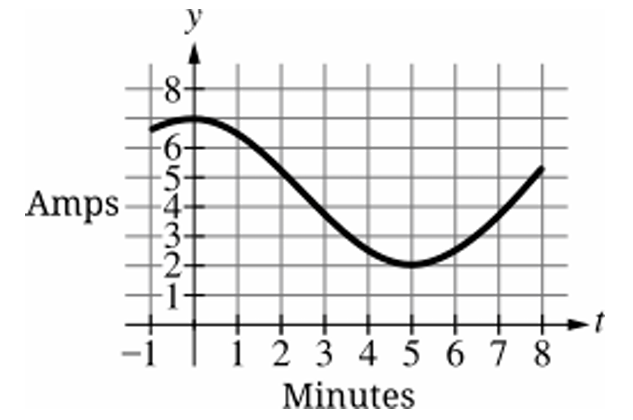
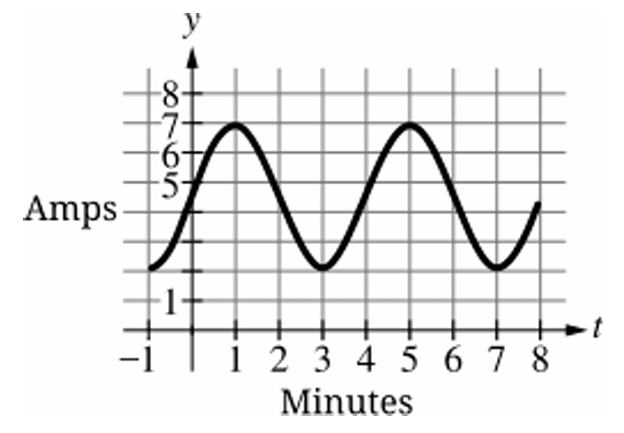
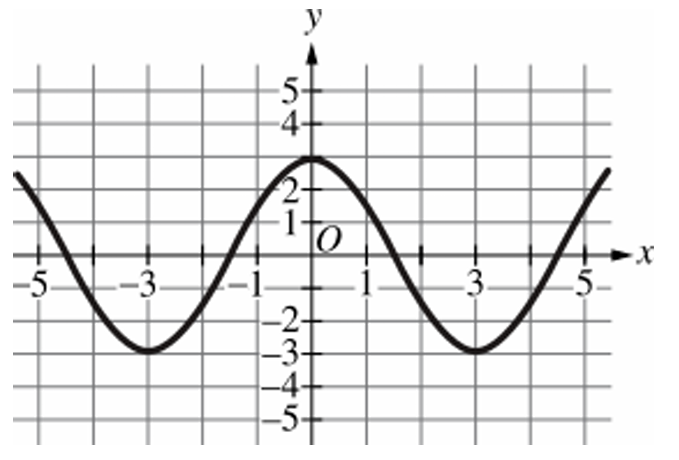
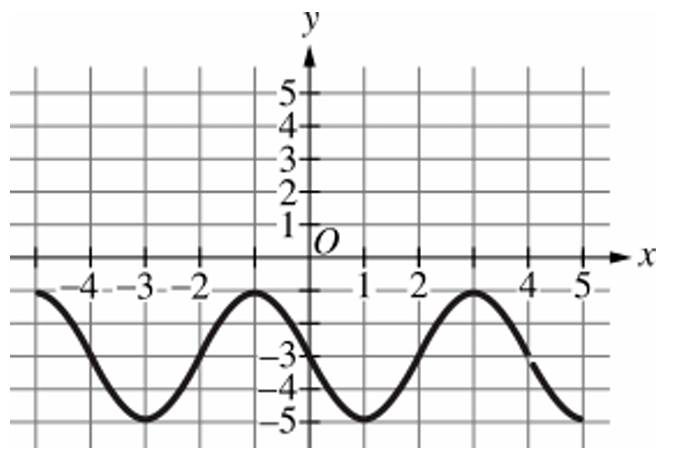
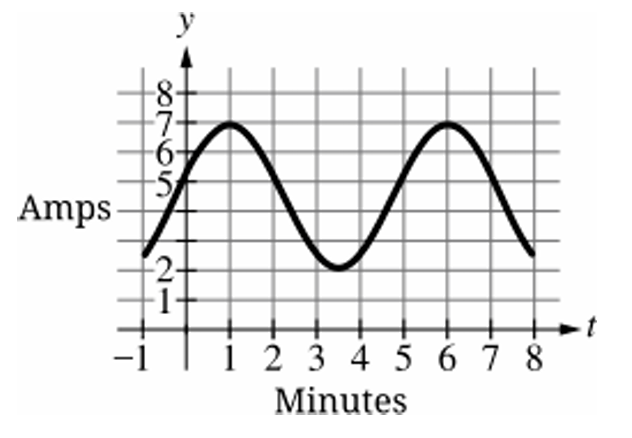
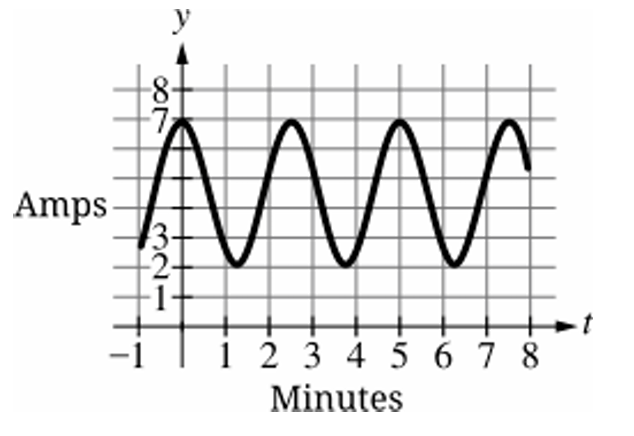
A certain type of machine produces a number of amps of electricity that follows a cyclic, periodically increasing and decreasing pattern. The machine produces a maximum of $7$ amps at certain times and a minimum of $2$ amps at other times. It takes about $5$ minutes for one cycle from $7$ amps to the next $7$ amps to occur. Which of the following graphs models amps as a function of time, in minutes, for this machine?
(A)
(B)
(C)
(D)
▶️ Answer/Explanation
Detailed solution

The maximum value (peak) of the graph must be $y = 7$.
The minimum value (trough) of the graph must be $y = 2$.
The period (the horizontal distance between two consecutive peaks) must be $5$ minutes.
Graph (A) has a maximum of $7$ and a minimum of $2$, but its period is $5$ minutes ($t = 1$ to $t = 6$).
Graph (B) has a maximum of $7$ and a minimum of $2$, but its period is only $2$ minutes.
Graph (C) has a period much longer than $5$ minutes.
Graph (D) shows a peak at $t = 0$ (approx), another at $t = 5$, and another at $t = 10$, confirming a period of $5$.
Therefore, Graph (D) is the correct model as it satisfies the range $[2, 7]$ and the $5$-minute periodicity.
Question 61

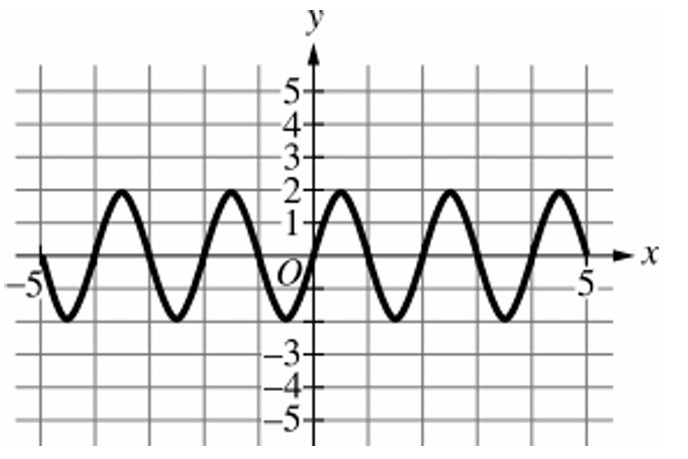
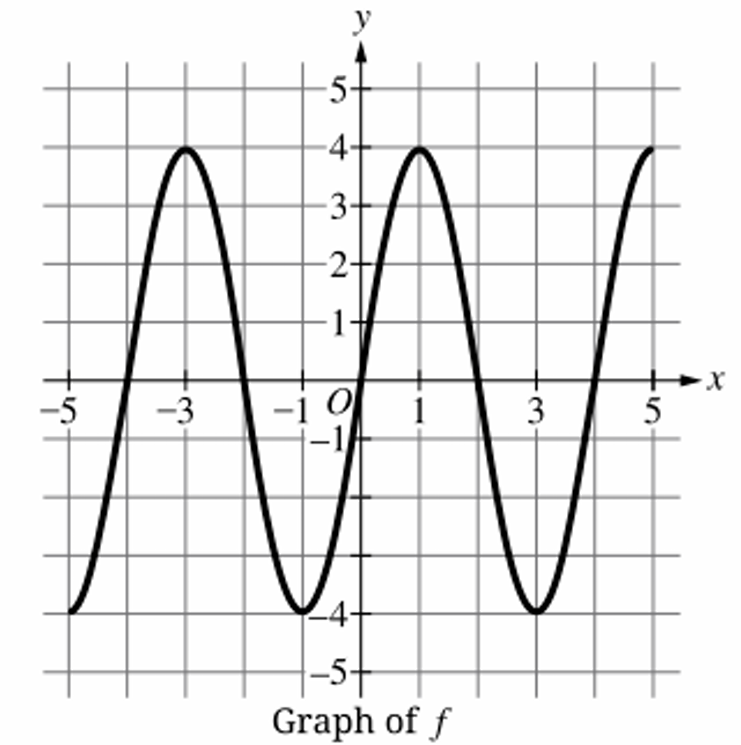
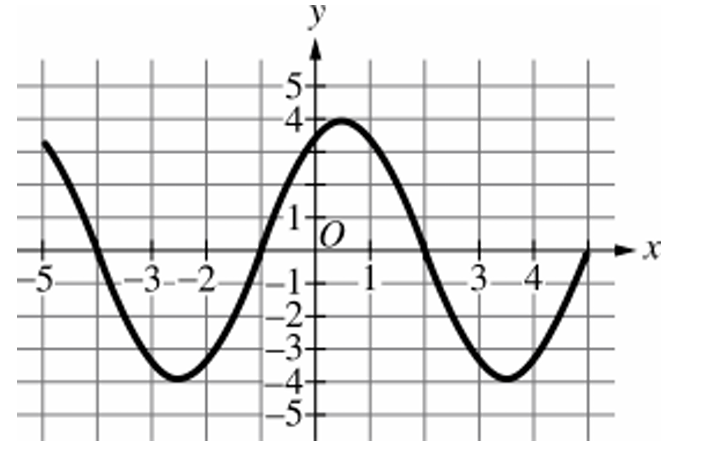
The graph of the function $f$ is given in the $xy$-plane. Which of the following functions has the same period as $f$?
(A)
(B)
(C)
(D)
▶️ Answer/Explanation
Detailed solution

The period of a periodic function is the horizontal distance required for the graph to complete one full cycle.
By observing the graph of $f$, a peak occurs at $x = 1$ and the next peak occurs at $x = 5$.
Therefore, the period of $f$ is calculated as $5 – 1 = 4$ units.
Looking at Option (A), a peak occurs at $x = 0$ and the next peak occurs at $x = 4$.
The period for Option (A) is $4 – 0 = 4$ units, which matches function $f$.
Other options have different periods: (B) has a period of $2$, (C) has a period of $8$, and (D) has a period of $6$.
Thus, the function in Option (A) has the same period as $f$.
Question 62

A metronome is a practice tool that produces a steady beat to help musicians play rhythms accurately. Some metronomes use a pendulum that repeatedly swings left and right to produce the steady beat. Which of the following is true about the beat produced by the metronome and the motion of the pendulum?
(A) Both the beat produced by the metronome and the motion of the pendulum have periodic relationships with time.
(B) Only the beat produced by the metronome has a periodic relationship with time.
(C) Only the motion of the pendulum has a periodic relationship with time.
(D) Neither the beat produced by the metronome nor the motion of the pendulum have periodic relationships with time.
▶️ Answer/Explanation
Detailed solution

The correct option is (A).
A periodic relationship means a motion or event repeats at regular intervals of time $T$.
The pendulum swings back and forth in a constant cycle, which is a classic example of periodic motion.
The metronome is designed to produce a “steady beat,” meaning the time interval between beats remains constant.
Since the beat repeats at fixed intervals, it also has a periodic relationship with time.
Therefore, both the mechanical motion and the resulting sound follow a predictable, repeating pattern.

Question 63

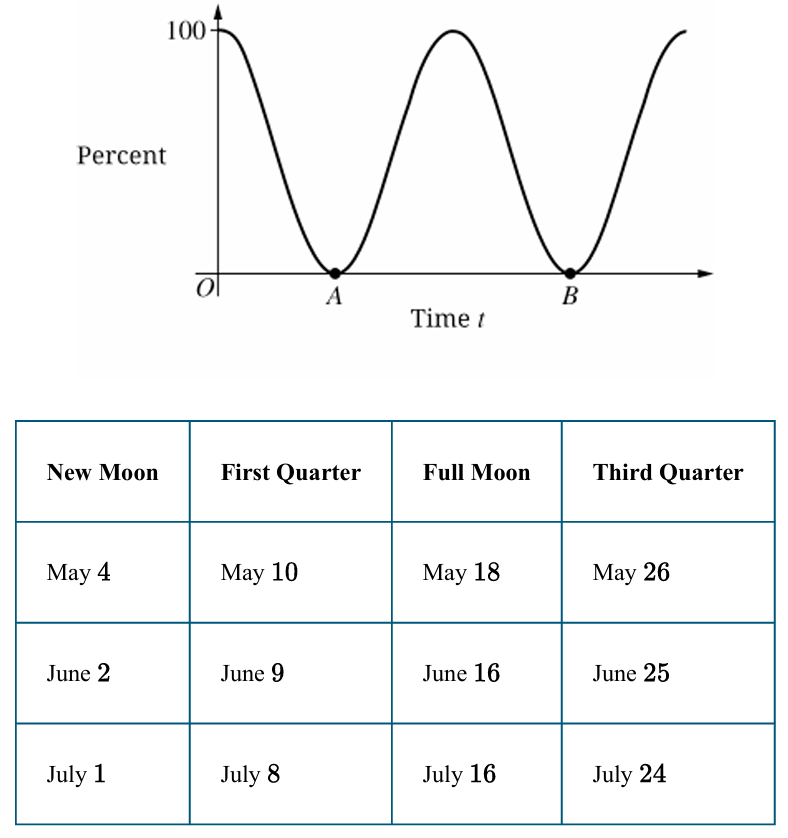
When seen from Earth, the percent of the Moon illuminated by the Sun varies. At the full moon phase, $100\%$ of the Moon is illuminated, while at the new moon phase $0\%$ of the Moon is illuminated. The graph gives the percent of the Moon illuminated at time $t$, in days, since an initial day, along with two labeled points $A$ and $B$. The table gives the dates of the four consecutive, periodic moon phases for three months of a certain year. Approximately how many days occur between points $A$ and $B$? (Note: Assume that a year has $365$ days and consists of $12$ months.)
(A) $7$
(B) $14$
(C) $28$
(D) $56$
▶️ Answer/Explanation
Detailed solution

Point $A$ and Point $B$ represent two consecutive New Moon phases where illumination is $0\%$.
According to the table, the first New Moon occurs on May 4 and the next on June 2.
The number of days in May is $31$.
Days from May 4 to May 31 is $31 – 4 = 27$ days.
Adding the $2$ days in June gives $27 + 2 = 29$ days.
Checking the next cycle: June 2 to July 1 is $28$ days in June plus $1$ day in July, totaling $29$ days.
Among the choices, $28$ is the closest approximation to the lunar cycle length.
Therefore, the correct option is (C).
Question 64

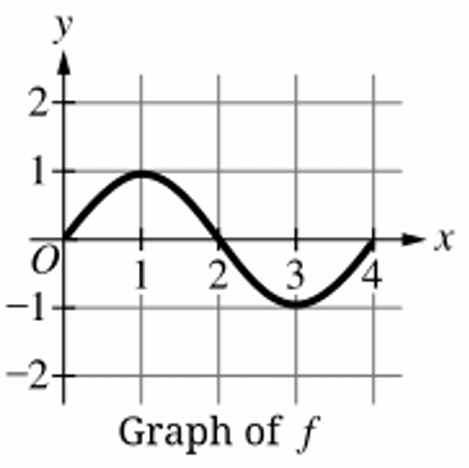
The graph gives one cycle of a periodic function $f$ in the $xy$-plane. Which of the following describes the behavior of $f$ on the interval $39 < x < 41$?
(A) The function $f$ is decreasing.
(B) The function $f$ is increasing.
(C) The function $f$ is decreasing, then increasing.
(D) The function $f$ is increasing, then decreasing.
▶️ Answer/Explanation
Detailed solution

The graph shows one full cycle of the function $f$ from $x = 0$ to $x = 4$.
The period of the function is $P = 4$.
To find the behavior at $39 < x < 41$, we find the equivalent values in the first cycle by calculating $x \pmod 4$.
For $x = 39$, $39 = (9 \times 4) + 3$, which corresponds to $x = 3$.
For $x = 41$, $41 = (10 \times 4) + 1$, which corresponds to $x = 1$.
On the interval $3 < x < 4$ of the original cycle, the function is increasing.
On the interval $0 < x < 1$ of the original cycle, the function is also increasing.
Since $x = 40$ (where $40 \equiv 0 \pmod 4$) is the transition point, the function continues increasing throughout the interval.
Therefore, the correct behavior is that the function $f$ is increasing.
Question 65

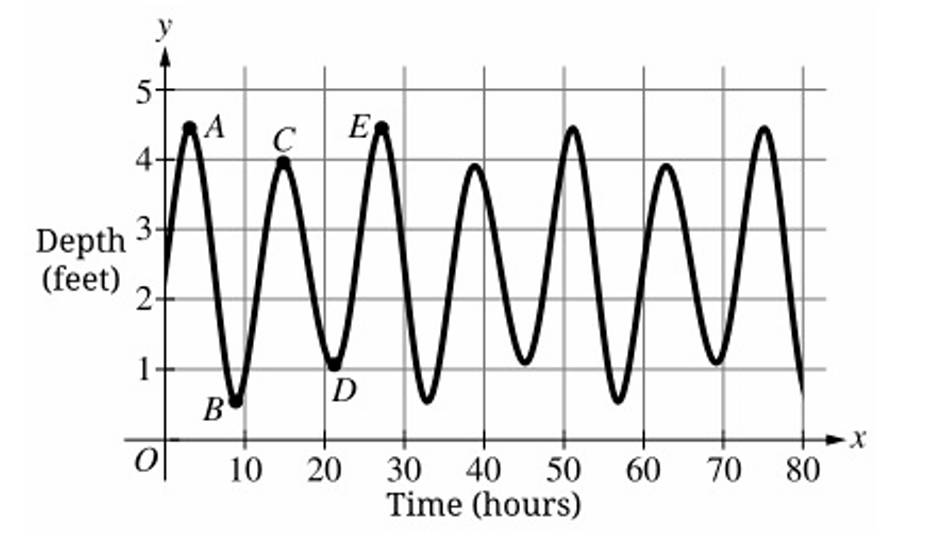
A graph of the depth of water at a pier in the ocean is given, along with five labeled points $A, B, C, D$, and $E$ in the $xy$-plane. For the time periods near these data points, a periodic relationship between depth of water, in feet, and time, in hours, can be modeled using one cycle of the periodic relationship. Based on the graph, which of the following is true?
(A) The time interval between points $A$ and $B$ gives the period.
(B) The time interval between points $A$ and $C$ gives the period.
(C) The time interval between points $A$ and $D$ gives the period.
(D) The time interval between points $A$ and $E$ gives the period.
▶️ Answer/Explanation
Detailed solution

The period of a periodic function is the horizontal distance required to complete one full cycle.
Point $A$ represents a maximum (peak) of the graph.
The next consecutive maximum of the same height occurs at point $E$.
The horizontal distance (time interval) from one peak to the very next peak represents one full cycle.
Intervals $A$ to $B$ or $A$ to $C$ only represent fractions of a cycle.
Therefore, the time interval between points $A$ and $E$ gives the period.
The correct option is (D).
Question 66

Consider a circle centered at the origin in the $xy$-plane. An angle of measure $\frac{\pi}{4}$ radians in standard position has a terminal ray that intersects the circle at point $P$. The angle is subtended by an arc of the circle in Quadrant I with length $40$ units. What is the radius of the circle?
(A) $5\pi$
(B) $10\pi$
(C) $\frac{80}{\pi}$
(D) $\frac{160}{\pi}$
▶️ Answer/Explanation
Detailed solution

The relationship between arc length $s$, radius $r$, and angle $\theta$ (in radians) is given by $s = r\theta$.
In this problem, the arc length $s$ is given as $40$.
The angle $\theta$ is given as $\frac{\pi}{4}$ radians.
Substitute the values into the formula: $40 = r \cdot \frac{\pi}{4}$.
Solve for $r$ by multiplying both sides by $4$: $160 = r\pi$.
Divide by $\pi$ to isolate the radius: $r = \frac{160}{\pi}$.
The correct option is (D).

Question 67

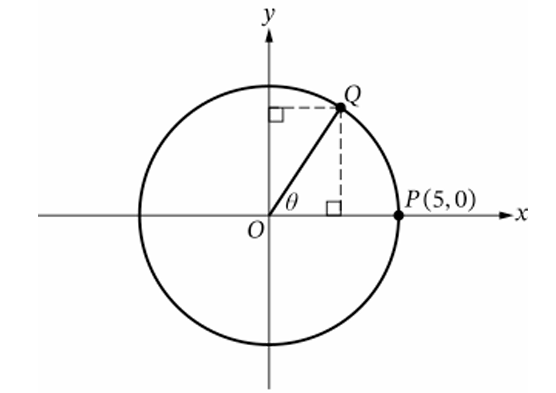
The figure shows a circle centered at the origin with an angle of measure $\theta$ radians in standard position and point $P$ on the circle. The terminal ray of the angle intersects the circle at point $Q$. The length of arc $\small \text{PQ}$ is $6$ units. Which of the following gives the distance of point $Q$ from the $y$-axis?
(A) $\cos\left(\frac{6}{5}\right)$
(B) $\sin\left(\frac{6}{5}\right)$
(C) $5 \cos\left(\frac{6}{5}\right)$
(D) $5 \sin\left(\frac{6}{5}\right)$
▶️ Answer/Explanation
Detailed solution

The radius of the circle is $r = 5$, as seen from point $P(5,0)$.
The arc length $s$ is given by the formula $s = r\theta$.
Substituting the given values, $6 = 5\theta$, which means $\theta = \frac{6}{5}$ radians.
The coordinates of point $Q$ on a circle are $(r \cos\theta, r \sin\theta)$.
The distance of a point from the $y$-axis is the absolute value of its $x$-coordinate.
Therefore, the distance is $|5 \cos(\frac{6}{5})|$.
Since $\frac{6}{5}$ radians is in the first quadrant, the distance is $5 \cos\left(\frac{6}{5}\right)$.
Correct Option: (C)
Question 68

Which of the following tables provides evidence that $f$ is an exponential function if $y = f(x)$?
(A)
$x$$y$
$1$$3$
$2$$6$
$3$$9$
$4$$12$
(B)
$x$$y$
$5$$30$
$6$$42$
$7$$56$
$8$$72$
(C)
$x$$\ln y$
$1$$1$
$2$$3$
$3$$9$
$4$$27$

(D)

$x$$\ln y$
$5$$50$
$6$$60$
$7$$70$
$8$$80$
▶️ Answer/Explanation
Detailed solution

An exponential function $y = a \cdot b^x$ becomes linear when transformed by logarithms.
Applying the natural log gives the equation $\ln y = \ln a + x \ln b$.
This implies that for an exponential function, $\ln y$ must have a constant rate of change relative to $x$.
In Table (D), as $x$ increases by $1$ unit, $\ln y$ increases by a constant addition of $10$.
Table (A) shows a linear relationship for $y$ itself, not an exponential one.
Table (C) shows $\ln y$ growing exponentially, which would mean $y$ grows even faster.
Only Table (D) shows the constant slope for $\ln y$ that characterizes an exponential function $f(x)$.
Thus, the correct choice is Table (D).

Question 69

The function $f$ is given by $f(x) = a \cdot c^x$, where $a > 0$ and $c > 1$. Which of the following is true about the values of constants $m$ and $b$ in the equation $\ln(f(x)) = mx + b$?
(A) $m > 0$ because $\ln c > 0$; $b$ can be any real number because $\ln a$ can be any real number.
(B) $m > 0$ because $\ln c > 0$; $b > 0$ because $\ln a > 0$.
(C) $m$ can be any real number because $\ln c$ can be any real number; $b$ can be any real number because $\ln a$ can be any real number.
(D) $m$ can be any real number because $\ln c$ can be any real number; $b > 0$ because $\ln a > 0$.
▶️ Answer/Explanation
Detailed solution

Take the natural log of the function: $\ln(f(x)) = \ln(a \cdot c^x)$.
Apply log properties: $\ln(f(x)) = \ln a + \ln(c^x) = (\ln c)x + \ln a$.
Comparing this to $mx + b$, we find $m = \ln c$ and $b = \ln a$.
Since $c > 1$, it follows that $\ln c > 0$, so $m > 0$.
Since $a > 0$, the value of $b = \ln a$ can be any real number ($-\infty < \ln a < \infty$).
Therefore, $m > 0$ and $b$ can be any real number.
The correct option is (A).

Question 70

In a semi-log plot, which of the following pairs of functions appear linear as parallel lines?
(A) $f(x) = 2x$ and $g(x) = 2x + 3$
(B) $f(x) = x^{2}$ and $g(x) = 3x^{2}$
(C) $f(x) = 2^{x}$ and $g(x) = 3 \cdot 2^{x}$
(D) $f(x) = \ln(2x)$ and $g(x) = 3 \ln(2x)$
▶️ Answer/Explanation
Detailed solution

In a semi-log plot, the vertical axis is logarithmic, so we plot $Y = \log(f(x))$.
For functions to appear linear, they must be of the form $y = Ab^{x}$, since $\log(Ab^{x}) = \log(A) + x\log(b)$.
For lines to be parallel, they must have the same slope in the log-transformed state.
In option (C), let $f(x) = 2^{x}$ and $g(x) = 3 \cdot 2^{x}$.
Applying log: $Y_{1} = \log(2^{x}) = x \log(2)$ and $Y_{2} = \log(3 \cdot 2^{x}) = \log(3) + x \log(2)$.
Both equations have the same slope, $\log(2)$, making them parallel lines.
Therefore, the correct choice is (C).

Question 71

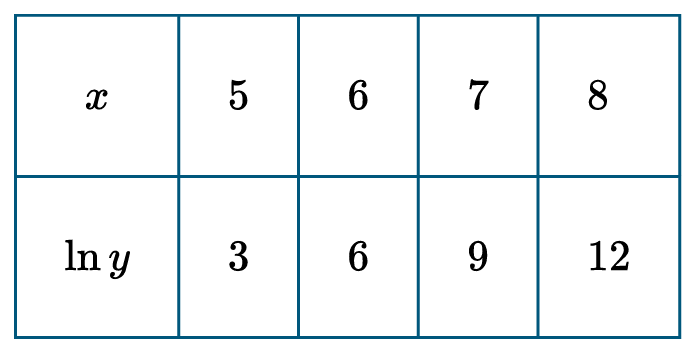
The table gives ordered pairs $(x, \ln y)$. For the function $y = f(x)$, which of the following statements about $f$ is supported by the data in the table?
(A) The function $f$ is logarithmic because the values of $x$ and the values of $\ln y$ both form arithmetic sequences.
(B) The function $f$ is linear because the values in each column form an arithmetic sequence.
(C) The function $f$ is exponential because the values of $x$ and the values of $\ln y$ both form arithmetic sequences.
(D) The function $f$ is exponential because the values of $\ln y$ increase faster than the values of $x$.
▶️ Answer/Explanation
Detailed solution

The $x$ values increase by a constant $1$ ($5, 6, 7, 8$), forming an arithmetic sequence.
The $\ln y$ values increase by a constant $3$ ($3, 6, 9, 12$), forming an arithmetic sequence.
Since $\ln y$ is a linear function of $x$, the relationship is of the form $\ln y = mx + b$.
Applying the exponential to both sides gives $y = e^{mx + b}$, which simplifies to $y = Ab^x$.
This structure confirms that the function $f(x)$ is an exponential function.
Therefore, statement (C) is the correct characterization of the data.
Correct Option: (C)
Question 72

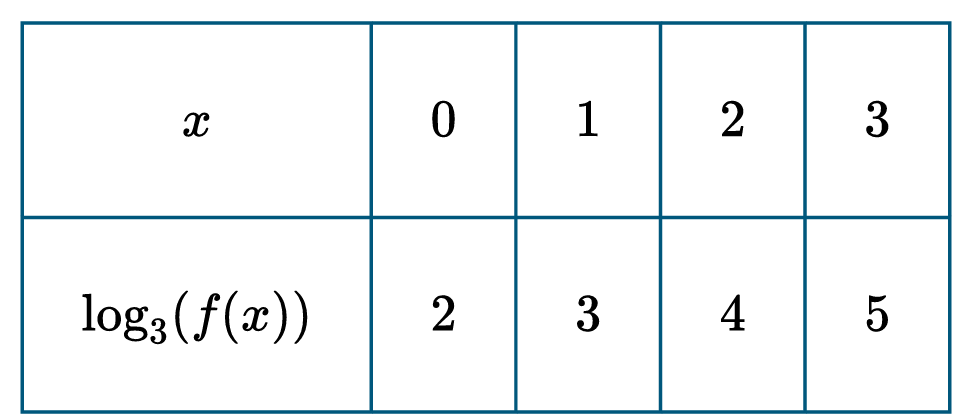
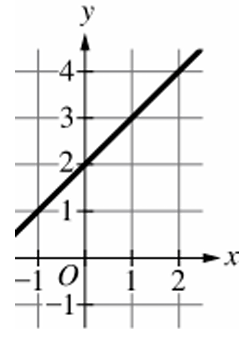
Consider the function $f$. The table gives values of $\log_{3}(f(x))$ for selected values of $x$. Which of the following is a graph of $y = f(x)$ ?
(A)
(B)
(C)
(D)
▶️ Answer/Explanation
Detailed solution

From the table, the linear relationship is $\log_{3}(f(x)) = x + 2$.
Convert this to exponential form: $f(x) = 3^{x+2}$.
Calculate the y-intercept by setting $x = 0$: $f(0) = 3^{0+2} = 9$.
Calculate the value at $x = 1$: $f(1) = 3^{1+2} = 27$.
Calculate the value at $x = 2$: $f(2) = 3^{2+2} = 81$.
The graph must be exponential and pass through points $(0, 9)$ and $(1, 27)$.
Therefore, the correct choice is (D).
Question 73

 
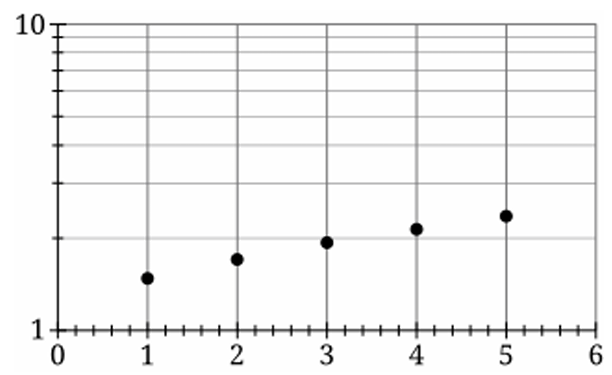
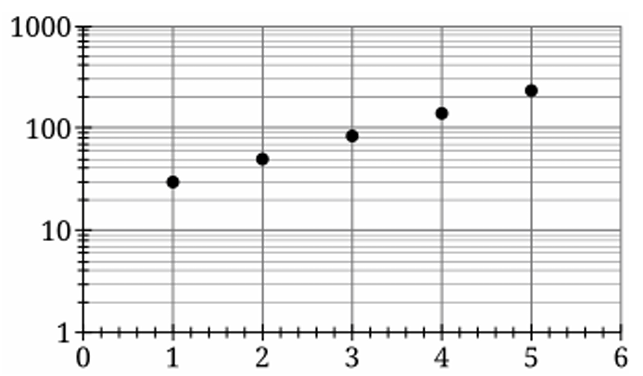
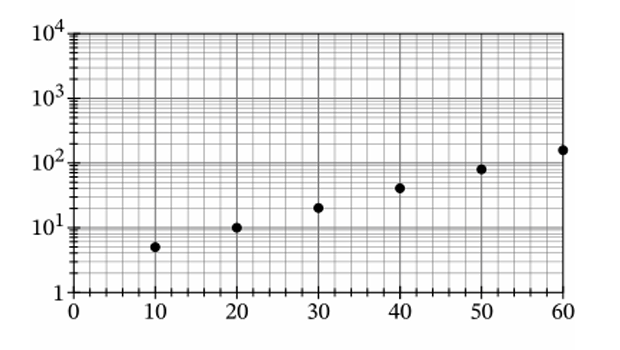
The number of thousands of people that have visited a new website is recorded every $10$ days for $60$ days. These data are used to produce a semi-log plot as shown. The function $N$ gives the number of thousands of people that have visited the website for day $t$. Which of the following could define $N(t)$?
(A) $\frac{1}{2}t$
(B) $\frac{1}{10}t + 5$
(C) $2.5 \cdot 2^{(t/10)}$
(D) $3 + 2^{(t/10)}$
▶️ Answer/Explanation
Detailed solution

The plot is semi-logarithmic, where a linear trend indicates an exponential function.
At $t = 20$, the point on the graph is at $10^1$, which means $N(20) = 10$.
At $t = 50$, the point is just below $10^2$ (roughly $80$); checking option (C): $2.5 \cdot 2^{(50/10)} = 2.5 \cdot 32 = 80$.
Testing option (C) for $t = 20$ gives $2.5 \cdot 2^{(20/10)} = 2.5 \cdot 4 = 10$, matching the data exactly.
Options (A) and (B) are linear functions, which would appear curved on a semi-log scale.
Option (D) at $t = 20$ yields $3 + 2^2 = 7$, which does not match the observed value of $10$.
Therefore, the function that correctly defines the data is (C).
Question 74

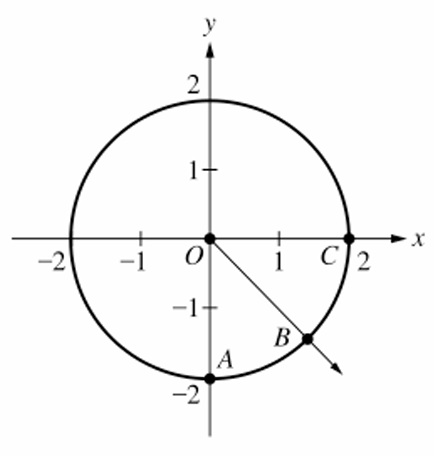
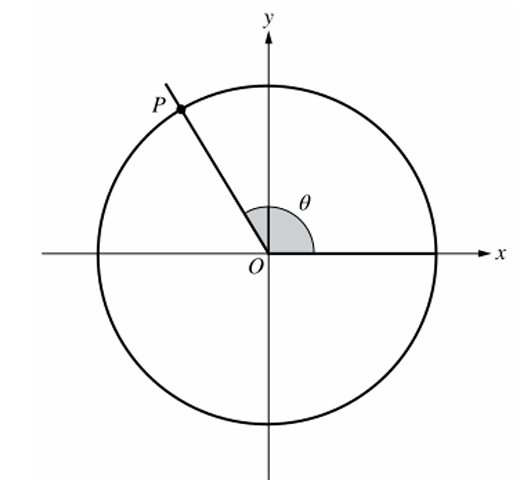
The figure shows a circle of radius $2$ along with four labeled points in the $xy$-plane. The measure of angle $COB$ is equal to the measure of angle $AOB$. What are the coordinates of point $B$?
(A) $\left( \cos\left( \frac{7\pi}{4} \right), \sin\left( \frac{7\pi}{4} \right) \right)$
(B) $\left( \sin\left( \frac{7\pi}{4} \right), \cos\left( \frac{7\pi}{4} \right) \right)$
(C) $\left( 2\cos\left( \frac{7\pi}{4} \right), 2\sin\left( \frac{7\pi}{4} \right) \right)$
(D) $\left( 2\sin\left( \frac{7\pi}{4} \right), 2\cos\left( \frac{7\pi}{4} \right) \right)$
▶️ Answer/Explanation
Detailed solution

The circle has a radius $r = 2$.
Point $C$ is at $0$ radians and point $A$ is at $\frac{3\pi}{2}$ radians (or $-\frac{\pi}{2}$).
Since angle $COB$ equals angle $AOB$, $B$ is the midpoint of the arc between $0$ and $\frac{3\pi}{2}$ in the clockwise direction.
The angle $\theta$ for point $B$ in standard position is $2\pi – \frac{\pi}{4} = \frac{7\pi}{4}$ radians.
The coordinates of any point on a circle are given by $(r\cos\theta, r\sin\theta)$.
Substituting the values, the coordinates of $B$ are $\left( 2\cos\left( \frac{7\pi}{4} \right), 2\sin\left( \frac{7\pi}{4} \right) \right)$.
Therefore, the correct option is (C).
Question 75

In the \(xy\)-plane, an angle in standard position measures \(\frac{5\pi}{6}\) radians. A circle centered at the origin has radius \(4\). What are the coordinates of the point of intersection of the terminal ray of the angle and the circle?
(A) \((-2\sqrt{3}, 2)\)
(B) \((-\frac{\sqrt{3}}{2}, \frac{1}{2})\)
(C) \((\frac{\sqrt{3}}{2}, \frac{1}{2})\)
(D) \((2\sqrt{3}, 2)\)
▶️ Answer/Explanation
Detailed solution

The coordinates of a point on a circle are defined as \((x, y) = (r \cos \theta, r \sin \theta)\).
Given radius \(r = 4\) and angle \(\theta = \frac{5\pi}{6}\) radians.
The angle \(\frac{5\pi}{6}\) is in the second quadrant, where cosine is negative and sine is positive.
Calculate \(x = 4 \cos(\frac{5\pi}{6}) = 4 (-\frac{\sqrt{3}}{2}) = -2\sqrt{3}\).
Calculate \(y = 4 \sin(\frac{5\pi}{6}) = 4 (\frac{1}{2}) = 2\).
The coordinates of the intersection point are \((-2\sqrt{3}, 2)\).
Therefore, the correct option is (A).

Question 76

Angles $A$ and $B$ are in standard position in the $xy$-plane. The measure of angle $A$ is $\frac{2\pi}{3}$ radians, and the measure of angle $B$ is $\frac{4\pi}{3}$ radians. The terminal rays of both angles intersect a circle centered at the origin with radius $20$. What is the distance between these two points of intersection: the circle and terminal ray of angle $A$, and the circle and terminal ray of angle $B$?
(A) $\cos\left(\frac{2\pi}{3}\right) – \cos\left(\frac{4\pi}{3}\right)$
(B) $20 \cos\left(\frac{2\pi}{3}\right) – 20 \cos\left(\frac{4\pi}{3}\right)$
(C) $\sin\left(\frac{2\pi}{3}\right) – \sin\left(\frac{4\pi}{3}\right)$
(D) $20 \sin\left(\frac{2\pi}{3}\right) – 20 \sin\left(\frac{4\pi}{3}\right)$
▶️ Answer/Explanation
Detailed solution

The coordinates of a point on a circle of radius $r$ at angle $\theta$ are $(r \cos \theta, r \sin \theta)$.
Point $A$ is at $\left(20 \cos\left(\frac{2\pi}{3}\right), 20 \sin\left(\frac{2\pi}{3}\right)\right)$ and Point $B$ is at $\left(20 \cos\left(\frac{4\pi}{3}\right), 20 \sin\left(\frac{4\pi}{3}\right)\right)$.
Both angles have the same reference angle $\frac{\pi}{3}$, so their $x$-coordinates are both $20 \cos\left(\frac{2\pi}{3}\right) = 20 \cos\left(\frac{4\pi}{3}\right) = -10$.
Since the $x$-coordinates are identical, the points lie on a vertical line.
The distance is the difference between the $y$-coordinates: $y_A – y_B$.
This results in $20 \sin\left(\frac{2\pi}{3}\right) – 20 \sin\left(\frac{4\pi}{3}\right)$.
Thus, the correct option is (D).

Question 77

In the $xy$-plane, the terminal ray of angle $\theta$ in standard position intersects a circle of radius $r$ at the point $(10, -10\sqrt{3})$. What are the values of $\theta$ and $r$?
(A) $\theta = \frac{5\pi}{3}$ and $r = 10$
(B) $\theta = \frac{5\pi}{3}$ and $r = 20$
(C) $\theta = \frac{11\pi}{6}$ and $r = 10$
(D) $\theta = \frac{11\pi}{6}$ and $r = 20$
▶️ Answer/Explanation
Detailed solution

The radius is calculated using $r = \sqrt{x^2 + y^2} = \sqrt{10^2 + (-10\sqrt{3})^2}$.
This simplifies to $r = \sqrt{100 + 300} = \sqrt{400} = 20$.
The point $(10, -10\sqrt{3})$ lies in the fourth quadrant since $x > 0$ and $y < 0$.
The reference angle $\alpha$ is found by $\tan \alpha = \left| \frac{y}{x} \right| = \left| \frac{-10\sqrt{3}}{10} \right| = \sqrt{3}$.
Thus, $\alpha = \frac{\pi}{3}$, making the standard position angle $\theta = 2\pi – \frac{\pi}{3} = \frac{5\pi}{3}$.
Therefore, the correct values are $r = 20$ and $\theta = \frac{5\pi}{3}$.
The correct option is (B).

Question 78

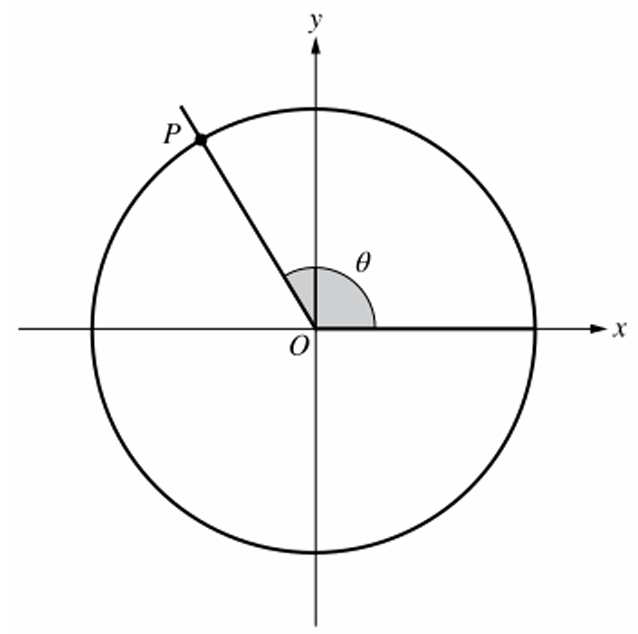
The figure shows the terminal ray of angle $\theta$, in standard position, intersecting the unit circle at point $P$ in the $xy$-plane. The function $g$ is given by $g(z) = \cos z$. For the angle $\omega$ (not shown), $\theta < \omega < \pi$. Which of the following is true?
(A) $g(\omega) < g(\theta)$
(B) $g(\omega) > g(\theta)$
(C) $g(\omega) = g(\theta)$
(D) Depending on the value of $\omega$, sometimes $g(\omega) < g(\theta)$ and sometimes $g(\omega) > g(\theta)$.
▶️ Answer/Explanation
Detailed solution

The function is defined as $g(z) = \cos z$.
The angle $\theta$ is in the second quadrant, where $\frac{\pi}{2} < \theta < \pi$.
We are given the interval $\theta < \omega < \pi$.
In the second quadrant, the cosine function is strictly decreasing.
As the angle $z$ increases from $\theta$ toward $\pi$, the $x$-coordinate on the unit circle moves left.
Therefore, if $\omega > \theta$, then $\cos \omega < \cos \theta$.
This means $g(\omega) < g(\theta)$, making (A) the correct choice.
Question 79

The figure shows the terminal ray of angle $\theta$, in standard position, intersecting the unit circle at point $P$ in the $xy$-plane. The function $f$ is given by $f(z) = \sin z$. For the angle $\beta$ (not shown), $\frac{\pi}{2} < \beta < \theta$. Which of the following is true?
(A) $f(\beta) < f(\theta)$
(B) $f(\beta) > f(\theta)$
(C) $f(\beta) = f(\theta)$
(D) Depending on the value of $\beta$, sometimes $f(\beta) < f(\theta)$ and sometimes $f(\beta) > f(\theta)$.
▶️ Answer/Explanation
Detailed solution

The point $P$ is in the second quadrant, meaning $\frac{\pi}{2} < \theta < \pi$.
The function is defined as $f(z) = \sin z$.
In the interval $(\frac{\pi}{2}, \pi)$, the sine function is strictly decreasing.
Given the inequality $\frac{\pi}{2} < \beta < \theta$, both angles are in the second quadrant.
Since $\beta < \theta$ and sine is decreasing here, it follows that $\sin \beta > \sin \theta$.
Therefore, $f(\beta) > f(\theta)$, which corresponds to option (B).
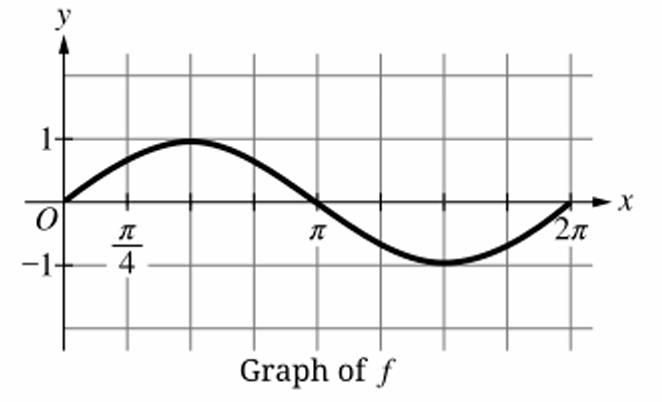
Question 80

The function $g$ is given by $g(\theta) = \cos \theta$. Which of the following describes $g$ on the interval from $\theta = \frac{3\pi}{2}$ to $\theta = 2\pi$ ?
(A) $g$ is decreasing, and the graph of $g$ is concave down.
(B) $g$ is decreasing, and the graph of $g$ is concave up.
(C) $g$ is increasing, and the graph of $g$ is concave down.
(D) $g$ is increasing, and the graph of $g$ is concave up.
▶️ Answer/Explanation
Detailed solution

The first derivative $g'(\theta) = -\sin \theta$ is positive on $(\frac{3\pi}{2}, 2\pi)$, so $g$ is increasing.
The second derivative $g”(\theta) = -\cos \theta$ is negative on $(\frac{3\pi}{2}, 2\pi)$ because $\cos \theta > 0$ in Quadrant IV.
Since $g”(\theta) < 0$, the graph of $g$ is concave down.
In the fourth quadrant, $\cos \theta$ increases from $0$ to $1$.
The curvature curves “downward” toward the horizontal axis as it approaches the maximum.
Therefore, the correct description is that $g$ is increasing and concave down.
Correct Option: (C)

Question 81

The figure shows the graph of the function $f$ in the $xy$-plane. The function $f$ is either a sine function or a cosine function. Consider an angle in standard position in another $xy$-plane (not shown). The terminal ray of the angle intersects the unit circle at point $P$. Which of the following is true about the relationship between $f$ and $P$?
(A) $f$ gives the vertical distance of $P$ from the $x$-axis for angle measures from $0$ to $2\pi$.
(B) $f$ gives the horizontal distance of $P$ from the $y$-axis for angle measures from $0$ to $2\pi$.
(C) $f$ gives the vertical displacement of $P$ from the $x$-axis for angle measures from $0$ to $2\pi$.
(D) $f$ gives the horizontal displacement of $P$ from the $y$-axis for angle measures from $0$ to $2\pi$.
▶️ Answer/Explanation
Detailed solution

The graph starts at $(0,0)$ and follows the shape of $y = \sin(x)$.
On a unit circle, the coordinates of point $P$ are $(\cos\theta, \sin\theta)$.
The $y$-coordinate, $\sin\theta$, represents the vertical displacement from the $x$-axis.
“Displacement” is used instead of “distance” because the function $f$ has negative values.
Distance is always non-negative, whereas $f$ is negative on the interval $(\pi, 2\pi)$.
Therefore, $f$ represents the vertical displacement of $P$ for $0 \le \theta \le 2\pi$.
The correct option is (C).
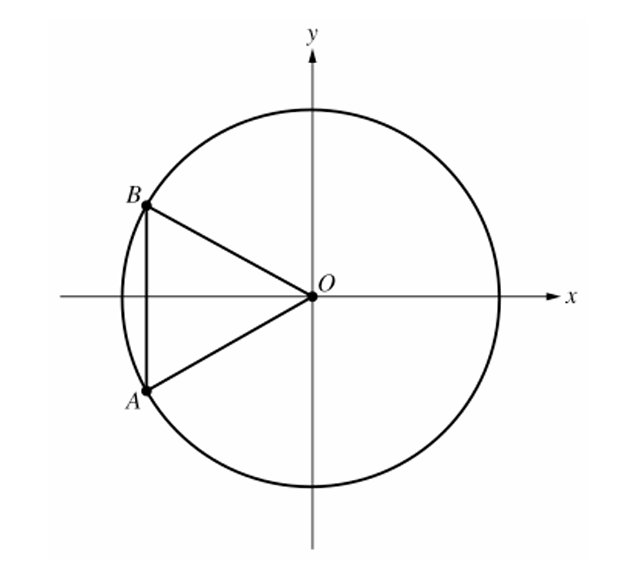
Question 82

The function $f$ is given by $f(\theta) = \cos \theta$, and the function $g$ is given by $g(\theta) = \sin \theta$. Which of the following describes $f$ and $g$ on the interval from $\theta = \frac{\pi}{2}$ to $\theta = \pi$?
(A) Both $f$ and $g$ are decreasing.
(B) Both $f$ and $g$ are increasing.
(C) $f$ is decreasing, and $g$ is increasing.
(D) $f$ is increasing, and $g$ is decreasing.
▶️ Answer/Explanation
Detailed solution

The interval $[\frac{\pi}{2}, \pi]$ corresponds to the Second Quadrant of the unit circle.
For $f(\theta) = \cos \theta$, the value moves from $\cos(\frac{\pi}{2}) = 0$ down to $\cos(\pi) = -1$.
Since the values are getting smaller, $f$ is decreasing.
For $g(\theta) = \sin \theta$, the value moves from $\sin(\frac{\pi}{2}) = 1$ down to $\sin(\pi) = 0$.
Since the values are getting smaller, $g$ is decreasing.
Therefore, both $f$ and $g$ are decreasing on this interval.
The correct option is (A).

Question 83

The function $f$ is given by $f(\theta) = \sin \theta$. Which of the following describes $f$ on the interval from $\theta = \pi$ to $\theta = \frac{3\pi}{2}$?
(A) $f$ is decreasing, and the graph of $f$ is concave down.
(B) $f$ is decreasing, and the graph of $f$ is concave up.
(C) $f$ is increasing, and the graph of $f$ is concave down.
(D) $f$ is increasing, and the graph of $f$ is concave up.
▶️ Answer/Explanation
Detailed solution

The correct option is (B).
On the interval $[\pi, \frac{3\pi}{2}]$, the value of $\sin \theta$ goes from $0$ to $-1$, meaning $f$ is decreasing.
The first derivative $f'(\theta) = \cos \theta$ is negative in the third quadrant, confirming the function is decreasing.
The second derivative $f”(\theta) = -\sin \theta$ is positive on this interval because $\sin \theta$ is negative.
Since $f”(\theta) > 0$, the graph of $f$ is concave up.
Therefore, $f$ is decreasing and concave up on the given interval.

Question 84

The figure shows equilateral triangle $ABO$ with sides of length $10$ in the $xy$-plane. Segment $AB$ is perpendicular to the $x$-axis. The terminal ray of an angle $\theta$ (not shown) in standard position passes through the point $B$. What is the value of $10 \sin \theta$?
(A) $-5\sqrt{3}$
(B) $-\frac{\sqrt{3}}{2}$
(C) $\frac{1}{2}$
(D) $5$
▶️ Answer/Explanation
Detailed solution

Since $\triangle ABO$ is equilateral with side length $10$, we have $OA = OB = AB = 10$.
Segment $AB$ is vertical and bisected by the $x$-axis due to the symmetry of the equilateral triangle centered at the origin horizontally.
The $y$-coordinate of point $B$ is half the length of side $AB$, which is $\frac{10}{2} = 5$.
Point $B$ lies on a circle centered at the origin with radius $r = OB = 10$.
In trigonometry, for any point $(x, y)$ on the terminal side of an angle $\theta$, $\sin \theta = \frac{y}{r}$.
Substituting the known values, we get $\sin \theta = \frac{5}{10} = \frac{1}{2}$.
The value of $10 \sin \theta$ is $10 \left( \frac{1}{2} \right) = 5$.
Therefore, the correct option is (D).
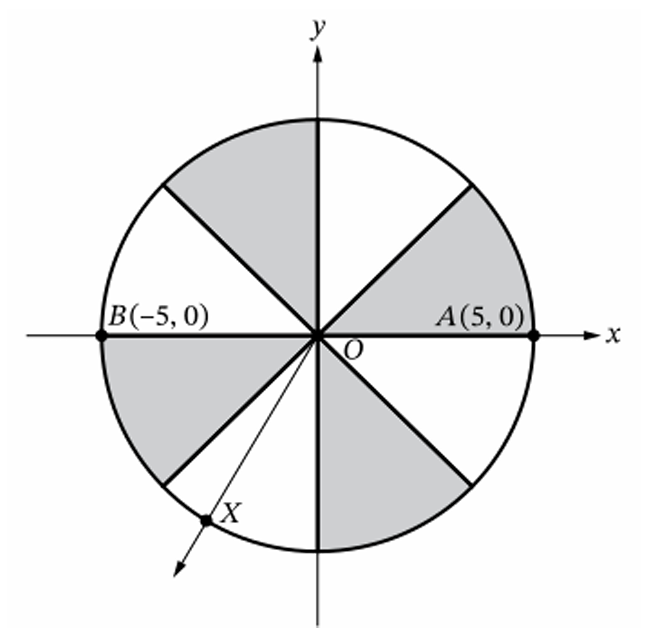
Question 85

The figure shows a spinner with eight congruent sectors in the $xy$-plane. The origin and three points are labeled. If the coordinates of $X$ are $\left( -\frac{5}{2}, \frac{-5\sqrt{3}}{2} \right)$, what is the measure of angle $XOB$?
(A) $\frac{\pi}{6}$
(B) $\frac{\pi}{3}$
(C) $\frac{7\pi}{6}$
(D) $\frac{4\pi}{3}$
▶️ Answer/Explanation
Detailed solution

Point $B$ is on the negative $x$-axis, so its position corresponds to an angle of $\pi$ radians.
Point $X$ has coordinates $x = -\frac{5}{2}$ and $y = -\frac{5\sqrt{3}}{2}$ in Quadrant III.
The reference angle $\theta$ for $X$ is found using $\tan(\theta) = \left| \frac{y}{x} \right| = \left| \frac{-5\sqrt{3}/2}{-5/2} \right| = \sqrt{3}$.
This gives a reference angle of $\frac{\pi}{3}$ measured from the negative $x$-axis.
Since angle $XOB$ is the angle between the ray $OX$ and the ray $OB$ (the negative $x$-axis), the measure is simply the reference angle.
Therefore, the measure of angle $XOB$ is $\frac{\pi}{3}$.
The correct option is (B).
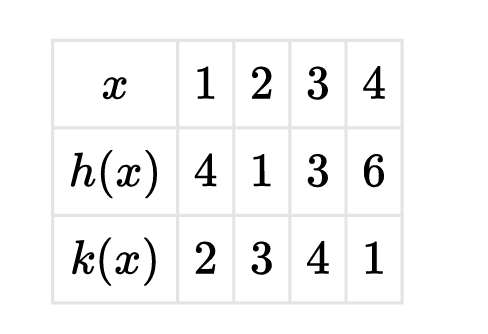
Question 86

The table gives values for the invertible functions $h$ and $k$ at selected values of $x$. What is the value of $h^{-1}(k(3))$ ?
(A) $1$
(B) $2$
(C) $6$
(D) $12$
▶️ Answer/Explanation
Detailed solution

First, locate $x = 3$ in the table to find the value of $k(3)$.
From the table, when $x = 3$, the value of $k(3) = 4$.
The expression now becomes $h^{-1}(4)$.
To find $h^{-1}(4)$, look for the value of $x$ such that $h(x) = 4$.
From the table, $h(x) = 4$ when $x = 1$.
Therefore, $h^{-1}(4) = 1$.
The final value is $1$, which corresponds to option (A).
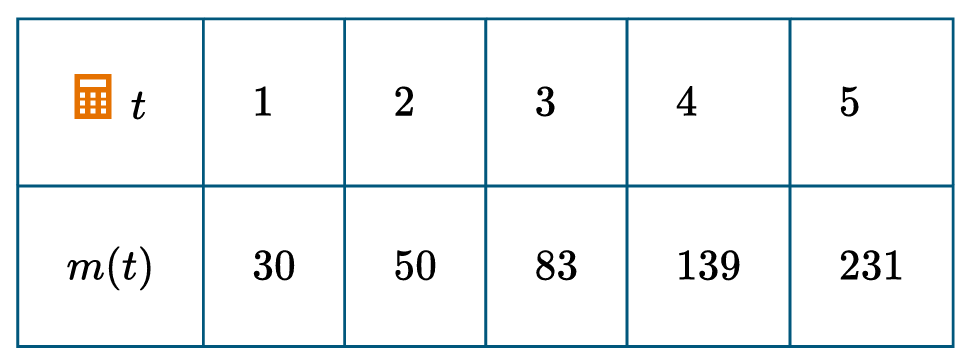
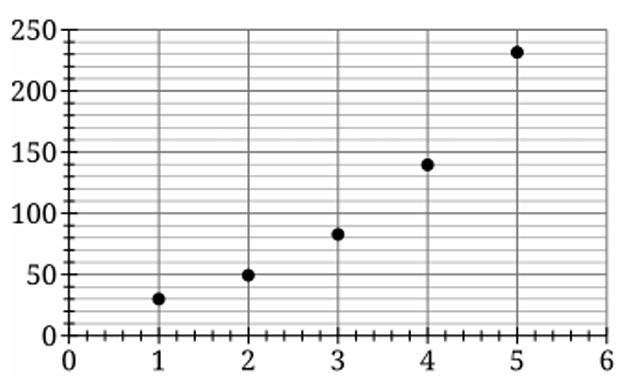
Question 87 (Calc allowed)

The table gives values for a function $m$ at selected values of $t$. Which of the following graphs could represent these data in a semi-log plot, where the vertical axis is logarithmically scaled?
(A)
(B)
(C)
(D)
▶️ Answer/Explanation
Detailed solution

The correct graph is (C).
A semi-log plot uses a logarithmic scale for the vertical axis to linearize exponential data.
The data values for $m(t)$ range from $30$ to $231$.
The vertical axis must include the interval $[30, 231]$, which fits within the $10$ to $1000$ scale.
The constant ratio $\frac{m(t+1)}{m(t)} \approx 1.67$ indicates the function is exponential.
On a logarithmic scale, this exponential relationship appears as a straight line.
Graph (C) shows the points forming a linear pattern on a log-scaled $y$-axis.
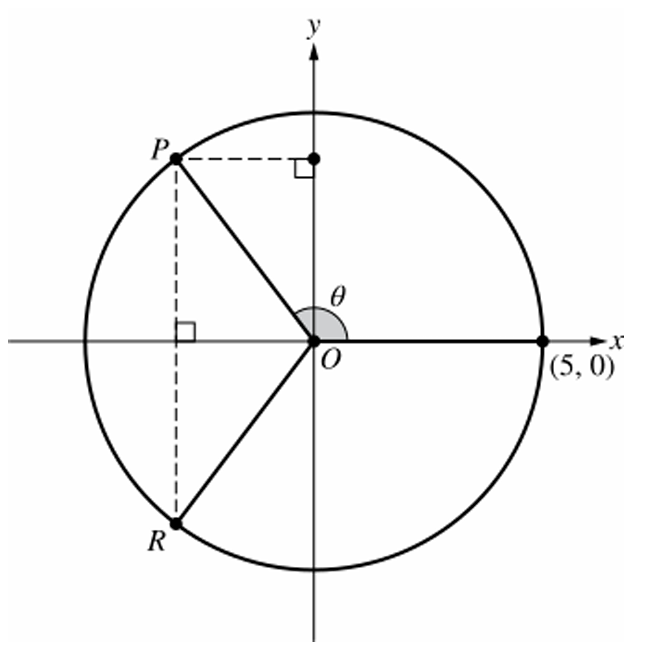
Question 88

The function $k$ is given by $k(\theta) = 2 \sin \theta$. What are all values of $\theta$, for $0 \le \theta < 2\pi$, where $k(\theta) = -1$?
(A) $\theta = \frac{\pi}{6}$ and $\theta = \frac{5\pi}{6}$
(B) $\theta = \frac{\pi}{3}$ and $\theta = \frac{5\pi}{3}$
(C) $\theta = \frac{2\pi}{3}$ and $\theta = \frac{4\pi}{3}$
(D) $\theta = \frac{7\pi}{6}$ and $\theta = \frac{11\pi}{6}$
▶️ Answer/Explanation
Detailed solution

Set the function equal to the target value: $2 \sin \theta = -1$.
Isolate the sine function by dividing both sides by $2$ to get $\sin \theta = -\frac{1}{2}$.
Identify the reference angle where $\sin \theta = \frac{1}{2}$, which is $\theta_{ref} = \frac{\pi}{6}$.
Since the sine value is negative, $\theta$ must be in Quadrant III or Quadrant IV.
In Quadrant III: $\theta = \pi + \frac{\pi}{6} = \frac{7\pi}{6}$.
In Quadrant IV: $\theta = 2\pi – \frac{\pi}{6} = \frac{11\pi}{6}$.
Therefore, the correct option is (D).

Question 89

The figure shows a circle centered at the origin with an angle of measure $\theta$ radians in standard position. The terminal ray of the angle intersects the circle at point $P$, and point $R$ also lies on the circle. The coordinates of $P$ are $(x, y)$, and the coordinates of $R$ are $(x, -y)$. Which of the following is true about the sine of $\theta$?
(A) $\sin \theta = \frac{x}{5}$, because it is the ratio of the horizontal displacement of $P$ from the $y$-axis to the distance between the origin and $P$.
(B) $\sin \theta = \frac{x}{5}$, because it is the ratio of the horizontal displacement of $R$ from the $y$-axis to the distance between the origin and $R$.
(C) $\sin \theta = \frac{-y}{5}$, because it is the ratio of the vertical displacement of $R$ from the $x$-axis to the distance between the origin and $R$.
(D) $\sin \theta = \frac{y}{5}$, because it is the ratio of the vertical displacement of $P$ from the $x$-axis to the distance between the origin and $P$.
▶️ Answer/Explanation
Detailed solution

The circle is centered at the origin $(0, 0)$ and passes through $(5, 0)$, so its radius $r$ is $5$.
Point $P(x, y)$ lies on the terminal ray of the angle $\theta$ in standard position.
By trigonometric definition on a circle, $\sin \theta$ is the ratio of the $y$-coordinate to the radius: $\sin \theta = \frac{y}{r}$.
The $y$-coordinate represents the vertical displacement of point $P$ from the $x$-axis.
The radius $r = 5$ represents the distance from the origin to point $P$.
Therefore, $\sin \theta = \frac{y}{5}$ based on the position and coordinates of point $P$.
This matches option (D).
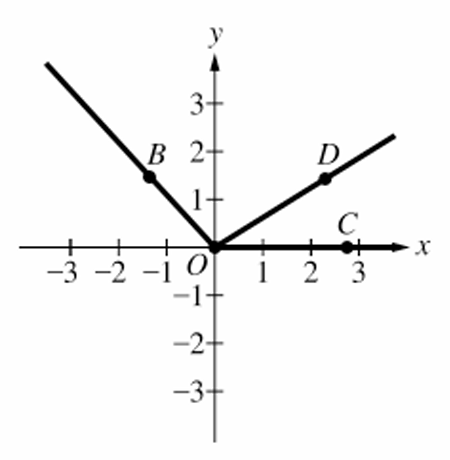
Question 90

The figure gives four points and some corresponding rays in the $xy$-plane. Which of the following is true?
(A) Angle $COB$ is in standard position with initial ray $OB$ and terminal ray $OC$.
(B) Angle $COB$ is in standard position with initial ray $OC$ and terminal ray $OB$.
(C) Angle $DOB$ is in standard position with initial ray $OB$ and terminal ray $OD$.
(D) Angle $DOB$ is in standard position with initial ray $OD$ and terminal ray $OB$.
▶️ Answer/Explanation
Detailed solution

An angle is in standard position if its vertex is at the origin $(0,0)$ and its initial ray lies on the positive $x$-axis.
In the given figure, point $C$ lies on the positive $x$-axis at $(3,0)$, making ray $OC$ the initial ray.
Angle $COB$ starts at ray $OC$ and rotates counter-clockwise to terminal ray $OB$.
Therefore, angle $COB$ is in standard position with initial ray $OC$ and terminal ray $OB$.
Options (C) and (D) are incorrect because the initial ray for standard position must be $OC$, not $OB$ or $OD$.
Option (A) is incorrect because it swaps the definitions of the initial and terminal rays.
The correct statement is (B).
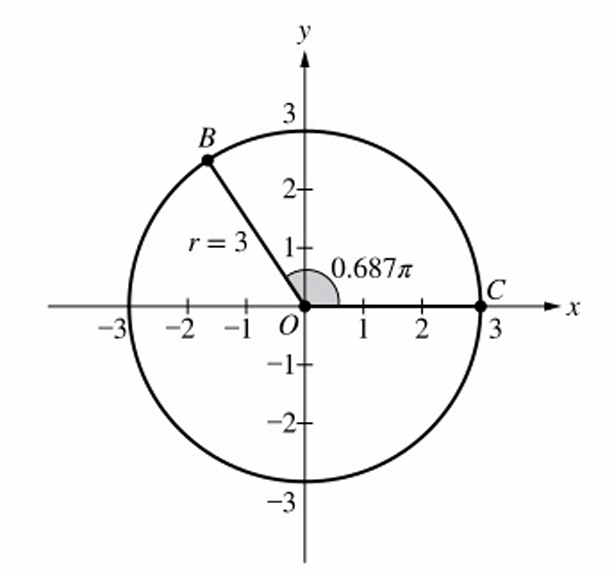
Question 91 (Calc allowed)

The figure gives an angle in standard position with measure $0.687\pi$ and a circle with radius $3$ in the $xy$-plane. What is the length of the minor arc of the circle from point $C$ to point $B$, the arc subtended by the angle?
(A) $0.719$
(B) $2.158$
(C) $6.475$
(D) $9.712$
▶️ Answer/Explanation
Detailed solution

The formula for the arc length $s$ is given by $s = r\theta$, where $\theta$ is in radians.
The radius of the circle is given as $r = 3$.
The central angle subtending the arc is given as $\theta = 0.687\pi$.
Substitute the values into the formula: $s = 3 \times (0.687\pi)$.
Calculate the product: $s = 2.061\pi$.
Using the approximation $\pi \approx 3.14159$, the length is $s \approx 6.4748…$
Rounding to three decimal places, the arc length is $6.475$.
The correct option is (C).
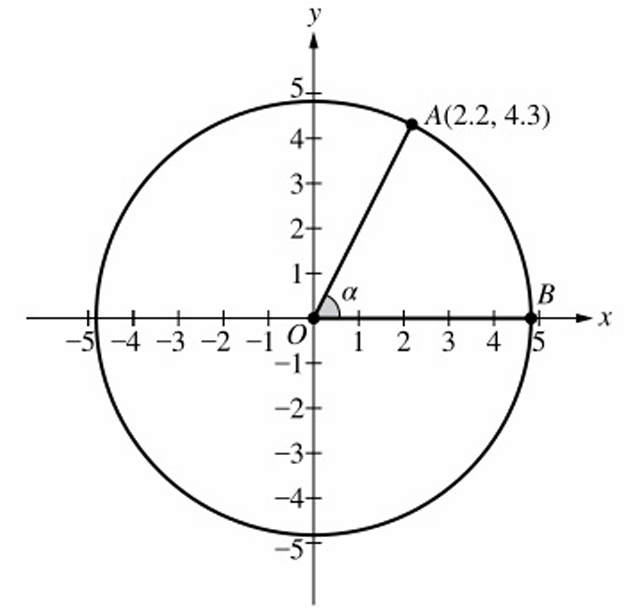
Question 92

The figure gives a circle of radius $4.8$ in the $xy$-plane with center at the origin, an angle $\alpha$ in standard position, and three labeled points. Which of the following is the value of $\sin \alpha$ ?
(A) $\frac{2.2}{4.8}$
(B) $\frac{4.3}{4.8}$
(C) $2.2$
(D) $4.3$
▶️ Answer/Explanation
Detailed solution

Point $A$ lies on the circle with coordinates $(x, y) = (2.2, 4.3)$.
The radius of the circle is given as $r = 4.8$.
For an angle $\alpha$ in standard position, the sine is defined as $\sin \alpha = \frac{y}{r}$.
Substitute the $y$-coordinate of point $A$, which is $4.3$.
Substitute the radius value, which is $4.8$.
Therefore, $\sin \alpha = \frac{4.3}{4.8}$.
The correct option is (B).
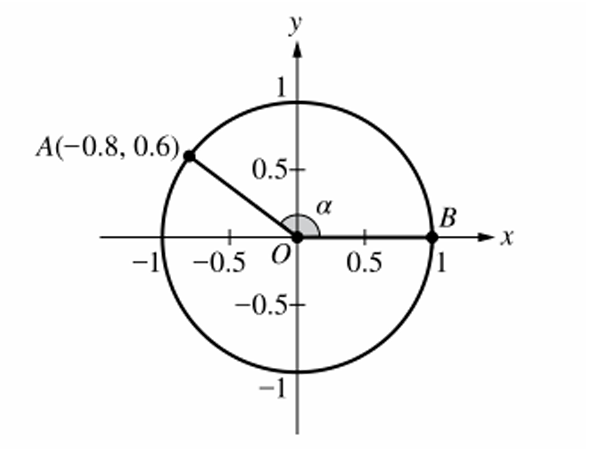
Question 93

In the $xy$-plane, angle $BAC$ is an angle in standard position with terminal ray $AC$, which intersects the unit circle at the point with coordinates $(0.4, -0.9)$. Which of the following descriptions is correct?
(A) The tangent of angle $BAC$ is $-\frac{4}{9}$, and the slope of ray $AC$ is $-\frac{4}{9}$.
(B) The tangent of angle $BAC$ is $-\frac{4}{9}$, and the slope of ray $AC$ is $-\frac{9}{4}$.
(C) The tangent of angle $BAC$ is $-\frac{9}{4}$, and the slope of ray $AC$ is $-\frac{9}{4}$.
(D) The tangent of angle $BAC$ is $-\frac{9}{4}$, and the slope of ray $AC$ is $\frac{4}{9}$.
▶️ Answer/Explanation
Detailed solution

The terminal ray $AC$ passes through the origin $(0,0)$ and the point $(0.4, -0.9)$.
The slope of ray $AC$ is calculated as $m = \frac{y_2 – y_1}{x_2 – x_1} = \frac{-0.9 – 0}{0.4 – 0} = -\frac{0.9}{0.4}$.
Simplifying the slope gives $m = -\frac{9}{4}$.
For an angle $\theta$ in standard position, $\tan(\theta) = \frac{y}{x}$ where $(x, y)$ is a point on the terminal ray.
Thus, $\tan(BAC) = \frac{-0.9}{0.4} = -\frac{9}{4}$.
Both the tangent of the angle and the slope of the ray are equal to $-\frac{9}{4}$.
Therefore, the correct description is given in option (C).

Question 94

An angle $\theta$ is in standard position in the $xy$-plane. Which of the following is true about $\theta$ on the interval $0 \le \theta \le 2\pi$ if $\tan \theta = 1$?
(A) There is a value of $\theta$ on $0 \le \theta \le 2\pi$ for which $\tan \theta = 1$ in Quadrant I only.
(B) There are values of $\theta$ on $0 \le \theta \le 2\pi$ for which $\tan \theta = 1$ in Quadrants I and III only.
(C) There are values of $\theta$ on $0 \le \theta \le 2\pi$ for which $\tan \theta = 1$ in all four Quadrants.
(D) There is no value of $\theta$ on $0 \le \theta \le 2\pi$ for which $\tan \theta = 1$.
▶️ Answer/Explanation
Detailed solution

The correct option is (B).
The tangent function is defined as $\tan \theta = \frac{y}{x}$ in the Cartesian plane.
For $\tan \theta = 1$, the values of $x$ and $y$ must have the same sign and magnitude.
In Quadrant I, both $x > 0$ and $y > 0$, so $\tan \theta = \frac{+}{+} = 1$ at $\theta = \frac{\pi}{4}$.
In Quadrant III, both $x < 0$ and $y < 0$, so $\tan \theta = \frac{-}{-} = 1$ at $\theta = \frac{5\pi}{4}$.
In Quadrants II and IV, $x$ and $y$ have opposite signs, making $\tan \theta$ negative.
Thus, there are exactly two solutions in the interval $[0, 2\pi]$, located in Quadrants I and III.

Question 95

The figure shows a unit circle in the $xy$-plane, an angle $\alpha$ in standard position, and three labeled points. Which of the following is the value of $\cos \alpha$?
(A) $-0.8$
(B) $-0.6$
(C) $0.6$
(D) $0.8$
▶️ Answer/Explanation
Detailed solution

The terminal side of angle $\alpha$ intersects the unit circle at point $A(-0.8, 0.6)$.
By definition, for any point $(x, y)$ on a unit circle, $x = \cos \alpha$ and $y = \sin \alpha$.
The $x$-coordinate of point $A$ is given as $-0.8$.
Therefore, $\cos \alpha = -0.8$.
The correct option is (A).

Scroll to Top