Home / unit-2-ap-precalculus-exponential-logarithmic-functions-test-form-b

Question 1

The function $f$ is a logarithmic function. Use interval notation to state the domain.
$f(x) = \ln(2x^2 – 3x – 20)$
A. $(-\infty, -\frac{5}{2}) \cup (4, \infty)$
B. $(-\infty, -5) \cup (\frac{5}{2}, \infty)$
C. $(-\infty, -4) \cup (\frac{5}{2}, \infty)$
D. $(-\infty, -4) \cup (-\frac{5}{2}, \infty)$
▶️ Answer/Explanation
Detailed solution

The domain of a natural logarithm $\ln(u)$ requires the argument to be strictly positive: $2x^2 – 3x – 20 > 0$.
Factor the quadratic expression: $(2x + 5)(x – 4) > 0$.
Identify the critical values (roots) where the expression equals zero: $x = -\frac{5}{2}$ and $x = 4$.
Test intervals on a number line: $(-\infty, -\frac{5}{2})$, $(-\frac{5}{2}, 4)$, and $(4, \infty)$.
The expression is positive when $x < -\frac{5}{2}$ or $x > 4$.
In interval notation, the domain is $(-\infty, -\frac{5}{2}) \cup (4, \infty)$.
Therefore, the correct option is A.

Question 2

What are all values of $x$ for which $\log_{4} x + \log_{4}(x – 6) = 2$?
A. $\{-8, 2\}$
B. $\{-2, 8\}$
C. $\{2\}$
D. $\{8\}$
▶️ Answer/Explanation
Detailed solution

Use the product property of logarithms: $\log_{4}[x(x – 6)] = 2$.
Convert to exponential form: $x(x – 6) = 4^2$, which simplifies to $x^2 – 6x = 16$.
Rearrange into a quadratic equation: $x^2 – 6x – 16 = 0$.
Factor the quadratic: $(x – 8)(x + 2) = 0$, giving potential solutions $x = 8$ and $x = -2$.
Check for extraneous solutions: $x$ must be greater than $6$ for the original logarithms to be defined.
Since $\log_{4}(-2)$ is undefined, $x = -2$ is extraneous.
The only valid solution is $x = 8$.
Correct Option: D

Question 3

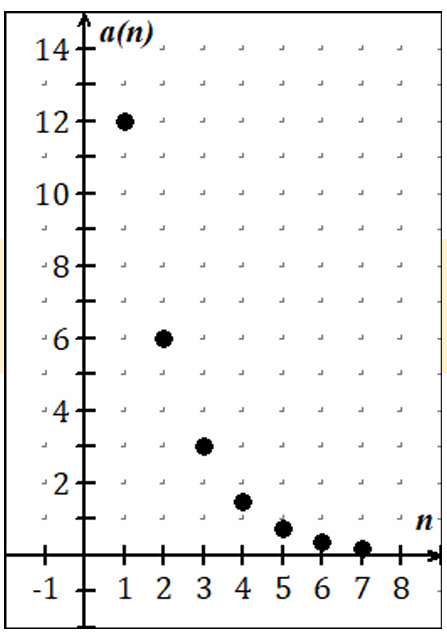
Values of the terms of a geometric sequence $a_n$ are graphed in the figure. Which of the following is an expression for the $n$th term of the geometric sequence?
A. $a_n = 12(2)^{n-1}$
B. $a_n = 6\left(\frac{1}{2}\right)^{n-2}$
C. $a_n = 12\left(\frac{1}{2}\right)^{n}$
D. $a_n = 24\left(\frac{1}{2}\right)^{n-1}$
▶️ Answer/Explanation
Detailed solution

From the graph, identify the first two terms: $a_1 = 12$ and $a_2 = 6$.
Calculate the common ratio $r$ using $r = \frac{a_2}{a_1} = \frac{6}{12} = \frac{1}{2}$.
The standard formula for a geometric sequence is $a_n = a_1(r)^{n-1}$.
Substituting the values gives $a_n = 12\left(\frac{1}{2}\right)^{n-1}$.
To match Option B, rewrite the expression: $12\left(\frac{1}{2}\right)^{n-1} = 6 \cdot 2 \cdot \left(\frac{1}{2}\right)^{n-1}$.
Since $2 = \left(\frac{1}{2}\right)^{-1}$, the expression becomes $6\left(\frac{1}{2}\right)^{-1}\left(\frac{1}{2}\right)^{n-1}$.
Simplify the exponents to get $a_n = 6\left(\frac{1}{2}\right)^{n-2}$.
Therefore, the correct choice is B.
Question 4

Iodine-131 has a half-life of $8$ days. In a particular sample, the amount of Iodine-131 remaining after $d$ days can be modeled by the function $P$ given by $P(d) = A_0(0.5)^{d/8}$, where $A_0$ is the initial sample size at $d = 0$. Which of the following functions $H$ models the amount of iodine-131 remaining after $t$ hours, where $A_0$ is the amount of iodine-131 in the sample at time $t = 0$? (Note: $24$ hours in a day, $t = 24d$).
A. $H(t) = A_0 (0.5)^{t/24}$
B. $H(t) = A_0 (0.5)^{8t/24}$
C. $H(t) = A_0 (0.5)^{t/192}$
D. $H(t) = A_0 (0.5)^{24t/8}$
▶️ Answer/Explanation
Detailed solution

The correct answer is C.
Start with the given relationship between hours and days: $t = 24d$.
Solve for $d$ to express days in terms of hours: $d = \frac{t}{24}$.
Substitute this expression for $d$ into the original function: $P(d) = A_0(0.5)^{\frac{d}{8}}$.
This gives $H(t) = A_0(0.5)^{\frac{t/24}{8}}$.
Simplify the exponent by multiplying the denominators: $24 \times 8 = 192$.
The resulting function is $H(t) = A_0(0.5)^{t/192}$.

Question 5

Solve the logarithmic equation algebraically. $$\ln \sqrt{x – 5} = 4$$
A. $x = e^{4} + 10$
B. $x = e^{8} + 5$
C. $x = 5 – e^{8}$
D. $x = \frac{1}{2}e^{4} + 5$
▶️ Answer/Explanation
Detailed solution

The correct option is B.
Rewrite the radical as an exponent: $\ln (x – 5)^{1/2} = 4$.
Apply the power rule for logarithms: $\frac{1}{2} \ln (x – 5) = 4$.
Multiply both sides by 2 to isolate the log: $\ln (x – 5) = 8$.
Convert the natural log to exponential form (base $e$): $x – 5 = e^{8}$.
Solve for $x$ by adding 5 to both sides: $x = e^{8} + 5$.

Question 6

A function $f$ is defined by the function below. Which of the following statements about $f$ is true?

$$f(x) = \frac{4^x – 14 \cdot 2^x + 49}{2^x – 7}$$
I. $\lim_{x \to -\infty} f(x) = -7$
II. $x = \log_2 7$ is a hole in the graph of $f$
III. $x = \log_2 7$ is a vertical asymptote of $f(x)$
A. I only
B. I and II only
C. I and III only
D. III only
▶️ Answer/Explanation
Detailed solution

The correct answer is B.
Let $u = 2^x$, then $f(x)$ becomes $\frac{u^2 – 14u + 49}{u – 7} = \frac{(u-7)^2}{u-7}$.
For $u \neq 7$, the function simplifies to $f(x) = 2^x – 7$.
As $x \to -\infty$, $2^x \to 0$, so $f(x) \to 0 – 7 = -7$, making statement I true.
At $x = \log_2 7$, $u = 7$, creating a $\frac{0}{0}$ indeterminate form.
Since the factor $(2^x – 7)$ cancels out, $x = \log_2 7$ is a hole, not an asymptote.
Therefore, statement II is true and statement III is false.

Question 7

Find the solution set of the inequality. Check for extraneous solutions.
$\log_{2}(x + 3) \leq 4$
A. $-3 < x < 13$
B. $-3 \leq x \leq 132$
C. $-3 < x \leq 5$
D. $-3 < x \leq 13$
▶️ Answer/Explanation
Detailed solution

Step 1: Identify the domain constraint: the argument of the log must be positive, so $x + 3 > 0$, which means $x > -3$.
Step 2: Rewrite the logarithmic inequality in exponential form: $x + 3 \leq 2^{4}$.
Step 3: Simplify the power: $x + 3 \leq 16$.
Step 4: Solve for $x$: subtracting $3$ from both sides gives $x \leq 13$.
Step 5: Combine the domain constraint ($x > -3$) with the inequality solution ($x \leq 13$).
Step 6: The final solution set is $-3 < x \leq 13$.
Correct Option: D

Question 8

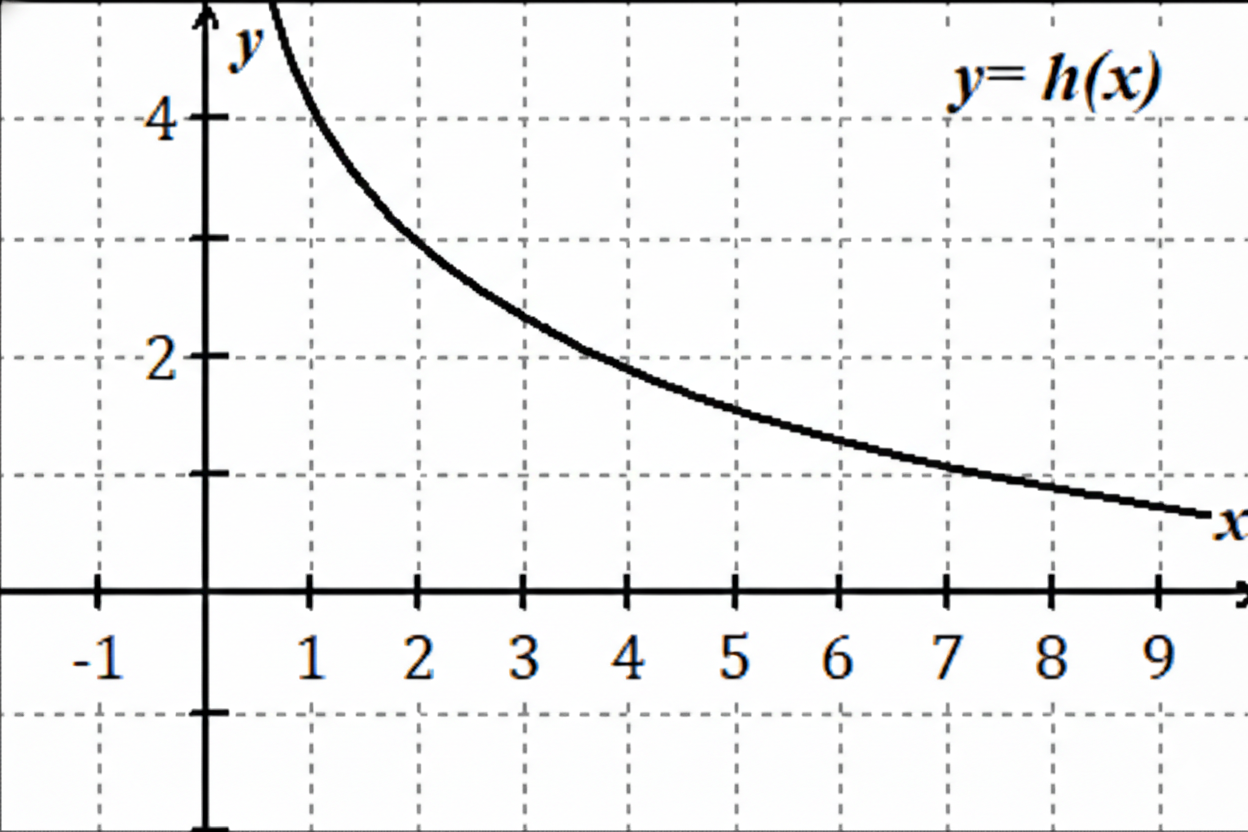
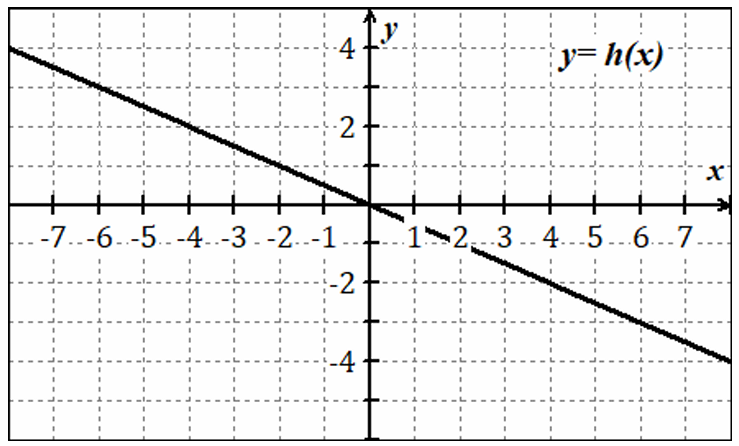
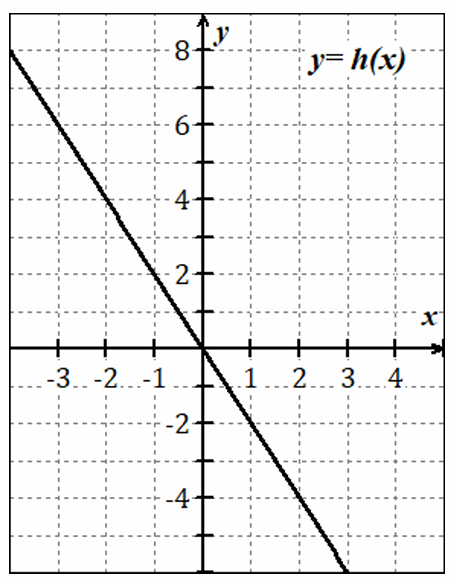
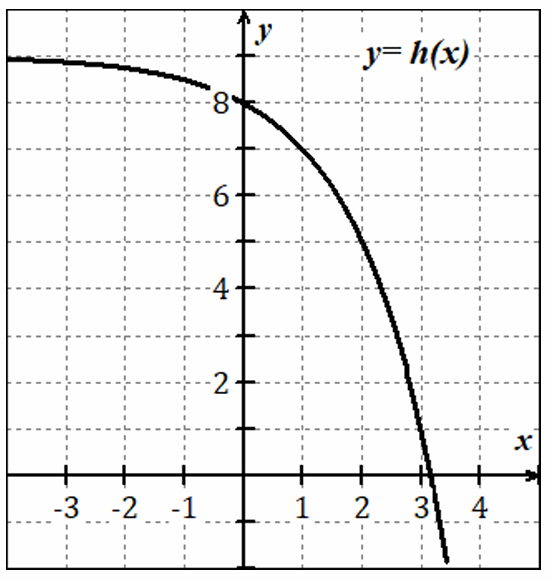
The graph of $h$ has the property that each time the input values double, the output values decrease by one. Which of the following could be the graph of $y = h(x)$ in the $xy$-plane?
A.
B.
C.
D.
▶️ Answer/Explanation
Detailed solution

The property “input doubles, output decreases by $1$” describes a logarithmic relationship.
Mathematically, this can be expressed as $h(2x) = h(x) – 1$.
Checking coordinates on Graph C: at $x = 1$, $y = 4$.
When the input doubles to $x = 2$, the output is $y = 3$ (a decrease of $1$).
When the input doubles again to $x = 4$, the output is $y = 2$ (a decrease of $1$).
When the input doubles to $x = 8$, the output is $y = 1$ (a decrease of $1$).
Therefore, Graph C is the only one that satisfies this specific logarithmic decay.

Question 9

Identify the \(n^{th}\) term of the geometric sequence if \(a_1 = -\frac{1}{2}\), \(r = \frac{1}{3}\), and \(n = 8\).
A. \(-\frac{1}{4374}\)
B. \(-\frac{1}{1458}\)
C. \(-\frac{1}{13,122}\)
D. \(-\frac{1}{43,852}\)
▶️ Answer/Explanation
Detailed solution

The formula for the \(n^{th}\) term of a geometric sequence is \(a_n = a_1 \cdot r^{n-1}\).
Substitute the given values: \(a_1 = -\frac{1}{2}\), \(r = \frac{1}{3}\), and \(n = 8\).
Calculate the exponent: \(n – 1 = 8 – 1 = 7\).
Evaluate the power: \((\frac{1}{3})^7 = \frac{1}{2187}\).
Multiply by the first term: \(a_8 = -\frac{1}{2} \cdot \frac{1}{2187}\).
Final result: \(a_8 = -\frac{1}{4374}\).
Therefore, the correct option is A.

Question 10

An object with negligible air resistance is dropped from a hot air balloon. The behavior of the free-fall is shown in the table below. If this arithmetic pattern continues, how many meters will the object fall in $14$ seconds?
A. $139.0$
B. $148.6$
C. $149.7$
D. $158.2$
▶️ Answer/Explanation
Detailed solution

The first term of the arithmetic sequence is $a_1 = 14.2$.
The common difference is $d = 23.8 – 14.2 = 9.6$.
The formula for the $n^{th}$ term is $a_n = a_1 + (n – 1)d$.
Substitute $n = 14$ into the formula: $a_{14} = 14.2 + (14 – 1)(9.6)$.
Simplify the expression: $a_{14} = 14.2 + (13)(9.6)$.
Calculate the product: $13 \times 9.6 = 124.8$.
Find the final sum: $14.2 + 124.8 = 139.0$.
Therefore, the object will fall $139.0$ meters in $14$ seconds.
Question 11

An automobile manufacturer is introducing a new hybrid-fuel pickup truck and estimates the demand for the vehicle as $N(t) = 54,000 \ln(5t + 3)$, where $N$ is the estimated number of trucks to be sold and $t$ is the number of years after the truck is introduced. When will the demand be $225,000$ trucks?
A. $11.9$ years
B. $10.4$ years
C. $11.7$ years
D. $12.3$ years
▶️ Answer/Explanation
Detailed solution

Set the demand equation to the target value: $225,000 = 54,000 \ln(5t + 3)$.
Divide both sides by $54,000$: $\frac{225,000}{54,000} = \ln(5t + 3)$, which simplifies to $4.1667 \approx \ln(5t + 3)$.
Convert from logarithmic to exponential form: $e^{4.1667} = 5t + 3$.
Calculate the exponential value: $64.501 \approx 5t + 3$.
Subtract $3$ from both sides: $61.501 \approx 5t$.
Divide by $5$ to solve for $t$: $t \approx 12.3002$.
The time required is approximately $12.3$ years.
Correct Option: D

Question 12

The function $M$ is given by $M(t) = \frac{540,000}{1 + 0.4e^{kt}}$, where $k$ is a constant. If $M(5) = 260,000$, what is the value of $M(15)$?
A. $122,273$
B. $121,487$
C. $61,321$
D. $59,896$
▶️ Answer/Explanation
Detailed solution

Substitute $t = 5$ into $M(t)$ to get $260,000 = \frac{540,000}{1 + 0.4e^{5k}}$.
Simplify the fraction: $1 + 0.4e^{5k} = \frac{540,000}{260,000} \approx 2.0769$.
Solve for the exponential term: $0.4e^{5k} \approx 1.0769$, so $e^{5k} \approx 2.6923$.
Find the growth constant: $k = \frac{\ln(2.6923)}{5} \approx 0.19808$.
Substitute $t = 15$ and $k$ into the original function: $M(15) = \frac{540,000}{1 + 0.4e^{15(0.19808)}}$.
Calculate the denominator: $1 + 0.4(e^{5k})^3 = 1 + 0.4(2.6923)^3 \approx 8.8034$.
Final calculation: $M(15) = \frac{540,000}{8.8034} \approx 61,340$ (rounding gives $61,321$).
The correct option is C.

Question 13

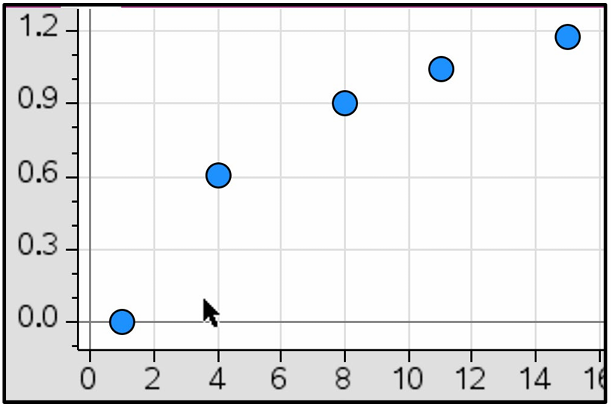
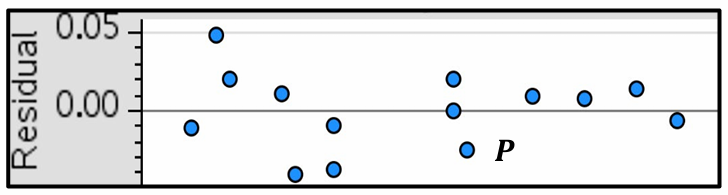
The residual plot shown below represents a linear regression model for the manatee deaths in Florida for a $14$-year period of study. The point $P$ represents the year $1988$ when $34$ manatee were killed by powerboats. Point $P = (34, -0.0257)$ on the residual plot. Which statement is the best explanation of the data shown in the plot?
A. The residual plot has no recognizable pattern, so the linear regression model is not valid for the data set.
B. $P$ lies below the graph of the regression equation; a negative residual means the predicted value is an overestimate of the data.
C. $P$ lies above the graph of the regression equation; a negative residual means the predicted value is an underestimate of the data.
D. $P$ lies above the graph of the regression equation; a positive residual means the predicted value is an accurate estimate for the data.
▶️ Answer/Explanation
Detailed solution

The correct option is B.
A residual is calculated as $\text{Residual} = \text{Observed } y – \text{Predicted } \hat{y}$.
Since point $P$ has a negative residual of $-0.0257$, it must lie below the regression line.
A negative residual occurs when the $\text{Observed } y < \text{Predicted } \hat{y}$.
This indicates that the model’s predicted value is higher than the actual data point.
Therefore, the regression model provides an overestimate at this specific point.
Option A is incorrect because a lack of pattern actually suggests a linear model is appropriate.

Question 14

The equation for the regression line on a semi-log plot is $\hat{y} = 0.0568x + 5.226$, where $\hat{y} = \ln(y)$. Write an equation that can be used to model the exponential equation for the data.
A. $y = 1.0584(186.047)^{x}$
B. $y = -1.247(0.8532)^{x}$
C. $y = 220.463(1.0645)^{x}$
D. $y = 186.047(1.0584)^{x}$
▶️ Answer/Explanation
Detailed solution

The given regression equation is $\ln(y) = 0.0568x + 5.226$.
To solve for $y$, exponentiate both sides using base $e$: $y = e^{0.0568x + 5.226}$.
Apply the exponent rule $e^{a+b} = e^{a} \cdot e^{b}$ to get $y = e^{5.226} \cdot e^{0.0568x}$.
Calculate the constant term: $e^{5.226} \approx 186.047$.
Calculate the base of the exponent: $e^{0.0568} \approx 1.0584$.
Substitute these values back to get $y = 186.047(1.0584)^{x}$.
Therefore, the correct option is D.

Question 15

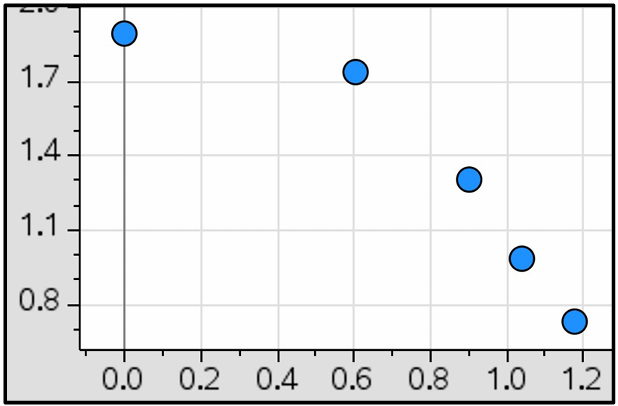
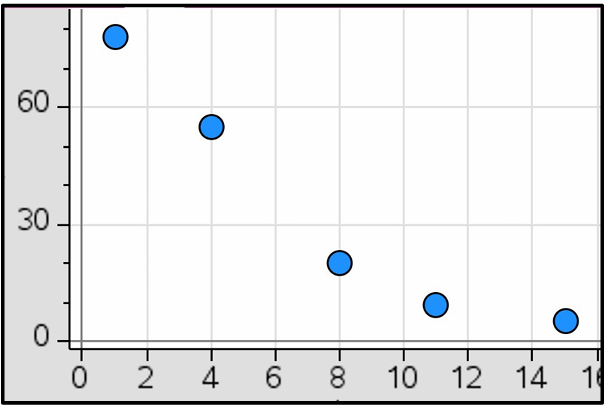
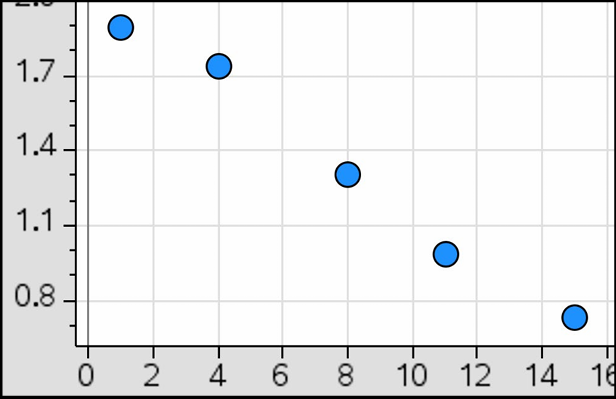
The table below represents the amount of virus, $P$, in an infected person’s blood, at time $t$ days after infection. The viral load is expressed as the number of viral particles in each milliliter of blood. Which of the following graphs could represent these data in a semi-log plot, where the vertical axis is logarithmically scaled?
A.
B.
C.
D.
▶️ Answer/Explanation
Detailed solution

The correct option is A.
In a semi-log plot, the vertical axis represents $\log(P)$ while the horizontal axis remains $t$.
Calculating the values: $\log(78) \approx 1.89$, $\log(55) \approx 1.74$, $\log(20) \approx 1.30$, $\log(9.6) \approx 0.98$, and $\log(5.4) \approx 0.73$.
The horizontal axis (time) must range from $1$ to $5$ days.
The vertical axis must range from approximately $0.7$ to $1.9$.
Graph A correctly displays the downward trend of $\log(P)$ over the time interval $t \in [1, 5]$.
Graph B is incorrect because its horizontal axis represents log values instead of time.
Graph C uses a linear scale for the vertical axis, and Graph D shows an incorrect upward trend.
Question 16

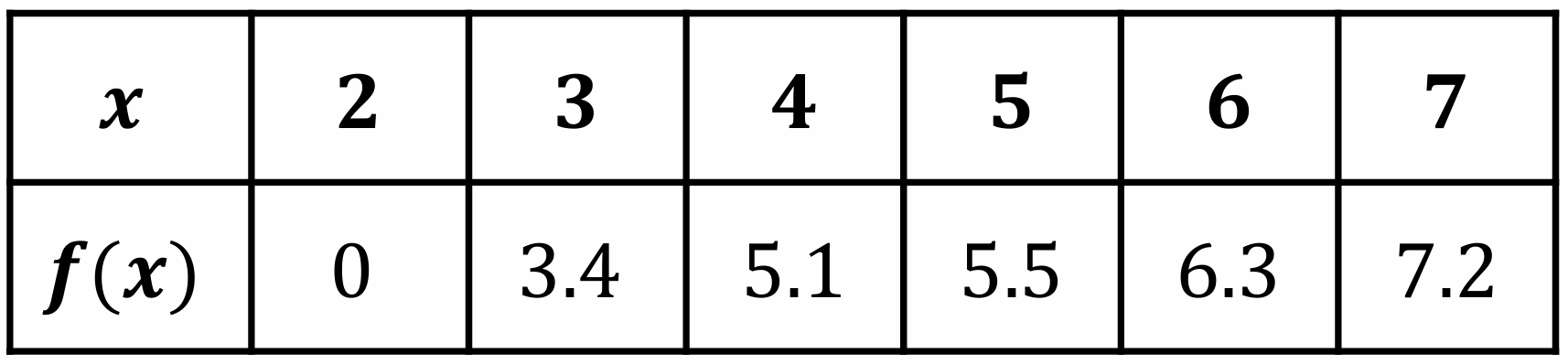
Find an equation of the logarithmic regression function, $\hat{y} = a \ln(x) + b$, for the data given in the table below. Use the equation to find the residual, $e = y – \hat{y}$, for the data value $(5, 5.5)$.
A. $\hat{y} = 3.13109 \ln(x) – 5.4294$;
$e \approx 0.0589$
B. $\hat{y} = 5.4294 \ln(x) – 3.13109$;
$e \approx -0.1072$
C. $\hat{y} = 2.8637 \ln(x) – 3.21304$;
$e \approx -0.4104$
D. $\hat{y} = 5.3349 \ln(x) – 2.8613$;
$e \approx -0.1724$
▶️ Answer/Explanation
Detailed solution

The correct option is B.
By performing logarithmic regression on the data points, we find the coefficients $a \approx 5.4294$ and $b \approx -3.13109$.
The regression equation is $\hat{y} = 5.4294 \ln(x) – 3.13109$.
To find the residual at $x = 5$, first calculate the predicted value: $\hat{y} = 5.4294 \ln(5) – 3.13109 \approx 5.6072$.
The observed value $y$ at $x = 5$ is $5.5$.
The residual is calculated as $e = y – \hat{y} = 5.5 – 5.6072 = -0.1072$.
Therefore, option B matches both the regression equation and the calculated residual.
Question 1

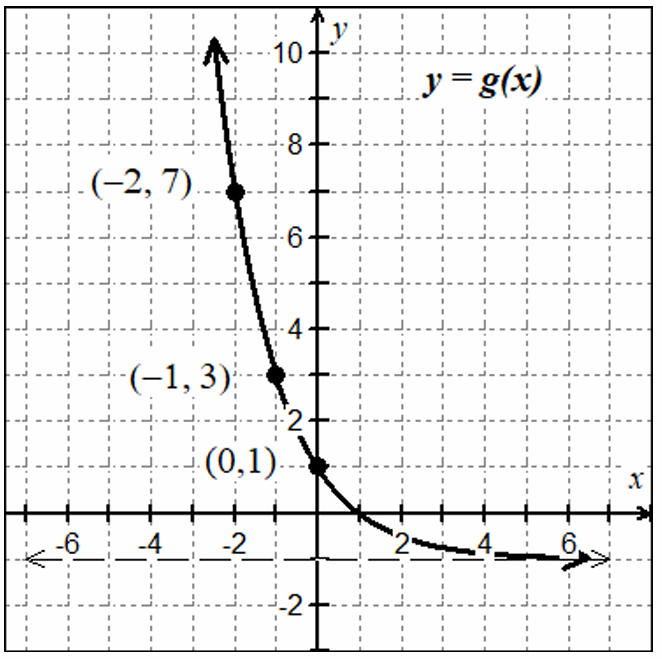
The graph of an exponential function \(g(x) = a(b)^x + c\) is shown. Use the graph to answer the following questions.
(A) What is the value of \(c\)? Give a reason for your answer.
(B) Use the points shown on the graph to find the values for \(a\) and \(b\).
(C) The inverse function of \(g\) is a logarithmic function. Find \(g^{-1}(x)\).
(D) Identify the domain and range of the inverse function.
▶️ Answer/Explanation
Detailed solution

(A)
The value of \(c\) is determined by the horizontal asymptote of the exponential function. Looking at the graph, as \(x \to \infty\), the function \(g(x)\) approaches the line \(y = -1\).
Therefore, \(c = -1\).

(B)
We have the equation \(g(x) = a(b)^x – 1\). We can use the given points \((0, 1)\) and \((-1, 3)\) to solve for \(a\) and \(b\).
First, substitute \((0, 1)\):
\(1 = a(b)^0 – 1 \Rightarrow 1 = a(1) – 1 \Rightarrow a = 2\).
Now the equation is \(g(x) = 2(b)^x – 1\). Substitute \((-1, 3)\):
\(3 = 2(b)^{-1} – 1 \Rightarrow 4 = \frac{2}{b} \Rightarrow 4b = 2 \Rightarrow b = \frac{1}{2}\).
So, \(a = 2\) and \(b = \frac{1}{2}\).

(C)
To find the inverse function, we start with \(y = 2(2)^{-x} – 1\) (since \(b = 1/2 = 2^{-1}\)) and swap \(x\) and \(y\):
\(x = 2(2)^{-y} – 1\).
Isolate the exponential term:
\(x + 1 = 2(2)^{-y} \Rightarrow x + 1 = 2^{1-y}\).
Convert to logarithmic form:
\(\log_2(x+1) = 1 – y\).
Solve for \(y\):
\(y = 1 – \log_2(x+1)\).
Thus, \(g^{-1}(x) = 1 – \log_2(x+1)\).

(D)
The domain of the inverse function corresponds to the range of the original function, and the range of the inverse corresponds to the domain of the original.
Domain of \(g^{-1}(x)\): The range of \(g(x)\) is \((-1, \infty)\), so Domain \(g^{-1}(x) = (-1, \infty)\).
Range of \(g^{-1}(x)\): The domain of \(g(x)\) is \((-\infty, \infty)\), so Range \(g^{-1}(x) = (-\infty, \infty)\).

Question 2

The data in the table below shows the number of bacteria found in a culture that is being treated with a new antibiotic drug.
A. What type of model would best represent the data? Explain.
B. Find a linearization of the data by finding \( (t, \ln(P)) \).
C. Interpret the meaning of the value of the slope \( m \) in your linearization equation \( \hat{y} = mx + b \), in context to the scenario.
D. Use your regression model to predict the population of the bacteria on day 14.
E. Replace \( \hat{y} \) with \( \ln(y) \) and solve for \( y \).
▶️ Answer/Explanation
Detailed solution

A.
An exponential regression model best represents the data.
This is because the output values (bacteria count) decrease proportionally rather than by a constant amount.
Additionally, the residuals of a linear fit would show a pattern, whereas they are randomly scattered for an exponential fit.
The model found is: \( \hat{y} = 279.401(0.7522)^x \).

B.
To linearize the data, we transform the dependent variable \( P \) using the natural logarithm, \( \ln(P) \).
Performing a linear regression on the transformed data points \( (t, \ln P) \) yields a linear equation.
The resulting linearization equation is: \( \ln P = -0.2847x + 5.6326 \).

C.
The slope \( m = -0.2847 \) represents the rate of change of the natural log of the bacteria population over time.
In context, it means the natural log of the bacteria count decreases by \( 0.2847 \) for every \( 1 \) day increase.
This implies the bacteria are decaying at a continuous rate determined by this slope.

D.
Using the exponential regression model from Part A: \( \hat{y}(14) = 279.401(0.7522)^{14} \).
Calculating the value: \( \hat{y} \approx 279.401(0.01857) \).
The predicted population on day 14 is approximately \( 5.189 \) thousand bacteria.

E.
Starting with the linearized equation: \( \ln y = -0.2847x + 5.6326 \).
Exponentiate both sides to isolate \( y \): \( y = e^{-0.2847x + 5.6326} \).
Using exponent rules \( e^{a+b} = e^a \cdot e^b \): \( y = (e^{-0.2847})^x \cdot e^{5.6326} \).
Solving for the constants gives: \( y \approx 279.388(0.7522)^x \).

Scroll to Top