Home / unit-2-key-mcqs-1-63-review-for-ap-precalculus-exam

Question 1

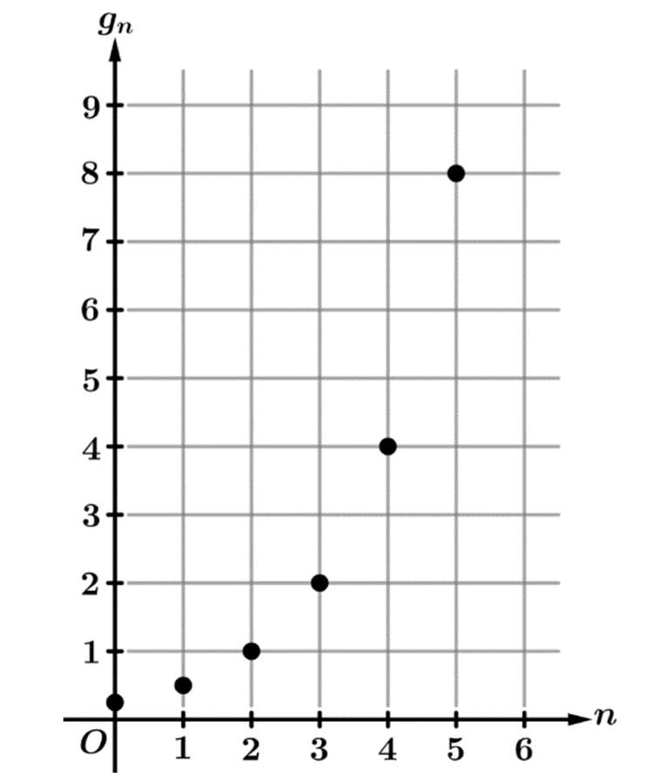
Values of the terms of a geometric sequence \( g_n \) are graphed in the figure. Which of the following is an expression for the \( n \)th term of the geometric sequence?
(A) \( \frac{1}{4}\left(\frac{1}{2}\right)^n \)
(B) \( \frac{1}{2} \cdot 2^n \)
(C) \( (2)^{n-1} \)
(D) \( 4(2)^{n-4} \)
▶️ Answer/Explanation
Detailed solution

From the graph, we observe the points: \( (2, 1) \), \( (3, 2) \), \( (4, 4) \), and \( (5, 8) \).
This shows a geometric sequence with a common ratio of \( 2 \) (e.g., \( \frac{4}{2} = 2 \)).
We test the options by substituting \( n = 2 \), knowing that \( g_2 \) must equal \( 1 \):
(A) \( \frac{1}{4}\left(\frac{1}{2}\right)^2 = \frac{1}{4} \cdot \frac{1}{4} = \frac{1}{16} \) (Incorrect)
(B) \( \frac{1}{2} \cdot 2^2 = \frac{1}{2} \cdot 4 = 2 \) (Incorrect)
(C) \( (2)^{2-1} = 2^1 = 2 \) (Incorrect)
(D) \( 4(2)^{2-4} = 4(2)^{-2} = 4\left(\frac{1}{4}\right) = 1 \) (Correct)
Therefore, the correct expression is \( 4(2)^{n-4} \).
Question 2

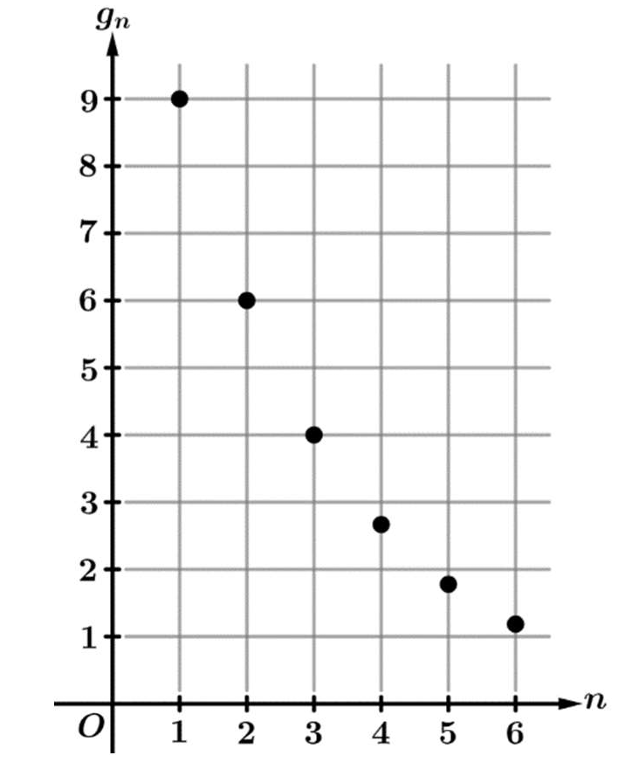
Values of the terms of a geometric sequence \(g_n\) are graphed in the figure. Which of the following is an expression for the \(n\)th term of the geometric sequence?
(A) \(9\left(\frac{2}{3}\right)^n\)
(B) \(6\left(\frac{2}{3}\right)^{n-1}\)
(C) \(9\left(\frac{3}{2}\right)^{n-1}\)
(D) \(4\left(\frac{2}{3}\right)^{n-3}\)
▶️ Answer/Explanation
Detailed solution

From the graph, we can identify the coordinates of the first few terms: \((1, 9)\), \((2, 6)\), and \((3, 4)\).
This gives us the first term \(a_1 = 9\) and the second term \(a_2 = 6\).
Calculate the common ratio \(r\) of the geometric sequence: \(r = \frac{a_2}{a_1} = \frac{6}{9} = \frac{2}{3}\).
The standard formula for the \(n\)th term is \(g_n = a_1 \cdot r^{n-1}\), which gives \(g_n = 9\left(\frac{2}{3}\right)^{n-1}\).
To find the matching option, we can substitute a known point like \(n=3\) (where \(g_3 = 4\)) into the choices.
Checking Option (D): \(4\left(\frac{2}{3}\right)^{3-3} = 4\left(\frac{2}{3}\right)^0 = 4(1) = 4\). This matches the graph perfectly.
Algebraically, we can also rewrite the standard formula to match Option (D): \(9\left(\frac{2}{3}\right)^{n-1} = 9\left(\frac{2}{3}\right)^2 \left(\frac{2}{3}\right)^{n-3} = 9 \cdot \frac{4}{9} \cdot \left(\frac{2}{3}\right)^{n-3} = 4\left(\frac{2}{3}\right)^{n-3}\).
Thus, the correct expression is (D).
Question 3

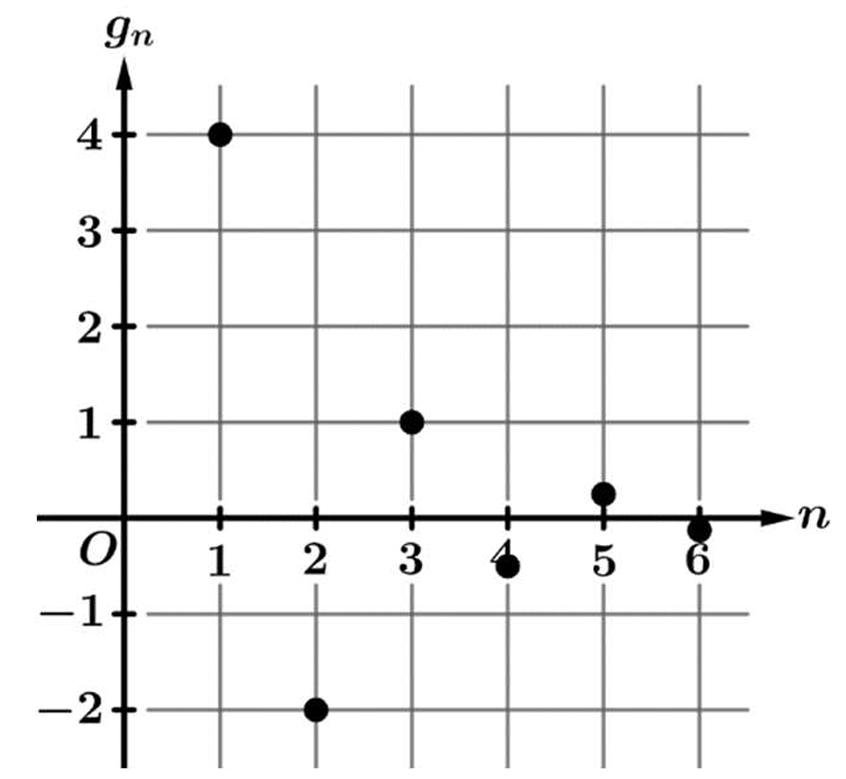
Values of the terms of a geometric sequence \(g_n\) are graphed in the figure. Which of the following is an expression for the \(n\)th term of the geometric sequence?
(A) \(-4{\left(\frac{1}{2}\right)}^{n-1}\)
(B) \(4{\left(-\frac{1}{2}\right)}^{n-1}\)
(C) \(4{\left(\frac{1}{2}\right)}^{n-1}\)
(D) \(8{\left(-\frac{1}{2}\right)}^{n}\)
▶️ Answer/Explanation
Detailed solution

From the graph, we identify the coordinates of the first few terms as \((1, 4)\), \((2, -2)\), and \((3, 1)\).
The first term of the sequence is \(g_1 = 4\).
We find the common ratio \(r\) by dividing the second term by the first: \(r = \frac{g_2}{g_1} = \frac{-2}{4} = -\frac{1}{2}\).
Verifying with the third term: \(g_3 = -2 \times (-\frac{1}{2}) = 1\), which matches the graph.
The general formula for a geometric sequence is \(g_n = a_1 \cdot r^{n-1}\).
Substituting our values, we get \(g_n = 4 \cdot {\left(-\frac{1}{2}\right)}^{n-1}\).
Comparing this result with the options, it matches option (B).

Correct Answer: (B)
Question 4

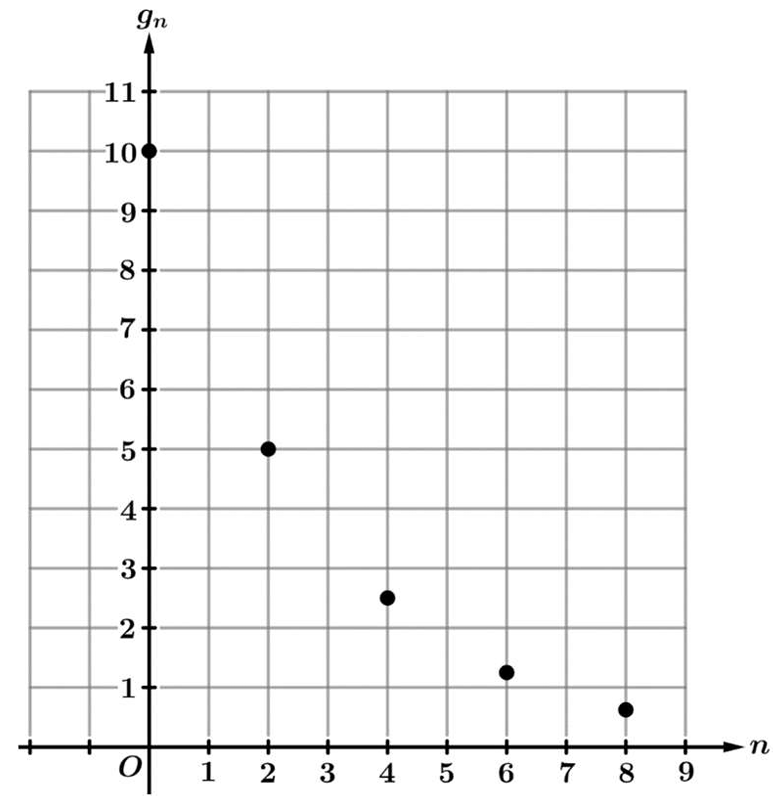
Values of the terms of a geometric sequence \( g_n \) are graphed in the figure. Which of the following is an expression for the \( n \)th term of the geometric sequence?
(A) \( 5\left(\frac{1}{2}\right)^{n/2} \)
(B) \( 5\left(\frac{1}{2}\right)^{n-2} \)
(C) \( 10\left(\frac{1}{2}\right)^{n/2} \)
(D) \( 10\left(\frac{1}{2}\right)^{2n} \)
▶️ Answer/Explanation
Detailed solution

From the graph, we identify two key points: \( (0, 10) \) and \( (2, 5) \). This means \( g_0 = 10 \) and \( g_2 = 5 \).

We test each option by substituting \( n = 0 \) first to check the initial value:

(A) \( n=0 \to 5(1/2)^0 = 5 \). Incorrect, as \( g_0 \neq 10 \).

(B) \( n=0 \to 5(1/2)^{-2} = 5(4) = 20 \). Incorrect, as \( g_0 \neq 10 \).

(C) \( n=0 \to 10(1/2)^0 = 10 \). Correct. Now check \( n=2 \to 10(1/2)^1 = 5 \). Correct.

(D) \( n=0 \to 10(1/2)^0 = 10 \). Correct. Now check \( n=2 \to 10(1/2)^4 = 10/16 \neq 5 \). Incorrect.

Thus, the correct expression matches the graph values in option (C).
Question 5

A large theater has rows of seats arranged in a way that the number of seats in each consecutive row form an arithmetic sequence. If the fourth row contains \(30\) seats and the eighth row contains \(54\) seats, which of the following gives the number of seats in the tenth row?
(A) \(60\)
(B) \(66\)
(C) \(75\)
(D) \(78\)
▶️ Answer/Explanation
Detailed solution

Let the number of seats in row \(n\) be denoted by \(a_n\) and the common difference by \(d\).

We are given \(a_4 = 30\) and \(a_8 = 54\).

Using the arithmetic sequence formula differences \(a_8 – a_4 = (8-4)d\):

\(54 – 30 = 4d \Rightarrow 24 = 4d \Rightarrow d = 6\).

To find the number of seats in the tenth row (\(a_{10}\)), we calculate:

\(a_{10} = a_4 + (10-4)d\)

\(a_{10} = 30 + 6(6) = 30 + 36 = 66\).

Therefore, the correct answer is (B).

Question 6

Let \( a_n \) represent an arithmetic sequence where \( a_3 = 22 \) and \( a_6 = 10 \). What is the value of \( a_{12} \)?
(A) \( -48 \)
(B) \( -14 \)
(C) \( -4 \)
(D) \( -2 \)
▶️ Answer/Explanation
Detailed solution

The relationship between any two terms in an arithmetic sequence is \( a_m = a_n + (m-n)d \).

First, substitute the given values \( a_6 = 10 \) and \( a_3 = 22 \) to find the common difference \( d \):

\( 10 = 22 + (6 – 3)d \implies 10 = 22 + 3d \).

Solving for \( d \): \( 3d = 10 – 22 = -12 \implies d = -4 \).

Now, solve for \( a_{12} \) using the term \( a_3 \) and the difference \( d = -4 \):

\( a_{12} = a_3 + (12 – 3)d = 22 + 9(-4) \).

\( a_{12} = 22 – 36 = -14 \).

Therefore, the correct option is (B).

Question 7

\(n\)01234
\(s_n\)1260\(-6\)\(-12\)
The table gives values of the sequence \(s_n\) at selected values of \(n\). Which of the following statements about \(s_n\) is true?
(A) \(s_n\) could be an arithmetic sequence, because successive terms have a constant difference.
(B) \(s_n\) could be an arithmetic sequence, because successive terms have constant proportional change.
(C) \(s_n\) could be a geometric sequence, because successive terms have a constant difference.
(D) \(s_n\) could be a geometric sequence, because successive terms have constant proportional change.
▶️ Answer/Explanation
Detailed solution

To identify the type of sequence, we analyze the relationship between consecutive terms in the table.
First, calculate the difference between the first two terms: \(6 – 12 = -6\).
Next, calculate the difference between the second and third terms: \(0 – 6 = -6\).
Checking the remaining terms confirms the pattern: \(-6 – 0 = -6\) and \(-12 – (-6) = -6\).
Since the difference between successive terms is a constant value (\(d = -6\)), the sequence is arithmetic.
By definition, an arithmetic sequence is characterized by a constant difference, not proportional change.
Therefore, the correct statement is that \(s_n\) could be an arithmetic sequence due to the constant difference.

Question 8

\(n\)23456
\(s_n\)124816
The table gives values of the sequence \(s_n\) at selected values of \(n\). Which of the following statements about \(s_n\) is true?
(A) \(s_n\) could be an arithmetic sequence, because successive terms have a constant difference.
(B) \(s_n\) could be an arithmetic sequence, because successive terms have constant proportional change.
(C) \(s_n\) could be a geometric sequence, because successive terms have a constant difference.
(D) \(s_n\) could be a geometric sequence, because successive terms have constant proportional change.
▶️ Answer/Explanation
Detailed solution

To determine the type of sequence, we analyze the relationship between consecutive terms of \(s_n\): \(1, 2, 4, 8, 16\).

First, check for an arithmetic sequence by looking for a constant difference: \(2-1=1\), \(4-2=2\). Since \(1 \neq 2\), it is not arithmetic.

Next, check for a geometric sequence by looking for a constant ratio (proportional change): \(\frac{2}{1} = 2\), \(\frac{4}{2} = 2\), \(\frac{8}{4} = 2\).

The sequence has a constant common ratio \(r = 2\).

A sequence with a constant proportional change between terms is defined as a geometric sequence.

Therefore, \(s_n\) is a geometric sequence because successive terms have a constant proportional change.


Correct Option: (D)

Question 9

\(n\)\(1\)\(5\)\(7\)\(8\)\(15\)
\(a_n\)\(b\)\(32\)\(26\)\(c\)\(2\)
The table above contains selected values of an arithmetic sequence \(a_n\), where \(b\) and \(c\) are constants. What is the value of \(b + c\)?
(A) \(49\)
(B) \(58\)
(C) \(67\)
(D) \(76\)
▶️ Answer/Explanation
Detailed solution

First, find the common difference \(d\) using the known terms \(a_5 = 32\) and \(a_7 = 26\):
\(a_7 = a_5 + 2d \implies 26 = 32 + 2d \implies -6 = 2d \implies d = -3\).

Next, calculate \(b\) (which corresponds to \(a_1\)) by working backwards from \(a_5\):
\(b = a_1 = a_5 – 4d = 32 – 4(-3) = 32 + 12 = 44\).

Then, calculate \(c\) (which corresponds to \(a_8\)) using \(a_7\) and \(d\):
\(c = a_8 = a_7 + d = 26 + (-3) = 23\).

Finally, calculate the value of \(b + c\):
\(b + c = 44 + 23 = 67\).

Question 10

Let \( g_n \) be a geometric sequence with \( g_1 = 3 \) and \( g_4 = 24 \). Which of the following is the value of \( g_3 \)?
(A) \( 6 \)
(B) \( 8 \)
(C) \( 12 \)
(D) \( 17 \)
▶️ Answer/Explanation
Detailed solution

The general formula for the \( n \)-th term of a geometric sequence is \( g_n = g_1 \cdot r^{n-1} \).
We are given \( g_1 = 3 \) and \( g_4 = 24 \). Substituting these into the formula:
\( 24 = 3 \cdot r^{4-1} \implies 24 = 3r^3 \).
Dividing both sides by 3 gives \( r^3 = 8 \).
Solving for the common ratio, we get \( r = 2 \).
Now, we calculate \( g_3 \) using \( r = 2 \) and \( n = 3 \):
\( g_3 = 3 \cdot 2^{3-1} = 3 \cdot 2^2 \).
\( g_3 = 3 \cdot 4 = 12 \).

Question 11

The number of students at Speedway High School that earn a qualifying score on an AP math exam can be modeled using an arithmetic sequence, where Mr. Passwater’s first year at SHS is year 1. The number of students earning a qualifying score in year 3 was 52, and the number of students earning a qualifying score in year 6 was 61. Which of the following functions gives the number of students earning a qualifying score in year \(t\), where \(t\) is a whole number?
(A) \( f(t) = \frac{1}{3}t + 51 \)
(B) \( g(t) = 3t + 43 \)
(C) \( h(t) = 3t + 52 \)
(D) \( k(t) = 3t + 61 \)
▶️ Answer/Explanation
Detailed solution
The problem provides two data points for an arithmetic sequence (linear model): \((3, 52)\) and \((6, 61)\).
Step 1: Calculate the common difference (slope, \(d\)) using the two points: \(d = \frac{61 – 52}{6 – 3} = \frac{9}{3} = 3\).
Step 2: The function is linear, so it takes the form \(y = dt + b\). Substitute \(d=3\).
Step 3: Use the point \((3, 52)\) to solve for the constant \(b\): \(52 = 3(3) + b \rightarrow 52 = 9 + b\).
Step 4: Solving for \(b\) gives \(b = 52 – 9 = 43\).
Step 5: The final function is \(g(t) = 3t + 43\). This matches option (B).

Question 12

(Calculator Active) Fearing a new computer virus, a security company performs a simulation to predict the number of computers that might be affected by the virus. The number of infected computers can be modeled by a geometric sequence, where the first day of the simulation is day \(1\). On day \(6\), the virus had infected \(750\) computers, and on day \(10\) the virus had infected \(3200\) computers. To the nearest whole number, how many computers had been infected by the virus on day \(14\) based on the simulation?
(A) \(5,650\)
(B) \(5,717\)
(C) \(13,653\)
(D) \(120,329\)
▶️ Answer/Explanation
Detailed solution

The problem describes a geometric sequence where the term \(g_n\) represents the number of infected computers on day \(n\).
We are given \(g_6 = 750\) and \(g_{10} = 3200\).
Using the property of geometric sequences, we can relate terms using the common ratio \(r\): \(g_{10} = g_6 \cdot r^{(10-6)}\).
Substitute the known values: \(3200 = 750 \cdot r^4\).
Solving for \(r^4\) gives: \(r^4 = \frac{3200}{750}\).
We need to find \(g_{14}\), which can be expressed as: \(g_{14} = g_{10} \cdot r^{(14-10)} = 3200 \cdot r^4\).
Substituting the value of \(r^4\): \(g_{14} = 3200 \cdot \left(\frac{3200}{750}\right) = 13653.33\dots\)
Rounding to the nearest whole number, the number of infected computers is \(13,653\).
The correct option is (C).

Question 13

The function $f$ is given by $f(x)=4\left(\frac{2}{3}\right)^x$. Which of the following describes the end behavior of $f$?
(A) $\lim_{x\to-\infty} f(x) = -\infty \text{ and } \lim_{x\to\infty} f(x) = \infty$
(B) $\lim_{x\to-\infty} f(x) = \infty \text{ and } \lim_{x\to\infty} f(x) = -\infty$
(C) $\lim_{x\to-\infty} f(x) = 0 \text{ and } \lim_{x\to\infty} f(x) = \infty$
(D) $\lim_{x\to-\infty} f(x) = \infty \text{ and } \lim_{x\to\infty} f(x) = 0$
▶️ Answer/Explanation
Detailed solution

The correct answer is (D).

The function is given by $f(x) = 4(\frac{2}{3})^x$, which is in the form $a \cdot b^x$.
Here, the base is $b = \frac{2}{3}$. Since $0 < b < 1$, $f(x)$ is an exponential decay function.
As $x \to \infty$, the term $(\frac{2}{3})^x$ approaches $0$, so $\lim_{x\to\infty} f(x) = 0$.
As $x \to -\infty$, the term $(\frac{2}{3})^x$ grows without bound (approaches $\infty$), so $\lim_{x\to-\infty} f(x) = \infty$.
Therefore, the end behavior is described by $\lim_{x\to-\infty} f(x) = \infty$ and $\lim_{x\to\infty} f(x) = 0$.

Question 14

The function \( g \) is given by \( g(x) = 2(3)^x \). Which of the following describes the end behavior of \( g \)?
(A) \( \lim_{x\to-\infty} g(x)=0 \) and \( \lim_{x\to\infty} g(x)=-\infty \)
(B) \( \lim_{x\to-\infty} g(x)=-\infty \) and \( \lim_{x\to\infty} g(x)=0 \)
(C) \( \lim_{x\to-\infty} g(x)=0 \) and \( \lim_{x\to\infty} g(x)=\infty \)
(D) \( \lim_{x\to-\infty} g(x)=\infty \) and \( \lim_{x\to\infty} g(x)=0 \)
▶️ Answer/Explanation
Detailed solution

The given function is \( g(x) = 2(3)^x \), which is an exponential function of the form \( y = ab^x \).
Here, the base is \( b = 3 \). Since \( b > 1 \), the function represents exponential growth.
As \( x \to \infty \) (as x gets larger), the value of \( 3^x \) increases without bound, so \( \lim_{x\to\infty} g(x)=\infty \).
As \( x \to -\infty \) (as x gets smaller), the value of \( 3^x \) approaches 0, so \( \lim_{x\to-\infty} g(x)=0 \).
Therefore, the end behavior is defined by a limit of 0 on the left and \( \infty \) on the right.
Correct Answer: (C)

Question 15

The function \( h \) is given by \( h(x) = \frac{2}{5}(4)^x \). Which of the following describes the end behavior of \( h \)?
(A) \( \lim_{x\to-\infty} h(x) = 0 \) and \( \lim_{x\to\infty} h(x) = -\infty \)
(B) \( \lim_{x\to-\infty} h(x) = -\infty \) and \( \lim_{x\to\infty} h(x) = 0 \)
(C) \( \lim_{x\to-\infty} h(x) = 0 \) and \( \lim_{x\to\infty} h(x) = \infty \)
(D) \( \lim_{x\to-\infty} h(x) = \infty \) and \( \lim_{x\to\infty} h(x) = 0 \)
▶️ Answer/Explanation
Detailed solution

The function is defined as \( h(x) = \frac{2}{5}(4)^x \).
Identify the base of the exponent: here, \( b = 4 \).
Since the base \( b > 1 \), the function represents exponential growth.
Consider the limit as \( x \to \infty \): As \( x \) gets larger, \( 4^x \) increases without bound, so \( \lim_{x\to\infty} h(x) = \infty \).
Consider the limit as \( x \to -\infty \): As \( x \) becomes a large negative number, \( 4^x \) approaches \( 0 \), so \( \lim_{x\to-\infty} h(x) = 0 \).
Therefore, the end behavior corresponds to Option (C).

Question 16

The function \( k \) is given by \( k(x) = -3(5)^x \). Which of the following describes the end behavior of \( k \)?
(A) \( \lim_{x\to-\infty} k(x) = 0 \) and \( \lim_{x\to\infty} k(x) = -\infty \)
(B) \( \lim_{x\to-\infty} k(x) = -\infty \) and \( \lim_{x\to\infty} k(x) = 0 \)
(C) \( \lim_{x\to-\infty} k(x) = 0 \) and \( \lim_{x\to\infty} k(x) = \infty \)
(D) \( \lim_{x\to-\infty} k(x) = \infty \) and \( \lim_{x\to\infty} k(x) = 0 \)
▶️ Answer/Explanation
Detailed solution

The correct option is (A).

Given the exponential function \( k(x) = -3(5)^x \), where \( a = -3 \) and \( b = 5 \).
Since the base \( b > 1 \), the term \( 5^x \) approaches \( \infty \) as \( x \to \infty \).
Multiplying by the negative coefficient \( a = -3 \), the limit becomes \( -\infty \). So, \( \lim_{x\to\infty} k(x) = -\infty \).
As \( x \to -\infty \), the term \( 5^x \) approaches \( 0 \) (since \( 5^{- \text{large}} = \frac{1}{5^{\text{large}}} \)).
Therefore, \( -3 \cdot 0 = 0 \). So, \( \lim_{x\to-\infty} k(x) = 0 \).
This confirms that since \( b > 1 \) and \( a < 0 \), \( k(x) \) is an exponential growth function reflected over the \( x \)-axis.

Question 17

The function \( j \) is given by \( j(x) = -5\left(\frac{1}{3}\right)^x \). Which of the following describes the end behavior of \( j \)?
(A) \( \lim_{x\to-\infty} j(x) = 0 \) and \( \lim_{x\to\infty} j(x) = -\infty \)
(B) \( \lim_{x\to-\infty} j(x) = -\infty \) and \( \lim_{x\to\infty} j(x) = 0 \)
(C) \( \lim_{x\to-\infty} j(x) = 0 \) and \( \lim_{x\to\infty} j(x) = \infty \)
(D) \( \lim_{x\to-\infty} j(x) = \infty \) and \( \lim_{x\to\infty} j(x) = 0 \)
▶️ Answer/Explanation
Detailed solution

The function is given by \( j(x) = a(b)^x \) with \( a = -5 \) and \( b = \frac{1}{3} \).
First, analyze the limit as \( x \to \infty \). Since the base \( 0 < \frac{1}{3} < 1 \), the term \( \left(\frac{1}{3}\right)^x \) approaches \( 0 \).
Multiplying by the coefficient \( -5 \), we get \( -5(0) = 0 \). Therefore, \( \lim_{x \to \infty} j(x) = 0 \).
Next, analyze the limit as \( x \to -\infty \). As \( x \) becomes a large negative number, \( \left(\frac{1}{3}\right)^x \) grows towards positive infinity (similar to \( 3^{|x|} \)).
Multiplying this large positive value by the negative coefficient \( a = -5 \) results in a value approaching negative infinity.
Thus, \( \lim_{x \to -\infty} j(x) = -\infty \).
Geometrically, since \( 0 < b < 1 \) and \( a < 0 \), \( j(x) \) is an exponential decay function reflected over the \( x \)-axis.
Comparing these findings with the given options, the correct description corresponds to option (B).

Question 18

The function \( f \) is given by \( f(x) = -\frac{1}{4}(3)^x \). Which of the following describes the end behavior of \( f \)?
(A) \( \lim_{x\to-\infty} f(x) = 0 \) and \( \lim_{x\to\infty} f(x) = -\infty \)
(B) \( \lim_{x\to-\infty} f(x) = -\infty \) and \( \lim_{x\to\infty} f(x) = 0 \)
(C) \( \lim_{x\to-\infty} f(x) = 0 \) and \( \lim_{x\to\infty} f(x) = \infty \)
(D) \( \lim_{x\to-\infty} f(x) = \infty \) and \( \lim_{x\to\infty} f(x) = 0 \)
▶️ Answer/Explanation
Detailed solution

The correct option is (A).

1. Identify the function parameters: base \( b = 3 \) and coefficient \( a = -\frac{1}{4} \).
2. Analyze the limit as \( x \to -\infty \): Since the base \( 3 > 1 \), the term \( 3^x \) approaches \( 0 \).
3. Therefore, \( \lim_{x \to -\infty} \left[ -\frac{1}{4}(3)^x \right] = -\frac{1}{4}(0) = 0 \).
4. Analyze the limit as \( x \to \infty \): The term \( 3^x \) grows towards \( \infty \) (exponential growth).
5. Multiplying by the negative coefficient \( a = -\frac{1}{4} \) drives the value towards negative infinity.
6. Therefore, \( \lim_{x \to \infty} \left[ -\frac{1}{4}(3)^x \right] = -\infty \).
7. Since \( b > 1 \) and \( a < 0 \), \( f(x) \) represents an exponential growth function reflected over the \( x \)-axis.

Question 19

The function \( g \) is given by \( g(x)=-2\left(\frac{4}{3}\right)^x \). Which of the following describes the end behavior of \( g \)?
(A) \( \lim_{x\to-\infty} g(x)=0 \) and \( \lim_{x\to\infty} g(x)=-\infty \)
(B) \( \lim_{x\to-\infty} g(x)=-\infty \) and \( \lim_{x\to\infty} g(x)=0 \)
(C) \( \lim_{x\to-\infty} g(x)=0 \) and \( \lim_{x\to\infty} g(x)=\infty \)
(D) \( \lim_{x\to-\infty} g(x)=\infty \) and \( \lim_{x\to\infty} g(x)=0 \)
▶️ Answer/Explanation
Detailed solution

The correct option is (A).

The function is in the form \( g(x) = a(b)^x \), with \( a = -2 \) and \( b = \frac{4}{3} \).
Since \( b > 1 \) and \( a < 0 \), \( g(x) \) is an exponential growth function reflected over the \( x \)-axis.
As \( x \to \infty \): The base \( \frac{4}{3} > 1 \), so \( \left(\frac{4}{3}\right)^x \to \infty \). Multiplying by \( -2 \) makes the function approach \( -\infty \).
As \( x \to -\infty \):

Question 20

\(x\)01234
\(f(x)\)36189\(\frac{9}{2}\)\(\frac{9}{4}\)
The exponential function \(f\) is defined by \(f(x)=ab^x\), where \(a\) and \(b\) are positive constants. The table gives values of \(f(x)\) at selected values of \(x\). Which of the following statements is true?
(A) \(f\) demonstrates exponential decay because \(a > 0\) and \(0 < b < 1\).
(B) \(f\) demonstrates exponential decay because \(a > 0\) and \(b > 1\).
(C) \(f\) demonstrates exponential growth because \(a > 0\) and \(0 < b < 1\).
(D) \(f\) demonstrates exponential growth because \(a > 0\) and \(b > 1\).
▶️ Answer/Explanation
Detailed solution

To determine the nature of the function, we find the values of constants \(a\) and \(b\).

Using the table value at \(x=0\), we have \(f(0) = a(b)^0 = a\). Since \(f(0)=36\), then \(a = 36\).

Using the table value at \(x=1\), we have \(f(1) = a(b)^1 = 36b\). Since \(f(1)=18\), we solve \(36b = 18\) to get \(b = \frac{18}{36} = \frac{1}{2}\).

For an exponential function \(f(x) = ab^x\) where \(a > 0\), if the base \(b\) satisfies \(0 < b < 1\), the function represents exponential decay.

Here, \(a = 36 > 0\) and \(b = \frac{1}{2}\), which satisfies \(0 < b < 1\).

Therefore, the statement in option (A) is correct.

Question 21

\( x \)\( 1 \)\( 2 \)\( 3 \)\( 4 \)\( 5 \)
\( h(x) \)\( 2 \)\( 6 \)\( 18 \)\( 54 \)\( 162 \)
The exponential function \( h \) is defined by \( h(x) = ab^x \), where \( a \) and \( b \) are positive constants. The table gives values of \( h(x) \) at selected values of \( x \). Which of the following statements is true?
(A) \( h \) demonstrates exponential decay because \( a > 0 \) and \( 0 < b < 1 \).
(B) \( h \) demonstrates exponential decay because \( a > 0 \) and \( b > 1 \).
(C) \( h \) demonstrates exponential growth because \( a > 0 \) and \( 0 < b < 1 \).
(D) \( h \) demonstrates exponential growth because \( a > 0 \) and \( b > 1 \).
▶️ Answer/Explanation
Detailed solution

1. Observe the table values: as \( x \) increases by \( 1 \), \( h(x) \) increases (\( 2 \to 6 \to 18 \dots \)), which indicates exponential growth.
2. Calculate the base \( b \) by taking the ratio of consecutive terms: \( b = \frac{h(2)}{h(1)} = \frac{6}{2} = 3 \).
3. Since \( b = 3 \), the condition \( b > 1 \) is satisfied.
4. To find \( a \), substitute the values from the first column (\( x=1, h(x)=2 \)) into the equation \( h(x) = a \cdot b^x \).
5. This gives \( 2 = a \cdot 3^1 \), which simplifies to \( a = \frac{2}{3} \). This satisfies \( a > 0 \).
6. Therefore, the function demonstrates exponential growth because \( a > 0 \) and \( b > 1 \).
7. The correct choice is (D).

Question 22

\( x \)12345
\( k(x) \)8121827\( \frac{81}{2} \)
The exponential function \( k \) is defined by \( k(x) = ab^x \), where \( a \) and \( b \) are positive constants. The table gives values of \( k(x) \) at selected values of \( x \). Which of the following statements is true?
(A) \( k \) demonstrates exponential decay because \( a > 0 \) and \( 0 < b < 1 \).
(B) \( k \) demonstrates exponential decay because \( a > 0 \) and \( b > 1 \).
(C) \( k \) demonstrates exponential growth because \( a > 0 \) and \( 0 < b < 1 \).
(D) \( k \) demonstrates exponential growth because \( a > 0 \) and \( b > 1 \).
▶️ Answer/Explanation
Detailed solution

To identify the properties of the function, we first calculate the growth factor \( b \) by taking the ratio of consecutive \( k(x) \) values.

\( b = \frac{k(2)}{k(1)} = \frac{12}{8} = \frac{3}{2} \). Since \( \frac{3}{2} = 1.5 \), we have \( b > 1 \).

Next, we solve for the initial value \( a \) using the equation \( k(1) = ab^1 \).

\( 8 = a \left(\frac{3}{2}\right) \Rightarrow a = 8 \cdot \frac{2}{3} = \frac{16}{3} \). Thus, \( a \) is a positive constant (\( a > 0 \)).

An exponential function represents growth when the base \( b > 1 \) and \( a > 0 \).

Therefore, \( k \) demonstrates exponential growth because \( a > 0 \) and \( b > 1 \).

Correct Option: (D)

Question 23

\( x \)01234
\( f(x) \)54362416\( \frac{32}{3} \)
The exponential function \( f \) is defined by \( f(x) = ab^x \), where \( a \) and \( b \) are positive constants. The table gives values of \( f(x) \) at selected values of \( x \). Which of the following statements is true?
(A) \( f \) demonstrates exponential decay because \( a > 0 \) and \( 0 < b < 1 \).
(B) \( f \) demonstrates exponential decay because \( a > 0 \) and \( b > 1 \).
(C) \( f \) demonstrates exponential growth because \( a > 0 \) and \( 0 < b < 1 \).
(D) \( f \) demonstrates exponential growth because \( a > 0 \) and \( b > 1 \).
▶️ Answer/Explanation
Detailed solution

To identify the correct statement, we first calculate the values of the constants \( a \) and \( b \).
Substitute \( x = 0 \) from the table into the function \( f(x) = ab^x \): \( f(0) = ab^0 = a(1) = a \).
From the table, \( f(0) = 54 \), therefore \( a = 54 \). This confirms that \( a > 0 \).
Next, substitute \( x = 1 \) into the function: \( f(1) = ab^1 = ab \).
From the table, \( f(1) = 36 \). So, \( 54b = 36 \).
Solving for \( b \), we get \( b = \frac{36}{54} = \frac{2}{3} \).
Since \( b = \frac{2}{3} \), the base falls in the range \( 0 < b < 1 \).
An exponential function with \( a > 0 \) and \( 0 < b < 1 \) represents exponential decay.
Thus, statement (A) is the correct description.

Question 24

Which of the following statements is true about the exponential function \( f \) given by \( f(x)=4\left(\frac{1}{3}\right)^x \)?
(A) \( f \) is always increasing, and the graph of \( f \) is always concave up.
(B) \( f \) is always increasing, and the graph of \( f \) is always concave down.
(C) \( f \) is always decreasing, and the graph of \( f \) is always concave up.
(D) \( f \) is always decreasing, and the graph of \( f \) is always concave down.
▶️ Answer/Explanation
Detailed solution

The given function is \( f(x) = 4\left(\frac{1}{3}\right)^x \), which is in the form \( f(x) = a \cdot b^x \).
Here, \( a = 4 \) (which is \( > 0 \)) and the base \( b = \frac{1}{3} \).
Since \( a > 0 \) and \( 0 < b < 1 \), the function represents exponential decay.
Exponential decay functions are strictly decreasing over their entire domain.
The graph of a standard exponential function \( a \cdot b^x \) (where \( a > 0 \)) curves upward like a cup, meaning it is concave up.
Mathematically, the second derivative \( f”(x) = 4(\ln(1/3))^2(1/3)^x \) is always positive, confirming concavity is up.
Therefore, \( f \) is always decreasing, and the graph of \( f \) is always concave up.
Correct Option: (C)

Question 25

Which of the following statements is true about the exponential function \( g \) given by \( g(x) = \frac{1}{2} \cdot 3^x \)?
(A) \( g \) is always increasing, and the graph of \( g \) is always concave up.
(B) \( g \) is always increasing, and the graph of \( g \) is always concave down.
(C) \( g \) is always decreasing, and the graph of \( g \) is always concave up.
(D) \( g \) is always decreasing, and the graph of \( g \) is always concave down.
▶️ Answer/Explanation
Detailed solution

The function is defined as \( g(x) = \frac{1}{2} \cdot 3^x \), which fits the form \( f(x) = a \cdot b^x \).
Here, the initial value \( a = \frac{1}{2} \) is positive (\( a > 0 \)) and the base \( b = 3 \) is greater than 1 (\( b > 1 \)).
Since \( a > 0 \) and \( b > 1 \), the function represents exponential growth, meaning \( g \) is always increasing.
As \( x \) increases, the slope of the graph becomes steeper, which indicates the graph curves upward.
Mathematically, the second derivative \( g”(x) = \frac{1}{2} (\ln 3)^2 \cdot 3^x \) is always positive.
A positive second derivative confirms that the graph is always concave up.
Therefore, statement (A) is the correct description of the function.

Question 26

Which of the following statements is true about the exponential function \( h \) given by \( h(x)=3 \cdot 5^x \)?
(A) \( h \) is always increasing, and the graph of \( h \) is always concave up.
(B) \( h \) is always increasing, and the graph of \( h \) is always concave down.
(C) \( h \) is always decreasing, and the graph of \( h \) is always concave up.
(D) \( h \) is always decreasing, and the graph of \( h \) is always concave down.
▶️ Answer/Explanation
Detailed solution
The correct option is (A).
1. The function is given by \( h(x) = 3 \cdot 5^x \), which is in the form \( f(x) = a \cdot b^x \).
2. Identify the constants: \( a = 3 \) and \( b = 5 \).
3. Since \( a > 0 \) and \( b > 1 \), the function represents exponential growth.
4. An exponential growth function is always increasing because the base (5) is greater than 1.
5. The graph of an exponential growth function curves upward like a “cup”, which means it is concave up.
6. Mathematically, the second derivative \( h”(x) = 3 \cdot (\ln 5)^2 \cdot 5^x \) is always positive, confirming the graph is concave up.
7. Therefore, \( h \) is always increasing and its graph is always concave up.

Question 27

Which of the following statements is true about the exponential function \(k\) given by \(k(x) = -4 \cdot 3^x\)?
(A) \(k\) is always increasing, and the graph of \(k\) is always concave up.
(B) \(k\) is always increasing, and the graph of \(k\) is always concave down.
(C) \(k\) is always decreasing, and the graph of \(k\) is always concave up.
(D) \(k\) is always decreasing, and the graph of \(k\) is always concave down.
▶️ Answer/Explanation
Detailed solution

The correct answer is (D).

1. The function is given by \(k(x) = -4 \cdot 3^x\), which is in the form \(f(x) = a \cdot b^x\).
2. Here, the base \(b = 3\). Since \(b > 1\), the parent function \(3^x\) represents exponential growth (increasing and concave up).
3. The leading coefficient is \(a = -4\). Since \(a < 0\), the graph is reflected over the \(x\)-axis.
4. When an increasing function is reflected over the \(x\)-axis, it becomes a decreasing function.
5. When a concave up graph is reflected over the \(x\)-axis, the concavity changes to concave down.
6. Therefore, \(k\) is always decreasing, and the graph of \(k\) is always concave down.

Question 28

Which of the following statements is true about the exponential function \( j \) given by \( j(x)=-6\left(\frac{2}{7}\right)^x \)?
(A) \( j \) is always increasing, and the graph of \( j \) is always concave up.
(B) \( j \) is always increasing, and the graph of \( j \) is always concave down.
(C) \( j \) is always decreasing, and the graph of \( j \) is always concave up.
(D) \( j \) is always decreasing, and the graph of \( j \) is always concave down.
▶️ Answer/Explanation
Detailed solution

The exponential function is in the form \( j(x) = a \cdot b^x \), with \( a = -6 \) and base \( b = \frac{2}{7} \).
First, analyze the base: since \( 0 < \frac{2}{7} < 1 \), the term \( \left(\frac{2}{7}\right)^x \) represents exponential decay and is naturally decreasing.
Next, analyze the coefficient: \( a = -6 \) is negative, which reflects the graph over the x-axis.
Reflecting a decreasing function over the x-axis reverses its direction, making \( j(x) \) always increasing.
Regarding concavity, the basic decay function \( b^x \) is always concave up (curves upward).
Reflecting a concave up graph over the x-axis inverts its curvature, making it concave down.
Mathematically, the second derivative is \( j”(x) = -6 \left(\ln \frac{2}{7}\right)^2 \left(\frac{2}{7}\right)^x \), which is always negative.
Therefore, the function is always increasing and the graph is always concave down.

Question 29

Which of the following statements is true about the exponential function \( f \) given by \( f(x) = -\frac{1}{3} \cdot 2^x \)?
(A) \( f \) is always increasing, and the graph of \( f \) is always concave up.
(B) \( f \) is always increasing, and the graph of \( f \) is always concave down.
(C) \( f \) is always decreasing, and the graph of \( f \) is always concave up.
(D) \( f \) is always decreasing, and the graph of \( f \) is always concave down.
▶️ Answer/Explanation
Detailed solution

The correct option is (D).

1. The function is given by \( f(x) = a \cdot b^x \), where \( a = -\frac{1}{3} \) and \( b = 2 \).
2. Since the base \( b = 2 \) is greater than \( 1 \), the parent function \( y = 2^x \) represents exponential growth, which is increasing and concave up.
3. The coefficient \( a = -\frac{1}{3} \) is negative (\( a < 0 \)).
4. As stated in the problem’s note: if \( a < 0 \) and \( b > 1 \), then \( f(x) \) is an exponential growth function reflected over the \( x \)-axis.
5. Reflecting an increasing function over the \( x \)-axis results in a function that is always decreasing.
6. Reflecting a graph that is concave up over the \( x \)-axis results in a graph that is always concave down.
7. Therefore, \( f \) is always decreasing, and the graph of \( f \) is always concave down.

Question 30

Which of the following statements is true about the exponential function \( f \) given by \( f(x) = 7 \left( \frac{4}{5} \right)^x \)?
(A) \( f \) is increasing at an increasing rate.
(B) \( f \) is increasing at a decreasing rate.
(C) \( f \) is decreasing at an increasing rate.
(D) \( f \) is decreasing at a decreasing rate.
▶️ Answer/Explanation
Detailed solution

The correct answer is (C).

The function is given by \( f(x) = 7(0.8)^x \). Since the base \( 0.8 < 1 \), the function represents exponential decay, meaning \( f(x) \) is decreasing.
The rate of change is given by the derivative \( f'(x) \). Since \( f'(x) \) is negative but approaching zero (becoming less negative) as \( x \) increases, the value of the rate is mathematically increasing.
Geometrically, the graph is concave up ( \( f”(x) > 0 \) ), which indicates that the slope of the tangent line is increasing.
Therefore, \( f \) is decreasing at an increasing rate.

Question 31

Which of the following statements is true about the exponential function \(g\) given by \(g(x) = -6 \cdot 5^x\) ?
(A) \(g\) is increasing at an increasing rate.
(B) \(g\) is increasing at a decreasing rate.
(C) \(g\) is decreasing at an increasing rate.
(D) \(g\) is decreasing at a decreasing rate.
▶️ Answer/Explanation
Detailed solution

The function is defined as \(g(x) = -6 \cdot 5^x\), which is an exponential function of the form \(ab^x\).
Here, the base \(b = 5 > 1\) suggests growth, but the coefficient \(a = -6 < 0\) causes a reflection over the \(x\)-axis.
Because of this reflection, as \(x\) increases, the value of \(g(x)\) moves further away from \(0\) in the negative direction, meaning \(g\) is decreasing.
To determine the rate, we look at concavity: since \(a < 0\), the graph is concave down.
Being concave down indicates that the slope (rate of change) is becoming more negative as \(x\) increases.
Thus, the rate of change is decreasing.
Therefore, \(g\) is decreasing at a decreasing rate.

Correct Option: (D)

Question 32

Which of the following statements is true about the exponential function \(h\) given by \(h(x)=4 \cdot 9^x\) ?
(A) \(h\) is increasing at an increasing rate.
(B) \(h\) is increasing at a decreasing rate.
(C) \(h\) is decreasing at an increasing rate.
(D) \(h\) is decreasing at a decreasing rate.
▶️ Answer/Explanation
Detailed solution

Correct Answer: (A)

For the exponential function \(h(x) = a \cdot b^x\), we identify the parameters \(a = 4\) and \(b = 9\).
Since the coefficient \(a > 0\) and the base \(b > 1\), \(h(x)\) is an exponential growth function.
This implies that as \(x\) increases, the value of \(h(x)\) is strictly increasing.
Furthermore, the graph of an exponential growth function is concave up.
Concavity indicates that the slope of the tangent line gets steeper as \(x\) increases.
Therefore, \(h\) is increasing at an increasing rate.

Question 33

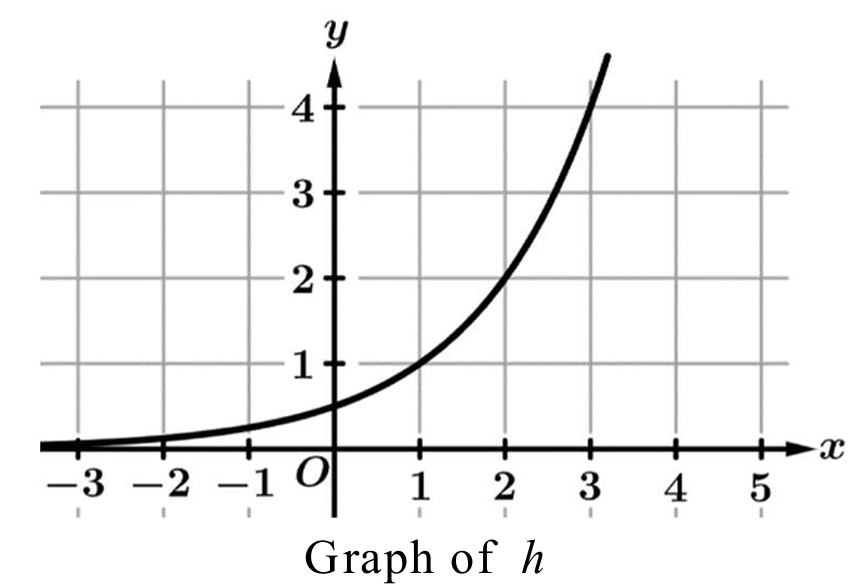
The figure shows a portion of the graph of a function \( h \). Which of the following conclusions is possible for \( h \)?
(A) \( h \) is logarithmic because the output values are proportional over equal-length input-value intervals.
(B) \( h \) is logarithmic because the input values are proportional over equal-length output-value intervals.
(C) \( h \) is exponential because the output values are proportional over equal-length input-value intervals.
(D) \( h \) is exponential because the input values are proportional over equal-length output-value intervals.
▶️ Answer/Explanation
Detailed solution

1. Examine the coordinates of points on the graph: specifically, the points \((1, 1)\), \((2, 2)\), and \((3, 4)\) are clearly identifiable.

2. Analyze the input intervals: The step from \(x = 1\) to \(x = 2\) is an increase of \(1\), and from \(x = 2\) to \(x = 3\) is also an increase of \(1\). These are equal-length input-value intervals.

3. Analyze the corresponding output values: As \(x\) increases by \(1\), \(y\) changes from \(1\) to \(2\), and then from \(2\) to \(4\).

4. Calculate the ratio of outputs: \(\frac{2}{1} = 2\) and \(\frac{4}{2} = 2\). The output values are being multiplied by a constant factor of \(2\).

5. This behavior, where output values change by a constant ratio (are proportional) over equal arithmetic steps in the input, defines an exponential function.

6. A logarithmic function would exhibit the inverse relationship (inputs proportional over equal output intervals).

7. Therefore, the correct conclusion is that \( h \) is exponential because the output values are proportional over equal-length input-value intervals.

Correct Option: (C)
Question 34

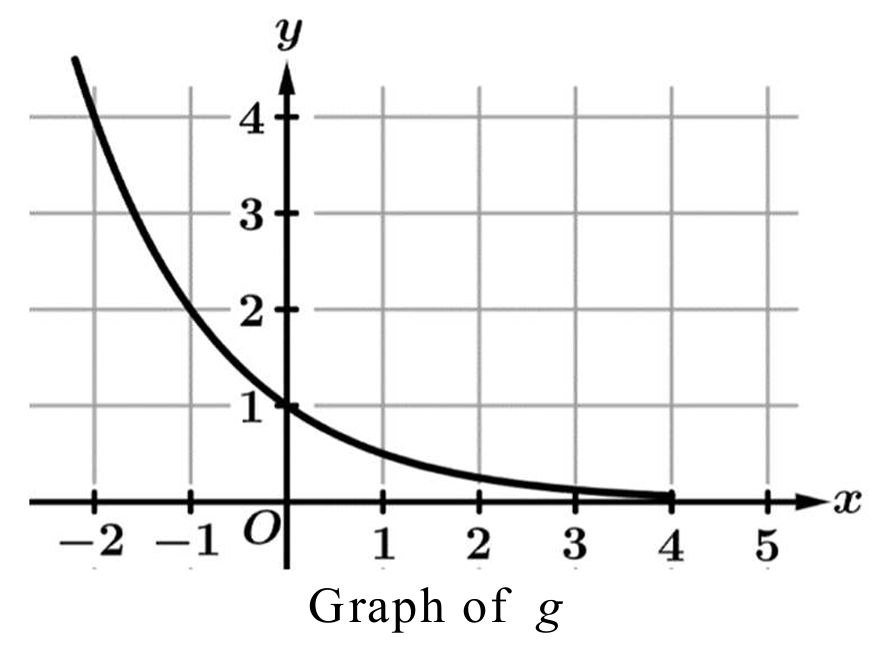
The figure shows a portion of the graph of a function \( g \). Which of the following conclusions is possible for \( g \)?
(A) \( g \) is logarithmic because the output values are proportional over equal-length input-value intervals.
(B) \( g \) is logarithmic because the input values are proportional over equal-length output-value intervals.
(C) \( g \) is exponential because the output values are proportional over equal-length input-value intervals.
(D) \( g \) is exponential because the input values are proportional over equal-length output-value intervals.
▶️ Answer/Explanation
Detailed solution

The correct option is (C).

1. Examine the points on the graph: \( (-2, 4) \), \( (-1, 2) \), and \( (0, 1) \).
2. Analyze the change in output values (\( y \)) as the input values (\( x \)) increase by a constant interval of \( 1 \).
3. From \( x = -2 \) to \( x = -1 \), the output changes from \( 4 \) to \( 2 \), which is a factor of \( \frac{1}{2} \).
4. From \( x = -1 \) to \( x = 0 \), the output changes from \( 2 \) to \( 1 \), which is again a factor of \( \frac{1}{2} \).
5. A function where output values are multiplied by a constant factor over equal-length input intervals is an exponential function.
6. Specifically, as noted in the image, the output values are multiplied by \( \frac{1}{2} \) over equal-length input-value intervals.
7. Therefore, \( g \) is exponential because the output values are proportional over equal-length input-value intervals.

Question 35

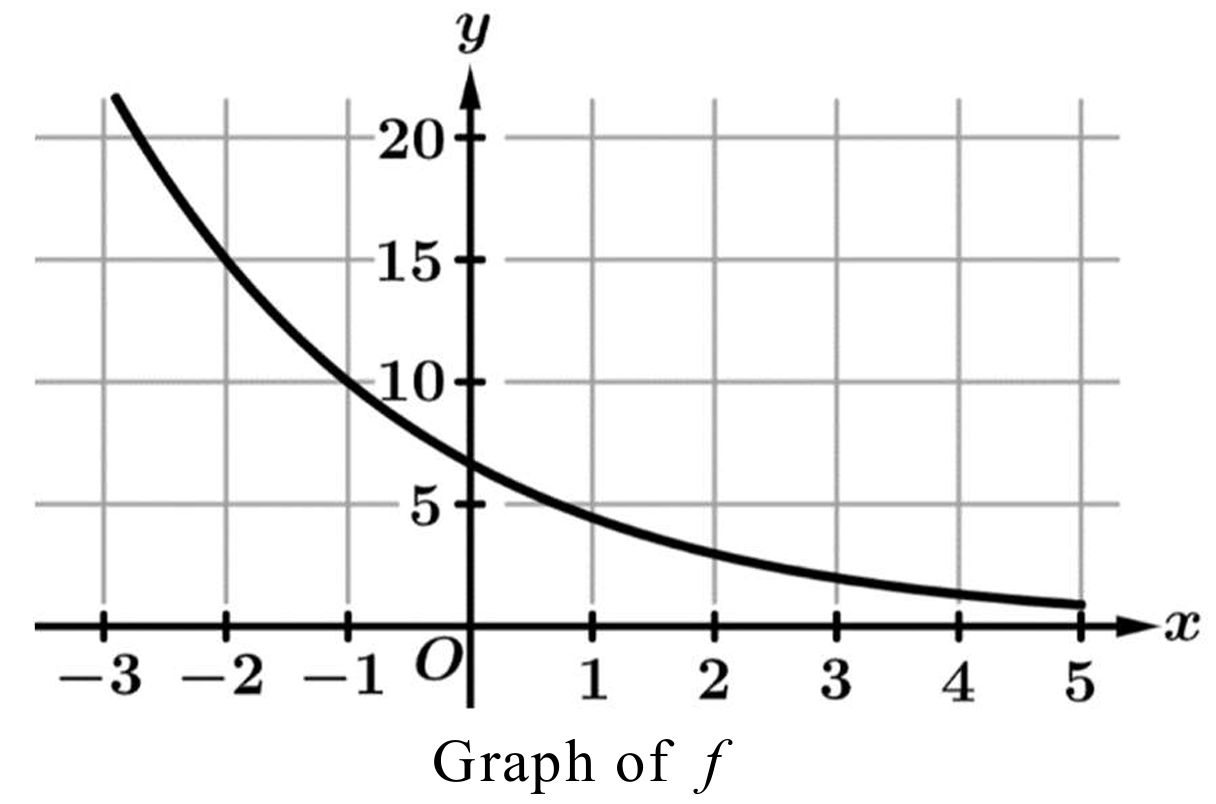
The figure shows a portion of the graph of a function $f$. Which of the following conclusions is possible for $f$?
(A) $f$ is quadratic because the output values are proportional over equal-length input-value intervals.
(B) $f$ is quadratic because the average rates of change over consecutive equal-length input-value intervals can be given by a linear function.
(C) $f$ is exponential because the output values are proportional over equal-length input-value intervals.
(D) $f$ is exponential because the average rates of change over consecutive equal-length input-value intervals can be given by a linear function.
▶️ Answer/Explanation
Detailed solution

The correct option is (C).
By observing the graph, at $x = -2$, $y \approx 15$, and at $x = -1$, $y = 10$.
The output values are multiplied by a constant ratio of $\frac{10}{15} = \frac{2}{3}$ over equal intervals of $\Delta x = 1$.
This constant proportionality of output values is the defining characteristic of an exponential function.
Option (B) describes a property of quadratic functions, but the graph shows asymptotic behavior toward the $x$-axis.
Option (D) is incorrect because exponential rates of change are themselves exponential, not linear.
Therefore, $f$ is exponential because the outputs are proportional over equal-length input intervals.

Question 36

The function $f$ is given by $f(x) = 36 \cdot 4^x$. Which of the following is an equivalent form for $f(x)$?
(A) $f(x) = 6 \cdot 2^{(x/2)}$
(B) $f(x) = 6 \cdot 2^{(2x)}$
(C) $f(x) = 36 \cdot 2^{(x/2)}$
(D) $f(x) = 36 \cdot 2^{(2x)}$
▶️ Answer/Explanation
Detailed solution

The given function is $f(x) = 36 \cdot 4^x$.
Identify the base of the exponential term, which is $4$.
Express the base $4$ as a power of $2$, so $4 = 2^2$.
Substitute $2^2$ back into the function: $f(x) = 36 \cdot (2^2)^x$.
Apply the power of a power rule, $(a^m)^n = a^{m \cdot n}$.
This simplifies the expression to $f(x) = 36 \cdot 2^{(2x)}$.
Comparing this to the options, the equivalent form is (D).

Question 37

The function $j$ is given by $j(x) = 3 \cdot 4^{(x+2)}$. Which of the following is an equivalent form for $j(x)$?
(A) $j(x) = 48^x$
(B) $j(x) = 48 \cdot 4^x$
(C) $j(x) = 3 \cdot 16^x$
(D) $j(x) = 9 \cdot 16^x$
▶️ Answer/Explanation
Detailed solution

The correct answer is (B).
Start with the given function: $j(x) = 3 \cdot 4^{(x+2)}$.
Apply the product rule for exponents: $a^{m+n} = a^m \cdot a^n$.
This allows us to rewrite the term $4^{(x+2)}$ as $4^2 \cdot 4^x$.
Substitute this back into the function: $j(x) = 3 \cdot 4^2 \cdot 4^x$.
Calculate the constant value: $4^2 = 16$.
Multiply the constants: $3 \cdot 16 = 48$.
The resulting equivalent form is $j(x) = 48 \cdot 4^x$.

Question 38

Which of the following functions is an equivalent form of the function $g(x) = 3 \cdot 5^{2x}$?
(A) $g(x) = 75^x$
(B) $g(x) = 3 \cdot 25^x$
(C) $g(x) = 9 \cdot 5^x$
(D) $g(x) = 9 \cdot 25^x$
▶️ Answer/Explanation
Detailed solution

The correct option is (B).
Start with the original function: $g(x) = 3 \cdot 5^{2x}$.
Apply the power of a power rule: $a^{bc} = (a^b)^c$.
Rewrite the exponential part as $(5^2)^x$.
Calculate the value inside the parentheses: $5^2 = 25$.
Substitute the value back to get $g(x) = 3 \cdot 25^x$.
This matches option (B).

Question 39

The function $h$ is given by $h(x) = 25 \cdot 16^{(x/2)}$. Which of the following is an equivalent form for $h(x)$?
(A) $h(x) = 100^{x}$
(B) $h(x) = 5 \cdot 4^{x}$
(C) $h(x) = 25 \cdot 4^{x}$
(D) $h(x) = 25 \cdot 8^{x}$
▶️ Answer/Explanation
Detailed solution

The given function is $h(x) = 25 \cdot 16^{(x/2)}$.
Using the exponent rule $(a^{m})^{n} = a^{m \cdot n}$, rewrite $16^{(x/2)}$ as $(16^{1/2})^{x}$.
Since $16^{1/2}$ is the square root of $16$, we find $16^{1/2} = 4$.
Substitute $4$ back into the expression to get $h(x) = 25 \cdot (4)^{x}$.
Comparing this to the options, it matches choice (C).
Therefore, the equivalent form is $h(x) = 25 \cdot 4^{x}$.

Question 40

Which of the following functions is an equivalent form of the function $p(x) = 4^{(-2x)}$?
(A) $p(x) = -(16)^x$
(B) $p(x) = (2)^x$
(C) $p(x) = \left(\frac{1}{2}\right)^x$
(D) $p(x) = \left(\frac{1}{16}\right)^x$
▶️ Answer/Explanation
Detailed solution

The given function is $p(x) = 4^{(-2x)}$.
Using the power of a power rule, $(a^m)^n = a^{mn}$, we can rewrite the expression as $p(x) = (4^{-2})^x$.
Apply the negative exponent rule $a^{-n} = \frac{1}{a^n}$ to the base.
This gives $4^{-2} = \frac{1}{4^2} = \frac{1}{16}$.
Substituting this back into the function, we get $p(x) = \left(\frac{1}{16}\right)^x$.
Therefore, the equivalent form is option (D).

Question 41

In the $xy$-plane, the function $f$, given by $f(x) = 4^{(x-2)}$, is a horizontal translation of the exponential function $g$, given by $g(x) = 4^x$. Which of the following is an equivalent form for $f(x)$ that expresses $f$ as a vertical dilation of $g$?
(A) $f(x) = -2 \cdot 4^x$
(B) $f(x) = 16 \cdot 4^x$
(C) $f(x) = \frac{1}{16} \cdot 4^x$
(D) $f(x) = \frac{1}{16} + 4^x$
▶️ Answer/Explanation
Detailed solution

The given function is $f(x) = 4^{(x-2)}$.
By applying the exponent rule $a^{m-n} = \frac{a^m}{a^n}$, we can rewrite the expression.
$f(x) = 4^x \cdot 4^{-2}$
$f(x) = 4^x \cdot \frac{1}{4^2}$
$f(x) = \frac{1}{16} \cdot 4^x$
Since $g(x) = 4^x$, this form represents $f(x) = \frac{1}{16} \cdot g(x)$.
This shows $f$ as a vertical dilation of $g$ by a factor of $\frac{1}{16}$.
Therefore, the correct equivalent form is option (C).

Question 42

In the $xy$-plane, the function $h$, given by $h(x) = 9 \cdot 3^{x}$, is a vertical dilation of the exponential function $k$, given by $k(x) = 3^{x}$. Which of the following is an equivalent form for $h(x)$ that expresses $h$ as a horizontal translation of $k$?
(A) $h(x) = 3^{(2x)}$
(B) $h(x) = 3^{(x+2)}$
(C) $h(x) = 3^{(x-2)}$
(D) $h(x) = 9 + 3^{x}$
▶️ Answer/Explanation
Detailed solution

The given function is $h(x) = 9 \cdot 3^{x}$.
We recognize that $9$ can be written as a power of the base $3$, specifically $9 = 3^{2}$.
Substitute this into the expression: $h(x) = 3^{2} \cdot 3^{x}$.
Using the exponent rule $a^{m} \cdot a^{n} = a^{m+n}$, we combine the terms.
This results in $h(x) = 3^{(x+2)}$.
In the form $f(x-c)$, a value of $c = -2$ represents a horizontal translation 2 units to the left.
Therefore, the correct equivalent form is (B).

Question 43

The graph of a function $f$ is a horizontal dilation of $y = 3^x$, and $f(x)$ is equivalent to $(\sqrt{3})^x$. Which of the following could be an expression for $f(x)$?
(A) $3^{(x/2)}$
(B) $3^{(2x)}$
(C) $9^{(x/2)}$
(D) $9^{(2x)}$
▶️ Answer/Explanation
Detailed solution

The given function is $f(x) = (\sqrt{3})^x$.
Recall that the square root of a number can be written as an exponent of $1/2$, so $\sqrt{3} = 3^{1/2}$.
Substitute this into the expression: $f(x) = (3^{1/2})^x$.
Apply the power of a power rule, $(a^m)^n = a^{m \cdot n}$.
This simplifies the expression to $f(x) = 3^{(1/2) \cdot x}$.
Therefore, $f(x) = 3^{(x/2)}$.
This matches Option (A).

Question 44

The increasing function $C$ gives the number of cars that are stuck in traffic due to lane closures. The table gives values of $C(t)$ for selected values of $t$, in minutes, since the beginning of the lane closures. If a model is constructed to represent these data, which of the following best applies to this situation?
(A) $y = 30t + 10$
(B) $y = 300t + 10$
(C) $y = 10\left(\frac{1}{3}\right)^{t}$
(D) $y = 10(3)^{t}$
▶️ Answer/Explanation
Detailed solution

The correct option is (D).
At $t = 0$, the initial value $C(0) = 10$, which matches the constant $a$ in $y = a(b)^t$.
Observe the ratio between successive output values: $\frac{30}{10} = 3$, $\frac{90}{30} = 3$, and $\frac{270}{90} = 3$.
Since the output values are multiplied by $3$ over equal-length input intervals, the function is exponential.
The common ratio or growth factor is $b = 3$.
Substituting these into the general form gives the model $y = 10(3)^{t}$.
$C(t)$ is exponential because the output values are proportional over equal-length input-value intervals.

Question 45

The number of cars that travel along a busy highway on a particular morning can be modeled by a function $C$. For $0 \leq t \leq 8$ hours, the total number of cars that have traveled on the highway at time $t$ hours increases by $15\%$ each hour. At time $t = 0$ hours, a total of $54$ cars had traveled on the highway. If $t$ is measured in minutes, which of the following is an expression for $C(t)$? (Note: There are $60$ minutes in one hour).
(A) $54(0.15)^{(t/60)}$
(B) $54(0.15)^{(60t)}$
(C) $54(1.15)^{(t/60)}$
(D) $54(1.15)^{(60t)}$
▶️ Answer/Explanation
Detailed solution

The initial value at $t = 0$ is $a = 54$ cars.
An increase of $15\%$ per hour gives a growth factor $b = 1 + 0.15 = 1.15$.
The standard hourly model is $C(h) = 54(1.15)^h$, where $h$ is hours.
Since $t$ is in minutes, we convert minutes to hours using $h = \frac{t}{60}$.
Substituting the conversion into the model gives $C(t) = 54(1.15)^{(t/60)}$.
Therefore, the correct expression is represented by option (C).

Question 46

Radon-222 has a half-life of $3.8$ days. In a particular sample, the amount of Radon-222 remaining after $d$ days can be modeled by the function $R$ given by $R(d) = A_0(0.5)^{(d/3.8)}$, where $A_0$ is the amount of Radon-222 in the sample at time $d = 0$. Which of the following functions $L$ models the amount of Radon-222 remaining after $w$ weeks, where $A_0$ is the amount of Radon-222 in the sample at time $w = 0$? (There are $7$ days in a week, so $d = 7w$.)
(A) $L(w) = A_0(0.5)^{(w/7)}$
(B) $L(w) = A_0\left(0.5^{(1/7)}\right)^{(3.8w)}$
(C) $L(w) = A_0\left(0.5^{(1/7)}\right)^{(w/3.8)}$
(D) $L(w) = A_0\left(0.5^{(7)}\right)^{(w/3.8)}$
▶️ Answer/Explanation
Detailed solution

The original function is given as $R(d) = A_0(0.5)^{(d/3.8)}$, where $d$ is in days.
Since there are $7$ days in one week, we use the substitution $d = 7w$.
Substituting this into the function gives $L(w) = A_0(0.5)^{(7w/3.8)}$.
Applying the power of a power rule: $a^{bc} = (a^b)^c$.
We rewrite the exponent as $(7) \cdot (w/3.8)$.
This results in the function $L(w) = A_0\left(0.5^{(7)}\right)^{(w/3.8)}$.
Therefore, the correct option is (D).

Question 47

From $2015 – 2024$, the number of residents in a small town that subscribed to the local newspaper decreased with exponential decay. The number of residents that subscribed to the newspaper is modeled by the function $S$, which decreased by $43\%$ each year. In $2015$ ($t = 0$), $5200$ residents subscribed to the newspaper. If $t$ is measured in months, which of the following is an expression for $S(t)$? (Note: There are twelve months in one year.)
(A) $5200(0.43)^{(t/12)}$
(B) $5200(0.43)^{(12t)}$
(C) $5200(0.57)^{(t/12)}$
(D) $5200(0.57)^{(12t)}$
▶️ Answer/Explanation
Detailed solution

The correct option is (C).
The initial amount at $t = 0$ is $a = 5200$.
A decrease of $43\%$ per year gives a decay factor $b = 1 – 0.43 = 0.57$.
Since $t$ is in months, the number of years is represented by $\frac{t}{12}$.
Substituting into the exponential form $S(t) = a(b)^{\text{years}}$ gives $S(t) = 5200(0.57)^{(t/12)}$.

Question 48

The value, in thousands of dollars, of an investment is modeled by the function $I$. The value is expected to increase by $2.9\%$ each month of the year. At time $t = 0$ years, the investment had a value of $215$ thousand dollars. If $t$ is measured in years, which of the following is an expression for $I(t)$? (Note: A month is one twelfth of a year.)
(A) $215(0.029)^{(t/12)}$
(B) $215(0.029)^{(12t)}$
(C) $215(1.029)^{(t/12)}$
(D) $215(1.029)^{(12t)}$
▶️ Answer/Explanation
Detailed solution

The initial value at $t = 0$ is $a = 215$ thousand dollars.
An increase of $2.9\%$ per month gives a growth factor $b = 1 + 0.029 = 1.029$.
The variable $t$ is measured in years, so the number of months is $12t$.
The general exponential growth form is $I(t) = a(b)^{\text{number of periods}}$.
Substituting the values gives $I(t) = 215(1.029)^{(12t)}$.
Therefore, the correct expression is represented by option (D).

Question 49

The table gives values of a decreasing function $f$ for selected values of $x$. If a model is constructed to represent these data, which of the following best applies to this situation?

(A) $y = -80x + 324$
(B) $y = -216x + 324$
(C) $y = 324 \left( \frac{1}{3} \right)^x$
(D) $y = 324(3)^x$
▶️ Answer/Explanation
Detailed solution

The correct option is (C).
Identify the initial value (y-intercept) where $x = 0$, giving $f(0) = 324$, so $a = 324$.
Observe the ratio between successive output values: $\frac{108}{324} = \frac{1}{3}$ and $\frac{36}{108} = \frac{1}{3}$.
Since the outputs are multiplied by a constant factor over equal intervals, the model is exponential.
The constant ratio represents the base $b = \frac{1}{3}$.
The general form of the exponential model is $y = a(b)^x$.
Substituting the values, we get the specific model: $y = 324 \left( \frac{1}{3} \right)^x$.
Question 50

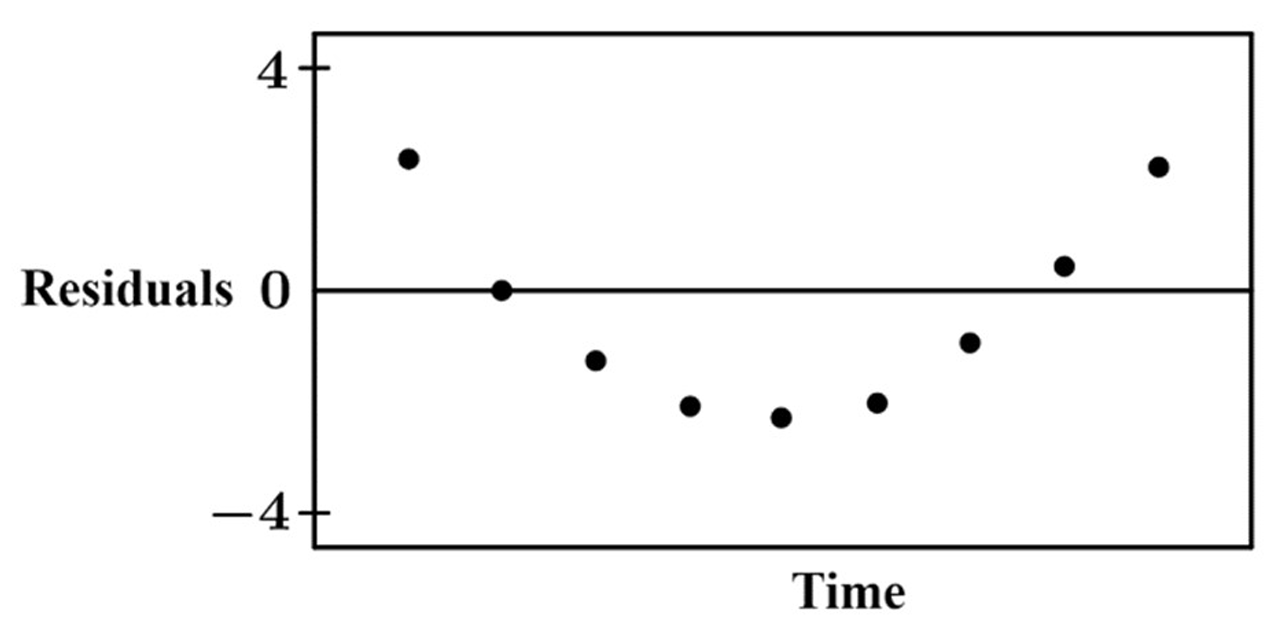
A linear regression was used to create a model for a set of data. The figure shows a graph of the residuals of the linear regression. Which of the following statements about the linear regression is true?
(A) A linear regression model is appropriate, because the residuals show a clear pattern.
(B) A linear regression model is appropriate, but a quadratic regression may be a better model.
(C) A linear regression model is not appropriate, because the residuals do not show a linear pattern.
(D) A linear regression model is not appropriate, because the residuals show a clear pattern.
▶️ Answer/Explanation
Detailed solution

The correct option is (D).
A residual plot should show a random scatter of points if a linear model is appropriate.
In this graph, the residuals exhibit a distinct $U$-shaped or curved pattern.
The presence of a non-random pattern indicates that the linear model fails to capture the underlying trend.
Therefore, the linear regression is not appropriate for this specific dataset.
This pattern suggests that a nonlinear model, such as a quadratic one, would be a better fit.
Option (D) correctly identifies that the pattern itself is the reason for the model’s inappropriateness.
Question 51

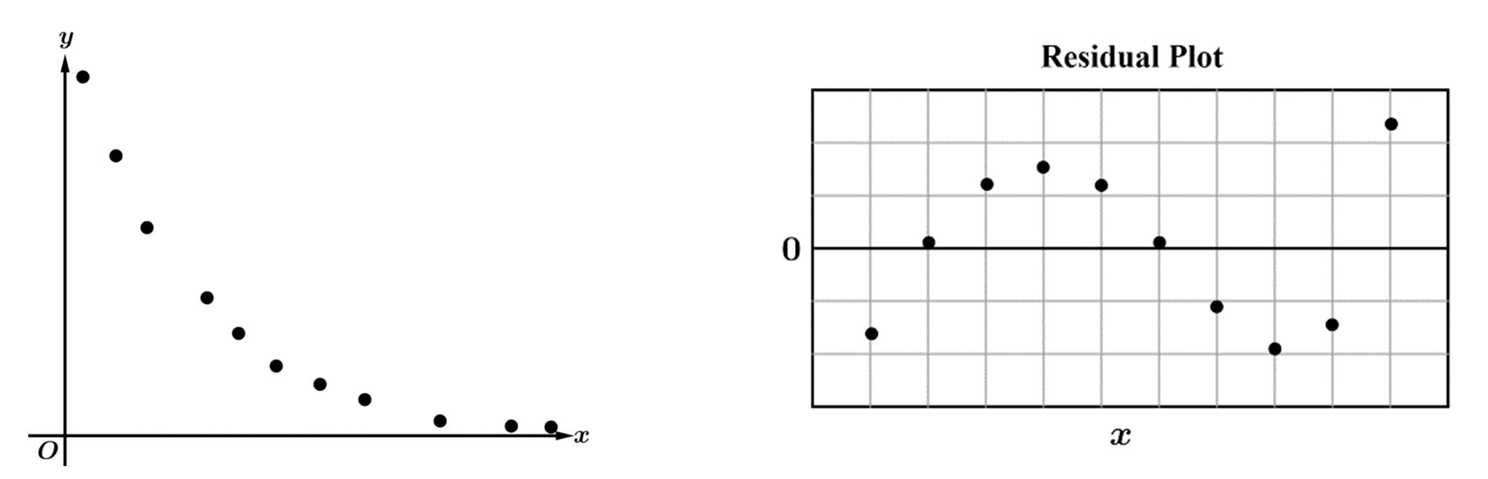
A regression model was created for the data in the graph above (left). The residual plot for the model is given above (right). Which of the following statements about the regression model is best?
(A) A quadratic regression model was used and the model is appropriate.
(B) A quadratic regression model was used and the model is not appropriate.
(C) An exponential regression model was used and the model is appropriate.
(D) An exponential regression model was used and the model is not appropriate.
▶️ Answer/Explanation
Detailed solution

The correct option is (B).
The residual plot shows a distinct curved, non-random pattern (a “U” or “inverted U” shape).
A curved pattern in a residual plot indicates that the model used is not appropriate for the data.
The original scatterplot shows a curved relationship that could be modeled by a quadratic function $y = ax^2 + bx + c$.
However, since the residuals are not randomly scattered around the $y = 0$ line, a quadratic fit fails to capture the full trend.
For a model to be appropriate, the residuals should be randomly distributed with no discernible pattern.
Therefore, the quadratic model was used, but the resulting pattern in the residuals proves it is not the best fit.
Question 52

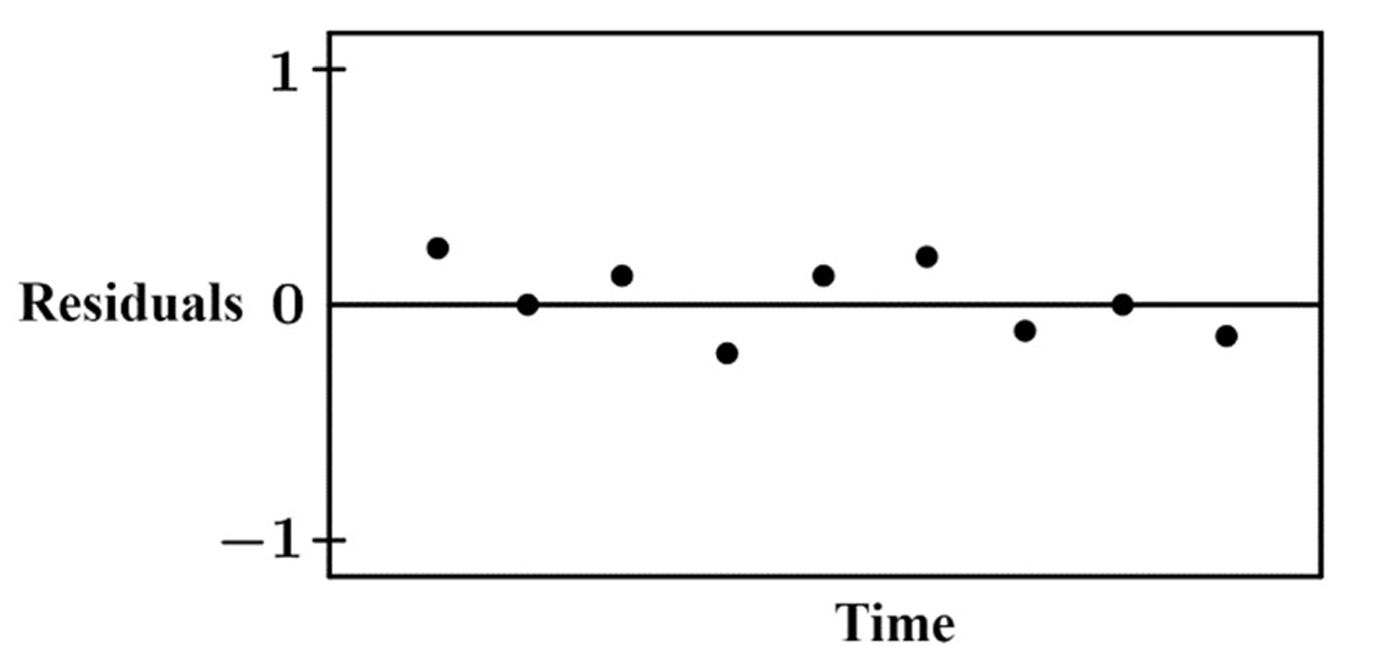
Mr. Passwater believed a set of data displayed exponential growth. He used the set of data to create an exponential regression model. The residual plot for his model is shown below. Based on the residual plot above, which of the following conclusions is correct?
(A) The residual plot has no apparent pattern, so the exponential model was appropriate.
(B) The residual plot has no apparent pattern, so the exponential model was not appropriate.
(C) The residual plot displays a pattern, so the exponential model was appropriate.
(D) The residual plot displays a pattern, so the exponential model was not appropriate.
▶️ Answer/Explanation
Detailed solution

The correct option is (A).
A residual is calculated as $\text{observed value} – \text{predicted value}$.
The provided residual plot shows points randomly scattered above and below the line $y = 0$.
There is no curved, U-shaped, or systematic pattern visible in the residuals.
A random distribution of residuals indicates that the chosen model fits the data well.
Since there is no apparent pattern, the exponential regression model is considered appropriate.
Therefore, the data confirms Mr. Passwater’s belief regarding the exponential growth.

Question 53

A set of data was used to create a linear, a quadratic, and an exponential regression model. The residual plots for the three models are shown above. Based on the three residual plots, which of the following could be an appropriate model for the data?
(A) $y = 3x + 1$
(B) $y = x^2 – 3x + 1$
(C) $y = 4(3)^x$
(D) $y = 1 + \log_3 x$
▶️ Answer/Explanation
Detailed solution

Correct Answer: (C) $y = 4(3)^x$

An appropriate regression model is indicated by a residual plot with no clear pattern and points randomly dispersed around the horizontal axis.
The Linear Residual Plot shows a distinct U-shaped pattern, suggesting a linear model is inappropriate.
The Quadratic Residual Plot also shows a clear curved pattern, indicating the quadratic model does not fit well.
The Exponential Residual Plot shows a random distribution of points above and below the $x$-axis.
Since the exponential residual plot is the most random, an exponential model is the best fit.
Option (C) represents an exponential function, $y = 4(3)^x$, making it the appropriate choice.
Question 54

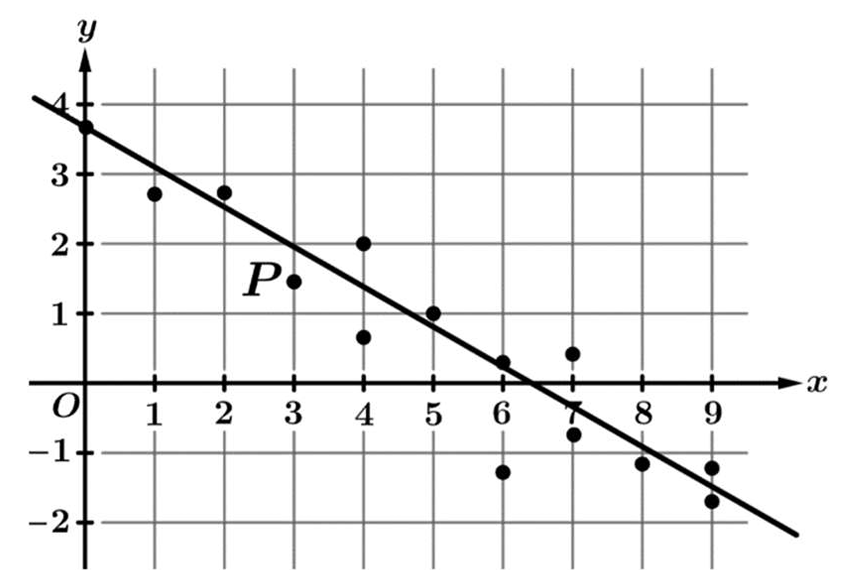
A set of data and the linear regression model constructed for the data set are shown in the figure, along with data point $P$. Which of the following is the best estimate of the residual for data point $P$?
(A) $-0.5$
(B) $0.5$
(C) $1.5$
(D) $3$
▶️ Answer/Explanation
Detailed solution

The residual is defined as the difference between the observed $y$-value and the predicted $\hat{y}$-value: $\text{Residual} = y – \hat{y}$.
Locate data point $P$ on the graph at the $x$-coordinate of $3$.
The actual $y$-value for point $P$ is $1.5$.
The predicted value $\hat{y}$ on the regression line at $x = 3$ is $2$.
Calculate the residual: $1.5 – 2 = -0.5$.
Therefore, the best estimate of the residual is $-0.5$.
The correct option is (A).
Question 55

An exponential regression model $S$ is constructed for a data set. The model $S$ is given by $S(x) = 3(2)^x$. The coordinates of a point $P$ from the data set are $(-1, 1)$. Which of the following statements is true about the residual of point $P$?
(A) The residual of point $P$ is a negative value because the model produces an overestimate at point $P$.
(B) The residual of point $P$ is a negative value because the model produces an underestimate at point $P$.
(C) The residual of point $P$ is a positive value because the model produces an overestimate at point $P$.
(D) The residual of point $P$ is a positive value because the model produces an underestimate at point $P$.
▶️ Answer/Explanation
Detailed solution

The correct option is (A).
Calculate the predicted value: $S(-1) = 3(2)^{-1} = 3(0.5) = 1.5$.
The actual $y$-coordinate of point $P$ is $1$.
The residual is calculated as $\text{Actual} – \text{Predicted} = 1 – 1.5 = -0.5$.
Since the residual is negative, the predicted value is greater than the actual value.
Therefore, the model produces an overestimate at point $P$.

Question 56

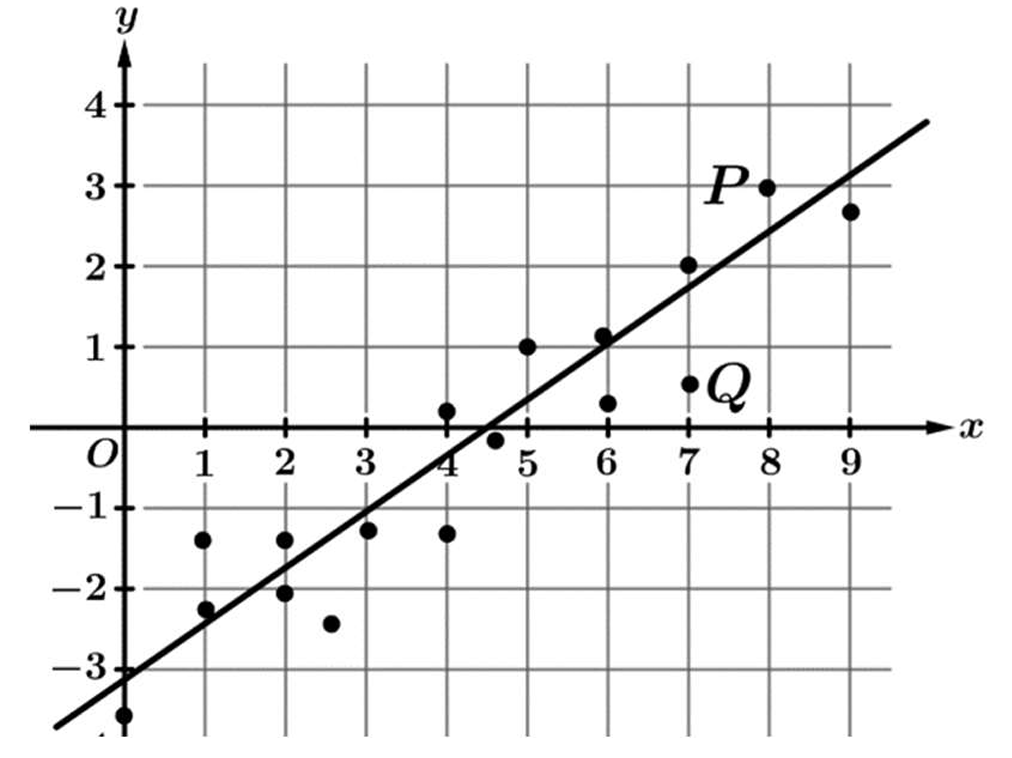
The figure shows a data set and its linear regression model in the \(xy\text{-plane}\). The points \(P\) and \(Q\) are labeled. Which of the following statements is true about the model and the estimates produced by the model that correspond to \(P\) and \(Q\)?
(A) The residuals for \(P\) and \(Q\) have the same sign. Based on the absolute value of the residuals, there is a greater error in the model with \(P\) than with \(Q\).
(B) The residuals for \(P\) and \(Q\) have the same sign. Based on the absolute value of the residuals, there is a greater error in the model with \(Q\) than with \(P\).
(C) The residuals for \(P\) and \(Q\) have opposite signs. Based on the absolute value of the residuals, there is a greater error in the model with \(P\) than with \(Q\).
(D) The residuals for \(P\) and \(Q\) have opposite signs. Based on the absolute value of the residuals, there is a greater error in the model with \(Q\) than with \(P\).
▶️ Answer/Explanation
Detailed solution

Point \(P\) is above the regression line, meaning it has a positive residual.
Point \(Q\) is below the regression line, meaning it has a negative residual.
Since one is positive and one is negative, the residuals have opposite signs.
The vertical distance from \(Q\) to the line is visually larger than the distance from \(P\) to the line.
The absolute value of a residual represents the magnitude of error for that point.
Therefore, there is a greater error in the model for point \(Q\) than for point \(P\).
This matches statement (D).
Question 57

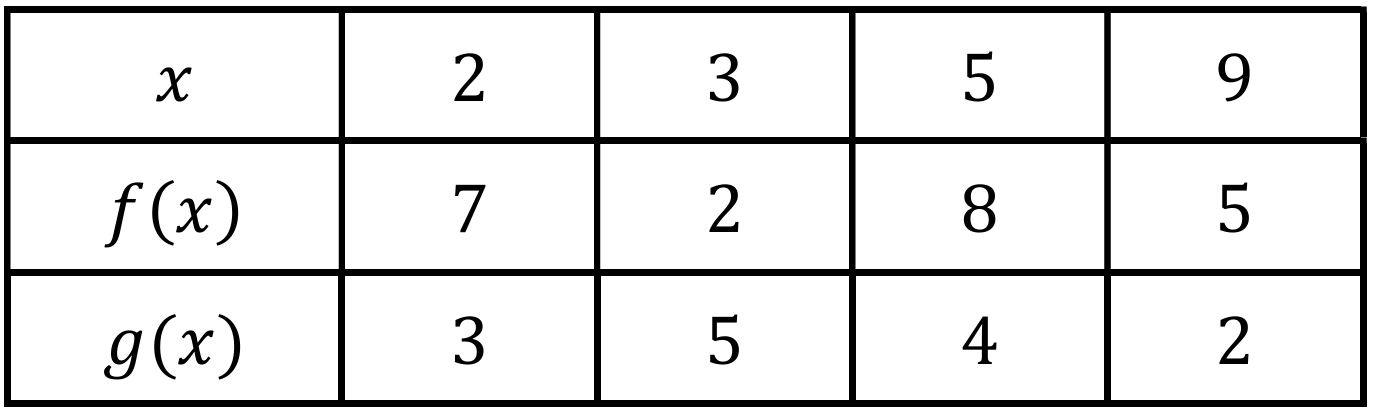
The table gives values for the functions $f$ and $g$ at selected values of $x$. Functions $f$ and $g$ are defined for all real numbers.
Let $h$ be the function defined by $h(x) = g(f(x))$. What is the value of $h(9)$?
(A) $4$
(B) $7$
(C) $8$
(D) $10$
▶️ Answer/Explanation
Detailed solution

To find the value of $h(9)$, we use the composition formula $h(9) = g(f(9))$.
First, locate $x = 9$ in the table and identify the value of $f(9)$.
From the table, when $x = 9$, $f(9) = 5$.
Substitute this value into the outer function: $g(f(9)) = g(5)$.
Next, locate $x = 5$ in the table and identify the value of $g(5)$.
From the table, when $x = 5$, $g(5) = 4$.
Therefore, $h(9) = 4$, which corresponds to option (A).

Question 58

The table gives values for the functions $f$ and $g$ at selected values of $x$. Functions $f$ and $g$ are defined for all real numbers.
Let $k$ be the function defined by $k(x) = f(g(x))$. What is the value of $k(3)$?
(A) $3$
(B) $7$
(C) $8$
(D) $10$
▶️ Answer/Explanation
Detailed solution

The correct answer is (C).
To find $k(3)$, identify the composite function $k(3) = f(g(3))$.
First, locate $x = 3$ in the table to find the value of $g(3)$.
From the table, when $x = 3$, $g(3) = 5$.
Substitute this value into the outer function: $f(g(3)) = f(5)$.
Next, locate $x = 5$ in the table to find the value of $f(5)$.
From the table, when $x = 5$, $f(5) = 8$.
Therefore, $k(3) = 8$.
Question 59

Graph of f Graph of g
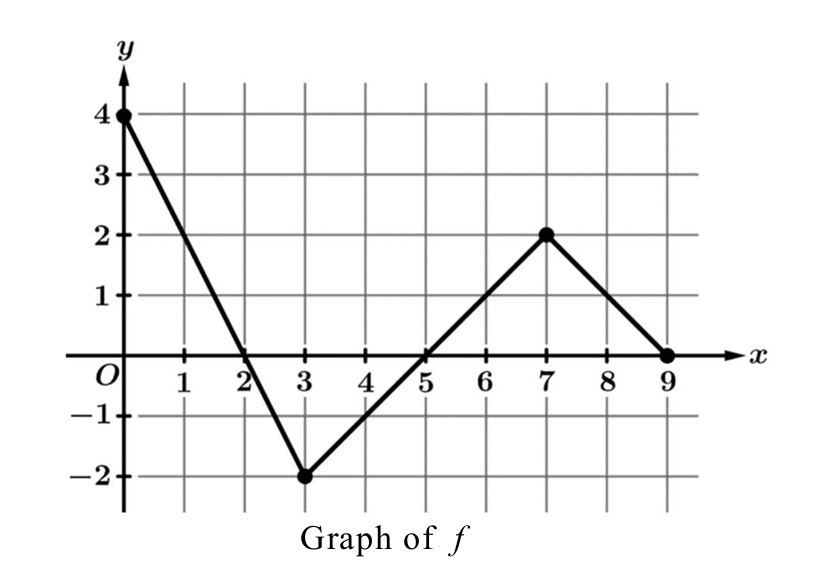
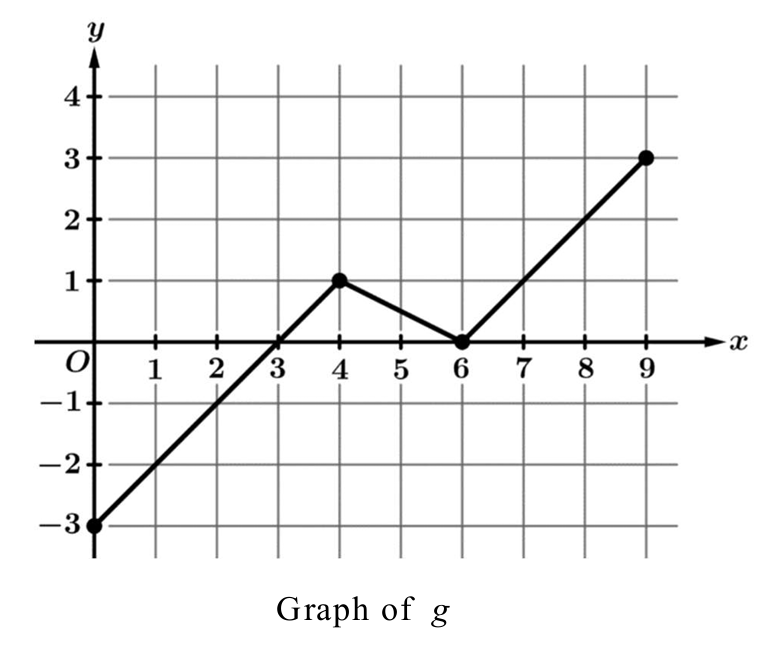
The graphs of $f$ and $g$ are shown for $0 \leq x \leq 9$, each consisting of three line segments.
Let $h$ be the function defined by $h(x) = g(f(x))$. What is the value of $h(8)$?
(A) $-2$
(B) $-1$
(C) $0$
▶️ Answer/Explanation
Detailed solution

To find $h(8)$, use the definition of composite functions: $h(8) = g(f(8))$.
First, locate $x = 8$ on the horizontal axis of the Graph of $f$.
Move vertically to the line segment to find the $y$-value: $f(8) = 1$.
Substitute this result into the outer function to get $g(1)$.
Now, locate $x = 1$ on the horizontal axis of the Graph of $g$.
Move vertically to the line segment to find the corresponding $y$-value: $g(1) = -2$.
Therefore, $h(8) = g(1) = -2$, which corresponds to choice (A).

Question 60

The graphs of $f$ and $g$ are shown for $0 \leq x \leq 9$, each consisting of three line segments.
Let $k$ be the function defined by $k(x) = f(g(x))$. What is the value of $k(9)$?
(A) $-3$
(B) $-2$
(C) $0$
(D) $4$
▶️ Answer/Explanation
Detailed solution

To find $k(9)$, we use the definition of a composite function: $k(9) = f(g(9))$.
First, identify the value of $g(9)$ by looking at the Graph of $g$ at $x = 9$.
From the graph, the point $(9, 3)$ exists, so $g(9) = 3$.
Next, substitute this value into $f$: $k(9) = f(3)$.
Identify the value of $f(3)$ by looking at the Graph of $f$ at $x = 3$.
From the graph, the point $(3, -2)$ exists, so $f(3) = -2$.
Therefore, $k(9) = -2$, which corresponds to option (B).
Question 61

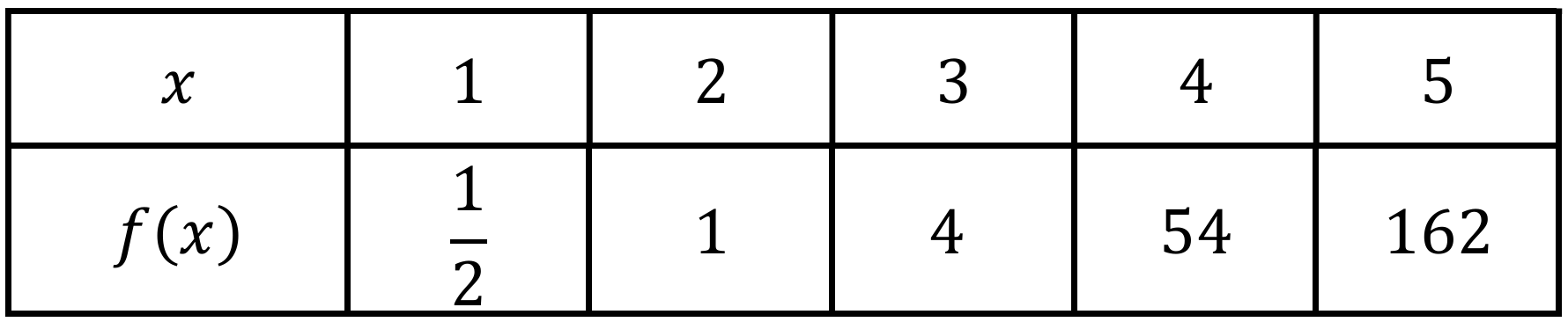
The table gives values of the function $f$ for selected values of $x$. The function $g$ is given by $g(x) = 9^x – 8x$.
What is the value of $g(f(1))$?
(A) $-1$
(B) $\frac{1}{2}$
(C) $\frac{3}{2}$
(D) $65$
▶️ Answer/Explanation
Detailed solution

To find $g(f(1))$, first identify the value of $f(1)$ from the provided table.
From the table, when $x = 1$, the corresponding value is $f(1) = \frac{1}{2}$.
Next, substitute this value into the function $g(x) = 9^x – 8x$.
This gives the expression $g\left(\frac{1}{2}\right) = 9^{1/2} – 8\left(\frac{1}{2}\right)$.
Calculate the square root: $9^{1/2} = \sqrt{9} = 3$.
Calculate the product: $8 \cdot \frac{1}{2} = 4$.
Subtract the values: $3 – 4 = -1$.
Therefore, the correct option is (A).

Question 62

The function $f$ is given by $f(x) = 4^{x^2}$, and the function $g$ is given by $g(x) = 3x$. Which of the following is an expression for $f(g(x))$?
(A) $4^{3x^2}$
(B) $4^{6x^2}$
(C) $4^{9x^2}$
(D) $3 \cdot 4^{x^2}$
▶️ Answer/Explanation
Detailed solution

To find the composite function $f(g(x))$, substitute the expression for $g(x)$ into $f(x)$.
Given $g(x) = 3x$, we replace the $x$ in $f(x) = 4^{x^2}$ with $(3x)$.
This gives the expression $f(g(x)) = 4^{(3x)^2}$.
Apply the power of a product rule: $(3x)^2 = 3^2 \cdot x^2$.
Simplify the exponent: $3^2 = 9$, resulting in $9x^2$.
The final expression is $4^{9x^2}$.
Therefore, the correct choice is (C).

Question 63

The function $f$ is given by $f(x) = 2x – 1$, and the function $g$ is given by $g(x) = x^2 + 3x$. Which of the following is an expression for $g(f(x))$?
(A) $2x^2 + 6x – 1$
(B) $4x^2 – x – 1$
(C) $4x^2 + 2x – 2$
(D) $2x^3 + 5x^2 – 3x$
▶️ Answer/Explanation
Detailed solution

To find the composite function $g(f(x))$, substitute the expression for $f(x)$ into $g(x)$.
Substitute $f(x) = 2x – 1$ into $g(x) = x^2 + 3x$:
$g(f(x)) = (2x – 1)^2 + 3(2x – 1)$
Expand the squared term: $(2x – 1)^2 = 4x^2 – 4x + 1$
Distribute the 3: $3(2x – 1) = 6x – 3$
Combine the parts: $4x^2 – 4x + 1 + 6x – 3$
Simplify by combining like terms: $4x^2 + 2x – 2$
Therefore, the correct choice is (C).

Scroll to Top