
▶️ Answer/Explanation
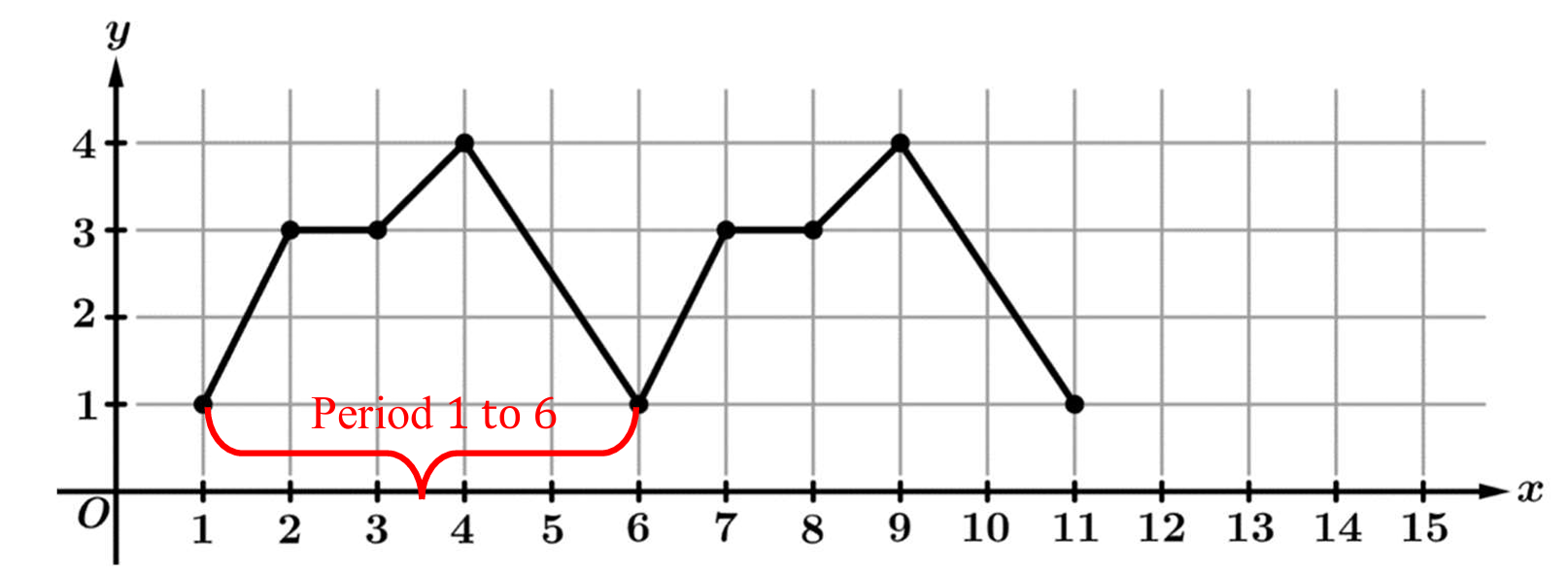
The period is the length of one complete cycle of the function. Observing the graph, the pattern begins at \( x=1 \) and repeats starting at \( x=6 \).
Therefore, the period is \( 6 – 1 = 5 \).
For a periodic function with period \( T \), the property \( f(x) = f(x + nT) \) holds true for any integer \( n \).
To find \( f(31) \), we can express \( 31 \) in terms of the starting point and the period: \( 31 = 1 + 30 = 1 + (6 \times 5) \).
This allows us to simplify the evaluation: \( f(31) = f(1 + 6 \times 5) = f(1) \).
Looking at the graph, the value of the function at \( x=1 \) is \( y=1 \).
Thus, \( f(31) = 1 \).
Comparing this with the given options, the correct statement is that the period is \( 5 \) and \( f(31)=1 \).
▶️ Answer/Explanation
The period of a function is the horizontal length of one complete cycle after which the graph repeats itself.
To find the period, identify two corresponding consecutive points on the graph, such as the peaks.
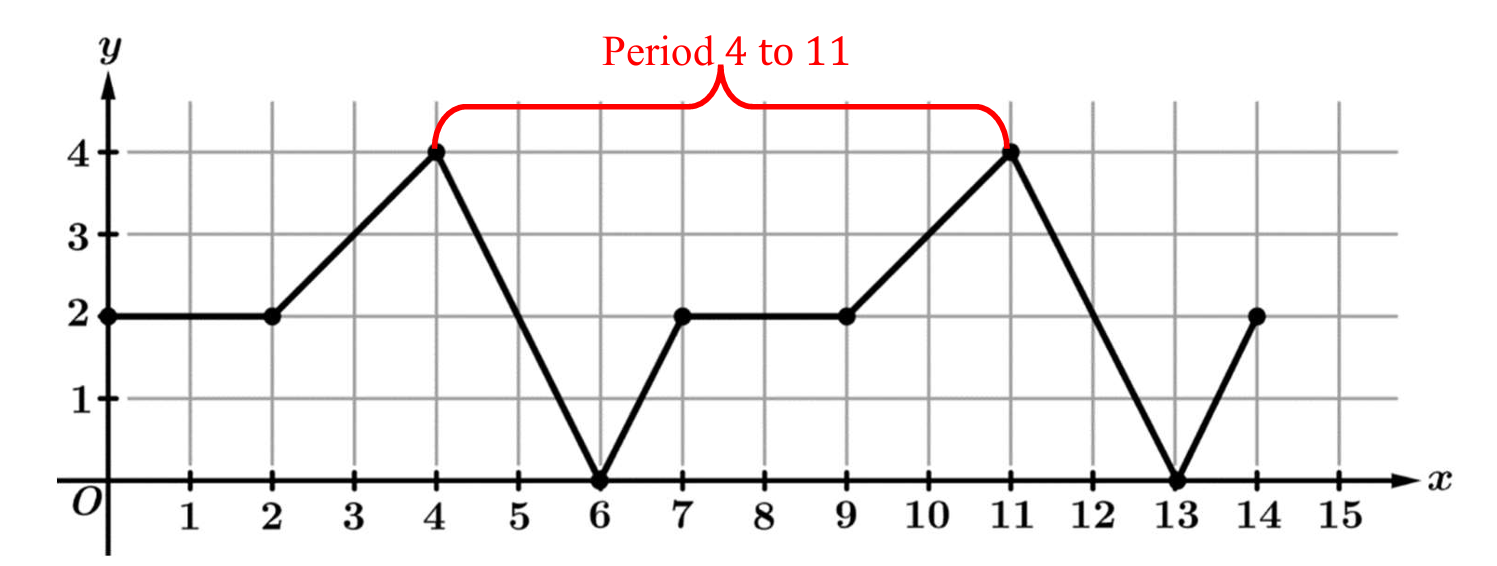
Observing the graph, the first peak is located at \( x = 4 \).
The next corresponding peak appears at \( x = 11 \).
The distance between these two peaks is calculated as \( 11 – 4 = 7 \).
Alternatively, the cycle starts at \( x=0 \) and begins to repeat the same pattern at \( x=7 \), which confirms the length.
Therefore, the period of the function \( g \) is 7.
Correct Option: (B)
▶️ Answer/Explanation
From the graph, we can observe that the function is periodic.
The pattern repeats between the peak at $x = 4$ and the next peak at $x = 11$.
The period of the function is the difference between these values: $11 – 4 = 7$.
To find $g(32)$, we divide $32$ by the period $7$: $32 = 4 \times 7 + 4$.
The remainder is $4$, which implies that $g(32) = g(4)$.
Looking at the graph, at $x = 4$, the value of the function is $4$.
Therefore, $g(32) = 4$.
The correct option is (D).
▶️ Answer/Explanation
The graph indicates that the function \( g \) is periodic. The pattern repeats every \( 7 \) units (e.g., from peak \( x=4 \) to peak \( x=11 \)), so the period is \( 7 \).
Within the fundamental period starting at \( x=4 \), the graph goes downward from \( x=4 \) to \( x=6 \). Therefore, \( g \) is decreasing on the interval \( (4, 6) \).
Since the function repeats every \( 7 \) units, it is decreasing on all intervals of the form \( (4 + 7k, 6 + 7k) \) for any integer \( k \).
We must find which option fits this form. Let’s test values of \( k \) to reach the \( 70 \)s range.
Set \( k = 10 \). The interval becomes \( (4 + 7(10), 6 + 7(10)) \).
Simplifying the expression: \( (4 + 70, 6 + 70) = (74, 76) \).
This calculated interval matches option (C).
▶️ Answer/Explanation
The correct answer is (A).
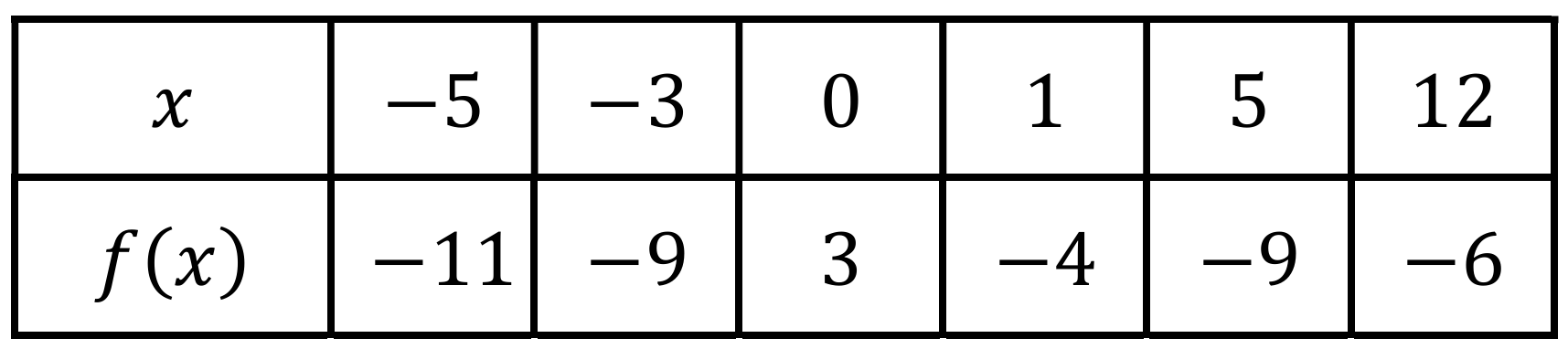
1. Examine the values in the table to identify a pattern. Notice that \( f(-3) = -9 \) and \( f(5) = -9 \).
2. The difference between these \( x \)-values is \( 5 – (-3) = 8 \). Since the function values repeat, this implies the function is periodic with a period of \( 8 \), meaning \( f(x) = f(x+8) \).
3. The question asks for the value of \( f(3) \).
4. Using the periodicity property, we can relate \( f(3) \) to a value known in the table by subtracting the period: \( f(3) = f(3 – 8) \).
5. Calculating the value inside the function gives \( f(3) = f(-5) \).
6. Referring back to the table, the value of \( f(x) \) when \( x = -5 \) is \( -11 \).
7. Therefore, \( f(3) = -11 \).
▶️ Answer/Explanation
▶️ Answer/Explanation
From the table provided, we can identify the value of $x$ for which $f(x) = -4$.
Looking at the row for $f(x)$, the value $-4$ corresponds to $x = 1$. Therefore, we know that $f(1) = -4$.
The question asks to select a value of $x$ from the given options. However, $x = 1$ is not among the options ($-12, -8, 4, 9$).
Based on the red annotation in the image, the correct option is (D) $x = 9$ because of the relationship $f(9 – 8) = f(1) = -4$.
This implies that the question likely intended to ask for the value of $x$ such that $f(x – 8) = -4$.
If we solve for $x$ in the equation $x – 8 = 1$ (since $f(1) = -4$), we get:
$x = 1 + 8$
$x = 9$
Thus, the value that satisfies the condition implied by the solution is $x = 9$.
▶️ Answer/Explanation
The correct option is (D).
The solution relies on the function having a periodic property, given by the condition \( h(x + 9) = h(x) \).
This equation indicates that the period of the function is \( 9 \), meaning values repeat every \( 9 \) units.
To find \( h(2) \), we can use this periodicity to find an equivalent input value that exists in the given table.
Using the relationship \( h(x) = h(x – 9) \), we substitute \( x = 2 \).
This gives us \( h(2) = h(2 – 9) \).
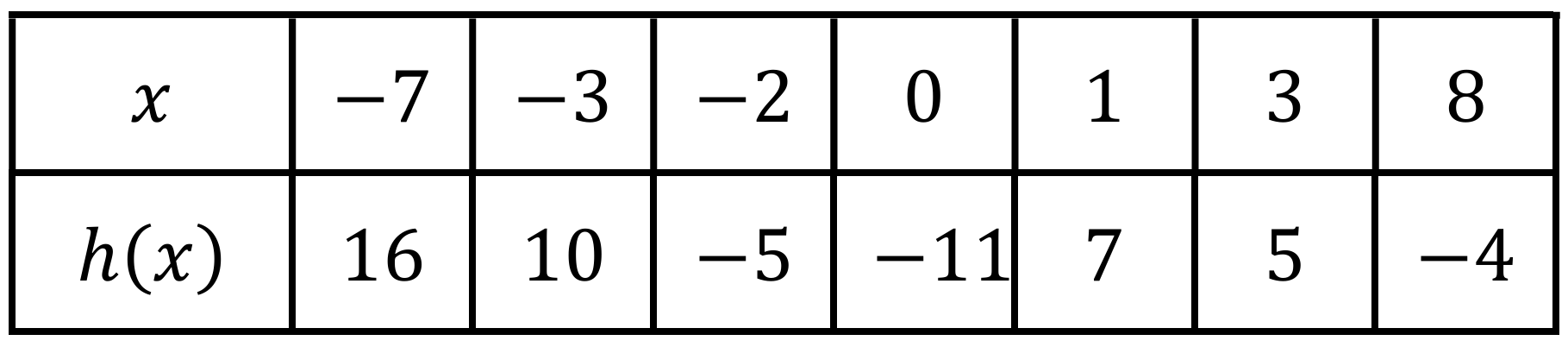
Calculating the difference inside the function: \( 2 – 9 = -7 \).
Therefore, \( h(2) = h(-7) \).
Looking at the provided table, the value of \( h(x) \) when \( x = -7 \) is \( 16 \).
Thus, \( h(2) = 16 \).
▶️ Answer/Explanation
▶️ Answer/Explanation
We are asked to find the value of \( h(9k-1) \) given that \( k \) is an integer.
We need to find an integer value for \( k \) such that the resulting expression \( 9k-1 \) corresponds to an \( x \)-value listed in the table.
Let’s test the integer \( k = 1 \).
Substituting \( k = 1 \) into the expression: \( 9(1) – 1 = 9 – 1 = 8 \).
Looking at the table, we verify if \( x = 8 \) is present. It is the last column.
From the table, when \( x = 8 \), the function value is \( h(8) = -4 \).
Therefore, \( h(9k-1) = -4 \).
Correct Option: (C)
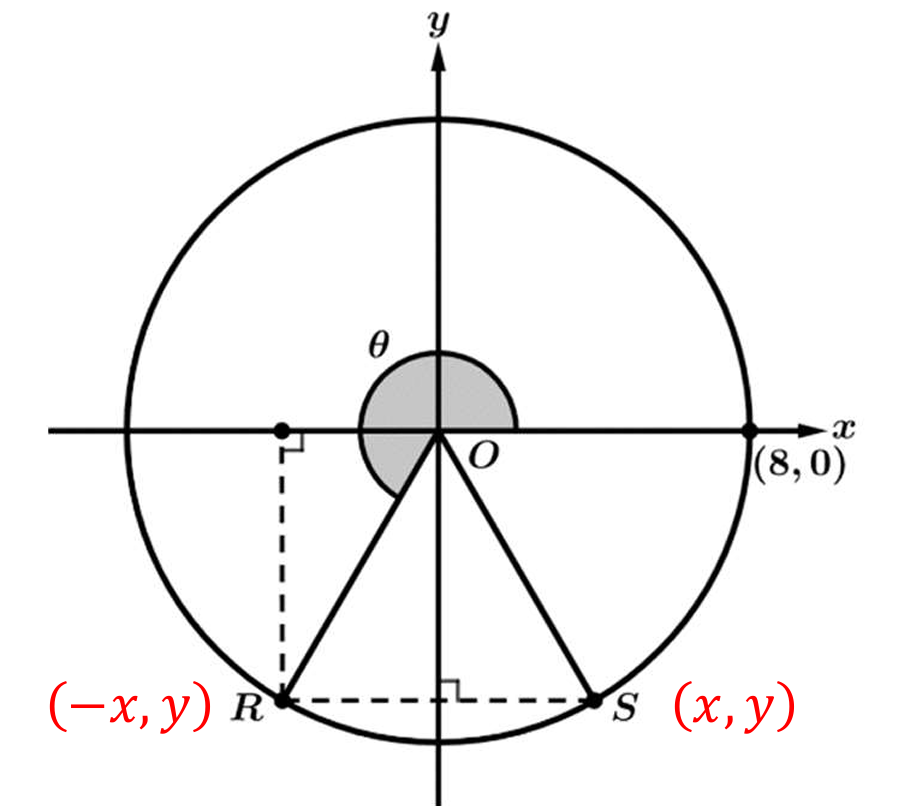
▶️ Answer/Explanation
The circle intersects the positive x-axis at the point \((8, 0)\), indicating that the radius of the circle is \(r = 8\).
By definition, for any angle \(\theta\) in standard position, the cosine is the ratio of the x-coordinate of the point on the terminal ray to the radius (\(\cos \theta = \frac{X}{r}\)).
The terminal ray of angle \(\theta\) intersects the circle at point \(R\), which has the coordinates \((-x, y)\).
The x-coordinate of \(R\) is \(-x\), which represents the horizontal displacement of the point from the y-axis.
Substituting these values into the cosine definition gives \(\cos \theta = \frac{-x}{8}\).
Therefore, the correct statement is that \(\cos \theta = \frac{-x}{8}\) because it relates the horizontal displacement of \(R\) to the radius.
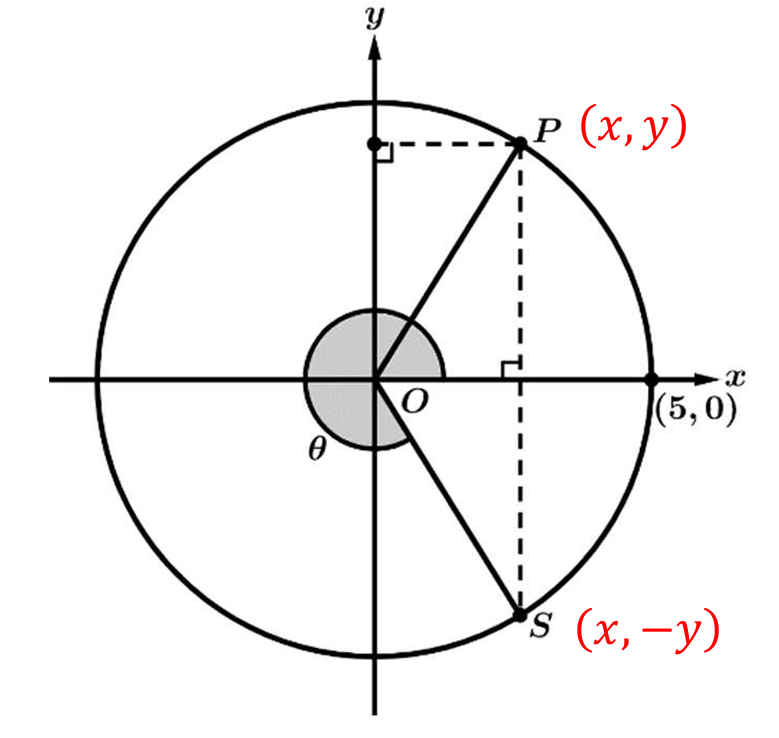
▶️ Answer/Explanation
The correct answer is (C).
1. By definition, for any point \((X, Y)\) on the terminal ray of an angle \(\theta\) in standard position, \(\sin \theta = \frac{Y}{r}\), where \(r\) is the distance from the origin.
2. The terminal ray of angle \(\theta\) intersects the circle at point \(S\), which has the coordinates \((x, -y)\).
3. The circle intersects the positive \(x\)-axis at \((5,0)\), which implies the radius of the circle is \(r = 5\).
4. The vertical displacement of point \(S\) from the \(x\)-axis corresponds to its \(y\)-coordinate, which is \(-y\).
5. Substituting these values into the sine definition gives \(\sin \theta = \frac{-y}{5}\).
6. This matches option (C), which correctly identifies the ratio as the vertical displacement of \(S\) divided by the distance to the origin.
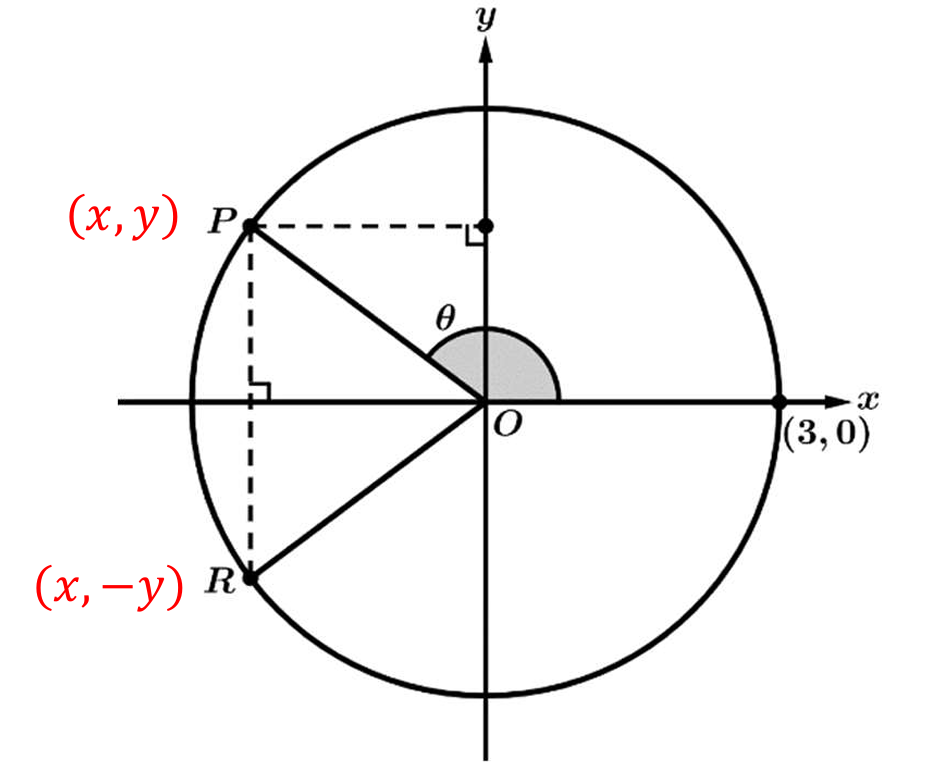
▶️ Answer/Explanation
The tangent of an angle \(\theta\) in standard position is defined by the coordinates of a point on its terminal ray.
In this figure, the point \(P(x, y)\) lies specifically on the terminal ray of the angle \(\theta\).
By definition, \(\tan \theta = \frac{\text{ordinate}}{\text{abscissa}} = \frac{y}{x}\).
The coordinate \(y\) corresponds to the vertical displacement of the point \(P\) from the x-axis.
The coordinate \(x\) corresponds to the horizontal displacement of the point \(P\) from the y-axis (origin).
Therefore, \(\tan \theta\) is correctly described as the ratio of the vertical displacement of \(P\) to the horizontal displacement of \(P\).
Point \(R\) lies on a different ray (corresponding to angle \(-\theta\)), so its coordinates define \(\tan(-\theta)\), not \(\tan(\theta)\).
Thus, the correct statement corresponds to option (A).
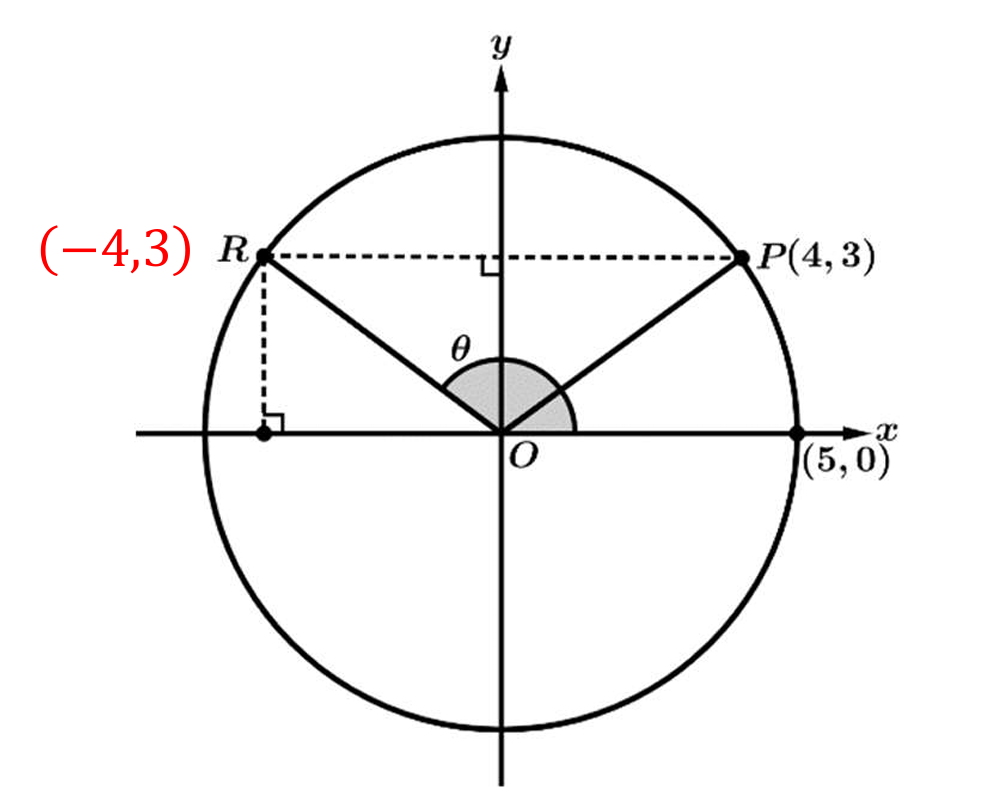
▶️ Answer/Explanation
The dashed horizontal line connecting \(R\) and \(P\) indicates they have the same \(y\)-coordinate. Since \(P\) is \((4, 3)\), then \(y_R = 3\).
Point \(R\) lies on the circle defined by \(x^2 + y^2 = r^2\). With \(r=5\) and \(y=3\), we solve for \(x_R\).
\(x_R^2 + 3^2 = 5^2 \Rightarrow x_R^2 + 9 = 25 \Rightarrow x_R^2 = 16\).
Since \(R\) is in the second quadrant, its \(x\)-coordinate must be negative, so \(x_R = -4\). Thus, \(R = (-4, 3)\).
The definition of the tangent function for a point \((x, y)\) on the terminal ray is \(\tan \theta = \frac{y}{x}\).
Substituting the coordinates of \(R\): \(\tan \theta = \frac{3}{-4}\).
Therefore, \(\tan \theta = -\frac{3}{4}\).
Correct Option: (A)
▶️ Answer/Explanation
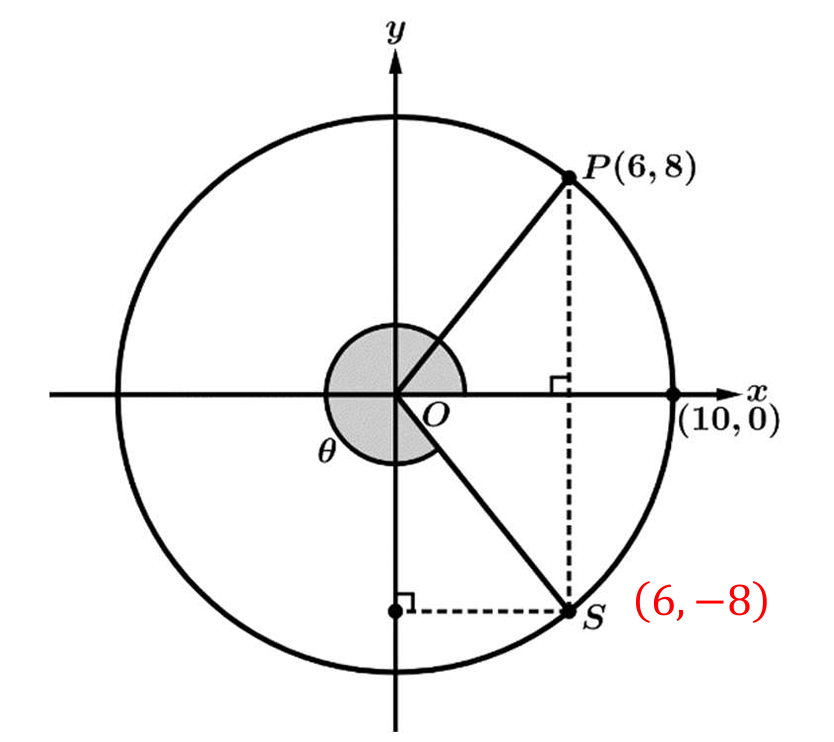
From the figure, point \( S \) shares the same x-coordinate as point \( P(6, 8) \), so \( x_S = 6 \).
Since \( S \) lies on the circle in the fourth quadrant, its y-coordinate is negative.
Using the circle equation \( x^2 + y^2 = r^2 \) with \( r=10 \), we get \( 6^2 + y^2 = 10^2 \), which yields \( y = -8 \).
The definition of sine for an angle in standard position is \( \sin \theta = \frac{y}{r} \).
Substituting the values for point \( S \): \( y = -8 \) and \( r = 10 \).
Thus, \( \sin \theta = \frac{-8}{10} = -\frac{4}{5} \).
Correct Option: (A)
▶️ Answer/Explanation
The correct option is (D).
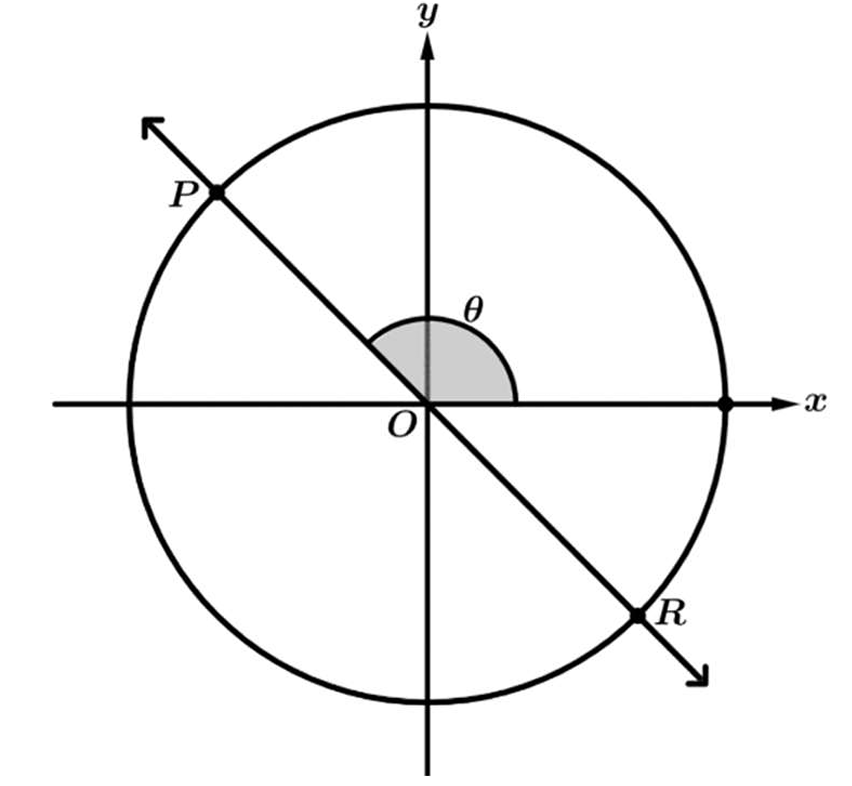
• The terminal ray of angle \(\theta\) lies on the line given by the equation \(y = -\frac{4}{3}x\).
• The slope of a line passing through the origin is given by \(m\) in the equation \(y = mx\). Here, the slope \(m = -\frac{4}{3}\).
• By definition, the tangent of an angle \(\theta\) in standard position is equal to the slope of its terminal ray.
• Therefore, \(\tan \theta = -\frac{4}{3}\).
• To check other values: Since the ray is in Quadrant II, let \(x = -3\) and \(y = 4\). The radius \(r = \sqrt{(-3)^2 + 4^2} = 5\).
• Calculating cosine: \(\cos \theta = \frac{x}{r} = -\frac{3}{5}\). This confirms options (A) and (B) are incorrect.
▶️ Answer/Explanation
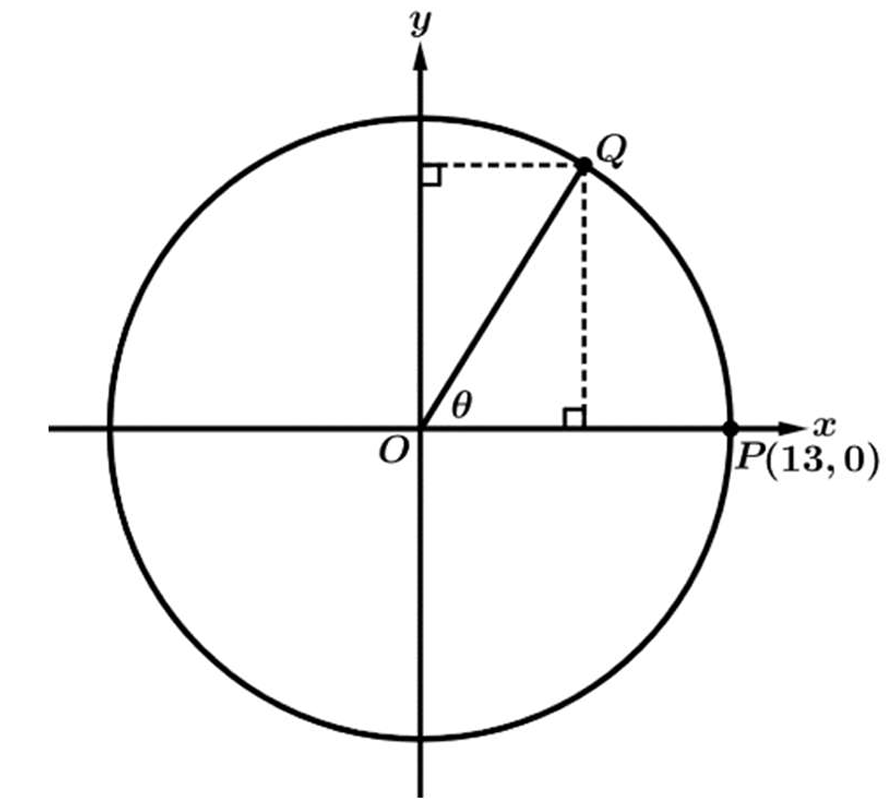
Step 1: Identify the radius of the circle. Since point \(P(13, 0)\) lies on the circle centered at the origin \((0,0)\), the radius is \(r = 13\).
Step 2: Calculate the angle \(\theta\). The length of the intercepted arc \(PQ\) is given as \(s = 15\). Using the formula \(s = r\theta\), we determine that \(\theta = \frac{s}{r} = \frac{15}{13}\) radians.
Step 3: Determine the coordinates of point \(Q\). For a circle with radius \(r\) and angle \(\theta\), the coordinates of a point on the circle are \((x, y) = (r\cos\theta, r\sin\theta)\).
Step 4: Find the distance from the \(x\)-axis. The distance of point \(Q\) from the \(x\)-axis is the vertical distance, which corresponds to the \(y\)-coordinate.
Step 5: Substitute the known values. The \(y\)-coordinate is \(13\sin(\theta)\). Substituting \(\theta = \frac{15}{13}\), we get \(13\sin\left(\frac{15}{13}\right)\), which matches option (D).
▶️ Answer/Explanation
The correct answer is (C).
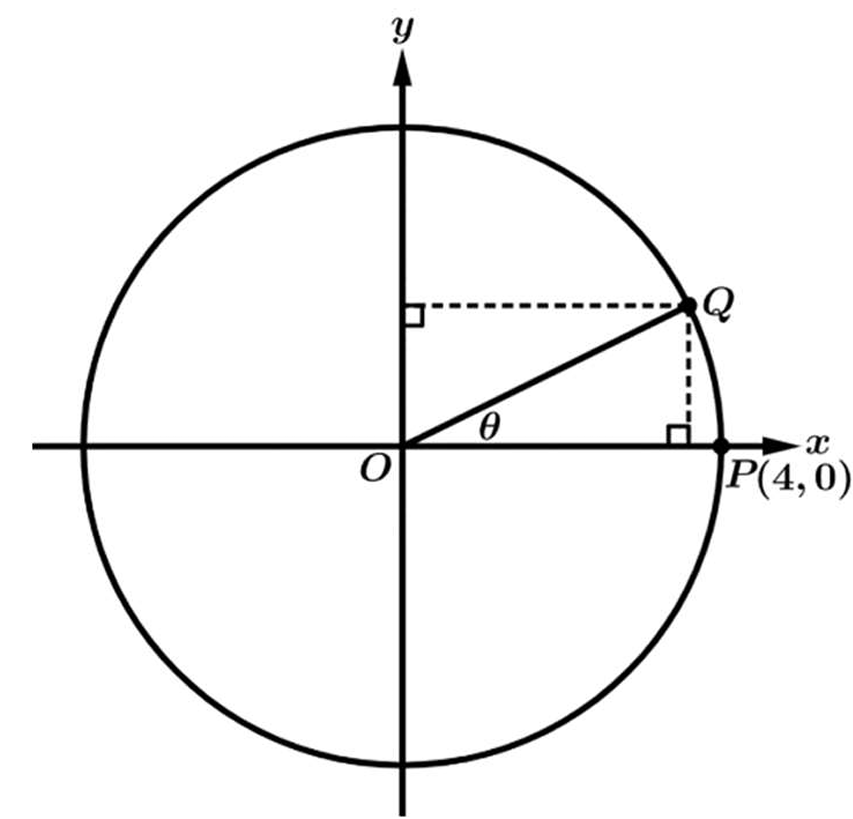
Since point \(P(4, 0)\) lies on the circle centered at the origin, the radius of the circle is \(r = 4\).
Using the arc length formula \(s = r\theta\), where \(s=3\) and \(r=4\), we find the angle: \(3 = 4\theta \Rightarrow \theta = \frac{3}{4}\) radians.
The coordinates of point \(Q\) on the circle are determined by \((x, y) = (r \cos \theta, r \sin \theta)\).
Substituting our values, the coordinates for \(Q\) become \(\left(4 \cos \left(\frac{3}{4}\right), 4 \sin \left(\frac{3}{4}\right)\right)\).
The distance of any point from the \(y\)-axis is represented by the absolute value of its \(x\)-coordinate.
Therefore, the distance of point \(Q\) from the \(y\)-axis is \(4 \cos\left(\frac{3}{4}\right)\).
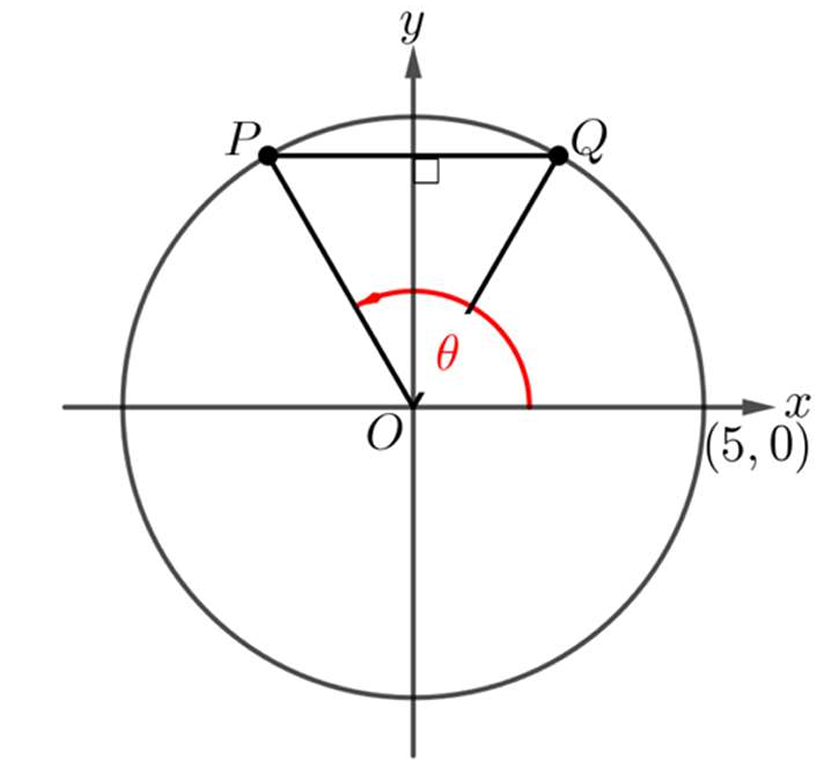
▶️ Answer/Explanation
The coordinates of any point on a circle of radius \(r\) are given by \((r \cos \theta, r \sin \theta)\), where \(\theta\) is the angle from the positive x-axis. Here, \(r=5\).
Since triangle \(PQO\) is equilateral, the central angle \(\angle POQ = \frac{\pi}{3}\) (which is \(60^\circ\)).
The triangle is symmetric about the y-axis, meaning the y-axis bisects \(\angle POQ\). Thus, the angle between the positive y-axis and \(OP\) is \(\frac{1}{2} \cdot \frac{\pi}{3} = \frac{\pi}{6}\).
The positive y-axis itself is at an angle of \(\frac{\pi}{2}\) relative to the positive x-axis.
Therefore, the total angle \(\theta\) for point \(P\) is the sum: \(\theta = \frac{\pi}{2} + \frac{\pi}{6}\).
Calculating the sum: \(\theta = \frac{3\pi}{6} + \frac{\pi}{6} = \frac{4\pi}{6} = \frac{2\pi}{3}\).
Hence, the coordinates of point \(P\) are \(\left( 5 \cos \frac{2\pi}{3}, 5 \sin \frac{2\pi}{3} \right)\).
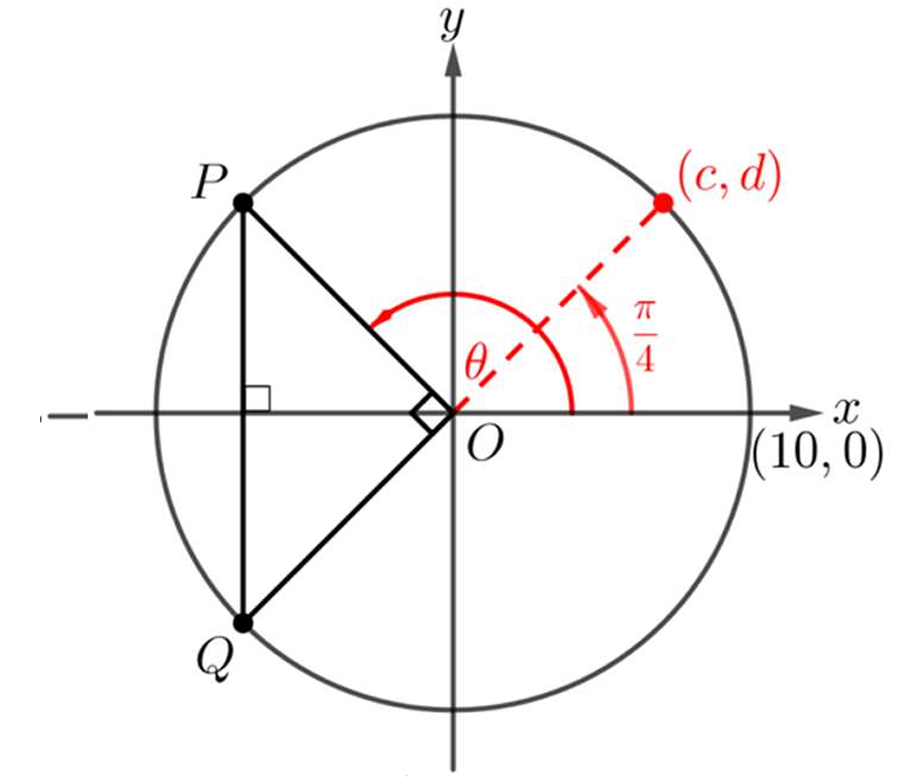
▶️ Answer/Explanation
The point \(P\) lies in the second quadrant where the x-coordinate is negative and the y-coordinate is positive.
Based on the symmetry shown in the diagram, point \(P\) makes an angle of \(\frac{3\pi}{4}\) with the positive x-axis, or has a reference angle of \(\frac{\pi}{4}\) with the negative x-axis.
Using the reference angle \(\frac{\pi}{4}\), the magnitude of the x-coordinate is \(10\cos\frac{\pi}{4}\) and the y-coordinate is \(10\sin\frac{\pi}{4}\).
Applying the signs for the second quadrant, the coordinates become \((-10\cos\frac{\pi}{4}, 10\sin\frac{\pi}{4})\).
Alternatively, checking the options: Option (C) is the only choice with a negative x-value and positive y-value, consistent with the second quadrant.
Therefore, the correct coordinates are given by choice (C).
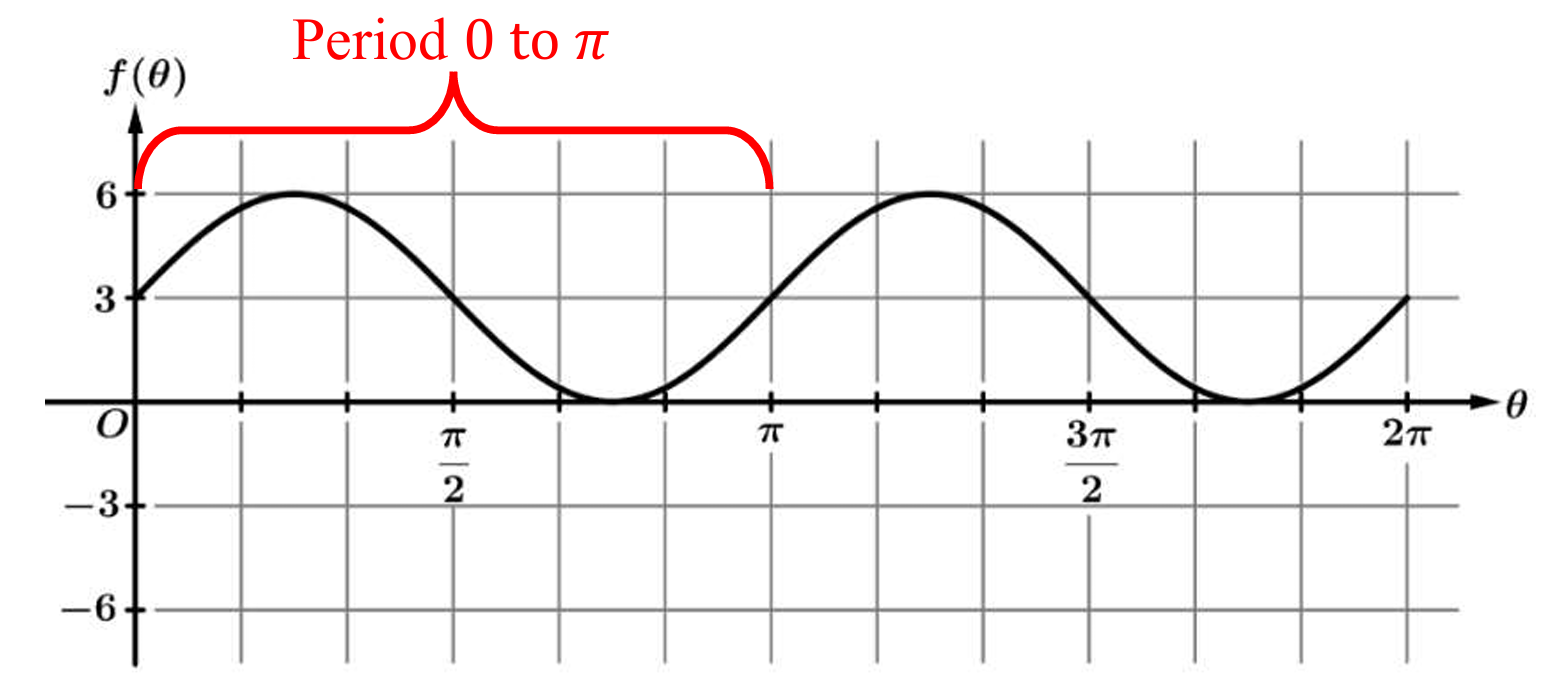
▶️ Answer/Explanation
The period of a sinusoidal function is defined as the horizontal length of one complete cycle of the graph.
To determine this, identify a starting point on the graph, such as the y-intercept at \( \theta = 0 \).
At \( \theta = 0 \), the graph is at the midline \( y=3 \) and is sloping upwards.
Trace the graph along the horizontal axis until this pattern (midline value with upward slope) repeats.
The graph completes a full wave—reaching a maximum, crossing the midline, reaching a minimum, and returning to the midline—at \( \theta = \pi \).
Therefore, the length of the period is \( \pi – 0 = \pi \).
As highlighted by the red brace in the image, the interval from \( 0 \) to \( \pi \) represents one full period.
Correct Option: (C)
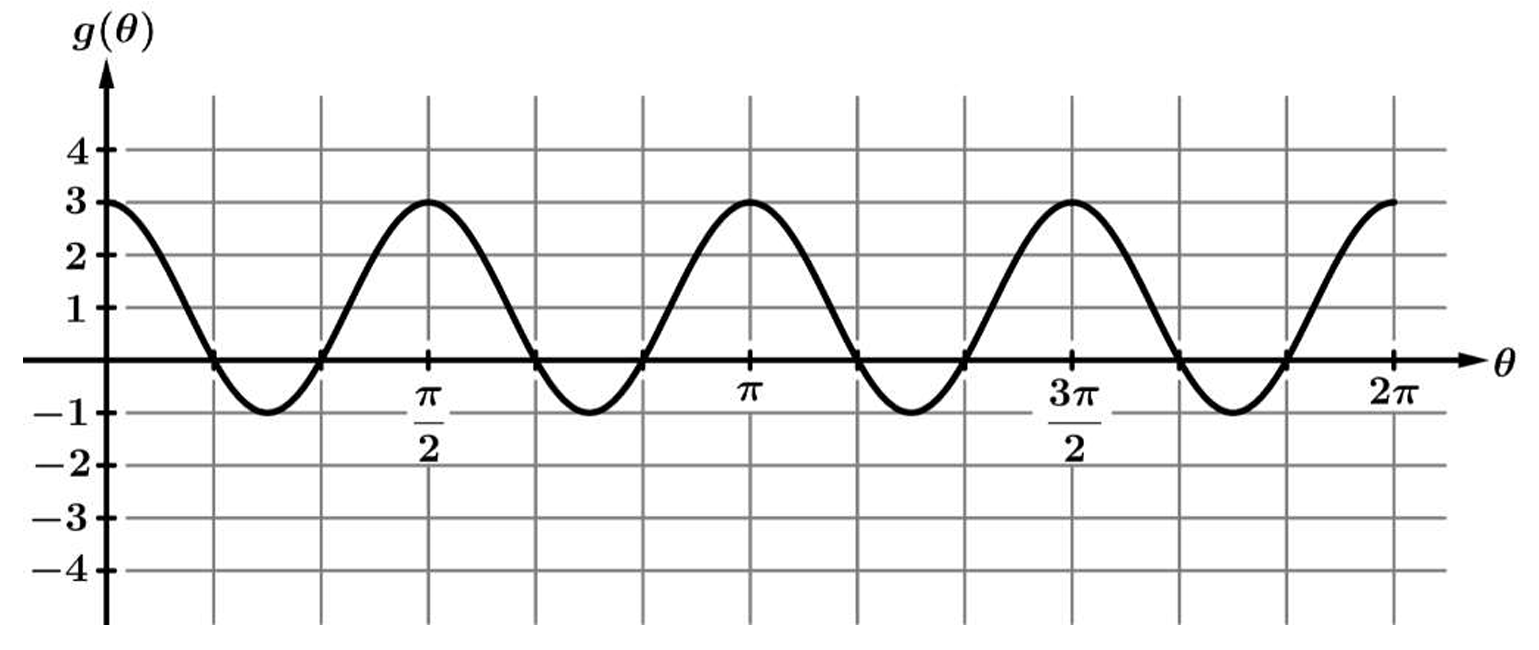
▶️ Answer/Explanation
First, identify the maximum and minimum values of the function \( g(\theta) \) from the graph.
The maximum value (peak) is \( y_{\text{max}} = 3 \).
The minimum value (trough) is \( y_{\text{min}} = -1 \).
The amplitude of a sinusoidal function is half the difference between its maximum and minimum values.
Using the formula: \( \text{Amplitude} = \frac{1}{2}(\text{max} – \text{min}) \).
Substitute the values: \( \text{Amplitude} = \frac{1}{2}(3 – (-1)) = \frac{1}{2}(4) \).
Therefore, \( \text{Amplitude} = 2 \).
The correct option is (B).
▶️ Answer/Explanation
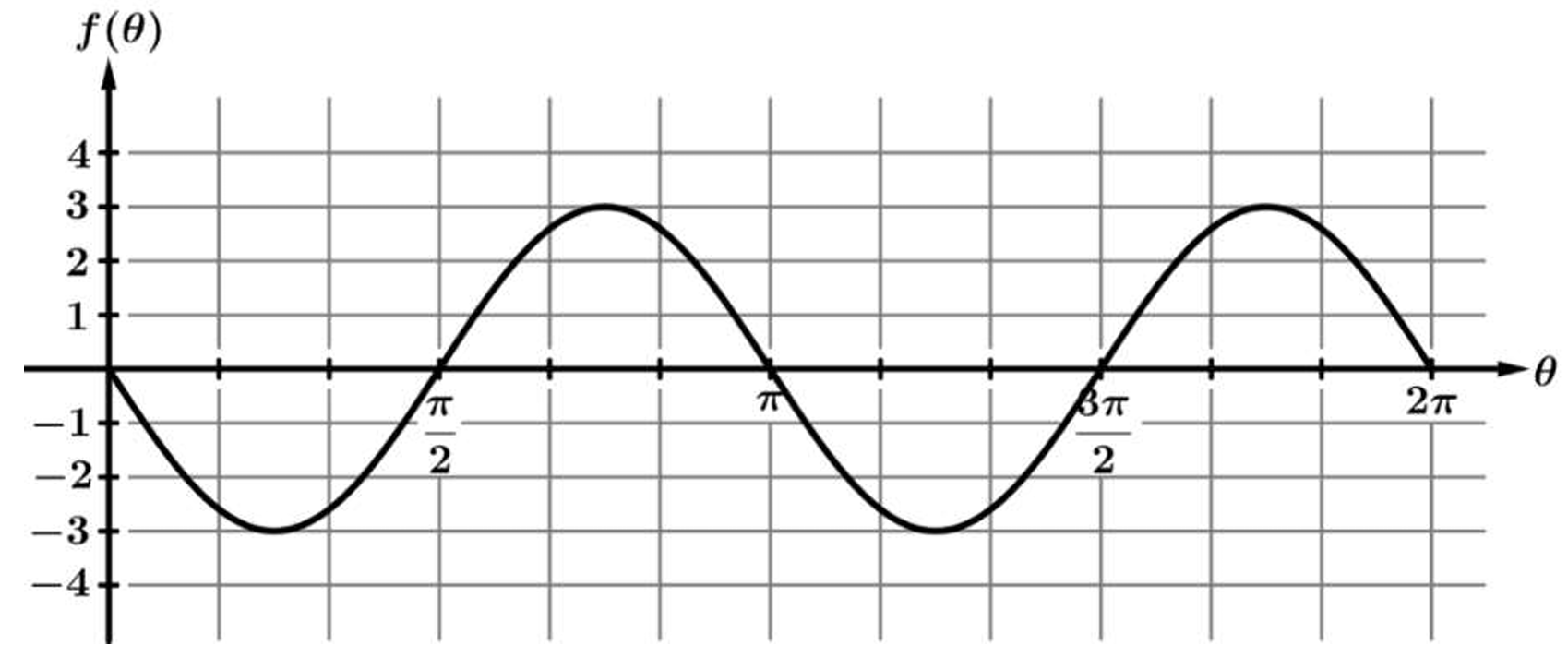
1. Find the Amplitude: The graph oscillates between a maximum value of \( 3 \) and a minimum value of \( -3 \). The amplitude is half of this range: \( \frac{3 – (-3)}{2} = 3 \).
2. Determine the Sign (Reflection): The standard sine graph \( \sin(x) \) starts at 0 and goes up. This graph starts at 0 and goes down, indicating a reflection over the x-axis. Therefore, the leading coefficient is negative, so \( a = -3 \).
3. Find the Period: The graph completes one full cycle (going down, then up, and back to 0) from \( x = 0 \) to \( x = \pi \). So, the period is \( \pi \).
4. Calculate the Frequency Coefficient (\( b \)): Using the formula \( \text{Period} = \frac{2\pi}{b} \), we substitute the period: \( \pi = \frac{2\pi}{b} \). Solving for \( b \) gives \( b = 2 \).
5. Conclusion: Combining these components (\( a = -3 \) and \( b = 2 \)), the expression is \( -3 \sin(2x) \). This matches option (C).
▶️ Answer/Explanation
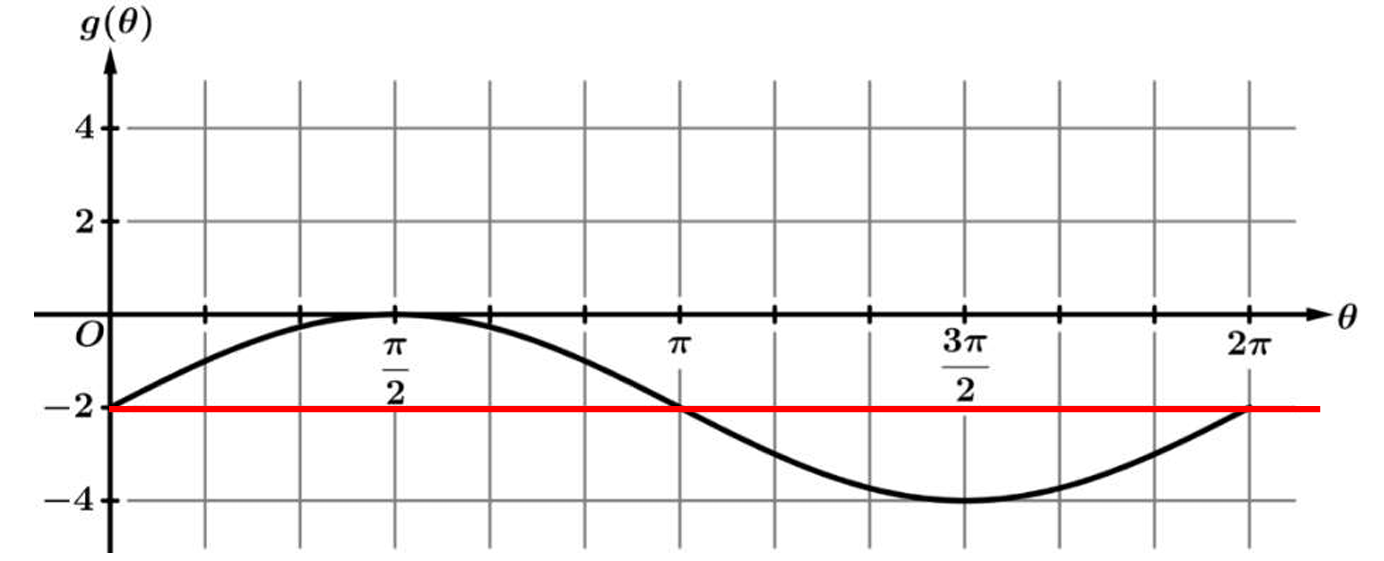
From the graph, the maximum y-value is \( 0 \) and the minimum y-value is \( -4 \).
The constant \( d \) is the midline (vertical shift), found by averaging the max and min: \( d = \frac{0 + (-4)}{2} = -2 \).
The constant \( a \) is the amplitude, found by taking half the distance between max and min: \( a = \frac{0 – (-4)}{2} = \frac{4}{2} = 2 \).
Since the graph starts at the midline and goes up (like a standard sine wave), \( a \) is positive.
Therefore, the correct values are \( a = 2 \) and \( d = -2 \).
Correct Option: (C)
▶️ Answer/Explanation
▶️ Answer/Explanation
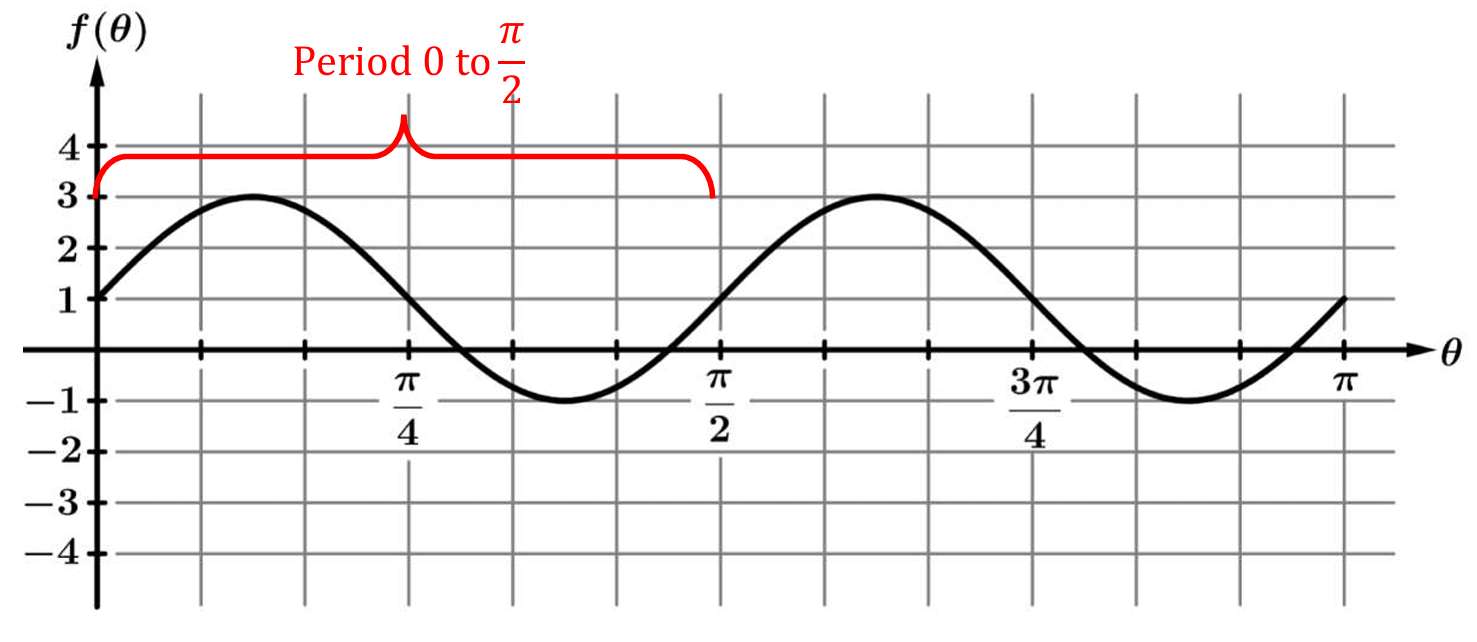
From the graph, identify the maximum value as \(3\) and the minimum value as \(-1\).
The amplitude is half the distance between the maximum and minimum values: \(\frac{1}{2}(\text{max} – \text{min})\).
Substituting the values, we get: \(\text{Amplitude} = \frac{1}{2}(3 – (-1)) = \frac{1}{2}(4) = 2\).
Next, identify the period by finding the length of one complete cycle.
The graph completes one full wave starting from \(0\) and ending at \(\frac{\pi}{2}\).
Therefore, the period is \(\frac{\pi}{2}\).
Matching these results with the options, we find the period is \(\frac{\pi}{2}\) and the amplitude is \(2\).
Correct Option: (D)
▶️ Answer/Explanation
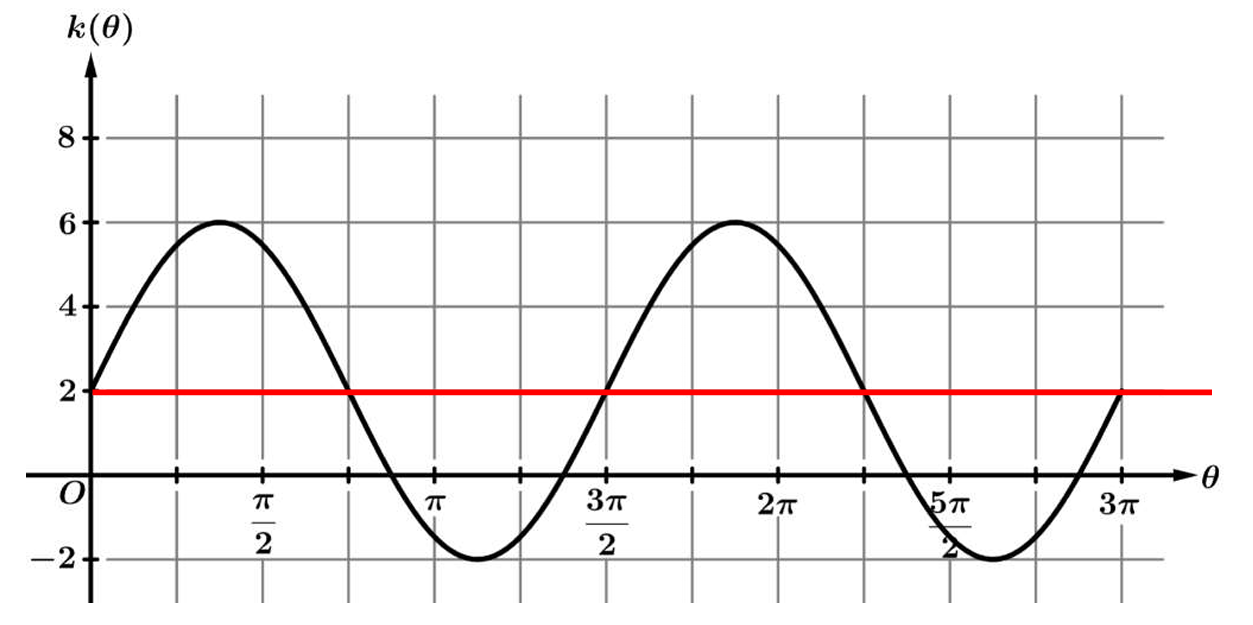
The correct answer is (C).
From the graph, we identify the maximum value as \( y_{\text{max}} = 6 \) and the minimum value as \( y_{\text{min}} = -2 \).
The constant \( d \) represents the midline (vertical shift), which is the average of the maximum and minimum values: \( d = \frac{6 + (-2)}{2} = \frac{4}{2} = 2 \).
The constant \( a \) represents the amplitude, which is half the distance between the maximum and minimum values: \( a = \frac{6 – (-2)}{2} = \frac{8}{2} = 4 \).
Thus, the values are \( a = 4 \) and \( d = 2 \), matching option (C).
▶️ Answer/Explanation
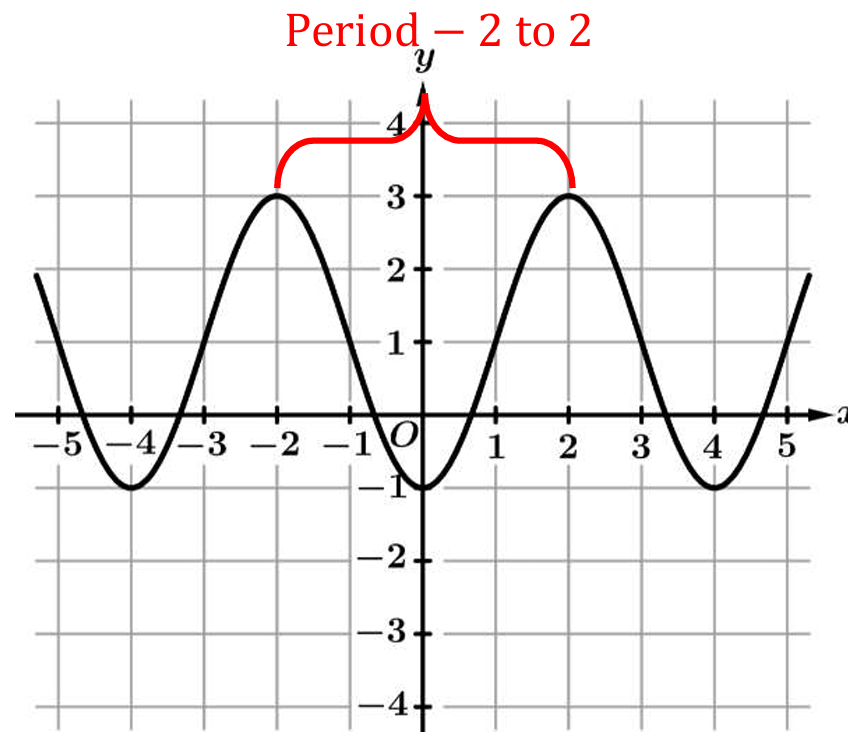
The maximum value is \(3\) and the minimum value is \(-1\).
Using the formula \(\text{Amplitude} = \frac{1}{2}(\text{max} – \text{min})\), we get \(\frac{1}{2}(3 – (-1)) = \frac{1}{2}(4) = 2\).
To find the period, we measure the horizontal distance between two consecutive peaks.
The peaks in the graph occur at \(x = -2\) and \(x = 2\).
The period is the difference: \(2 – (-2) = 4\).
Thus, the period is \(4\) and the amplitude is \(2\), corresponding to option (C).
▶️ Answer/Explanation
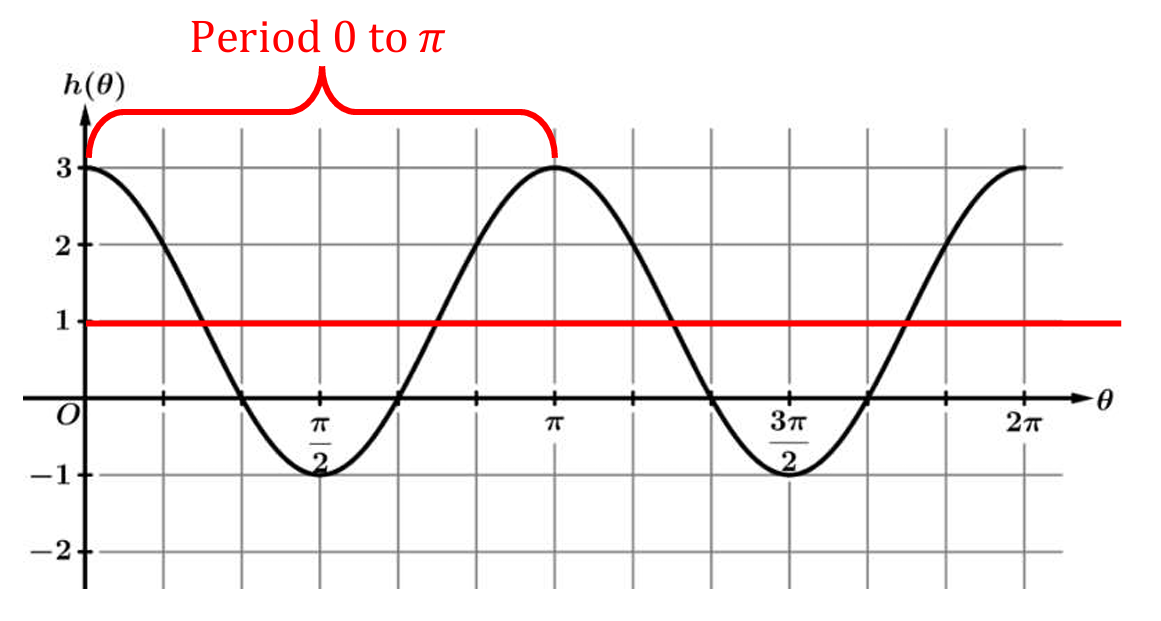
The correct option is (D).
1. Determine Amplitude and Midline: The maximum value is \(3\) and the minimum is \(-1\). The midline is \(y = \frac{3 + (-1)}{2} = 1\), and the amplitude is \(\frac{3 – (-1)}{2} = 2\). All options reflect this.
2. Determine Period: The graph completes one full cycle from \(x=0\) to \(x=\pi\). Therefore, the period is \(\pi\).
3. Find Frequency Coefficient (\(b\)): Using the formula \(\text{Period} = \frac{2\pi}{b}\), we get \(\pi = \frac{2\pi}{b}\), which implies \(b = 2\). This eliminates option (A) because it has \(b=\pi\).
4. Test Points: At \(x=0\), the graph is at its maximum \(y=3\). We substitute \(x=0\) into the remaining options:
5. Option (B): \(2 \cos(2(0 – \frac{\pi}{2})) + 1 = 2 \cos(-\pi) + 1 = -1\) (Incorrect).
6. Option (C): \(-2 \cos(2(0 – \pi)) + 1 = -2 \cos(-2\pi) + 1 = -1\) (Incorrect).
7. Option (D): \(-2 \cos(2(0 – \frac{3\pi}{2})) + 1 = -2 \cos(-3\pi) + 1 = -2(-1) + 1 = 3\) (Correct).
▶️ Answer/Explanation
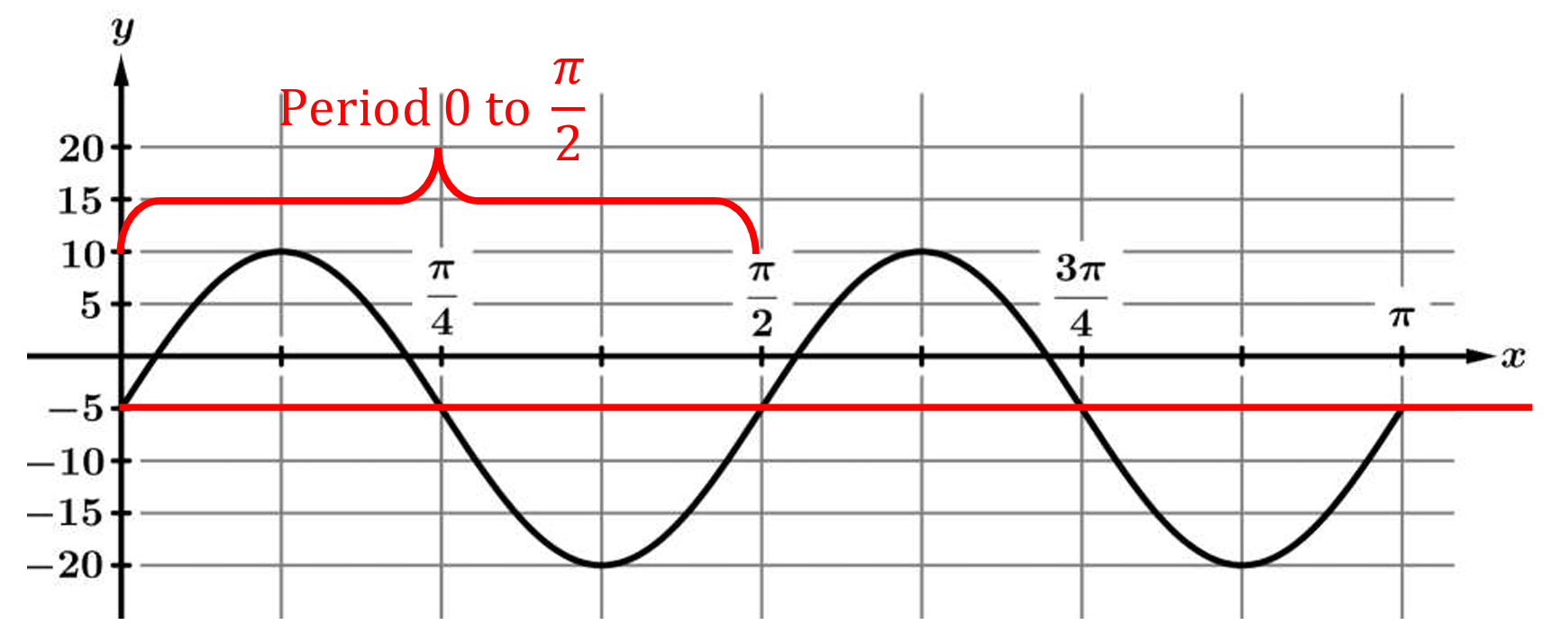
The amplitude is half the distance between the max and min: \( \frac{10 – (-20)}{2} = 15 \).
The midline is the average of the max and min: \( y = \frac{10 + (-20)}{2} = -5 \).
The graph completes one full cycle from \( x=0 \) to \( x=\frac{\pi}{2} \), so the period is \( \frac{\pi}{2} \).
Using \( \text{Period} = \frac{2\pi}{b} \), we find \( b = \frac{2\pi}{\pi/2} = 4 \). This eliminates option (A).
To identify the correct phase shift, test the maximum point at \( x = \frac{\pi}{8} \).
Substitute \( x = \frac{\pi}{8} \) into option (B): \( -15\sin\left(4\left(\frac{\pi}{8} – \frac{\pi}{4}\right)\right) – 5 = -15\sin\left(-\frac{\pi}{2}\right) – 5 \).
Since \( \sin\left(-\frac{\pi}{2}\right) = -1 \), this yields \( -15(-1) – 5 = 10 \), which matches the graph.
Therefore, option (B) is the correct expression.
▶️ Answer/Explanation
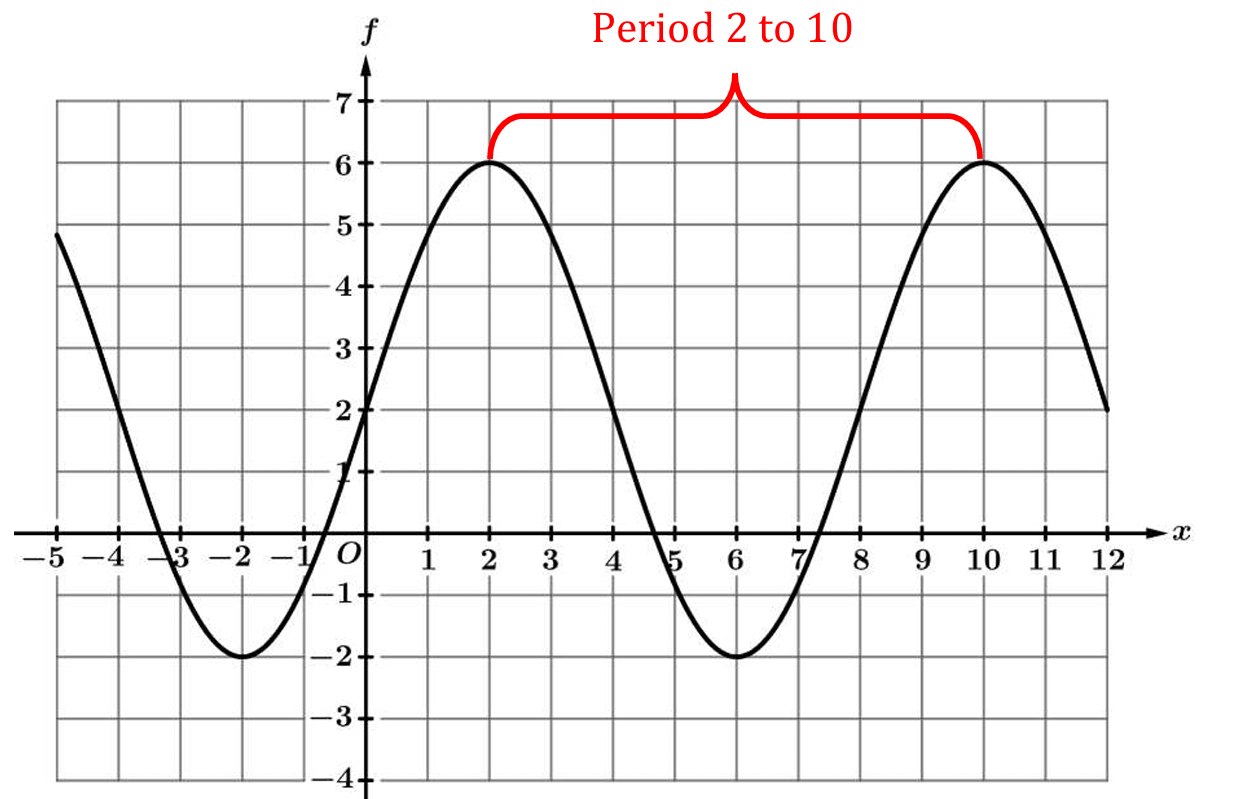
The amplitude \( a \) corresponds to the vertical stretch from the midline.
From the graph, the maximum value is \( 6 \) and the minimum value is \( -2 \).
Calculate \( a = \frac{\text{max} – \text{min}}{2} = \frac{6 – (-2)}{2} = \frac{8}{2} = 4 \).
The period is the horizontal length of one complete cycle, found between two peaks.
The peaks occur at \( x = 2 \) and \( x = 10 \), so the Period \( = 10 – 2 = 8 \).
The formula for the period of a sine function is \( \frac{2\pi}{b} \).
Set \( \frac{2\pi}{b} = 8 \) and solve for \( b \): \( b = \frac{2\pi}{8} = \frac{\pi}{4} \).
Thus, \( a = 4 \) and \( b = \frac{\pi}{4} \), which matches option (B).
▶️ Answer/Explanation
The correct answer is (C).
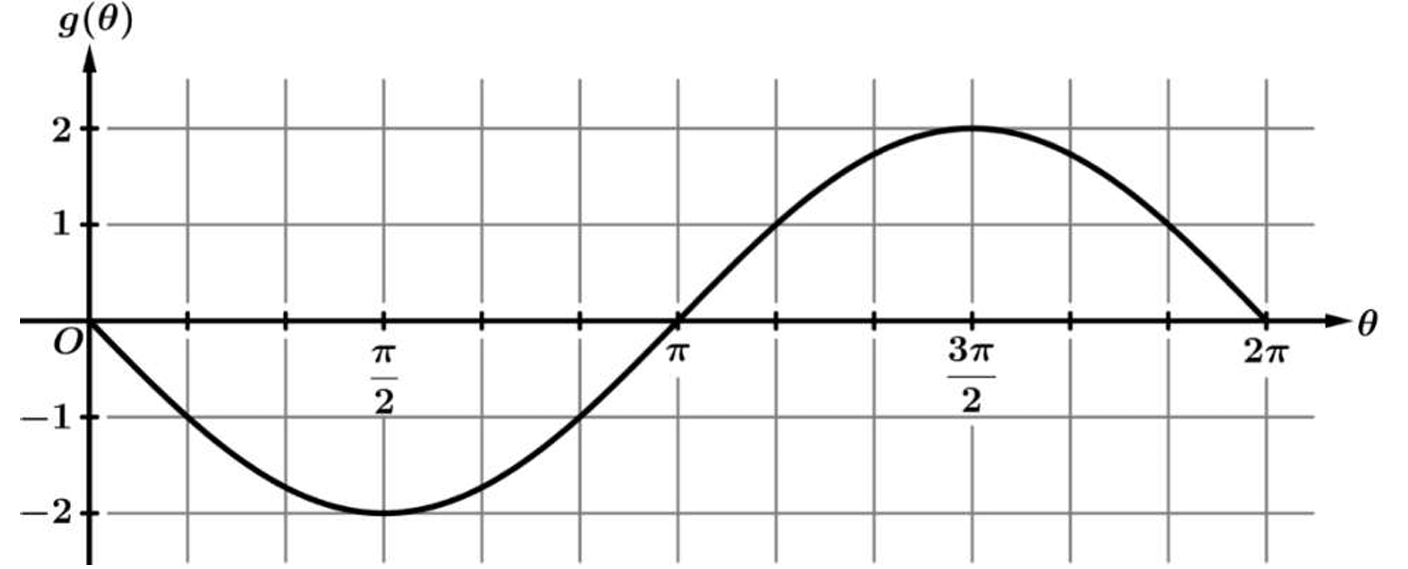
1. Analyze the function value: Looking at the graph in the interval \( 0 < \theta < \frac{\pi}{2} \), the curve goes downwards from the origin to a minimum. Since the values of \( g(\theta) \) are dropping, \( g \) is decreasing.
2. Analyze the rate of change (slope): The graph is concave up (curved like a cup) in this interval. Mathematically, the slope starts as a steep negative value and approaches zero (becomes less negative).
3. Interpret the rate: Since the slope is moving from a negative value towards zero (e.g., from -2 to -0.5), the numerical value of the rate is increasing.
Conclusion: Therefore, the function is decreasing (values going down) at an increasing rate (slope is increasing).
▶️ Answer/Explanation
Step 1: Identify the interval on the horizontal axis from \( \theta = \frac{\pi}{2} \) to \( \theta = \pi \).
Step 2: Observe the position of the graph relative to the horizontal axis. In this region, the curve is strictly below the \( \theta \)-axis, which means \( g(\theta) \) is negative.
Step 3: Analyze the slope of the curve. Starting from \( \theta = \frac{\pi}{2} \), the graph is at its minimum value of \( -2 \) and moves upwards to \( 0 \) at \( \theta = \pi \).
Step 4: Since the \( y \)-values are getting larger (moving from negative towards zero), the function is increasing.
Step 5: Therefore, on the interval \( \frac{\pi}{2} < \theta < \pi \), \( g \) is negative and increasing.
Step 6: Comparing this with the given options, it corresponds to option (C).
▶️ Answer/Explanation
The correct answer is (D).
1. Analyze the Graph Shape: Observe the graph on the interval \( \pi < \theta < \frac{3\pi}{2} \). The curve is shaped like an inverted bowl, bending downwards.
2. Determine Concavity: This downward bending shape indicates that the graph is concave down on this interval.
3. Connect to Rate of Change: The “rate of change of \( g \)” is the first derivative, \( g’ \). Concavity is determined by the second derivative, \( g” \).
4. Interpret Concavity: If a function is concave down, its derivative (slope) is decreasing.
5. Visual Verification: At \( \theta = \pi \), the slope is positive and steep. As \( \theta \) approaches \( \frac{3\pi}{2} \), the tangent line flattens out (slope approaches 0). Thus, the slope is decreasing.
6. Conclusion: The rate of change is decreasing because the graph is concave down.
▶️ Answer/Explanation
The correct option is (D).
1. Identify the relevant section of the graph: The interval \(\frac{3\pi}{2} < \theta < 2\pi\) corresponds to the curve segment after the peak, descending towards the x-axis.
2. Determine the sign of the rate of change: In this interval, the function values \(g(\theta)\) are dropping from the maximum (2) down to 0.
3. Since the function is strictly decreasing, the slope of the tangent (rate of change) is negative.
4. Analyze the behavior of the rate of change: At the peak \(\theta = \frac{3\pi}{2}\), the slope is zero (horizontal tangent).
5. As \(\theta\) increases towards \(2\pi\), the graph becomes steeper in the downward direction.
6. This means the slope values are changing from 0 to negative numbers (e.g., -1, -2).
7. Since the value of the slope is going down (becoming more negative), the rate of change is decreasing.
8. Therefore, the rate of change of \(g\) is negative and decreasing.
▶️ Answer/Explanation
The correct answer is (B).
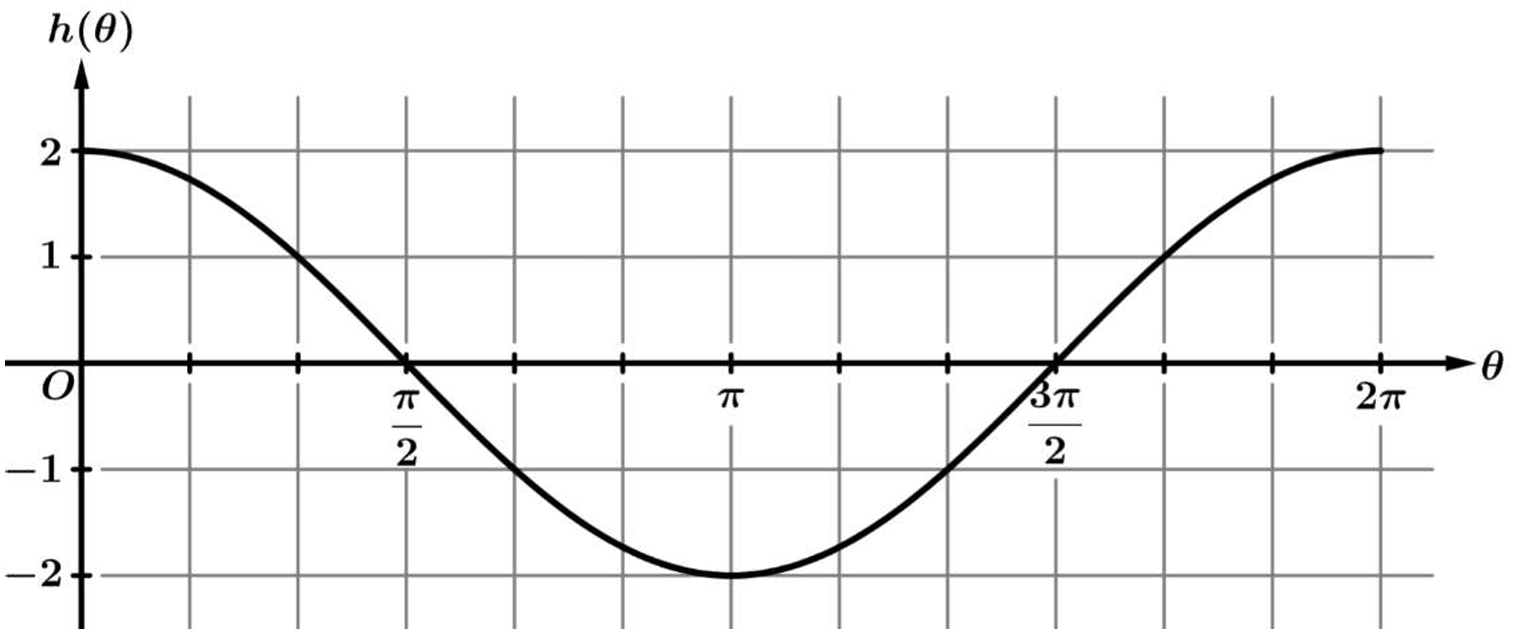
1. First, locate the interval \(\left( 0, \frac{\pi}{2} \right)\) on the horizontal axis (\(\theta\)-axis) of the provided graph.
2. Observe the position of the function \(h(\theta)\) relative to the x-axis. In this specific interval, the graph is entirely above the x-axis, which means \(h\) is positive.
3. Next, observe the direction of the curve as you move from left to right (from \(0\) to \(\frac{\pi}{2}\)).
4. The value of \(h(\theta)\) starts at \(2\) and goes down to \(0\). A downward slope indicates that the function is decreasing.
5. Therefore, on the interval \(\left( 0, \frac{\pi}{2} \right)\), \(h\) is positive and decreasing.
▶️ Answer/Explanation
The correct answer is (D).
1. Identify the interval \(\left(\frac{\pi}{2}, \pi\right)\) on the horizontal \(\theta\)-axis.
2. Observe the position of the curve relative to the horizontal axis. The graph lies below the x-axis in this interval, meaning the function values \(h(\theta)\) are negative.
3. Analyze the slope of the curve as you move from left to right. The graph slopes downwards, going from a value of \(0\) at \(\frac{\pi}{2}\) to \(-2\) at \(\pi\).
4. Since the function values are falling, \(h\) is decreasing.
5. Therefore, on this interval, \(h\) is both negative and decreasing.
▶️ Answer/Explanation
▶️ Answer/Explanation
(A)
1. First, identify the relevant section of the graph on the horizontal axis between \(\theta = \frac{3\pi}{2}\) and \(\theta = 2\pi\).
2. Check the sign of the function: The curve lies entirely above the horizontal axis (the \(\theta\)-axis) in this interval, which means \(h(\theta) > 0\) (it is positive).
3. Check the direction of the function: As you move from left to right along the interval, the curve goes upwards, rising from \(0\) to \(2\).
4. Since the curve is going up, the slope is positive, meaning the function is increasing.
5. Therefore, \(h\) is positive and increasing.
▶️ Answer/Explanation
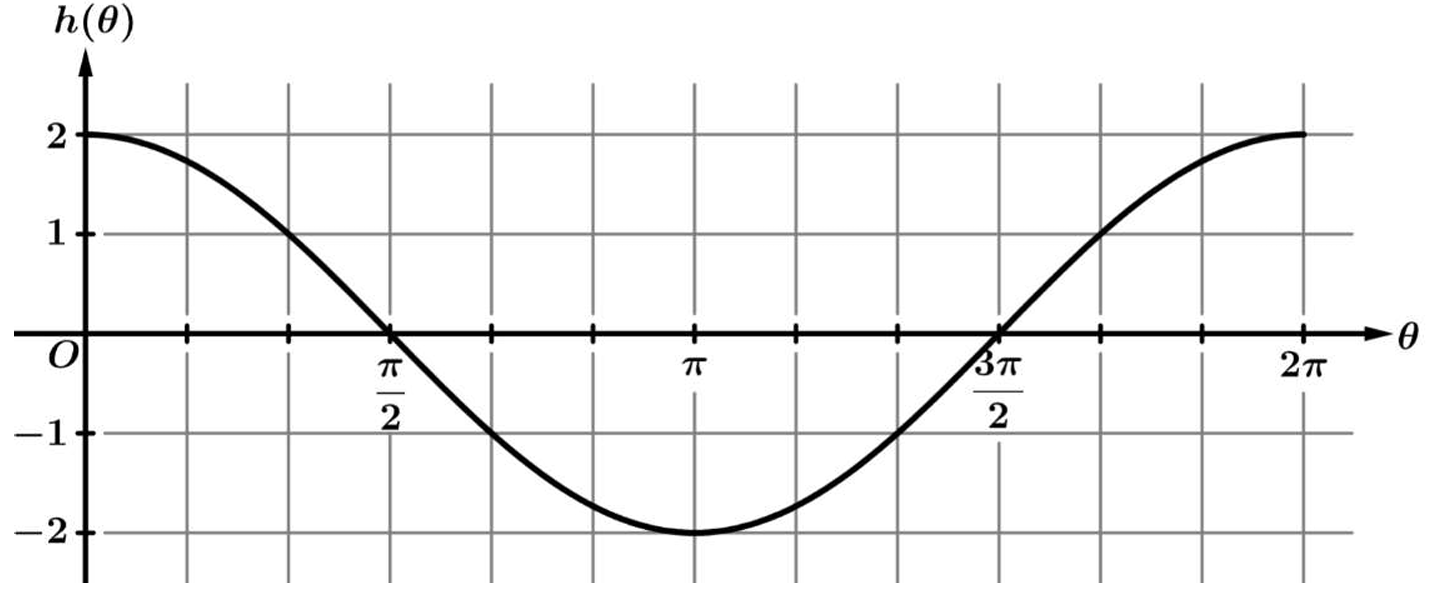
The “rate of change of \( h \)” refers to the slope of the function (the first derivative, \( h’ \)).
The change in this rate is determined by the concavity of the graph (the second derivative, \( h” \)).
On the interval \( \left(0, \frac{\pi}{2}\right) \), the graph of \( h \) curves downwards, resembling an upside-down bowl.
This shape indicates that the graph is concave down in this region.
When a graph is concave down, the slope of the tangent lines decreases as \( \theta \) increases.
Therefore, the rate of change of \( h \) is decreasing because the graph of \( h \) is concave down.
Correct Option: (D)
▶️ Answer/Explanation
The correct answer is (A).
1. Analyze the Graph Shape: Observe the curve of \(h(\theta)\) on the interval \(\left(\frac{\pi}{2}, \pi\right)\). The graph curves upwards, resembling the shape of a bowl “holding water.”
2. Determine Concavity: This upward curvature indicates that the function is concave up on this specific interval.
3. Relate Concavity to Rate of Change: By definition, if the graph of a function is concave up, its first derivative (which represents the rate of change) is increasing.
4. Verify with Slopes: At \(\theta = \frac{\pi}{2}\), the slope is steep and negative. As \(\theta\) approaches \(\pi\), the slope becomes less negative and reaches zero. Since the slope values are rising from a negative number to zero, the rate of change is increasing.
5. Conclusion: Therefore, the rate of change of \(h\) is increasing because the graph of \(h\) is concave up.
▶️ Answer/Explanation
The correct answer is (A).
1. First, identify the section of the graph on the interval \( \left( \pi, \frac{3\pi}{2} \right) \). In this region, the curve is bending upwards (holding water), which means the graph is concave up.
2. The “rate of change of \( h \)” refers to the first derivative, \( h'(\theta) \), or the slope of the tangent line.
3. “How the rate of change is changing” refers to the second derivative, \( h”(\theta) \).
4. When a graph is concave up, its second derivative is positive (\( h”(\theta) > 0 \)).
5. A positive second derivative implies that the first derivative (the rate of change) is increasing.
6. Visually, the slope of the graph starts at \( 0 \) at \( \theta = \pi \) and becomes steeper in the positive direction as it approaches \( \frac{3\pi}{2} \).
▶️ Answer/Explanation
The correct answer is (D).
The “rate of change of \( h \)” represents the slope of the graph’s tangent line.
The phrase “how the rate of change is changing” refers to the concavity of the graph (the second derivative).
On the interval \( \left( \frac{3\pi}{2}, 2\pi \right) \), the graph curves downwards, resembling an inverted bowl.
This geometric shape indicates that the graph is concave down on this interval.
Mathematically, when a graph is concave down, its slope (rate of change) is strictly decreasing.
Therefore, the rate of change of \( h \) is decreasing because the graph of \( h \) is concave down.
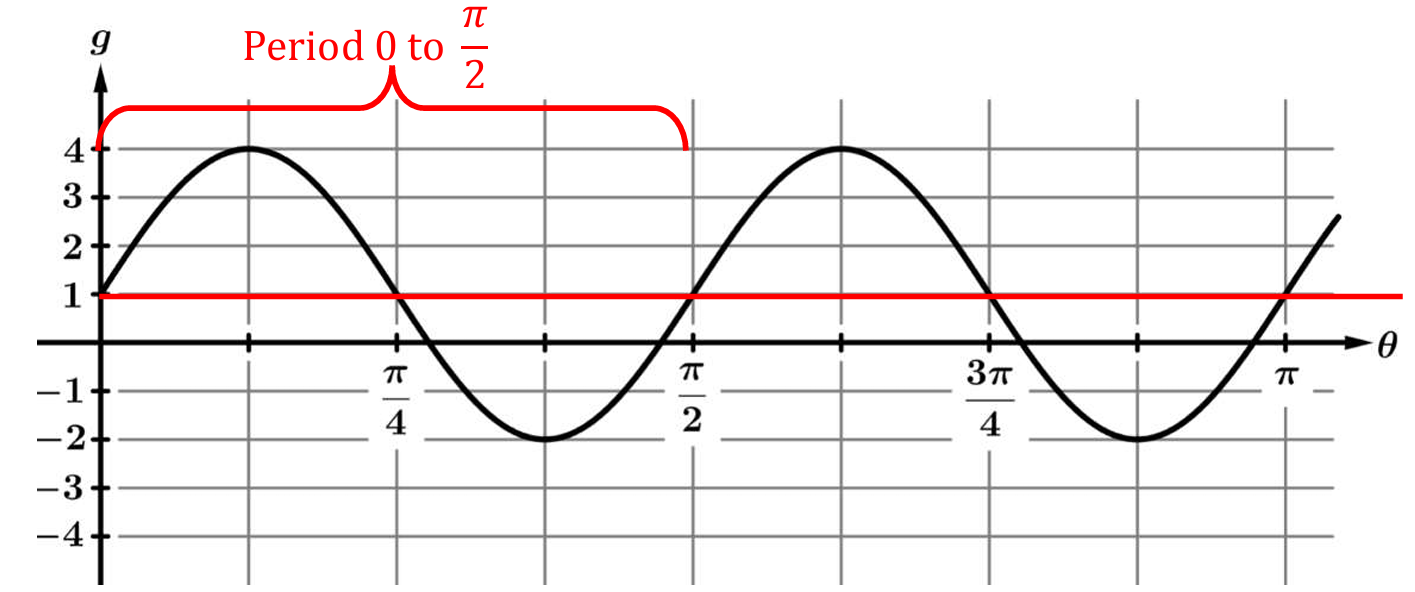
▶️ Answer/Explanation
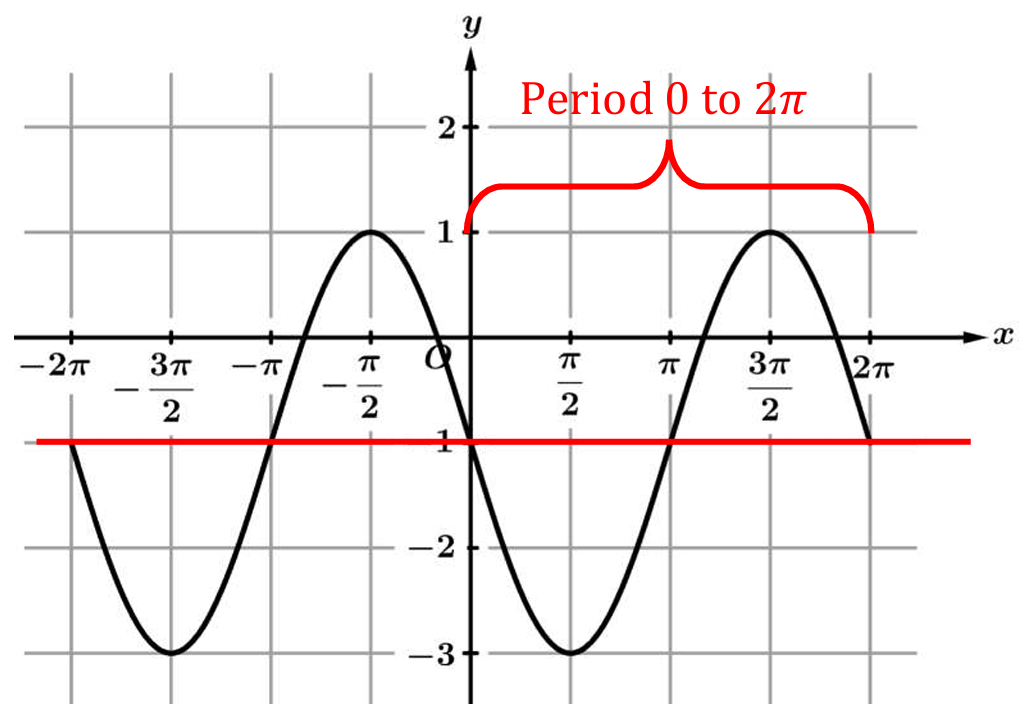
▶️ Answer/Explanation
The maximum value of the graph is \( 1 \) and the minimum is \( -3 \), so the midline is \( y = \frac{1 + (-3)}{2} = -1 \).
The amplitude is half the distance between the maximum and minimum: \( \frac{1 – (-3)}{2} = 2 \).
The graph completes one full cycle from \( x=0 \) to \( x=2\pi \), so the period is \( 2\pi \).
At \( x=0 \), the graph starts at the midline and goes downwards, which indicates a reflected sine function: \( y = -2\sin(x) – 1 \).
Looking at option (D), \( -2\sin(x + 2\pi) – 1 \) is equivalent to \( -2\sin(x) – 1 \) because the sine function has a period of \( 2\pi \).
Therefore, option (D) is the correct expression for the function \( k(x) \).
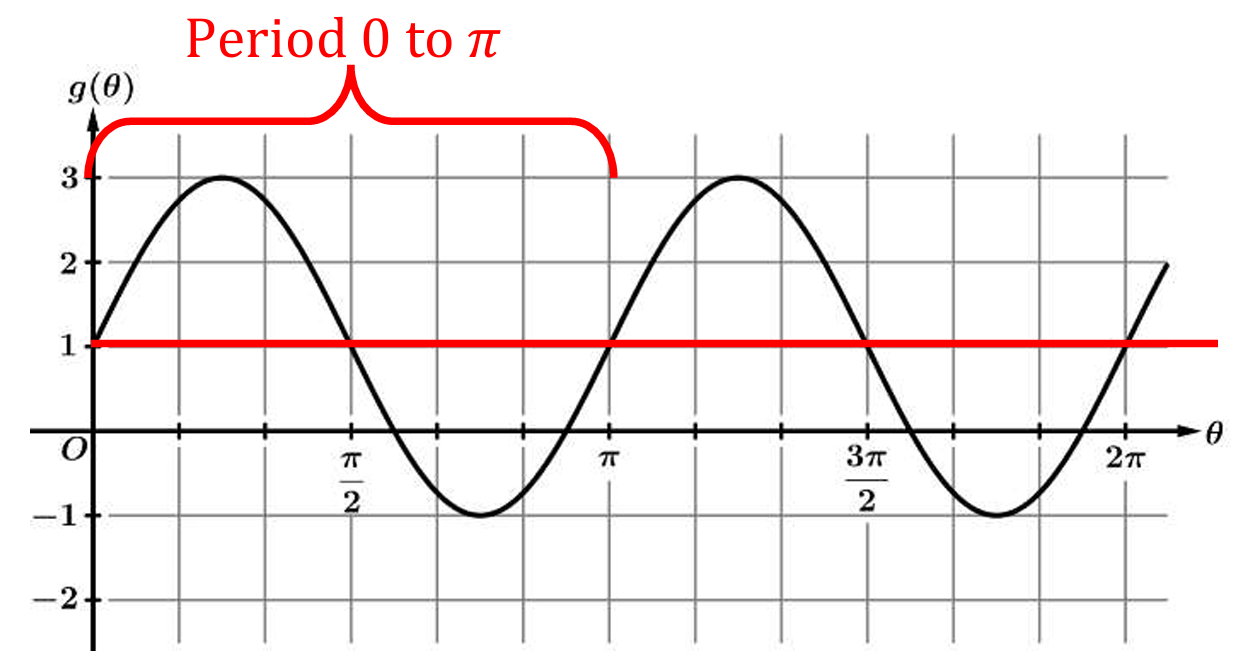
▶️ Answer/Explanation
The Midline is the average of the maximum and minimum values: \(y = \frac{3 + (-1)}{2} = 1\), so the vertical shift is \(+1\).
The Amplitude is half the distance between the max and min: \(\frac{3 – (-1)}{2} = 2\).
The Period is the length of one full cycle, which is clearly \(\pi\). The frequency coefficient is \(b = \frac{2\pi}{\text{Period}} = \frac{2\pi}{\pi} = 2\).
The graph starts at the midline \((0, 1)\) and goes up, which corresponds to a standard sine function: \(y = 2\sin(2x) + 1\).
To match option (A), we verify using the identity \(\sin(\theta – 3\pi) = -\sin(\theta)\).
Expanding option (A): \(-2\sin(2x – 3\pi) + 1 = -2(-\sin(2x)) + 1 = 2\sin(2x) + 1\).
Therefore, option (A) is the correct expression equivalent to the graph.
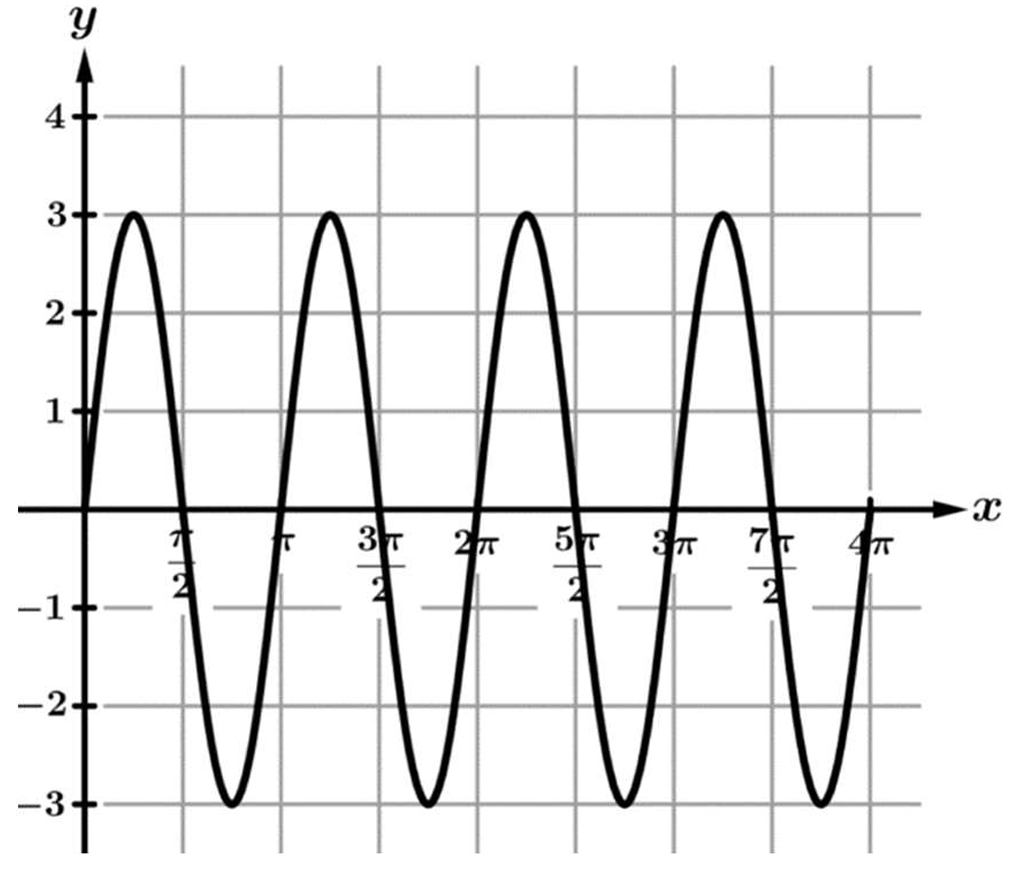
▶️ Answer/Explanation
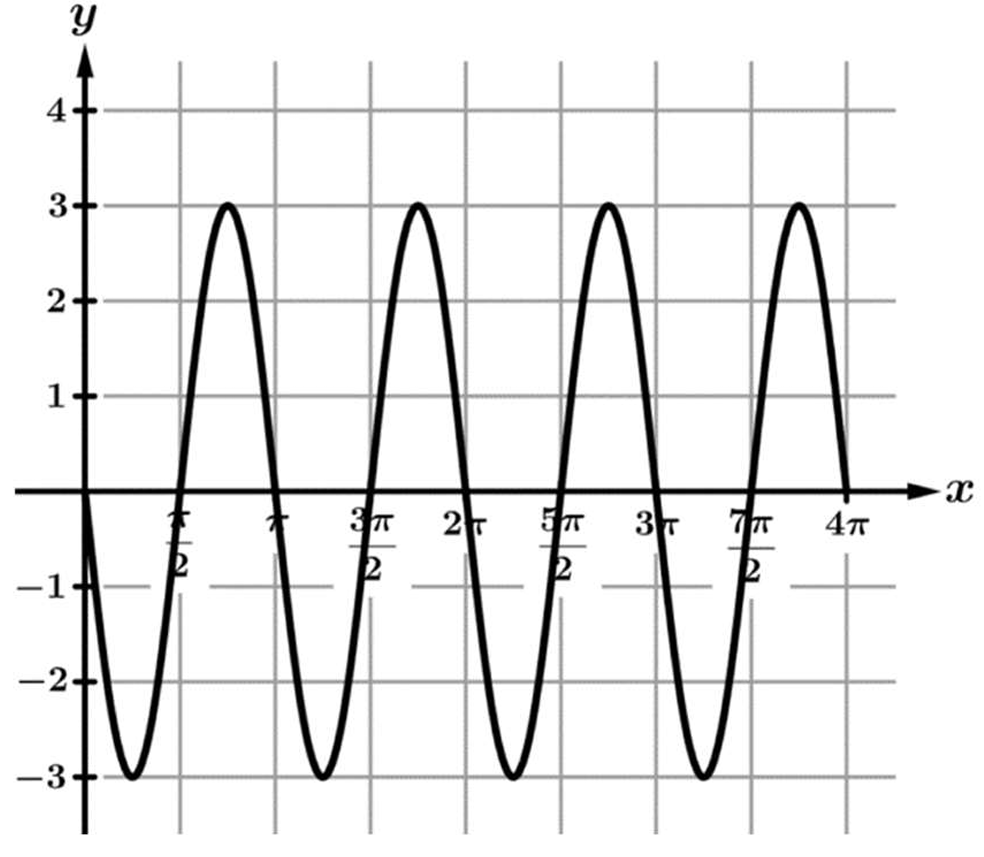
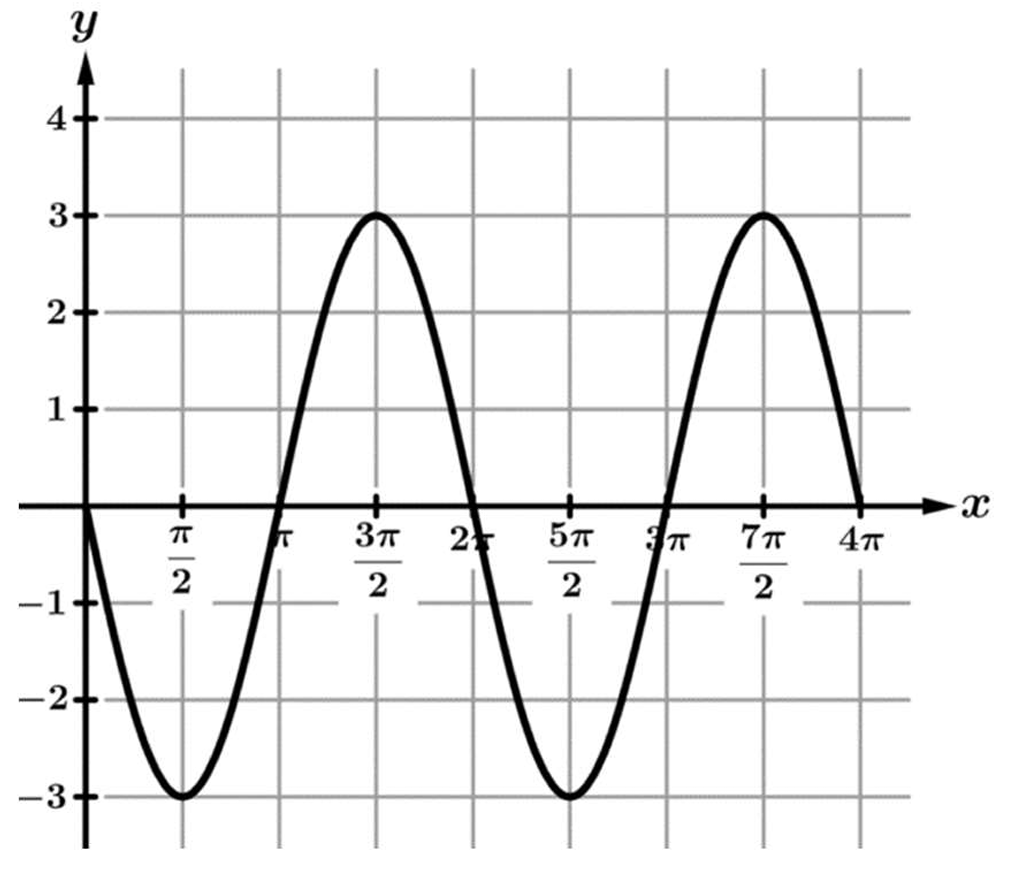
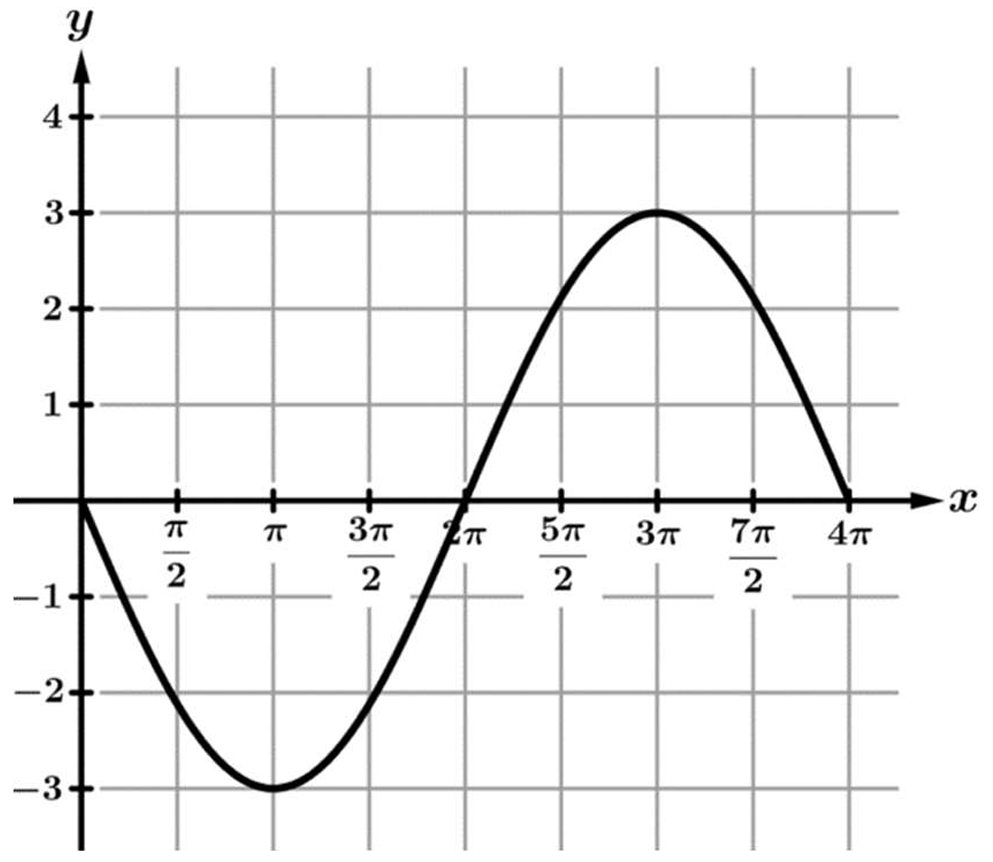
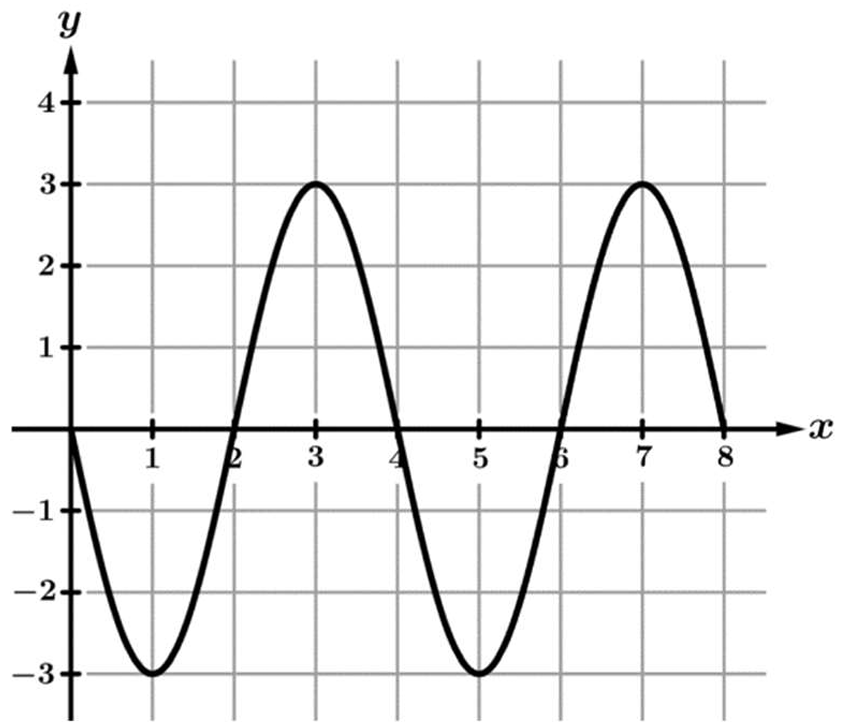
The function is given by \( f(x) = -3\sin(2x) \).
The amplitude is \( |-3| = 3 \), so the graph ranges between -3 and 3.
The coefficient \( b = 2 \) determines the period: \( \text{Period} = \frac{2\pi}{b} = \frac{2\pi}{2} = \pi \).
The negative sign (\( -3 \)) indicates a reflection across the x-axis, so the graph must start at 0 and go downwards.
Graphs (C) and (D) are incorrect because they display periods of \( 2\pi \) and \( 4\pi \) respectively.
Graph (A) is incorrect because it starts by going upwards (positive sine).
Graph (B) correctly shows a period of \( \pi \) and reflects across the x-axis (starts downwards).
Therefore, the correct option is (B).
▶️ Answer/Explanation
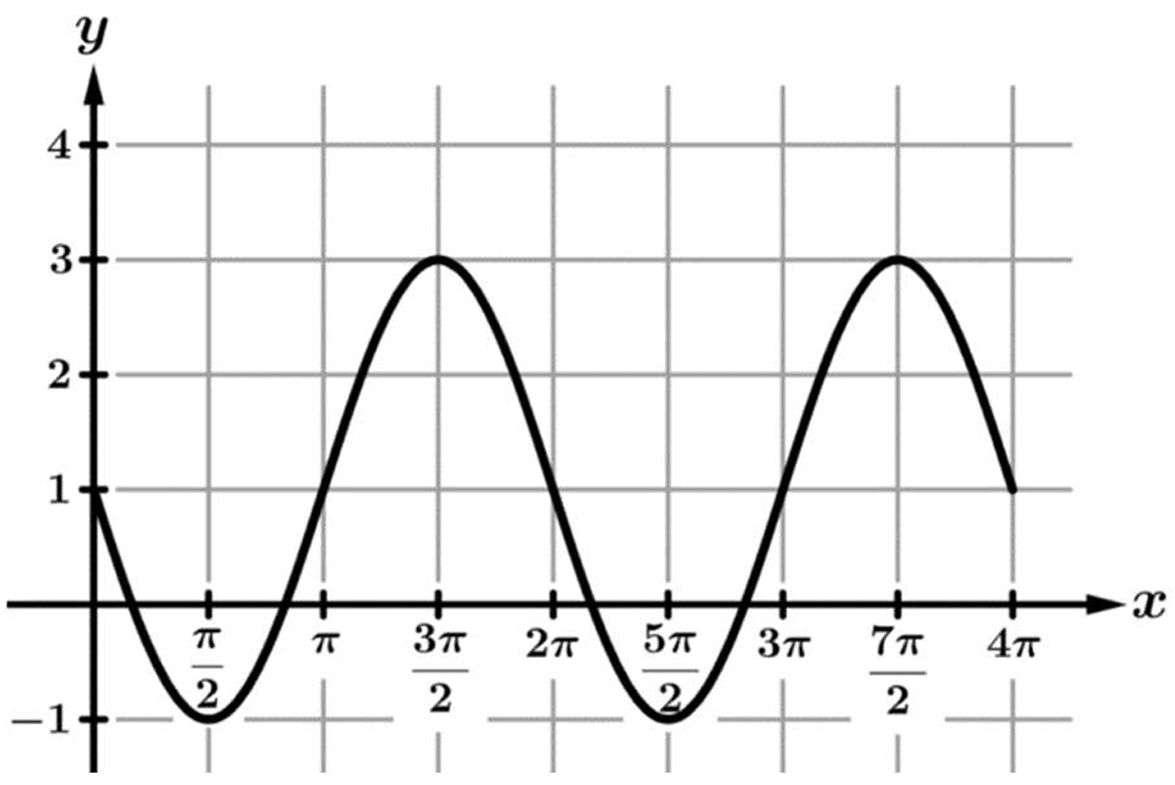
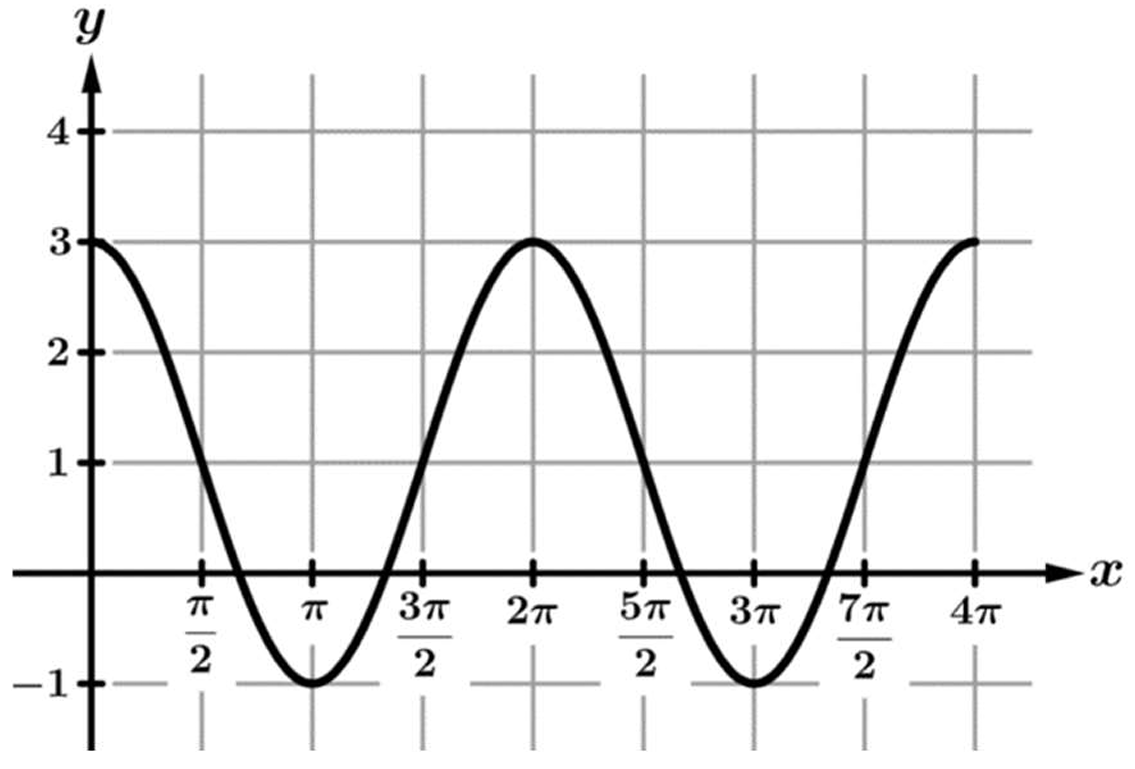
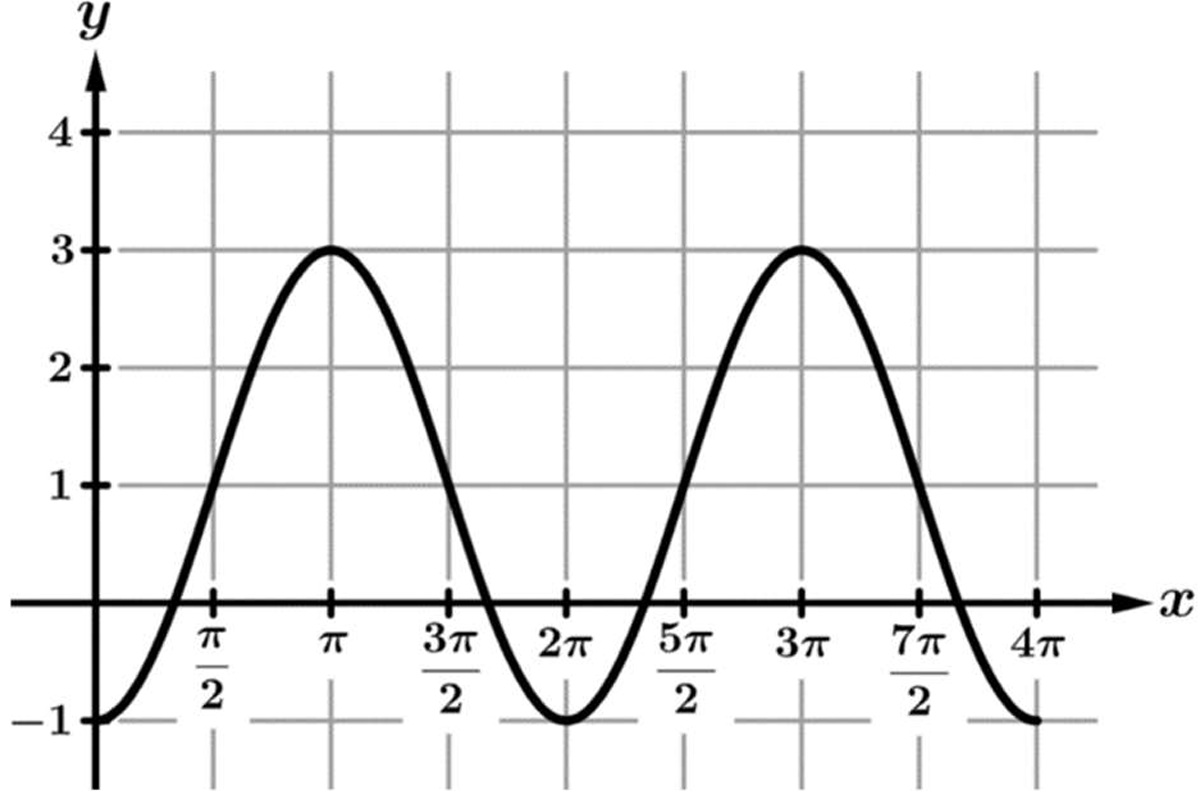
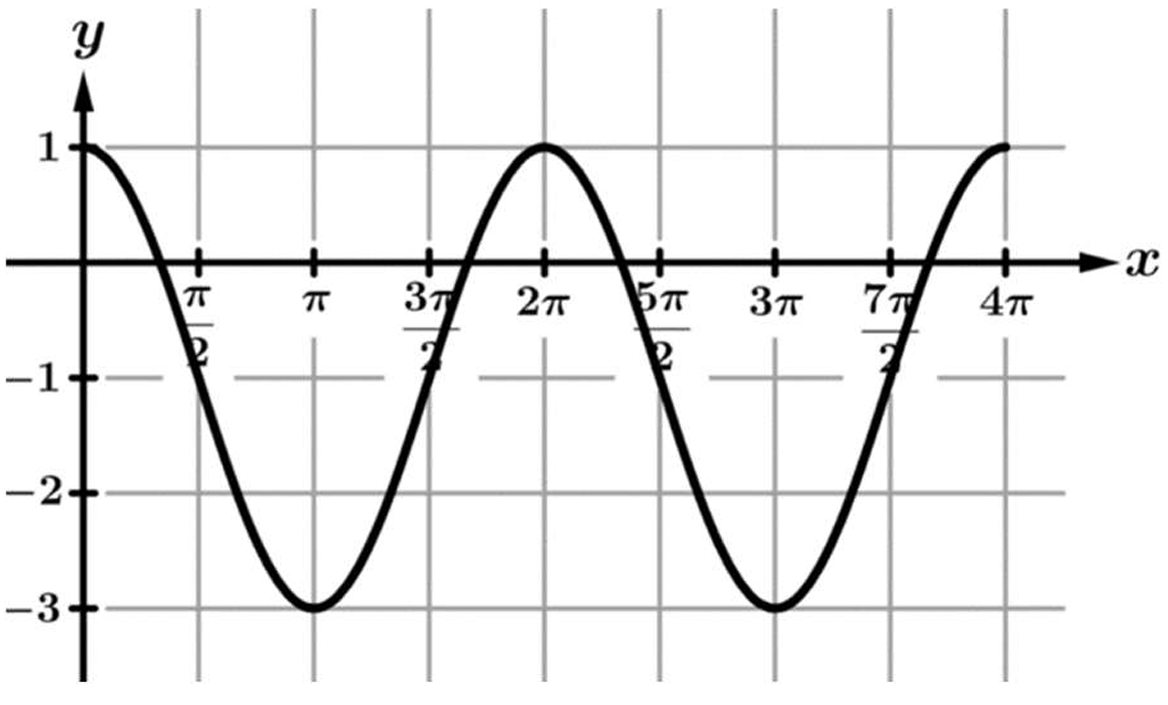
The function is \( f(x) = 1 – 2\cos(x) \). The constant term is \( 1 \), so the midline is \( y = 1 \). This eliminates option (D) which has a midline of \( y = -1 \).
The period is determined by \( \frac{2\pi}{1} = 2\pi \). Option (A) displays a period of \( 4\pi \), so it is incorrect.
The coefficient of the cosine term is \( -2 \). The negative sign indicates a reflection over the midline, meaning the graph starts at a minimum.
Evaluating at \( x = 0 \), we get \( f(0) = 1 – 2\cos(0) = 1 – 2(1) = -1 \). The graph must start at \( (0, -1) \).
Option (B) starts at a maximum value of \( y = 3 \), so it is incorrect.
Option (C) correctly starts at \( y = -1 \), oscillates with a period of \( 2\pi \), and has the correct midline of \( y = 1 \).
Therefore, the correct graph is (C).
▶️ Answer/Explanation
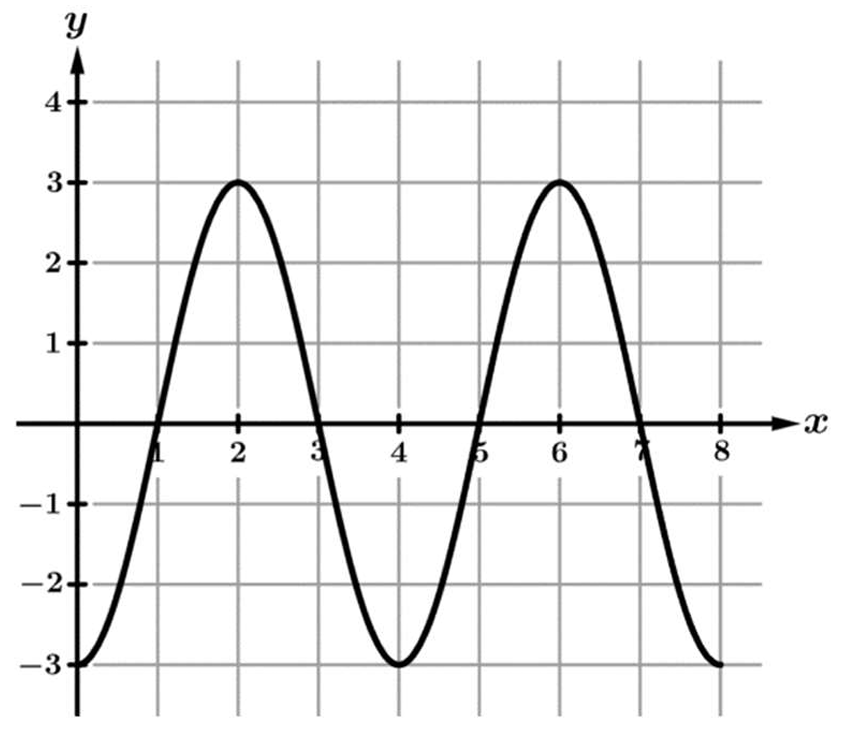
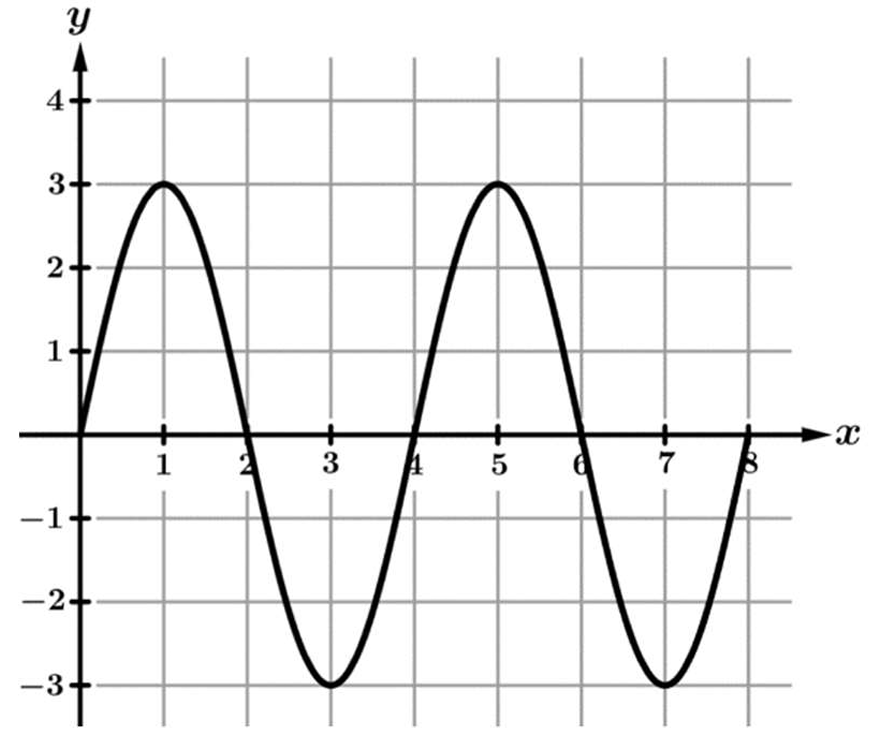
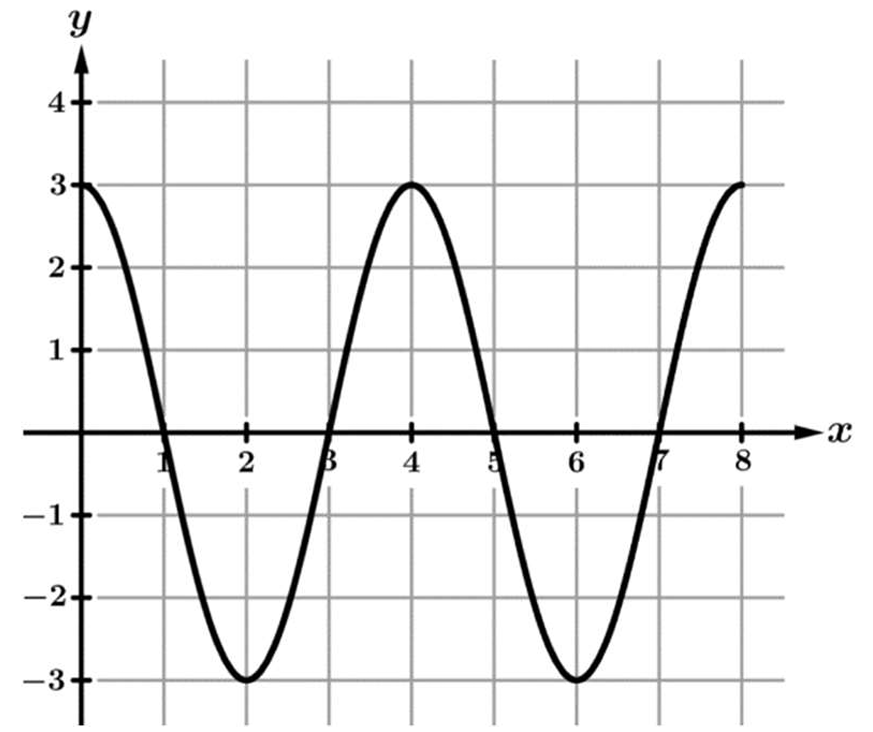
The correct choice is (B).
1. Calculate Period: Using \( b = \frac{\pi}{2} \), the period is \( \frac{2\pi}{b} = \frac{2\pi}{\pi/2} = 4 \). All options show a period of 4.
2. Identify Function Type: Graphs (A) and (C) start at \( y=0 \), which indicates sine curves. The given function is a cosine curve.
3. Check y-intercept: Evaluate \( h(x) \) at \( x=0 \). \( h(0) = -3 \cos(0) = -3(1) = -3 \). The graph must start at -3.
4. Analyze Reflection: The negative coefficient (\(-3\)) reflects the cosine graph over the line \( y=0 \) (x-axis), meaning it starts at a minimum rather than a maximum.
5. Conclusion: Graph (D) is a standard positive cosine curve (starts at 3), while Graph (B) correctly starts at -3.