
1.30 Calculating Percentage Yield
In chemical reactions, the amount of product made in practice is often less than the amount predicted from calculations.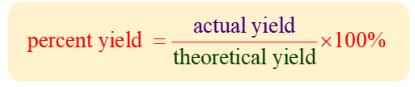
The percentage yield compares the actual amount of product made to the maximum possible amount (theoretical yield).
Key Definitions
- Theoretical yield = maximum possible amount (from calculations)
- Actual yield = amount actually obtained from experiment
Percentage Yield Formula

\( \text{Percentage yield} = \dfrac{\text{Actual yield}}{\text{Theoretical yield}} \times 100 \)
Why Yield Is Less Than 100%
• Reaction may not go to completion
• Some product may be lost during transfer
• Side reactions may occur
Important Exam Note
If percentage yield is over 100%, this usually means:
• Product was not completely dry
• Experimental error
Example 1 (Conceptual):
Why is the percentage yield rarely exactly 100% in real experiments?
▶️ Answer/Explanation
Reactions may not be complete.
Some product may be lost during filtration or transfer.
Side reactions may produce other substances.
Therefore, actual yield is often lower than theoretical yield.
Example 2 (Numerical):
A reaction should produce 25 g of product, but only 20 g is obtained. Calculate the percentage yield.
▶️ Answer/Explanation
\( \text{Percentage yield} = \dfrac{20}{25} \times 100 \)
\( = 0.8 \times 100 = 80\% \)
Answer: 80%
Example 3 (Hard):
Calcium carbonate decomposes:
\( \mathrm{CaCO_3} \rightarrow \mathrm{CaO} + \mathrm{CO_2} \)
50 g of CaCO₃ is heated. The experiment produces 18 g of CaO.
Calculate the percentage yield.
(Ar: Ca=40, C=12, O=16)
▶️ Answer/Explanation
Step 1: Calculate Mr values
\( M_r(\mathrm{CaCO_3}) = 40 + 12 + 48 = 100 \)
\( M_r(\mathrm{CaO}) = 40 + 16 = 56 \)
Step 2: Calculate theoretical yield
1 mol CaCO₃ → 1 mol CaO
Moles of CaCO₃ = \( \dfrac{50}{100} = 0.5 \)
Mass of CaO (theoretical) = \( 0.5 \times 56 = 28 \text{ g} \)
Step 3: Calculate percentage yield
\( \dfrac{18}{28} \times 100 \)
\( = 64.3\% \)
Answer: 64.3%