
1.56C Electrical Conductivity of Ionic Compounds
Key Principle:
Electrical conductivity requires mobile charged particles.
In ionic compounds, the charged particles are ions.
Structure of Ionic Compounds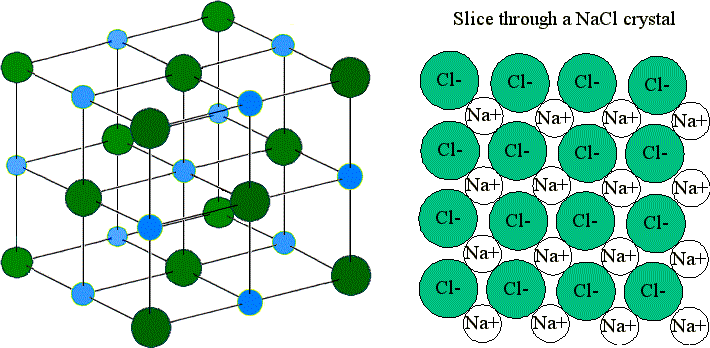
Ionic compounds consist of a giant ionic lattice.
They contain:
- Positive ions
- Negative ions
- Strong electrostatic attractions between oppositely charged ions
1. Solid Ionic Compounds
In the solid state:
- Ions are fixed in a regular lattice
- They cannot move
- There are no mobile charge carriers
Therefore, solid ionic compounds do not conduct electricity.
2. Molten Ionic Compounds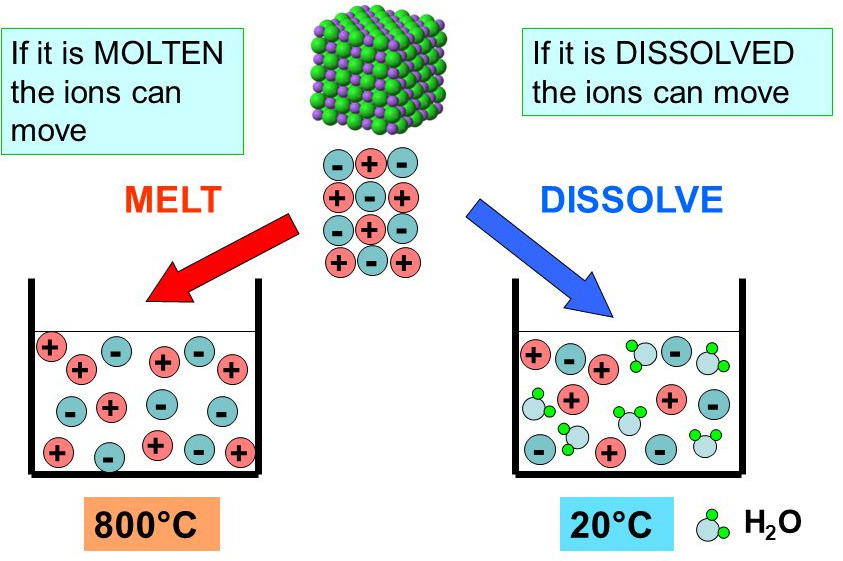
When heated until molten:
- The lattice breaks down
- Ions become free to move
- Mobile ions carry electrical charge
Therefore, molten ionic compounds conduct electricity.
3. Ionic Compounds in Aqueous Solution
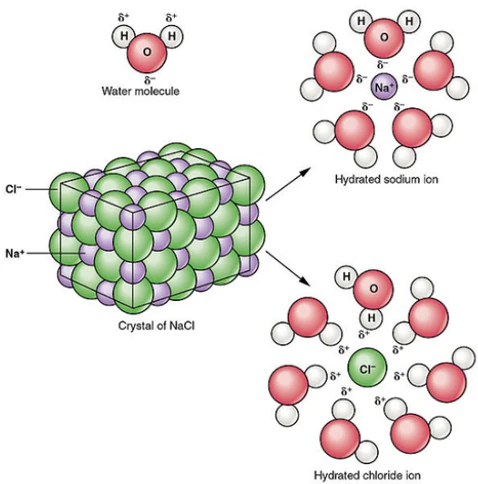
When dissolved in water:
\( \mathrm{NaCl(s)} \rightarrow \mathrm{Na^+(aq)} + \mathrm{Cl^-(aq)} \)
The ions separate and become free to move in solution.
Therefore, aqueous ionic solutions conduct electricity.
| State | Are Ions Free to Move? | Conducts Electricity? |
|---|---|---|
| Solid | No | No |
| Molten | Yes | Yes |
| Aqueous | Yes | Yes |
Example 1 (Conceptual):
Why does solid magnesium oxide not conduct electricity?
▶️ Answer/Explanation
\( \mathrm{MgO} \) consists of a giant ionic lattice.
The ions are fixed in position.
They cannot move.
Therefore, no electrical current flows.
Example 2 (Application):
Explain why molten potassium bromide conducts electricity.
▶️ Answer/Explanation
When molten, the ionic lattice breaks down.
\( \mathrm{K^+} \) and \( \mathrm{Br^-} \) ions become free to move.
Moving ions carry charge.
Therefore electricity flows.
Example 3 (Hard):
Explain fully why sodium chloride solution conducts electricity but solid sodium chloride does not.
▶️ Answer/Explanation
Solid sodium chloride has ions fixed in a lattice.
The ions cannot move.
When dissolved in water:
\( \mathrm{NaCl(s)} \rightarrow \mathrm{Na^+(aq)} + \mathrm{Cl^-(aq)} \)
The ions separate and are free to move.
Mobile charged particles carry current.
Therefore, the solution conducts electricity but the solid does not.
1.57C Anions and Cations 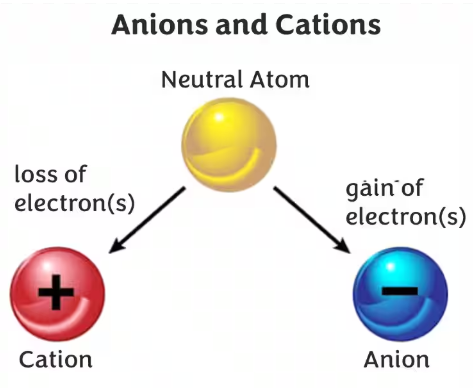
Definition:
- A cation is a positively charged ion.
- An anion is a negatively charged ion.
How Ions Form
Ions are formed when atoms gain or lose electrons.
Loss of electrons → Cation
\( \mathrm{Na} \rightarrow \mathrm{Na^+} + e^- \)
When an atom loses electrons, it has more protons than electrons, so it becomes positively charged.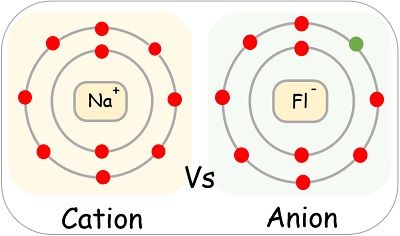
Gain of electrons → Anion
\( \mathrm{Cl} + e^- \rightarrow \mathrm{Cl^-} \)
When an atom gains electrons, it has more electrons than protons, so it becomes negatively charged.
Memory Tip
Cation → “Cats are positive” (starts with C and P in alphabetical order).
| Term | Charge | Formed By | Example |
|---|---|---|---|
| Cation | Positive (+) | Loss of electrons | \( \mathrm{Na^+} \) |
| Anion | Negative (–) | Gain of electrons | \( \mathrm{Cl^-} \) |
Why This Matters in Ionic Bonding
Ionic bonding is the strong electrostatic attraction between cations and anions.
Example 1 (Conceptual):
Why is \( \mathrm{Mg^{2+}} \) called a cation?
▶️ Answer/Explanation
Magnesium loses two electrons.
It becomes positively charged.
Positive ions are called cations.
Example 2 (Application):
Is \( \mathrm{O^{2-}} \) an anion or a cation? Explain.
▶️ Answer/Explanation
\( \mathrm{O^{2-}} \) has a negative charge.
It gained electrons.
Negative ions are called anions.
Example 3 (Hard):
Explain fully why a sodium ion is a cation and a chloride ion is an anion in sodium chloride.
▶️ Answer/Explanation
Sodium loses one electron:
\( \mathrm{Na} \rightarrow \mathrm{Na^+} + e^- \)
It has more protons than electrons.
It becomes positively charged, so it is a cation.
Chlorine gains one electron:
\( \mathrm{Cl} + e^- \rightarrow \mathrm{Cl^-} \)
It has more electrons than protons.
It becomes negatively charged, so it is an anion.