
2.31 Acids and Alkalis in Aqueous Solution
An aqueous solution is a solution in water.
When substances dissolve in water, they may produce ions.
Acids in Aqueous Solution
An acid is a substance that produces hydrogen ions when dissolved in water.
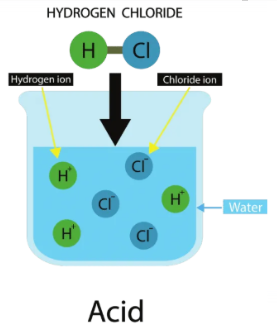
\( \mathrm{Acid(aq) \rightarrow H^+(aq) + Anion(aq)} \)
Examples:
\( \mathrm{HCl(aq) \rightarrow H^+(aq) + Cl^-(aq)} \)
\( \mathrm{H_2SO_4(aq) \rightarrow 2H^+(aq) + SO_4^{2-}(aq)} \)
The presence of \( \mathrm{H^+} \) ions gives acids their properties.
- pH less than 7
- Turn blue litmus red
- React with metals to produce hydrogen
Alkalis in Aqueous Solution
An alkali is a soluble base that produces hydroxide ions in water.
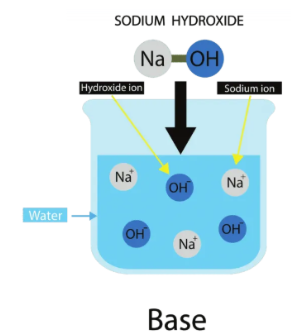
\( \mathrm{Alkali(aq) \rightarrow Metal^+(aq) + OH^-(aq)} \)
Examples:
\( \mathrm{NaOH(aq) \rightarrow Na^+(aq) + OH^-(aq)} \)
\( \mathrm{KOH(aq) \rightarrow K^+(aq) + OH^-(aq)} \)
The presence of \( \mathrm{OH^-} \) ions gives alkalis their properties.
- pH greater than 7
- Turn red litmus blue
- Feel soapy (caution: corrosive)
Neutralisation Reaction
When an acid reacts with an alkali, hydrogen ions react with hydroxide ions to form water:
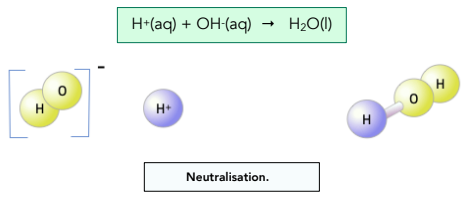
\( \mathrm{H^+(aq) + OH^-(aq) \rightarrow H_2O(l)} \)
This is called neutralisation.
| Substance | Ion Produced in Water | pH |
|---|---|---|
| Acid | \( \mathrm{H^+} \) | < 7 |
| Alkali | \( \mathrm{OH^-} \) | > 7 |
Example 1 (Conceptual):
Why is hydrochloric acid acidic in water?
▶️ Answer/Explanation
It produces \( \mathrm{H^+} \) ions when dissolved in water.
These hydrogen ions give acidic properties.
Example 2 (Application):
Sodium hydroxide solution has pH 13. Which ion is responsible for this?
▶️ Answer/Explanation
The hydroxide ion \( \mathrm{OH^-} \).
Alkalis produce hydroxide ions in water.
Example 3 (Hard):
Explain fully why the reaction between hydrochloric acid and sodium hydroxide is a neutralisation reaction.
▶️ Answer/Explanation
Hydrochloric acid produces \( \mathrm{H^+} \) ions in aqueous solution.
Sodium hydroxide produces \( \mathrm{OH^-} \) ions in aqueous solution.
The hydrogen ions react with hydroxide ions to form water:
\( \mathrm{H^+ + OH^- \rightarrow H_2O} \)
The remaining ions form sodium chloride.
Because an acid reacts with an alkali to form water and a salt, this is a neutralisation reaction.