
2.47 Tests for Cations Using Sodium Hydroxide Solution
Certain positive ions (cations) can be identified by adding sodium hydroxide solution.
Observations include formation of precipitates or production of a gas.
1. Test for Ammonium Ion, \( \mathrm{NH_4^+} \) 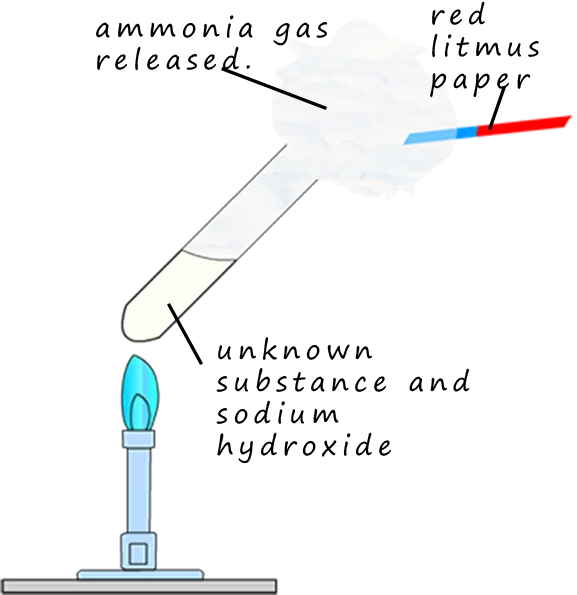
Procedure:
- Add sodium hydroxide solution to the sample.
- Warm the mixture gently.
- Hold damp red litmus paper near the mouth of the test tube.
Reaction:
\( \mathrm{NH_4^+(aq) + OH^-(aq) \rightarrow NH_3(g) + H_2O(l)} \)
Observation:
- Pungent gas produced (ammonia).
- Damp red litmus turns blue.
This confirms the presence of \( \mathrm{NH_4^+} \).
2. Test for Copper(II) Ion, \( \mathrm{Cu^{2+}} \)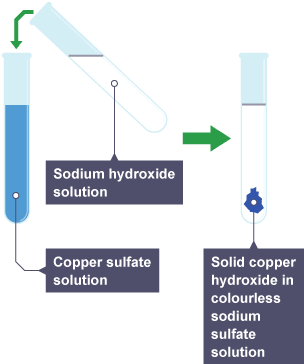
Procedure:
- Add sodium hydroxide solution to the sample.
Reaction:
\( \mathrm{Cu^{2+}(aq) + 2OH^-(aq) \rightarrow Cu(OH)_2(s)} \)
Observation:
- Blue precipitate forms.
- Insoluble in excess sodium hydroxide.
3. Test for Iron(II) Ion, \( \mathrm{Fe^{2+}} \)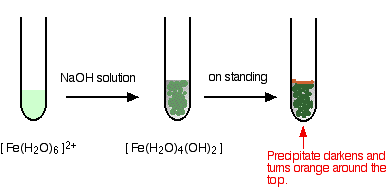
\( \mathrm{Fe^{2+}(aq) + 2OH^-(aq) \rightarrow Fe(OH)_2(s)} \)
Observation:
- Green precipitate forms.
- Slowly turns brown on standing (due to oxidation).
4. Test for Iron(III) Ion, \( \mathrm{Fe^{3+}} \)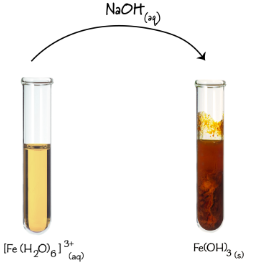
\( \mathrm{Fe^{3+}(aq) + 3OH^-(aq) \rightarrow Fe(OH)_3(s)} \)
Observation:
- Brown precipitate forms.
- Insoluble in excess sodium hydroxide.
| Cation | Observation with NaOH |
|---|---|
| \( \mathrm{NH_4^+} \) | Ammonia gas evolved, turns damp red litmus blue |
| \( \mathrm{Cu^{2+}} \) | Blue precipitate |
| \( \mathrm{Fe^{2+}} \) | Green precipitate (turns brown) |
| \( \mathrm{Fe^{3+}} \) | Brown precipitate |
Example 1 (Conceptual):
Why must the ammonium test be warmed?
▶️ Answer/Explanation
Warming helps release ammonia gas.
This makes the gas easier to detect.
Example 2 (Application):
A blue precipitate forms when sodium hydroxide is added. Which ion is present?
▶️ Answer/Explanation
\( \mathrm{Cu^{2+}} \) is present.
It forms blue \( \mathrm{Cu(OH)_2} \).
Example 3 (Hard):
A green precipitate forms and slowly turns brown when left exposed to air. Identify the ion and explain fully.
▶️ Answer/Explanation
The green precipitate indicates \( \mathrm{Fe^{2+}} \).
The reaction is:
\( \mathrm{Fe^{2+} + 2OH^- \rightarrow Fe(OH)_2} \)
Iron(II) hydroxide slowly oxidises in air to iron(III) hydroxide.
Iron(III) hydroxide is brown.
This colour change confirms \( \mathrm{Fe^{2+}} \) was present.