
3.10 Effects of Different Factors on the Rate of Reaction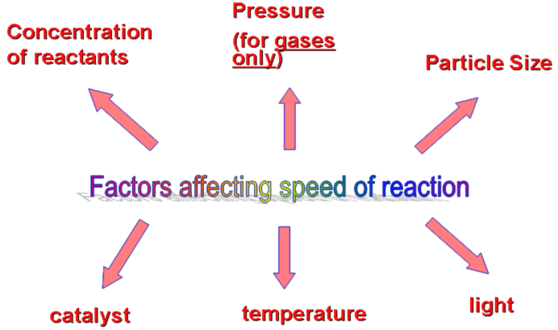
Definition:
The rate of reaction is the change in amount of reactant or product per unit time.
According to collision theory, a reaction occurs when particles collide with:
- Sufficient energy (greater than activation energy).
- Correct orientation.
1. Surface Area of a Solid
- Increasing surface area increases rate.
- Powdered solids react faster than large lumps.
Explanation:
- More particles are exposed.
- More frequent collisions occur.
2. Concentration of a Solution
- Increasing concentration increases rate.
Explanation:
- More particles per unit volume.
- Increased collision frequency.
3. Pressure of a Gas
- Increasing pressure increases rate (for gases).
Explanation:
- Gas particles are closer together.
- More frequent collisions.
4. Temperature
- Increasing temperature increases rate.
Explanation:
- Particles have more kinetic energy.
- Move faster.
- More collisions per second.
- Greater proportion of collisions exceed activation energy.
5. Catalyst
- A catalyst increases rate without being used up.
Explanation:
- Provides an alternative reaction pathway.
- Lowers activation energy.
- More successful collisions occur.
| Factor | What Changes | Effect on Rate | Collision Theory Reason |
|---|---|---|---|
| Surface area | More exposed particles | Increase | More frequent collisions |
| Concentration | More particles per volume | Increase | More frequent collisions |
| Pressure (gas) | Particles closer together | Increase | More frequent collisions |
| Temperature | Higher kinetic energy | Increase | More energetic & frequent collisions |
| Catalyst | Lower activation energy | Increase | More successful collisions |
Example 1 (Conceptual):
Why does increasing pressure increase the rate of a gaseous reaction?
▶️ Answer/Explanation
Gas particles are closer together.
Collisions occur more frequently.
The rate increases.
Example 2 (Application):
A reaction doubles in rate when temperature increases. Explain why.
▶️ Answer/Explanation
Particles move faster.
More collisions per second.
More particles have energy greater than activation energy.
Example 3 (Hard):
Explain fully, using collision theory, why a catalyst increases the rate of reaction.
▶️ Answer/Explanation
A catalyst provides an alternative reaction pathway.
This pathway has lower activation energy.
A greater proportion of particles have sufficient energy.
More successful collisions occur per second.
The catalyst is not used up.