Edexcel iGCSE Chemistry -4.17–4.18 Catalytic Cracking and Its Importance- Study Notes- New Syllabus

Edexcel iGCSE Chemistry -4.17–4.18 Catalytic Cracking and Its Importance- Study Notes- New syllabus

Edexcel iGCSE Chemistry -4.17–4.18 Catalytic Cracking and Its Importance- Study Notes -Edexcel iGCSE Chemistry – per latest Syllabus.

Key Concepts:

4.17 describe how long-chain alkanes are converted to alkenes and shorter-chain alkanes by catalytic cracking (using silica or alumina as the catalyst and a temperature in the range of 600–700 °C)

4.18 explain why cracking is necessary, in terms of the balance between supply and demand for different fractions

Edexcel iGCSE Chemistry -Concise Summary Notes- All Topics

4.17 Catalytic Cracking of Long-Chain Alkanes

Catalytic cracking is the process used to break down long-chain alkanes into:
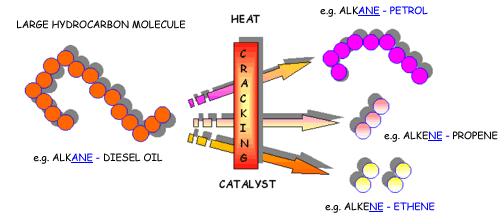
  • Shorter-chain alkanes
  • Alkenes

This process increases the supply of more useful and more valuable hydrocarbons.

Why Cracking Is Needed

  • Long-chain hydrocarbons are less useful.
  • They are less flammable.
  • They have high boiling points and high viscosity.
  • There is greater demand for shorter-chain fuels and alkenes.

Conditions for Catalytic Cracking

  • Temperature: \( 600\text{–}700^\circ \mathrm{C} \)
  • Catalyst: silica \( \mathrm{SiO_2} \) or alumina \( \mathrm{Al_2O_3} \)
  • Vapour phase (hydrocarbon vapour)

What Happens During Cracking

Large alkane molecules are broken into smaller molecules.

Example:

\( \mathrm{C_{10}H_{22} \rightarrow C_8H_{18} + C_2H_4} \)

A long-chain alkane produces:

  • A shorter alkane
  • An alkene (contains a C=C double bond)

Role of the Catalyst

  • Provides a surface for the reaction.
  • Lowers the activation energy.
  • Speeds up the reaction.
  • Remains chemically unchanged.
Before CrackingAfter Cracking
Long-chain alkaneShorter-chain alkane
High boiling pointLower boiling point
Low demandHigh demand products

Why Alkenes Are Important

  • Used to make polymers (plastics).
  • Undergo addition reactions.
  • More reactive than alkanes.

Exam Structure for Explanation

  • Long-chain alkane is heated to \( 600\text{–}700^\circ \mathrm{C} \).
  • Vapour passes over silica or alumina catalyst.
  • Molecules break into smaller molecules.
  • Products include alkanes and alkenes.

Example 1 (Conceptual):

Why is catalytic cracking used in industry?

▶️ Answer/Explanation

There is high demand for shorter-chain hydrocarbons and alkenes.

Cracking converts less useful long-chain alkanes into more valuable products.

Example 2 (Application):

One product of cracking must contain a double bond. Why?

▶️ Answer/Explanation

The original alkane is saturated.

When it splits, not all fragments can remain saturated.

At least one fragment forms an alkene with a C=C bond.

Example 3 (Hard):

Explain fully how long-chain alkanes are converted into alkenes and shorter-chain alkanes by catalytic cracking.

▶️ Answer/Explanation

Long-chain alkanes are first vaporised.

The vapour is heated to \( 600\text{–}700^\circ \mathrm{C} \).

It passes over a silica or alumina catalyst.

The catalyst lowers the activation energy.

The large molecules break into smaller molecules.

The products formed include shorter-chain alkanes and alkenes.

The alkenes contain a carbon–carbon double bond.

4.18 Why Cracking Is Necessary (Supply and Demand)

Crude oil contains a mixture of hydrocarbons that are separated into fractions by fractional distillation.

However, the amounts of each fraction produced do not match the demand for each fraction.

The Problem: Imbalance of Supply and Demand

  • There is high demand for short-chain hydrocarbons (e.g. petrol).
  • There is lower demand for long-chain hydrocarbons (e.g. fuel oil).
  • Fractional distillation produces large amounts of long-chain fractions.

This creates a surplus of long-chain hydrocarbons and a shortage of short-chain hydrocarbons.

The Solution: Cracking

Cracking breaks long-chain alkanes into:

  • Shorter-chain alkanes (useful fuels)
  • Alkenes (used to make plastics)

Example:

\( \mathrm{C_{12}H_{26} \rightarrow C_8H_{18} + C_4H_8} \)

Economic Importance

  • Increases the supply of high-demand fuels (e.g. gasoline).
  • Produces alkenes for the polymer industry.
  • Reduces waste of low-demand heavy fractions.
  • Makes oil refining more profitable.
Fraction TypeSupplyDemand
Short-chain (petrol)Lower natural supplyHigh demand
Long-chain (fuel oil)High natural supplyLower demand

Example 1 (Conceptual):

Why is there a need to convert long-chain hydrocarbons into shorter ones?

▶️ Answer/Explanation

There is higher demand for shorter-chain fuels.

There is excess supply of long-chain hydrocarbons.

Example 2 (Application):

Which fraction is in higher demand: petrol or fuel oil?

▶️ Answer/Explanation

Petrol.

It is widely used as fuel for cars.

Example 3 (Hard):

Explain fully why cracking is necessary in the oil industry.

▶️ Answer/Explanation

Fractional distillation produces more long-chain hydrocarbons than are needed.

There is greater demand for short-chain hydrocarbons such as petrol.

There is also demand for alkenes used to make plastics.

Cracking breaks long-chain hydrocarbons into shorter-chain alkanes and alkenes.

This increases the supply of high-demand products.

Therefore cracking balances supply and demand.

Scroll to Top