
4.33C Conditions Required for Fermentation (Absence of Air and Optimum Temperature)
Fermentation is the process by which glucose is converted into ethanol and carbon dioxide by enzymes in yeast.
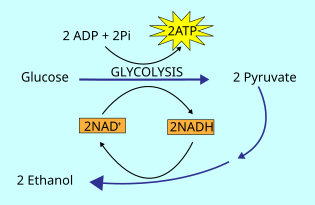
\( \mathrm{C_6H_{12}O_6 \rightarrow 2C_2H_5OH + 2CO_2} \)
For fermentation to work effectively, specific conditions are required.
1. Absence of Air (Anaerobic Conditions)

- Fermentation is an anaerobic process.
- If oxygen is present, yeast carries out aerobic respiration instead.
- Aerobic respiration produces carbon dioxide and water, not ethanol.
- Oxygen can also cause ethanol to oxidise into ethanoic acid.
Therefore, oxygen must be excluded to ensure ethanol is produced.
2. Optimum Temperature
- Yeast contains enzymes that catalyse the reaction.
- Enzymes work best at an optimum temperature.

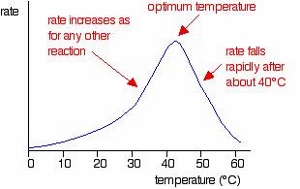
If temperature is too low:
- Reaction rate is slow.
- Ethanol is produced very slowly.
If temperature is too high:
- Enzymes become denatured.
- Their shape changes permanently.
- Fermentation stops.
| Condition | Reason |
|---|---|
| No oxygen | Prevents aerobic respiration and oxidation of ethanol |
| \( (30 – 40 )^\circ \mathrm{C} \) | Ensures enzymes work at optimum rate |
Key Points
- Fermentation must occur without oxygen.
- Optimum temperature is about \( 30^\circ \mathrm{C} \).
- Too high temperature denatures enzymes.
- Too low temperature slows the reaction.
Example 1 (Conceptual):
Why must fermentation take place without oxygen?
▶️ Answer/Explanation
If oxygen is present, yeast carries out aerobic respiration.
Ethanol would not be produced.
Example 2 (Application):
What happens if fermentation is carried out at \( 60^\circ \mathrm{C} \)?
▶️ Answer/Explanation
The enzymes in yeast become denatured.
The reaction stops.
Example 3 (Hard):
Explain fully why fermentation must be carried out in the absence of air and at about \( 30^\circ \mathrm{C} \).
▶️ Answer/Explanation
Fermentation is an anaerobic process.
If oxygen is present, yeast carries out aerobic respiration instead.
This would prevent ethanol production.
The enzymes in yeast work best at about \( 30^\circ \mathrm{C} \).
If the temperature is too low, the reaction is slow.
If the temperature is too high, enzymes denature and the reaction stops.