
4.36C Reactions of Aqueous Carboxylic Acids with Metals and Metal Carbonates
Carboxylic acids contain the functional group:
−COOH
In aqueous solution, they behave as weak acids.
They react in a similar way to other acids such as hydrochloric acid.
1. Reaction with Metals
Carboxylic acids react with reactive metals to form:
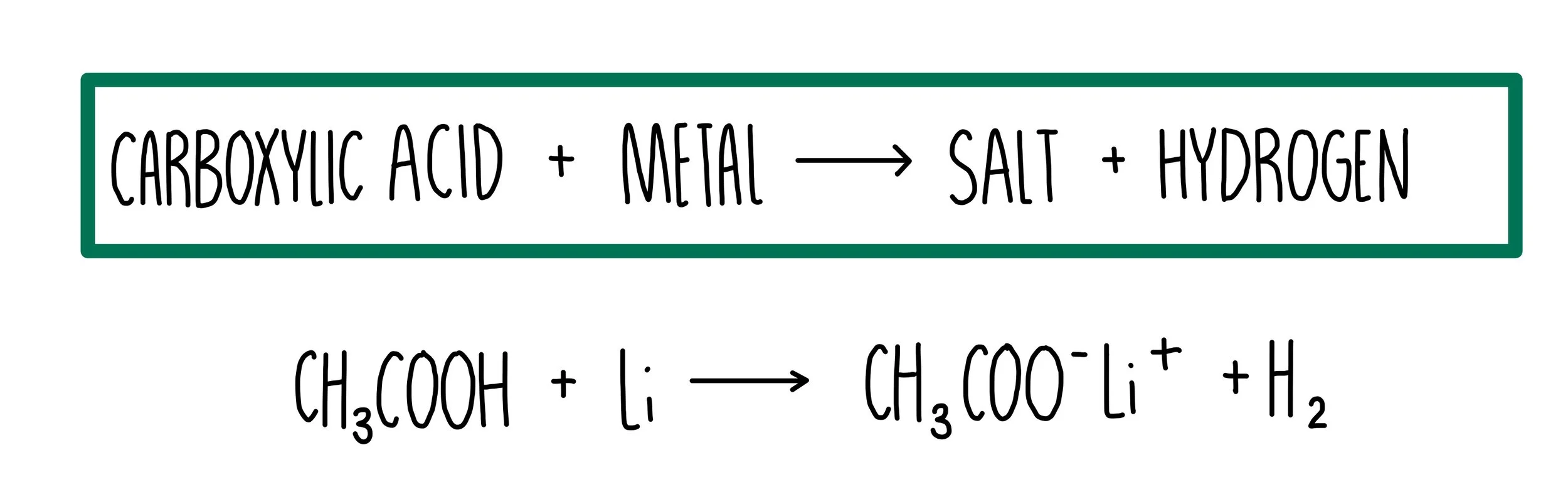
- A salt (metal carboxylate)
- Hydrogen gas
General equation:
Acid + Metal → Salt + Hydrogen
Example: Ethanoic acid and magnesium
\( \mathrm{2CH_3COOH + Mg \rightarrow (CH_3COO)_2Mg + H_2} \)
Observation:
- Effervescence (bubbles of hydrogen gas).
- Magnesium gradually disappears.
2. Reaction with Metal Carbonates
Carboxylic acids react with metal carbonates to form:
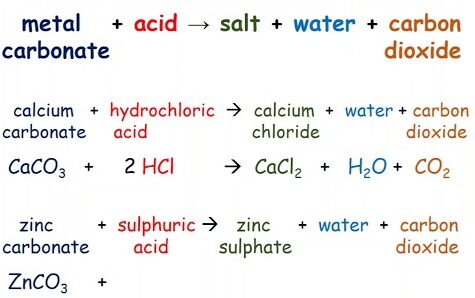
- A salt
- Carbon dioxide
- Water
General equation:
Acid + Carbonate → Salt + Carbon dioxide + Water
Example: Ethanoic acid and sodium carbonate
\( \mathrm{2CH_3COOH + Na_2CO_3 \rightarrow 2CH_3COONa + CO_2 + H_2O} \)
Observation:
- Effervescence due to carbon dioxide.
- Carbon dioxide turns limewater milky.
| Reactant | Products | Gas Produced |
|---|---|---|
| Metal | Salt + Hydrogen | \( \mathrm{H_2} \) |
| Metal carbonate | Salt + \( \mathrm{CO_2} \) + Water | \( \mathrm{CO_2} \) |
Why These Reactions Occur
- Carboxylic acids release \( \mathrm{H^+} \) ions in aqueous solution.
- Metals react with \( \mathrm{H^+} \) to produce hydrogen gas.
- Carbonates react with \( \mathrm{H^+} \) to produce carbon dioxide and water.
Key Points
- Carboxylic acids behave like other acids in aqueous solution.
- They form metal salts called carboxylates.
- Hydrogen is produced with metals.
- Carbon dioxide is produced with carbonates.
Example 1 (Conceptual):
Why is hydrogen gas produced when ethanoic acid reacts with magnesium?
▶️ Answer/Explanation
Ethanoic acid releases \( \mathrm{H^+} \) ions in solution.
Magnesium reacts with \( \mathrm{H^+} \) to form hydrogen gas.
Example 2 (Application):
Write the balanced equation for the reaction between methanoic acid and sodium carbonate.
▶️ Answer/Explanation
\( \mathrm{2HCOOH + Na_2CO_3 \rightarrow 2HCOONa + CO_2 + H_2O} \)
Example 3 (Hard):
Explain fully what would be observed when aqueous propanoic acid reacts with calcium carbonate.
▶️ Answer/Explanation
Bubbles would be seen due to carbon dioxide gas.
The calcium carbonate would gradually dissolve.
A calcium propanoate salt would form.
Water would also be produced.
The reaction occurs because the acid releases \( \mathrm{H^+} \) ions.