
4.41C Writing Structural and Displayed Formulae of Esters from Alcohols and Carboxylic Acids (and Vice Versa)
Esters are formed by the reaction between: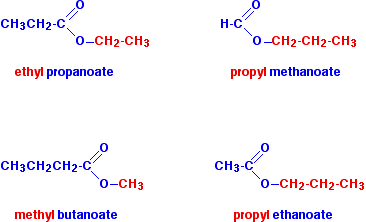
- An alcohol (contains −OH)
- A carboxylic acid (contains −COOH)
This reaction is called esterification.
\( \mathrm{Carboxylic\ acid + Alcohol \rightleftharpoons Ester + Water} \)
The Ester Functional Group
\( \mathrm{-C(=O)O-} \)
When forming an ester:
- The −OH from the acid is removed.
- The H from the alcohol’s −OH is removed.
- These combine to form water.
- The remaining parts join through an −O− link.
Step-by-Step Method (From Acid + Alcohol to Ester)
Example: Ethanoic acid + Propanol
Ethanoic acid:
\( \mathrm{CH_3COOH} \)
Propan-1-ol:
\( \mathrm{CH_3CH_2CH_2OH} \)
Remove:
- −OH from the acid
- H from the alcohol
Join remaining parts:
\( \mathrm{CH_3COOCH_2CH_2CH_3} \)
Name: propyl ethanoate
Naming Rule for Esters
- The alcohol gives the first part of the name (alkyl group).
- The acid gives the second part (ending changes to -oate).
Example:
- Ethanol → Ethyl
- Ethanoic acid → Ethanoate
- Product → Ethyl ethanoate
Working Backwards (From Ester to Acid + Alcohol)
Example: Ethyl propanoate
- “Ethyl” comes from ethanol
- “Propanoate” comes from propanoic acid
Alcohol:
\( \mathrm{C_2H_5OH} \)
Acid:
\( \mathrm{CH_3CH_2COOH} \)
| Ester Name | Alcohol | Carboxylic Acid |
|---|---|---|
| Ethyl ethanoate | Ethanol | Ethanoic acid |
| Propyl ethanoate | Propanol | Ethanoic acid |
| Ethyl propanoate | Ethanol | Propanoic acid |
Displayed Formula Example
Propyl ethanoate:
\( \mathrm{CH_3 – C(=O) – O – CH_2 – CH_2 – CH_3} \)
Must clearly show:
- The C=O double bond.
- The −O− linkage.
- All atoms.
Key Points
- Alcohol part becomes the first name.
- Acid part changes to -oate.
- Remove −OH from acid and H from alcohol.
- Join through −O−.
Example 1 (Conceptual):
From which alcohol and acid is methyl ethanoate formed?
▶️ Answer/Explanation
Methyl comes from methanol.
Ethanoate comes from ethanoic acid.
Example 2 (Application):
Write the structural formula of ethyl propanoate.
▶️ Answer/Explanation
Propanoate part: \( \mathrm{CH_3CH_2COO-} \)
Ethyl part: \( \mathrm{-CH_2CH_3} \)
\( \mathrm{CH_3CH_2COOCH_2CH_3} \)
Example 3 (Hard):
Explain fully how you would determine the alcohol and carboxylic acid used to form butyl ethanoate.
▶️ Answer/Explanation
The first part “butyl” comes from butanol.
The second part “ethanoate” comes from ethanoic acid.
So the alcohol is butanol.
The acid is ethanoic acid.
The ester contains the −COO− functional group linking the two parts.