
4.44 Addition Polymers and Monomers
An addition polymer is formed when many small molecules called monomers join together to make one very large molecule.
This process is called addition polymerisation.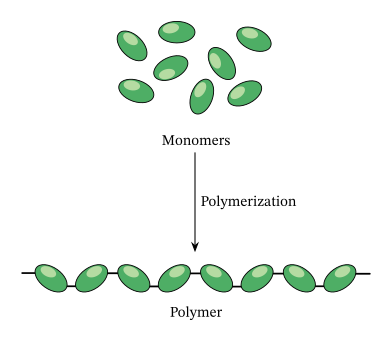
Monomer
A monomer is a small molecule that can join to other similar molecules.
In addition polymerisation, the monomer usually contains a carbon–carbon double bond.
Example monomer: ethene \( \mathrm{CH_2=CH_2} \)
Polymer
A polymer is a very large molecule made from repeating units of monomers.
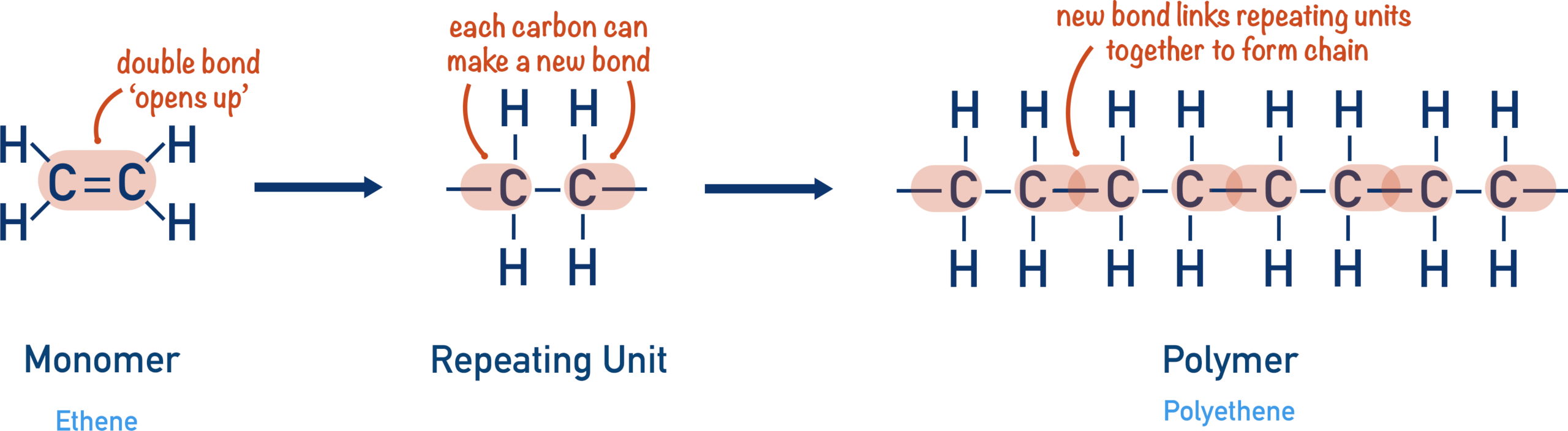
When ethene polymerises:
\( \mathrm{nCH_2=CH_2 \rightarrow [-CH_2-CH_2-]_n} \)
The double bond opens and forms long chains.
Why It Is Called “Addition” Polymerisation
- The monomers join together.
- No other products are formed.
- All atoms from the monomers are present in the polymer.
| Term | Definition |
|---|---|
| Monomer | Small molecule that joins to others |
| Polymer | Large molecule made of repeating units |
| Addition polymer | Formed by addition polymerisation |
Key GCSE Points
- Addition polymers form from alkenes.
- The C=C double bond opens.
- No small molecules are eliminated.
- The polymer is made from repeating units.
Example 1 (Conceptual):
Why must the monomer contain a carbon–carbon double bond?
▶️ Answer/Explanation
The double bond can open.
This allows the monomers to join into long chains.
Example 2 (Application):
Write the repeating unit for the polymer formed from ethene.
▶️ Answer/Explanation
\( \mathrm{[-CH_2-CH_2-]_n} \)
Example 3 (Hard):
Explain fully why addition polymerisation does not produce any small molecules as by-products.
▶️ Answer/Explanation
In addition polymerisation, the double bond opens.
The monomers join directly to each other.
No atoms are removed from the monomer.
Therefore no small molecules are formed as by-products.
4.45 Drawing the Repeat Unit of Addition Polymers
An addition polymer is formed when many alkene monomers join together.
To draw the repeat unit:
- Start with the alkene monomer.
- Open the C=C double bond.
- Convert it into a single bond.
- Place brackets around the repeating section.
- Add a small \( \mathrm{n} \) outside the brackets.
1. Poly(ethene)
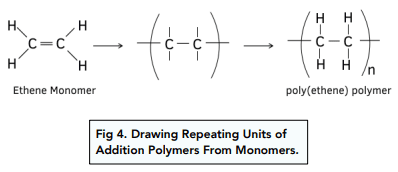
Monomer: Ethene
\( \mathrm{CH_2=CH_2} \)
Repeat unit:
\( \mathrm{[-CH_2-CH_2-]_n} \)
2. Poly(propene)
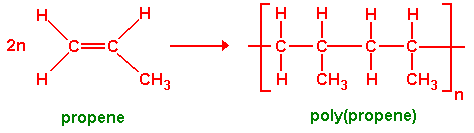
Monomer: Propene
\( \mathrm{CH_2=CHCH_3} \)
Repeat unit:
\( \mathrm{[-CH_2-CH(CH_3)-]_n} \)
The \( \mathrm{CH_3} \) group stays attached to the second carbon.
3. Poly(chloroethene) (PVC)
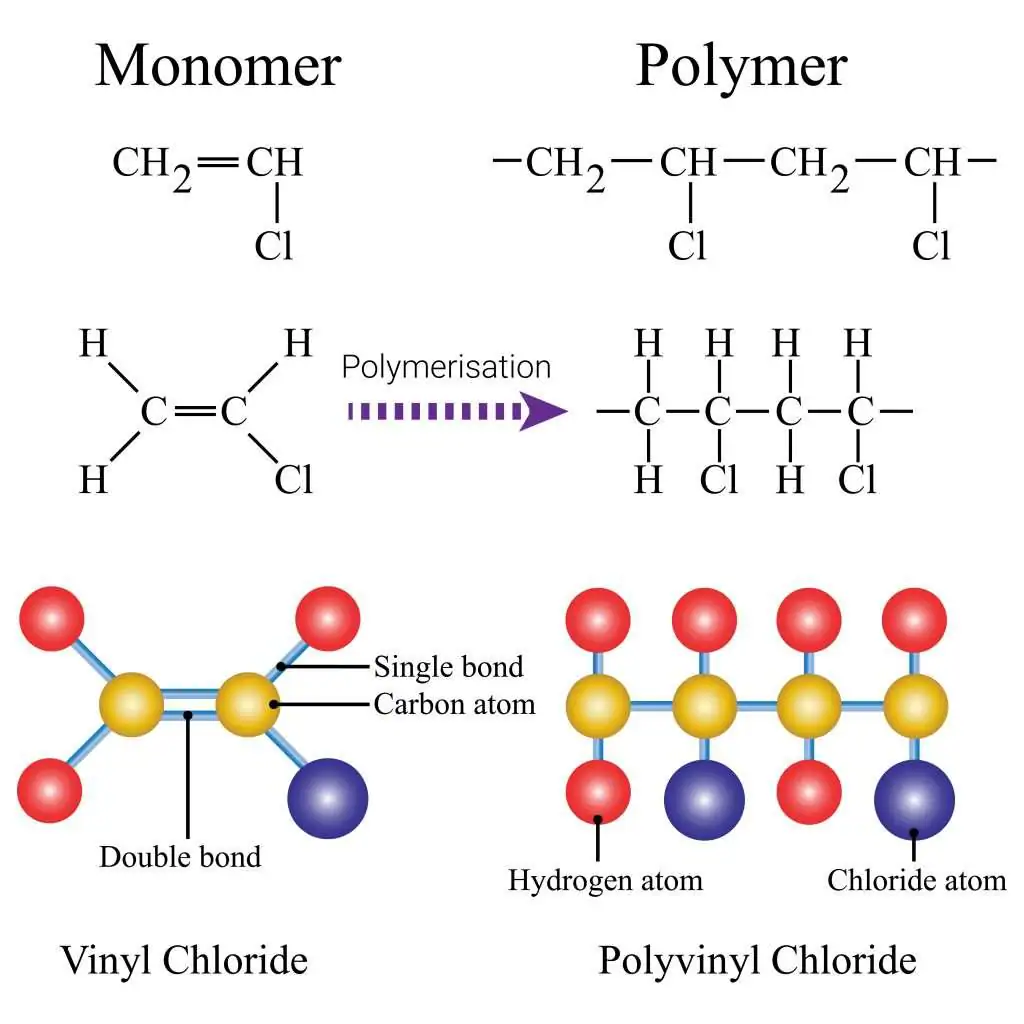
Monomer: Chloroethene
\( \mathrm{CH_2=CHCl} \)
Repeat unit:
\( \mathrm{[-CH_2-CH(Cl)-]_n} \)
The chlorine atom remains bonded to the second carbon.
4. Poly(tetrafluoroethene) (PTFE)
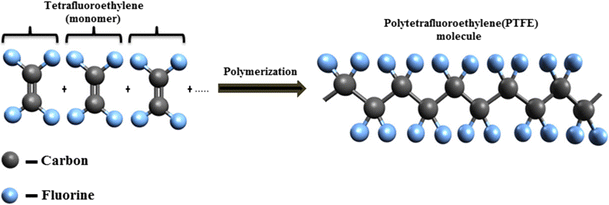
Monomer: Tetrafluoroethene
\( \mathrm{CF_2=CF_2} \)
Repeat unit:
\( \mathrm{[-CF_2-CF_2-]_n} \)
| Polymer | Monomer | Repeat Unit |
|---|---|---|
| Poly(ethene) | \( \mathrm{CH_2=CH_2} \) | \( \mathrm{[-CH_2-CH_2-]_n} \) |
| Poly(propene) | \( \mathrm{CH_2=CHCH_3} \) | \( \mathrm{[-CH_2-CH(CH_3)-]_n} \) |
| Poly(chloroethene) | \( \mathrm{CH_2=CHCl} \) | \( \mathrm{[-CH_2-CH(Cl)-]_n} \) |
| Poly(tetrafluoroethene) | \( \mathrm{CF_2=CF_2} \) | \( \mathrm{[-CF_2-CF_2-]_n} \) |
Common Exam Mistakes
- Forgetting to remove the double bond.
- Forgetting brackets around the repeat unit.
- Placing \( \mathrm{n} \) inside the brackets instead of outside.
Key Points
- Open the C=C bond.
- Keep side groups attached to the same carbon.
- Use brackets and write \( \mathrm{n} \) outside.
Example 1 (Conceptual):
Why does the double bond disappear in the repeat unit?
▶️ Answer/Explanation
The double bond opens during polymerisation.
It becomes a single bond linking monomers together.
Example 2 (Application):
Draw the repeat unit of poly(chloroethene).
▶️ Answer/Explanation
\( \mathrm{[-CH_2-CH(Cl)-]_n} \)
Example 3 (Hard):
Explain fully how you would draw the repeat unit of poly(propene) from its monomer.
▶️ Answer/Explanation
Start with the monomer \( \mathrm{CH_2=CHCH_3} \).
Open the carbon–carbon double bond.
Replace it with a single bond.
Keep the \( \mathrm{CH_3} \) group attached to the second carbon.
Place brackets around the repeating section.
Write \( \mathrm{n} \) outside the brackets.