
4.50C Biopolyesters and Biodegradability
Some polyesters are known as biopolyesters.
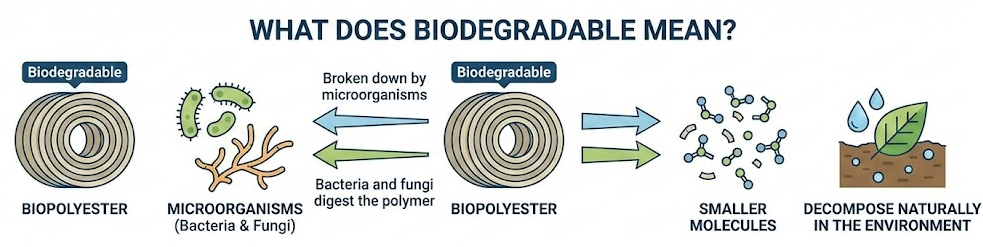
Biopolyesters are biodegradable.
What Does Biodegradable Mean?
- They can be broken down by microorganisms.
- Bacteria and fungi digest the polymer.
- They decompose naturally in the environment.
Why Some Polyesters Are Biodegradable
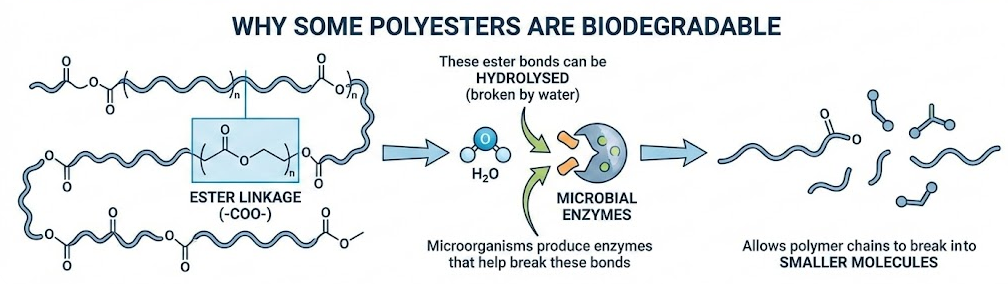
Polyesters contain ester linkages:
\( \mathrm{-COO-} \)
These ester bonds can be hydrolysed (broken by water).
Microorganisms produce enzymes that help break these bonds.
This allows the polymer chains to break into smaller molecules.
Comparison with Addition Polymers
| Polymer Type | Bond in Backbone | Biodegradable? |
|---|---|---|
| Addition polymer | C–C only | No |
| Polyester | Contains \( \mathrm{-COO-} \) | Some are biodegradable |
Environmental Importance
- Reduce plastic pollution.
- Break down more easily in landfill or compost conditions.
- Often used in biodegradable packaging and medical materials.
GCSE Points
- Biopolyesters are biodegradable polyesters.
- They can be broken down by microorganisms.
- Ester linkages allow hydrolysis.
- Not all polyesters are biodegradable, only some.
Example 1 (Conceptual):
Why are some polyesters biodegradable but addition polymers are not?
▶️ Answer/Explanation
Polyesters contain ester bonds that can be hydrolysed.
Addition polymers only contain strong C–C bonds.
Microorganisms cannot easily break C–C bonds.
Example 2 (Application):
State what is meant by biodegradable.
▶️ Answer/Explanation
It means capable of being broken down by microorganisms.
Example 3 (Hard):
Explain fully why biopolyesters are more environmentally friendly than many addition polymers.
▶️ Answer/Explanation
Biopolyesters contain ester bonds that can be broken down by hydrolysis.
Microorganisms can digest these materials.
They therefore decompose naturally.
Addition polymers have strong carbon–carbon bonds and are not biodegradable.
They persist in landfill and cause long-term pollution.