Question
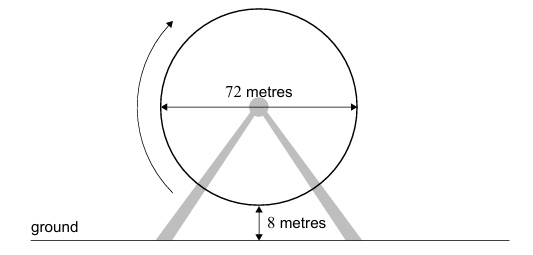
(i) \( a \);
(ii) \( b \).
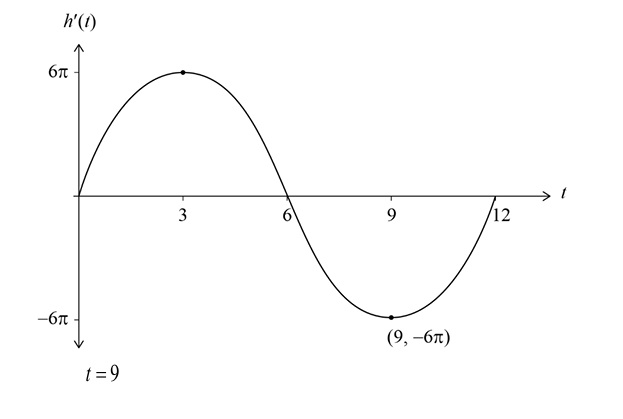
(ii) Hence, find the specific time at which the passenger’s height is decreasing at the maximum possible rate.
Most-appropriate topic codes (Mathematics: analysis and approaches guide):
SL 5.6: Derivative of \( \sin x, \cos x \); the chain rule for composite functions — Part d(i)
SL 5.8: Optimization; local maximum and minimum points — Part d(ii)
▶️ Answer/Explanation
(a)(i) Determine \( a \):
The radius of the wheel is \( 72 / 2 = 36 \) m, which represents the amplitude. Since the seat starts at the lowest point (a minimum), the cosine function is reflected.
\( \boxed{a = -36} \)
(a)(ii) Determine \( b \):
The period is 12 minutes. Using the relationship \( \text{Period} = \frac{2\pi}{b} \):
\( 12 = \frac{2\pi}{b} \implies b = \frac{2\pi}{12} = \frac{\pi}{6} \)
\( \boxed{b = \frac{\pi}{6}} \)
(b) Sketch the graph:
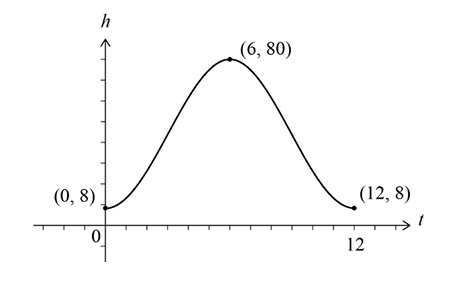
• Minimum points: \( (0, 8) \) and \( (12, 8) \)
• Maximum point: \( (6, 80) \)
• The midline is at \( h = 44 \).
(c) Calculate \( T \):
Solve the inequality \( h(t) \geq 26 \):
\( -36\cos\left(\frac{\pi}{6}t\right) + 44 \geq 26 \)
\( -36\cos\left(\frac{\pi}{6}t\right) \geq -18 \)
\( \cos\left(\frac{\pi}{6}t\right) \leq \frac{1}{2} \)
On the interval \( [0, 12] \), the boundaries are \( \frac{\pi}{6}t = \frac{\pi}{3} \) and \( \frac{\pi}{6}t = \frac{5\pi}{3} \).
\( t_1 = 2 \) and \( t_2 = 10 \).
The duration is \( T = 10 – 2 = 8 \) minutes.
\( \boxed{T = 8} \)
(d)(i) Find \( h'(t) \):
Applying the chain rule:
\( h'(t) = -36 \left(-\sin\left(\frac{\pi}{6}t\right)\right) \cdot \frac{\pi}{6} \)
\( \boxed{h'(t) = 6\pi \sin\left(\frac{\pi}{6}t\right)} \)
(d)(ii) Maximum rate of decrease:
The rate is decreasing when \( h'(t) \) is negative. We find the minimum value of the sine component.
The fastest decrease occurs when \( \sin\left(\frac{\pi}{6}t\right) = -1 \).
\( \frac{\pi}{6}t = \frac{3\pi}{2} \implies t = 9 \).
\( \boxed{t = 9 \text{ minutes}} \)