
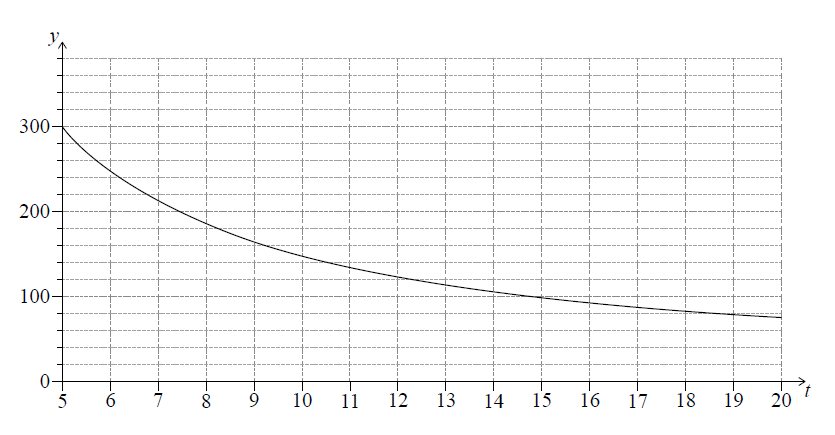
▶️ Answer/Explanation
(a)
Since \(V\) varies inversely with \(t\),
\(V=\dfrac{k}{t}\),
where \(k\) is a constant.
At 12:05 pm, \(t=5\) and \(V=300\). Therefore,
\(300=\dfrac{k}{5}\).
\(k=1500\).
Hence,
\(V=\dfrac{1500}{t}\).
✅ Answer: \(V=\dfrac{1500}{t}\)
(b)
The reservoir initially contains \(300\text{ m}^3\) of water. When the volumes in the reservoir and the pond are equal, each contains half of this amount:
\(V=150\text{ m}^3\).
Using \(V=\dfrac{1500}{t}\),
\(150=\dfrac{1500}{t}\).
\(150t=1500\).
\(t=10\).
This is \(10\) minutes after 12:00 pm, or 12:10 pm.
✅ Answer: \(t=10\) minutes
(c)
At \(t=5\), the pond is empty, so the graph of \(P(t)\) begins at \((5,0)\).
As water leaves the reservoir, the volume in the pond increases. The graph should therefore be a smooth increasing curve that:
• starts at \((5,0)\);
• passes through \((10,150)\), where the two volumes are equal;
• is concave down;
• approaches \(300\text{ m}^3\) as \(t\) increases.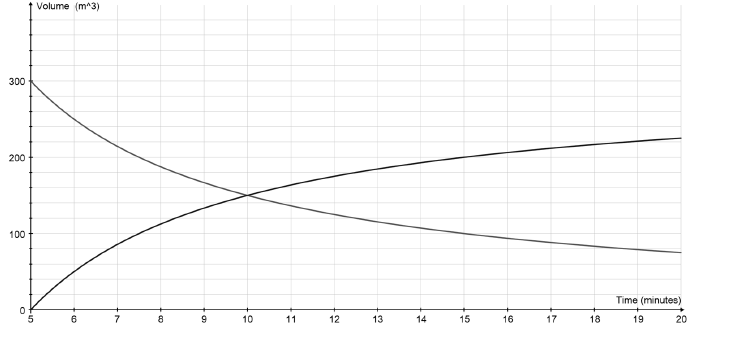
✅ Answer: Sketch an increasing, concave-down curve through \((5,0)\) and \((10,150)\), approaching \(y=300\).
(d)
The total volume of water is always \(300\text{ m}^3\). Therefore,
\(P(t)+V(t)=300\).
Since \(V(t)=\dfrac{1500}{t}\),
\(P(t)=300-\dfrac{1500}{t}\).
✅ Answer: \(P(t)=300-\dfrac{1500}{t}\)