
Question
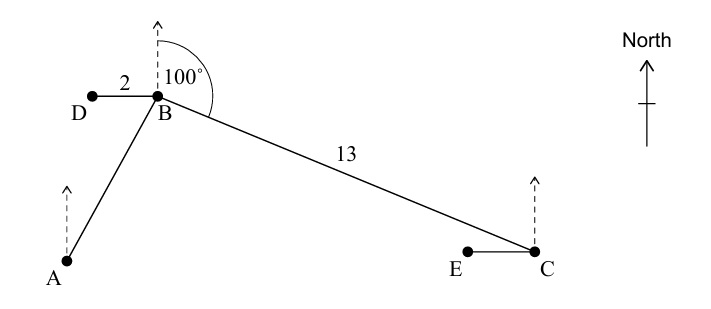
Most appropriate topic codes (IB Mathematics: applications and interpretation):
• SL 3.2: Use of sine and cosine rules to find sides and angles — parts (a)(ii), (a)(iii)
• SL 3.1: Geometric properties of 2D shapes (parallelograms) — part (b)
▶️ Answer/Explanation
(a)(i)
The bearing from B to C is \(100^\circ\).
Angles around point B: Bearing of BC = \(100^\circ\) (10° east of south).
Bearing of BD = \(270^\circ\) (since D is west of B).
The interior angle \( \angle DBC \) is the difference going the shorter way around: \( \angle DBC = 100^\circ + (360^\circ – 270^\circ) = 190^\circ \) clockwise from BD to BC, but interior angle = \(360^\circ – 190^\circ = 170^\circ\).
✅ Answer: \(\boxed{170^\circ}\).
(a)(ii)
In triangle DBC: \( DB = 2 \text{ km} \), \( BC = 13 \text{ km} \), \( \angle DBC = 170^\circ \).
Using cosine rule: \( DC^2 = DB^2 + BC^2 – 2(DB)(BC)\cos(\angle DBC) \)
\( DC^2 = 2^2 + 13^2 – 2 \times 2 \times 13 \times \cos 170^\circ \)
\( DC^2 = 4 + 169 – 52 \cos 170^\circ \)
\( \cos 170^\circ \approx -0.984807753 \)
\( DC^2 \approx 173 – 52 \times (-0.984807753) = 173 + 51.209 \approx 224.209 \)
\( DC \approx \sqrt{224.209} \approx 14.9736 \text{ km} \)
To 3 significant figures: \(15.0 \text{ km}\).
✅ Answer: \(\boxed{15.0 \text{ km}}\) (accept \(15.0\)).
(a)(iii)
Find bearing from D to C. First, find \( \angle BDC \) in triangle DBC.
Using sine rule: \( \frac{\sin(\angle BDC)}{BC} = \frac{\sin(\angle DBC)}{DC} \)
\( \frac{\sin(\angle BDC)}{13} = \frac{\sin 170^\circ}{14.9736} \)
\( \sin(\angle BDC) \approx \frac{13 \times \sin 170^\circ}{14.9736} \approx 0.1508 \)
\( \angle BDC \approx \sin^{-1}(0.1508) \approx 8.67^\circ \).
Now, bearing from D to C: From D, the direction to B is due east (bearing \(090^\circ\)).
Since C is south of the line DB, the bearing to C = \(090^\circ + 8.67^\circ = 098.67^\circ\).
✅ Answer: Bearing \(\boxed{098.7^\circ}\).
(b)
Points: D is 2 km west of B. E is 2 km west of C.
Thus DB and EC are parallel and equal in length (both 2 km west).
The vector from B to C is the same as the vector from D to E (translation by 2 km west).
Therefore, DE = BC = 13 km, and DE is parallel to BC.
✅ Answer: Distance DE = \(\boxed{13 \text{ km}}\), because B, C, D, E form a parallelogram (or by vector translation).